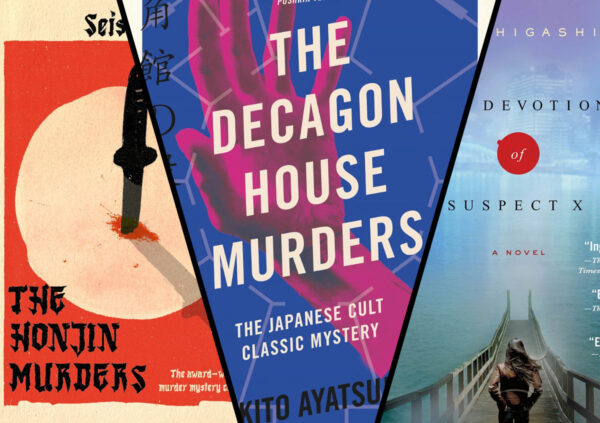
Every Yukito Ayatsuji house mystery begins with a building. A fictional architect named Nakamura Seiji, who hid tricks and secret passages in everything he designed and died when one of his own houses burned down, left a series of strange mansions scattered across Japan, and in each one people start dying. Ayatsuji’s detective, Kiyoshi Shimada, keeps turning up at them. That simple premise, launched in 1987 with The Decagon House Murders, revived the classic fair-play puzzle mystery in Japan and has become one of the most popular series in translated crime fiction.
This guide covers the Yukito Ayatsuji books available in English, what each one is like, and how to read them. For his role in reviving the Japanese puzzle mystery, and a full discussion of The Decagon House Murders, see our ranking of Japanese mystery novels. I’m working from the reviews and publishing record here rather than my own reading of the series.
Where to Start
Start with The Decagon House Murders. It’s the first book, the most famous, and a deliberate homage to Agatha Christie’s And Then There Were None. After that, reading in order makes sense, though reviewers note that each book stands on its own and later ones don’t spoil the solutions of earlier ones.
If The Decagon House Murders doesn’t quite work for you, don’t give up on the series. Some readers who found the first book underwhelming have loved later ones, particularly Labyrinth and the later Clock House.
The Student Who Never Stopped Writing Puzzles
Ayatsuji is a pen name. He was born Naoyuki Uchida in Kyoto in December 1960, and the name he writes under is a small joke: the given name reads roughly as passer-by, and the characters of the surname carry the sense of design and crossing, which is a fair description of a writer whose plots are architectural drawings with people moving through them.
He read Ellery Queen at eleven and was hooked on the logic of it, and by his last year of elementary school he was writing his own stories, buying stacks of paper, filling them, and reading the results aloud to classmates who encouraged him to keep going. At Kyoto University he joined the Mystery Club, the student society that has produced a remarkable number of Japanese crime writers, and in 1986 he married the fantasy and horror novelist Fuyumi Ono, best known for The Twelve Kingdoms.
The debut came the following year, while he was still a graduate student. Kodansha’s editorial department published The Decagon House Murders and called it a shinhonkaku mystery, new orthodox, and the label stuck to a whole generation. He finished a master’s degree, spent three years on a doctorate, took a leave of absence and finally withdrew without submitting a thesis, and in March 1992 became a full-time writer. That same year Japan’s mystery writers gave The Clock House Murders their prize for best novel.
The series has sold in the millions in Japan, passing four million copies for the House books alone by 2012, and Decagon sits eighth on the standard Japanese ranking of the hundred best mysteries of all time. He became a founding member of the Honkaku Mystery Writers Club of Japan, has sat on prize committees including the Yokomizo Seishi Prize, and in 2018 had a minor planet named after him.
The Decagon House Murders
1987 · translated by Ho-Ling Wong

Seven members of a university mystery club, each using the name of a Western crime writer in place of their own, take a holiday on an island where six months earlier a whole family was slaughtered, and lodge in a ten-sided building. On the first morning they find seven plates laid out, each marked with a role, one of which reads victim. Then the killing starts again.
Our mystery ranking sets out how the book works and why it reopened a whole tradition. Long thought impossible to adapt because of how its central trick works, it was turned into a Hulu Japan series in 2024, and it also exists as a manga. The The Decagon House Murders page covers the book’s long road into English and both adaptations.
The Mill House Murders
1988 · translated by Ho-Ling Wong

Deep in the mountains of Okayama stands the Mill House, home to a reclusive man who wears a mask and gloves to hide injuries from an accident. In September 1985, during a yearly gathering of guests at the house, two people die, one guest disappears, and a valuable painting vanishes. A year later, with a typhoon approaching, the survivors gather again, and this time Kiyoshi Shimada arrives uninvited.
The novel alternates between the two gatherings, a year apart, and blends a locked-room puzzle with gothic atmosphere. Reviewers have praised its eerie mood, which it sustains to the final page, though this is also the book in the English sequence that divided the specialist blogs most: several found the puzzle thinner than Decagon’s and the prose stiffer. Read it for the atmosphere and the masked host rather than for a second revelation on the scale of the first book’s.
The Labyrinth House Murders
1988 · translated by Ho-Ling Wong

A famous mystery writer invites four younger authors he regards as his protégés to his house, a building designed as a maze, for his sixtieth birthday, and announces a competition: each of them is to write a murder mystery set in the house itself, and the prize is his estate. Then the deaths begin, following the stories.
The novel is presented as a true-crime book written by one of the people who was there, which adds an extra layer of games to an already elaborate puzzle. It’s the book in the series that reviewers have singled out for its finale, with reversals piling on reversals, and the one most often recommended to readers who were lukewarm on Mill House.
The Clock House Murders
1991 · translated by Ho-Ling Wong

A magazine editor from an occult publication joins a group investigating reports of a ghost at the Clock House, a building filled with clocks that all run to their owner’s private schedule, while Shimada, now writing mysteries himself, follows a parallel thread outside. The two storylines converge on what happens inside.
Japan’s mystery writers gave it their Best Novel prize in 1992, and it is often ranked among the strongest books in the series. One specialist reviewer, who has been hard on the later translations, called it the most successful entry since Decagon for the way it uses its setting, while still finding the journey slow: the verdict, roughly, is that there is a genius-level misdirection at its core and a long walk to reach it. Like The Decagon House Murders, it was adapted as a Hulu Japan series, in 2026.
The Gap in the Series
The house series runs to ten books in Japanese, and the English sequence skips the fourth, The Doll House Murders, which has not been translated. Because each book is self-contained, the gap doesn’t block the ones after it, but completists should know it’s there. The Japanese mystery novels list tracks which of the remaining books are still untranslated.
Given that Pushkin Vertigo has published one a year, the odds of the rest arriving are good, and The Black Cat House Murders has been announced.
The Another Books

Outside the house series, Ayatsuji writes horror, and his most successful work in that vein is now three books in English. Another, translated by Karen McGillicuddy, is set in a middle-school class under a curse: every year an extra student appears in the class, someone who should be dead, and every year someone connected to the class dies, unless the students perform a specific ritual of denial. It was adapted as an anime in 2012 and as a live-action film, and it is the Ayatsuji most non-mystery readers have met.
Another Episode S, also translated by McGillicuddy, is a side novel following a student who meets the series’ central girl on holiday, and Another 2001, translated by Nicole Wilder, returns to the cursed classroom a decade on. There is a manga of Another too, drawn by Hiro Kiyohara, who later adapted The Decagon House Murders.
The Full English List at a Glance
House mysteries, in order: The Decagon House Murders · The Mill House Murders · The Labyrinth House Murders · The Clock House Murders
Horror: Another · Another Episode S/0 · Another 2001
Suggested order: Decagon, then Labyrinth if you want the cleverest puzzle, then Clock House, then Mill House. Another stands entirely apart.
Where to Go Next
Soji Shimada, whose The Tokyo Zodiac Murders inspired the revival Ayatsuji led, has an entry in that same mystery ranking, and his book has its own Tokyo Zodiac Murders page. The prewar and postwar master they both learned from is covered in the Seishi Yokomizo guide, while Strange Pictures covers a writer who puts his clues on the page as drawings.