Cozy fantasy is the fastest-growing corner of the genre and the hardest to get a straight recommendation for, because most lists covering it can’t decide what it is.
Here’s the problem. The category has no agreed definition, everyone admits as much, and into that gap has poured an enormous amount of romantasy wearing a cardigan. Search for cozy fantasy and half the results are fae-romance novels with explicit content and a mug of tea on the cover, filed as cozy because the marketing decided cozy sells. That’s a different genre. It has its own readers and they’re well served elsewhere.
So this list uses a definition, and the definition isn’t about temperature. Cozy fantasy is fantasy organized around competence and community rather than conflict. The engine is someone building something, running a business, fixing a place, learning a craft, or finding a home, and the pleasure is watching them do it well. Magic is present and usually low-stakes. There’s no dark lord, or if there is one, defeating him isn’t the point. Romance can absolutely be there, and in many of these it is, but as a thread in a larger fabric rather than the whole cloth. The moment the relationship becomes the plot, you’ve left cozy fantasy and entered romantasy, and this list stops there. And if you want the shelf this one is the antidote to, my grimdark books and dark fantasy books lists are that shelf.
That filter cuts the category down to something smaller and considerably better. Eleven books, and I’d rather stop at eleven genuinely good ones than pad to twenty-five with things that don’t fit. For the wider genre, my list of the best fantasy books covers everything else.
Fiction by René Rehn


Fiction by René Rehn
The Ancestors
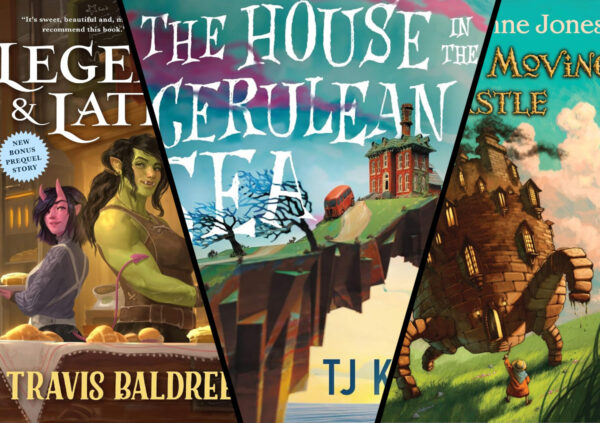
Howl’s Moving Castle by Diana Wynne Jones (1986)

The book cozy fantasy has been imitating for forty years, written before the category existed.
Sophie Hatter is the eldest of three sisters, which in a fairy tale means she’s resigned to failure, and she runs the family hat shop without complaint until a witch curses her into the body of a ninety-year-old woman. Unable to explain what’s happened, she marches off and installs herself as cleaning lady in the moving castle of the wizard Howl, who is vain, cowardly, dramatic, and nowhere near as wicked as his reputation.
What makes it the template is the emphasis. The stakes exist, there’s a curse and a missing prince and a war, but the book cares more about Sophie bullying a fire demon, tidying a filthy castle, and needling Howl than about any of it. Competence is the engine: Sophie is good at things, and watching her be good at them is the pleasure.
Jones is funnier and sharper than almost everyone she inspired. The Miyazaki film is wonderful and substantially different, so the book still holds surprises.
The Modern Wave
Legends & Lattes by Travis Baldree (2022)

The book that turned the category into a phenomenon and set every convention that followed.
Viv is an orc, a career mercenary, and tired. She takes her cut from one last job, travels to a city that has never heard of coffee, and opens a coffee shop. That’s the plot. She finds a location, fixes it up, sources beans, invents the menu, hires staff, and builds a clientele, and the tension comes almost entirely from whether the business will work and whether the found family assembling around it will hold.
Baldree, an audiobook narrator by trade, wrote it as an antidote to grimdark, and it’s explicit about that: the old adventuring life is the thing Viv is leaving, and the book treats opening a café properly as more worthy of attention than another dungeon. There’s a romance and it’s genuinely handled as a subplot, which is exactly the balance the category later lost.
It’s warm, it’s short, and it’s the purest example of cozy fantasy as craft-and-community fiction. Start here.
Bookshops & Bonedust by Travis Baldree (2023)

The prequel, and the better book of the two.
A younger Viv is injured on a job and left to convalesce in a seaside town she has no interest in, where she falls in with a failing bookshop run by a curmudgeon and gradually decides to save it. The structure is the same, someone competent fixing a struggling small business, and the bookshop material is specific and loving in a way that will land hard for anyone who’s worked retail.
Baldree tightened his craft between books. The supporting cast is stronger, the town feels more lived-in, and the low-stakes threat is better integrated.
You can read either first, since they sit years apart in Viv’s life. This is the one I’d hand a bookseller.
Emily Wilde’s Encyclopaedia of Faeries by Heather Fawcett (2023)

The category’s best prose and its most interesting protagonist.
Emily Wilde is a Cambridge dryadologist, a scholar of faeries, and she is difficult: precise, misanthropic, far more comfortable with fieldwork than with people. She travels to a remote northern village to complete the first comprehensive encyclopedia of faerie species, and the book is structured as her research journal, complete with footnotes and citations.
The craft here is scholarship. Emily is superbly good at her work and hopeless at everything else, and the comedy and the warmth both come from that gap. Her charming, infuriating colleague turns up uninvited, and yes, there’s a slow-burn romance, but the actual subject is the research, the village, and Emily slowly learning that other people are not simply obstacles to fieldwork.
Fawcett writes beautifully and the faerie lore is genuinely inventive rather than decorative. It’s the most literary thing on this list.
The House in the Cerulean Sea by TJ Klune (2020)

The warmest book here, and the one most likely to make you cry in a good way.
Linus Baker is a caseworker for the Department in Charge of Magical Youth, a lonely middle-aged bureaucrat who inspects orphanages for magical children by the letter of a very thick rulebook. He’s assigned to assess a remote island home housing six particularly dangerous children, including the literal Antichrist, and their enigmatic caretaker, and the assignment slowly dismantles everything his gray life is built on.
The community is the whole point. The island household is a found family in the fullest sense, and the book’s argument is quietly political: that the bureaucratic impulse to categorize and control children is the actual monstrousness, and that care is the alternative.
There’s a romance, gentle and central to Linus’s arc, and it stays in balance with the larger story about the household. It’s sentimental and it knows it and it earns it.
Tress of the Emerald Sea by Brandon Sanderson (2023)

The most inventive world-building on this list, folded into a genuinely cozy shape.
Tress is a window-washer on a remote island in a world where the seas are made of colored spores that react violently with water, including the water in a human body. When the boy she loves is taken away, she does the un-fairy-tale thing and leaves her island to get him back herself, and the journey turns her into a reluctant, resourceful problem-solver aboard a pirate ship.
Sanderson wrote it as a deliberate homage to The Princess Bride, narrated with the same wry affection, and Tress’s defining quality is competence under pressure: she solves problems with observation and nerve rather than with power. The spore-seas are one of his best inventions, which means the cozy tone sits on top of hard, rigorous world-building.
It’s the entry point for someone who wants cozy without giving up ambitious fantasy, and it stands completely alone despite sitting in his larger universe. Where it sits in that universe is mapped on my Brandon Sanderson guide.
Can’t Spell Treason Without Tea by Rebecca Thorne (2022)

The most on-the-nose premise in the category, executed with real charm.
Reyna is a royal bodyguard and Kianthe is the most powerful mage in the world, they’re in love, and they’re both exhausted by their obligations, so they run away to open a bookshop that also serves tea. The book is the setting-up of that shop in a remote town on the edge of dragon country, complicated by a dragon, a local dispute, and the queen Reyna abandoned.
This one sits closest to the romantasy line, since the couple is established and central, but it stays on the cozy side because the relationship isn’t the source of tension: they’re already together and stable, and the actual plot is the business and the town. The romance is the settled foundation the craft-and-community story is built on rather than the drama itself.
It’s light, quick, and unabashed about what it is.
A Psalm for the Wild-Built by Becky Chambers (2021)

The most thoughtful book on this list, and the one that pushes cozy toward philosophy.
On the moon Panga, centuries after the robots gained consciousness and walked away into the wilderness, Dex is a tea monk: they travel between villages in a wagon, serving people the right blend and listening to their troubles. Restless despite a good life, Dex goes off the map, and a robot walks out of the forest to ask a question no human has been asked in generations: what do people need?
The craft is the tea service, described in loving practical detail, and the community is everyone Dex serves. There’s no romance at all, no antagonist, and barely a plot, just two beings having a long conversation about purpose in a world that solved its problems and now has to work out what it’s for.
Chambers writes contentment better than almost anyone. It’s cozy fantasy that takes the “what is enough” question seriously, and it’s on my solarpunk list too, where it belongs equally.
The Spellshop by Sarah Beth Durst (2024)

The most straightforwardly comforting recent entry.
Kiela is a librarian who has spent eleven years hiding from people among the spellbooks of the capital’s great library. When revolution burns it down, she flees with as many books as she can carry to the remote island where she grew up, and quietly opens a jam shop as a front for something illegal: selling spells to islanders who need them.
The craft is doubled, jam-making and spellwork both, and Durst is specific about both. The community is the island slowly drawing a hermit back into the world, and there’s a gentle romance with a local that stays firmly in the background.
It’s the coziest book here by temperature, and it’s the one to reach for when you want no edges at all.
Cozy-Adjacent, Worth Knowing
The Goblin Emperor by Katherine Addison (2014)

Not quite cozy, and included because the overlap is instructive.
Maia is the half-goblin fourth son of the elven emperor, raised in exile and contempt, who becomes emperor overnight when an airship crash kills his father and older brothers. He is unprepared, friendless, and surrounded by a court that despises him, and the entire novel is him trying to be a decent person inside a machine designed to prevent it.
It reads as cozy despite a setting that isn’t, because the pleasure is watching a kind, competent, overwhelmed person slowly earn the loyalty of the people around him through decency rather than force. There’s no battle, and the stakes are court politics and Maia’s soul.
The invented naming conventions are a real barrier for the first fifty pages. Push through them. It’s one of the warmest books in fantasy about a genuinely good person, and it belongs beside the cozy shelf even if it isn’t quite on it.
The Witches Books by Terry Pratchett

The cozy heart of Discworld, for readers who want the warmth with sharper teeth.
Discworld isn’t cozy fantasy, but several of its sequences run on exactly the same fuel: competent people, tight communities, and problems solved through good sense rather than heroics. The Witches books especially, starting properly with Wyrd Sisters, are about Granny Weatherwax and her coven managing a rural community through headology and stubbornness, and the Tiffany Aching books apply the same idea to a young witch learning her trade.
The difference from true cozy fantasy is the bite: Pratchett is doing satire, and the comfort comes with an argument. But the emphasis on craft, community, and quiet competence is the same, and a cozy reader will find a great deal to love.
Fuller treatment of Discworld sits on my best fantasy series list, and the complete sub-series map is on my Terry Pratchett guide.
What This List Leaves Out
Worth stating plainly, because the omissions are the point.
Romantasy shelved as cozy. A large share of what gets filed under cozy fantasy is fae or dragon romance where the relationship is the plot and the heat level is not low. Fourth Wing, the ACOTAR books, and their many imitators are not cozy fantasy in any useful sense. They’re romance with fantasy furniture, and calling them cozy blurs a distinction that helps readers find what they actually want. There’s nothing wrong with the genre. It simply isn’t this one.
The test is simple: if you removed the romance, would there still be a book? For everything on the list above, yes, there’s a coffee shop or an encyclopedia or a jam business or a question about purpose. For the excluded titles, the romance is the book.
If you’re starting from nothing: Legends & Lattes for the founding text, Howl’s Moving Castle for the ancestor that outclasses most of its descendants, Emily Wilde for the best prose, and A Psalm for the Wild-Built if you want the version that has something on its mind.