Brandon Sanderson books come with a reputation for being impossible to navigate, and the reputation is half-deserved. The true half is that most of his adult fantasy is secretly one connected universe, the Cosmere, spread across different planets and published wildly out of internal order, with characters and objects crossing between series. Search for where to start and you’ll hit sprawling tables of novels, novellas and graphic novels across multiple worlds, and you could reasonably conclude it’s hopeless.
The other half is a myth. Sanderson built each series to stand on its own, and the connections between them are bonus content for readers who go looking, not homework you have to keep track of. You can read Mistborn, enjoy it completely, and never think about the Cosmere at all. The crossovers are a reward for staying, not a barrier to entering.
So this guide does two things the reading-order pages mostly don’t. It gives you the actual answer to where to start, which is more settled than the tables suggest, and it tells you honestly what each of the Brandon Sanderson books is like, from the 2005 debut to The Fires of December in 2026, because he has written a lot and the books are not all equally good. His place in the genre is on my best fantasy books list, Stormlight sits on my best fantasy series list, and the epic fantasy books guide places The Way of Kings in the line that runs back through Jordan to Tolkien.
Fiction by René Rehn


The Short Version
Start with Mistborn: The Final Empire. That’s the settled consensus and it’s right: it’s a complete story at a manageable length, it shows you everything Sanderson does well, and it eases you into the wider universe without a thousand-page commitment up front. If it clicks, finish the trilogy, read Warbreaker, then open the Stormlight Archive with The Way of Kings. Don’t start with Stormlight, because all five of its books run past a thousand pages in hardcover, and don’t read in Cosmere-chronological order, which front-loads confusion for no payoff. Publication order within each series is the smooth path through the Brandon Sanderson books.
If you’re already caught up, here’s where things stand in October 2026. The Fires of December is the newest Cosmere novel, out in ebook and audio with the hardcover due on December 8. The next Mistborn era begins with Ghostbloods, slated for December 2028, and the second arc of the Stormlight Archive comes after that, which puts book six in the 2030s at the earliest.
Brandon Sanderson Books in Order
The table runs by first publication, counting the backer editions of the crowdfunded books, and includes the three Wheel of Time volumes he completed for Robert Jordan.
| Year | Title | Series or type | Notes |
| 2005 | Elantris | Cosmere standalone | His first published novel |
| 2006 | Mistborn: The Final Empire | Mistborn, era one, book 1 | Start here |
| 2007 | The Well of Ascension | Mistborn, era one, book 2 | |
| 2007 | Alcatraz Versus the Evil Librarians | Alcatraz, book 1 | Middle grade |
| 2008 | Alcatraz Versus the Scrivener’s Bones | Alcatraz, book 2 | |
| 2008 | The Hero of Ages | Mistborn, era one, book 3 | |
| 2009 | Warbreaker | Cosmere standalone | Free on his website |
| 2009 | Alcatraz Versus the Knights of Crystallia | Alcatraz, book 3 | |
| 2009 | The Gathering Storm | The Wheel of Time, book 12 | With Robert Jordan |
| 2010 | Alcatraz Versus the Shattered Lens | Alcatraz, book 4 | |
| 2010 | The Way of Kings | The Stormlight Archive, book 1 | Gemmell Legend Award |
| 2010 | Towers of Midnight | The Wheel of Time, book 13 | With Robert Jordan |
| 2011 | Infinity Blade: Awakening | Novella | Video game tie-in |
| 2011 | The Alloy of Law | Mistborn, era two, book 1 | |
| 2012 | Legion | Novella | In the 2018 omnibus |
| 2012 | The Emperor’s Soul | Cosmere novella | Hugo Award |
| 2013 | A Memory of Light | The Wheel of Time, book 14 | With Robert Jordan |
| 2013 | The Rithmatist | Standalone, young adult | Sequel planned |
| 2013 | Steelheart | The Reckoners, book 1 | |
| 2013 | Infinity Blade: Redemption | Novella | Video game tie-in |
| 2013 | Shadows for Silence in the Forests of Hell | Cosmere novella | In Arcanum Unbounded |
| 2014 | Words of Radiance | The Stormlight Archive, book 2 | Gemmell Legend Award |
| 2014 | Legion: Skin Deep | Novella | In the 2018 omnibus |
| 2014 | Sixth of the Dusk | Cosmere novella | Expanded into Isles of the Emberdark |
| 2015 | Firefight | The Reckoners, book 2 | |
| 2015 | Perfect State | Novella | Hugo finalist |
| 2015 | Shadows of Self | Mistborn, era two, book 2 | |
| 2016 | The Bands of Mourning | Mistborn, era two, book 3 | |
| 2016 | Mistborn: Secret History | Cosmere novella | Read after era one |
| 2016 | Calamity | The Reckoners, book 3 | |
| 2016 | Alcatraz Versus the Dark Talent | Alcatraz, book 5 | |
| 2016 | White Sand, Volume 1 | Cosmere graphic novel | With Rik Hoskin |
| 2016 | Arcanum Unbounded | Cosmere collection | |
| 2016 | Edgedancer | Stormlight novella | Standalone edition 2017 |
| 2017 | Snapshot | Novella | In Tailored Realities |
| 2017 | Oathbringer | The Stormlight Archive, book 3 | Dragon Award |
| 2018 | White Sand, Volume 2 | Cosmere graphic novel | With Rik Hoskin |
| 2018 | Children of the Nameless | Novella | Magic: The Gathering tie-in |
| 2018 | Legion: The Many Lives of Stephen Leeds | Omnibus | Adds Lies of the Beholder |
| 2018 | Skyward | Skyward, book 1 | Young adult science fiction |
| 2019 | White Sand, Volume 3 | Cosmere graphic novel | With Rik Hoskin |
| 2019 | Starsight | Skyward, book 2 | |
| 2020 | The Way of Kings Prime | Early draft | Released online |
| 2020 | The Original | Audio novella | With Mary Robinette Kowal |
| 2020 | Dawnshard | Stormlight novella | |
| 2020 | Rhythm of War | The Stormlight Archive, book 4 | |
| 2021 | Sunreach, ReDawn and Evershore | Skyward novellas | With Janci Patterson |
| 2021 | Lux | Reckoners audio novel | With Steven Michael Bohls |
| 2021 | Cytonic | Skyward, book 3 | |
| 2022 | Skyward Flight | Collection | The three novellas |
| 2022 | Bastille Versus the Evil Librarians | Alcatraz, book 6 | With Janci Patterson |
| 2022 | White Sand Omnibus | Cosmere graphic novel | All three volumes |
| 2022 | The Lost Metal | Mistborn, era two, book 4 | |
| 2023 | Tress of the Emerald Sea | Cosmere, Hoid’s Travails | Secret project one |
| 2023 | The Frugal Wizard’s Handbook for Surviving Medieval England | Standalone, not Cosmere | Secret project two |
| 2023 | Yumi and the Nightmare Painter | Cosmere, Hoid’s Travails | Secret project three |
| 2023 | The Sunlit Man | Cosmere standalone | Secret project four |
| 2023 | Defiant | Skyward, book 4 | |
| 2024 | The Most Boring Book Ever | Picture book | Pictures by Kazu Kibuishi |
| 2024 | Dragonsteel Prime | Early novel | His BYU honors thesis |
| 2024 | Wind and Truth | The Stormlight Archive, book 5 | Ends the first arc |
| 2025 | Elsecaller and King Lopen the First of Alethkar | Stormlight short fiction | First released as story decks in 2024 |
| 2025 | Isles of the Emberdark | Cosmere standalone | Secret project five |
| 2025 | Tailored Realities | Collection | Non-Cosmere short fiction |
| 2026 | Songs of the Dead | The Strata Wars, book 1 | With Peter Orullian |
| 2026 | Blightfall | Riftwake, book 1 | With Janci Patterson |
| 2026 | The Fires of December | Cosmere, Hoid’s Travails | Hardcover December 8 |
Where to Start With Brandon Sanderson
For most readers the door into the Brandon Sanderson books is Mistborn: The Final Empire, for the reasons in the short version above. Readers who want something shorter first have two excellent options: The Emperor’s Soul, the Hugo-winning novella that shows off his ideas in under two hundred pages, and Tress of the Emerald Sea, a warm, funny standalone narrated by the Cosmere’s resident storyteller. Both stand alone, and both tell you quickly whether his style works for you.
Readers who already know they love very long epics can ignore the usual advice and go straight to The Way of Kings, accepting that the first few hundred pages are a slow build. Younger readers, and anyone who wants Sanderson outside fantasy, have Skyward for science fiction, Steelheart for superheroes and Alcatraz Versus the Evil Librarians for middle-grade comedy. The books not to start with are Elantris, which gives a misleadingly rough first impression, and the later Cosmere books, Mistborn: Secret History, The Lost Metal, The Sunlit Man and Isles of the Emberdark, which assume you already know the wider universe.
The book sections below run in the order most readers take them: the two Mistborn eras, the Stormlight Archive with its novellas, the early Cosmere standalones, the secret projects and the newer standalones, the Cosmere collection and graphic novels, everything outside the Cosmere, and finally his completion of The Wheel of Time.
Brandon Sanderson’s Life, Briefly
Brandon Sanderson was born on December 19, 1975, in Lincoln, Nebraska, and studied at Brigham Young University in Utah, taking a bachelor’s degree in English in 2000 and a master’s in creative writing in 2004. The road to the first of the Brandon Sanderson books was long. By 2003 he had written twelve novels and sold none of them. Then Moshe Feder, an editor at Tor, got in touch about Elantris, the sixth of those novels, which Sanderson had submitted about a year and a half earlier. Tor published it on April 21, 2005, and he was a finalist for the John W. Campbell Award for Best New Writer in 2006 and 2007.
Mistborn followed in 2006, and it changed his career in an unexpected direction. After Robert Jordan’s death in 2007, Harriet McDougal, Jordan’s widow and editor, chose Sanderson to finish The Wheel of Time, having been impressed by Mistborn, and Tor announced the decision on December 7, 2007. Alongside the books he co-founded the writing podcast Writing Excuses in 2008 with Dan Wells and Howard Tayler, and he has taught a creative writing workshop at BYU, English 318R, since 2004, posting the lectures free on YouTube.
The business grew to match the output. Dragonsteel, his company, acts as publisher, storefront and producer, and runs its own convention, Dragonsteel Nexus. In March 2022 its Kickstarter for four secret novels raised $41,754,153 from 185,341 backers, the most any Kickstarter campaign had ever raised. His books have sold more than 50 million copies worldwide in some 40 languages, according to his literary agency, and in January 2026 Apple took film and television rights to the whole Cosmere, which is covered in its own section below.
Mistborn, Era One (2006-2008)
Mistborn is the most common first stop among the Cosmere books. It’s set on Scadrial, a world of falling ash and nightly mists, where a few people can burn ingested metals for specific, rule-bound powers. Sanderson plans it as a sequence of eras on the same planet: this first one is an epic fantasy trilogy, the second moves the world into an industrial age, the third, Ghostbloods, pushes it into an early computer age, and a fourth is planned as space opera.
Read era one in order: The Final Empire, The Well of Ascension, The Hero of Ages. The entries below stay spoiler-free, though the premise of each later book necessarily assumes you’ve read the one before it.
Mistborn: The Final Empire (2006)

Mistborn: The Final Empire is the book nearly every reading-order guide sends new readers to first, and the consensus is right: it’s the cleanest door into the Cosmere and the best single demonstration of what Sanderson does. It’s built on a premise that still sounds like a dare. The prophesied hero failed, the Dark Lord won, and for a thousand years the immortal Lord Ruler has governed an empire of ash, mist and enslaved skaa.
The story follows Vin, a half-starved street thief who doesn’t know she can burn metals for power, and Kelsier, a charismatic survivor of the Lord Ruler’s prison mines who recruits her into a crew planning the impossible: a heist against the emperor himself. Allomancy is the hook. Each ingested metal grants one specific ability, from pushing on nearby metal to flaring strength or senses, and the fights are built entirely out of those rules, so a reader can follow every move and still be surprised by how the pieces combine.
The crew gives the book its warmth, and Vin’s slow move from distrust to belonging is its emotional spine. The prose is plain, though, and the long stretches of noble balls and court intrigue drag for some readers. It’s also a complete story, which is rarer than it should be in the genre. If you only ever read one of the Brandon Sanderson books, this is the one that tells you whether you’ll want the rest, and the trilogy has its own entry on my best fantasy books list too.
The Well of Ascension (2007)

The Well of Ascension is the middle book most readers find slowest, and it’s also the one that turns Mistborn from a heist novel into something larger. The story trades the crew’s caper for siege politics, with Vin and the idealistic young nobleman Elend Venture trying to hold the capital, Luthadel, together while three armies gather outside its walls and the mists begin to behave in ways nobody can explain.
It’s a book about consequences. Elend is a scholar learning that political theory and actual power are different animals, Vin is testing who she is when nobody needs her to be a thief, and the city’s factions turn the siege into a three-way game of chess. Sanderson also starts layering in the trilogy’s deeper mystery here, through chapter epigraphs and odd details that pay off a book later.
The long middle is where it sags, with council debates and a romantic subplot taking over, and readers who loved the momentum of the first book can find it sluggish until its final act, which is one of the strongest climaxes in the early Sanderson books. That ending, and everything it sets up, is what The Hero of Ages is built on.
The Hero of Ages (2008)

The Hero of Ages is the finale of the first Mistborn trilogy and the volume that most often wins over readers who had doubts during book two. The story follows Vin, Elend and the scattered crew across an empire coming apart, as the ashfalls thicken, the mists turn deadly, and the hunt for the hidden caches the Lord Ruler left behind becomes a race against the end of the world.
This is where the trilogy’s design shows. Nearly every odd detail of the first two books, the epigraphs included, turns out to have been a clue, and magic systems that seemed separate snap together into one picture. Sazed’s long struggle with belief gives the book its quiet heart, and for many readers the ending is the reason they trust Sanderson with a thousand-page setup forever after.
It is a bleak book for long stretches, heavier in tone than the first, and some middle chapters move pieces around more than they move the story. Finish it and you have a complete trilogy, which is the best argument for starting your Brandon Sanderson books with Mistborn rather than anywhere else.
Mistborn, Era Two (2011-2022)
The second era jumps roughly three centuries forward to a Scadrial of railways, revolvers and growing cities, and follows a new cast, the lawman Waxillium Ladrian and his partner Wayne, in four novels that start as a Western romp and end tangled in the whole Cosmere. Read them in order, The Alloy of Law, Shadows of Self, The Bands of Mourning and The Lost Metal, and read them after the first trilogy, since they lean on its history.
The novella Mistborn: Secret History belongs here too, for reasons its entry explains. After era two comes Ghostbloods, the first book of era three, which Sanderson has scheduled for December 2028, with its sequels slated for December 2029 and December 2030. His end-of-2025 update reported much of the first book already written.
The Alloy of Law (2011)
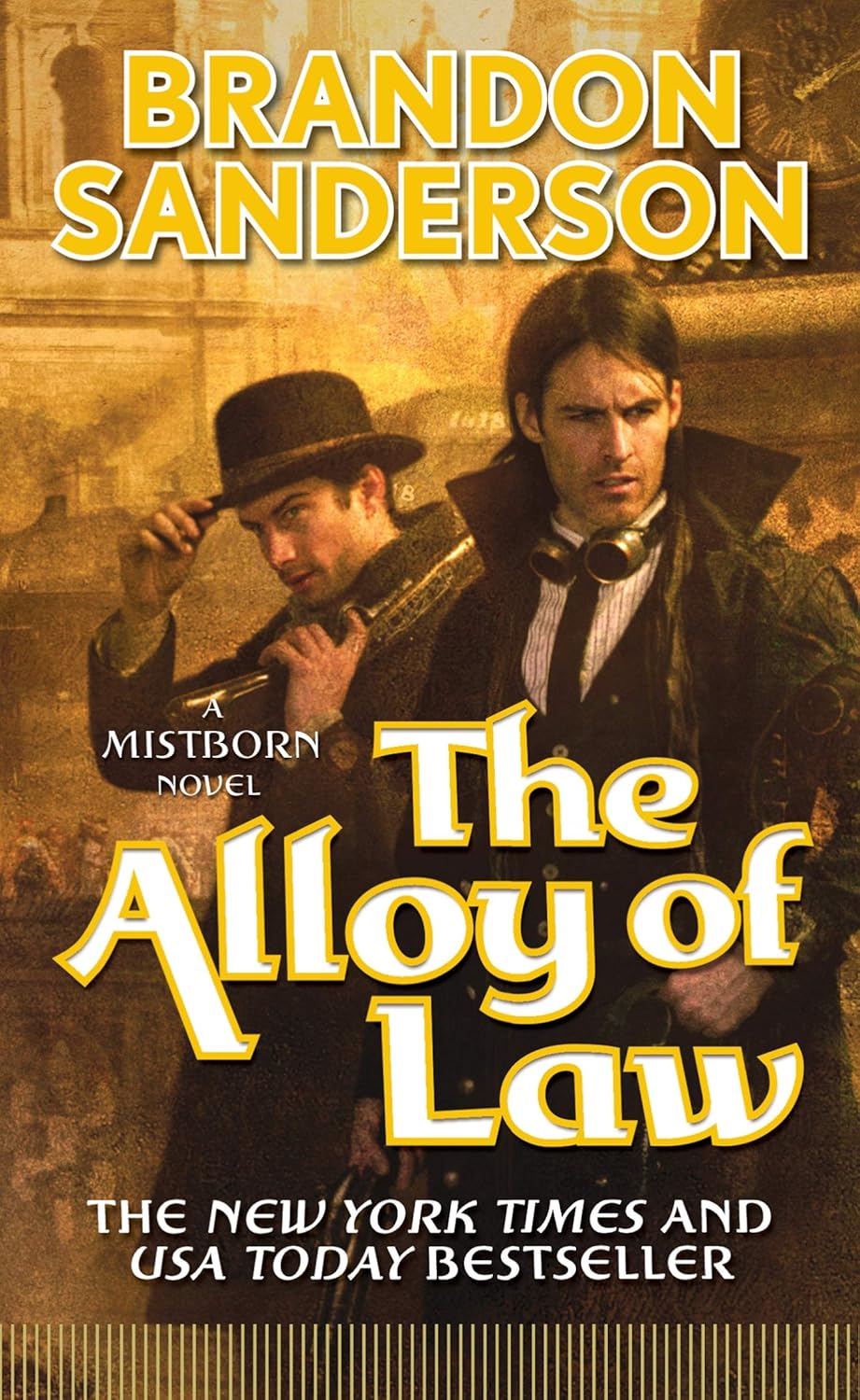
The Alloy of Law opens Mistborn’s second era and is the lightest, most purely fun of the Mistborn novels. Roughly three hundred years after the first trilogy, Scadrial has railways, revolvers and a frontier called the Roughs, and the story follows Waxillium Ladrian, a lawman who comes home to the city of Elendel to take up his late uncle’s title just as a gang called the Vanishers starts robbing trains and kidnapping women.
Wax is Twinborn, an Allomancer who can push on metal and a Feruchemist who can store and change his own weight, and Sanderson builds gunfights out of the combination that feel like nothing else in fantasy. His partner Wayne, a master of accents and borrowed hats, steals nearly every scene, and Marasi Colms, a sharp young student of the law, becomes the series’ third lead. The setting, a fantasy world grown into its industrial age, is the era’s real selling point.
It’s also the slightest of the four, short by his standards, with a thinner villain than era one’s and an ending that’s a hook rather than a full stop. It works best straight after the first trilogy, as the easy on-ramp into era two.
Shadows of Self (2015)

Shadows of Self is the second Wax and Wayne novel and the book where the series stops being a romp and starts tying itself back to the history of the first trilogy. A string of killings, staged to stir up labor strife and religious conflict, threatens to tip Elendel’s shaky peace into chaos, and Wax’s investigation leads him toward forces older than the city itself.
The procedural plotting is tighter than in The Alloy of Law, Wayne’s comedy picks up a sadder undertone, and Steris, Wax’s methodical fiancée, starts to emerge as one of the era’s best characters. Readers of the first trilogy will recognize names and powers that the people of Elendel treat as legend. It’s darker than readers coming from the first Wax and Wayne book might expect, and its last act gives era two the weight The Alloy of Law lacked. Don’t skip it on the way to The Lost Metal.
The Bands of Mourning (2016)

The Bands of Mourning is the third Wax and Wayne novel and the one that opens Scadrial up beyond Elendel. Wax, Wayne, Marasi and Steris go after the Bands of Mourning, the legendary metalminds said to have belonged to the Lord Ruler and to grant his powers to whoever wears them, and the hunt pulls them out of the city into a much wider world.
It’s the era’s adventure novel, with trains, a temple raid and a strong turn for Steris, and it seeds a good deal of the Cosmere’s wider machinery, partly through a sharply drawn kandra and the cultures of the south. The pace can feel like set piece after set piece, and some of its revelations only land fully in The Lost Metal. The companion novella Mistborn: Secret History came out the same day, January 26, 2016.
Mistborn: Secret History (2016)

Mistborn: Secret History is the most spoiler-sensitive of all the Brandon Sanderson books, a novella released alongside The Bands of Mourning that changes how you see the first trilogy. Its title is literal. It tells a hidden story running alongside the events of the first three books, from an angle those novels never show, and it assumes you’ve read all of them.
For Cosmere readers it’s one of the most important short works he has written, because it opens up the metaphysical layer behind the series, the realms and powers the novels only hint at, far more directly than the trilogy does. It’s also a terrible place to start, and readers who don’t care about the wider universe can skip it without losing the plot of either era. Read the first trilogy at the very least before opening it. Most reading orders slot it after The Bands of Mourning, and it’s also collected in Arcanum Unbounded.
The Lost Metal (2022)

The Lost Metal closes the Wax and Wayne series and is the Mistborn novel most openly woven into the wider Cosmere. Some years after The Bands of Mourning, Wax is a senator and Marasi a constable, both still chasing the Set, the secret organization that has shadowed the whole era, and the trail leads to a threat aimed at Elendel itself.
It’s the best-paced book of the era, with a climax that pulls together threads from all four novels and a finale that lands with real emotional force. Much of that power, though, comes from the crossover. Characters, objects and ideas from elsewhere in the Cosmere are central rather than decorative, and a reader who has only read Mistborn will feel the weight of references they can’t place. For the Cosmere books as a connected project, it’s a turning point, and it hands Scadrial over to the Ghostbloods era.
The Stormlight Archive (2010-2024)
The Stormlight Archive is the center of the Cosmere books, so every volume gets its own entry here. It’s set on Roshar, a world scoured by highstorms, and Sanderson planned it as ten books in two arcs of five. The first arc is complete: The Way of Kings (2010), Words of Radiance (2014), Oathbringer (2017), Rhythm of War (2020) and Wind and Truth (2024), every one of them past a thousand pages in hardcover.
Two novellas sit between the novels and belong in the reading order: Edgedancer after Words of Radiance, and Dawnshard after Oathbringer. The usual advice in reading-order guides is also to read Warbreaker before Words of Radiance, because a few of its characters matter later. Two short stories, Elsecaller (with Dan Wells) and King Lopen the First of Alethkar (with Isaac Stewart), began as story-card decks in 2024 and became a double volume in 2025. Completists can also read The Way of Kings Prime, the very different early draft he released in 2020.
What’s next is a long wait. A Stormlight novella about Rock, Horneater, is planned but not yet out, and the second arc will open after a time skip. Sanderson has said he’ll write it after the Ghostbloods trilogy and the planned Elantris sequels, so book six is a 2030s proposition at the earliest.
The Way of Kings (2010)

The Way of Kings is the first book of the Stormlight Archive, Sanderson’s planned ten-volume epic, and the novel that made the Cosmere’s ambitions plain. It’s set on Roshar, a world scoured by highstorms, where the ecology has evolved around the weather, emotions manifest as small spirits called spren, and a few warlords carry ancient Shardblades and Shardplate that make them nearly unstoppable.
The story follows three people. Kaladin, a surgeon’s son turned soldier turned slave, is forced to run bridges under enemy fire in a war of vengeance on the Shattered Plains. Shallan, a young scholar from a minor house deep in debt, talks her way into the service of the brilliant, heretical Jasnah Kholin with a theft in mind. And Dalinar Kholin, a highprince and legendary warrior, is haunted by visions that may be madness or may be a warning. A prologue featuring an assassin in white sets the stakes in its first pages.
Kaladin’s chapters are the reason people fall for the series. His depression is written seriously and without shortcuts, and the bridge-crew chapters, a handful of condemned men learning to become a team, are some of the most gripping in modern epic fantasy. Roshar is also the most fully imagined world in the Cosmere books, and the interludes, short chapters set elsewhere on the planet, keep widening it.
The first few hundred pages ask for patience, Shallan’s chapters take longer to find their footing, and at just over a thousand pages it’s a heavy first ask. It debuted at number seven on the New York Times list and won the David Gemmell Legend Award in 2011. It’s the destination rather than the door: read Mistborn first, then come here when you know you like how he builds, because this is where the Brandon Sanderson books become a long-term commitment.
Words of Radiance (2014)
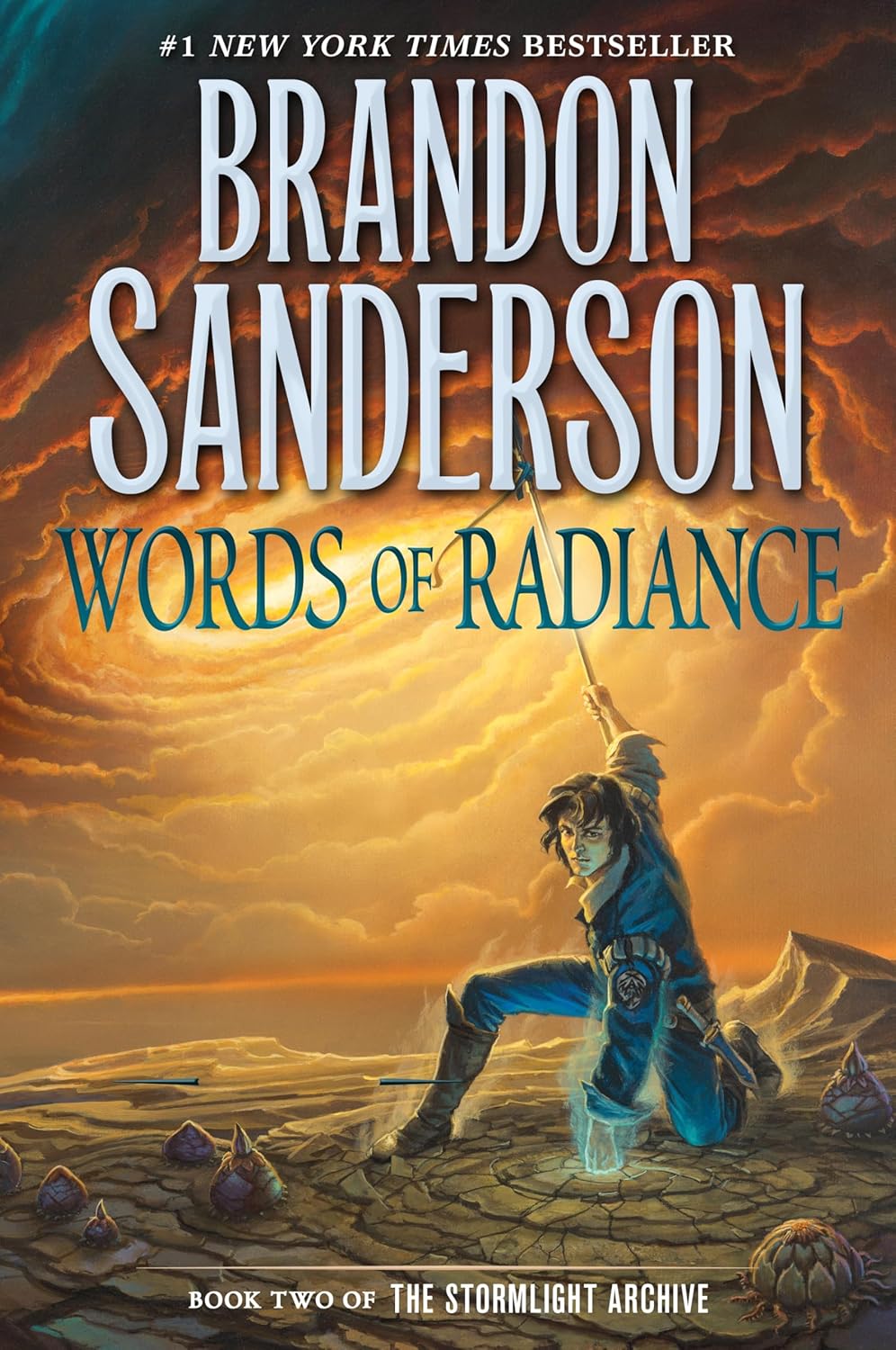
Words of Radiance is the second Stormlight novel and the one a large share of readers name as the series’ high point, the book where the slow build of The Way of Kings pays off at scale. Its flashback chapters belong to Shallan, whose past turns out to be far darker than her wit suggests, while Kaladin takes a new post guarding the Kholin family and the war on the Shattered Plains moves toward a decisive campaign.
Everything sharpens here. Shallan becomes a lead to match Kaladin, her illusions and her lies feeding each other, Adolin’s dueling chapters give the book some of its best set pieces, and Kaladin’s struggle between his oaths and his hatreds is the spine of the whole thing. The last few hundred pages are a textbook example of what fans call the Sanderlanche, the final-act convergence the Sanderson books are known for, with threads colliding at a speed the first volume never attempted.
At 1,080 pages in hardcover it’s longer than the first book, and the middle stretch on the Plains can drag. It debuted at number one on the New York Times hardcover fiction list and won the David Gemmell Legend Award in 2015. Read Warbreaker first if you can, since a couple of its threads cross over here, and treat this book as the reason anyone who struggled with book one is told to keep going.
Edgedancer (2016)

Edgedancer is the Stormlight novella about Lift, the irrepressible young thief who steals scenes in the interludes of Words of Radiance, and it’s the lightest thing in the series. Set between the second and third books, it sends Lift and her long-suffering spren Wyndle, a sentient vine, to the city of Yeddaw in Tashikk, where someone is quietly hunting people with powers like hers.
Lift’s voice is the attraction, cheeky, hungry and unexpectedly perceptive, and under the comedy sits a tender story about the people the world ignores. It reads like a bridge between books, which is what it is, and readers who find Lift grating won’t change their minds here. It first appeared in Arcanum Unbounded in 2016 and came out on its own in October 2017. Read it after Words of Radiance and before Oathbringer, where it feeds straight into the plot.
Oathbringer (2017)

Oathbringer is the third Stormlight novel, and its flashback chapters for Dalinar Kholin are widely considered the strongest character work in the series. The war goes global, the story moves to an ancient tower city the Radiants are only beginning to understand, and Dalinar’s past, the warlord he was before he became the series’ conscience, finally comes into view.
In those flashbacks Sanderson commits fully to showing what Dalinar did and what it cost, and the question of whether a person can become better than their worst acts runs through every thread. The cast widens again, and the war stops being one battlefield and becomes the whole map.
It’s also the baggiest of the five. A long middle section, a detour that separates several leads from the main action, tests patience. It debuted at number one on the New York Times list and won the Dragon Award for best fantasy novel in 2018. For many readers already invested, it’s the emotional peak of the series, the place where Stormlight becomes a story about redemption rather than war.
Dawnshard (2020)

Dawnshard is the Stormlight novella set between Oathbringer and Rhythm of War, and at about 55,000 words it’s really a short novel. Navani Kholin sends an expedition by sea to Akinah, a storm-shrouded island where the Radiants’ powers mysteriously drain away, to learn whether it has fallen into enemy hands. Rysn, a shipowner who has lost the use of her legs, takes the job partly to save her ailing larkin, Chiri-Chiri, and Lopen, Bridge Four’s irrepressible joker, comes along.
Rysn’s story about disability and self-worth is handled with care, Lopen’s humor balances it, and the title points at one of the Cosmere’s biggest mysteries. It’s lore-heavy for a short book, though, and reads partly as setup for later Cosmere books. Read it before Rhythm of War. Like most of the Stormlight extras, it’s essential only for readers who want everything.
Rhythm of War (2020)
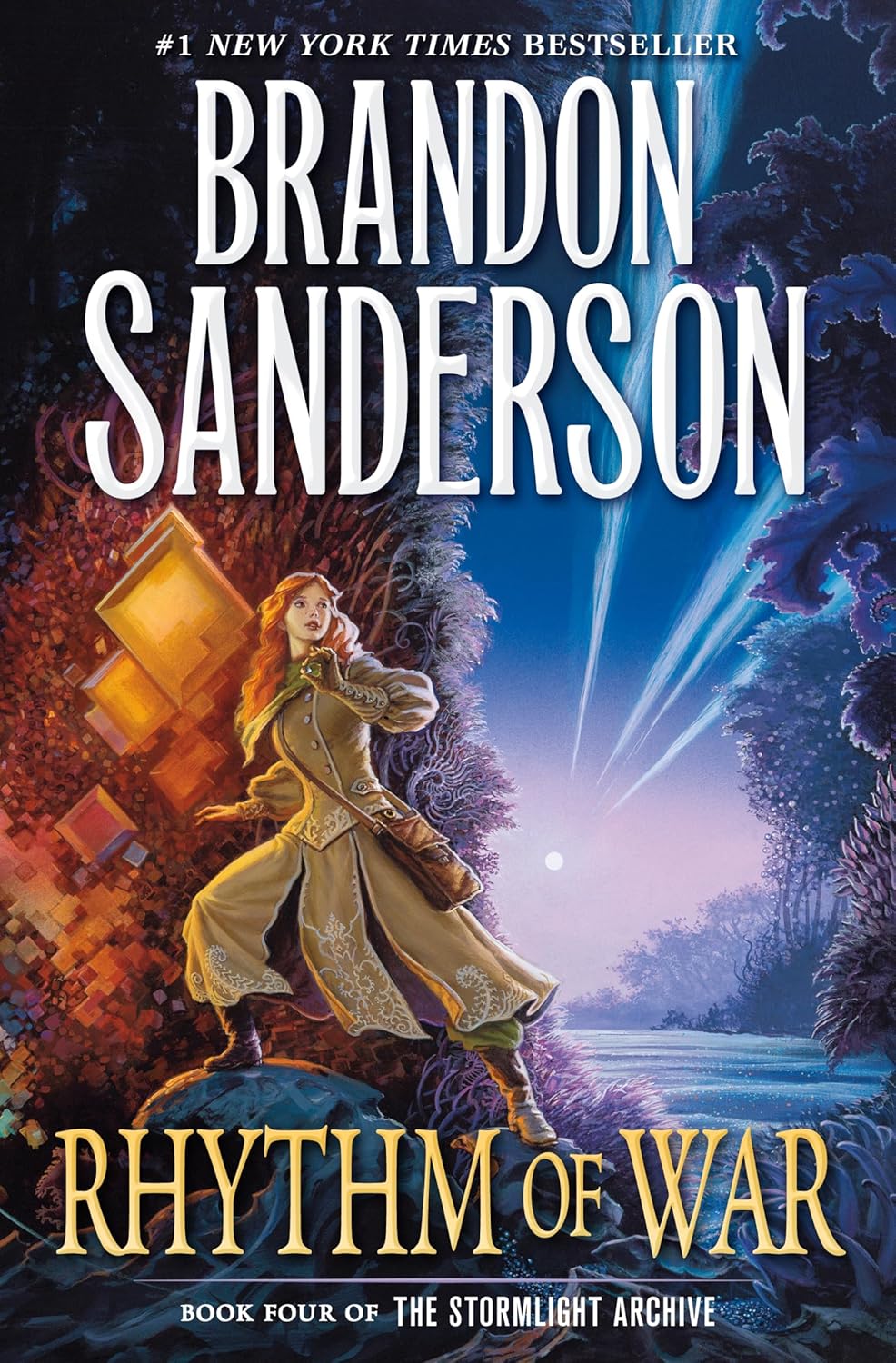
Rhythm of War is the fourth Stormlight novel, often called the most divisive of the first four, and the book where the series’ interest in mental health moves from subtext to center. A year after Oathbringer, the coalition is locked in a grinding war, Navani’s scholars are making discoveries that could change it, and Kaladin, worn down by years of fighting, is trying to find out who he is without a spear in his hand.
Its strengths are unusual ones, even among the Sanderson books. Navani’s research into fabrials, the Rosharan technology built on captured spren, gives the book a scholar’s heroism, and Kaladin’s arc treats burnout and trauma with patience and respect. The flashbacks belong to the sisters Eshonai and Venli, and they give the series’ other side a history at last.
A long, claustrophobic central storyline and a research-heavy middle make it the slowest of the five for many readers, and at roughly 455,000 words it was the longest yet when it appeared. It still debuted at number one on the New York Times list. Readers who come to Stormlight for the battles may find it a grind, while readers who come for the characters get some of his most careful work.
Wind and Truth (2024)

Wind and Truth closes the first arc of the Stormlight Archive, and at 1,344 pages in hardcover it’s the longest book in the series. It was published on December 6, 2024, and it’s built as a countdown: the Radiants have ten days to prepare for a confrontation that will decide Roshar’s future, and the story runs across those ten days on fronts all over the world.
The flashbacks finally belong to Szeth, the assassin in white who opened The Way of Kings, and they answer questions readers have carried since 2010. Dalinar, Kaladin, Shallan and Adolin all get the climaxes the first four books built toward, and the scale is the biggest in the series.
It sold more than half a million English-language copies in its first two days and debuted at number one on the New York Times and USA Today lists, but reception among longtime readers was more divided than for the earlier volumes, with the prose and the page count drawing most of the complaints. What isn’t in dispute is the structure. The book was designed to close the arc rather than end on a cliffhanger, and a reader who stops here gets a genuine resolution. With the second arc still years away, the first five Stormlight novels work as a complete story, and this is a natural place to pause.
The Early Cosmere Standalones (2005-2012)
Alongside the first Mistborn trilogy and the opening of Stormlight came two standalone novels and a Hugo-winning novella. Elantris and The Emperor’s Soul share the planet Sel, Warbreaker takes place on Nalthis, and all three can be read at any point, though Warbreaker pays off most when read before the second Stormlight book.
Elantris (2005)

Elantris was the first of the Brandon Sanderson books to reach print, and it reads like a debut: ambitious, inventive and rougher than anything that came after. The city of Elantris was once home to the gods, people transformed by its magic into shining, near-immortal beings, until ten years ago the magic failed and the transformation began producing something closer to the living dead.
The story rotates among three viewpoints. Raoden, crown prince of Arelon, wakes one morning transformed and is thrown into the rotting city. Sarene, the princess of Teod who has arrived to marry him, finds him declared dead and sets out to save his kingdom anyway. And Hrathen, a high priest of an expansionist empire, has three months to convert Arelon or see it destroyed.
Raoden’s stubborn optimism in a city of the damned is the book’s heart, Hrathen is a genuinely conflicted antagonist and arguably its best character, and the magic, built on glowing written characters called Aons, is a puzzle the plot solves in front of you. The prose and pacing are noticeably rougher than in his later work, and the strict rotation of viewpoints makes the structure feel mechanical.
It’s the one book where starting would give a misleadingly weak first impression, so read it once you already like him, as a look at where he began. Its world returns in The Emperor’s Soul, and Sanderson still plans two Elantris sequels, so it’s worth reading before they arrive.
Warbreaker (2009)

Warbreaker is the stronger of his two early standalones, and the one of his Cosmere books whose threads run most directly into the Stormlight Archive. Two princesses of Idris end up in the capital of rival Hallandren: Siri, the rebellious younger sister sent to marry the feared God King in her sister’s place, and Vivenna, raised her whole life for that marriage, who follows to rescue her.
Hallandren is a kingdom where gods are dead heroes returned to life and kept in a court of luxury in the capital, T’Telir, and where magic runs on Breath, a kind of soul that can be traded and hoarded and used, at the cost of color, to bring objects to life. The best character is Lightsong, a returned god who doesn’t believe in his own divinity and treats the whole business as a joke, and the most memorable is Nightblood, a talking sword with a cheerfully alarming idea of morality.
The romance thread is stronger than in most of his work, and the political maneuvering is fun to untangle. The middle drags for some readers, and Vivenna’s arc frustrates others before it pays off. Sanderson released Warbreaker free on his website under a Creative Commons license, so there’s no cost to trying it. Most reading-order guides put it before Words of Radiance, which is the right call, and it stands alone well enough to make a fine second Sanderson read.
The Emperor’s Soul (2012)

The Emperor’s Soul won the 2013 Hugo Award for Best Novella, and it’s the best argument that Sanderson is at his sharpest when he has to be brief. Shai, a thief and a Forger, someone who can rewrite an object’s history with carved soulstamps, is caught and condemned, then offered a deal by the imperial court. The emperor survived an assassination attempt but his mind is gone, and she has a hundred days to forge him a new soul.
Most of the book is a two-hander between Shai and Gaotona, the one advisor with a conscience, and the questions it asks are good ones: what makes a person who they are, and whether a forgery can be truer than the original. At 175 pages in its Tachyon first edition it’s lean, and the standard reservation, put most sharply by The A.V. Club, is that its magic is “far more developed than any of the characters.” It was also nominated for the World Fantasy Award.
It shares the world of Sel with Elantris but needs nothing from it. Any point in the reading order suits it, including the very start, since it’s the best short door into the Brandon Sanderson books, and Arcanum Unbounded collects it too.
The Secret Projects and the New Standalones (2023-2026)
In 2020, with touring canceled, Sanderson wrote novels nobody had asked for and told almost no one. He revealed them in March 2022 with a Kickstarter that funded four books for 2023, one delivered to backers each quarter: Tress of the Emerald Sea, The Frugal Wizard’s Handbook for Surviving Medieval England, Yumi and the Nightmare Painter and The Sunlit Man, with Tor’s bookstore editions following months later. Three are Cosmere books. The Frugal Wizard’s Handbook is not, and its entry lives below with the non-Cosmere books.
The secret projects became a habit. Isles of the Emberdark, funded in 2024 alongside a leatherbound Words of Radiance, reached backers in 2025, and The Fires of December, announced at Dragonsteel Nexus 2025, followed in 2026. In 2025 Sanderson grouped the Hoid-narrated books under the label Hoid’s Travails, which so far means Tress, Yumi and The Fires of December, and they can be read in any order.
Tress of the Emerald Sea (2023)

Tress of the Emerald Sea was the first of the secret projects, and it’s one of the warmest, funniest books Sanderson has written. Tress lives on a barren rock in an ocean of colored spores that turn deadly on contact with water, including the water in a human body, and when the boy she loves is carried off by the Sorceress who rules the Midnight Sea, she does the un-fairy-tale thing and leaves her island to get him back herself.
The narrator is Hoid, the Cosmere’s wandering storyteller, and his wry asides give the book the feel of a bedtime story told by someone who has seen too much. The book was inspired by The Princess Bride, and Tress’s defining quality is competence under pressure: she gets out of trouble with observation and nerve rather than power. Kirkus called it “a fantasy adventure with a sometimes-biting wit,” which sums up the consensus well, and it was a Dragon Award finalist in 2023.
Hoid’s narration is intrusive by design, and some reviewers found the Cosmere references heavier than a standalone needs. Neither should stop you. It’s one of the best Brandon Sanderson books to hand someone who has never read him, and it sits on my cozy fantasy books list for good reason.
Yumi and the Nightmare Painter (2023)

Yumi and the Nightmare Painter was the third secret project and one of the most unusual Brandon Sanderson books, a Hoid-narrated Cosmere novel with its roots in Japanese media. Yumi is a yoki-hijo, a young priestess whose rituals of stacked stones call down the spirits her land depends on. Painter, in the dark city of Kilahito, is a nightmare painter, one of the people who trap the shapeless nightmares that feed on the city’s fear by painting them.
When a spirit asks Yumi for help and Painter drives off a powerful nightmare, the two find themselves bound together, trading places between their worlds in a way that forces each to live the other’s life. Sanderson has named the manga and anime Hikaru no Go, the film Your Name and the game Final Fantasy X among its inspirations, and he has called it his favorite of the secret projects.
It’s slower and more melancholy than Tress, and the opening chapters of ritual and routine ask for patience before the two halves click together. Once they do, it’s a moving book about duty, exhaustion and art, and as tender as anything he has written.
The Sunlit Man (2023)

The Sunlit Man was the fourth secret project, a breakneck Cosmere chase novel about a man who calls himself Nomad. He’s on the run, forced to hop from world to world whenever the Night Brigade gets too close, and his latest jump lands him on Canticle, a slowly turning planet whose sunrise incinerates anything it touches.
Canticle’s people survive by staying ahead of the dawn on hoverbikes and airships, lashing ships together into moving cities, and Nomad is dragged into a fight between a tyrant and the rebels resisting him, with the sun always coming. Sanderson has said it grew from one of his earliest Cosmere ideas, a people who must keep moving or die, and it’s the only one of the four secret projects illustrated by more than one artist.
It’s also the most breathless of the four, a chase that rarely pauses. It leans on the wider Cosmere, and on the Stormlight Archive in particular, so it belongs later in your reading rather than first.
Isles of the Emberdark (2025)

Isles of the Emberdark is the fifth secret project, funded in 2024 and delivered to backers in 2025, and it pushes the Cosmere into its space age. It expands Sanderson’s 2014 novella Sixth of the Dusk into a full novel with two leads. Dusk is a trapper on the deadly island of Patji, bonded to supernatural birds called Aviar, who leads his people in a race to modernize before invaders from the stars conquer them.
Starling of the starship Dynamic is a young dragon chained in human form, and she and her crew of exiles are deep in debt and close to losing their freedom when she finds an ancient map to a hidden portal. Both stories run through the Emberdark, a strange region reached through a portal on Patji, and the result sits squarely on the border the science fantasy books list maps, with canoes and starships in the same plot.
Readers who know Sixth of the Dusk will find Dusk’s strand familiar at first, since the novella is folded into it, and the space-age material assumes some comfort with the wider Cosmere. It’s the clearest look yet at the far future the Cosmere books have been building toward.
The Fires of December (2026)

The Fires of December is the newest of the Cosmere books, the sixth secret project, announced at Dragonsteel Nexus 2025 and the third book in Hoid’s Travails. December, a young woman on the previously unseen planet Miral, learns that a devastating plague is coming, and in a world that runs on colorful rivers of demon blood, she travels up the River Violet to warn the royal court, with a talkative priestess and an aspiring fashion designer for company.
Skeptical officials, court politics and a roguish count stand in her way, and Hoid’s narration carries over the fairy-tale register of Tress and Yumi. Backers got their digital copies in September 2026, the ebook and audiobook went on general sale on October 6, and Tor’s hardcover is due on December 8, 2026. It’s too new for a settled verdict, but readers who loved the first two Hoid’s Travails books are its obvious audience, and the series can be read in any order.
Cosmere Short Fiction and Graphic Novels
Most of the shorter Cosmere fiction lives best in one volume, so the early stories and the novellas without entries of their own are covered under Arcanum Unbounded. White Sand is the odd one out, a graphic novel trilogy adapted from one of his unpublished early novels. Still to come in this corner is Hoid’s Storybook Collection, picture books built mostly on the stories Hoid tells in the Stormlight Archive, crowdfunded in March 2026 and planned for delivery by the end of the year.
Arcanum Unbounded (2016)

Arcanum Unbounded is the Cosmere collection, published by Tor in November 2016, and the sensible way to own the shorter Cosmere books in one volume. It gathers The Emperor’s Soul, Edgedancer and Mistborn: Secret History alongside Shadows for Silence in the Forests of Hell, a dark, folk-horror-tinged novella about an innkeeper who secretly hunts bounties in a forest of deadly shades, and Sixth of the Dusk, the Patji novella later expanded into Isles of the Emberdark.
The short pieces round it out: “The Hope of Elantris,” “The Eleventh Metal,” a Kelsier story set before the first trilogy, the pulp parody “Allomancer Jak and the Pits of Eltania,” and an excerpt from White Sand with a previously unpublished opening from its prose version. Each world gets an essay and illustrations on its planetary system, which is catnip for completists.
Publishers Weekly called it required reading for fans, while Kirkus thought some pieces felt “more like deleted scenes.” If you plan to read more than one of these novellas, buy this instead of the separate editions, and save it until you know the main series.
White Sand (2016)

White Sand is a Cosmere graphic novel trilogy adapted by Rik Hoskin from one of Sanderson’s unpublished early novels, published by Dynamite in three volumes between 2016 and 2019 and collected in the White Sand Omnibus in 2022. It’s set on Taldain, a tidally locked world, and follows Kenton, a young Sand Master whose order is massacred, and Khriss, a visitor from the planet’s dark side.
The sand magic, in which Masters command ribbons of sand powered by their own body’s water, is classic Sanderson system-building, and the first volume won the Dragon Award for best graphic novel in 2018. The omnibus adds a new prologue, art and text fixes and a magic appendix, and it’s the edition to get. It’s an early story, though, and the comic format compresses it. A prose version is still planned but sits on the back burner, so for now this is the only way to read the Taldain story, and it’s strictly for completists.
Outside the Cosmere
The non-Cosmere shelf of Sanderson books is substantial, entirely separate, and the best option if you want Sanderson without the universe-spanning commitment. Three of its series are read-in-order sets for younger readers, Alcatraz for middle grade and the Reckoners and Skyward for teens, so each gets one entry on its first book with the rest of the order inside the entry. The others are a standalone young adult novel, an omnibus, the one secret project outside the Cosmere, a short-fiction collection and a 2026 collaboration.
A few more titles fill out the table above rather than earning entries here: the Infinity Blade novellas, written for the video game, Children of the Nameless for Magic: The Gathering, The Original, an audio novella with Mary Robinette Kowal, and The Most Boring Book Ever, a picture book with pictures by Kazu Kibuishi. He has also co-written a graphic novel outside the Cosmere, Dark One.
Alcatraz Versus the Evil Librarians (2007)

Alcatraz Versus the Evil Librarians is the first book of Sanderson’s middle-grade comedy series, the silliest of the Brandon Sanderson books by a distance, and the one to put in front of a younger reader, or anyone convinced he only writes solemn epics. Alcatraz Smedry is a thirteen-year-old foster kid with a talent for breaking things, and on his birthday a bag of sand arrives in the mail and pulls him into a secret war against a cult of evil Librarians who quietly control the world.
He narrates, insists he’s a liar, and keeps breaking off to lecture the reader about storytelling, so the book is as much a parody of fantasy conventions as an adventure. The jokes come fast, the magic, family Talents for arriving late or tripping or breaking things, is gleefully silly, and adult readers tend to enjoy it more than they expect. The meta humor can feel relentless, and it’s pitched firmly at middle-grade readers.
The reading order is Alcatraz Versus the Scrivener’s Bones (2008), Alcatraz Versus the Knights of Crystallia (2009), Alcatraz Versus the Shattered Lens (2010) and Alcatraz Versus the Dark Talent (2016), and the series continues in Bastille Versus the Evil Librarians (2022), written with Janci Patterson and starring Bastille, Alcatraz’s knightly bodyguard.
The Rithmatist (2013)

The Rithmatist is a standalone young adult novel, published by Tor Teen in 2013, and one of the most inventive Brandon Sanderson books. In an alternate America made of islands, Rithmatists duel with chalk: their lines and circles become defensive geometry, and their chalklings come to life and attack. Joel, the son of a chalkmaker at Armedius Academy, wants nothing more than to be one, and has no gift for it at all.
When Rithmatist students start disappearing, Joel’s obsession with the theory of a magic he can’t use makes him useful to the investigation. The diagrams that accompany the chapters teach the dueling system as you go, which is the most Sanderson thing imaginable. Its ending opens threads for a sequel that Sanderson still plans but has not scheduled, more than a decade later. As a standalone it’s satisfying enough, and it’s an ideal book for a teenager who likes puzzles.
Steelheart (2013)

Steelheart is the first book of the Reckoners, Sanderson’s young adult superhero trilogy, built on an inverted premise. When a red star called Calamity appeared in the sky, ordinary people began gaining superpowers, and every one of these Epics turned villainous. Steelheart, invulnerable and absolute, rules Newcago, the old Chicago turned to steel, and David, who watched him kill his father, has spent ten years studying how to kill him back.
David knows something nobody else does, because he once saw Steelheart bleed, and he joins the Reckoners, a cell of ordinary humans who assassinate Epics. The book is fast and propulsive and runs on the rigorous logic of the other Sanderson books: every Epic has a weakness, and the plot is the hunt for it. David’s terrible metaphors are a running joke that some readers love and others find grating, and the trilogy is lighter in theme than his epic fantasy.
The reading order is Steelheart (2013), the short story “Mitosis” (2013, now collected in Tailored Realities), Firefight (2015) and Calamity (2016), which was a Dragon Award finalist. Lux, an audio-original sequel written with Steven Michael Bohls, followed in 2021. This is Sanderson at his most cinematic, and the series to try if fantasy has always felt too slow.
Legion: The Many Lives of Stephen Leeds (2018)

Legion: The Many Lives of Stephen Leeds collects the three Stephen Leeds novellas, the Brandon Sanderson books closest to a modern thriller, and it’s the obvious way to buy them. Stephen is a genius whose mind generates aspects, hallucinated experts who each know things he doesn’t, from a security specialist to a historian, and he solves strange cases by consulting a crowd only he can see.
The first novella, Legion (2012), hunts for a camera that can photograph the past. Skin Deep (2014) chases a stolen corpse whose cells have been used to store data. Lies of the Beholder, first published in this 2018 volume, turns the series inward toward the mystery of Stephen’s own mind. The aspects’ bickering is the main pleasure, and the cases are lighter than the premise, but the third story gives the set a satisfying shape. An audio-original spin-off, Stephen Leeds: Death and Faxes (2022), was written with three co-authors. It’s all thriller-shaped science fiction rather than fantasy, compact enough for a weekend and built on one strong central gimmick.
Skyward (2018)

Skyward is the first book of Sanderson’s young adult science fiction series, and for many readers the best of the non-Cosmere Brandon Sanderson books. Spensa lives with the descendants of a crashed fleet on Detritus, a ruined planet under constant attack by the alien Krell, and she wants to be a pilot like her father, even though he’s remembered as a coward who deserted his flight. Then she finds a crashed starship with a talking AI, M-Bot, whose memory is corrupted.
The flight-school chapters are the heart of it, with a cadet team that becomes a found family and dogfights staged with real attention to physics. M-Bot, sardonic and obsessed with mushrooms, is a scene-stealer. The voice is young adult, Spensa’s bravado is loud by design, and the sequels change setting so sharply that the series rarely feels the same twice. It debuted at number three on the New York Times young adult hardcover list.
The reading order is Skyward (2018), Starsight (2019), Cytonic (2021) and Defiant (2023), with three novellas written with Janci Patterson, Sunreach, ReDawn and Evershore (all 2021, collected as Skyward Flight in 2022), running alongside the later books. The story continues in the Riftwake series, also with Patterson, which began with Blightfall on September 1, 2026, with Songrise planned for 2027.
The Frugal Wizard’s Handbook for Surviving Medieval England (2023)

The Frugal Wizard’s Handbook for Surviving Medieval England was the second of the 2023 secret projects, and the only one of the four outside the Cosmere. A man wakes in a clearing in what appears to be medieval England with no memory of who he is, chased by people from his own time, and the guidebook meant to help him survive, the handbook of the title, was destroyed in transit. All he has left are fragments he has to decode as he goes.
It’s a comic science fiction caper wrapped around a mystery, the mystery being who the narrator is and why he’s there, and it moves fast. Backers received it in April 2023, and Tor’s edition followed on June 27, 2023. Its humor is broader and more modern than anything in the Cosmere books, which will delight some readers and grate on others, and the amnesia device works harder early on than it does once the answers start arriving.
Because it shares a Kickstarter with three Cosmere novels, readers often assume it’s connected. It isn’t, and that’s freeing: it’s the one secret project that needs no Cosmere knowledge at all, and the lightest commitment on this page.
Tailored Realities (2025)
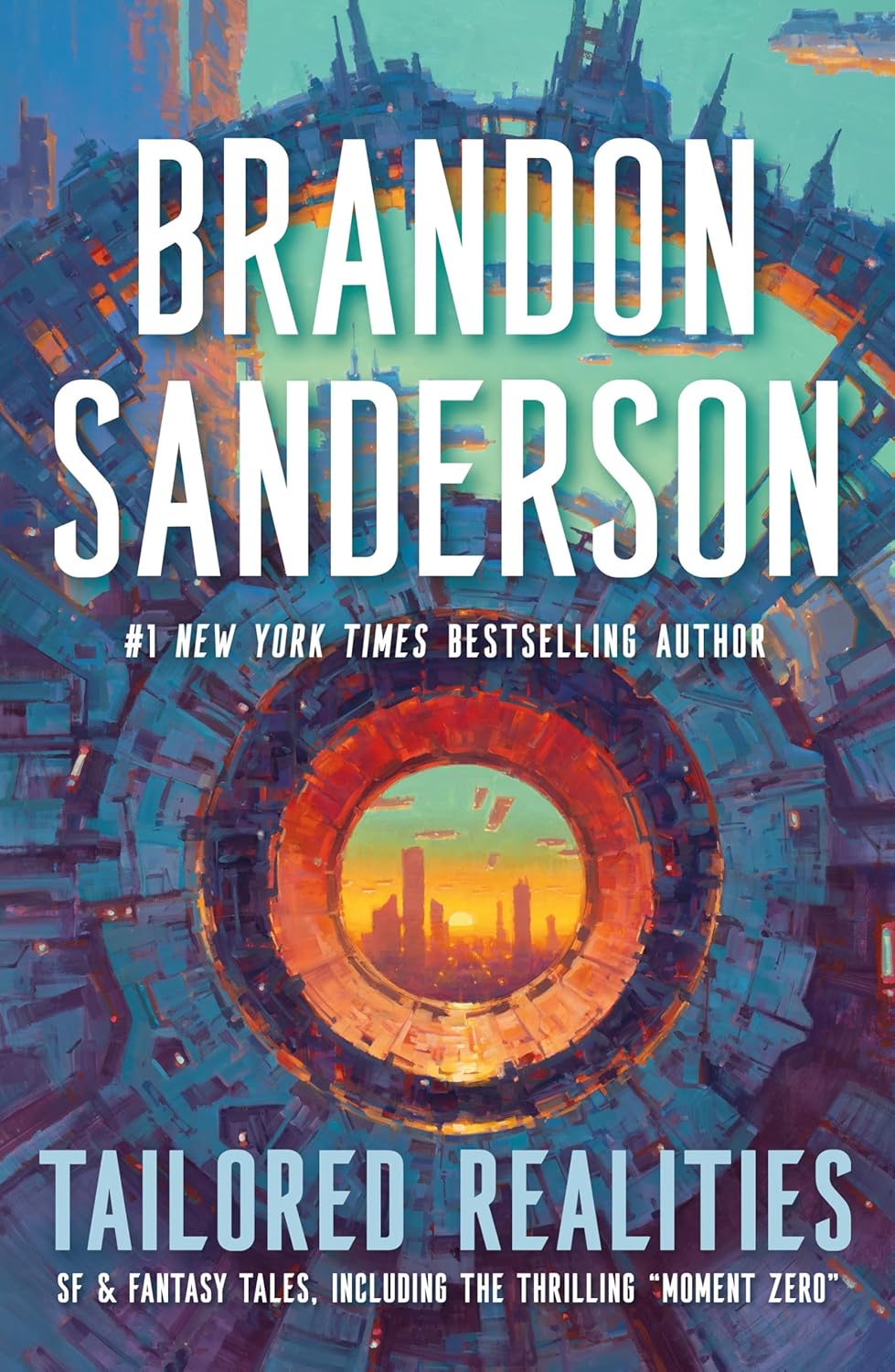
Tailored Realities is the collection of Sanderson’s short fiction outside the Cosmere, published by Tor on December 9, 2025, to coincide with Dragonsteel Nexus. It gathers ten pieces, from flash fiction to novellas, each with a black-and-white illustration: the detective novella Snapshot, in which a city is recreated for a day so the police can investigate the past, the virtual-world novella Perfect State, a Hugo finalist, and the short stories “I Hate Dragons,” “Defending Elysium,” “Firstborn” and the Reckoners story “Mitosis.”
Horror readers should look for “Dreamer,” a short horror story first published in the anthology Games Creatures Play. The collection also adds three previously unpublished pieces: the novellas “Brain Dump” and “Moment Zero,” and “Probability Approaching Zero,” his first attempt at flash fiction. It’s a grab bag by nature, running from flash fiction to full novellas, so the weight varies from piece to piece. For readers who want the science fiction side of the Brandon Sanderson books in one volume, it’s the place to start, and it replaces a shelf of scattered ebooks.
Songs of the Dead (2026)

Songs of the Dead is a collaboration, co-written by Brandon Sanderson and Peter Orullian, and the first book of The Strata Wars, a contemporary fantasy published by Saga Press in June 2026. Jack Solomon, a struggling musician in London’s West End, is killed and wakes in a new reality where light and music make magic and living eras of the past lie beneath modern London, layer upon layer. Sanderson’s own shorthand for the character is a heavy metal musician who becomes a necromancer.
The idea is an old one for him. He first talked about it around 2010 as Death by Pizza, an urban fantasy about a necromancer pizza delivery man, which he drafted and shelved, then revived in 2018 with heavy metal in place of the pizza. Sanderson did the worldbuilding and outline, Orullian wrote the draft and developed the characters, and Sanderson has called it Peter’s book, so expect Orullian’s voice rather than his. Orullian will write the rest of the series, and it’s for readers curious about the collaborations as much as the Brandon Sanderson books proper.
The Wheel of Time Completion (2009-2013)
Robert Jordan died in 2007 with the last book of The Wheel of Time unfinished, and Harriet McDougal, his widow and editor, chose Sanderson to complete it from Jordan’s notes, outlines and finished scenes. The single planned final volume grew into three, a change announced in March 2009: The Gathering Storm (2009), Towers of Midnight (2010) and A Memory of Light (2013).
It’s the work that brought Sanderson to a much wider audience, and by most accounts Wheel of Time readers regard the ending as a strong close to a series that had lost momentum in its middle volumes. The Wheel of Time as a whole was a Hugo finalist for Best Novel in 2014, credited to Jordan and Sanderson, and all three completion volumes were nominated for the David Gemmell Legend Award.
Those three books belong to Jordan’s series, so their entries live on the Robert Jordan books guide rather than with the Brandon Sanderson books here, alongside the full reading order and an honest map of the slow middle. Sanderson also wrote two Wheel of Time short stories for the Unfettered anthologies, “River of Souls” (2013) and “A Fire Within the Ways” (2019).
Brandon Sanderson: Deep Dive & FAQ
What Runs Through Sanderson’s Books
The first thread is systems. In a February 2007 essay he called Sanderson’s First Law, he argued that magic can only resolve a story’s conflicts to the degree that the reader understands how it works, and laid out a spectrum from soft magic, mysterious and wondrous, with Tolkien on that side, to hard magic with knowable rules. He put his own systems at “perhaps 80% hard, maybe a bit more.” Later essays added a Second Law, that limitations matter more than powers, and a Third, to expand what you already have before adding something new.
The second thread is structure, and it’s why the climaxes in Sanderson books feel earned. The payoff is a rule you were shown hundreds of pages earlier, used in a way you didn’t see coming, and the novels famously build to a final-act convergence his fans call the Sanderlanche, where a hundred threads resolve at once. Across the Cosmere the same habit becomes the hidden architecture of a whole universe, with the worldhopping storyteller Hoid turning up on planet after planet and a shared cosmology of godlike Shards behind the separate magic systems.
The third thread is people under pressure: a depressed soldier, a scholar hiding her past, a warlord haunted by what he did, a thief learning to trust. Mental health and redemption are unusually central in Brandon Sanderson books, and the endings lean hopeful. The trade-off is the prose, clean, clear and functional, built for momentum rather than beauty, and that’s the most common reservation in otherwise admiring reviews. If you come to fantasy for the sentence-level pleasure of a Le Guin or a Peake, that isn’t what he’s offering. If you come for airtight plots and ingenious magic, he’s close to unmatched.
Prizes and Honors
The headline award is the 2013 Hugo for Best Novella, which The Emperor’s Soul won after also being nominated for the World Fantasy Award, and the same year Writing Excuses, the podcast he co-founded, took the Hugo for Best Related Work. The Way of Kings won the David Gemmell Legend Award in 2011 and Words of Radiance won it again in 2015. Oathbringer won the Dragon Award for best fantasy novel in 2018, the same year the first White Sand volume won for best graphic novel.
The Stormlight Archive was a Hugo finalist for Best Series in 2018 and again in 2025, The Wheel of Time was a finalist for Best Novel in 2014, and Perfect State was a Best Novella finalist in 2016. Earlier, he was a Campbell Award finalist for best new writer in 2006 and 2007, and The Alloy of Law won Israel’s Geffen Award for translated fantasy in 2019. The sales numbers say the rest: more than 50 million copies of Brandon Sanderson books sold, according to his agency, with Words of Radiance, Oathbringer and Rhythm of War all debuting at number one on the New York Times hardcover fiction list.
Which Brandon Sanderson Editions to Buy
In the United States the standard editions of Sanderson books are Tor’s, in hardcover, paperback and ebook, and in Britain Gollancz publishes him. The Stormlight hardcovers are worth owning if you can, since the maps and interior art are part of the reading experience and thousand-page paperbacks are hard on the spine. In Germany he is published by Heyne, and Wind and Truth arrived in German as two hardcovers in 2025.
Dragonsteel sells its own premium editions. Its leatherbounds include a tenth-anniversary The Way of Kings, funded by a 2020 Kickstarter that raised $6.7 million, and Words of Radiance, which shipped to more than 100,000 backers. The secret projects exist in two forms, Dragonsteel’s illustrated backer editions and Tor’s trade editions, which can carry different art: Tress of the Emerald Sea, for example, has a Howard Lyon cover from Dragonsteel and a Carlos Guimerà cover from Tor.
On audio, Michael Kramer and Kate Reading read the five Stormlight novels for Macmillan Audio, and GraphicAudio has dramatized every Stormlight novel and novella to date, along with Mistborn. For the shorter work, Arcanum Unbounded, the Legion omnibus, Skyward Flight and the White Sand Omnibus are the sensible single purchases.
Sanderson on Screen
Adaptations of the Cosmere books have a long history of almost happening. Mistborn was optioned in 2010 and the option lapsed in 2014. In 2016 DMG Entertainment licensed the whole Cosmere, starting with The Way of Kings, but development stalled, and at the end of 2023 Sanderson described the Mistborn film as paused.
That changed on January 28, 2026, when The Hollywood Reporter broke the news that Apple had acquired film and television rights to the entire Cosmere, with Sanderson keeping unusually extensive creative control. The plan is Mistborn as feature films and the Stormlight Archive as a television series, with Blue Marble Pictures attached to Stormlight. Sanderson is writing the first Mistborn film himself, and in his weekly video update in late July 2026 he reported the first draft of the screenplay finished. No director, cast or release date had been announced for either project as of late summer 2026.
Outside the Cosmere, Universal Television took the Skyward rights in 2020, and Sanderson’s December 2025 update described a Skyward pilot in development. The same update called a planned film of the novella Snapshot dead, with the rights returning to him.
Questions About Brandon Sanderson
What Order Should I Read Brandon Sanderson Books In?
Read them in publication order within each series, starting with Mistborn: The Final Empire. Finish the first Mistborn trilogy, read Warbreaker, then start the Stormlight Archive with The Way of Kings, slotting Edgedancer in after Words of Radiance and Dawnshard after Oathbringer. The standalones and the secret projects can be read whenever you like, though The Sunlit Man and Isles of the Emberdark reward readers who already know the wider Cosmere.
Where Should I Start With Brandon Sanderson?
Mistborn: The Final Empire is the consensus first pick among the Brandon Sanderson books, a complete story at a sane length that shows you exactly what he does. If you want something shorter, try The Emperor’s Soul or Tress of the Emerald Sea, and if you want science fiction, try Skyward. Avoid starting with The Way of Kings unless you already know you love very long epics, and avoid Elantris as a first book.
What Is the Cosmere, and Do I Need to Read It in Order?
The Cosmere is the shared universe behind most Sanderson books for adult readers, from Elantris and Mistborn to the Stormlight Archive and the secret projects. Each series stands alone, so you don’t need a master reading order. The crossovers, from the worldhopper Hoid to the deeper links in the later books, are rewards for readers who stay, and publication order handles them naturally.
Is the Stormlight Archive Finished?
The first half is. Sanderson planned ten books in two arcs, and Wind and Truth (2024) closed the first arc of five, so a reader who stops there gets a real resolution. The second arc opens after a time skip, and Sanderson has said he’ll write it after the Ghostbloods trilogy and the Elantris sequels, which puts book six in the 2030s at the earliest.
When Is the Next Mistborn Book Coming Out?
Ghostbloods, the first book of Mistborn’s third era, is scheduled for December 2028, with the second and third books slated for December 2029 and December 2030. It moves Scadrial into an early computer age, with technology closer to the 1980s and 1990s, and Sanderson reported much of the first book written by the end of 2025.
Is the Frugal Wizard’s Handbook Part of the Cosmere?
No, it isn’t. The Frugal Wizard’s Handbook for Surviving Medieval England was the second of the 2023 secret projects, funded by the same Kickstarter as the three Cosmere books, but it’s a standalone set outside the Cosmere, about an amnesiac stranded in what looks like medieval England. That’s why this page lists it with the non-Cosmere books.
Is There a Brandon Sanderson Movie or TV Show?
Not yet, but one is in development. In January 2026 Apple acquired film and television rights to the Cosmere, planning Mistborn as feature films and the Stormlight Archive as a series, with Sanderson holding unusual creative control. He finished a first draft of the Mistborn screenplay in the summer of 2026, and no director, cast or release date had been announced by late summer.
Did Brandon Sanderson Finish the Wheel of Time?
Yes, he did. After Robert Jordan’s death in 2007, Harriet McDougal, Jordan’s widow and editor, chose Sanderson to complete the series from Jordan’s notes. The planned final volume became three books, The Gathering Storm (2009), Towers of Midnight (2010) and A Memory of Light (2013), and by most accounts Wheel of Time readers regard the ending as a strong close.
Where to Go Next
The natural next step after the Brandon Sanderson books is the series that brought him to a mass audience: the Robert Jordan books guide covers The Wheel of Time from The Eye of the World to the three volumes Sanderson finished. For another modern epic with big battles and a clear moral frame, the John Gwynne books guide covers The Faithful and the Fallen and The Shadow of the Gods.
Readers who want the opposite of Sanderson’s clarity have two strong options. The Robin Hobb books guide maps the Realm of the Elderlings, where interiority and slow heartbreak do the work his magic systems do, and the Steven Erikson books guide covers the Malazan Book of the Fallen, which drops the reader into a soft-magic world of staggering scale and trusts them to keep up.