John Gwynne books come with a formal succession attached. Mark Lawrence’s blurb calls him “the closest we have to an inheritor of David Gemmell’s mantle,” and the inheritance runs both directions: when Orbit published the 40th anniversary collector’s edition of Legend in 2025, it was Gwynne the publisher asked to write the new introduction, a fact my David Gemmell guide covers from the other end. Heroic fantasy with grit and heart needed a standard-bearer after 2006, and the genre quietly agreed on a Viking reenactor from East Sussex.
The reenactor part is not decoration. Gwynne spends his weekends in an actual shield wall, and he has said plainly that the reenactment shapes how he writes fighting and gear. The verdict on my best fantasy books pillar, where The Faithful and the Fallen holds its entry, rests on exactly that: nobody currently writing renders the physics of massed combat with his authority.
What this page adds is the map, because the shelf now spans two distinct eras, the classic epic that made his name and the Norse saga that made him a bestseller, and, rarest of all in this cluster, every series he has published is finished. The next era already has a date, too: The Wolves of War, the first book of a brand-new series, arrives on November 3, 2026, and this guide covers what’s known about it alongside everything in the Gwynne books you can read today.
Fiction by René Rehn


The Short Version
Two doors, both complete. The Shadow of the Gods opens the Bloodsworn Saga, the modern, Norse, three-books-done door, and it’s where most new readers should start. Malice opens The Faithful and the Fallen, the classic four-book epic, with the bridge trilogy Of Blood and Bone waiting after it. Ten novels, zero cliffhangers pending, no waiting room. In this cluster, that sentence is a luxury item.
Full-catalog order for the completionist: the Faithful four, then Of Blood and Bone, then the Bloodsworn three, one continuous education in how the man’s craft sharpened. And if you finish all ten with the calendar on your side, The Wolves of War opens the next era in November 2026.
John Gwynne Books in Order
Everything is listed by first publication, and within each of the three series that order is also the right reading order.
| Year | Title | Series or type | Notes |
| 2012 | Malice | The Faithful and the Fallen, book 1 | Morningstar Award for best debut |
| 2014 | Valour | The Faithful and the Fallen, book 2 | Spelled Valor in US editions |
| 2015 | Ruin | The Faithful and the Fallen, book 3 | |
| 2016 | Wrath | The Faithful and the Fallen, book 4 | |
| 2018 | A Time of Dread | Of Blood and Bone, book 1 | A century after Wrath |
| 2019 | A Time of Blood | Of Blood and Bone, book 2 | |
| 2020 | A Time of Courage | Of Blood and Bone, book 3 | |
| 2021 | The Shadow of the Gods | The Bloodsworn Saga, book 1 | |
| 2022 | The Hunger of the Gods | The Bloodsworn Saga, book 2 | |
| 2024 | The Fury of the Gods | The Bloodsworn Saga, book 3 | New York Times bestseller |
| 2026 | The Wolves of War | The Wolfheart Chronicles, book 1 | Announced for November 3, 2026 |
Where to Start With John Gwynne
The Shadow of the Gods is the current-decade door and the entry most new readers come for: shorter chapters, a faster hook, and the Norse texture that made the Bloodsworn Saga his breakout into the bestseller lists. Malice is the door for readers who want the full old-school epic experience first, a large cast, a prophesied war, and a slow build that pays compound interest. Both roads are paved to the end, so the only real decision is which complete story to walk into first.
Of Blood and Bone is the read-second series by design. It rewards readers who know the Banished Lands, and starting there spoils the shape of the first epic for no benefit. Read it between the two eras or after both. Just don’t start here.
If you’re still weighing whether to commit at all, the Faithful and the Fallen is exactly the kind of finished, binge-ready epic my best fantasy series list exists to sort: four books, one arc, no waiting.
John Gwynne’s Life, Briefly
Gwynne was born in 1968 and studied at the University of Brighton, where he later lectured. His publisher bio collects the pre-writing resume with visible fondness: he played double bass in a rock and roll band, packed soap in a soap factory, and dug ditches for a landscaping crew. He lives in East Sussex, where he is part of a Viking reenactment group, and he has said the reenactment directly informs how he depicts fighting and equipment. He names Bernard Cornwell’s novels and the film Braveheart among his formative influences, which anyone who has read his shield walls could have guessed.
The writing career started late and landed immediately. Malice, his debut, appeared from Pan Macmillan in 2012 and won the Morningstar Award for best fantasy newcomer at the 2013 David Gemmell Awards, about as on-the-nose a prize as the genre could have handed him. The Faithful and the Fallen ran to four volumes by 2016, the follow-up trilogy Of Blood and Bone reportedly sold in a six-figure deal, and The Shadow of the Gods arrived in 2021, square in the middle of the culture’s Viking decade, and made him a household name in fantasy. The Bloodsworn finale hit the New York Times bestseller list in 2024.
The Faithful and the Fallen (2012-2016)
The first era is the Banished Lands: a prophesied war between a returning angelic host and the demonic Kadoshim, a large cast across several nations, and at its center a blacksmith’s son growing from boyhood into the war’s hinge. What made the series beloved is precisely what the era around it had abandoned. This is good versus evil with the courage of its convictions, loyalty, oaths, and sacrifice treated as real forces rather than setups for subversion, published into the middle of the grimdark decade and landing like a hammer anyway, mostly because the losses are real enough that the ideals cost something.
Read it in order, Malice through Wrath, no shortcuts and no skipping. It’s a single continuous story in the classic mold, and it has earned its place in the epic fantasy tradition’s modern wing. The series’ watchwords, “truth and courage,” became the fandom’s own sign-off, and Gwynne reportedly inscribes the phrase in the books he signs.
Malice (2012)

Malice is the debut that announced the Gemmell succession, and the David Gemmell Awards made it official by handing it the 2013 Morningstar Award for best newcomer. The story follows Corban, a blacksmith’s son in the small kingdom of Ardan who wants nothing grander than to earn his warrior’s torc, while omens pile up and the powerful start quietly sorting themselves around an old prophecy of god-war. The structure’s quiet masterstroke sits on the other side of the lines: a second thread follows Veradis, a decent young warrior sworn to a charismatic prince the reader clocks long before he does, and watching loyalty and decency serve the wrong cause gives the whole series its ache.
The standard honest note applies in full: Malice builds slowly, a whole book of groundwork, training yards and feast halls and gathering dread, before the pieces start to move. Readers who bounce off it tend to bounce early. But the groundwork is the point: among John Gwynne books this is the one a large faction of longtime fans still names first. Everything the later books burn down gets built here, and the payoff compounds across four volumes.
Valour (2014)

Valour picks up at full speed, with the board scattered, and it solves the debut’s one weakness by arriving with all the groundwork already laid. The story follows Corban’s band on the run through hostile country while Veradis marches deeper into service he believes in and the reader dreads, and the two threads start pulling toward each other with real gravitational force. This is where Gwynne’s battle craft becomes the headline: ambushes, sieges, and running fights that track exhaustion, footing, and fear the way only someone who has stood in a shield wall writes them.
The middle-book caveat is mild here. The cast keeps growing, and a few new viewpoints earn their pages more slowly than others, but the pace never drops back to Malice’s warm-up gear. It was shortlisted for the David Gemmell Legend Award in 2015, the first of three straight shortlists for the series. US editions spell it Valor, same book, different flag.
Ruin (2015)

Ruin is the big middle volume, the longest book of the four, and the one where the private griefs of the first two books scale up into open war. The story follows the survivors converging on alliances nobody wanted while the prophecy’s two sides finally stop pretending the conflict is deniable, and Gwynne starts spending the goodwill he banked, which means losses that hurt and are meant to. The set-piece battles here are the series at full power, massed combat with geography and logistics that actually matter.
If the series has a stretch where the page count tests you, it’s the marching in this book’s middle, a lot of map gets crossed to put everyone where Wrath needs them. The 2016 Legend Award shortlist suggests readers forgave it instantly, and most do, because the last third runs at a sprint. For anyone deep enough in the Gwynne books to be reading entry three, there was never a question of stopping.
Wrath (2016)

Wrath closes the Faithful and the Fallen, and the consensus on it is unusually warm for a finale: the series sticks the landing. The story follows every surviving thread into the war’s final convergence, the prophecy comes due, and the book pays off four volumes of oaths, debts, and griefs without going soft on any of them. I’ll say nothing about outcomes. What can be said is that the sincerity holds to the last page, and that the ending is the reason readers who finish the series rarely rank it below the Norse books, with a large faction ranking it above.
It took its third straight David Gemmell Legend Award shortlist in 2017 and won the BookNest Award for best traditionally published novel the same year. As finales go, it’s the safest recommendation in this guide: by the time you reach it, you already know exactly what you’re getting, and it delivers exactly that, at scale.
Of Blood and Bone (2018-2020)
The middle trilogy returns to the Banished Lands over a century after Wrath, with the god-war’s consequences calcified into uneasy institutions and a darker, tighter story growing in the cracks. It’s leaner than either neighbor, built on new leads and old shadows, and it completes the Banished Lands into one continuous seven-book history. Read in order: A Time of Dread, A Time of Blood, A Time of Courage, 2018 to 2020, one arc.
A Time of Dread (2018)
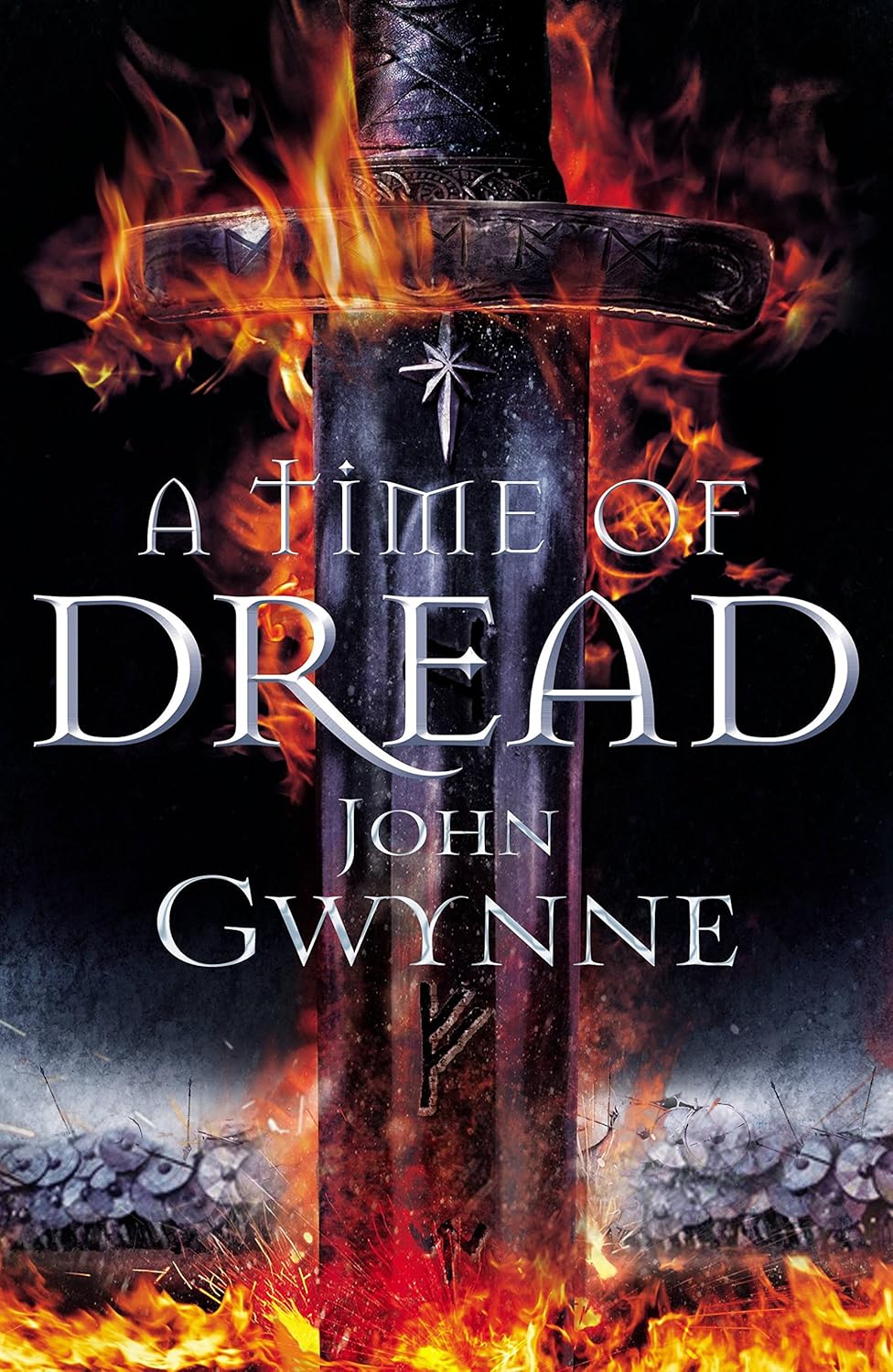
A Time of Dread opens the bridge trilogy on Drem, a trapper’s son in the frozen north who stumbles onto signs that the old enemy never fully died, while the order that came out of the god-war on top has hardened from saviors into something closer to occupiers, a ruling power extracting tithes and oaths. That inversion gives Of Blood and Bone its distinct flavor: the last war’s winners as the new moral problem, and ordinary people caught between a stirring darkness and the institution that claims to protect them. It’s the darkest shelf of the Gwynne books, closer to horror in its quiet north-country dread than anything in the first series.
The trilogy reads as one story, so take it straight through: A Time of Blood (2019) tightens the hunt, and A Time of Courage (2020) brings the whole Banished Lands history to its close. The connective tissue rewards Faithful and the Fallen readers directly, descendants, echoes, and consequences on every other page, which is exactly why it’s the read-second series and not the door in. Leaner and faster than the first epic, it’s for readers who finished Wrath and want the aftermath taken seriously.
The Bloodsworn Saga (2021-2024)
The second era trades angels and demons for the Norse material Gwynne half lives in on weekends, and it’s grounded in the real sources: the gods, the oath-culture, and the monsters all run on the same mythology my Norse mythology books guide covers from the scholarly end. Vigrid is the Battle-Plain, a land literally built on the bones of dead gods, because three centuries ago the gods fought their last war here and lost it, all of them, leaving tusk and skull as landscape and their half-blooded descendants, the Tainted, as property to be collared and used.
Three books, 2021 to 2024, complete. Each volume gets its own entry below because each carries its own weight, but the saga is one continuous story: read it in publication order.
The Shadow of the Gods (2021)

The Shadow of the Gods is the book that made Gwynne the flagship of the Norse fantasy wave, arriving in 2021 with perfect timing atop the culture’s Viking decade and drawing blurbs like Anthony Ryan’s “a masterfully crafted, brutally compelling Norse-inspired epic.” It’s the single entry most readers come to the Gwynne books for, and it earns the traffic.
The story follows three strands: Orka, a huntress and mother whose quiet steading life ends in blood and who becomes the saga’s runaway favorite, an axe-swinging force of maternal vengeance the fandom canonized on sight. Varg is an escaped thrall who falls in with the mercenary Bloodsworn while hunting his sister’s killers, and Elvar is a jarl’s daughter chasing battle-fame with a warband of god-hunters.
The Tainted thread ties the three together. Those carrying dead gods’ blood manifest their gifts, wolf and bear and worse, and wear thrall-collars for it, hunted, priced, and sold, which makes every Tainted character a walking argument about what this world does with power it fears. What the three hunts are actually converging on, I’ll leave where book one’s ending puts it. The honest note is structural: three strands means slow braiding early, and the first hundred pages ask for patience the back half repays with interest. The craft signature is all over it, shield walls that track exhaustion and footing, sea and snow you can feel, and mead-hall texture from a culture its author practices rather than researches.
The Hunger of the Gods (2022)

The Hunger of the Gods is the middle volume, published in 2022, and it widens the saga instead of merely sustaining it. The story follows the aftermath of book one’s collisions, adds new viewpoints on the other side of the board, and raises the stakes from personal hunts to something the whole Battle-Plain has to reckon with, all of which I’m keeping vague on purpose, because the end of The Shadow of the Gods lands as a genuine jolt for most readers and deserves to land clean. What can be said safely: the battle writing gets bigger, the mythology gets louder, and Orka’s chapters remain the ones readers tear through first.
The common reservation is the common middle-book one. More viewpoints means more braiding, the pages split wider, and a few stretches mark time while the pieces move into place. The broad verdict runs that it holds the saga’s quality without quite matching book one’s lightning-in-a-bottle arrival, which is about the gentlest thing ever said about a middle volume. One book deep in the Bloodsworn, it’s not a decision, it’s momentum.
The Fury of the Gods (2024)

The Fury of the Gods completes the Bloodsworn Saga, published in 2024, and it carried the series onto the New York Times bestseller list, the commercial peak of Gwynne’s career so far. The story follows every strand into the saga’s final battle season, and that’s as much premise as a spoiler-free entry can hold. It’s the payoff volume: the oaths come due, the collars come off or don’t, and the shield-wall craft that defines these books gets its largest canvas yet.
Reception ran strong rather than rapturous. The consensus lands firmly on satisfied, but a visible slice of the superfan readership ranks the ending a step below the opening volume’s promise, the usual tax on a beloved series’ finale and worth knowing going in. Nobody disputes the trilogy’s standing as the defining Norse fantasy of its decade, and with the whole thing complete, the risk calculus for new readers is zero. Among the John Gwynne books, the Bloodsworn is the shelf that converts people who think they don’t read epic fantasy.
The Wolfheart Chronicles (from 2026)
The next era has a date. The Wolves of War, book one of The Wolfheart Chronicles, is announced for November 3, 2026 from Orbit, and the pitch marks a deliberate turn: where the Bloodsworn mined the Norse material, the new series is inspired by Slavic mythology.
The Wolves of War (2026)

The Wolves of War opens Gwynne’s third fantasy world, and at this writing, in October 2026 ahead of its release, what exists to report is the announcement rather than a verdict. The publisher’s premise: the Clans once lived freely, honoring their gods and traditions, until northern invaders unleashed a tide of blood and fire and made them a conquered people. Ivan wants only to keep his family safe, especially his daughter Halia, who dreams of running with wolves, is whispered about as cursed, and whose awakening powers may be the family’s best chance of survival, while two princes turn mortal enemies and an iron-toothed witch moves in the shadows.
Early blurbs are arriving in the usual weight class, Jay Kristoff calls it “a heartfelt tour de force by one of fantasy’s greatest writers,” and the Slavic turn is a genuinely fresh patch of mythology for a writer whose Norse books proved how much he gets out of a tradition’s primary sources. Treat this entry as a signpost: preorder territory for the committed, and a clean future entry point for everyone else once the reviews land.
John Gwynne: Deep Dive and FAQ
What Runs Through John Gwynne’s Books
The shield wall comes first, because it’s the thing no one else does at his level. Gwynne’s battles track the unglamorous physics of massed combat, the weight of a shield after an hour, the footing, the press, the way formations break, and the authority is bought with his own weekends. The second thread is sincerity. Across three worlds he writes loyalty, oaths, and sacrifice as real forces, good versus evil played straight in a genre decade that mostly smirked at the idea, and he makes it land by pricing it honestly: the ideals cost lives the books make you care about first.
The third is family as the engine of everything. Parents and children, found families, warbands that function as households: nearly every Gwynne protagonist fights for a hearth rather than a throne, and the books’ most feral moments belong to parents. And the fourth is the animal companion, wolven-hound or crow or bear, a Gwynne signature so reliable the fandom jokes about it, and a tell for the deeper pattern: his heroes are defined by what they protect.
Prizes and Honors
Malice won the Morningstar Award for best fantasy newcomer at the David Gemmell Awards in 2013. The series then made the Legend Award shortlist three years running: Valour in 2015, Ruin in 2016, and Wrath in 2017, with Wrath adding the BookNest Award for best traditionally published novel in 2017. The Gemmell Awards closed in 2019, two years before the Bloodsworn Saga arrived, which feels like a scheduling error on history’s part.
The commercial honors arrived with the Norse books: The Fury of the Gods hit the New York Times bestseller list in 2024. And in 2025 Orbit published the 40th anniversary collector’s edition of Legend with a new introduction by Gwynne, which is not a prize, but as succession documents go, it outranks most trophies.
Which John Gwynne Editions to Buy
Everything is in print and nothing is complicated. In the US, the whole catalog lives at Orbit in paperback, ebook, and audio, and the Bloodsworn Saga also comes as a three-book boxed set, the obvious buy for anyone starting that door. The one trap for the unwary is Valour, which US editions spell Valor: same book, different flag, so don’t buy it twice and don’t panic when the spines disagree.
UK readers get the original Pan Macmillan editions of the Banished Lands books and Orbit UK for the Bloodsworn, with matching trade dress across each series for shelf-minded collectors. The audiobooks have a strong reputation in the fandom, and battle-heavy epics tend to work well read aloud, but print is the way to keep track of the larger casts in the first series.
Questions About John Gwynne
What Order Should I Read John Gwynne’s Books In?
By series, in publication order. The Faithful and the Fallen runs Malice, Valour, Ruin, Wrath. Of Blood and Bone runs A Time of Dread, A Time of Blood, A Time of Courage, and reads second since it’s set a century after Wrath. The Bloodsworn Saga runs The Shadow of the Gods, The Hunger of the Gods, The Fury of the Gods, and stands fully alone, so it can be read first.
Where Should I Start With John Gwynne?
The Shadow of the Gods for most readers: it’s his most accessible opening, it’s a complete trilogy, and it shares nothing with the earlier books, so there’s no homework. Start with Malice instead if you want the full seven-book Banished Lands epic from the beginning and don’t mind a slower first volume.
Is the Bloodsworn Saga Finished?
Yes. The trilogy completed with The Fury of the Gods in 2024, so all three books, The Shadow of the Gods (2021), The Hunger of the Gods (2022), and the finale, are on shelves now. Every John Gwynne series published to date is finished, which makes him a rare safe commitment among living epic fantasy writers.
What Is John Gwynne’s Next Book?
The Wolves of War, book one of The Wolfheart Chronicles, announced for November 3, 2026 from Orbit. It opens a new series inspired by Slavic mythology, following Halia, a girl whispered about as cursed, whose awakening powers may be her family’s best chance of survival. It is a fresh entry point: no earlier reading required.
Are the Faithful and the Fallen and of Blood and Bone Connected?
Yes, directly. Of Blood and Bone is set in the same world, the Banished Lands, roughly a century after Wrath, and its story grows out of that war’s consequences. It stars new leads, but it rewards readers of the first series on every other page and spoils that series’ shape if read first. The Bloodsworn Saga, by contrast, is a separate world entirely.
Is There a Shadow of the Gods TV Show or Movie?
Not yet. As of October 2026, no film or television adaptation of the Bloodsworn Saga or any other Gwynne series has been publicly announced. Given how squarely the books sit in the post-Vikings, post-Last Kingdom lane, the fandom treats an eventual option as a matter of time, but nothing is on the record.
Did John Gwynne Win the David Gemmell Legend Award?
He won the Morningstar Award, the Gemmell Awards’ best-newcomer prize, for Malice in 2013. The Legend Award itself shortlisted him three years running, for Valour, Ruin, and Wrath, without a win, and the awards closed in 2019 before the Bloodsworn books could contend. The deeper Gemmell connection is editorial anyway: Gwynne wrote the introduction to the 2025 anniversary edition of Legend.
Where to Go Next
The direct ancestor is the obvious first stop: the David Gemmell books guide covers Legend and the Drenai shelf that Gwynne’s whole mode descends from, heroic fantasy with grit and heart in its original print run. The man who wrote the succession blurb is the natural counterweight, and the Mark Lawrence books guide covers a writer who takes similar materials somewhere far colder.
Readers who came for the shield walls and want them with more moral rot should walk the grimdark list, where Joe Abercrombie holds the modern standard. And readers who came for the completed-epic luxury can find the other safe commitments on the best fantasy series list, which marks which doors are finished and which are still waiting on their authors.