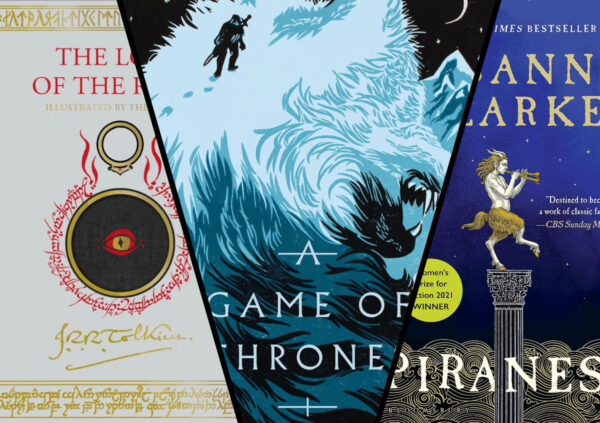
Science fantasy is the genre’s most useful mongrel and its worst-defined shelf, a label bookstores slap on anything with both a sword and a starship and critics mostly use to mean “I can’t tell which section this goes in.” This page fixes the definition problem first, because a list that can’t say what it’s listing is just a pile. The working rule this site uses: a science fantasy book takes at least one load-bearing element from science fiction and one from fantasy, and refuses to resolve into either.
Not fantasy with a prologue about ancient technology. Not science fiction with a psychic. Books where the fusion is the point, where you genuinely cannot file it clean, and where that irresolution is the reading experience. Everything below sits somewhere my best fantasy books pillar and my best sci-fi books pillar both have a claim on and neither fully wins.
It sorts into four modes, and naming them is most of the job.
Mode one: the Dying Earth
The future so old that science has decayed back into magic.

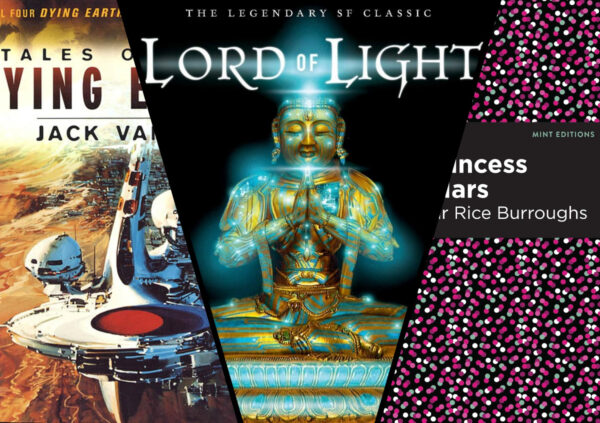
The oldest and purest lane, named for the book that defined it. Jack Vance’s The Dying Earth (1950) is the foundational text: the sun is guttering, the Earth is impossibly ancient, and its last decadent inhabitants work “magic” that is plainly the fossilized science of a million forgotten civilizations, all rendered in the most imitated-and-never-equaled ironic prose in the genre. Its DNA is everywhere on this list and off it, and my classic fantasy page covers Vance’s full standing. The mode’s modern summit is Gene Wolfe’s The Book of the New Sun, whose custody this site has always assigned to fantasy proper, so the Gene Wolfe guide handles it in full. Know only that it is the deep end of this exact pool, a far-future Earth where a torturer’s guild, functioning starships, and literal resurrection coexist without the narrator ever flagging which is which. M. John Harrison’s Viriconium closes the lane as its art-house entry, deliberately dismantling its own dying-earth setting book by book.
Mode two: magic with an engine
Fantasy where the sorcery turns out to have a mechanism.
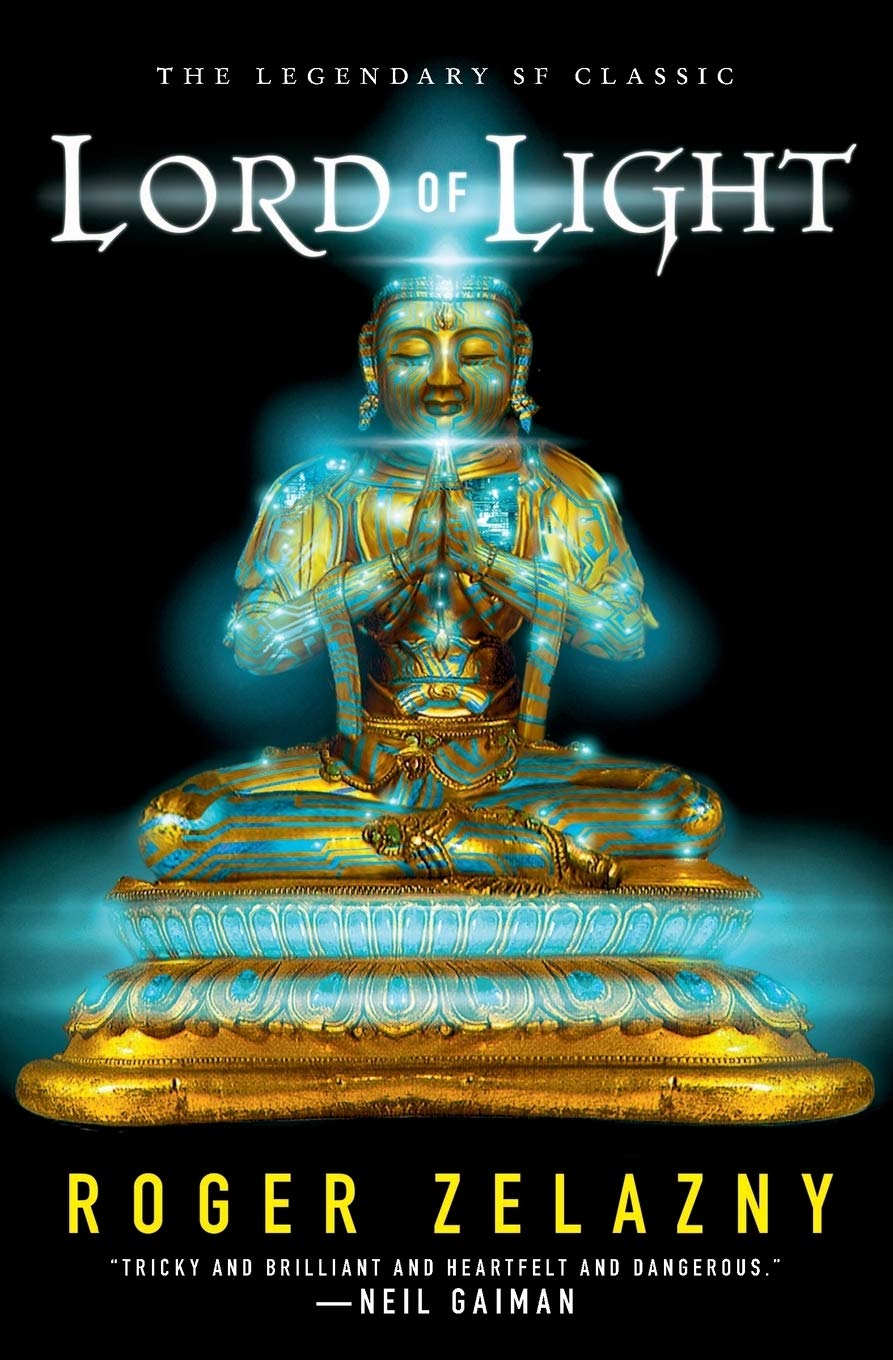
The lane where a magic system is secretly a technology, or a technology behaves exactly like magic. Roger Zelazny’s Lord of Light (1967) is the classic case and one of the genre’s permanent high-water marks: human colonists on a far world have used mind-transfer tech and engineered bodies to install themselves as the living Hindu pantheon, and one heretic takes up the Buddha’s role to break the pantheon they built, a Hugo winner whose custody this site keeps sci-fi-adjacent, mapped in full on the Chronicles of Amber page alongside the rest of Zelazny. C. S. Friedman’s Coldfire trilogy runs the same engine colder: colonists on the planet Erna discover a natural force, the fae, that reifies human thought into reality, and their “sorcery” is applied planetary science with a body count, opening in Black Sun Rising. And Anne McCaffrey’s Pern is the mode’s most famous Trojan horse, dragons, telepathy, and feudal Holds that a great many readers finish before fully clocking they’ve been reading science fiction about a lost colony the whole time.
Mode three: rockets and necromancy, same room
The overt blend, where both genres share the page without apology.

The most visible modern mode: books that put spaceships and spellcraft on screen together and dare you to object. Tamsyn Muir’s The Locked Tomb is the reigning champion, lesbian necromancers in a decaying interstellar empire, bone magic and FTL travel treated with equal seriousness, and since this site’s Tamsyn Muir guide already claims it for fantasy, take this only as the entry that made the whole mode fashionable again. Christopher Ruocchio’s The Sun Eater is the current-wave heavyweight and, as of the seventh and final volume in November 2025, a complete one: Hadrian Marlowe narrates his own legend across twenty thousand years of galactic empire, a saga its own author calls “science fantasy adventure” and everyone else calls Dune by way of Wolfe, with the honest caveat that its middle volumes bloat and its narrator monologues, a real divider among its otherwise devoted readers. Robert Silverberg’s Majipoor opens the mode’s gentler classic wing, a planet so vast its geography is the story, where sorcerers and offworld species and dream-magic share one enormous map, beginning with Lord Valentine’s Castle.
Mode four: the planetary romance root
Where the whole thing started: Earthmen, other worlds, sword in hand.

The historical headwater, and the reason the category exists at all. Edgar Rice Burroughs’ Barsoom, beginning with A Princess of Mars (1912), planted the flag more than a century ago: a Civil War veteran wakes on a dying Mars of warring races, airships, and telepathy, and every science-fantasy blend since is downstream of that image, a man from Earth with a blade against an alien sunset. It reads as pulp because it invented the pulp, and read as origin it is genuinely essential. Michael Swanwick’s The Iron Dragon’s Daughter drags the tradition somewhere vicious and modern, dragons as fighter-jets on an assembly line, industrial faerie as capitalist nightmare, the anti-Barsoom in every way that counts. Between them sits a century of the sword-and-planet lineage, and this is the lane that quietly feeds everything in the other three.
The shelves that belong here and aren’t on the list
Now the honest part, because a science fantasy page that pretends otherwise is lying to you. Several of the genre’s most famous shelves are pure science fantasy and appear nowhere above, on purpose, because naming which mode they belong to would detonate a reveal their own authors built entire series to protect. At least two of the best-selling epic fantasies of the last fifty years are secretly this category, their “magic” resolving into something else hundreds or thousands of pages in, and this site guards those turns on the author pages exactly as the books do. If you’ve read widely on this site you can already name a couple. If you haven’t, that’s the point: the Mark Lawrence and Terry Brooks guides are where those particular doors are kept, unspoiled, and the discovery is worth more than the tidiness of a complete list. Some categories are better served by what they refuse to say.
Where to actually start
By mode, honestly. The best science fantasy books reward this kind of sorting, so start by mode. For the pure old magic of a dying world, Vance, then Wolfe once you’re ready for the deep end. If you want sorcery with a mechanism, Lord of Light, no question, one of the best novels in or out of the category. For the overt modern blend, Muir if you want sharp and short, Sun Eater if you want the completed doorstopper saga. And for the root of it all, A Princess of Mars, read as the century-old wellspring it is. The best science fantasy books were never a genre so much as a refusal to pick one, and that refusal, done well, produces some of the most alive writing on either shelf. Pick a mode and cross the border.
More in Fantasy