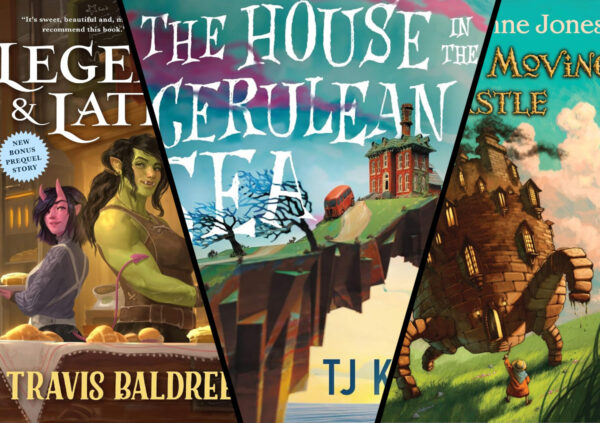
Most people hunting for Diana Wynne Jones books arrive from the Ghibli film, and the first thing this page owes them is the truth: the Howl’s Moving Castle book and the movie share a curse, a fire demon, and a title, and diverge on nearly everything else. The second thing it owes them is bigger. The book is one door into a shelf of some forty books by one of the finest fantasy writers Britain has produced, and the film’s fame has kept most of her audience from ever finding the rest.
Jones learned the trade in the room. At Oxford in the 1950s she attended lectures by both C. S. Lewis and J. R. R. Tolkien, and left the funniest firsthand account we have of the pair, quoted properly in the life section below. She then spent half a century quietly outgrowing the children’s author box her era filed her in, collected the World Fantasy award for life achievement in 2007, and died in 2011 with a generation of working fantasy writers citing her as the one who showed them how it was done. Neil Gaiman called her “quite simply the best writer for children of her generation,” and the books back him up.
So this page maps the whole shelf: the three Howl books, the seven-book Chrestomanci series that is its true center, the standalones where her deepest work lives, and the genre satire that is the sharpest critique epic fantasy ever received from inside the family. Howl’s itself holds a spot on my cozy fantasy books list, and if you want to see the genre she spent a career affectionately dismantling, the best fantasy books pillar is the wider map. Here is hers.
Fiction by René Rehn


The Short Version
Read Howl’s Moving Castle even if you love the film, especially if you love the film, because it’s a different story wearing the same hat. Then fork: the two loose Howl companions if you want more of that world, Charmed Life if you want the true center of her shelf, Fire and Hemlock if you want the masterpiece the critics rate highest, and The Tough Guide to Fantasyland with Dark Lord of Derkholm if you want the funniest thing ever written about how fantasy works. Publication order matters almost nowhere with Jones, which is one of her charms.
Diana Wynne Jones Books in Order
The table runs by first publication and covers the novels, the main story collections and the nonfiction. The picture books, the early readers and the posthumous repackagings are left out.
| Year | Title | Series or type | Notes |
| 1970 | Changeover | Novel (adult) | Her first book |
| 1973 | Wilkins’ Tooth | Standalone | US title Witch’s Business |
| 1974 | The Ogre Downstairs | Standalone | |
| 1975 | Cart and Cwidder | Dalemark Quartet, book 1 | |
| 1975 | Dogsbody | Standalone | Carnegie commended |
| 1975 | Eight Days of Luke | Standalone | |
| 1976 | Power of Three | Standalone | |
| 1977 | Charmed Life | Chrestomanci | Guardian Children’s Fiction Prize |
| 1977 | Drowned Ammet | Dalemark Quartet, book 2 | |
| 1979 | The Spellcoats | Dalemark Quartet, book 3 | |
| 1980 | The Magicians of Caprona | Chrestomanci | |
| 1981 | The Homeward Bounders | Standalone | |
| 1981 | The Time of the Ghost | Standalone | |
| 1982 | Witch Week | Chrestomanci | |
| 1984 | Archer’s Goon | Standalone | World Fantasy Award nominee |
| 1984 | Fire and Hemlock | Standalone | |
| 1984 | Warlock at the Wheel and Other Stories | Collection | |
| 1984 | The Skiver’s Guide | Nonfiction | |
| 1986 | Howl’s Moving Castle | Howl, book 1 | Basis of the 2004 Ghibli film |
| 1987 | A Tale of Time City | Standalone | |
| 1988 | The Lives of Christopher Chant | Chrestomanci | Carnegie commended |
| 1990 | Castle in the Air | Howl, book 2 | |
| 1991 | Black Maria | Standalone | US title Aunt Maria |
| 1992 | A Sudden Wild Magic | Novel (adult) | |
| 1993 | Hexwood | Standalone | |
| 1993 | The Crown of Dalemark | Dalemark Quartet, book 4 | Mythopoeic Award |
| 1993 | Stopping for a Spell | Collection | Three short comedies |
| 1996 | Minor Arcana | Collection | |
| 1996 | The Tough Guide to Fantasyland | Nonfiction | Hugo finalist |
| 1997 | Deep Secret | Magids, book 1 (adult) | |
| 1998 | Dark Lord of Derkholm | Derkholm, book 1 | Mythopoeic Award |
| 1999 | Believing Is Seeing | Collection | US edition of Minor Arcana |
| 2000 | Year of the Griffin | Derkholm, book 2 | |
| 2000 | Mixed Magics | Chrestomanci stories | |
| 2002 | Unexpected Magic | Collection | |
| 2003 | The Merlin Conspiracy | Magids, book 2 | |
| 2005 | Conrad’s Fate | Chrestomanci | |
| 2006 | The Pinhoe Egg | Chrestomanci | |
| 2007 | The Game | Novella | |
| 2008 | House of Many Ways | Howl, book 3 | |
| 2010 | Enchanted Glass | Standalone | |
| 2011 | Earwig and the Witch | Standalone | Basis of the 2020 Ghibli film |
| 2012 | Reflections: On the Magic of Writing | Nonfiction | Essays, posthumous |
| 2014 | The Islands of Chaldea | Standalone | Completed by Ursula Jones |
Where to Start With Diana Wynne Jones
If the film brought you here, start where you were always going to start: Howl’s Moving Castle, read for what it is rather than what Miyazaki made of it. Then go straight to Charmed Life, because Chrestomanci is where the shelf’s heart lives, and it shows you what she does when nobody is comparing her to a movie.
Adult readers who want proof she was never just a children’s author have two doors. Fire and Hemlock is the deep one, a layered Tam Lin retelling that rewards rereading more than almost any fantasy of its decade. Deep Secret is the fun one, her novel actually marketed to adults, set half in a hotel full of fantasy fans. And anyone who has read a lot of epic fantasy should treat The Tough Guide to Fantasyland as required equipment.
One honest warning for new readers of any age: Jones trusts you. She withholds explanations, buries clues in jokes, and tends to detonate her endings in the last twenty pages at a speed that splits readers. The common complaint about Diana Wynne Jones books is that the endings arrive all at once. The common discovery on rereading is that everything was there the whole time.
Diana Wynne Jones’s Life, Briefly
Diana Wynne Jones was born in London on August 16, 1934, and had the kind of childhood she would later hand to her characters. Evacuated to Wales at five when the war broke out, she was moved through the Lake District, York and London before her parents settled in Thaxted, Essex, in 1943 to run an educational conference center, where she and her two younger sisters were left largely to raise themselves on whatever books they could get.
She read English at St Anne’s College, Oxford, graduating in 1956, and sat in the lecture halls of both C. S. Lewis and J. R. R. Tolkien. Her memoir pieces, collected in Reflections, remember Lewis “booming to crowded halls” while Tolkien lectured to her and three other students. By her account he was hoping to wind the course up early and get back to The Lord of the Rings, mumbling “with his face pressed up to the blackboard” while she stubbornly stayed on as one of the handful of listeners who kept the lectures alive. Both men’s shelves are covered on this site, Lewis here and Tolkien here.
She married the medievalist John Burrow in 1956, raised three sons, and published her first book, the adult novel Changeover, in 1970, with her first children’s book, Wilkins’ Tooth, following in 1973. From 1976 she lived in Bristol, where most of the shelf was written. Diagnosed with lung cancer in 2009, she died in Bristol on March 26, 2011, at seventy-six, mid-novel. Her sister Ursula Jones finished that last book, The Islands of Chaldea, from her drafts in 2014.
Howl’s Moving Castle and the Film
Most readers of this page met Sophie Hatter in the 2004 film, so the comparison comes first. The shared skeleton: Sophie, eldest of three in a land where fairy-tale logic is openly acknowledged law, is cursed into old age by the Witch of the Waste, moves into the wizard Howl’s ambulatory castle as a self-appointed cleaning lady, and strikes a bargain with Calcifer, the fire demon bound to Howl’s hearth by a contract neither will explain. Curse, castle, contract: that much survives the adaptation.
Nearly everything else is Jones or Miyazaki, not both. The film’s war, the bombing raids, the whole pacifist spine, is Miyazaki’s invention, tangential in the book and nothing to do with its Howl. Book Sophie has unrecognized magic of her own, and the film mutes it. Book Howl keeps the vanity but also a rakish love life the film quietly retires, the Witch of the Waste stays dangerous far longer, and the endings part ways almost completely, a difference this page leaves unspoiled in both directions.
Jones had no hand in the production and wanted none. “I write books, not films,” she said, adding that the film would be different from the book and that this was as it should be. Miyazaki flew to England in 2004 to give her a private screening. The film is a masterpiece of atmosphere. The book is a masterpiece of voice. Take both, but don’t mistake one for the other.
Howl’s Moving Castle (1986)

Howl’s Moving Castle is the famous one, and it earns the fame on completely different grounds than the film. The story follows Sophie Hatter, resigned to dullness because every fairy tale agrees the eldest of three fails first, until the Witch of the Waste turns her into an old woman and she marches into Howl’s castle to demand a future. What follows is a comedy of two frauds unmasking each other: Sophie, who can talk life into hats and doesn’t know it, and Howl, a vain, slithering heartbreaker whose deepest secret is that he’s really Howell Jenkins of Wales, from our world, with an old rugby club and a sister who despairs of him.
The voice is the thing. Jones writes the whole book in a tone of brisk domestic exasperation and lets the romance happen in the gaps between arguments: two prickly, petty, very funny people falling in love mid-quarrel, which the film’s nobler pair never quite manage. The seven-league boots, the door that opens on four places, the curse that comes apart clue by clue, all of it clicks together with watchmaker precision. Even devoted readers concede the last two chapters resolve at a sprint, the standing complaint across Diana Wynne Jones books, and here the rereading rule applies in full.
It was a Boston Globe-Horn Book honor book in 1986 and won the Phoenix Award in 2006, the prize for a book that outlived its first reception. That is exactly what happened: the film sent millions back to it, and the book out-argues the adaptation.
Castle in the Air (1990)

Castle in the Air is the first Howl companion, and it is honest about what it is: not Howl 2, but an Arabian Nights riff set in the same world. The story follows Abdullah, a young carpet merchant in the southern land of Zanzib whose daydreams about being a lost prince become horribly literal once a flying carpet, a bottled genie and a kidnapped princess enter his inventory. The castle’s household arrives sideways, in disguise, and half the pleasure of the book is working out who’s who before Jones tells you.
It was a Mythopoeic Award finalist, and readers who take it on its own terms tend to rate it just under its parent. The only readers who come out disappointed are the ones expecting a direct sequel, which the book never promises. Go in for Abdullah, whose flowery courtesy under pressure is one of her best running jokes.
House of Many Ways (2008)

House of Many Ways came nearly two decades later and closes the set. The story follows Charmain Baker, a sheltered, book-devouring girl volunteered to mind her Great-Uncle William’s cottage, which turns out to fold space: one door, dozens of destinations, plus a stray dog, a hapless apprentice and a kingdom quietly going bankrupt. Sophie arrives as visiting fixer with a royal problem to untangle, and Howl tags along in a disguise he enjoys far too much and nobody else enjoys at all.
Among the later Wynne Jones books this is the easy, warm one, written with total late-career command. It is lighter than Howl’s Moving Castle and knows it, Charmain’s lazy, bookish slide into competence is a character arc she had been refining for forty years, and the whole thing reads fine out of order. It is the natural third stop for anyone the film brought in.
Chrestomanci: The Center of the Shelf
If Howl is the famous door, Chrestomanci is the house. Across six novels and a story collection published between 1977 and 2006, Jones built a multiverse of Related Worlds supervised by the Chrestomanci, a government office filled by whichever nine-lived enchanter currently holds the job, mostly the impossibly elegant Christopher Chant, who materializes in embroidered dressing gowns wherever magic is being misused. The series never stops being funny, never talks down, and rewards adults at least as much as the children it was filed under.
Two reading orders circulate. Jones’s own suggestion starts with Charmed Life, the first published, then The Lives of Christopher Chant, and after those two the order barely matters. The internal chronology instead runs The Lives of Christopher Chant, then Conrad’s Fate, then Charmed Life and onward. Take her suggestion: Charmed Life is the better first experience, and the prequel hits harder once you know the man Christopher becomes.
The two essentials get full entries below. Of the rest, The Magicians of Caprona (1980) moves the magic to a spell-feuding Italian city and plays its Romeo and Juliet angle for comedy, Witch Week (1982) drops a note reading that someone in the class is a witch into a boarding school in a world that still burns them, Conrad’s Fate (2005) sends a fifteen-year-old Christopher undercover in a mansion where someone keeps shifting reality, and The Pinhoe Egg (2006) gives Cat a village of hidden witch clans and an egg that badly wants hatching. Mixed Magics (2000) collects the four Chrestomanci stories.
Charmed Life (1977)

Charmed Life is the perfect introduction to the Diana Wynne Jones books, and nearly fifty years on it is still the one readers press on each other first. The story follows orphaned Eric “Cat” Chant and his coldly gifted sister Gwendolen, taken into Chrestomanci Castle after a boating disaster leaves them alone, where Gwendolen expects her talents to be worshiped and begins a one-girl campaign of magical escalation when they aren’t. The reader learns, slightly ahead of Cat, what his sister actually is, and that slow, sickening dawning is the engine of the book.
Gwendolen is one of children’s fantasy’s great monsters, all the more chilling for being eleven, and Cat’s passivity, infuriating at first, turns out to be the whole point. Around them Jones runs castle comedy with a straight face: dragons’ blood in the schoolroom, misfiring spells, and the unending politeness of a household that has seen everything. It won the Guardian Children’s Fiction Prize in 1978 and was commended for the Carnegie Medal, and its only real tax on modern readers is an amble-first pace that trusts you to wait for the trap to spring. Hand it to a smart ten-year-old, then admit you wish you had met it at ten yourself.
The Lives of Christopher Chant (1988)

The Lives of Christopher Chant is the prequel, written eleven years later, and most readers find it lands harder in second position, exactly where Jones suggested it. The story follows Christopher, a lonely, grandly neglected boy who can walk into other worlds in his dreams, running errands between them for a charming uncle whose projects are not what they seem. Along the way he picks up a girl who happens to be a living goddess, Throgmorten the most violently opinionated cat in fantasy, and the slow discovery of what his spare lives mean.
It is a darker book than Charmed Life, about a child being used by every adult who notices his gifts, and it is also the funniest origin story the series could have had: the future unflappable enchanter in dressing gowns starts as a boy who hates magic and wants to play cricket. It was commended for the Carnegie Medal in 1988. Read it second and the whole series clicks into place.
The Dalemark Quartet
Dalemark is her epic-fantasy corner, and the shelf’s darkest stretch: a divided land, tyrants in the South, feuding earls in the North, gods who answer to older names, and children carrying instruments and secrets through all of it. The quartet runs Cart and Cwidder (1975), Drowned Ammet (1977), The Spellcoats (1979) and The Crown of Dalemark (1993), and publication order is the right order: the first two run in parallel, The Spellcoats drops into the land’s prehistory, and the Mythopoeic-winning finale knots every thread together two centuries on. The anchor entry below covers the door in.
Cart and Cwidder (1975)

Cart and Cwidder opens the quartet at child height. The story follows Moril, youngest son of a family of traveling Singers whose wagon is one of the few things allowed to cross between the free North and the spy-ridden South, and who inherits his father’s huge old cwidder, an instrument that does more than play, at exactly the moment the family’s passengers and secrets catch up with them. What begins as a road story hardens, fast, into something about what performers are allowed to say under tyranny and what the songs were hiding all along.
It is shorter and quieter than the modern epics, but the politics are real, the deaths count, and Moril’s slow understanding of the cwidder is Jones’s theory of art smuggled into a children’s book. Readers who only know the funny registers of the Diana Wynne Jones books find Dalemark the biggest surprise on the shelf. Drowned Ammet, the parallel novel about a boy on the other side of the same conflict, is rated by a vocal minority as the quartet’s best, and The Crown of Dalemark pays everything off.
The Deep Shelf: The Standalones
This is where the devoted end up. Jones wrote standalones her whole career, they share no world and no order, and several of them are the books her hardest-core readers rate above anything with a castle on the cover. Eight of them earn entries here, and the roundup near the end of the page sweeps up the rest.
Fire and Hemlock (1984)

Fire and Hemlock is the consensus masterpiece of the Diana Wynne Jones books. The story follows nineteen-year-old Polly, packing for university, who realizes she owns two sets of memories: the ordinary life everyone around her confirms, and a decade of friendship with a cellist named Thomas Lynn, met at a funeral she apparently never attended, which someone has carefully edited out of her mind. The book is built on the ballads of Tam Lin and Thomas the Rhymer, and on the reading lists Tom mails her, so that the books Polly reads become instructions she only decodes at the end.
It is Jones at her most adult and most layered, a book about memory, the stories children tell, and the exact point where a protective friendship becomes something that needs renegotiating, handled with more care than most adult novels manage. And then there is the ending, a compressed, dreamlike final movement that readers have argued about, productively, for forty years. It stays a puzzle here. Jones later wrote an essay circling how the book was built, and the ending’s logic does come clear, on the second read, mostly.
First published in 1984, it was a Mythopoeic Fantasy Award finalist in 1986 and took a Phoenix Award honor in 2005, two decades after its own era underrated it. When you want to see what she could really do, this is the book.
Dogsbody (1975)

Dogsbody is the one that quietly devastates. The story follows Sirius, the actual Dog Star, a celestial being tried by his peers for a death he swears he didn’t cause and sentenced to be born on Earth as a puppy, memories intact, with a deadline: find the fallen weapon before the dog’s short life runs out. He is fished out of a river by Kathleen, an Irish girl boarded with relatives who treat her as the household servant, and the book becomes a double portrait of two unwanted creatures keeping each other alive.
The dog’s-eye writing is extraordinary, smells and loyalties and the agony of understanding human speech without being able to answer, and the ending lands with a weight most animal stories never risk. Commended for the Carnegie Medal, this is the book Wynne Jones readers mention with a hand on their chest. Keep tissues in range.
Archer’s Goon (1984)

Archer’s Goon is the twisty one, with a swerve this page will not touch. The story follows Howard Sykes, who comes home to find a Goon filling the kitchen, sent to collect the two thousand words Howard’s writer father owes a man named Archer. It turns out the town is secretly run, utilities, police, music and all, by seven squabbling wizard siblings who farm its life among them, and the missing two thousand words are somehow the hinge of everything.
Of all the Diana Wynne Jones books this is the most purely plotted, a family farce that keeps revealing another floor underneath, played so fairly that the reread becomes a different, equally good book. It was a World Fantasy Award nominee in 1985 and a Boston Globe-Horn Book honor book, and the BBC ran it as a six-part serial in 1992, a fact that still surprises people who assume her screen history starts with Ghibli. Readers who want the machinery of a mystery under the furniture of fantasy should bump it up the pile.
Eight Days of Luke (1975)

Eight Days of Luke gets to the Norse-gods-next-door premise decades before it became a subgenre. The story follows David, parked for the holidays with relatives who treat him as a budgeting error, who botches what he thinks is a made-up curse and frees Luke, a charming boy who is very, very good with fire. Then the visitors start arriving, one per day of the week, politely insisting that Luke owes them something, and a mythology-minded reader can decode the whole guest list from the day names alone.
The myth-game is the hook, but the heart of it is David and Luke’s friendship, loyal, funny and increasingly expensive. It’s a small book that a long list of later fantasists clearly read closely, and one of the easiest doors into her 1970s work.
Power of Three (1976)
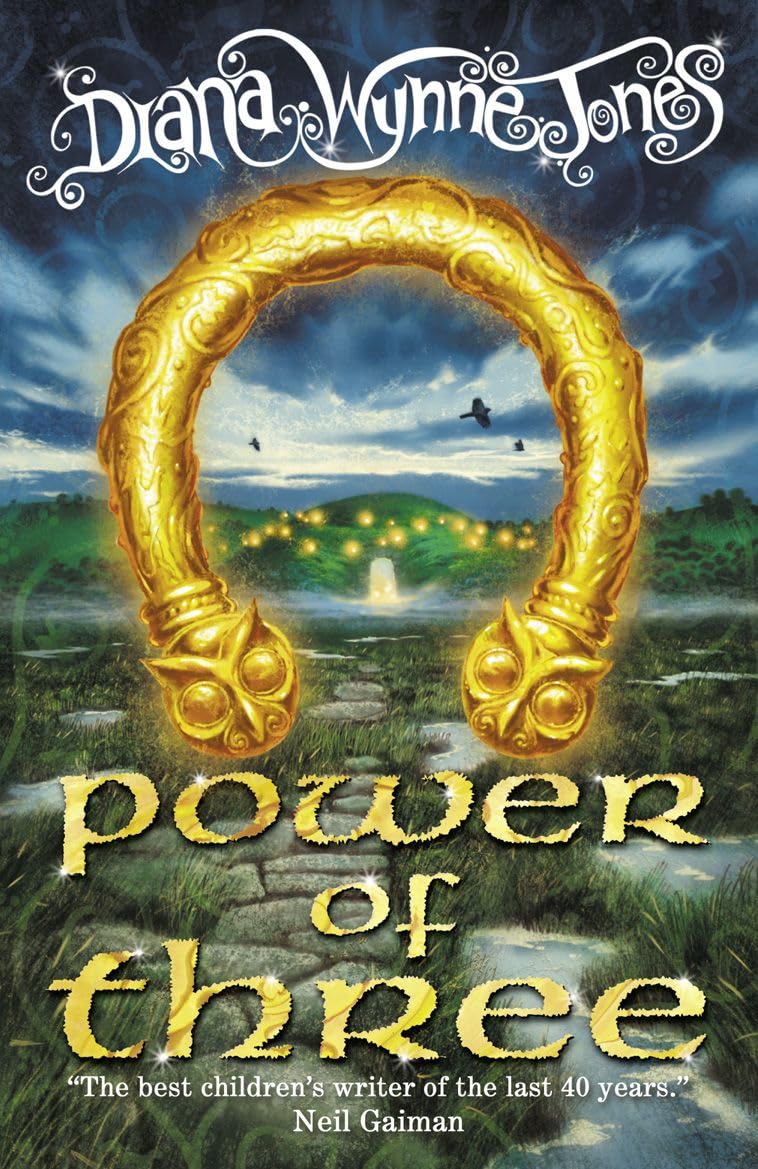
Power of Three is the buried gem of the early years. The story follows Gair, the unremarkable middle child of a chief’s family on the Moor, where three peoples, his own, the shape-shifting Dorig, and the lumbering Giants, live in mutual fear salted by an old curse that started with a murder and a gold collar. Jones tells it almost entirely from inside the assumptions of Gair’s people, and the slow, sly work the book does on those assumptions is the real plot.
It reads like a dry run for everything she did later with perspective, and its picture of an ordinary-feeling child in a family of talents cuts close for a lot of readers. The book is quiet, structurally cunning, and better the older the reader is.
The Ogre Downstairs (1974)

The Ogre Downstairs is her early domestic classic. The story follows two sets of newly blended step-siblings who despise each other until the glowering stepfather they call the Ogre gives the boys a pair of chemistry sets, and the chemicals turn out to work: flight, body swaps, animated toffee bars that have to be herded like cattle, each experiment escalating the household chaos while the children learn to run a conspiracy together.
Under the slapstick it is a sharp, kind book about step-families actually becoming families, written from obvious firsthand knowledge of how children negotiate. For parents reading aloud it is the single safest Wynne Jones book to start with, and the toffee bars alone justify it.
The Time of the Ghost (1981)

The Time of the Ghost is the closest she came to outright horror, and readers of this site should take that as the recommendation it is. The story follows a ghost who drifts up from a riverbank knowing only that she is one of four sisters, daughters of two teachers too consumed by the boys’ boarding school they run to feed or notice them, and that something old and hungry has been invited into the family’s games. Working out which sister she is, and when she is, is the book’s first mystery, and not its worst one.
The household is drawn, by her own later account, from the childhood she and her sisters actually had, which explains why the neglect lands so precisely. Genuinely frightening in places, it is the Wynne Jones book for readers who came to her from the horror side of the shelf.
Hexwood (1993)

Hexwood is the difficult one, worn as a badge by the readers who love it. The story follows Ann, watching from her sickbed as people enter the gates of Hexwood Farm and fail to come out, while something in the wood rearranges time, memory and identity around a device called the Bannus, which plays out scenarios the way a game master runs a campaign, and an interstellar ruling cabal starts to notice its old machine is awake. Arthurian matter and far-future politics end up in the same blender.
Even by the standard of late Diana Wynne Jones books the chronology is scrambled, the first stretch is genuinely disorienting, and the book rewards exactly the readers who enjoy assembling it. Fans of puzzle-box fantasy tend to rank it far higher than its general reputation, which is the mark of a cult book doing its job.
The Genre Satire: Fantasyland and Derkholm
In the mid-1990s Jones did something to epic fantasy that it never fully recovered from, in two stages: first the reference book that cataloged every cliché, then the novel that weaponized the catalog. The only comparable body of in-family genre comedy is Terry Pratchett’s, and the Terry Pratchett books guide covers that shelf. Jones’s version is smaller, meaner and aimed with a critic’s precision.
The Tough Guide to Fantasyland (1996)

The Tough Guide to Fantasyland is a merciless A-to-Z travel guide to the land every post-Tolkien quest trilogy is set in: the Stew everyone eats, the horses that function as bicycles, the Dark Lord’s fixed address, the taverns, the prophecies, the Gnomic Utterances, all written in the deadpan of a package-tour brochure issued by the mysterious Management. The oddest item among the Diana Wynne Jones books, it reads as comedy and functions as criticism, and it was a Hugo Award finalist in 1997 in the nonfiction category, which is the genre admitting the charges.
Thirty years on, its fingerprints are on every writer who flinches before reaching for stew, and half the entries elsewhere in this cluster walk a little more carefully because of it. It is a dictionary, though: read it in sittings, not straight through. For anyone who has logged serious hours in epic fantasy, it is the funniest book on this page, and quietly one of the most useful.
Dark Lord of Derkholm (1998)

Dark Lord of Derkholm turns the Tough Guide’s jokes into a story with a body count. The story follows a fantasy world held in economic bondage by Mr. Chesney’s Pilgrim Parties, which run tourists from our world through it on packaged quests, complete with contracted battles, scheduled sackings and a Dark Lord whose costume changes hands annually. This year the job lands on Derk, a mild, unfashionable wizard who breeds flying pigs and griffins and raises the griffins as his children, and whose attempt to survive the tour season gradually exposes what the tours cost the world that stages them.
The first half is farce, the second half means it, and the pivot is managed so smoothly most readers only notice afterward how dark the book got. It won the Mythopoeic Fantasy Award in 1999, and together with the Tough Guide it forced a genre to look at its own furniture. A big cast and a few sagging middle chapters are the price of admission, and the book is worth both.
Year of the Griffin (2000)

Year of the Griffin is the lighter sequel, set eight years later at the Wizards’ University, now broke, timid and teaching magic as rote compliance. The story follows Elda, Derk’s youngest griffin, enrolling as a freshman alongside a dorm floor of misfits whose families all violently object to their education, and whose private experiments start outrunning the syllabus about the time the assassins arrive.
It is a campus comedy with real affection for students and real contempt for administrators, and readers who wanted more Derkholm get him mostly offstage. Slighter than its parent and happy to be, it closes the pair on a warm note.
The Magids Books, for Adults
Jones wrote for adults from the start. Her first book, Changeover (1970), was an adult comedy published years before anyone filed her under children’s fantasy, and A Sudden Wild Magic (1992) sent a coven of witches on a multiverse sabotage mission for the grown-up shelves. The pair below is the heart of her adult work, built on the Magids, a secret service of magic-workers who keep the multiverse’s worlds nudged toward balance. Deep Secret was published for adults, The Merlin Conspiracy for younger readers, and they share one world and one recurring character.
Deep Secret (1997)

Deep Secret is the essential grown-up entry among the Diana Wynne Jones books, the novel for every adult who suspects her children’s books were secretly for them. The story follows Rupert Venables, junior Magid for Earth, saddled with two jobs at once: vet the shortlist of candidates to replace his dead mentor, and untangle a succession bloodbath in a multiverse empire that kept its heirs secret even from themselves. His solution to the first problem, contriving to gather every candidate at a fantasy convention in a provincial English hotel, detonates the second.
The convention chapters are the draw, openly drawn from the British fan circuit Jones knew well and stuffed with panel feuds, costume logistics and hotel geometry that stops obeying Euclid, and they are among the funniest sustained stretches she wrote. Underneath them the imperial plot turns grim, with on-page violence the children’s books only imply. Maree Mallory, the prickly, disaster-prone co-lead, is one of her best characters at any age bracket.
The Merlin Conspiracy (2003)

The Merlin Conspiracy is the Magids follow-up, pitched back at younger readers but working the same multiverse. The story follows Roddy and Grundo, two children traveling with the King’s Progress across Blest, a Britain where the court never stops moving and the Merlin is a government post, who overhear exactly the wrong conversation after the old Merlin dies. Their only outside help is Nick Mallory, wandering in from Deep Secret’s world with more confidence than sense.
Told in alternating voices, it is big, busy and generous, with some of her best magical set pieces, and its middle sags only because it carries so much. Readers who loved Deep Secret’s Nick get the payoff here.
The Rest of the Shelf
The entries above are the load-bearing books, but the shelf keeps going. Wilkins’ Tooth (1973), her first for children, runs a kids’ revenge agency into witch trouble. The Homeward Bounders (1981) is the other famous twisty one, a boy discarded by the players of a cross-worlds game, with a final page readers carry around for years, left untouched here. A Tale of Time City (1987) is a time-travel confection remembered by everyone who read it for the butter-pie. Black Maria (1991, Aunt Maria in the US) is seaside horror-comedy about weaponized politeness, and Enchanted Glass (2010) is the late, warm one: a village, an inheritance, and a very good dog.
For shorter work, The Game (2007) is a dense novella about the mythosphere, Unexpected Magic (2002) is the fattest story collection, and Mixed Magics (2000) belongs with Chrestomanci. Reflections: On the Magic of Writing (2012) gathers her essays and lectures and doubles as one of the smartest books about writing fantasy ever assembled. And The Islands of Chaldea (2014) is the last novel, left unfinished at her death and completed from her drafts by her sister Ursula Jones: a gentler island-hopping quest, and a graceful way for the shelf to end.
A Note on Where to Actually Start
Howl’s Moving Castle, read for what it is rather than what the film made of it, and then Charmed Life the moment it charms you, because Chrestomanci is where the shelf’s heart lives. Save Fire and Hemlock for when you want to see what she could really do, and keep the Tough Guide by the bed as seasoning. Tolkien’s own leading scholar once wrote that her essay on The Lord of the Rings said more about its structure than Tolkien himself could have, which is the right frame for the whole career: the Diana Wynne Jones books were never children’s books that adults happen to like. They’re the work of the sharpest student in that Oxford lecture hall, playing a long game the genre is still catching up to.
Diana Wynne Jones: Deep Dive & FAQ
What Runs Through Diana Wynne Jones’s Books
Start with the adults. Nobody in fantasy wrote failed guardians better: parents too busy, aunts too respectable, uncles too charming, teachers too tired, a whole taxonomy of grown-ups who let children down, drawn from a childhood that supplied the field notes. Her child heroes are rarely chosen ones. They are overlooked ones, and the standard arc is a child discovering that the power everyone insisted they lacked has been leaking out of them the whole time, disguised as talking to hats or bad luck or an awful sibling’s success.
Second, the shelf is a long argument with the genre it lives on. Fairy-tale rules enforced like bylaws in Howl’s Moving Castle, the quest economy audited in Dark Lord of Derkholm, every cliché cataloged in the Tough Guide: she loved fantasy the way a mechanic loves an engine, by taking it apart. The criticism was literal, too. Her 1983 essay on the narrative shape of The Lord of the Rings, reprinted in Reflections, grew out of those Oxford lectures, and the Tolkien scholar Tom Shippey wrote in the Times Literary Supplement that it tells us more about how the book works than he suspects Tolkien himself could have.
And third, the thing the obituaries kept circling: she built the furniture early. Magic-riddled boarding schools, the ordinary child in an enchanted institution, alternate Britains stacked like plates, all standing decades before Harry Potter made that furniture the most valuable in publishing. The comparison is documented reception rather than this page’s invention, and the fairest version of it is simple: readers who arrived in the 2000s kept discovering she had been there first, and been funnier about it.
Prizes and Honors
The big one came late: the World Fantasy Award for life achievement in 2007, with the British Fantasy Society’s Karl Edward Wagner Award preceding it in 1999. Charmed Life won the Guardian Children’s Fiction Prize in 1978. The Mythopoeic Fantasy Award went to The Crown of Dalemark in 1996 and Dark Lord of Derkholm in 1999, out of seven nominations stretching from Fire and Hemlock to the posthumous Islands of Chaldea. The Tough Guide to Fantasyland was a Hugo finalist in 1997, and Archer’s Goon a World Fantasy Award nominee in 1985.
The slower honors tell their own story. Dogsbody, Charmed Life and The Lives of Christopher Chant were all commended for the Carnegie Medal, and Howl’s Moving Castle took the Phoenix Award in 2006 with Fire and Hemlock a Phoenix honor in 2005, both prizes given twenty years after publication to books their own era underrated. Bristol, her home city, awarded her an honorary doctorate in 2006.
Which Diana Wynne Jones Editions to Buy
Nearly everything that matters is in print in paperback and ebook through HarperCollins on both sides of the Atlantic, and the covers rotate often enough that matching sets are a collector’s game rather than a buying guide. Two bundles are worth knowing. The Chronicles of Chrestomanci paperbacks collect the series two books per volume, and Volume I pairs Charmed Life with The Lives of Christopher Chant, which happens to be exactly the recommended reading order in one purchase. The World of Howl collection does the same job for the three Howl books.
The Tough Guide to Fantasyland is easiest to find in its later revised paperback. Reflections: On the Magic of Writing is the one to buy in a durable format, since it gets reread and loaned. The adult novels and the story collections drift in and out of print, so a used copy of Minor Arcana or A Sudden Wild Magic is normal business, and nothing on the shelf commands rare-book prices except early hardcovers.
Diana Wynne Jones on Screen
Her screen history is short and strange. The BBC got there first, running Archer’s Goon as a six-part serial in 1992. Then came the big one: Studio Ghibli’s Howl’s Moving Castle, written and directed by Hayao Miyazaki, which premiered at Venice in 2004, took about 236 million dollars worldwide, and was nominated for the Academy Award for Best Animated Feature at the 78th Academy Awards, losing to Wallace & Gromit: The Curse of the Were-Rabbit. Jones, who had approved but not participated, got a private screening from Miyazaki himself in 2004.
Ghibli returned to her shelf with Earwig and the Witch, directed by Goro Miyazaki, which aired on Japanese television in December 2020 as the studio’s first fully computer-animated feature and reached theaters and streaming abroad in 2021. The reception was rough, the rare Ghibli release critics mostly panned, and the book remains the better hour. Nothing else is announced as of late 2026, which, given how adaptable the shelf looks, is one of the industry’s small mysteries.
Questions About Diana Wynne Jones
Is the Howl’s Moving Castle Book Different From the Movie?
They are very different. The two share the setup, Sophie’s curse, the castle and Calcifer’s contract, and little else. The film’s war plot is Miyazaki’s invention, the book’s Howl is vainer and funnier and comes from our world, Sophie has magic of her own, and the endings diverge almost completely. Jones approved of the film precisely as a different thing: she said she wrote books, not films.
Are There Sequels to Howl’s Moving Castle?
Two loose companions: Castle in the Air (1990), an Arabian Nights riff where the castle’s household arrives in disguise, and House of Many Ways (2008), where Sophie and Howl turn up as visiting fixers. Both follow new protagonists, and neither is a direct continuation, which is the main thing to know going in.
What Order Should I Read the Chrestomanci Books In?
Jones’s own suggestion: Charmed Life first, then The Lives of Christopher Chant. After those two, any order works, including publication order. The internal chronology instead starts with The Lives of Christopher Chant and Conrad’s Fate. The series was written to be enterable almost anywhere, so the stakes are low.
What Is Diana Wynne Jones’s Best Book?
Fire and Hemlock is the usual critics’ answer and the most argued-about. Howl’s Moving Castle is the best loved, Charmed Life the best starting point, and Dogsbody the one readers call underrated most often. Archer’s Goon and Deep Secret both have devoted best-book factions, which tells you how deep the shelf runs.
Where Should I Start With Diana Wynne Jones?
Howl’s Moving Castle if the film brought you, Charmed Life if you want the center of her work, Fire and Hemlock or Deep Secret if you are an adult reader wanting the strongest proof first. For reading aloud with younger kids, The Ogre Downstairs is the safe door.
Did Diana Wynne Jones Write Books for Adults?
Yes, at both ends of her career. Changeover (1970), her first book, was an adult comedy, and A Sudden Wild Magic (1992) and Deep Secret (1997) were published for adults. In practice the line barely matters: Fire and Hemlock, Hexwood and the Dalemark books reward adult readers as much as anything officially shelved for them.
Did Diana Wynne Jones Influence Harry Potter?
The comparison is made constantly, and the overlap is real: magical boarding schools, ordinary children in enchanted institutions, alternate Britains, all in print from her decades earlier, Witch Week being the sharpest example. Direct influence is not documented, and this page doesn’t claim it. What is documented is that Potter-era readers kept rediscovering Jones, and that her publishers kept her shelf in print for them.
What Was Diana Wynne Jones’s Last Book?
Earwig and the Witch, a short novel for younger readers, appeared in 2011, the year she died. She left a longer novel unfinished, and her sister Ursula Jones completed it from her drafts as The Islands of Chaldea (2014), which reads as a proper Wynne Jones quest rather than a salvage job.
Where to Go Next
The natural next stop depends on which Jones you loved. If it was the castle, the cozy fantasy books list maps the modern shelf that Howl’s domesticity grandparented. If it was the voice and the era, the classic fantasy books list puts her century’s essentials in one place, sorted by how hard they are to start.
Readers pulled in by the English-magic register, government enchanters and polite multiverses, should go straight to the Susanna Clarke books guide, where Jonathan Strange & Mr Norrell reads like the adult, footnoted cousin of Chrestomanci’s world. And when you want the whole genre she spent a career affectionately dismantling, the best fantasy books list is the long way home.