Jim Butcher books mostly mean one thing, the Dresden Files, and I should confess how I first met them. I live in Dresden, the actual city in Germany, and when I saw the title I briefly assumed somebody had written urban fantasy about my hometown. Then I learned Dresden is the hero’s surname, and somewhere around the words “wizard rides a reanimated Tyrannosaurus into battle” I accepted that this was probably not a series about a historical Saxon city. It’s more fun than that.
What the shelf actually holds: one of the defining urban fantasy series of the century, eighteen novels and counting, plus a complete six-book epic fantasy that deserves far more readers than it gets, and an in-progress steampunk saga with airships and talking cats. The honest caveat comes first, because everyone who loves the Dresden Files says the same thing: the series has one of the weakest openings in modern fantasy relative to what it becomes, and knowing that going in is the difference between quitting at book two and discovering one of the genre’s great long games.
The Dresden Files’ genre context sits on my urban fantasy books list, and Butcher’s wider standing is marked on my best fantasy books list. What follows maps the whole career.
Fiction by René Rehn


The short version
Start with Storm Front and read in publication order. The first two books are apprentice work, the series ignites around Summer Knight, and the climb is real enough that you can watch it in the aggregate ratings, which rise almost every book for a decade straight. If you want the alternative half the fandom offers, skim the first two and settle in at book three or four, but publication order costs you nothing except patience.
The Dresden Files
Start with Storm Front. Publication order, and push through the early books.

Harry Dresden is a wizard in the Chicago phone book, under W, a private investigator who works cases the police can’t file and pays his rent one exorcism at a time. The chassis is detective noir, first-person, wisecracking, chronically broke, and the engine underneath it turns out to be something much bigger: across eighteen books the case-of-the-week series quietly becomes a war story about courts of faeries, vampire nations, and a man accumulating power at prices he keeps refusing to look at.
What keeps eighteen books running is the ledger. Dresden narrates in a voice that never stops joking and never stops counting: every borrowed power carries a price tag, every ally becomes a hostage to fortune, and the series’ real subject slowly turns out to be what a decent man will trade away to keep other people alive. Around him Butcher builds one of the genre’s better found families, cop and vampire and knight and wisecracking skull, and the middle-run case books, Proven Guilty through Small Favor, each feed the larger war while standing alone as mysteries. It’s formula in the best sense, the kind you order again on purpose.
The growth curve is the famous part. Storm Front (2000) and Fool Moon are rough, workmanlike books, and nobody pretends otherwise. Grave Peril raises the ceiling, Summer Knight is where the long game visibly starts, and the run from Dead Beat through Changes is the golden stretch, the one that turned a midlist paperback series into a phenomenon. Dead Beat is also where the Tyrannosaurus happens, and it’s every bit as glorious in context as it sounds out of it. Changes then does exactly what its title threatens and reinvents the premise entirely, and Skin Game, the heist book, is the fan-favorite peak of the later run.
Then the hard part, honestly told. Peace Talks and Battle Ground (both 2020) are one story split into two volumes, and the split shows: the first half is all setup, the second is one enormous battle, and the pair remains the most argued-about stretch of the series, with costs some readers haven’t forgiven. After that came the longest gap in the series’ history, which finally ended in January 2026 with Twelve Months, the eighteenth book, an instant number one bestseller and a deliberately quieter novel about a wrecked city and a wrecked man rebuilding. James Marsters has narrated these audiobooks long enough that the performances are an institution of their own, and his reading of the new one drew fresh praise for handling exactly that quieter register. The series is alive again, and Butcher has said for years that the whole thing is plotted toward a concluding apocalyptic trilogy, so this is that rare open-ended giant with a known destination. There was also a one-season TV adaptation back in 2007, remembered fondly and gone quickly.
Codex Alera
Complete. Start with Furies of Calderon.
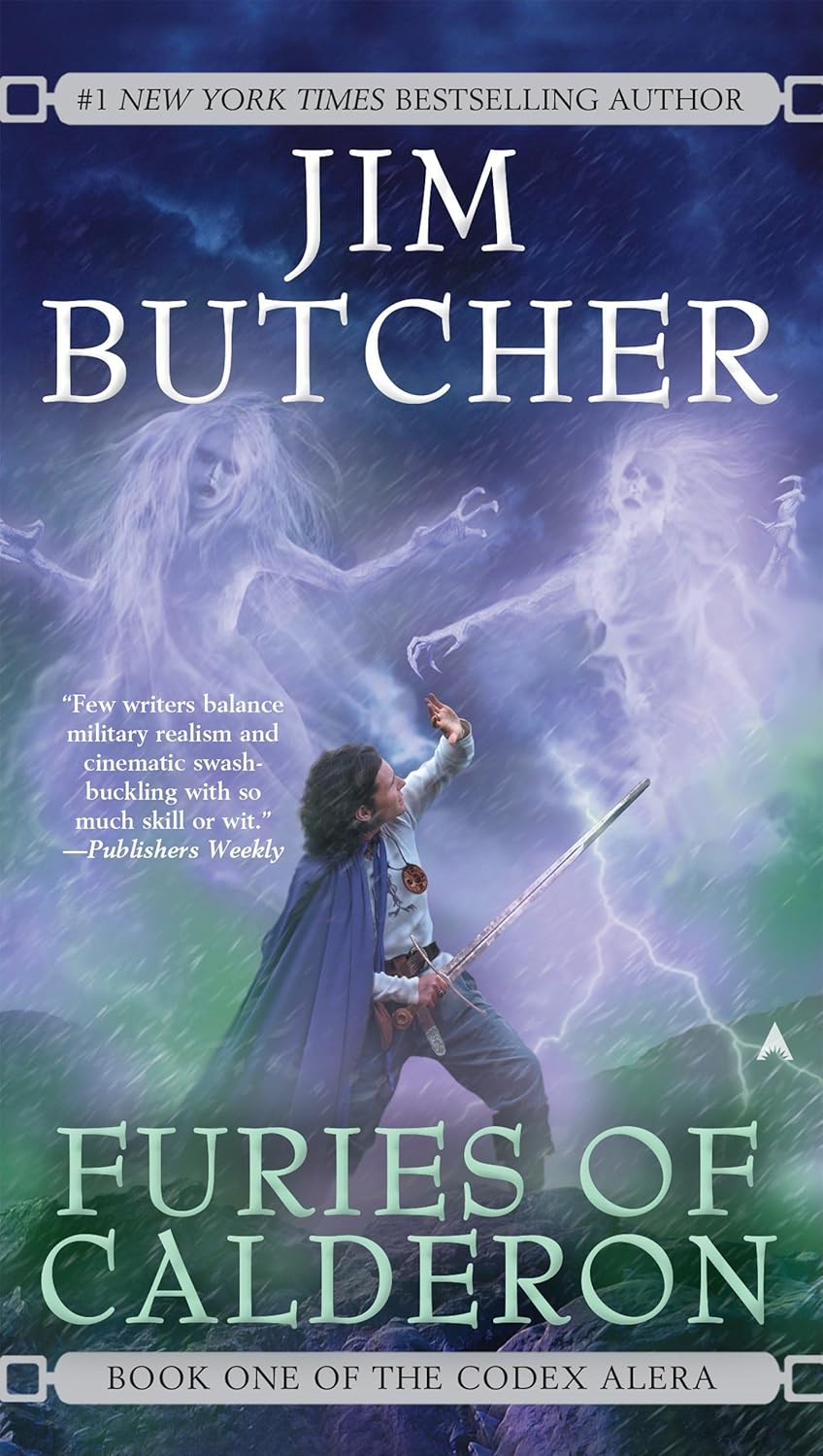
The finished one, and the best-kept secret on the shelf.
By Butcher’s own cheerful telling, the series began as a bet that a good writer could make a story out of any two bad prompts, and the prompts he got were a lost Roman legion and Pokémon. The result is far better than the joke: Alera is a Rome-descended empire where everyone bonds elemental spirits called furies, everyone except Tavi, the one boy in the realm without one, who has to survive on wits in a world where power is a birthright. Six books, published 2004 to 2009, done.
It’s Butcher’s tightest plotting, the escalation from valley skirmish to continental war is beautifully managed, and a protagonist who out-thinks a superpowered world never stops being satisfying. This is the series to hand anyone allergic to open-ended commitments, and among Jim Butcher books it’s the one most unfairly overshadowed by its famous sibling.
The Cinder Spires
The Aeronaut’s Windlass, then The Olympian Affair.

The active side project: a world of colossal spires above a deadly mist, wooden airships riding crystal-powered ether currents, and cats who talk, scheme, and consider themselves the senior species, chief among them Rowl, whom a large share of the readership rates the best character Butcher has written anywhere. The Aeronaut’s Windlass (2015) is swashbuckling in the best sense, and after an eight-year wait The Olympian Affair (2023) proved the series is really happening, with a novella, Warriorborn, arriving alongside it and more promised. It’s lighter than Dresden, closer to naval adventure with fur and etiquette, and a fine palate cleanser between the heavier shelves.
The side shelf

The short fiction matters more here than for most authors, because the stories slot into the series timeline and several carry real weight. Side Jobs (2010) and Brief Cases (2018) collect the Dresden shorts, each story labeled by where it falls in the sequence, and both are best read alongside or after the novels they neighbor, since the later pieces carry major spoilers. The novella The Law picks up after Battle Ground and bridged part of the long wait. And for trivia night: Butcher also wrote a Spider-Man novel, The Darkest Hours, which is exactly the kind of thing that happens when a lifelong comics fan gets famous.
A note on where to actually start
Start at Storm Front, with the growth curve taken on faith, because tens of thousands of readers have made the same climb and the view from Dead Beat onward justifies every step. If book one leaves you cold, don’t quit, jump, because the series you were promised starts around Summer Knight. And if what’s kept you away is the fear of another unfinished epic, this one published a new book eight months ago and has known its ending for twenty years.
And no, none of it takes place in Saxony. I checked so you don’t have to.