Jim Butcher books mostly mean one thing, the Dresden Files, and I should confess how I first met them. I live in Dresden, the actual city in Germany, and when I saw the title I briefly assumed somebody had written urban fantasy about my hometown. Then I learned Dresden is the hero’s surname, and somewhere around the words “wizard rides a reanimated Tyrannosaurus into battle” I accepted that this was probably not a series about a historical Saxon city. It’s more fun than that.
What the shelf actually holds: one of the defining urban fantasy series of the century, eighteen novels and counting, plus a complete six-book epic fantasy that deserves far more readers than it gets, and an in-progress steampunk saga with airships and talking cats. The honest caveat comes first, because everyone who loves the Dresden Files says the same thing: the series has one of the weakest openings in modern fantasy relative to what it becomes, and knowing that going in is the difference between quitting at book two and discovering one of the genre’s great long games.
The Dresden Files’ genre context sits on my urban fantasy books list, and Butcher’s wider standing is marked on my best fantasy books list. What follows maps the whole career, every novel with its own entry, the collections, the awards, and the state of the series as of late 2026.
Fiction by René Rehn


The Short Version
Start with Storm Front and read the Dresden Files in publication order. The first two books are apprentice work, the series ignites around Summer Knight, and the climb is real enough that readers chart it in the aggregate ratings, which rise almost every book for a decade straight. If you want the alternative half the fandom offers, skim the first two and settle in at book three or four, but publication order costs you nothing except patience.
If you want Butcher finished and self-contained, the Codex Alera is six books, done, and his tightest plotting. For something lighter, check out The Aeronaut’s Windlass, which is swashbuckling with cats. And if the fear of another abandoned epic is what kept you away from Jim Butcher books, relax: the Dresden Files published its eighteenth novel in January 2026, the nineteenth is being written, and the ending has been planned for decades.
Jim Butcher Books in Order
The table runs by first publication and covers all the Jim Butcher books with entries below, plus the novellas and the tie-in work.
| Year | Title | Series or type | Notes |
| 2000 | Storm Front | The Dresden Files, book 1 | The debut |
| 2001 | Fool Moon | The Dresden Files, book 2 | |
| 2001 | Grave Peril | The Dresden Files, book 3 | |
| 2002 | Summer Knight | The Dresden Files, book 4 | Where the long game starts |
| 2003 | Death Masks | The Dresden Files, book 5 | |
| 2004 | Blood Rites | The Dresden Files, book 6 | |
| 2004 | Furies of Calderon | Codex Alera, book 1 | |
| 2005 | Dead Beat | The Dresden Files, book 7 | The Tyrannosaurus one |
| 2005 | Academ’s Fury | Codex Alera, book 2 | |
| 2006 | Proven Guilty | The Dresden Files, book 8 | |
| 2006 | Cursor’s Fury | Codex Alera, book 3 | |
| 2006 | Spider-Man: The Darkest Hours | Tie-in novel | |
| 2007 | White Night | The Dresden Files, book 9 | |
| 2007 | Captain’s Fury | Codex Alera, book 4 | |
| 2008 | Small Favor | The Dresden Files, book 10 | |
| 2008 | Princeps’ Fury | Codex Alera, book 5 | |
| 2009 | Turn Coat | The Dresden Files, book 11 | |
| 2009 | First Lord’s Fury | Codex Alera, book 6 | Completes the series |
| 2010 | Changes | The Dresden Files, book 12 | |
| 2010 | Side Jobs | Stories | |
| 2011 | Ghost Story | The Dresden Files, book 13 | |
| 2012 | Cold Days | The Dresden Files, book 14 | |
| 2014 | Skin Game | The Dresden Files, book 15 | Hugo finalist |
| 2015 | The Aeronaut’s Windlass | The Cinder Spires, book 1 | Hugo finalist |
| 2018 | Brief Cases | Stories | |
| 2020 | Peace Talks | The Dresden Files, book 16 | |
| 2020 | Battle Ground | The Dresden Files, book 17 | Dragon Award |
| 2022 | The Law | Novella | After Battle Ground |
| 2023 | Warriorborn | Novella | Cinder Spires |
| 2023 | The Olympian Affair | The Cinder Spires, book 2 | |
| 2026 | Twelve Months | The Dresden Files, book 18 | Dragon Award |
| 2026 | Out Law | Novella |
Mirror Mirror, the nineteenth Dresden Files novel, is announced and being written, with no release date yet.
Where to Start With Jim Butcher
For almost everyone, the answer is Storm Front, taken on faith. Tens of thousands of readers have made the same climb, the view from Dead Beat onward justifies every step, and the early books plant things the series pays off years later. If book one leaves you cold, don’t quit, jump: the series you were promised starts around Summer Knight, and the fandom will wave you forward with a clear conscience.
Readers allergic to open-ended commitments should start with Furies of Calderon instead. The Codex Alera is complete at six books, tightly plotted from the first chapter, and asks for no patience at all. And readers who want something lighter than either, closer to naval adventure than noir, should board The Aeronaut’s Windlass.
The one wrong door is the middle. Dresden Files books lean on their own history harder than almost any other urban fantasy series, and a reader who starts at Changes or Skin Game is skipping the decade of setup that makes those books land. And no, none of it takes place in Saxony. I checked so you don’t have to.
Jim Butcher’s Life, Briefly
Jim Butcher was born on October 26, 1971, in Independence, Missouri, the youngest of three children. His origin story as a reader is the classic one: laid up with strep throat, he was handed The Lord of the Rings and a stack of Han Solo novels by his older sisters, and that was that. He wrote his first novel as a teenager, took an English degree with a creative writing emphasis, and went on to the University of Oklahoma’s professional writing program.
That program is where the famous story happened. In author Deborah Chester’s novel-writing class, Butcher, by his own telling, had been ignoring her advice for years, so he decided to run an experiment in spite. One semester, he recalled in an interview on The Author Hour, he resolved to do everything she said, exactly as she said it. “I’m going to show her how wrong she is.” He followed every rule and filled in every worksheet, and the result, written in 1996, was the first Dresden Files book. “Which showed her,” as he puts it. He has named Chester his primary mentor ever since.
Storm Front reached print in April 2000, and Butcher has spent the quarter century since running two or three series at once. His publisher bio describes him as a martial arts enthusiast whose résumé is full of “skills rendered obsolete at least 200 years ago,” and jokes that his head can generally be found in the Rocky Mountains of Colorado. The family trade continues: his son, James J. Butcher, is a fantasy novelist as well.
The Dresden Files
Harry Dresden is a wizard in the Chicago phone book, under W, a private investigator who works cases the police can’t file and pays his rent one exorcism at a time. The chassis is detective noir, first-person, wisecracking, chronically broke, and the engine underneath turns out to be something much bigger: across eighteen books the case-of-the-week series quietly becomes a war story about courts of faeries, vampire nations, and a man accumulating power at prices he keeps refusing to look at.
What keeps the Dresden Files books running is the ledger. Dresden narrates in a voice that never stops joking and never stops counting: every borrowed power carries a price tag, every ally becomes a hostage to fortune, and the series’ real subject slowly turns out to be what a decent man will trade away to keep other people alive. Around him Butcher builds one of the genre’s better found families, cop and vampire and knight and wisecracking skull, and the middle-run case books each feed the larger war while standing alone as mysteries. It’s formula in the best sense, the kind you order again on purpose.
Read in publication order, and push through the early books. Butcher has described the plan for years: the case-file novels run to roughly book 22, and a big apocalyptic trilogy ends the story, about 25 books in all. The entries below keep the later plot out of sight, because this series rewards going in blind more than most.
Storm Front (2000)

Storm Front is the book that started it all and the one nobody pretends is the peak. Harry takes two cases at once, a missing husband and a double murder committed with magic brutal enough to alarm even the wizarding authorities who already distrust him, and the two threads tangle exactly the way noir demands. The mechanics of Harry’s magic, the skull in the basement lab, the wisecracks under pressure: everything the series becomes is already here in rough form.
Rough is the operative word. The plotting is workmanlike, some of the gender writing is dated in ways Butcher himself has long since outgrown, and the prose has the stiffness of a first novel, because it was one, written in a classroom to a professor’s formula. Read it as the foundation of one of the great modern Butcher books runs, not as its showcase, and keep going.
Fool Moon (2001)

Fool Moon is the werewolf book, and by broad fan consensus the weakest of the Dresden Files. A string of brutal killings tracks the lunar cycle, the FBI gets involved, and Butcher cheerfully throws four different varieties of werewolf at a hero who spends most of the book bleeding. The creature-feature plotting is fun in a B-movie way, and a few supporting characters introduced here matter enormously later.
The standard advice is blunt: this is the book where new readers stall, and skimming it costs little. The counterargument is that its consequences echo for many volumes, so even readers who hurry through should not skip it outright. Either way, do not judge the series here.
Grave Peril (2001)

Grave Peril is where the ceiling rises. Chicago’s ghosts are being driven violent by something systematic, and Harry investigates alongside a new ally, Michael Carpenter, a knight whose sword and unshakable faith give the series a moral counterweight it keeps forever. The vampire courts arrive in force, the tone darkens several shades, and for the first time a Dresden case ends with bills that will take entire books to pay.
Readers often date the series’ real beginning here, one book before the fandom’s usual marker. The plotting still lurches in places, but the ambition is visible, and the final act commits to consequences in a way the first two books never dared.
Summer Knight (2002)
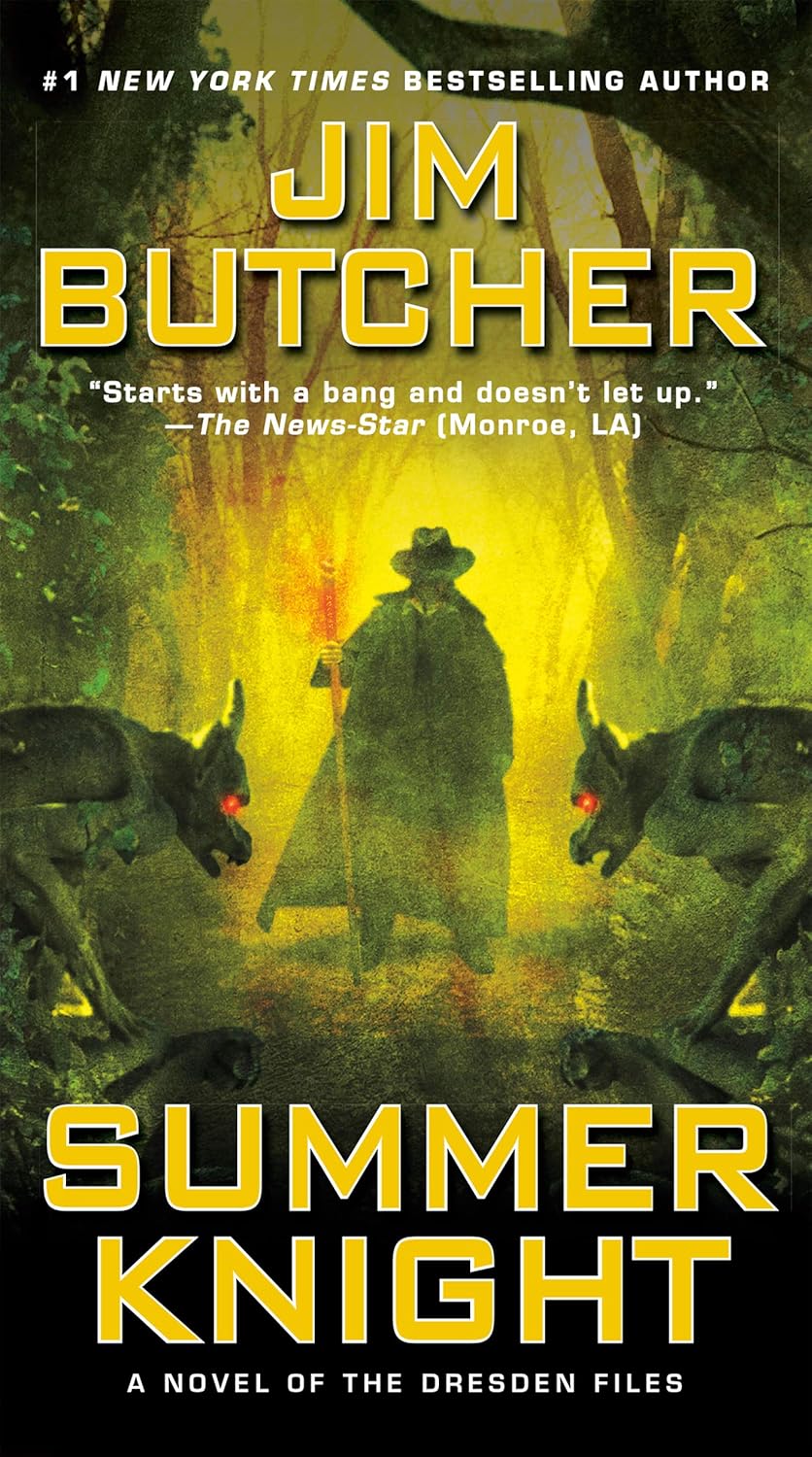
Summer Knight is the ignition point, the book the whole fandom tells you to reach. The Winter Queen of Faerie buys Harry’s debts and makes him an offer he can’t refuse: clear her name in the murder of the Summer Court’s mortal champion, with a war between Winter and Summer hanging on the answer. Faerie politics turn out to be the series’ richest vein, equal parts beauty, menace and contract law, and Butcher mines it for the rest of the run.
This is also where the long game becomes visible. The wizards’ White Council stops being background noise, the war kicked off in Grave Peril starts collecting its dues, and the case-of-the-week format reveals that it was quietly building an epic all along. Among Dresden Files books it’s the most common answer to “where did you fall in love with this series,” and it earns that.
Death Masks (2003)

Death Masks opens with the theft of the Shroud of Turin and escalates from there. The buyers and hunters converging on Chicago include the Denarians, fallen angels riding ancient silver coins, and their leader Nicodemus Archleone steps instantly into the role of the series’ most durable villain: patient, courteous, and scarier than anything with claws. A duel with a vampire noble, a dying priest, and Harry’s tangled past all share the docket.
It’s a mid-tier entry elevated by its antagonist and by how much future story it seeds. The Knights of the Cross become a full institution here, and the book’s questions about redemption and free will run under the series from now on.
Blood Rites (2004)

Blood Rites sends Harry undercover on an adult film set where the women around the production keep dying in ways that look like a curse, which is both the series’ funniest premise to date and a Trojan horse for some of its most serious long-term material. The White Court of vampires, who feed on emotion rather than blood, move to center stage and prove far more interesting than monsters who merely bite.
This is also the book that introduces Mouse, the puppy fans will tell you grows into the best dog in modern fantasy, and that quietly deepens one of the series’ central relationships in ways first-time readers won’t clock until later. Mid-tier as a mystery, essential as a load-bearing wall.
Dead Beat (2005)

Dead Beat is the turning point, the book fans hand people as proof. The disciples of a dead master necromancer converge on Chicago for Halloween, racing to claim a power that would make one of them a god, and Harry, with the White Council’s forces tied down elsewhere, is most of what stands in the way. Bob the skull gets his best material yet, the villains are genuinely frightening, and the escalation is managed so well that the famous climax, a polka-powered one involving a reanimated Tyrannosaurus named Sue, feels earned rather than absurd. It is every bit as glorious in context as it sounds out of it.
From here through Changes is the golden stretch, the run that turned a midlist paperback series into a phenomenon, and if the early Dresden Files books were a tax, this is the refund. Readers who make it to Dead Beat do not stop.
Proven Guilty (2006)

Proven Guilty turns a horror convention into a hunting ground. Something is pulling fear-feeding creatures shaped like slasher-movie monsters into the real world, and the trail leads uncomfortably close to the family of Michael Carpenter, the ally Harry can least afford to fail. Meanwhile the White Council’s war is going badly enough that Harry has new responsibilities he never asked for.
The convention setpieces are a horror writer’s playground, and the book’s real subject, what the adults of the series owe the kids growing up inside it, gives the back half unexpected weight. The found family that carries the late series is being assembled here, piece by piece.
White Night (2007)

White Night is the one about the murdered practitioners. Someone is killing Chicago’s small-time magical talents, women too minor for the White Council to protect, and the evidence is arranged to point at people Harry trusts. The investigation drags the White Court’s internal politics into the light, and the series’ running theme, power’s cost paid in installments, gets some of its most direct treatment yet.
It’s a tight, confident mid-run mystery, less flashy than Dead Beat, more disciplined than the early books, and the ending quietly repositions several pieces for the bigger war. It’s the connoisseur’s underrated pick of the middle run.
Small Favor (2008)

Small Favor calls in a debt. The Winter Queen owes Harry nothing and he owes her plenty, so when she demands a favor in the middle of a Chicago winter, with the Denarians back in town and a mortal power broker gone missing, refusing isn’t on the menu. Nicodemus and company are at their most dangerous here, the Knights of the Cross get their best book, and the Archive, a little girl carrying all written knowledge, becomes one of the series’ most haunting creations.
The winter-war setpieces are superb, and the escalation discipline, each rescue pricing in the next crisis, shows Butcher at full professional strength.
Turn Coat (2009)

Turn Coat opens with Harry’s oldest enemy on his doorstep, asking for help. Morgan, the Warden who has spent a decade waiting for an excuse to execute Harry, stands accused of treason against the White Council, and the only wizard paranoid enough to believe in a hidden traitor is the one Morgan persecuted. The result is the series’ best pure whodunit, with a monster on the hunt that even the heavy hitters fear.
The book interrogates the Council itself, its fear, its politics, its willingness to eat its own, and sets charges under the series’ institutions that keep detonating for books to come. The loyalty questions cut deeper than any fight scene.
Changes (2010)

Changes does exactly what its title threatens. The less a new reader knows going in, the better, so this entry stays deliberately vague: an enemy strikes at Harry through the people he loves, every debt and alliance of eleven books gets called at once, and by the final page the series’ entire status quo has been burned to the ground on purpose. It is the most consequential volume of the run and, by wide consensus, one of the two or three best.
What can be said safely is how controlled the demolition is. Payoffs land that were planted five and eight books earlier, the pacing never lets up, and the ending is one of the most famous cliffhangers in modern fantasy, the kind that sent readers straight back to the store. This is the summit of the long game the Dresden Files books had been playing all along, and everything after it is a different series wearing the same coat.
Ghost Story (2011)
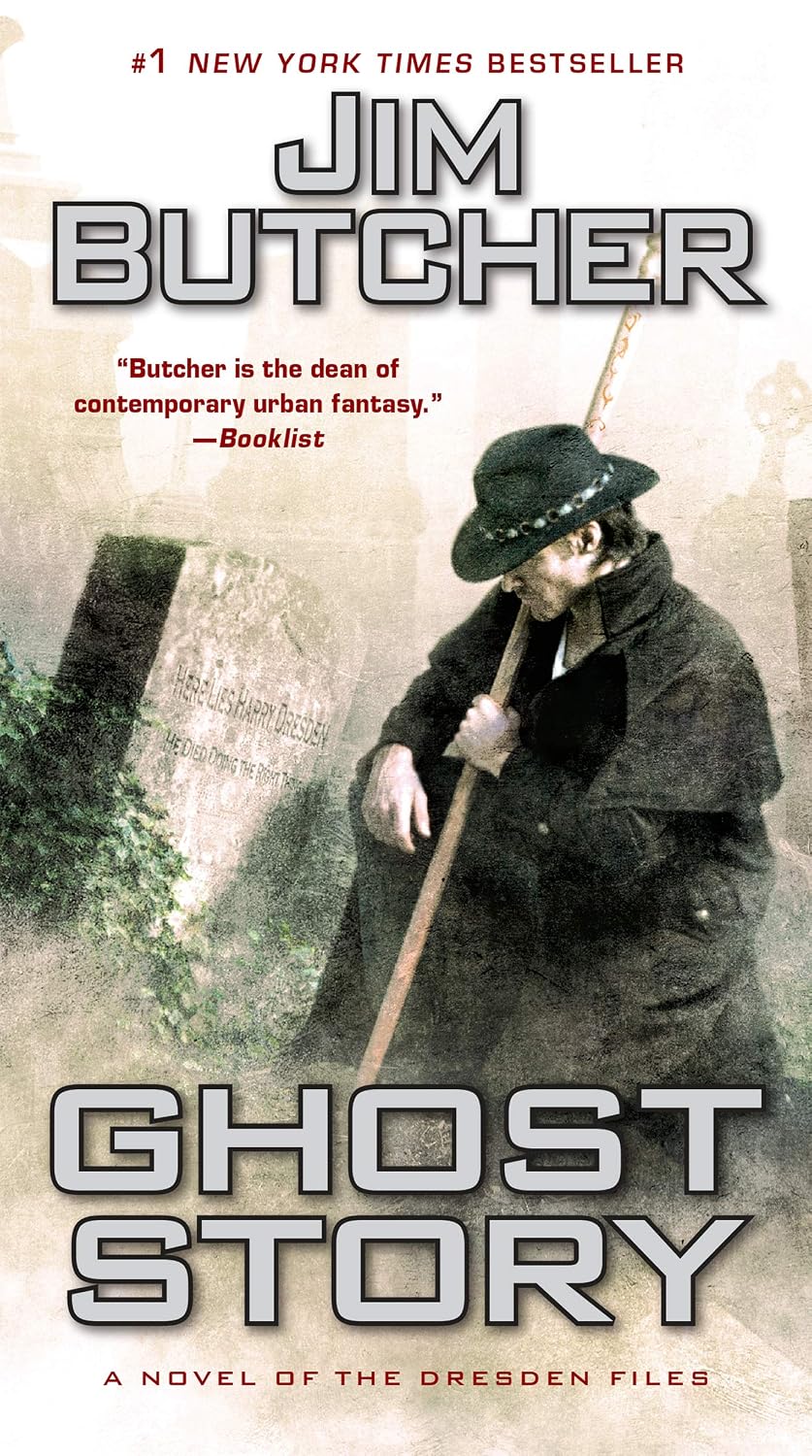
Ghost Story picks up directly from the cliffhanger that closes Changes, and nearly anything specific about its premise would spoil that ending, so forgive the vagueness here too. What matters: Harry must work a case stripped of almost everything he normally relies on, the book is slower and far more reflective than anything before it, and Chicago shows the damage of the previous volume on every page.
Readers split on it. Some find the inward turn the series’ most interesting experiment, a meditation on consequences in a series suddenly brave enough to sit still. Others find it a 500-page pause between two louder books. Both camps agree you cannot skip it.
Cold Days (2012)

Cold Days puts the series back at full speed. Harry returns to the board under a new and dangerous arrangement he spends the whole book trying to survive, with a single impossible task, a literal deadline, and the deepest dive yet into what the faerie courts actually are and why they exist. The answers reframe half the series, and the island of Demonreach, one of Butcher’s best inventions, moves to the center of the mythology.
The pace is relentless, the new status quo opens more doors than it closes, and the book’s big revelations about the series’ cosmology are delivered at a sprint. After the grief-soaked Ghost Story, the sheer momentum reads as a promise kept.
Skin Game (2014)

Skin Game is the heist book, and the fan-favorite peak of the later run. Harry is loaned out, through debts there’s no polite way to refuse, to a crew assembled by Nicodemus Archleone for a burglary with the series’ most audacious target: a vault belonging to Hades, Lord of the Underworld. Every heist convention gets its tribute, the double-crosses stack four deep, and working beside his worst enemy forces Harry into the series’ sharpest moral chess.
It earned Butcher his first Hugo Award nomination for best novel, in 2015, and it’s the late-run book that works best as pure entertainment even for readers behind on the mythology. Of all the Dresden Files books, this is the one fans reread for fun.
Peace Talks (2020)

Peace Talks arrived after a six-year gap, and it is half a story by design. The supernatural nations convene in Chicago to negotiate an end to hostilities, every faction of the series sends a delegation, and family trouble lands on Harry in the middle of the most delicate week of his career. The reunion pleasures are real: after six years away, fans were glad just to hear the voice again.
The consensus hasn’t softened with time: it reads as one long first act, because it is one. Butcher wrote one enormous book that was split in two for publication, and this half carries the setup. Read it with Battle Ground stacked next to it and the problem mostly disappears.
Battle Ground (2020)

Battle Ground is the payoff volume, one colossal battle for Chicago that runs nearly the length of the book. The scale is something urban fantasy had simply never attempted, the losses are permanent, and the series’ table is not so much reset as flipped. It won the Dragon Award for best fantasy novel in 2021, and it remains the most argued-about stretch of the series, with costs some readers haven’t forgiven.
The split verdict is the accurate one. As spectacle and consequence, it’s overwhelming, and as a novel it’s a war reel where the quieter character beats fight for air. Either way it changes the series permanently, and the books after it are written in its shadow.
Twelve Months (2026)

Twelve Months ended the wait. Published on January 20, 2026, after more than five years of silence on the novel front, the eighteenth Dresden Files book debuted as an instant number one New York Times bestseller and went on to win the 2026 Dragon Award for best fantasy novel. It is deliberately the quietest book of the late run: a wrecked city and a wrecked man rebuilding, the aftermath of Battle Ground traced across a longer span of time than any previous volume, with the question of whether the man who always saves the day can manage to save himself.
The register change is the point, and most readers took it as exactly the book the series needed after two volumes of war. It is not a jumping-on point, but as a statement that the Dresden Files is alive, plotted, and heading somewhere, it did its job emphatically. Mirror Mirror, book nineteen, is being written now, with Butcher’s own site tracking the manuscript at 42 percent complete as of this fall.
The Dresden Files Story Collections
The short fiction matters more here than for most authors, because the stories slot into the series timeline and several carry real weight. Both collections label every story by where it falls in the sequence, and both are best read alongside or after the novels they neighbor, since the later pieces assume you know what the novels did.
The uncollected side keeps growing too. The Law, a 2022 novella also issued as a signed, limited Subterranean Press hardcover, picks up in the months after Battle Ground and bridged part of the long wait, with Harry taking a deliberately small case to remember why he does the job. A follow-up novella, Out Law, arrived in May 2026 on the heels of Twelve Months.
There’s also a comics shelf. The Dabel Brothers began adapting the series in 2008 with Welcome to the Jungle, an original prequel written by Butcher that picked up a Hugo nomination for best graphic story in 2009, and Dynamite Entertainment has carried the line since, mixing adaptations of the early novels with original stories, one of which, Wild Card, took a Dragon Award in 2017. And for trivia night: Butcher also wrote a Spider-Man novel, The Darkest Hours, in 2006, which is exactly the kind of thing that happens when a lifelong comics fan gets famous.
Side Jobs (2010)

Side Jobs collects the first decade of Dresden shorts, from an early story Butcher wrote before Storm Front sold, included with cheerful warnings about its quality, through the series’ golden stretch. The standouts are the novellas: “Backup,” told by one of the series’ most popular supporting characters, and the closer, “Aftermath,” set in the hours immediately after Changes, which makes this collection genuinely essential rather than optional.
Read it after Changes, not before, and the timeline labels make that easy to respect. For readers pacing themselves through the Dresden Files books, it slots in perfectly as a breather between the heaviest volumes.
Brief Cases (2018)

Brief Cases gathers the second wave of stories, and the average quality is higher than Side Jobs, because Butcher by now treated the short form as a place for things the novels couldn’t do: other narrators, other corners of the world, jokes too big for a war arc. The bigfoot novellas, following a sasquatch client across three cases, are the fan favorites, and the closing original story rotates through three points of view for one chaotic day out, including one perspective longtime readers had waited years for.
The collection was a Locus Award finalist in 2019. Save it until you’re past Skin Game and the spoiler labels lose their teeth.
The Codex Alera
The finished one, and the best-kept secret on the shelf. By Butcher’s own cheerful telling, the series began as a bet on the Del Rey Online Writer’s Workshop: a challenger wagered that he couldn’t write a good story from a lame idea, and Butcher countered that he’d do it with two lame ideas of the challenger’s choosing. He got a lost Roman legion and Pokémon, and between 2004 and 2009 he turned them into a complete six-book epic fantasy that deserves far more readers than it gets.
Read it in order: Furies of Calderon (2004), Academ’s Fury (2005), Cursor’s Fury (2006), Captain’s Fury (2007), Princeps’ Fury (2008) and First Lord’s Fury (2009). The entry below covers the opening volume, because this is a single continuous story and the first book is the only sensible door. Where the series sits in the broader tradition, between Rome-flavored worldbuilding and the modern long-arc epic, is mapped on my epic fantasy books guide.
Furies of Calderon (2004)
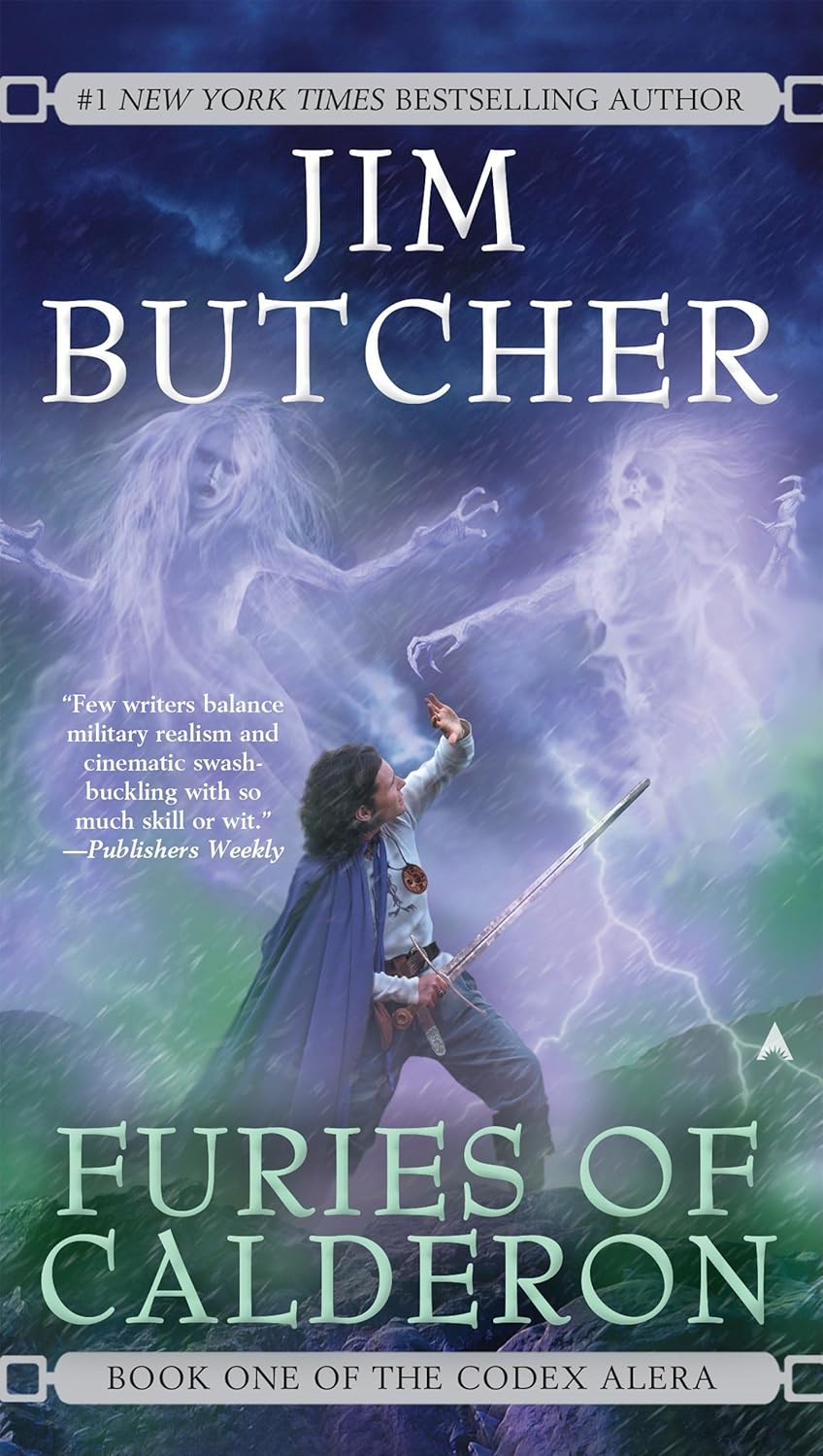
Furies of Calderon opens the series in a Rome-descended empire where every citizen bonds elemental spirits called furies, beings of earth, air, fire, water, wood and metal that fight, heal and spy for their holders. Every citizen except Tavi, a shepherd boy in a border valley, the one person in Alera with no fury at all, who has to survive on wits in a world where power is a birthright. When a barbarian invasion and an imperial power struggle both land on his valley in the same season, wits turn out to scale.
The joke origin is nowhere visible in the execution. This is Butcher’s tightest plotting, the escalation from valley skirmish to continental war is beautifully managed across the six volumes, and a protagonist who out-thinks a superpowered world never stops being satisfying. The series improves book over book, the back half runs at full epic scale, and the ending actually ends, a sentence worth gold in this genre. Among Jim Butcher books it’s the one most unfairly overshadowed by its famous sibling, and the right first Butcher for epic fantasy readers.
The Cinder Spires
The active side project: a world of colossal spires rising above a deadly surface mist, wooden airships riding crystal-powered ether currents, and cats who talk, scheme, and consider themselves the senior species. It’s lighter than Dresden, closer to naval adventure with fur and etiquette, and a fine palate cleanser between the heavier shelves. Two novels exist so far, each with its own entry below, plus the novella Warriorborn (2023). A third book is expected but has no date, and with Mirror Mirror occupying Butcher’s desk, patience is advised.
The Aeronaut’s Windlass (2015)

The Aeronaut’s Windlass launches the series with a privateer captain, a disgraced noble crew, and a war between spires that opens with an ambush and never slows down. Captain Grimm of the Predator is honor-bound naval romance in the Hornblower line, the boarding actions and ship duels are the best pure action Butcher has written, and the cat Rowl, prince of his tribe and unshakably convinced the humans work for him, walks off with the book. A vocal part of the readership rates him the best character Butcher has created anywhere, and the case is strong.
It was a Hugo Award finalist for best novel in 2016, and a Dragon Award nominee the same year, a nomination that fan memory sometimes upgrades to a win. Swashbuckling in the best sense, and of the Jim Butcher books outside Dresden, the easiest to hand to a reader cold.
The Olympian Affair (2023)

The Olympian Affair proved the series is really happening. Published on November 7, 2023, after an eight-year wait, it widens the war, promotes several book-one supporting players to leads, and stages its centerpiece at a diplomatic summit where the dueling is both literal and political. The airship combat takes another step up, and the cats remain the correct amount of insufferable.
The novella Warriorborn preceded it by a few weeks in September 2023 and slots neatly between the two novels. One note for series-shy readers: this is a middle volume in an unfinished saga, with threads left deliberately loose, so anyone burned by long waits may want to let the shelf grow another book first.
Jim Butcher: Deep Dive and FAQ
What Runs Through Jim Butcher’s Books
The price tag is the signature. Across all three series, power is never free: Dresden’s every bargain compounds like debt, Tavi succeeds precisely because he has nothing given, and the Cinder Spires runs its ships on crystals that are bred, bought and owed. Butcher’s plots are ledgers, and his heroes are the people who pay willingly so others don’t have to. The second thread is the found family, assembled slowly, defended at any cost, and the real reason readers stay for eighteen volumes: the cases are the occasion, the people are the point.
The third is escalation discipline. Nobody in modern fantasy manages a longer fuse: jokes become plot points five books later, bit players return as linchpins, and each climax prices in the next crisis. That long game, more than the wisecracks or the monsters, is what the Jim Butcher books are actually famous for among the people who’ve read all of them. And under it all sits a stubborn, unfashionable optimism: the conviction that ordinary decency, applied repeatedly under terrible pressure, is the strongest force on any battlefield.
Prizes and Honors
Butcher’s awards run heavily to the fan-voted side, which fits a career built on reader loyalty. Skin Game was a Hugo Award finalist for best novel in 2015, and The Aeronaut’s Windlass followed as a finalist in 2016, also picking up a Dragon Award nomination that year. The Dragon wins came later: Battle Ground took best fantasy novel in 2021, and Twelve Months won the same category in 2026. On the comics side, Welcome to the Jungle was a Hugo finalist for best graphic story in 2009, and the graphic novel Wild Card won a Dragon Award in 2017.
The early recognition was quieter: Storm Front was a finalist for the Compton Crook Award for best first novel in 2001, and Brief Cases drew a Locus Award nomination for best collection in 2019. Add the long string of New York Times bestsellers, Twelve Months debuting at number one among them, and the shape is clear: the critics came around slowly, the readers never left.
Which Jim Butcher Editions to Buy
Everything is comfortably in print in the United States in paperback and ebook, and for the Dresden Files the mass-market paperbacks remain the cheapest way to run the full climb. The series is long enough that box sets and bundled ebook editions of the early books turn up regularly and are worth a price check before buying singly.
The audiobooks are the famous alternative. James Marsters has narrated the Dresden Files for years, his performance is an institution of its own, and a meaningful slice of the fandom knows the series only through his voice. Since August 2025 GraphicAudio has also been releasing full-cast dramatized editions, starting with Storm Front, for readers who want the radio-play treatment. The novella The Law exists physically only as a signed, limited Subterranean Press hardcover, so expect collector prices for the physical edition and read it in ebook like everyone else.
Jim Butcher on Screen
There was one television series, and it was brief. The Dresden Files ran for a single twelve-episode season on the Sci Fi Channel from January to April 2007, with Paul Blackthorne as Harry and Nicolas Cage among the executive producers, and the network declined a second season that August. It was a loose adaptation by design, and Butcher described it at the time as an alternate world with a similar background rather than a recreation of the novels. It’s remembered fondly and gone quickly.
Since then the screen rights have circled without landing. Fox21 optioned the series for television in 2018 and nothing publicly came of it. More recently, in a May 2025 New York Times profile, Butcher said a new adaptation was in serious discussions, far enough along that he’d had to hand over his “tax I.D. number,” reportedly focused on an early stretch of the novels. As of this writing, no network, cast or date has been announced, so file it under hopeful.
Questions About Jim Butcher
What Order Should I Read the Dresden Files In?
Publication order, starting with Storm Front (2000) and running through Twelve Months (2026). The books build on each other heavily, and the short story collections, Side Jobs and Brief Cases, label every story by where it falls in the timeline. There is no sensible alternative order, only the question of how fast you push through the first two books.
Is the Dresden Files Finished?
No, and that’s by design. Eighteen novels are out, Mirror Mirror, the nineteenth, is being written, and Butcher has described the plan for years: case-file novels to roughly book 22, then a big apocalyptic trilogy to end the story, about 25 books in all. Unlike some famous unfinished epics, this one has delivered a new novel and two novellas since the 2020 double-header, with the next book underway.
Can I Skip the First Two Dresden Files Books?
You can skim them, and half the fandom will tell you to. Storm Front and Fool Moon are the weakest of the Jim Butcher books, and the series finds its stride at Summer Knight. Skipping them entirely costs you character introductions and running debts that matter later, so the better plan is to read them fast with low expectations.
What Is the Best Jim Butcher Book?
Changes and Skin Game are the two most common answers among Dresden fans, with Dead Beat the pick for where the series first hits full power. Outside Dresden, Furies of Calderon opens his most tightly plotted work, and The Aeronaut’s Windlass was a Hugo finalist. Ask the fandom and expect a fight, which is the sign of a healthy shelf.
Is the Codex Alera Finished?
Yes, completely. Six books, published from 2004 to 2009, beginning with Furies of Calderon and ending with First Lord’s Fury, with a real ending. It’s the Jim Butcher series to hand anyone who refuses to start unfinished epics, and it holds up as his cleanest sustained plotting.
Will There Be a Third Cinder Spires Book?
It’s expected but unscheduled. The Olympian Affair arrived in 2023 alongside the novella Warriorborn, and the series has more road in front of it, but Butcher’s current project is the next Dresden Files novel, with his own site tracking Mirror Mirror at 42 percent written as of fall 2026. Expect the spires to wait their turn.
Is There a Dresden Files TV Show?
There was: one twelve-episode season on the Sci Fi Channel in 2007, starring Paul Blackthorne, canceled that August. Nothing has reached the screen since, though Butcher said in a May 2025 New York Times profile that serious talks about a new adaptation were underway. No network or date has been announced as of late 2026.
Where to Go Next
The closest neighbor is Ben Aaronovitch, whose Rivers of London series is the London answer to Dresden, a police procedural where the magic runs on Latin and paperwork: the Ben Aaronovitch books guide maps that series the same way this page maps Butcher. For the wider field Harry anchors, the urban fantasy books list sets the Dresden Files among the genre’s other load-bearing series.
And if the Codex Alera was your favorite part of this page, two doors: the best fantasy series list collects more long arcs worth committing to, finished ones flagged, and the epic fantasy guide linked above places Alera’s Roman experiment in the tradition it quietly honors.