Michael Moorcock books present the opposite problem to most classic fantasy: not too little, but far too much.
The man has published well over a hundred books across more than sixty years, and a huge number of them connect through a single audacious idea called the Eternal Champion. So a newcomer who goes looking for where to start hits a wall of interlocking series, alternate editions, omnibuses, and reissues, and understandably backs away. The good news is that the entry point is clear and the underlying structure, once explained, is the most fun part.
Here’s the key that unlocks everything. The Eternal Champion is a single hero reincarnated across countless parallel worlds, Moorcock’s multiverse, forever caught up in the cosmic struggle between Law and Chaos and forever paying for it. Elric, Corum, Hawkmoon, Erekose, and a dozen others are all aspects of this one recurring figure, living different lives in different realities, occasionally aware of each other and occasionally meeting. You don’t need to read them in any particular grand order. You pick a Champion, read his sequence, and the connections deepen the more you read.
Moorcock is on my best fantasy books list and my classic fantasy list, where Elric sits as the deliberate anti-Conan. This is the guide to navigating the wider multiverse.
Fiction by René Rehn


The short version
Start with Elric of Melniboné, the first Elric novel. It’s the most famous Champion, the most influential, and the natural door into everything else. The modern collected editions let you read the Elric saga in Moorcock’s own preferred order, and they explicitly present Elric of Melniboné as the place to begin.
If Elric grabs you, the rest of the multiverse opens up from there, and you can follow whichever Champion appeals next.
What the Eternal Champion actually is
Worth understanding before you start, because it’s the thing that makes Moorcock Moorcock.
Across his fantasy, reality is a multiverse of countless parallel worlds, and the fundamental cosmic force isn’t good versus evil but Law versus Chaos, two principles that both become monstrous in excess, with a Cosmic Balance that must be maintained between them. Into this structure Moorcock places a single soul, doomed to be reborn again and again as a warrior who must fight to preserve the Balance, usually at terrible personal cost, usually without thanks, and often without even understanding what he is.
Each incarnation has his own name, world, and story, but they rhyme. There’s always a doomed hero, a fateful weapon, a companion, a lost love, and a tragic price. And because they’re all the same being, they can occasionally cross paths, which produces some of the strangest and best moments in the whole enterprise, several Champions meeting and dimly recognizing one another. Moorcock even built in a rule that gathering too many of them in one place threatens reality itself.
It’s a structure that lets him write fast, self-contained adventures that also accumulate into something vast and mythic. And he does write fast: most of these books are short, propulsive, and readable in a sitting, which is part of their charm.
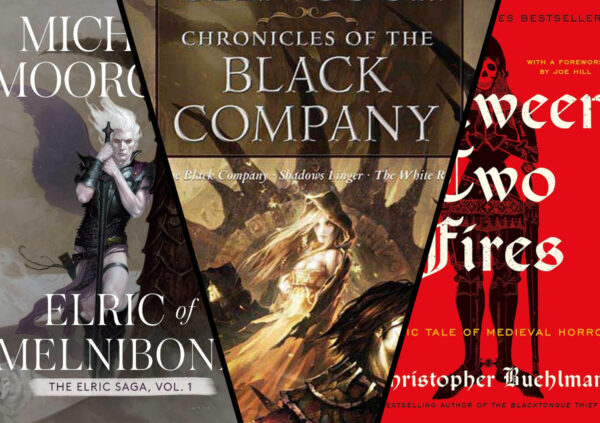
Elric of Melniboné
Start here. Begin with Elric of Melniboné and read the saga in preferred order.

The most important sword and sorcery character after Conan, and a deliberate reaction against him.
Elric is the albino emperor of Melniboné, a cruel and decadent civilization in its long twilight. He is physically frail, kept alive by drugs and then by Stormbringer, a sentient black runesword that feeds on the souls of those it kills, including, repeatedly, the people Elric loves. Where Conan is vital, strong, and self-reliant, Elric is weak, dependent, introspective, and cursed, and Moorcock created him in the early 1960s explicitly to puncture the muscular certainties of the genre.
The stories are short and headlong, and the doom accumulates relentlessly: Elric’s saga is a tragedy from the first page, and Stormbringer’s final act is one of the great bleak endings in fantasy. The prose is quick and sometimes careless, written at speed, but the imaginative intensity never flags.
Modern editions collect the saga so you can read it in Moorcock’s preferred sequence, which resolves the biggest historical headache with Elric, that the stories were written and published wildly out of order across decades.
The Other Champions
Read after Elric, in any order you like.

Once Elric has shown you the shape, the other incarnations each offer a different flavor of the same myth.
Corum is the melancholy elf-like prince of a near-extinct race, hunting the gods of Chaos who slaughtered his people. His two trilogies, beginning with The Knight of the Swords, are drenched in Celtic mythology, especially the second sequence, and many readers rate Corum as the most emotionally resonant of the Champions after Elric. If Elric is doom, Corum is grief.
Hawkmoon is the most straightforwardly heroic and adventure-driven of them, fighting the grotesque, science-fantastical Dark Empire of Granbretan across a far-future Europe. The History of the Runestaff, beginning with The Jewel in the Skull, is the most fun and the least angst-ridden sequence, the closest Moorcock comes to pure pulpy pleasure. It’s a good pick if Elric’s relentless gloom isn’t your mood.
Erekose is the darkest of all, a modern man pulled from our world into an endless cycle of incarnations he slowly comes to understand and despair of. His story is the most explicit meditation on what it means to be the Eternal Champion, and the most nihilistic.
Beyond these, Jerry Cornelius is Moorcock’s satirical, psychedelic, deliberately confusing 1960s incarnation of the Champion, a wild departure into experimental literary fiction that’s brilliant and not remotely a starting point.
Editions and the sprawl
The practical warning, because Moorcock’s publishing history is genuinely chaotic. His books have been collected, recollected, retitled, and reordered many times over sixty years, in different configurations in Britain and America, and the same stories appear under different volume titles. This is why picking a modern collected edition of whichever Champion you’re reading matters: it gets you the intended order and the complete sequence without hunting individual out-of-print paperbacks.
Don’t try to read the entire multiverse in one master chronological order. Even Moorcock’s most devoted readers don’t agree on one, and the books weren’t built for it. Pick a Champion, read his sequence in its own order, and let the larger structure reveal itself.
A note on where to actually start
The real answer: read Elric of Melniboné, and if you’re enjoying it, continue through the Elric saga in a modern collected edition. It’s the most influential thing Moorcock wrote, it’s short and fast, and its particular blend of doom, speed, and cosmic myth announces itself almost immediately, so you’ll know quickly whether you want the rest.
If Elric’s gloom appeals, Corum is the next step. If you’d rather have adventure with a lighter touch, jump to Hawkmoon instead. And don’t be daunted by the hundred-book bibliography: you’re not signing up for all of it, you’re picking one thread of an infinite tapestry, which is exactly how Moorcock designed it to be read.