Mervyn Peake books are dominated by one towering achievement, and understanding the man behind it explains both why it’s so strange and why there isn’t more of it.
Peake was a painter first. Born in 1911 in a missionary compound in China, a place as alien to Western eyes as anything in his fiction, he trained as an artist, made his name as an illustrator, and only then turned to writing, bringing a painter’s eye to prose in a way almost nobody else has. He was also, cruelly, cut down mid-career: a degenerative illness, most likely Parkinson’s, slowly took his ability to work and then his life, ending at fifty-seven a body of work that should have been far larger.
What he left is small but extraordinary, and centered on Gormenghast, one of the most original sustained feats of imagination in twentieth-century English fiction. This guide covers that masterpiece and the less-known work around it, the poetry, the illustrations, the stranger fictions, because Peake was one of the genuine polymaths the genre has produced.
He’s on my best fantasy books list and my classic fantasy list, where Gormenghast gets a full entry. This is the guide to the whole artist.
Fiction by René Rehn


The short version
Read Titus Groan, the first Gormenghast novel, then Gormenghast, the second. Those two books are a complete and self-sufficient masterpiece, and they’re the reason anyone knows Peake’s name. Everything else is a coda to them, and the third novel is a complicated case I’ll get to.
Go in knowing what these books are and aren’t: they are slow, dense, and almost plotless by design, built from extraordinarily detailed prose rather than incident, and readers either abandon them early or reorganize their taste around them. There isn’t much middle ground, and that’s part of what makes Peake Peake.
The Gormenghast Novels
Titus Groan, then Gormenghast. Read these as a pair.

The core, and one of the strangest great achievements in English fantasy.
These are the books a painter would write, and knowing Peake trained as one is the key to reading them. The setting is a decaying castle the size of a city, governed by ancient compulsory ritual, but what stays with you is not the plot so much as the way Peake sees: every hall, every face, every shaft of light rendered with a draughtsman’s obsessive attention until the building becomes more vivid and more alive than the people in it. He composes scenes the way he composed drawings, in arrested, intensely visual tableaux, and the castle accumulates presence through sheer accumulated looking. I cover what the ritual and the castle mean on my classic fantasy list. Here the point is that only a visual artist of Peake’s gifts could have built it this way.
Those people are grotesques, drawn with a caricaturist’s exaggeration, most of them trapped in roles they’ve never questioned. The exception, and the engine of what plot there is, is Steerpike, a kitchen boy who looks at the whole ossified structure and correctly sees something that can be climbed by anyone ruthless enough. His ascent drives both books.
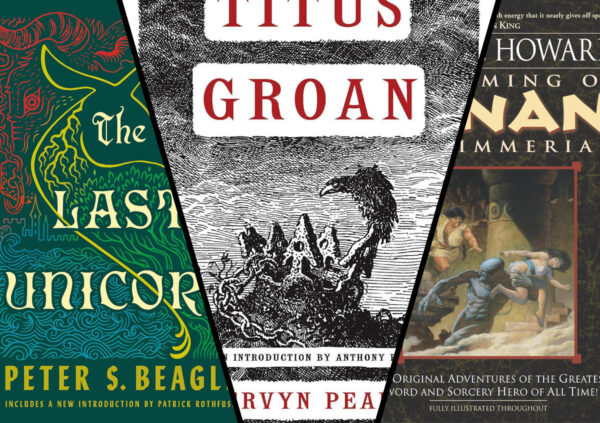
Titus Groan (1946) covers the first year of the heir’s life, establishing the castle and its cast. Gormenghast (1950) follows Titus into a boyhood spent chafing against the ritual that defines him. Together they’re a complete arc, and Peake’s prose, aggressively three-dimensional in Anthony Burgess’s phrase, will spend a page on the light on a wall in a way that would be padding in another writer and is the entire substance here.
The Royal Society of Literature gave Peake its Heinemann Prize in 1951 for Gormenghast and his poetry collection The Glassblowers together, one of the few pieces of official recognition the fiction received in his lifetime.
Titus Alone: the complicated third book

Read only if the first two grip you, and know what you’re getting.
Titus Alone (1959) is the third Gormenghast novel and a genuinely different, much weaker book, for reasons that are heartbreaking rather than artistic.
Peake wrote it as his illness was taking hold, and it shows. Titus leaves the castle entirely for a strange, half-industrial modern world, the setting and register change completely, and the prose has lost the dense control of the first two books. Worse, the text itself is compromised: Peake was too ill to see it properly through, the first edition was heavily and clumsily cut by others, and later editors reconstructed it from manuscript, so the version you read is an approximation of a book he never got to finish on his own terms.
The honest verdict is the one the first two books earn on their own: read Titus Groan and Gormenghast as a complete work, because they are one. Treat Titus Alone as an appendix for readers who want to see where Peake was heading before illness stopped him, not as the conclusion of a trilogy, because it was never truly allowed to be that.
There’s also Titus Awakes, a fourth book Peake barely began and his widow Maeve Gilmore completed decades later. It’s for the deeply devoted only.
Beyond Gormenghast

The rest of Peake’s fiction is small, strange, and worth knowing.
Boy in Darkness (1956) is a novella, sometimes set in the Gormenghast world and sometimes read as separate, in which a boy who is clearly Titus escapes his home and encounters three horrifying half-animal figures, the Goat, the Hyena, and the blind, terrible Lamb. It’s darker and more nightmarish than the novels, a compressed fable, and it’s some of Peake’s most concentrated horror. A genuine deep cut worth seeking out.
Mr Pye (1953) is a complete change of register: a comic, whimsical novel about a well-meaning man who arrives on the Channel Island of Sark determined to do good, and finds that his goodness starts growing him angel’s wings, while any lapse threatens something worse. It’s lighter, funnier, and more accessible than anything in Gormenghast, and it shows a side of Peake the castle books hide.
The Poetry

Peake published poetry throughout his life and considered himself a poet as seriously as a novelist.
His collections include Shapes and Sounds, The Glassblowers, and the remarkable The Rhyme of the Flying Bomb, a narrative poem set during the Blitz. He also wrote genuinely great nonsense verse in the tradition of Lear and Carroll, collected in books like A Book of Nonsense, which pairs with his gift for the grotesque in a lighter key.
The poetry is where to go if the language of Gormenghast, its sound and density, was the thing that gripped you, because it’s the same sensibility distilled.
The Illustrations
This is the part most fantasy readers miss entirely, and it’s central to who Peake was.
He was a superb illustrator, better known in his lifetime for his art than his writing, and his illustrated editions are treasures: his Alice’s Adventures in Wonderland, his Treasure Island, his Rime of the Ancient Mariner, and his own bizarre children’s book Captain Slaughterboard Drops Anchor. His line work is spiky, grotesque, and unmistakable, the visual equivalent of his prose, and seeing it explains instantly why Gormenghast feels the way it does.
Peake also served as a war artist and was sent to draw the Belsen concentration camp in the weeks after its liberation, an experience that marked him deeply and fed directly into the darker, more desolate vision of his later work. The drawings he made there are harrowing, and they’re part of understanding the man who wrote the castle.
A note on where to actually start
The real answer is simple: read Titus Groan. If its slow, painterly, ritual-soaked world takes hold of you, read Gormenghast straight after, and you’ll have experienced one of the singular achievements in fantasy, a complete masterpiece by a writer who was also a painter, a poet, and an illustrator of rare gifts.
If the first book hasn’t taken hold of you by the time Steerpike makes his move, it isn’t going to, and that’s alright, because Peake asks for a particular kind of surrender. But for the readers who give it, there’s nothing else quite like Gormenghast, and knowing it came from a polymath cut down too soon only deepens what’s already there.