N. K. Jemisin books carry the most decorated run in modern fantasy, and the numbers still look typo-like when you write them out: three consecutive Hugo Awards for Best Novel, one for each volume of the Broken Earth trilogy, in 2016, 2017 and 2018. She is the first author in the award’s history to win Best Novel three years in a row, the first to win it for every book of a trilogy, and the first Black writer to win the category at all, with a MacArthur Fellowship arriving on top in 2020 and the SFWA Grand Master title following in 2025.
On this site she holds a distinction nobody else does: she is the only author with entries on both the best fantasy books pillar and the best sci-fi books pillar at once, plus spots on the dark fantasy and best fantasy series lists, which is what happens when a career refuses to pick a lane.
This page covers all of it: the record-setting trilogy, the two earlier series, the New York duology, the short fiction, and the comic that won her a fifth Hugo in a third different category. Everything is in print, nothing requires anything else first, and the shelf is still short enough to read whole.
Full disclosure, and unusually for this cluster: I haven’t read her yet, so this page is written entirely from the consensus, which on Jemisin runs as close to unanimous as this genre ever gets. Her readers guard The Fifth Season’s secrets ferociously, and this page honors the custom.
Fiction by René Rehn


The Short Version
Read The Fifth Season, blind, skipping every summary you can dodge, then finish the trilogy. The earlier series are independent doors: The Hundred Thousand Kingdoms for palace-of-gods fantasy, The Killing Moon for the deep cut, The City We Became for New York with its soul on the outside. The masterpiece goes first, and the rest can come in any order at all.
N. K. Jemisin Books in Order
First publication order, with the collaborations and the comic included, so the whole shelf is in one place.
| Year | Title | Series or type | Notes |
| 2010 | The Hundred Thousand Kingdoms | The Inheritance Trilogy, book 1 | Locus Award, first novel |
| 2010 | The Broken Kingdoms | The Inheritance Trilogy, book 2 | |
| 2011 | The Kingdom of Gods | The Inheritance Trilogy, book 3 | |
| 2011 | Geek Wisdom | Nonfiction, co-written | |
| 2012 | The Killing Moon | The Dreamblood Duology, book 1 | |
| 2012 | The Shadowed Sun | The Dreamblood Duology, book 2 | |
| 2014 | The Awakened Kingdom | Novella | In the Inheritance omnibus |
| 2015 | Shades in Shadow | Stories | Inheritance triptych, e-only |
| 2015 | The Fifth Season | The Broken Earth, book 1 | Hugo Award |
| 2016 | The Obelisk Gate | The Broken Earth, book 2 | Hugo Award |
| 2017 | The Stone Sky | The Broken Earth, book 3 | Hugo, Nebula and Locus Awards |
| 2017 | Mass Effect: Andromeda Initiation | Tie-in, with Mac Walters | |
| 2018 | How Long ’til Black Future Month? | Stories | Locus Award, collection |
| 2019 | Emergency Skin | Novelette | Hugo Award, Amazon Original |
| 2019-2021 | Far Sector | Comic, with Jamal Campbell | Hugo Award, collected 2021 |
| 2020 | The City We Became | Great Cities, book 1 | Locus and BSFA Awards |
| 2022 | The World We Make | Great Cities, book 2 | Closes the duology |
Where to Start With N. K. Jemisin
The Fifth Season, handed over with nothing but “trust me,” which is how its readers have passed it along for a decade and the method this page endorses. It is the hardest of her openings and the one that pays the most for going in clean, so dodge the summaries, take the first hundred pages on faith, and let the book teach you how to read it.
Readers who want a gentler door have two good ones. The Hundred Thousand Kingdoms is the debut, romantic and myth-drunk, and the fastest way to find out whether her voice works on you. The City We Became is the fun one, a love letter and a monster movie at once, and the right first Jemisin for anyone who bounces off grim openings.
The Killing Moon is the pick for readers who already know the famous books by reputation and want the shelf nobody talks about. Start anywhere except The Obelisk Gate or The Stone Sky, which are the middle and end of one continuous story.
Jemisin’s Life, Briefly
Nora Keita Jemisin was born in Iowa City in 1972 and grew up between New York City and Mobile, Alabama. She took a psychology degree at Tulane and a master’s in education at Maryland, then spent her first career as a counseling psychologist while writing before work and on lunch breaks. The day job lasted until May 2016, when a Patreon campaign funded the jump to writing full time, months before the first Hugo landed.
The professional arc since reads like a speedrun. From January 2016 to early 2018 she wrote Otherworldly, the science fiction and fantasy review column of the New York Times Book Review, handing it to Amal El-Mohtar in early 2018. The MacArthur Foundation made her a fellow in 2020, the Science Fiction Hall of Fame inducted her in 2023, and in November 2025 the SFWA named her its 42nd Damon Knight Memorial Grand Master, the field’s lifetime honor. She lives and writes in Brooklyn, which anyone who finishes The City We Became will have guessed.
The Broken Earth
The Fifth Season, The Obelisk Gate, The Stone Sky: one continuous story, published a year apart, each volume winning the Hugo for Best Novel as it appeared. No other trilogy in the genre’s history has done that, and the achievement sits at the center of where epic fantasy went after Martin. Read them in order, and read them blind: this is the series whose fans police spoilers the way Malazan fans police reading orders.
The setting is the Stillness, a single continent wracked by regular apocalypses called Seasons, which its people survive in hardened communities built on bitter protocol. The orogenes, people born with the power to still or unleash the earth itself, are feared, enslaved and used by the civilization their power protects. That machinery of use and fear is the engine of all three books, not the wallpaper.
The Fifth Season (2015)

The Fifth Season is the book of its decade by most reasonable countings, and the reason N. K. Jemisin books now get shelved as a canon rather than a career. The premise, exactly as the flap gives it: Essun comes home to find that her husband has murdered their young son and vanished with their daughter. On the same day, a great red rift tears across the Stillness, vomiting enough ash to blacken the sky for years, maybe centuries, and the empire that held the world together begins to die. Essun is an orogene. She doesn’t care that the world is ending. She wants her daughter back, and she’ll break what’s left to get her.
Two things make it the landmark. The first is the fury: fantasy had gestured at oppression forever, and this is the book where the machinery of it, who gets used, who gets feared, what surviving as a weapon costs, becomes the plot engine, written by someone with no interest in consoling anyone.
The second is the telling. Part of the novel comes at you in second person, a choice that ought to sink a book and instead carries this one, and the structure is doing a further thing that goes undescribed here, as her readers would insist, because discovering it is the reading. It won the 2016 Hugo, the first of the three, and it repays a reread like almost nothing else in modern fantasy.
The Obelisk Gate (2016)

The Obelisk Gate is the middle volume, and the rare one that converts a famous opening into a bigger story instead of coasting on it. Essun has found shelter of a sort in an unusual community that takes orogenes in rather than killing them, and the book splits its attention between her and her daughter Nassun, far to the south with the father who destroyed their family, coming into power of her own with no one safe to learn it from. Above everything float the obelisks, immense crystalline relics of a dead civilization that nobody understands, and the series starts explaining what they are for.
The consensus call is that it trades the first book’s structural fireworks for depth: slower, more confined, and carried by the mother-daughter mirroring, which turns into one of the great dual character studies in the genre. Readers who found the first volume punishing tend to find this one quieter and more painful at once. It took the 2017 Hugo, the second step of the streak, and it ends with the stakes of the whole series fully visible for the first time.
The Stone Sky (2017)

The Stone Sky closes the trilogy, and the reception verdict is nearly unanimous: this is the rare finale that lands everything. Mother and daughter are moving toward the same place with opposite intentions, one trying to end the Seasons forever, one ready to finish what the rift started, and the book finally opens the deep past to show how the world broke in the first place. Those history chapters, patient and devastating, are the volume’s spine, and they turn the whole series into an argument about what civilizations are built on and what the bill looks like when it comes due.
It swept the 2018 Hugo, Nebula and Locus Awards, completing the three-in-a-row record no author had ever managed, and the acceptance speech that capped the streak became nearly as famous as the streak itself. Among Jemisin books it is the one most often named her best single volume, which is unusual praise for a third book of three. Readers finish it wrung out, and most of them start pressing the series on other people within the week.
The Inheritance Trilogy
Before the records, there was the debut series: The Hundred Thousand Kingdoms in 2010, The Broken Kingdoms later the same year, and The Kingdom of Gods in 2011, with a coda novella, The Awakened Kingdom, added in 2014. Each book jumps forward in time to a new narrator, so the trilogy reads as three linked standalones rather than one serial. The sale unit matters here: Orbit’s one-volume omnibus, The Inheritance Trilogy, carries all three novels plus the novella for the price of about one and a half books, and it is the obvious buy, which is why the whole series gets one entry and one button below.
The Hundred Thousand Kingdoms (2010)

The Hundred Thousand Kingdoms is the debut, and gods in chains. Yeine Darr, an outcast from the barbarian north, is summoned to the floating palace-city of Sky when her mother dies and finds herself named an heir to the world-ruling family, thrown into a succession fight she can’t win by the rules. The hook is the household staff: the ruling Arameri keep gods, actual gods, enslaved in the palace as weapons and servants, the Nightlord himself among them, and Yeine’s alliance with them is as dangerous as it sounds and exactly as charged.
The debut energy is real, romantic, furious and myth-drunk, and the award record was a warning shot: Hugo, Nebula and World Fantasy nominations plus the Locus Award for best first novel in 2011, about as loud as a first book announces itself.
The sequels shift the view down to street level and then up into the gods’ own heads: The Broken Kingdoms follows a blind street artist who sees magic, ten years on, and The Kingdom of Gods, itself a Nebula nominee, gives the last word to a trickster godling learning mortality. Readers generally rank the three as a writer visibly leveling up book over book toward what came next, and the omnibus is the right way in: among the N. K. Jemisin books it’s the one to read for the pleasure of watching the engine warm up.
The Dreamblood Duology
The Dreamblood books, The Killing Moon and The Shadowed Sun, both landed in 2012, written before the Inheritance books sold but published after. They are the least-read corner of the shelf and the one her deepest readers push hardest. The pair shares a world and a generation-later timeline but each stands on its own story, so the entry below anchors on the first book, with the second covered in its prose.
The Killing Moon (2012)

The Killing Moon is the deep cut, and the book to hand anyone who thinks they already have Jemisin mapped. In the city-state of Gujaareh, peace is the only law, and the priests of the dream goddess keep it: the Gatherers move through the city by night, harvesting the dreams of the dying and granting them a gentle passage, with the harvested magic healing the sick. Ehiru, the most devout Gatherer of his generation, begins to suspect his holy work is being aimed. It is Egyptian-inflected rather than medieval, tight where the epics sprawl, and the moral machinery, faith weaponized by the faithful, is as sharp as anything she’s built.
The Nebula and World Fantasy nominations it drew in 2013 say the field noticed even if the market was slower. The Shadowed Sun picks the world up a generation later, following the first woman trained as a healer-priest into a city under occupation and a plague of nightmares, and most readers call it the darker and more political half. If you want to out-hipster every Jemisin reader you know, this is the shelf.
The Great Cities
The City We Became arrived in 2020 and The World We Make closed the story in 2022. Jemisin planned the series as a trilogy and compressed it to a duology, a change she explains in a note at the end of the second book, and the two volumes stand complete: nothing is missing and nothing is left hanging. After the Broken Earth’s grief, this is the series where she lets herself have fun, and it doubles as her entry in the modern urban fantasy canon.
The City We Became (2020)

The City We Became runs on a premise of pure joy: when a city grows real enough, it wakes, incarnating as human avatars, and New York wakes as six, one for each borough and one for the whole, just as something pale, many-tentacled and profoundly hostile to everything the city is starts pushing through. The book is conceived openly as an answer to Lovecraft, his xenophobia repurposed as the literal enemy, and it runs on borough banter, gentrification warfare and real love for the town. It grew out of “The City Born Great,” a Hugo-nominated short story from 2016, and the expansion keeps the story’s momentum while multiplying its cast.
The consensus take is that it is the most purely fun thing she’s written, with the honest caveat that readers outside New York, and some inside it, find the borough symbolism laid on thick. It won the BSFA Award and the 2021 Locus Award for fantasy novel and was a Hugo and Nebula finalist, which for a book this openly playful is its own kind of record. For anyone who found the Broken Earth too heavy a first step into Jemisin books, this is the other door.
The World We Make (2022)

The World We Make finishes the fight for New York, with the city’s avatars facing the enemy’s shift from monsters in the water to something more insidious: politics, money and a mayoral race, the hostile force learning to wear the city’s own institutions. The avatars campaign, scheme and travel, other living cities enter the story, and the book moves fast enough to cover in one volume what was planned for two.
The reception splits more than anything else on her shelf. Admirers call it a warm, defiant close that chooses hope on purpose. Critics find the compression visible, with threads resolved at speed that the first book set up at leisure, and the common verdict lands in the middle: a satisfying ending that readers wish had been given more room. Either way the duology is complete, the two books are one story, and finishing is not optional once the first volume has you.
The Short Fiction, the Comic and the Rest
The novels get the trophies, but the short fiction is where Jemisin tests engines before installing them, and two of her five Hugos live here.
How Long ’til Black Future Month? (2018)

How Long ’til Black Future Month? collects over twenty stories from across her first decade, and it is the best single-volume tour of her range: fantasy, science fiction, horror and a few things that refuse the sorting. The headliners are “The Ones Who Stay and Fight,” her much-discussed answer to Le Guin’s “The Ones Who Walk Away from Omelas,” and “The City Born Great,” the New York story that grew into The City We Became. Around them sit steampunk New Orleans intrigue in “The Effluent Engine,” food magic, a dragon in drowned New Orleans in “Sinners, Saints, Dragons, and Haints, in the City Beneath the Still Waters,” and early sketches of worlds the novels later built out.
The collection won the 2019 Locus Award and drew World Fantasy and British Fantasy nominations, and the consensus puts it in the first rank of modern single-author collections. Some stories are visibly apprentice work next to the late ones, which is part of the point: read in order, the book is a time-lapse of a major writer assembling herself. It’s the connective tissue of the N. K. Jemisin books, and the fastest tour of the workshop.
Emergency Skin (2019)

Emergency Skin is a novelette-length Amazon Original from the Forward collection, and proof of how much argument she can fit in forty pages. An explorer is sent back to a ruined, abandoned Earth to retrieve something his founders’ colony needs, with an AI wired into his head speaking the whole mission in a seductive second person. What he finds on Earth is not what the founders’ story promised, and the gap between the voice in his head and the world in front of him is the whole engine.
It won the 2020 Hugo for best novelette, her first win outside the novel category, and it reads in a sitting. The knock, fairly made, is that the targets are broad and the argument wins a little easily. The counterpunch is the form: the second-person trick from The Fifth Season, retooled into a weapon with a completely different grip.
Far Sector (2021)
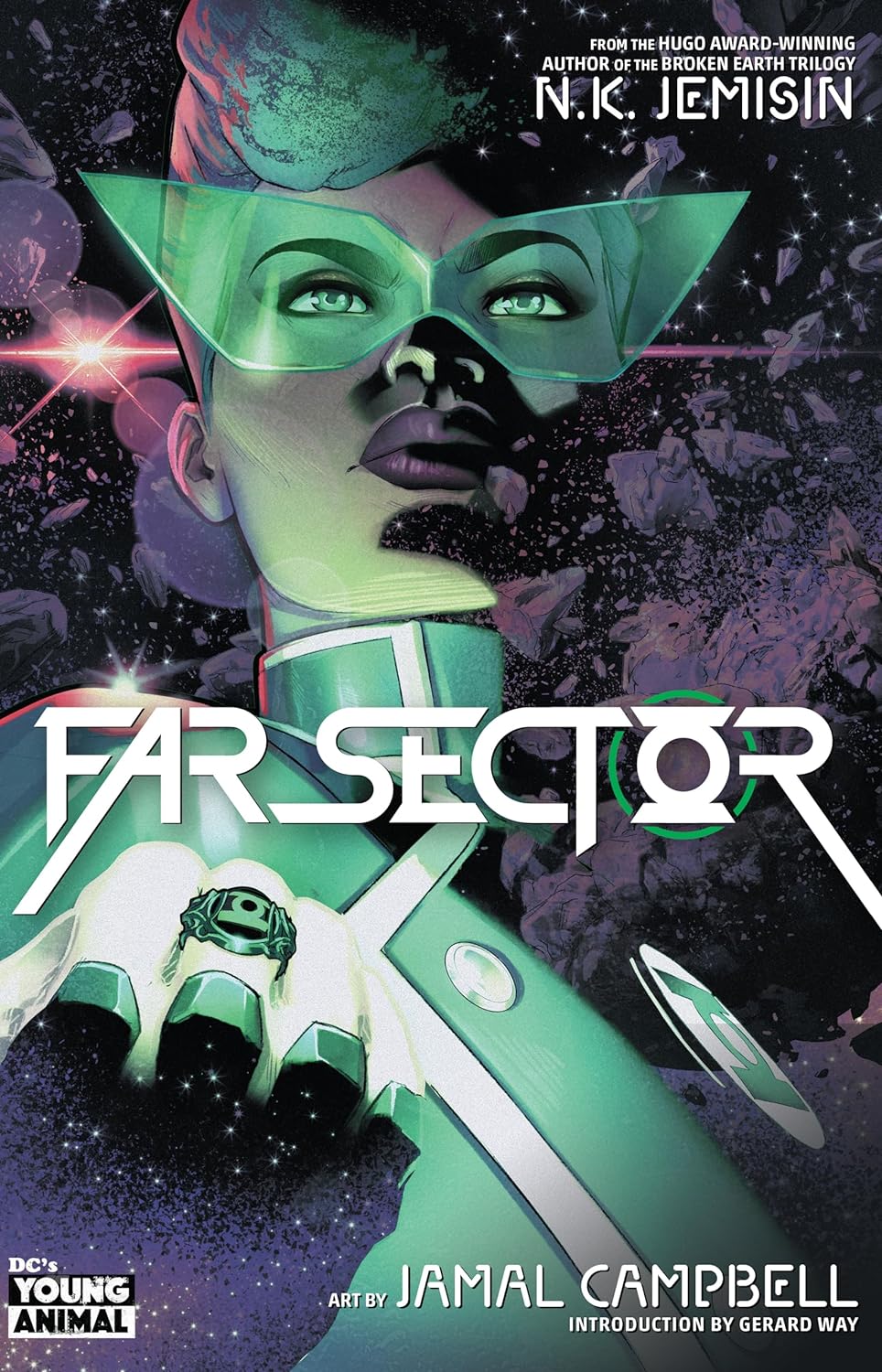
Far Sector is her twelve-issue Green Lantern series for DC, drawn by Jamal Campbell and collected in a single trade edition in 2021, which is the unit to buy. Sojourner “Jo” Mullein, a new kind of Lantern with a ring that works differently from the classic ones, polices the City Enduring, a megastructure of twenty billion souls across three species who ended their wars by engineering their own emotions away. Then the city gets its first murder in centuries, and Jo, an ex-cop with her own history, has to work the case in a society that has forgotten what feelings do.
It won the 2022 Hugo for best graphic story, her fifth Hugo and her third different category, and Campbell’s art is a running argument for the format. No Green Lantern homework is required, which makes it the rare superhero comic that works as a first comic. Completists should know the shelf’s last corners too: Mass Effect: Andromeda Initiation, a 2017 game tie-in written with Mac Walters, and Geek Wisdom, a co-written 2011 pop-culture book, both for the fully committed only.
N. K. Jemisin: Deep Dive and FAQ
What Runs Through N. K. Jemisin’s Books
The first thread is power examined from underneath. Every series builds a system, a god-owning family, a dream-tithing theocracy, a world that runs on enslaved earth-movers, a city defending itself from assimilation, and then tells the story from inside the people the system runs on. The machinery of oppression is never set dressing in these books. It is the plot, the magic system and the villain at once, and the anger driving the examination is controlled, aimed and sustained in a way the genre had not really seen before her.
The second is structure as meaning. The second-person voice, the braided timelines, the narrator choices that only explain themselves late: Jemisin’s formal experiments are never decoration, and the famous one in The Fifth Season is famous precisely because the trick and the theme turn out to be the same thing. The third is the community as protagonist. Families chosen and broken, comms, boroughs, priesthoods: her books keep asking what survival costs a group, not just a hero, and whether the world as given deserves to be saved or needs to be remade. The endings tend to answer that question honestly rather than comfortably.
Prizes and Honors
The run is the headline: Hugo Awards for Best Novel for The Fifth Season (2016), The Obelisk Gate (2017) and The Stone Sky (2018), the first three-in-a-row in the award’s history, the first trilogy to win for every volume, and with the 2016 win the first Best Novel Hugo for a Black writer. The Stone Sky added the Nebula and the Locus in 2018. Two more Hugos followed in other categories: Emergency Skin for best novelette in 2020 and Far Sector for best graphic story in 2022.
Around the run sit the Locus Award for first novel for The Hundred Thousand Kingdoms (2011), Locus wins for The City We Became (2021) and the collection How Long ’til Black Future Month? (2019), and the BSFA Award for The City We Became. The institutions then weighed in: a MacArthur Fellowship in 2020, induction into the Science Fiction Hall of Fame in 2023, and in November 2025 the SFWA named her its 42nd Damon Knight Memorial Grand Master.
Which N. K. Jemisin Editions to Buy
The novels are all in print from Orbit in the United States, in paperback, ebook and audio, so the standard editions are easy. The two purchases worth knowing about are the bundles. The Inheritance Trilogy omnibus collects all three novels plus The Awakened Kingdom in one fat volume and is the clear buy for that series. The Broken Earth is sold as a three-paperback box set, the right unit for the series most often pressed on friends whole.
The short fiction splits by format: How Long ’til Black Future Month? is a normal book, while Emergency Skin is an Amazon Original, so it lives as an ebook and audiobook rather than a standalone print volume. Far Sector’s single trade paperback collects all twelve issues, and a deluxe hardcover followed in 2025 for readers who want Campbell’s art at full size.
N. K. Jemisin on Screen
Nothing yet, despite years of motion. TNT announced a television adaptation of The Fifth Season in 2017, but the project never reached production. In June 2021 Sony’s TriStar Pictures won the film rights to the whole Broken Earth trilogy in a reported seven-figure deal, with Jemisin, unusually, adapting the novels herself. Since then the public record has gone quiet: as of October 2026 no director, cast or release date has been announced, and the books remain the only version. Given how much of the first novel’s power lives in its structure, her readers tend to treat that as the adaptation’s central puzzle, and nobody envies the person solving it, even when that person is the author.
Questions About N. K. Jemisin
What Should I Read First by N. K. Jemisin?
The Fifth Season, read as blind as you can manage, is the standard answer and the right one. If you want a gentler entry, The Hundred Thousand Kingdoms is the fast, romantic debut and The City We Became is the fun one. Only the Broken Earth books need to be read in order.
Is the Broken Earth Trilogy Fantasy or Science Fiction?
Both, famously. It reads as epic fantasy, won its Hugos in open competition with science fiction, and late revelations push it toward the border between the genres. Jemisin’s world has a geological, systematic logic that SF readers claim, and a mythic register fantasy readers claim. The honest answer is that the trilogy is the strongest modern argument that the two shelves are one shelf.
Did N. K. Jemisin Really Win Three Hugos in a Row?
Yes. The Fifth Season won Best Novel in 2016, The Obelisk Gate in 2017 and The Stone Sky in 2018. No author had ever won three consecutive Best Novel Hugos, and no trilogy had ever won for all three volumes. She was also the first Black writer to win the category.
Do the Jemisin Series Connect to Each Other?
No. The Inheritance Trilogy, the Dreamblood Duology, the Broken Earth and the Great Cities are four separate worlds with no shared continuity, which makes any of them a valid starting point. Within each series the books do connect, loosely in Inheritance and Dreamblood, tightly in Broken Earth and Great Cities.
Is There a Broken Earth Movie or TV Show?
Not yet. A 2017 TNT television project faded without production, and in 2021 TriStar Pictures took the film rights with Jemisin writing the adaptation herself. As of October 2026 there is no announced director, cast or date, so the books remain the only version.
Why Are There Only Two Great Cities Books?
The series was planned as a trilogy and Jemisin compressed it into a duology, explaining the change in a note at the end of The World We Make. The two books tell a complete story, so nothing was canceled or left unfinished.
What Is N. K. Jemisin Writing Next?
Nothing has a title or a date as of October 2026. Her most recent new fiction is the 2023 short story “Reckless Eyeballing” in the horror anthology Out There Screaming, and the Broken Earth screenplay work sits alongside whatever comes next. When a new novel is announced, this page gets updated.
Where to Go Next
The natural next step depends on which Jemisin pulled you in. Readers who came for the Broken Earth’s scale and seriousness should walk the tradition it now anchors on the epic fantasy books guide, which maps the line from Tolkien through Martin to the 2020s. If the anger and the empire-breaking are the draw, R. F. Kuang’s books run the nearest parallel track, with The Poppy War and Babel asking kindred questions at similar volume.
Readers hooked by the structural daring should try Tamsyn Muir’s books, where Gideon the Ninth and especially Harrow the Ninth play narrative games of the same order. And if the Broken Earth’s bleakness was itself the pleasure, the dark fantasy books list keeps that shelf going.