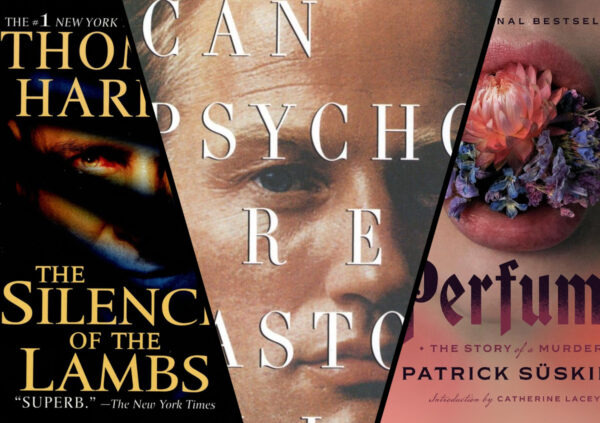
Thomas Harris has published six novels in fifty years and invented the modern serial killer thriller with two of them.
He is famously private, gives almost no interviews, and works slowly enough that a decade between books is normal. What he actually did, across Red Dragon and The Silence of the Lambs, was to fuse three things that hadn’t been combined before: the police procedural, the psychological case study, and genuine horror. Every profiler novel since is working from the template the Thomas Harris books established, and so is most of prestige television.
The other thing he did, unfortunately, was create Hannibal Lecter, and then spend two further books being unable to leave him alone. The arc of the Thomas Harris books is a writer producing two near-perfect novels and then dismantling their best invention in public.
That sounds harsh. The first two are so good that it’s worth being clear about what happened afterwards.
I haven’t read these. What follows is the critical consensus.
Fiction by René Rehn


The Short Version
Read Red Dragon. It’s the better novel and the less famous, and Dolarhyde is the best thing in the catalog.
Then The Silence of the Lambs, which is the more famous and is not far behind.
Then stop, or proceed knowing what you’re getting.
The Essential Two
Two of the Thomas Harris books changed crime fiction permanently, and they were published seven years apart.
Red Dragon (1981)

Will Graham is a former FBI investigator who left the work after catching Hannibal Lecter and nearly dying for it. He’s pulled back to consult on a killer the press has named the Tooth Fairy, who is murdering entire families in their homes on a lunar cycle.
Francis Dolarhyde is the reason to read it. Harris gives him a full and genuinely harrowing childhood, a cleft palate, a grandmother, and a belief that he is Becoming: transforming, through his killings, into the figure in Blake’s painting The Great Red Dragon and the Woman Clothed in Sun. That belief is treated seriously rather than as a symptom, and the sections from inside his head are as good as anything in the genre.
Lecter appears in perhaps five scenes, which is why he works. More on cannibal books. He is not the antagonist. He is a resource Graham has to use, and the cost of using him is the book’s real tension.
There’s also Reba McClane, a blind woman who becomes involved with Dolarhyde without knowing what he is, and their relationship is the most humane thing Harris wrote.
Filmed twice, as Manhunter in 1986 and Red Dragon in 2002, and the first is much the better film.
The Silence of the Lambs (1988)

Clarice Starling is an FBI trainee sent to interview Lecter as part of a questionnaire exercise, and is drawn into the hunt for a killer called Buffalo Bill who is skinning women.
What it adds is Clarice, and specifically the institutional texture around her: the hierarchy, Chilton’s pettiness, Crawford’s manipulation, and the constant low-grade contempt she works through. The novel is far more interested in class and in being underestimated than the film has room for.
Buffalo Bill is the case, Lecter is the negotiation, and the interview scenes are the best dialog Harris ever wrote. More on serial killer books.
It won the Bram Stoker Award. The 1991 film won all five major Academy Awards, which has happened three times in history, and that success is arguably what wrecked what came next.
What Happened Afterwards
Hannibal (1999)

Eleven years later, and the book that divides Harris’s readership permanently.
Lecter is at large in Florence. Mason Verger, a surviving victim, is pursuing him with considerable money and a plan involving pigs. Clarice’s career is being destroyed by a Justice Department official.
The problem is what the novel does with Lecter. Harris moves him from the periphery to the center, gives him an aesthete’s interior life, a sympathetic backstory involving his sister, and an eidetic memory palace, and then has the novel side with him. The ending, which is very different from the film’s, resolves Clarice’s arc in a way a great many readers found not just wrong but a betrayal of the character.
The Florence material and the Verger sections are genuinely well written. The verdict that has stuck is magnificent failure rather than bad novel.
Hannibal Rising (2006)

The prequel, and Harris has been fairly open that he didn’t want to write it.
Dino De Laurentiis held the film rights and made it clear that a Lecter origin film would be produced with or without him, so Harris wrote the novel and the screenplay simultaneously.
It follows Lecter from Lithuania in 1944, through the death of his sister Mischa at the hands of deserters who ate her during the retreat, to Paris, medical school, and the systematic killing of the men responsible.
The problem is structural rather than a failure of execution. Lecter worked because he had no explanation. Giving him a childhood trauma that accounts for everything converts the most frightening figure in modern crime fiction into a revenge protagonist with a comprehensible motive, and the reader is asked to be on his side.
The Japanese aunt and the war material are well researched. It is the weakest of the four and Harris knew it.
Before and After Lecter
The two Thomas Harris books with no Lecter in them, separated by forty-four years.
Black Sunday (1975)

His first novel, published in 1975, and there is no Lecter in it.
A Black September cell plans to detonate a shaped charge packed with rifle darts over the crowd at the Super Bowl, using the Goodyear blimp, and the pilot is an embittered American Vietnam veteran and former prisoner of war.
The research is the reason it works and it establishes what Harris would do for the rest of his career. He was a crime reporter for the Associated Press, he covered the Munich Olympics aftermath, and the novel’s technical material on explosives, on aviation, and on the mechanics of Israeli counter-intelligence is accurate enough that it caused concern at the time.
Michael Lander is also the first Harris antagonist who gets a full interior life, and the sections on his captivity and his marriage are better than the thriller around them.
Filmed by John Frankenheimer in 1977. Harris then spent six years writing Red Dragon.
Cari Mora (2019)

Thirteen years after Hannibal Rising, and it was the book that ended the longest silence in commercial fiction.
Cari Mora is a Colombian woman in Miami with temporary protected status, a former child soldier with the FARC, who caretakes a house that once belonged to Pablo Escobar. There is gold under the house. Several people want it, and one of them is Hans-Peter Schneider, who traffics women and dissolves people in a tank.
The Miami material is genuinely good. Harris has lived there, the birds and the tidal flats and the immigrant economy are precise, and Cari herself is a well-made character.
Schneider is the problem. He is a Lecter without the intelligence or the coherence, his appetites are described rather than motivated, and the novel keeps cutting to him for reasons the plot does not require.
The general reading files it as minor, with prose still exceptional at sentence level.
Where to Start
Read Red Dragon and be surprised by how much better it is than its reputation.
Then The Silence of the Lambs, which will feel familiar from the film and is doing more than you remember.
If you loved both and want more Lecter, read Hannibal knowing it will change how you feel about him, and skip Hannibal Rising entirely.
And if you want to see Harris without any of this, Black Sunday is a well-made thriller by a writer who hadn’t yet been captured by his own creation.
My best horror books list ranks the rest of the genre. Lecter is the reason half my serial killer books list exists.