Hard science fiction books are the ones where the science has to work. Not sound plausible, not gesture at plausibility, but actually hold up when someone who knows the field reads it. My best science fiction books roundup covers the wider tradition. Clarke, who built half the discipline’s foundations, has a shelf of his own on my Arthur C. Clarke books page.
Before the list, two things worth clearing up, because both come up constantly.
Hard doesn’t mean difficult. This trips up more readers than anything else about the term. The hardness refers to the hard sciences, physics, chemistry, astronomy, engineering, by analogy with the way we distinguish those from the soft sciences. It has nothing to do with reading difficulty. The Martian is a comedy you can finish in two sittings and it’s about as hard as science fiction gets. Plenty of hard science fiction novels are fast, funny reads. Gene Wolfe is one of the most difficult writers in the genre and almost none of his work qualifies.
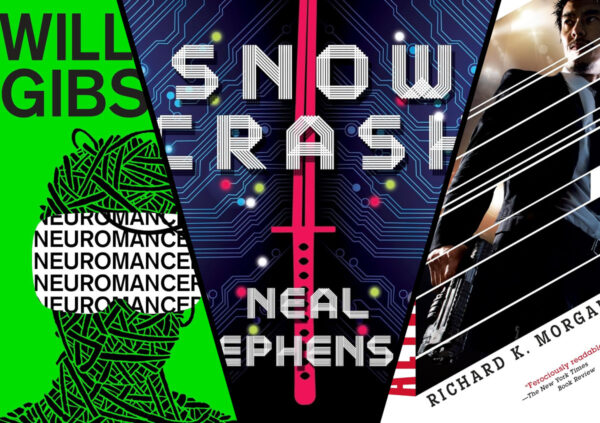
The test is whether the science is load-bearing. Take the rigor out and see whether the book survives. Remove the neuroscience from Blindsight and there is no novel left. Remove the orbital mechanics from Rendezvous with Rama and you have nothing. Compare that to Neuromancer, which is a masterpiece and is not hard science fiction: Gibson knew next to nothing about computers when he wrote it, cyberspace is a gorgeous image rather than an engineering proposal, and if you strip the tech out you still have a functioning heist novel. Predicting the future correctly is not the same as showing your work.
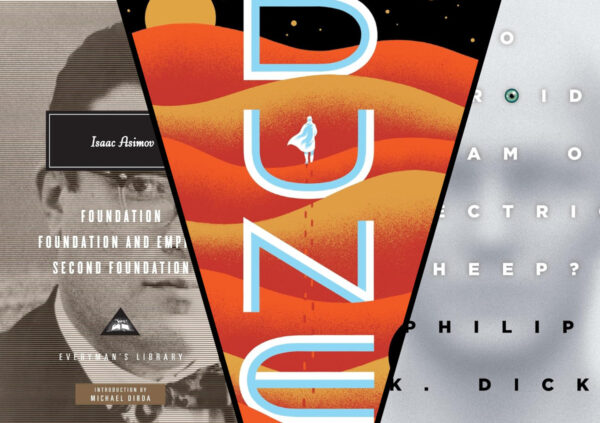
That distinction is why a lot of lists on this topic are unreliable. Foundation turns up on most of them, and psychohistory is a made-up social science that Asimov never grounds in real mathematics. Starship Troopers turns up too, and its powered armor is set dressing for a book about political philosophy. Both are excellent. Neither belongs among hard science fiction novels.
One more thing. Hard science fiction has traditionally meant physics and engineering, which quietly excludes books doing rigorous work in biology, neuroscience, linguistics, or anthropology. I think that’s a mistake, so those are included and tagged by discipline below. If you’re a purist who wants the physics-and-engineering canon only, the tags let you skip the rest.
Thirty hard science fiction novels, chronological, each one with the science that earns its place. The wider canon, hard and soft together, is on my list of the best science fiction books.
Fiction by René Rehn


The Best Hard Science Fiction Books at a Glance
| Year | Title | Author |
| 1870 | Twenty Thousand Leagues Under the Sea | Jules Verne |
| 1957 | The Black Cloud | Fred Hoyle |
| 1961 | A Fall of Moondust | Arthur C. Clarke |
| 1970 | Tau Zero | Poul Anderson |
| 1970 | Ringworld | Larry Niven |
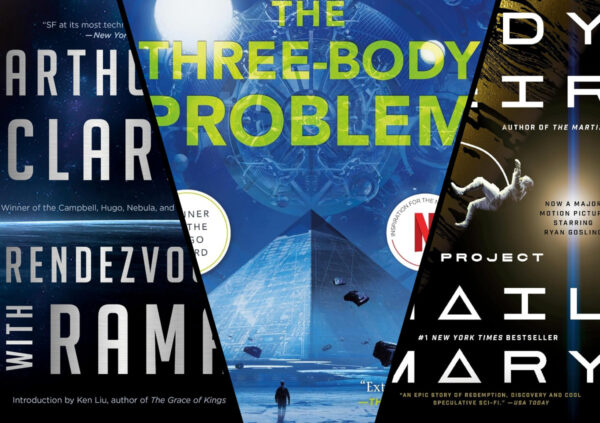
| 1973 | Rendezvous with Rama | Arthur C. Clarke |
| 1974 | The Mote in God’s Eye | Niven and Pournelle |
| 1974 | The Forever War | Joe Haldeman |
| 1979 | The Fountains of Paradise | Arthur C. Clarke |
| 1980 | Dragon’s Egg | Robert L. Forward |
| 1988 | Cyteen | C. J. Cherryh |
| 1992 | Red Mars | Kim Stanley Robinson |
| 1994 | Permutation City | Greg Egan |
| 1997 | Diaspora | Greg Egan |
| 1995 | The Diamond Age | Neal Stephenson |
| 1992 | A Fire Upon the Deep | Vernor Vinge |
| 2006 | Blindsight | Peter Watts |
| 2005 | Spin | Robert Charles Wilson |
| 2011 | The Martian | Andy Weir |
| 2021 | Project Hail Mary | Andy Weir |
| 2008 | The Three-Body Problem | Cixin Liu |
| 2015 | Children of Time | Adrian Tchaikovsky |
| 2015 | Aurora | Kim Stanley Robinson |
| 2015 | Seveneves | Neal Stephenson |
| 2008 | Incandescence | Greg Egan |
| 2002 | Schild’s Ladder | Greg Egan |
| 2008 | Anathem | Neal Stephenson |
| 2014 | Echopraxia | Peter Watts |
| 2018 | Semiosis | Sue Burke |
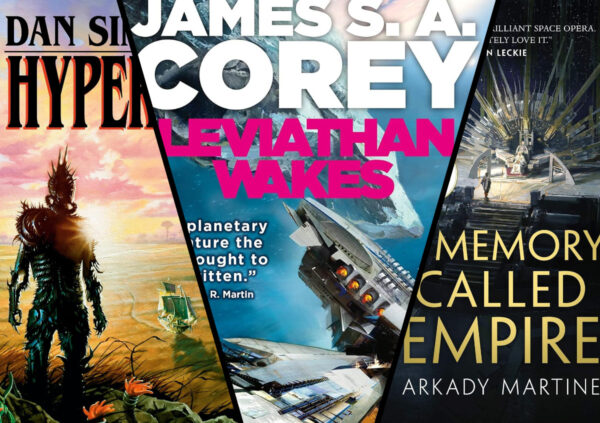
| 2011 | The Expanse: Leviathan Wakes | James S. A. Corey |
Twenty Thousand Leagues Under the Sea by Jules Verne (1870)
Discipline: engineering, marine biology

The origin of the entire mode. Verne worked out how the Nautilus generates power, replenishes its air, manages pressure at depth, and feeds its crew, and then wrote a novel in which those solutions matter.
Professor Aronnax and his companions are taken aboard by Captain Nemo and shown the ocean floor, the Antarctic, and a giant squid, while Nemo pursues a grievance against the surface world he refuses to explain.
The taxonomy is real, the engineering is worked through with a period-appropriate understanding of electricity, and Verne’s method is the founding procedure of hard science fiction books: research the thing properly, then let the research generate the plot.
Some of it is wrong, because 1870. All of it is honest, and every hard science fiction novel since works the same way.
The Black Cloud by Fred Hoyle (1957)
Discipline: astrophysics

Written by an actual astrophysicist, and it reads like it in the best way.
An enormous cloud of gas is detected moving toward the solar system on a course that will park it between Earth and the Sun, with catastrophic consequences for the climate. A team of scientists assembles to work out what it is and what can be done. Then they establish that the cloud is alive, and considerably more intelligent than they are.
Hoyle coined the term Big Bang, largely as a sneer at a theory he opposed, and he wrote fiction the way he did science: with real equations, genuine argument between researchers, and no interest whatsoever in making the process dramatic. The scientists behave like scientists, including badly.
The first contact sequence is remarkable, and unlike most hard science fiction novels the difficulty isn’t hostility: the cloud simply has no reason to have anticipated intelligence at our scale.
A Fall of Moondust by Arthur C. Clarke (1961)
Discipline: physics, engineering

Clarke’s tightest engineering problem, and a masterclass in generating tension from procedure.
A tourist cruiser on the Moon sinks into a sea of extremely fine dust, taking twenty-two people down with it. They have limited air. The surface teams have to find them, then work out how to reach them through a medium that behaves like a liquid but conducts heat like a blanket.
Everything that goes wrong goes wrong for a physical reason, and every solution is derived from the properties of the dust, the vacuum, and the equipment available.
Clarke’s lunar dust seas turned out not to exist, which is the risk of writing this close to the science. The novel works anyway, because in hard science fiction novels the reasoning matters more than the premise, and Clarke’s reasoning is sound.
Tau Zero by Poul Anderson (1970)
Discipline: relativistic physics

The purest application of a single physical principle in the genre’s history.
A colony ship using a Bussard ramjet suffers damage that leaves it unable to decelerate. The crew can only keep accelerating, and as they approach lightspeed, time dilation compresses their experience while the universe outside ages by millions, then billions of years. They watch stars die. They keep going.
Anderson takes relativity seriously and follows it all the way to the end of the universe, and the mathematics is the plot. There’s no antagonist and no mechanical failure to fix. There’s just a crew, an equation, and the consequences.
The human material is thin, which is the standard criticism of hard science fiction novels generally and a fair one here. The cosmology is unmatched.
Ringworld by Larry Niven (1970)
Discipline: physics, engineering, xenobiology

The most famous megastructure in science fiction, and the reason engineers argue about fiction at all.
An expedition investigates an artificial ring a million miles wide encircling a distant star, with a habitable inner surface three million times the area of Earth. Niven worked out the spin gravity, the shadow squares that produce day and night, the walls that hold the atmosphere, and the material strength required.
Then MIT students pointed out at a convention that his ring was dynamically unstable and would drift into its star. Niven wrote the sequel partly to fix it, incorporating attitude jets into the structure. That exchange is hard science fiction books working exactly as intended.
The Puppeteers and Kzinti are among the better-designed aliens in the genre, built from evolutionary pressures rather than costumes.
Rendezvous with Rama by Arthur C. Clarke (1973)
Discipline: physics, engineering

The genre’s purest expression of what it can do without a plot.
A cylinder fifty kilometers long falls sunward through the solar system, too smooth and too regular to be anything except built, and a crew gets a handful of weeks inside before its orbit carries it away for good.
There is no antagonist, no conspiracy, no first contact. The tension is entirely in the exploration: the cylindrical sea, the biots, the moment the interior lights come on, the working out of what each structure is for. The Coriolis effects are correct. The engineering is consistent.
The Ramans never show themselves, and Clarke never explains them, because the object was never about us in the first place.
The 1974 award season simply surrendered to it, and it remains the standard hard science fiction gets measured against for sheer sense of wonder. Clarke’s full shelf is on my Arthur C. Clarke books guide.
The Mote in God’s Eye by Niven and Pournelle (1974)
Discipline: xenobiology, evolutionary biology, physics

The best first contact novel written from the alien biology outward.
A human empire encounters the Moties, a species with specialized castes: Engineers, Mediators, Masters, Warriors, each physically adapted to its role. They’re brilliant, friendly, and hiding something structural about their species that explains their entire history.
The reveal is one of the great pieces of extrapolation in the genre, and it comes directly from biology rather than from politics. Every strange thing about Motie civilization, the cyclical collapses, the museums, the Crazy Eddie figure, follows from a single reproductive constraint.
The human characters have aged worse than the aliens, particularly the women, who are written the way 1974 wrote women. The Moties themselves remain the standard by which the genre’s alien design gets judged, and the biological reveal has never been bettered.
The Forever War by Joe Haldeman (1974)
Discipline: relativistic physics (borderline)

A borderline case, included deliberately and flagged.
The premise runs on time dilation. Mandella’s tours of duty each swallow decades of Earth time, and Haldeman builds the entire emotional architecture of the novel on that physics: a soldier who outlives his own culture without aging past thirty, watching home become a foreign country in installments. The equations are doing the structural work a plot usually does. That’s the case for inclusion.
Against it: the collapsar jumps, the stasis field, and the tachyon drive are pure handwave, and Haldeman isn’t interested in justifying them. The book is a Vietnam novel using relativity as its central metaphor.
If you’re strict about what counts among hard science fiction novels, it’s out. I think the dilation earns its place, and the novel is too good to lose on a technicality.
The Fountains of Paradise by Arthur C. Clarke (1979)
Discipline: engineering, materials science

Clarke’s third and final appearance, and his most thorough piece of engineering.
Vannevar Morgan wants to build a space elevator: a cable from geostationary orbit to a mountaintop, allowing payloads to be lifted rather than launched. The novel is about the materials problem, the political problem, the geographical problem, and the several ways a project like this kills people.
Clarke calculated the requirements properly, which is why the book is still cited in actual space elevator research. The tensile strength needed exceeded anything then available. Carbon nanotubes were discovered a decade later.
Woven through the engineering is a story about a Buddhist monastery occupying the only suitable site, which gives it a texture most hard science fiction books lack.
Dragon’s Egg by Robert L. Forward (1980)
Discipline: physics (nuclear, gravitational)

The most extreme piece of extrapolation in this list, written by a gravitational physicist.
Life evolves on the surface of a neutron star. The cheela are the size of a sesame seed, live under a gravity 67 billion times Earth’s, and are built from degenerate matter with nuclear rather than chemical reactions. Their metabolism runs a million times faster than ours, so their civilization advances from the stone age to superiority over humanity in the space of a month of human observation.
Forward derived all of it. The physics is in an appendix and it holds up. He built the biology from nuclear chemistry, the sociology from the timescale, and the tragedy from the mismatch.
The prose is functional at best and the characters are instruments, which is the trade some hard science fiction novels ask you to make. Nothing else attempts what this attempts.
Cyteen by C. J. Cherryh (1988)
Discipline: genetics, developmental psychology

The most rigorous novel about the manufacture of human beings, and a Hugo winner that far too few people have read.
Union society runs on azi: cloned humans conditioned from birth through tape-based psychological programming, occupying every level of the workforce. Ariane Emory is a councillor and the leading researcher in the field. When she’s murdered, her people attempt to recreate her: not just her genome but her exact childhood environment, in the belief that a person can be reproduced by reproducing their inputs.
Cherryh treats developmental psychology as a hard science and follows it rigorously, and the result is deeply unsettling. The book’s argument is that identity is an engineering problem, and it does not flinch from what that implies.
It’s dense, slow, and organized around laboratory politics. It’s also one of the most intelligent hard science fiction novels ever written.
Red Mars by Kim Stanley Robinson (1992)
Discipline: planetology, geology, biology, engineering

The definitive terraforming novel, and the most thoroughly researched book on this list.
A hundred colonists arrive on Mars in 2026 to begin the process of making it habitable. Robinson covers the geology, the atmospheric chemistry, the psychology of isolation, the engineering of habitats, the biology of introduced organisms, and above all the politics of who decides what a planet is for.
The central conflict is between those who want to transform Mars and those who believe it has value as it is, and Robinson gives the preservationist argument real weight rather than treating it as an obstacle.
It’s slow and it’s dense with process. The Mars trilogy is the closest hard science fiction books come to speculative nonfiction, and the areology is accurate enough that planetary scientists cite it.
Permutation City by Greg Egan (1994)
Discipline: computer science, philosophy of mind, mathematics

The most conceptually aggressive novel here, and Egan’s best.
In a near future where human minds can be scanned and run as software, copies experience subjective continuity while their originals go on living. Paul Durham is running experiments on his own copies, and he’s discovered something about the nature of computation that suggests a running mind doesn’t need coherent hardware, or a coherent timeline, to exist.
The Dust Theory that follows is one of the strangest ideas in fiction, and Egan builds it with genuine mathematical rigor rather than assertion.
He’s the most uncompromising writer of hard science fiction novels alive and the least interested in your comfort. Characters exist to instantiate arguments. The prose is clean and cold. If the ideas grip you, nothing else will do.
Diaspora by Greg Egan (1997)
Discipline: physics, mathematics, computer science

Egan again, going further out.
By the year 2975 most of humanity exists as software in polises, with a minority of gleisners in robot bodies and a few fleshers left on Earth. When a neutron star collision threatens the solar system, the polises scatter across the galaxy and eventually beyond it, into higher-dimensional spaces and toward the origin of the universe itself.
The opening chapter, describing the birth of a conscious mind from the software processes that generate it, is one of the most extraordinary things in the genre, and Egan wrote a companion set of mathematical notes for the physics.
This is the far end of hard science fiction books: a novel that expects you to follow real mathematics through five-dimensional topology, with no human comfort offered at any point.
It’s astonishing, and it is not for everyone.
The Diamond Age by Neal Stephenson (1995)
Discipline: nanotechnology, materials science

The most thoroughly imagined nanotech future in fiction.
The premise is post-scarcity by molecular assembler: matter compilers in every home, fed by a utility infrastructure called the Feed, in a world that has reorganized itself into voluntary tribes because nation-states stopped mattering. Stephenson works through the whole stack, including the immune systems societies deploy against hostile nanotech and the economics of a world where objects cost nothing and designs cost everything.
The story that runs through it follows Nell, a girl from the bottom of that world, raised by a stolen copy of an interactive book intended for an aristocrat’s daughter.
The ending collapses in the traditional Stephenson manner. As nanotech hard science fiction novels go, the world-building is unmatched.
A Fire Upon the Deep by Vernor Vinge (1992)
Discipline: physics, computer science, xenobiology

The best space opera that also qualifies as hard SF, on the strength of one enormous idea.
The galaxy is divided into Zones of Thought: regions where the possible level of computation and intelligence varies by location. In the Slow Zone, faster-than-light travel and strong AI are impossible. Further out, both work. Near the galactic core, minds decay.
That single postulate solves the genre’s oldest problem, letting Vinge write both realistic physics and interstellar civilization without cheating, and he follows the implications rigorously.
The Tines are the other achievement: a species whose individuals are packs of four to eight dog-like creatures sharing one consciousness through ultrasonic communication, with all the political and reproductive consequences worked out.
It won the Hugo, and the Zones remain the cleverest structural idea in any of these hard science fiction novels.
Blindsight by Peter Watts (2006)
Discipline: neuroscience, evolutionary biology

The best of all modern hard science fiction novels, and the one I’d hand someone first.
An alien object surveys Earth. A ship is sent to investigate, crewed by a linguist with surgically induced multiple personalities, a biologist more machine than human, a soldier, an observer who reads people by watching their surfaces, and a commander who is a resurrected vampire, a predatory human subspecies revived through genetics.
What they find is genuinely alien: entities that respond intelligently, converse fluently, and appear to have no consciousness at all. They process, model, and act, and nobody is home.
That’s the argument, and it’s why the book matters. Watts, a marine biologist by training, proposes that consciousness isn’t the crown of evolution but an expensive malfunction, a bottleneck a sufficiently sophisticated intelligence would be better off without. The aliens are smarter than us precisely because they aren’t aware. The bibliography runs to 144 references and it isn’t decoration.
My one real complaint is the vampires. They’re justified in-universe at length with a genuine biological rationale, and I still spent the book asking why they were there and what the novel would actually lose without them. Not much, I think.
Everything else is exceptional: the ship, the technology, the aliens, and the central question. Watts released it free online, where it still is.
Spin by Robert Charles Wilson (2005)
Discipline: astrophysics, cosmology

A Hugo winner built on one of the best opening premises in the genre.
The stars go out. A membrane has enclosed the Earth, and inside it time runs roughly a hundred million times slower than outside, meaning the sun will exhaust itself within a human lifetime as experienced on the ground. Three childhood friends respond differently: one falls apart, one turns to religion, and one starts terraforming Mars, because a few years inside the Spin is hundreds of millions of years outside.
The physics of the time differential is worked through properly and generates the plot’s best ideas, including a Mars colonization program that can be launched and reported on within a single afternoon.
It’s also a warm novel about friendship and mortality, which is rarer among hard science fiction books than the genre admits.
The Martian by Andy Weir (2011)
Discipline: chemistry, botany, orbital mechanics, engineering

The most purely enjoyable hard science fiction book ever written, and the one that brought the subgenre back to a mass audience.
Mark Watney is left for dead on Mars when his crew evacuates during a storm. He isn’t dead. He has a habitat rated for thirty-one days, food for considerably less, and four years before anyone could reach him.
What follows is problem after problem solved with chemistry, botany, and improvisation, all of it checked. Weir calculated the orbital mechanics himself, worked out the water reclamation, and the potato farming is sound apart from a few known shortcuts. The one significant cheat is the opening storm, since Martian atmospheric pressure couldn’t produce those winds, and Weir has admitted it freely.
It’s also very funny, which is why it worked commercially where drier hard science fiction novels didn’t. The subgenre doesn’t have to be austere.
Project Hail Mary by Andy Weir (2021)
Discipline: physics, astrobiology, chemistry

Weir again, and better.
Ryland Grace comes to aboard a ship he can’t name, with two dead crewmates and a mission he only gradually remembers accepting: an organism is consuming the sun’s output, and he is what’s left of the response. The memory recovery is the structural device and the science is the substance: astrophage biology, relativistic travel, the chemistry of an alien environment.
The middle section, in which Grace and another party work out how to communicate from first principles with no shared frame of reference, is the best thing Weir has written and one of the best treatments of the problem in the genre.
More rigorous than The Martian and warmer. If someone tells you hard science fiction novels are cold, hand them this.
The Three-Body Problem by Cixin Liu (2008)
Discipline: physics, astronomy, mathematics

The Hugo’s first winner in translation, and the proof that rigorous physics could anchor a global bestseller.
The story begins with a daughter watching ideology kill her father in the Cultural Revolution, and tracks what that does to her faith in the species through the decades that put her in front of a radio telescope with a choice to make. The contemporary thread drops a physicist into a virtual reality game where players attempt to build civilization under three suns, calculating the stable eras and burning in the chaotic ones.
The titular problem is real orbital mechanics: three gravitating bodies produce motion that has no general closed-form solution, and Liu builds an entire alien civilization’s history on that instability.
The sophon is the most audacious idea in recent hard science fiction books, a proton unfolded into higher dimensions and re-etched as a computer, and Liu walks through the dimensional geometry required to do it.
Characterization is functional, which loses some readers. The ideas justify it.
Children of Time by Adrian Tchaikovsky (2015)
Discipline: evolutionary biology, zoology

The best evolutionary biology in fiction, written by a zoologist.
A terraforming project’s uplift virus misses its intended monkeys and takes root in the local spiders instead, and the novel commits to the consequences at full evolutionary scale: each chapter jumps generations, following the growth of language, mathematics, and faith among creatures with eight legs, while the remnant of humanity closes in aboard an ark ship running out of everything.
The spiders are the achievement and the reason it’s here. Their society is derived from actual spider biology: communication by web vibration, chemical inheritance of learned information, and a sexual politics arising directly from the fact that males are small and edible. Every cultural development follows from a biological fact.
The human chapters are deliberately weaker, and by the midpoint you’re rooting for the spiders. It won the Arthur C. Clarke Award.
Aurora by Kim Stanley Robinson (2015)
Discipline: ecology, biology, engineering

The generation ship novel that argues generation ships won’t work.
A ship approaching Tau Ceti after 160 years carries the descendants of its original crew, and the biology is failing: soil chemistry degrading, disease evolving faster than medicine, ecosystems too small to remain stable, and the population’s collective knowledge eroding.
Robinson’s argument is that closed ecological systems of this scale are thermodynamically doomed, and that the fantasy of interstellar colonization ignores what an ecosystem actually requires. It’s the most pessimistic of recent hard science fiction novels and the most thoroughly reasoned.
It made a lot of readers angry, which is usually a sign the argument landed. Narrated partly by the ship’s AI, whose developing consciousness is the book’s emotional core.
Seveneves by Neal Stephenson (2015)
Discipline: orbital mechanics, genetics, engineering

Stephenson’s most extreme engineering novel, and the one with the sharpest quality split.
The moon breaks apart for reasons never explained. Within two years the fragments will collide enough to bombard Earth with a rain of meteorites lasting five thousand years. Humanity has that long to put a viable population into orbit.
The first two thirds are superb: orbital mechanics, delta-v budgets, radiation shielding, and the politics of a species organizing its own survival, all worked through in obsessive detail. Stephenson consulted with actual aerospace engineers and it shows.
The final third jumps five thousand years and reads like a different, worse book. Most readers say to stop at the time skip, and most readers are right.
The first two thirds are worth it alone, and they’re as good as engineering-driven hard science fiction books get.
Incandescence by Greg Egan (2008)
Discipline: physics (general relativity)

Egan’s third appearance and the hardest book on this list, deliberately placed near the end.
A species living inside a rocky world orbiting a black hole must discover general relativity from scratch, using only what they can observe from inside their own habitat, in order to understand why their orbit is decaying and save themselves.
The novel is essentially a derivation. You watch a civilization construct relativistic physics from first principles through observation and reasoning, and Egan expects you to follow the argument.
There is no other book like it among hard science fiction novels, and it is not for most readers. If the idea of watching aliens derive Einstein sounds thrilling rather than exhausting, this is the summit.
Schild’s Ladder by Greg Egan (2002)
Discipline: quantum physics, mathematics

Included briefly because Egan’s catalog is deep and readers who click with him want the map.
A physics experiment produces a novo-vacuum, a region of space with different fundamental physics that expands at half the speed of light, consuming inhabited worlds. The question is whether the new vacuum contains life of its own, and therefore whether stopping it would be genocide.
The plot engine is quantum graph theory, played entirely straight. The human stakes ride on Tchicaya and Mariama, childhood friends who end up on opposite sides of the preserve-or-destroy argument, which is as close as Egan comes to writing a love story. Read Permutation City and Diaspora first.
Anathem by Neal Stephenson (2008)
Discipline: mathematics, philosophy, physics

A thousand pages set in a world where mathematicians and scientists live in monastic concents, sealed away from a secular society that has cycled through several collapses.
Erasmas is a young avout inside one such concent when something appears in the sky and the outside world comes looking for the mathematicians.
The book is genuinely about mathematics and the philosophy of it: Platonism versus formalism, the many-worlds interpretation, and configuration space, all worked into the plot rather than discussed alongside it. Stephenson invents vocabulary for everything, which is a barrier of about a hundred pages.
Its treatment of consciousness and quantum mechanics is speculative rather than established, so purists may object. The mathematics is real.
Echopraxia by Peter Watts (2014)
Discipline: neuroscience, biology

The parallel novel to Blindsight, set on Earth and in the solar system during the same period.
A field biologist gets caught between a hive-mind monastic order running experiments on physics, a vampire, and a military augment, on a ship heading toward the sun.
It’s messier than Blindsight and more argumentative, and it extends the same thesis about consciousness into free will and religious experience. Watts is if anything more rigorous here, with an even longer bibliography. Daniel Brüks, the baseline biologist, spends the novel as the only unaugmented mind in the cast, which is the point: the book keeps asking what a legacy human is still for.
Read Blindsight first. If you want more of that specific vertigo, this is where it is.
Semiosis by Sue Burke (2018)
Discipline: botany, ecology, evolutionary biology

The best recent hard SF built on plant science.
Human colonists arrive on a planet where the dominant intelligence is vegetal. Across multiple generations, told through successive narrators, the colony negotiates a relationship with a bamboo species that turns out to be intelligent, manipulative, and considerably more patient than they are.
Burke’s botany is rigorous, and the plant’s intelligence is derived from real plant biology: chemical signaling, resource allocation, and the long timescales on which vegetation actually operates. The negotiation between species is genuinely alien because the timescales don’t match.
Few people have read it, and no hard science fiction novel has given a better answer to what non-animal intelligence might actually be like.
The Expanse: Leviathan Wakes by James S. A. Corey (2011)
Discipline: orbital mechanics, physics (borderline)
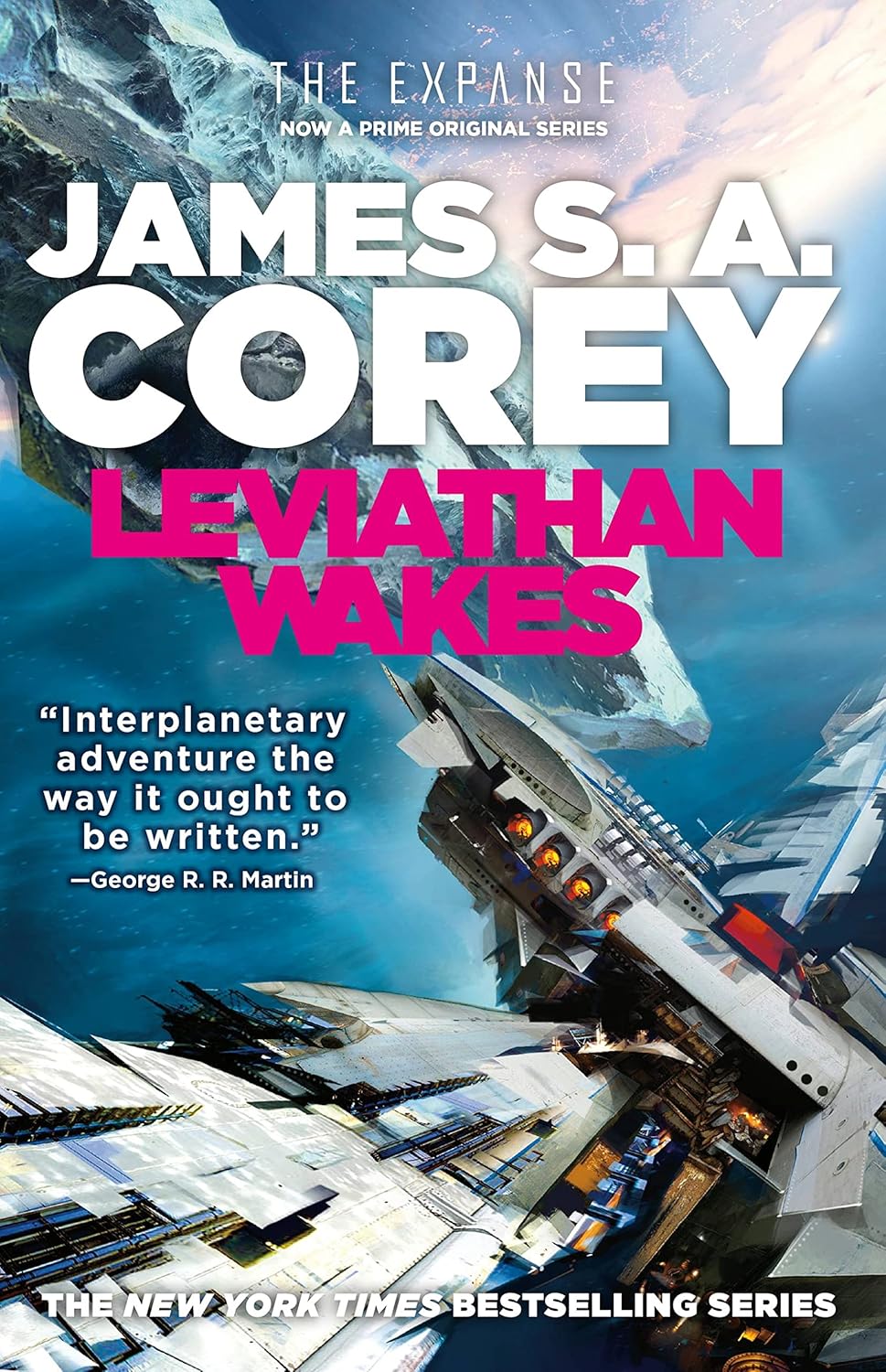
The last borderline case, flagged like the first.
A colonized solar system, divided between Earth, Mars, and the Belt, where a missing-persons case and a derelict ship expose something that will reorganize everything. The ships use realistic thrust and reaction mass, the travel times are correct, the effects of sustained high-g burns on human bodies are handled properly, and the politics of water and air in the Belt drive the plot.
Against it: the protomolecule is functionally magic, and the Epstein Drive is an efficiency handwave that makes the whole setting possible.
The system-wide physics is rigorous enough that I’d include it. Purists will disagree, which is why it’s tagged.
If you want the pure canon, the physics-and-engineering entries above are where to start: Clarke, Forward, Egan, Niven, Weir. If you want the argument that biology and neuroscience count, start with Blindsight, Children of Time, and Cyteen. Both traditions are doing the same thing, which is taking the world seriously enough to work it out.
Where to Go Next
The space opera list carries the books where the physics serves the scale instead of the other way around, and the biology-first strand continues on the biopunk list.