Arthur C. Clarke books present the opposite problem to most author guides. He wrote around seventy of them across six decades, a substantial number are collaborations he barely touched, and the sequels to his two most famous novels are considerably worse than the originals. So this is not a complete list of the Arthur C. Clarke books. It is the fiction worth your time, with the weak material named rather than quietly omitted, because a guide that recommends everything is useless.
He was a physicist and mathematician by training, published the paper proposing geostationary communications satellites in 1945, twenty years before anyone launched one, and spent the second half of his life in Sri Lanka. He won every award the field has, and the Arthur C. Clarke Award is named for him. His best books sit high on my list of the best science fiction books, and the engineering-first tradition he perfected runs through my hard science fiction roundup.
Fiction by René Rehn


The Short Version
Read Rendezvous with Rama for the purest version of what Clarke was for: exploration, engineering, and the sense of scale. Read Childhood’s End for the version that stays with you longest, a self-contained novel with one of the strangest endings in the genre. Read The City and the Stars for the most beautiful of his books, and the Collected Stories whenever you want to know what he could do in fifteen pages. Save 2001 for after you know his range, not before.
Arthur C. Clarke Books in Order
The table keeps to the solo fiction and the essential nonfiction. The late collaborations are covered, honestly, further down.
| Year | Title | Type | Notes |
| 1951 | The Exploration of Space | Nonfiction | Book of the Month Club |
| 1951 | Prelude to Space | Novel | |
| 1951 | The Sands of Mars | Novel | |
| 1953 | Childhood’s End | Novel | His first major success |
| 1953 | Against the Fall of Night | Novel | Rebuilt as The City and the Stars |
| 1955 | Earthlight | Novel | |
| 1956 | The City and the Stars | Novel | |
| 1957 | The Deep Range | Novel | |
| 1957 | Tales from the White Hart | Stories | |
| 1961 | A Fall of Moondust | Novel | |
| 1962 | Profiles of the Future | Nonfiction | Source of the Three Laws |
| 1963 | Glide Path | Novel | His one non-SF novel |
| 1963 | Dolphin Island | Novel | Juvenile |
| 1968 | 2001: A Space Odyssey | Novel | Written alongside the film |
| 1972 | Rendezvous with Rama | Novel | Swept the 1973-74 awards |
| 1975 | Imperial Earth | Novel | |
| 1979 | The Fountains of Paradise | Novel | Hugo and Nebula |
| 1982 | 2010: Odyssey Two | Novel | Filmed in 1984 |
| 1986 | The Songs of Distant Earth | Novel | |
| 1987 | 2061: Odyssey Three | Novel | |
| 1990 | The Ghost from the Grand Banks | Novel | |
| 1993 | The Hammer of God | Novel | |
| 1997 | 3001: The Final Odyssey | Novel | |
| 2000 | The Collected Stories | Stories | The one-volume short fiction |
Where to Start With Arthur C. Clarke
Two books, and they do different things.
Rendezvous with Rama if you want the purest version of what Clarke was for: exploration, engineering, and the sense of scale. It’s the one I’d hand anyone first.
Childhood’s End if you want the version that will stay with you longest. It’s self-contained, it asks nothing of you in advance, and its ending is one of the strangest in the genre.
Not 2001. It’s his most famous novel and it’s famous for being the film’s companion piece, written alongside Kubrick’s screenplay rather than before it. It’s good. It is not the Arthur C. Clarke book his reputation should rest on, and readers who start there often come away thinking he’s flatter than he is.
Clarke’s Life, Briefly
Arthur Charles Clarke was born in Minehead, Somerset, on December 16, 1917, a farm boy who built telescopes and read the American pulps. The war made him a radar man: from 1941 to 1946 he served in the RAF, working on the ground-controlled approach system that talked aircraft down through fog, an experience he later fictionalized in Glide Path. In October 1945, still in uniform, he published “Extra-Terrestrial Relays” in Wireless World, the paper proposing communications relays in geostationary orbit. The orbit now informally carries his name, and he spent the rest of his life cheerfully noting that he never patented a thing.
After the war came a first-class degree in mathematics and physics at King’s College London, two early careers as an indexer and an editor, and the writing. In 1956 he moved to Ceylon, later Sri Lanka, for the diving, and stayed for fifty years, running a dive school, writing about the reefs, and becoming the island’s most famous resident. The 1968 collaboration with Stanley Kubrick made him the most visible science fiction writer alive, and the 1980s television series on unexplained phenomena made his voice familiar to people who never read him.
The honors stacked up accordingly: the field’s awards, a knighthood announced in the 1998 New Year Honours and conferred in Colombo in 2000, and the naming of the Arthur C. Clarke Award, which he endowed in 1986 for the best science fiction novel published in Britain. He died in Colombo on March 19, 2008, at ninety, having outlived the century he spent his life predicting.
The Essential Novels
Rendezvous with Rama (1973)

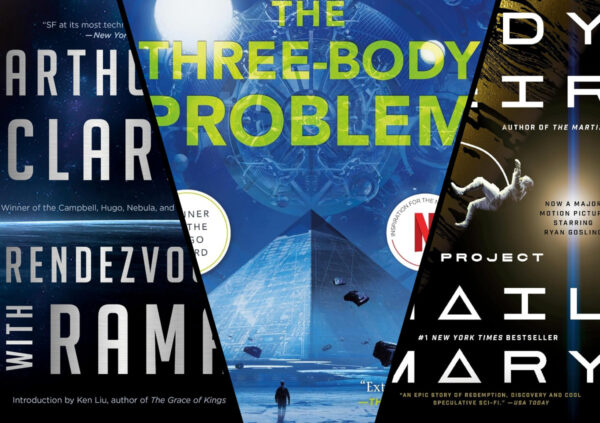
The best of all the Arthur C. Clarke books, and the purest thing hard science fiction has done without a plot. In 2130 an early-warning system built to track asteroids picks up something on an orbit that shouldn’t exist, and by the time anyone gets close it’s clear the object is manufactured. Commander Norton and the crew of the Endeavour have a matter of weeks before it rounds the sun and accelerates away.
What I love about it is how little Clarke does. There is a moment where the crew descend a staircase built into the end wall of an enclosed world and simply keep going down, for kilometers, and the whole novel is that: careful people looking at something enormous and trying to work out what it is for. He never manufactures a crisis to hold your attention, and the confidence that takes is remarkable.
The politics on the outside, committees arguing about whether to destroy it, are the weakest thread and Clarke seems to know it. The interior is where everything happens. Nobody ever meets the builders. The object was not sent to us, we are not important to it, and it goes on its way. That refusal is why the book lasts.
It swept the awards for its year: Hugo, Nebula, Locus, BSFA, Campbell, Jupiter. Skip the sequels. Rama II and the two that follow were written with Gentry Lee, they’re conventional character-driven novels bolted onto a premise that worked because it refused exactly that, and they undo the first book’s central achievement by explaining things. Rama also sits near the top of my best science fiction books list.
Childhood’s End (1953)

His first major success and the novel he named as a personal favorite. Karellen speaks to humanity for half a century without being seen. He is patient, courteous, faintly amused, and he does not answer questions about his appearance. Under his administration the arms race stops, hunger ends, cruelty to animals is abolished by direct intervention, and the species enters what everyone calls the Golden Age.
Clarke is unusually good on what a solved world does to people. Nobody needs to work. Art becomes decorative. A generation grows up with nothing left to struggle against, and the novel is quietly clear that this is a loss even as it insists the suffering wasn’t worth keeping. Then the Overlords reveal themselves, and the reason for the delay is a very old joke about how humans have always pictured a particular shape.
The last movement is the reason people still argue about the book. What arrives isn’t an invasion or a betrayal. It’s a change in the children, and the parents cannot follow them and are not meant to. Syfy eventually filmed it as a 2015 miniseries, which proved mostly how resistant the material is to a screen.
The City and the Stars (1956)

The most beautiful of the Clarke books, and a rewrite of his own first novel. A billion years in the future, the city of Diaspar is the last human settlement: enclosed, eternal, and running on machinery nobody understands any more. Its citizens are stored as patterns in a central computer and reborn at intervals, and they have all lived many lives. Nobody has left in a billion years, because everyone in Diaspar is terrified of the outside.
Alvin is the first genuinely new person born in ten million years, and he wants to know what’s out there.
Clarke first published this as Against the Fall of Night in 1948 in magazine form, then rebuilt it entirely. The later version is the one to read. The moment Alvin gets out of the city, and what he finds, is the best sequence in his fiction.
The Fountains of Paradise (1979)

The Fountains of Paradise is his most thorough piece of engineering, and a novel he ranked among his own favorites. Morgan is an engineer with one enormous idea and no gift whatsoever for people, which makes him an unusual protagonist for a novel that is essentially a construction project. He has already built the longest bridge on Earth. What he wants now is a tower reaching orbit, and the only viable anchor point on the planet is the summit of a mountain occupied by a monastery that has been there for three thousand years and declines to move.
Clarke sets it on a fictionalized Sri Lanka, where he had lived for decades, and threads in a parallel narrative about an ancient king who built a palace on the same rock, which gives the engineering an unexpected melancholy.
The technical case, and why researchers still cite the book, is covered on my hard science fiction list. What that list can’t capture is this side of it: a story about a man who can hold a cable’s load tables in his head and cannot hold a conversation, set against three thousand years of other people’s ambitions on the same mountain. The sequence where something goes wrong partway up, and the rescue has to be improvised at altitude, is as tense as anything he wrote. Hugo and Nebula, and both earned.
2001: A Space Odyssey (1968)

The famous one among the Arthur C. Clarke books, written alongside Kubrick’s film rather than adapted from or into it, with “The Sentinel,” a short story from 1948, as the shared seed. A monolith is discovered on the Moon. A ship is sent outward. The onboard computer, HAL 9000, has been given contradictory instructions and resolves the contradiction in the way a machine would.
The novel explains things the film deliberately doesn’t, which is either its great advantage or its central weakness depending on who you ask. Clarke tells you what the monoliths are, what happened to Bowman, and why HAL failed, and the mystery contracts accordingly.
It’s a good novel and a strange artifact: a book that exists as one half of a collaboration and can’t quite be read without the other. The sequels, 2010, 2061, and 3001, decline steadily, though 2010 is decent and answers questions a lot of readers wanted answered. It gets its own entry below.
A Fall of Moondust (1961)

The most underrated of the Arthur C. Clarke books, and the one that shows he could write people when he wanted to. The Selene is a sightseeing boat that carries tourists across a lunar dust basin, and a moonquake drops it under the surface with everyone aboard.
The rescue occupies half the novel: the search, the heat-detection scheme that locates them, the improvised drilling. The other half belongs to the twenty-two people inside, and it’s the half his reputation says he couldn’t write. Air is finite, the temperature is rising because the dust holds heat, and a competent commodore among the passengers organizes entertainments to stop anyone thinking about the arithmetic. The moment they realize the insulation problem is worse than the air problem is one of the best reversals in his fiction.
The dust-sea premise didn’t survive the lunar probes, and I’ve covered why that doesn’t sink the book on my hard science fiction list, where it also earns a place. Here it’s enough to say that the passengers, not the physics, are what you remember.
The Songs of Distant Earth (1986)

Clarke’s other stated favorite, and the most emotionally direct of the Clarke books. Earth is gone, destroyed by the sun going nova, a catastrophe humanity had six centuries of warning about. Thalassa is an ocean world colonized by seedships launched during that window, and its people have been living peacefully for generations with no memory of the disaster. Then the Magellan arrives, carrying a million sleeping refugees from the final evacuation, needing to stop only long enough to build a shield of Thalassan ice.
The novel is about the encounter between people who lost everything and people who never knew it existed, and Clarke handles the resulting relationships with more warmth than he usually allowed himself. He described it as the only one of his novels he’d want filmed properly. It has an unusual claim to fame in that Mike Oldfield made an album of it.
The Second Shelf
Six more that reward the trip once the essentials are read. None is required, and each has something none of the famous books do.
2010: Odyssey Two (1982)

2010: Odyssey Two is the one worthwhile Odyssey sequel, written after the Voyager probes rewrote the outer solar system and visibly energized by them. A joint Soviet-American crew flies to salvage the derelict Discovery, wake HAL, and answer for what was done to him, and the HAL material lands with real feeling: the computer gets the fairest hearing in the series, and his handler Chandra makes the case that the machine was betrayed before it betrayed anyone.
Peter Hyams filmed it competently in 1984. The book’s closing pages, and the famous final transmission about which world to leave alone, give the series its one genuinely mythic moment after the first book. Stop after this one, though. 2061 and 3001 are for completists only, and the skip section below says why.
Earthlight (1955)

Earthlight stages an interplanetary cold war on the Moon, where an accountant is sent to find a leak at a lunar observatory while Earth and the planetary Federation edge toward the genre’s politest war. The spy plot is serviceable. What everyone remembers is the battle, a single engagement watched from the observatory windows, one fortress against three ships, fought with physics instead of noise.
It stood for decades as the genre’s best space battle precisely because Clarke refused to choreograph it like one. It is a minor novel with an immortal set piece, and the right second-shelf pick for readers who came through the hard SF door. The lunar-dome daily life of its first half, grumbling staff and supply runs, also reads as a dry run for A Fall of Moondust’s working Moon.
The Deep Range (1957)

The Deep Range is the ocean book, with a grounded ex-astronaut rebuilt as a warden on the whale ranches that feed a crowded Earth, patrolling herds by submarine. It is Clarke’s diving life turned into a future, and the procedural texture, sea fences, plankton farms, a hunt for something enormous out of the deeps, is as satisfying as his orbital engineering.
The last act turns, decades ahead of schedule, on a Buddhist challenge to the ethics of the whole enterprise, and the book takes the challenge seriously. It is the quiet sleeper of the catalog for readers who liked A Fall of Moondust’s working-world mode. Clarke called the sea his other space, and this is the book where that equation runs longest and warmest.
The Hammer of God (1993)

The Hammer of God is late, lean Clarke: the asteroid Kali is found on an Earth-crossing orbit, and the spacecraft Goliath is sent to push it off course, with a religious movement back home arguing the rock should be allowed to arrive. Grown from a short piece he wrote for Time, it runs barely two hundred pages and reads like a precis of every later asteroid thriller, written before most of them. The characterization is thin even by his standards and the orbital mechanics are the real protagonist, which, this late in the catalog, is exactly what his readers came for. The best of the final solo novels by a clear margin.
Glide Path (1963)

Glide Path is the one novel with no science fiction in it at all. A young RAF officer in 1943 helps field the ground-controlled approach radar that talks bombers down through fog, which is to say it is Clarke’s own war, lightly fictionalized.
The technical suspense works exactly like his space rescues, instrument readings and improvisation against weather and time, and the portrait of American radar crews colliding with English weather has real charm. For readers of the Arthur C. Clarke books it is a curiosity with a payoff: the engineer’s temperament that built the fiction, shown at its source. It is also the only place in the catalog to watch him write characters with no cosmos behind them, and the self-portrait in young Alan Bishop is more candid than any interview he gave.
Tales from the White Hart (1957)

Tales from the White Hart is the pub book. In a London pub a man named Harry Purvis tells scientific tall tales, each one escalating from a plausible premise to a catastrophic punchline, and the regulars fail to catch him in a lie. It is Clarke’s humor collection, closer to Wodehouse than to Rama, and the best entries, the sound weapon, the flatly disastrous inventions, show how funny the engineering mindset can be when pointed at itself. It is completist territory, cheerfully, and the one Arthur C. Clarke book to hand someone who thinks he was all cathedral solemnity. Several of the tall tales began as genuine pub performances, and the book keeps that late-evening cadence on the page.
The Short Fiction
The Collected Stories of Arthur C. Clarke (2000)

The best single purchase among all the Arthur C. Clarke books. Over a hundred stories spanning six decades, from the early magazine pieces through to his late work, and Clarke was arguably a better short story writer than novelist. The form suited an author whose real subject was the single startling idea.
“The Nine Billion Names of God” is the best of them: a computer is leased to a Tibetan monastery to complete a task the monks believe will end the universe, and the closing line is the most perfect ending in science fiction. “The Star” won the Hugo and concerns a Jesuit astrophysicist who has discovered which star’s destruction lit the sky over Bethlehem. “The Sentinel” is the seed of 2001. “Rescue Party,” his first sale, has an ending readers still quote.
If the novels don’t work for you, the stories might, and it’s a better test of whether Clarke is your writer than any single novel is.
The Nonfiction
Profiles of the Future (1962)

Profiles of the Future is the best of the nonfiction Clarke books, and the source of his Three Laws. It gathers essays on the limits of prediction, arguing that failures of imagination are more common than failures of nerve, and it contains the line everyone knows: any sufficiently advanced technology is indistinguishable from magic.
Much of it has been overtaken. That’s fine, because the book is really about how to think about the future rather than about any specific forecast, and the reasoning holds even where the conclusions don’t. The chapters on transport and communication show the method at its best, each one a controlled walk from the known to the barely imaginable, and the revised editions track which walls moved.
The Exploration of Space (1951)

The Exploration of Space is historically significant and now mostly of period interest. It was a Book of the Month Club selection, made spaceflight legible to a general readership before anyone had achieved it, and it’s the book that established Clarke as a public advocate for the space program rather than only a novelist.
Read it as an artifact of the moment spaceflight moved from pulp to engineering, with Clarke as its calmest advocate. Its sales and that Book of the Month stamp mattered: they put orbital mechanics in living rooms years before Sputnik. The 1945 paper proposing geostationary satellites, published in Wireless World, is the more remarkable document and it’s freely available.
Arthur C. Clarke: Deep Dive & FAQ
What to Skip
Worth saying plainly, because most guides won’t.
The Rama sequels undo the original. Imperial Earth (1975) is widely regarded as the weakest novel of his prime years, slow and structurally inert. The late collaborations, the Time Odyssey books with Stephen Baxter, The Light of Other Days, and The Last Theorem, are variable, and the ones published in his final decade were substantially written by his co-authors while he was in poor health. The same goes for 2061 and 3001, which have moments and do not need to exist.
That’s not a criticism of Clarke, who was open about the arrangements, and it doesn’t diminish the Arthur C. Clarke books that matter. It’s a reason to start elsewhere.
What Runs Through Clarke’s Books
The first constant is scale, handled with manners. The signature Clarke scene is a competent professional looking at something overwhelming, an alien cylinder, a billion-year city, the wreck of the Earth, and taking careful notes instead of screaming. The emotion arrives through the restraint, and when he lets awe fully off the leash, as at the end of Childhood’s End, it hits harder for all the preceding calm.
Under that runs an engineer’s faith that the universe is comprehensible and a mystic’s suspicion that comprehension has a ceiling. The famous Clarke move is to ride rigorous extrapolation upward until it quietly becomes religious experience, transcendence reached by load calculation. Optimism, too, of a specific kind: wars and stupidities are local weather, and the species’ trajectory is outward.
And everywhere the real hero is the project rather than the person, the satellite network, the space elevator, the first contact protocol, which is why his thin characters rarely hurt the books that matter. The Arthur C. Clarke books are about what people can do together with physics, and on that subject nobody has written better.
Prizes and Honors
Rendezvous with Rama swept the field’s awards across 1973 and 1974, the Hugo, Nebula, and the rest of the shelf, and The Fountains of Paradise took the Nebula for 1979 and the Hugo in 1980. “The Star” won the 1956 Hugo for short story. SFWA named him Grand Master in 1986, and the knighthood came in the 1998 New Year Honours, conferred at a Colombo ceremony in 2000.
The honor that outlasts the rest is infrastructure: the geostationary belt is informally called the Clarke Orbit, after the 1945 paper written by an RAF officer who asked for no patent, and the Arthur C. Clarke Award, which he endowed in 1986, remains Britain’s sharpest science fiction prize.
Which Arthur C. Clarke Editions to Buy
Nothing here requires edition hunting. The current trade paperbacks cover the essentials, Rama and Childhood’s End and 2001 rotate through handsome reissues constantly, and the one purchase that genuinely upgrades a shelf is the single-volume Collected Stories, which stays in print and replaces a dozen overlapping older collections.
Secondhand readers should favor the solo-era printings for the covers and check one thing on The City and the Stars: that they are buying the 1956 rebuild rather than Against the Fall of Night, unless they want both versions of the same dream, which is a legitimate way to read Clarke.
Clarke on Screen
The screen record holds one masterpiece, made with him rather than from him: 2001, co-written with Kubrick, the rare case where film and novel are twin originals. 2010 followed in 1984 as a solid, literal-minded adaptation, and Syfy’s 2015 Childhood’s End miniseries mostly demonstrated why the book was called unfilmable for sixty years. Rama adaptations have been announced and unannounced for decades, which fits a novel whose point is that the thing does not care whether we understand it.
His own screen presence did as much as the adaptations: the Mysterious World series made him television’s resident skeptical futurist in the 1980s, and his satellite-linked interviews from Sri Lanka made the Clarke Orbit a lived demonstration.
Questions About Arthur C. Clarke
Where Should I Start With Arthur C. Clarke?
Rendezvous with Rama or Childhood’s End. Rama for exploration and engineering, Childhood’s End for the long haunting. 2001 reads better once you already know his range.
What Is Arthur C. Clarke’s Best Book?
Rendezvous with Rama by consensus, with Childhood’s End as the perennial challenger and The City and the Stars as the connoisseur’s vote. Clarke’s own picks ran to The Fountains of Paradise and The Songs of Distant Earth, depending on the year he was asked.
Are the Rama Sequels Worth Reading?
No. Rama II and its follow-ups, written with Gentry Lee, explain the mystery the original refused to explain, and they trade its austerity for conventional melodrama. The first book stands alone by design.
Did Clarke Really Invent the Communications Satellite?
He proposed using the geostationary orbit for radio relays in a 1945 Wireless World paper, two decades before the hardware existed, and the orbit informally bears his name. He didn’t patent it, a decision he joked about for the rest of his life.
What Are Clarke’s Three Laws?
Three maxims about prediction from Profiles of the Future, of which the third is the famous one: any sufficiently advanced technology is indistinguishable from magic. The first, about elderly scientists declaring things impossible, gets quoted at every skeptic eventually.
Book or Film First for 2001?
Either, knowing they are siblings rather than adaptation and source. The film keeps the mystery, the novel explains it, and the ideal order is probably film first, novel after, 2010 only if the explanations left you wanting more.
Was Clarke a Scientist?
Trained in mathematics and physics, a wartime radar specialist, and a lifelong advocate rather than a working researcher. His fiction’s authority comes from an engineer’s habits of mind applied with a poet’s patience.
Where to go next
The engineering tradition Clarke perfected is mapped on my list of the best hard science fiction books, and its modern heirs, from Weir to Robinson, live there. His golden-age peers each have their own guide: the Isaac Asimov books page for the other systems-builder, and the Robert Heinlein books page for the third of the era’s big three. And for the cosmic-scale wing of the genre, the best space opera books list carries the tradition his restraint made possible.