Robert A. Heinlein is one of the three writers who built modern science fiction, and the only one of them people still argue about with real heat. Where Asimov is admired and Clarke is revered, Heinlein is loved and loathed, often for the same books, sometimes by the same reader on the same page. He won four Hugo Awards, was named the SFWA’s first Grand Master, put the words “grok” and “waldo” into the English language, and wrote the novel that became a countercultural bible. He also wrote long stretches of political lecture, dated sexual politics, and gender attitudes that land badly now, and pretending otherwise would make this guide useless.
So this page does two things: it points you at the Robert A. Heinlein books worth your time, all of them this time, from the pulp years to the strange late novels, and it tells you honestly what you are walking into with each. “Heinlein” is not one writer but at least three: the pulp craftsman, the young-adult adventure novelist, and the didactic provocateur of the 1960s. Stranger in a Strange Land is the one that made him a household name beyond the genre, and Starship Troopers turns up, as hotly contested as ever, among the entries on my best science fiction books list, with a whole shelf of its descendants on the military science fiction list.
A note on the verdicts: Starship Troopers is the Heinlein I’ve actually read, so its entry is mine to stand behind. For every other book here I’m relaying how the genre and its long-time readers have judged it, not a personal verdict, and I mark that plainly where it matters.
Fiction by René Rehn


The Short Version
Read Stranger in a Strange Land if you want the cultural landmark, the free-love Martian messiah novel that defined a decade, going in aware that it is half brilliant and half sermon. The Moon Is a Harsh Mistress is recommended if you want what many consider his actual best book, a tight, rousing lunar revolution with a great narrator. Read Starship Troopers for the military science fiction that started a sixty-year argument. And read the juveniles, the young-adult novels, if you want the pure, unpretentious adventure craftsmanship he was quietly best at.
Robert A. Heinlein Books in Order
The table runs by first book publication. Serials that became books years later are listed under the book, with the serial year noted.
| Year | Title | Type | Notes |
| 1947 | Rocket Ship Galileo | Juvenile | First of the twelve Scribner’s juveniles |
| 1948 | Space Cadet | Juvenile | |
| 1948 | Beyond This Horizon | Novel | Serialized 1942, a Retro Hugo decades later |
| 1949 | Red Planet | Juvenile | |
| 1949 | Sixth Column | Novel | Serialized 1941, from a Campbell premise |
| 1950 | Farmer in the Sky | Juvenile | Retro Hugo, awarded 2001 |
| 1951 | Between Planets | Juvenile | |
| 1951 | The Puppet Masters | Novel | |
| 1952 | The Rolling Stones | Juvenile | |
| 1953 | Starman Jones | Juvenile | |
| 1954 | The Star Beast | Juvenile | |
| 1955 | Tunnel in the Sky | Juvenile | |
| 1956 | Double Star | Novel | Hugo Award |
| 1956 | Time for the Stars | Juvenile | |
| 1957 | Citizen of the Galaxy | Juvenile | |
| 1957 | The Door into Summer | Novel | |
| 1958 | Have Space Suit, Will Travel | Juvenile | Last of the Scribner’s twelve |
| 1958 | Methuselah’s Children | Novel | Serialized 1941, first Lazarus Long |
| 1959 | Starship Troopers | Novel | Hugo Award |
| 1959 | The Unpleasant Profession of Jonathan Hoag | Stories | The fantasy and horror side |
| 1961 | Stranger in a Strange Land | Novel | Hugo Award |
| 1963 | Podkayne of Mars | Novel | The thirteenth juvenile, more or less |
| 1963 | Glory Road | Novel | His one real fantasy quest |
| 1963 | Orphans of the Sky | Fix-up | The 1941 generation-ship stories |
| 1964 | Farnham’s Freehold | Novel | The most criticized book he wrote |
| 1966 | The Moon Is a Harsh Mistress | Novel | Hugo Award |
| 1967 | The Past Through Tomorrow | Collection | The Future History in one volume |
| 1970 | I Will Fear No Evil | Novel | |
| 1973 | Time Enough for Love | Novel | Lazarus Long at full length |
| 1980 | The Number of the Beast | Novel | See also The Pursuit of the Pankera |
| 1982 | Friday | Novel | |
| 1984 | Job: A Comedy of Justice | Novel | |
| 1985 | The Cat Who Walks Through Walls | Novel | |
| 1987 | To Sail Beyond the Sunset | Novel | His last |
| 2003 | For Us, the Living | Novel | Written 1938, published posthumously |
| 2020 | The Pursuit of the Pankera | Novel | The alternate Number of the Beast |
Where to Start With Robert A. Heinlein
There is no required order, and almost everything stands alone. The cleanest doors in are The Moon Is a Harsh Mistress for adults who want his best novel, Starship Troopers for readers who want the argument, and Have Space Suit, Will Travel or Citizen of the Galaxy for anyone who wants the storytelling without the politics. Stranger in a Strange Land is the famous one, and it works better once you already know how Heinlein sounds.
Readers who come from the short fiction side should start with The Past Through Tomorrow instead, the Future History stories in one volume, and watch the whole career assemble itself in miniature.
The late novels, from I Will Fear No Evil onward, are for readers who already know they like him. Starting there is how people bounce off Heinlein for good.
Heinlein’s Life, Briefly
Robert Anson Heinlein was born on July 7, 1907, in Butler, Missouri, and grew up in Kansas City. He graduated from the Naval Academy at Annapolis in 1929 and served as a ship’s officer until 1934, when tuberculosis ended his Navy career. The engineering habit of mind never left: his futures run on hardware, checklists and competence, and the Navy stayed the model for every disciplined society he wrote.
He sold his first story, “Life-Line,” to John W. Campbell’s Astounding in 1939, and within two years he was the magazine’s star writer, mapping his stories onto a wall chart of the next few centuries that became known as the Future History. During the war he did civilian engineering work at the Naval Air Experimental Station at the Philadelphia Navy Yard, where he recruited Isaac Asimov and L. Sprague de Camp. After it, he broke science fiction into the glossy magazines, selling “The Green Hills of Earth” to the Saturday Evening Post in 1947, and co-wrote the 1950 film Destination Moon, which won an Oscar for its effects.
In 1948 he married Virginia Gerstenfeld, an engineer and chemist who became his first reader, business manager and the model for a line of his red-haired heroines. From 1947 to 1958 he wrote a juvenile a year for Scribner’s while publishing adult novels alongside, and from 1959 onward the adult novels took over and grew steadily more political. A run of serious illnesses in the 1970s, including a near-fatal case of peritonitis in 1970 and carotid surgery in 1978, slowed him, and the late books bear the marks. He died in Carmel, California, on May 8, 1988, at eighty, and his ashes were scattered at sea from a Navy ship.
The honors tell the arc: four Hugo Awards for best novel, more than anyone else won in his lifetime, the SFWA’s first Grand Master title in 1974, and a stack of Retro Hugos awarded decades later for the early work. The Heinlein Prize Trust now manages the estate, and a crater on Mars carries his name.
The Three Big Ones
Most readers meet Heinlein through one of three novels, and they are three very different experiences. Each gets its full entry here, and each is a fair test of whether the rest of the Robert Heinlein books are for you.
Stranger in a Strange Land (1961)

His most famous novel, the one that reached far outside the genre, and the most uneven of his major books.
Valentine Michael Smith, a human born on Mars and raised by Martians after the first expedition dies, is brought back to Earth as a young man who has never seen another human being and does not think like one. He grows into powers no human has, telepathy, telekinesis, and the ability to wish enemies out of existence, and under the wing of the cynical polymath Jubal Harshaw he founds a new religion built on shared water, radical free love, and a Martian word for total understanding: grok.
The first half, a political thriller about who controls a naive man with god-like powers, is Heinlein at his sharpest. The second half, in which Smith’s church expands and Jubal delivers Heinlein’s opinions on sex, religion and society at length, is where readers split hardest.
Its cultural afterlife dwarfs its literary reputation. It became a foundational text of 1960s counterculture, “grok” survives in the language to this day, especially among programmers, and it won the Hugo and made the Library of Congress’s list of books that shaped America. The honest verdict is that it is essential for its influence and flawed as a novel. Read the sharp first half and decide for yourself how much of the sermon you can take.
The Moon Is a Harsh Mistress (1966)

The one a lot of readers, and most of the critics who look closely, consider his real masterpiece.
In 2075 the Moon is a penal colony, its inhabitants the descendants of transported convicts, kept poor by an Earth that treats them as a food-growing labor camp. A one-armed computer technician, a supercomputer that has just woken into sentience and a sense of humor, and a fierce young revolutionary organize a lunar war of independence, modeled openly on the American Revolution and fought with the physics of dropping rocks down a gravity well. It is tightly plotted where Stranger sprawls, and built on real thinking about how a revolution is actually run: cells, front organizations, propaganda, and the arithmetic of who can be allowed to know what.
Two things lift it. Mike, the awakening computer, is one of the most likable artificial intelligences in the genre, decades before such characters became common, and the narrator’s clipped, Russian-inflected lunar dialect is a small marvel of sustained craft. The libertarian politics are strong here too, the famous line that there ain’t no such thing as a free lunch comes from this book, but they are woven into character and plot rather than delivered from a podium, which is exactly why it holds up where the preachier novels sag. It won the Hugo, and it is the Heinlein to read if Stranger’s reputation makes you wary.
Starship Troopers (1959)

The most argued-about book he wrote, and the one my all-time list picks from his shelf.
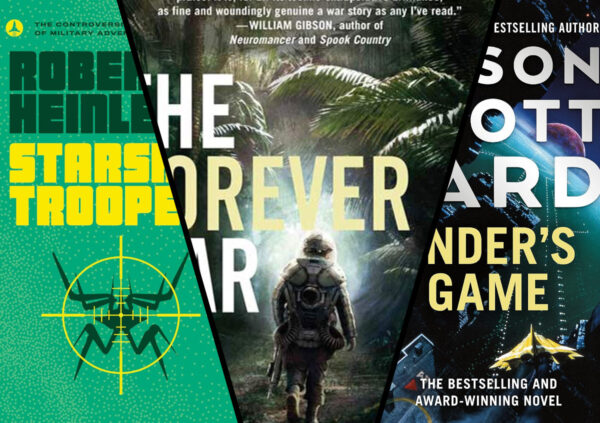
Juan Rico enlists in the Mobile Infantry, endures a brutal boot camp, and fights a war against an insectoid alien species in powered armor, while the novel stops repeatedly to lay out the philosophy of his society, a future Earth where full citizenship and the vote must be earned through federal service. The powered-armor combat is foundational, half the genre’s military hardware descends from these drop capsules, and the book reads fast and hits hard.
The fight is the politics. Some readers find a serious, coherent argument about civic duty and earned responsibility. Others find a militarist tract that flirts with something uglier. Heinlein wrote it fast and angry in 1958, breaking off the book that became Stranger over a proposed nuclear test moratorium, and that anger is on the page. Paul Verhoeven’s gleefully satirical 1997 film only poured fuel on the argument, and a new film adaptation was announced at Sony in 2024 with Neill Blomkamp, the director of District 9, attached to write and direct, so the argument is not ending soon.
My own take, having read it, is that the split is the point. The powered-armor adventure genuinely thrills, the political lectures genuinely refuse to let you stay neutral, and a book that does both at once is not going to stop being argued about. Read it for the argument as much as the action, and expect to come out with opinions.
The Scribner’s Juveniles (1947-1958)
Between 1947 and 1958 Heinlein wrote twelve young-adult novels for Scribner’s, one a year, and many longtime readers quietly rate them as his most purely satisfying work, precisely because the format gave him no room to lecture. They take young readers completely seriously, the science is real and load-bearing, and the best of them are as good as anything he wrote. They are also the reason a generation of American engineers and astronauts cite Heinlein books as the thing that sent them into the field.
The books share a loose future but stand fully alone, so read them in any order. The four full entries below are the peaks, and the shorter notices cover the rest of the run.
Citizen of the Galaxy (1957)

Citizen of the Galaxy is the best of the juveniles, and a serious novel by any measure. Thorby is a slave boy bought at auction in the port city of a far-off empire by a crippled beggar who is more than he seems. What follows moves through four societies, the beggar’s underworld, a clannish free-trader starship, a military hitch, and the boardrooms of Earth, as Thorby learns who he is and what was done to him, and the novel turns out to be about slavery, freedom and responsibility all the way down.
The beggar Baslim is one of Heinlein’s great characters, the trader-ship chapters are a complete anthropology lesson smuggled into an adventure, and the ending refuses the easy triumph. Readers who want to know why people speak of the juveniles with real respect should start exactly here, and it makes a strong first Heinlein book for an adult too.
Have Space Suit, Will Travel (1958)

Have Space Suit, Will Travel is the last and most charming of the twelve. Kip Russell, a small-town high-school senior, wins a secondhand space suit in a soap jingle contest, restores it to working order in his backyard, and is promptly kidnapped off his own lawn into an interstellar crisis that ends with humanity on trial before a galactic tribunal.
The opening chapters, Kip rebuilding the suit valve by valve while his eccentric father quotes Jerome K. Jerome, are the purest distillation of the Heinlein method: competence as romance. The escalation from backyard to galaxy is perfectly paced, Peewee, the ferocious eleven-year-old genius he rescues, is a delight, and the physics of every predicament is honest. It was a Hugo finalist in its year, and it is the juvenile most often named first when readers list the Robert A. Heinlein books they loved as kids.
Tunnel in the Sky (1955)

Tunnel in the Sky is the anti-Lord of the Flies, published a year after Golding. A high-school survival class takes its final exam by being dropped through a matter gate onto an unnamed wild planet for a few days. The gate fails, and the scattered teenagers have to build a society that lasts years, not days.
Where Golding’s boys collapse into savagery, Heinlein’s teenagers argue, organize, elect, feud and build, and the book is a stealth civics lesson about why institutions exist, run entirely through concrete survival problems. Rod Walker is one of his most likable leads, and readers have long noted the quiet suggestion that Rod may be Black, unusual for 1955. It is the juvenile with the strongest claim on adult readers of dystopian and survival fiction.
Starman Jones (1953)

Starman Jones is the purest starship novel of the run. Max Jones, a farm boy with a photographic memory and no connections, cons his way aboard a starship as a lowly crewman in a guild-locked future where every good job is hereditary. When the ship misjumps into uncharted space and the officers who can navigate home are gone, the stowaway with the memorized tables is what is left.
It is the Heinlein formula at its cleanest, honest work rewarded under pressure, and the astrogation scenes, officers chanting numbers against the clock, have a tension no amount of modern computing has dated. The guild satire gives it a spine of real anger too. Among the quieter juveniles it is the one most worth seeking out.
The other eight, and the one that came after, in shorter notices.
Rocket Ship Galileo (1947)

Rocket Ship Galileo is where the juveniles began. Three teenagers and their physicist uncle, Dr. Cargraves, convert a surplus rocket in the desert into an atomic moonship, fly it themselves, and find a Nazi base waiting on the far side. Publishers turned the book down as too far-fetched before Scribner’s took the chance, which is its own period piece now.
The premise creaks, but the method that carried eleven more juveniles is already complete: real orbital mechanics, radiation shielding and machine-shop problems treated as the adventure rather than as obstacles to it. It loosely seeded Destination Moon, the 1950 film Heinlein co-wrote, and the boys’ rocket club gave a generation of readers the idea that space was something you could build toward. It’s one for completists and historians of the shelf.
Space Cadet (1948)

Space Cadet follows Matt Dodson from oath to officer through the academy of the Space Patrol, the interplanetary force that holds a nuclear peace over every national government, including his own. The training chapters, hazings, washouts, ethics drills and all, set the template half of military science fiction still uses, and the quiet point of the curriculum is that the Patrol’s loyalty runs to humanity rather than to any flag.
The last third drops the cadets into a first-contact mess on Venus, where the locals are better chemists than the colonists and the adults are out of their depth, and the moral lands without a lecture. It reads young today, but its DNA is everywhere from Starship Troopers to every academy story since.
Red Planet (1949)

Red Planet sends Jim Marlowe and his Martian “pet” Willis on a winter flight across the canals of a colonized Mars, out of a boarding school run by a petty tyrant who wants Willis confiscated, and into the discovery of what Willis actually is, with a colonial uprising close behind. The skating journey down the frozen canals is one of the great set pieces in the juveniles.
The ancient, patient Martians here are a first sketch of the ones Stranger in a Strange Land made famous, water rituals included. Heinlein’s editor forced cuts to the guns and to Willis’s biology that he resented for decades, and the text his estate restored in the 1990s is the one to read now.
Farmer in the Sky (1950)

Farmer in the Sky is the homesteading novel. Bill Lermer, a California Scout, emigrates with his family to Ganymede and farms soil that has to be manufactured from crushed rock before anything will grow in it. It began as a serial in Boys’ Life, and the scouting bones show, badges, troop politics and all.
What stays with readers is how tough it is. The colony is oversold and underequipped, a moonquake kills colonists by the hundreds, the loss reaches inside Bill’s own family, and the book lets it hurt. Quiet, procedural and honest about what frontiers cost, it took the Retro Hugo for its year half a century later. Readers who like process will love it.
Between Planets (1951)

Between Planets strands Don Harvey, born in space to parents from two worlds, in the middle of an interplanetary war with a ring he does not know carries a secret. Pulled out of his New Mexico school as the crisis breaks, he lands on a Venus that promptly declares independence from Earth, and citizenship, which he has never had to think about, becomes a matter of survival.
The stateless-teenager premise gives the book the series’ sharpest political edge before Citizen of the Galaxy, and the Venerian dragons, one of whom does physics under the name Sir Isaac Newton, are a delight. The long middle of dishwashing and waiting is the point: wars are mostly endured.
The Rolling Stones (1952)

The Rolling Stones sends a family of Loonie eccentrics touring the system in a secondhand ship, bickering all the way: twin teenage hustlers, a doctor mother, an engineer father, a poet grandmother with a revolutionary past on Luna, and a little brother doing orbital math at four. The plot is wherever the Stone family points the ship, from Mars to the asteroid-belt mining camps, where the mother’s practice turns the lightest book of the twelve briefly serious.
It introduced the flat cats, the breeding fuzzballs Star Trek’s tribbles famously resemble, and Grandmother Hazel turns up again as a child of the revolution in The Moon Is a Harsh Mistress. It’s pure charm, and it set the family-sitcom template for half of cozy space fiction since.
The Star Beast (1954)

The Star Beast is the funny one. Lummox, the family pet smuggled home from the stars by a spacefaring great-great-grandfather, has grown to the size of a truck, eats a secondhand Buick, and turns out to be something nobody in the family history ever guessed. The resulting diplomatic crisis threatens Earth itself, and teenage John Thomas Stuart XI mostly wants his pet back.
The book belongs to Mr. Kiku, the unflappable African Under-Secretary for Spatial Affairs who actually runs Earth’s diplomacy while his ornamental boss takes the credit, the genre’s best civil servant and a quietly radical piece of 1954 casting. The bureaucratic comedy has aged beautifully, and the custody hearing over Lummox is Heinlein’s funniest courtroom.
Time for the Stars (1956)

Time for the Stars runs on the twin paradox. Some identical twins can speak mind to mind, the link turns out to work faster than light, and so the Long Range Foundation installs one twin aboard each exploring torchship while the other stays home as the receiver. Tom goes to the stars and stays young at relativistic speed. Pat stays on Earth and ages, and so does everyone else Tom loves.
It is the saddest of the juveniles, a book about time doing its work on a family, told through calls home that get harder to make with every voyage. The late twist, involving who is waiting when the ship is finally recalled, still splits readers down the middle.
Podkayne of Mars (1963)

Podkayne of Mars came after the Scribner’s run and sits just outside it. Podkayne Fries, a Marsgirl who wants to captain starships, gets a dream trip toward Earth with her senator uncle and her kid brother Clark, a cheerful borderline sociopath with a hobbyist’s interest in explosives. At Venus the family itinerary turns out to include politics, and the cruise becomes a kidnapping plot.
Heinlein’s publisher refused his original ending as too dark, and he resented the softened one for the rest of his life. Editions since 1995 print both so readers can judge. The book is minor, and its ideas about what girls are for date it badly, but Poddy’s voice has real fans and Clark steals every page he is on.
The Adult Novels of the 1940s and 1950s
While the juveniles ran, Heinlein was writing adult novels alongside, and three of them are essential. These are the tight, professional books of his middle period, before the lectures took over, and several readers who dislike late Heinlein love everything in this section.
The Puppet Masters (1951)

The Puppet Masters is the alien-invasion thriller the 1950s kept remaking. Slug-like parasites land in Iowa and ride human hosts undetected, and a secret agency fights a war most of the country refuses to believe is happening. Sam, the agent narrator, spends part of the book with a slug on his own back, and those chapters, narrated from inside possession, are the most unsettling pages Heinlein wrote.
It is paranoid Cold War fiction with the serial numbers showing, and it beat Invasion of the Body Snatchers to the central image by four years. Fast, nasty and efficient, it reads today like the missing link between the pulps and The X-Files. A 1994 film with Donald Sutherland adapted it without much trace.
Double Star (1956)

The Great Lorenzo, a vain, broke, gifted actor, is hired to impersonate a kidnapped politician for one speech, and then the politician cannot return, and the one speech becomes a career. The joke is that the job slowly makes the fraud into the better man, and the ending lands with real weight.
It won Heinlein his first Hugo, and a lot of quiet readers name it his most perfect novel: short, funny, humane, and completely free of sermon. The political machinery, a parliamentary empire with a ceremonial emperor, is sketched with a reporter’s economy. The Library of America chose it for its anthology of the best 1950s American science fiction, which is exactly where it belongs. If you want one compact proof of Heinlein’s pure craft, this is it.
The Door into Summer (1957)

An engineer cheated out of his company and his fiancée takes the long way to revenge: cold sleep to the year 2000, and then, via a crackpot’s time machine, back again to set things right. The plot is a clockwork of loops that clicks shut perfectly, and the tone is unexpectedly warm for a story that starts in betrayal, thanks largely to Pete, the tomcat who hates the Door into Winter and gives the book its title and its heart.
One element, the hero’s eventual marriage to a girl he first knew as a child, lands much more awkwardly than it did in 1957, and the honest consensus holds both things at once: it is one of the most likable time-travel novels in the genre, with one durable flaw. Readers who collect time loops should also see the short fiction section below, where “By His Bootstraps” and “All You Zombies” close the loop tighter still, and the time travel books list puts the whole family side by side. A 2021 Japanese film moved the story to Tokyo.
Beyond This Horizon (1948)

Beyond This Horizon is the strangest of the early books, a genetically perfected utopia where hunger and disease are solved, armed dueling enforces good manners, and the hero’s problem is that life lacks a point, which the plot pursues through a failed coup and into funded research on reincarnation. Heinlein wrote it in 1942 under his Anson MacDonald pen name, and it reached book form six years later.
Scattershot by any standard, it is also wall-to-wall ideas, and the famous line that an armed society is a polite society starts here, quoted ever since by people who rarely mention the utopian economics around it. It won a Retro Hugo in 2018. It’s for readers who want the raw, unedited idea engine.
Sixth Column (1949)

Sixth Column is the one to know about before buying. A conquered America resists a PanAsian invader using superscience that can be tuned to race, wrapped in a fake religion to hide the resistance from the occupiers. The premise came from editor John W. Campbell, from an unpublished story of his own, and Heinlein said plainly in later years that he had filed off the worst of it and done the job as work for hire.
What he could not file off is still there, and the consensus treats it as his weakest book by a distance. The church-as-cover machinery has admirers as pure plot engineering, and the rest is a document of what 1941 magazine fiction would print. It’s for completists only, eyes open.
Methuselah’s Children (1958)

Methuselah’s Children introduces Lazarus Long and the Howard Families, bred for longevity through four centuries of arranged marriages and finally exposed in 2136, whereupon a world that cannot believe long life was merely inherited sets out to extract the “secret” they do not have. The Families’ answer, engineered by the oldest man alive, is to steal a starship and run.
The voyage out, with its two alien stops, each offering a paradise at an unacceptable price, is prime early Heinlein, and Andy Libby’s improvised stardrive mathematics became genre furniture. Expanded from the 1941 serial into a 1958 book, it is brisk, inventive, and the seed of the late-period mythology: every World As Myth novel grows from this root.
Orphans of the Sky (1963)

Orphans of the Sky put the generation starship into the genre. The Vanguard has been underway so long its inhabitants have forgotten the outside universe exists, “the Ship is the universe” is now theology, and the Trip is a doctrine rather than a journey. Hugh Hoyland, captured and adopted by the two-headed mutant Joe-Jim, sees the stars from the abandoned control room and has the conversion experience science fiction has been rewriting ever since.
The two joined novellas, from 1941, are crude early work with a rushed ending, and the central image has powered a hundred later books, several of them on the hard science fiction shelf. Read it as the blueprint it is. It costs an hour, and it repays it.
The Future History and the Short Fiction
Heinlein’s reputation was built in the magazines before any of the novels, on a run of stories mapped against a wall chart of the next few centuries, with its crew-cut engineers, rolling roads, Luna City and the prophet-ruled Interregnum. Campbell printed the chart in Astounding in 1941, and the genre has been building future histories to the same blueprint ever since.
The Past Through Tomorrow (1967)

The Past Through Tomorrow is the one-volume Future History, and the single best-value Heinlein purchase there is: over twenty stories and the short novel Methuselah’s Children territory in one brick of a book.
The essentials are all here. “The Roads Must Roll,” a strike on the rolling roads that civilization literally rides on. “The Man Who Sold the Moon,” D. D. Harriman conning and bribing humanity off its own planet. “Requiem,” its quiet sequel, which Heinlein readers tend to name when asked what the fuss is about. “The Green Hills of Earth,” the blind singer of the spaceways. And “The Menace from Earth,” a teenage-girl narrator, flying under her own wings in a Luna City tourist cavern, decades ahead of its time.
Story for story this is Heinlein the working craftsman, no sermons, just futures built out of offhand detail, which is the technique every writer after him stole. If the novels ever wear on you, this is the book that explains the reputation anyway.
The Unpleasant Profession of Jonathan Hoag (1959)

The Unpleasant Profession of Jonathan Hoag is the other Heinlein, five fantasy and horror stories plus the title novella, in which a man who cannot remember what he does all day hires detectives to follow himself, and the answer unravels reality. “They,” a paranoid’s day in an asylum where the paranoia is correct, and “All You Zombies,” the tightest time-loop ever constructed and the basis of the 2014 film Predestination, are both here, along with “By His Bootstraps,” its longer sibling.
Readers who know Heinlein only as the engineers’ optimist find this book genuinely surprising: solipsism, dread and metaphysical unease, handled with the same dry competence. It is the collection to hand a weird-fiction reader who thinks Heinlein is not for them.
The Sixties Detours, Briefly
Glory Road (1963)

Glory Road is his one sword-and-sorcery quest. E. C. “Oscar” Gordon, fresh out of a Southeast Asian war, answers a personals ad seeking a hero, permanent employment, great danger, and is swept across the multiverse by the most beautiful woman alive to steal the Egg of the Phoenix. The adventure is grand fun for two thirds, dragons, traps and swordplay played straight against a soldier’s grumbling commentary.
Then the quest succeeds, and the last third becomes an essay on the question no quest story asks: what is a hero for afterward? Readers split on whether that coda is the best or worst thing in the book, which is a very Heinlein place to leave them. Fantasy readers take the deal knowingly.
Farnham’s Freehold (1964)

Farnham’s Freehold needs the plainest warning on the page. Hugh Farnham’s bomb shelter takes a direct hit and surfaces centuries forward, in a society where the racial order of American power has been inverted and the white survivors are property. Heinlein intended an attack on racism by forcing his readers into the other end of it. The consensus of decades is that the execution reproduces racist imagery, a cannibalism device included, grotesque enough to sink the intention entirely.
Even critics sympathetic to Heinlein treat it as the book where his method failed worst, and its defenders are rare. The survivalist first act still gets cited as competent-man Heinlein at speed. Read the history around it before the book, if at all.
The Late Novels (1970-1987)
After the 1960s, and especially after the illnesses of the 1970s, the books grew longer, looser, more sexual and more self-referential, until the last ones merged all his earlier casts into a single multiverse held together by in-jokes. The consensus is honest here: some gold, much indulgence, and none of it a place to start. This is also where the lectures stop being interruptions and become the point, and readers decide for themselves whether the company is worth it.
I Will Fear No Evil (1970)

I Will Fear No Evil puts the brain of Johann Sebastian Bach Smith, a dying billionaire, into the body of his murdered young secretary, Eunice, and spends the rest of its length inside their shared inner dialogue. Whether it really is shared is the open question: the book never settles whether Eunice’s voice is present or imagined, and that deliberate ambiguity is the one thing even detractors defend. Heinlein wrote it before the peritonitis that nearly killed him and finished it in the shadow of the illness.
Around that question sprawl six hundred pages of talk about sex and identity that promise more than they deliver, and the editing pass he was too ill to make is missing on every page. It sold enormously anyway. It’s a book for the hardcore only, and nobody’s first late Heinlein.
Time Enough for Love (1973)

Time Enough for Love is the big one of the late period, and the fairest test of whether late Heinlein is for you. Lazarus Long, now more than two thousand years old and tired of living, is talked into recording his memoirs while his descendants hunt for something still worth his time. The frame lets Heinlein do everything: nested novellas, aphorisms, family theory, and finally time travel back to 1917 Kansas City and the most notorious of his transgressions, Lazarus falling in love with his own mother.
Two of the embedded tales, “The Man Who Was Too Lazy to Fail” and the slave-rescue story of “The Tale of the Adopted Daughter,” rank with his best work anywhere, and the Notebooks of Lazarus Long aphorisms escaped the book entirely to live on posters. Around them sprawls everything the period is accused of. Readers who finish it tend to feel they have met the author with the mask fully off, for better and worse, and the book has defenders at full volume. It was a Hugo and Nebula finalist, which tells you the genre could not look away either.
The Number of the Beast (1980)

The Number of the Beast sends two couples in a flying car named Gay Deceiver across six-to-the-sixth-to-the-sixth universes, pursued by alien “Black Hats” and trading banter that never stops, with stops in Oz and on Barsoom along the way. It is widely considered the nadir of the period, a book where the in-jokes drive and the plot rides along.
A long-standing defense reads it as a deliberate writing workshop in disguise, its flaws planted as lessons. The 2020 publication of The Pursuit of the Pankera, an alternate version from the same opening chapters found in the archives, turned the argument archaeological: readers can now run the fork themselves and see which book they were promised. The curiosity value is real either way.
Friday (1982)

Friday is the late novel that works best as a novel. Its heroine, Friday Jones, is an artificial person, a genetically engineered courier for a private intelligence outfit, running jobs across a Balkanized North America of corporate enclaves and collapsed states that reads considerably less far-fetched now than it did in 1982. She is fast, lethal, charming, and quietly desperate to belong to anyone, and her self-loathing about being “not human” gives the book a wound the swagger never quite covers.
The travelogue plotting wanders, one early sequence treats a sexual assault with a glibness that rightly draws fire, and the politics are pure late Heinlein. But Friday herself is his best late character by a distance, and the book was a Hugo and Nebula finalist and a bestseller. Readers who want exactly one late-period novel usually do best choosing between this and Job.
Job: A Comedy of Justice (1984)

Job is the last late novel with a real shape. Alex Hergensheimer, a smug fundamentalist minister, firewalks on a dare and comes up in a different universe, and then the universes keep changing under him and his lover Margrethe, each shift stripping them of money, papers and dignity, while Heaven and Hell turn out to be run exactly like corporations. It is Heinlein doing James Branch Cabell, the book’s open model, and his sharpest satire of American religion.
The dishwashing chapters, two people staying human while reality itself gaslights them, are oddly the most touching thing in late Heinlein, and the tour of the afterlife pays the premise off. It took the Locus Award for best fantasy novel and was a Hugo and Nebula finalist, and it is the late book most often recommended to readers who gave up on the others.
The Cat Who Walks Through Walls (1985)

The Cat Who Walks Through Walls starts as a crisp murder-frame thriller. A one-legged writer on the Golden Rule habitat watches a stranger die at his dinner table, is evicted, framed and hunted within a day, and runs with the charming Gwen Novak, who is more than she says, and whom longtime readers will recognize well before he does. The first half is the last stretch of pure Heinlein storytelling there is, fast and funny and mean.
Halfway through, the World As Myth arrives, the earlier casts pour in, and the plot dissolves into the family reunion, kitten and all. That makes the second half the period’s biggest tease, and the whole book a loyalty test it half intends to be.
To Sail Beyond the Sunset (1987)

To Sail Beyond the Sunset, his last novel, gives the whole mythology to Maureen Johnson, Lazarus Long’s mother, as a memoir that starts in 1882 Missouri and runs through the twentieth century she scandalized, the title lifted from Tennyson’s “Ulysses.” As a tour of American mores conducted by a woman cheerfully unbothered by any of them, it has real charm, and the early chapters are the best sustained writing of the late period.
As a finale it is all curtain calls, a wrap party for every character he ever wrote, and it exists for readers already invested in the family. Those readers tend to be fonder of it than its reputation suggests. Everyone else should stop at Job.
For Us, the Living (2003)

For Us, the Living is the apprentice work, written in 1938, rejected everywhere, and published only in 2003 after a surviving copy surfaced long after his death. Perry Nelson drives off a cliff in 1939 and wakes in 2086, where patient citizens lecture him on economics, custom, privacy law and free love for a book’s length. As a novel it barely exists, and every publisher who passed was right.
As the Rosetta Stone it is fascinating: the rolling roads, the social credit economics, the sexual politics and half the Future History are already here, a career laid out in blueprint a year before his first published story. Read it last, which is exactly the order to approach it in.
Robert A. Heinlein: Deep Dive & FAQ
What Runs Through Heinlein’s Books
The competent man is the first thread, and the most imitated: the engineer, the tramp, the actor, the slave boy who learns the systems and works the problem. Heinlein’s deepest faith was in competence, and his favorite plot is a person becoming equal to events. The second is the lecture. From Jubal Harshaw to Lazarus Long, his books install a voice of experience whose job is to explain how the world works, and your tolerance for that voice is, more than anything else, your tolerance for Heinlein.
The third is liberty, argued from a dozen directions across the shelf, service-earned citizenship in one book, free-love communes in another, revolution in a third, which is why readers of every politics have claimed and disowned him in turn. And the fourth is technique: the future built out of offhand detail, the door that dilates with no one stopping to explain it. That trick, more than any opinion, is his permanent legacy, and it is now so standard nobody notices whose it was.
Prizes and Honors
Four Hugo Awards for best novel: Double Star (1956), Starship Troopers (1960), Stranger in a Strange Land (1962) and The Moon Is a Harsh Mistress (1967). The SFWA named him its first Grand Master in 1974. Retro Hugos followed decades later for the early work, Farmer in the Sky and Beyond This Horizon among the winners. Destination Moon, which he co-wrote, took the 1950 Oscar for special effects, and “grok” and “waldo” sit in the dictionaries, which may be the rarest honor on the list.
Which Robert Heinlein Editions to Buy
Nearly everything is in print in the United States as Ace or Berkley paperbacks and ebooks, and those are the copies most readers want. Since 2019 the Heinlein Prize Trust has also been reissuing the catalog through CAEZIK, including handsome editions of the juveniles and the first trade publication of The Pursuit of the Pankera, and those are the copies to look for where the mass-market printings have gone scarce. In Britain, Gollancz keeps the major novels in its SF Masterworks line, with The Moon Is a Harsh Mistress and Double Star the obvious picks.
Double Star is also in the Library of America’s two-volume American Science Fiction set of classic 1950s novels, the closest thing Heinlein has to a canonical edition. Completists and collectors can go further: the Virginia Edition, named for his wife, is the leather-bound complete works in forty-six volumes, and Grumbles from the Grave (1989) collects the letters, including the running fight with his Scribner’s editor over what boys could be allowed to read.
Heinlein on Screen
Destination Moon (1950) came first and won its effects Oscar, with Heinlein on the script. The Puppet Masters became a 1994 Donald Sutherland film, remembered mostly for existing. Starship Troopers became Paul Verhoeven’s 1997 satire, which inverted the book’s politics, spawned sequels and animated films, and started a second argument on top of the book’s own. A new adaptation was announced at Sony in 2024, with Neill Blomkamp attached, and no release date yet.
The best Heinlein film is the quietest: Predestination (2014), with Ethan Hawke and Sarah Snook, films “All You Zombies” almost line by line and understands it completely. The Door into Summer became a 2021 Japanese production, and The Moon Is a Harsh Mistress has spent decades in development without emerging, which Loonies would find fitting.
Questions About Robert A. Heinlein
Who was Robert A. Heinlein?
An American science fiction writer, born in Missouri in 1907 and died in 1988, counted with Asimov and Clarke as one of the Big Three of the genre’s golden age. He wrote the Scribner’s juveniles, Starship Troopers, Stranger in a Strange Land and The Moon Is a Harsh Mistress, and won four Hugo Awards for best novel.
What Is Robert Heinlein’s Best Book?
The Moon Is a Harsh Mistress is the most common critical answer, with Double Star the connoisseur’s pick and Stranger in a Strange Land the famous one. The juveniles, especially Citizen of the Galaxy and Have Space Suit, Will Travel, are the best of him with no caveats attached.
What Should I Read First?
The Moon Is a Harsh Mistress for adults, Have Space Suit, Will Travel for younger readers or anyone who wants pure adventure, Starship Troopers if the argument is what draws you. Do not start with anything published after 1970.
Do Robert Heinlein Books Share a Universe?
Loosely and late. The Future History stories share a timeline, Methuselah’s Children and Time Enough for Love carry it forward through Lazarus Long, and the last novels merge everything into a single multiverse called the World As Myth. Almost every book still stands alone.
Is Starship Troopers Fascist?
It has been argued both ways for sixty years. The novel’s society restricts the vote to those who complete voluntary federal service, which some readers take as a serious civic argument and others as militarist fantasy. The entry above lays out both cases, and the Verhoeven film answers the book by parodying it.
What Is Grok?
A Martian word from Stranger in a Strange Land meaning, roughly, to understand something so completely that observer and observed merge. It jumped from the novel into 1960s counterculture and then into programmer slang, where it lives on.
Were the Juveniles Really Written for Kids?
For teenagers, through Scribner’s, one a year from 1947 to 1958, and written without condescension, which is why they survive. Several, Citizen of the Galaxy above all, are adult novels in everything but marketing.
In What Order Should I Read the Late Novels?
Time Enough for Love first, since everything after it assumes you know Lazarus Long, then Friday or Job, which stand alone. The Number of the Beast, The Cat Who Walks Through Walls and To Sail Beyond the Sunset are for readers already committed to the World As Myth game.
Where to Go Next
The natural next shelf is the rest of the Big Three: the Isaac Asimov books guide covers the Foundation and robot shelves Heinlein argued with for forty years, and the Arthur C. Clarke books guide has the serene cosmic third of the triangle. Readers pulled in by Starship Troopers should walk the whole lineage on the military science fiction books list, where Haldeman’s The Forever War is the direct answer to Heinlein’s book.
And the strongest single counterweight is Ursula K. Le Guin, whose The Dispossessed takes the Moon Is a Harsh Mistress setup, a breakaway society on a harsh world, to opposite conclusions: her shelf is covered in the Ursula K. Le Guin books guide.