Frank Herbert wrote the best-selling science fiction novel of all time, and for most readers that is the beginning and the end of the conversation. Dune has sold tens of millions of copies, survived two very different film adaptations, and become the rare genre novel that people who never read genre novels have still heard of. But Herbert wrote five more Dune books after it, and they go to places the movies will never follow, and the single question this guide exists to answer is the one every reader has after the Villeneuve films: what do I read, in what order, and when do I stop?
The honest answer has a fork in it, because the Dune saga gets stranger as it goes. The first novel is a perfect, self-contained masterpiece. The second deliberately dismantles everything the first appeared to celebrate. The fourth is one of the oddest books ever to sell in the millions. And there is a whole second shelf of Dune novels that Herbert did not write at all, which is where the real arguments start. On my best science fiction books list, Dune stands among the very highest entries, and this page covers the rest of the Frank Herbert books around it, the non-Dune novels included, because a few of them deserve far more company than they get.
A register note: Dune itself is the Herbert I’ve read, so that entry stands on my own reading. The sequels and the rest of the catalog run on the field’s long consensus, marked plainly where readers split.
Fiction by René Rehn


The Short Version
Read Dune first. If it grips you, read Dune Messiah next, knowing it is a deliberate correction rather than a victory lap, and then Children of Dune, which most readers consider the equal of the first. That trilogy is the natural stopping point for most people. God Emperor of Dune is the strange, brilliant, divisive turn that follows, and Heretics and Chapterhouse close Herbert’s own run. The Brian Herbert and Kevin J. Anderson novels are a separate matter, addressed at the end.
Frank Herbert Books in Order
The table runs the essential catalog by first book publication, collaborations marked.
| Year | Title | Type | Notes |
| 1956 | The Dragon in the Sea | Novel | Serialized as Under Pressure |
| 1965 | Dune | Dune saga | First Nebula, shared Hugo |
| 1966 | Destination: Void | Novel | Start of the Pandora sequence |
| 1966 | The Green Brain | Novel | |
| 1968 | The Santaroga Barrier | Novel | |
| 1969 | Dune Messiah | Dune saga | |
| 1970 | Whipping Star | Novel | ConSentiency |
| 1972 | Soul Catcher | Novel | His one mainstream novel |
| 1972 | The Godmakers | Novel | |
| 1973 | Hellstrom’s Hive | Novel | |
| 1976 | Children of Dune | Dune saga | |
| 1977 | The Dosadi Experiment | Novel | ConSentiency |
| 1979 | The Jesus Incident | Novel | With Bill Ransom |
| 1981 | God Emperor of Dune | Dune saga | |
| 1982 | The White Plague | Novel | |
| 1983 | The Lazarus Effect | Novel | With Bill Ransom |
| 1984 | Heretics of Dune | Dune saga | |
| 1985 | Chapterhouse: Dune | Dune saga | His last Dune novel |
| 1988 | The Ascension Factor | Novel | With Ransom, posthumous |
Where to Start With Frank Herbert
With Dune, and this is one of the rare catalogs where there is no clever alternative answer. Everything else he wrote is either downstream of it or deliberately unlike it, and the sequels assume you have lived through the first book’s ending.
The real starting question is where to stop, and the honest answer depends on what you want. Stop after Dune and you have a complete masterpiece. Stop after Children of Dune and you have the full tragedy. Push through God Emperor and you have the argument Herbert was actually making, which most readers of the first book never meet.
Herbert’s Life, Briefly
Frank Herbert was born in Tacoma, Washington, on October 8, 1920, and spent most of his working life as a newspaperman up and down the West Coast, from the Glendale Star at nineteen through Oregon and Seattle papers to a decade at the San Francisco Examiner’s California Living magazine. The journalist’s habits never left: the research files, the interest in how systems actually run, the patience with specialists.
Dune began as a magazine piece he never finished writing, about the dunes near Florence, Oregon, where the government was stabilizing moving sand with grass. The research swallowed him, ecology joined religion and politics in the notebooks, and Analog serialized the result in eight installments across 1963 to 1965 as Dune World and The Prophet of Dune. Nearly twenty publishers turned the novel down. The one that said yes, Chilton, was famous for auto-repair manuals, and their gamble became the best-selling science fiction novel ever printed.
Herbert kept reporting and teaching alongside the saga for years, wrote a shelf of fierce standalone novels nobody asked him for, and found genuine wealth only in the last decade of his life, when the sequels hit bestseller lists. His wife Beverly, his first reader through it all, died in early 1984 after a long illness he wrote about with unusual openness in Chapterhouse’s afterword. He died two years later, on February 11, 1986, in Madison, Wisconsin, of a pulmonary embolism while recovering from cancer surgery, at sixty-five, with a seventh Dune novel in outline on his desk.
The Dune Saga
One series, six books, and a sale-unit note before the entries: every volume is sold separately, the first three circulate as a boxed trilogy, and the right buy is one book at a time, because each stopping point below is legitimate.
Dune (1965)

Paul Atreides’s family accepts the governorship of Arrakis, the only source of the spice that makes interstellar civilization run, knowing the appointment is a trap. The trap closes inside a hundred pages, and the book becomes the story of Paul among the Fremen, the desert people whose planet everyone else strip-mines, as he grows into something between a prophet and a weapon.
Herbert’s real achievement is that nothing in the book stands alone. The desert ecology creates the sandworms, the sandworms create the spice, the spice funds and addicts an entire empire, and the religion the Fremen carry was engineered generations earlier by a secret sisterhood for exactly the moment Paul exploits. Ecology, economics, religion, and politics lock together into a machine, and the novel takes them all seriously as forces. It won the first Nebula Award for best novel and shared the 1966 Hugo, and sixty years on it remains the measuring stick for worldbuilding density.
What I’ll add from my own reading: the book earns its reputation. The slow first act pays for everything after, the appendices are part of the pleasure rather than homework, and the ending lands colder than the films let it, which matters for what comes next. Among the Frank Herbert books it is not just the biggest, it is the load-bearing wall.
Dune Messiah (1969)

Dune Messiah is the correction, published four years later, and it is the most misread of the Frank Herbert books. Paul has won, and the victory is the horror: the jihad he foresaw has burned across the universe in his name, the religion built on him runs an empire, and the book is a conspiracy story in which the people plotting against the god-emperor include the god-emperor.
Readers who wanted Dune again hated it in 1969, and readers who take it on its own terms tend to rate it as the saga’s hinge. It is short, claustrophobic, and almost entirely an argument about whether a man who sees the future can be anything but its prisoner. Consensus has climbed steadily, helped by the films making Herbert’s anti-messiah intent harder to miss. Read it directly after Dune, while the first book’s triumph is still warm enough to curdle.
Children of Dune (1976)

It follows Paul’s twin children, Leto II and Ghanima, born pre-aware and dangerous, as the empire Paul built curdles and a transformed figure returns from the desert to force a reckoning. This is where Herbert’s ideas about power, prophecy, and the terrible cost of seeing the future pay off in full, and it sets up the most radical decision in the entire saga, one this guide will not spoil.
Consensus rates Children the strongest Dune book after the original, and many readers who stop after it feel the story complete. It was also the book that made the saga a phenomenon, the first genre hardcover of its kind to hit the major bestseller lists. The original trilogy ends here, and so does the version of Dune the films will ever be able to tell.
God Emperor of Dune (1981)

God Emperor of Dune arrives three and a half thousand years later as the strangest best-seller of its decade, a novel whose protagonist is a prescient tyrant halfway through becoming a sandworm, ruling an enforced peace he knows is monstrous, for reasons the book spends its whole length letting him explain. There is a rebellion, a love story of a terrible kind, and more philosophy per page than anything else on the bestseller lists of 1981.
This is the fork in the readership. To some, it is the saga’s masterpiece, the book the first three existed to set up, and the fullest statement of Herbert’s argument about why humanity must never again trust a savior. To others it is five hundred pages of a worm lecturing his majordomo. Both descriptions are accurate. What nobody disputes is the audacity. Among the Frank Herbert books it is the one that could not have been written by anyone else alive.
Heretics of Dune
1984 and 1985. Herbert’s final act, and an ending he never reached.

Heretics of Dune resets the board fifteen hundred years further on: the old empire is gone, the Bene Gesserit sisterhood runs the long game, and something is coming back from the human diaspora with enough force to frighten them. The saga becomes faster and more conventional here, closer to adventure fiction than anything since the first book, with one of Herbert’s best late characters in the endlessly repurposed warrior Duncan Idaho and a genuinely unsettling new enemy.
Consensus puts the late pair below the first four, and readers who make it this far rarely stop, because Heretics moves. The trade-off is texture for momentum, and the sisterhood’s internal politics replace the ecology as the machine being studied. For the committed, it is the start of an unfinished argument rather than a decline.
Chapterhouse: Dune

Chapterhouse: Dune is the last Frank Herbert Dune novel, with the sisterhood reduced to one hidden planet, their enemies closing, and the series’ remaining pieces gathered for an endgame the author did not live to write. It ends on a deliberate cliffhanger and a pair of mysterious watchers, and then it ends again, in an afterword to his dying wife Beverly that is the most openly personal page in the entire saga and reframes everything the series ever said about ghola love and loyalty.
As a novel it is late-Herbert through and through, dense with sisterhood politics and conversations that are duels. As a stopping point it is unresolved by design, which is the honest warning. The notes he left became the two continuation volumes discussed below, and readers decide for themselves whether that counts as an ending.
The Continuation Shelf, Honestly
After Herbert’s death, his son Brian and Kevin J. Anderson extended the universe at industrial scale: prequel trilogies about the houses and the Butlerian Jihad, and a two-volume completion of the original story, Hunters of Dune and Sandworms of Dune, built from Frank’s Dune 7 outline.
The fan verdict is sharply divided and worth knowing before you spend money. To some readers these books are a welcome return to a beloved universe and the only way to see how the story was meant to end. To many longtime fans they are a different and lesser thing, faster and more conventional than Frank Herbert’s dense, philosophical originals, and the completion novels in particular are treated with suspicion. The honest recommendation for a newcomer is simple: read Frank Herbert’s six first, decide what the saga means to you, and only then decide whether you want someone else’s ending.
Beyond Dune
The rest of the Frank Herbert books are a shelf of fierce, strange machines that his famous series keeps in shadow. Several would anchor another writer’s whole reputation.
The Dragon in the Sea (1956)

The Dragon in the Sea was his first novel, a decade before Dune, and it puts a nuclear submarine crew smuggling oil out of enemy waters in a future of resource war, with a saboteur aboard and a psychologist narrator hunting the breaking point in each man. It is a pressure-cooker thriller that reads like The Hunt for Red October crossed with a case study, and its predictions about oil politics aged alarmingly well. It is tight, early proof that Herbert’s real subject was always minds under systems, and the right pick for readers who want him lean. The psychology-of-crews material came straight from his research obsessions, and submariners have claimed the book as theirs ever since.
The Santaroga Barrier (1968)

The Santaroga Barrier sends a psychologist to a California valley town that outsiders’ businesses cannot penetrate, where nobody watches television and nobody leaves, and the explanation involves a local fungus and a collective way of seeing that the book refuses to call either utopia or horror. Herbert said he built it so half his readers would envy Santaroga and half would flee it, and the split holds. It is the slowest-burning of his standalones and the one closest to the sixties’ questions about consciousness, and it reads today like a prophecy about communities that opt out of consensus reality. Minor key, major ideas, and the ending refuses the exits both audiences wanted, which is the most Herbert thing about it.
Whipping Star (1970)

Whipping Star opens the ConSentiency, a multi-species civilization whose Bureau of Sabotage exists to slow its own too-efficient government down. Agent Jorj X. McKie must stop the flogging death of a Caleban, a being the book strongly implies is a star, because every sentient who ever touched a Caleban contract will die with her. It is Herbert at his most playful, a metaphysical detective story built on the impossibility of translation, and the warm-up for the better book below. McKie himself, a saboteur extraordinary in a government designed to be sabotaged, is the straightest fun Herbert ever had with a protagonist. Completists start here for the pair’s full effect, and the Caleban’s sideways dialogue is worth the ticket alone.
The Dosadi Experiment (1977)
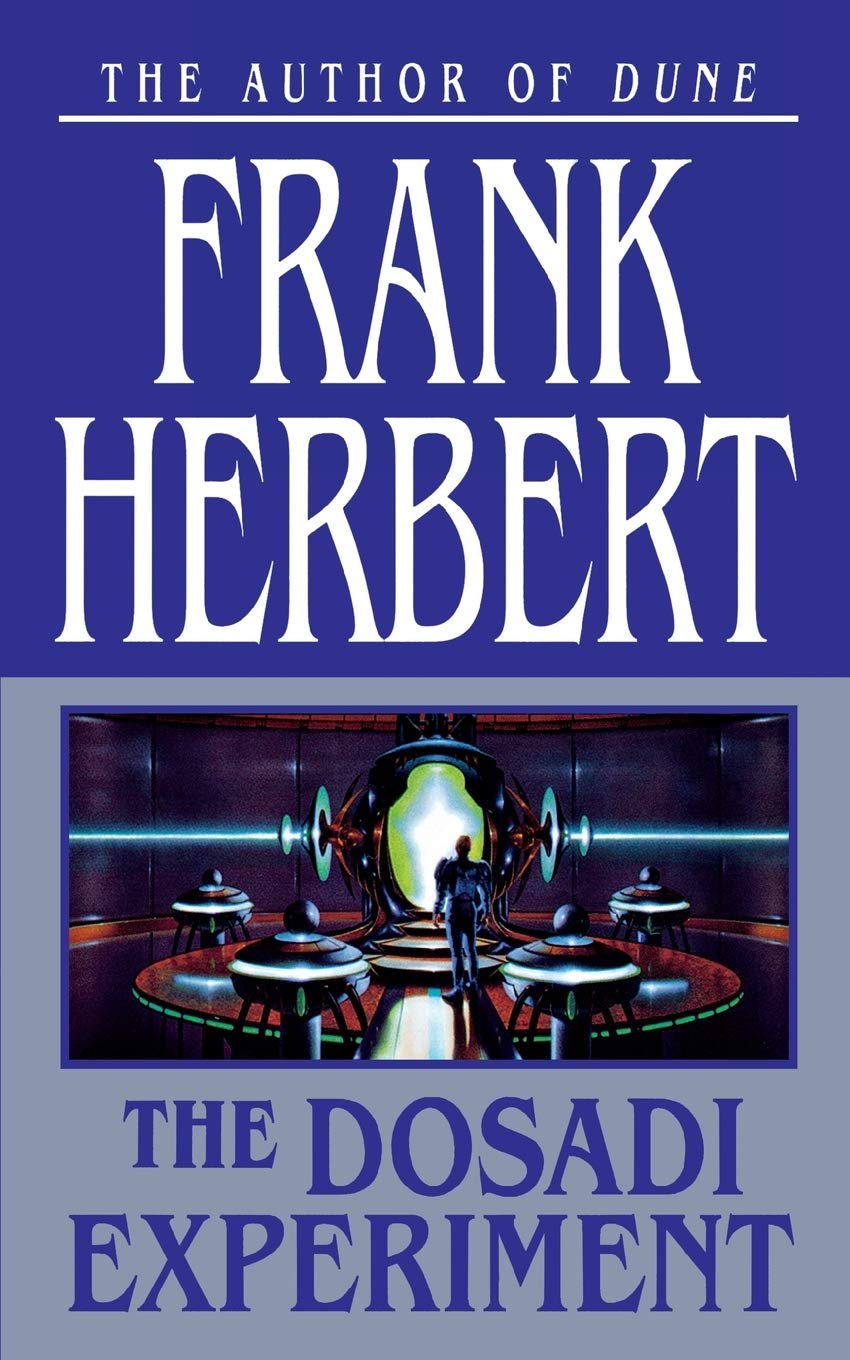
The Dosadi Experiment is the best non-Dune novel by consensus and the one serious Herbert readers push hardest. On a poisoned planet behind an impenetrable barrier, someone has run an experiment in pressure: close to ninety million humans and aliens packed into one lethal city, and what evolved there is more dangerous than anyone outside can imagine. McKie goes in, and the courtroom endgame, in an alien legal system where losing counsel can be executed, is Herbert’s tensest sustained sequence outside Dune. Power, selection, and law, compressed to a blade. If Dune’s politics were your favorite part, this is the purest second helping on his shelf.
Destination: Void (1966)

Destination: Void strands a cloned crew on a colony ship with a hidden assignment: build an artificial consciousness or die, with failure modes their designers planned for them. The book is the attempt itself, rendered as engineering and theology at once, circuit diagrams next to arguments about the soul, and its ending is one of the genre’s great cold shocks. Herbert revised it in 1978 as the Pandora sequence got moving, and it reads today like the ancestor of every rogue-AI story that takes the machine’s side of the question seriously. Dense, odd, and the necessary first step into the books that follow.
The Jesus Incident (1979)

Written with the poet Bill Ransom, it picks up generations after Destination: Void on Pandora, the most hostile planet in his fiction, where the ship that carried humanity there has decided it is God and demands WorShip, without explaining what that means. Kelp that thinks, colonists who fail, and a machine deity running out of patience make it the strangest theology in the Frank Herbert books, which is a high bar.
The sequence continues through The Lazarus Effect and the posthumous The Ascension Factor, both with Ransom, and consensus rates the collaborations underrated and genuinely strange. Readers who want Herbert’s religious machinery without sand start here.
Hellstrom’s Hive (1973)

Hellstrom’s Hive follows a covert agency into a documentary filmmaker’s Oregon farm, where a human hive waits beneath: three hundred years of selective breeding toward insect organization, with castes, chemical signaling, and vats for the unproductive. The genius move is the double perspective, because the hive gets to argue its case, and the agents hunting it are no advertisement for individualism. It is his most purely horrifying book, a thought experiment about what survival might cost the self, and it has quietly become a cult favorite. It is not for claustrophobes, which is exactly the recommendation. The documentary frame, built from the fictional Hellstrom’s own chillingly reasonable narration, does half the horror’s work before anything happens.
The White Plague (1982)

The White Plague opens with a molecular biologist watching an IRA bomb kill his wife and daughters in Dublin, goes precisely insane, and engineers a plague that kills only women, releasing it against Ireland, Britain, and Libya. The novel is the aftermath at every scale, from the barricaded nations to the mad biologist walking through the country he condemned. Written at technothriller length and pace, it divides readers between those who find it his most chillingly plausible book and those who find it bloated. Nobody calls it safe. It is the book of his that reads most like tomorrow’s worst headline.
Soul Catcher (1972)

Soul Catcher is the one with no science fiction in it at all. A Native American graduate student, broken by his sister’s death after an assault by white men, takes a thirteen-year-old boy hostage in the Washington wilderness as a ritual act, and the book walks both of them toward an ending Herbert refused to soften. It was his own favorite among his novels, and it is the most argued-about thing he wrote, both for the ending and, now, for a white author inhabiting that perspective at all. Read it knowing both arguments. As prose and as tragedy it is the strongest pure writing in the catalog.
Frank Herbert: Deep Dive & FAQ
What Runs Through Herbert’s Books
The first constant is distrust of saviors, stated flat. Dune looks like a chosen-one story and is engineered to be its autopsy, and the sequels exist because readers kept missing the point: charismatic leadership, in Herbert, is a disaster that happens to a civilization. The non-Dune books run the same warning through churches, bureaus, and hives.
The second is ecology as destiny, decades early. Systems thinking is the actual protagonist of the Frank Herbert books: desert hydrology, submarine air budgets, hive economics, legal pressure cookers. He wrote environments that select for the people who then remake the environment, a loop he learned watching grass pin down Oregon sand.
The third is consciousness under pressure. The spice, the Santaroga fungus, the ship-god, the Dosadi crucible, every book asks what a mind becomes when its constraints change. His people are experiments, willing or not, and the question is never whether they stay human but what human turns out to mean.
Prizes and Honors
Dune won the first Nebula Award for best novel and shared the 1966 Hugo, a double crown at the moment both institutions were defining themselves, and its long commercial afterlife did the rest: the best-selling science fiction novel of all time, the book that proved the genre could carry hardcover bestsellers, and the founding text of ecological science fiction. The later saga volumes made him one of the first genre writers to live on the major lists.
The field’s formal honors largely passed over the sequels, which fits a series that spent five books arguing with its own audience. The lasting prize is influence: there is a direct line from Arrakis to every built-world epic since, and the word spice needs no footnote anywhere in the genre.
Which Frank Herbert Editions to Buy
The Ace premium paperbacks keep the six-book saga uniform and in print, and the first three circulate as an inexpensive boxed set, which is the practical buy for a new reader. Film-cover editions are everywhere and harmless. For gift shelves, illustrated and anniversary hardcovers of Dune rotate steadily, and any of them serves, because the text is stable.
The standalones are the hunt: most cycle through print-on-demand and used copies, with The Dosadi Experiment and Hellstrom’s Hive the ones worth chasing first. Nothing requires edition scholarship, only patience with secondhand listings.
Herbert on Screen
The curse ran long before it broke. Jodorowsky’s unmade 1970s version became a legend and a documentary, David Lynch’s 1984 film became a beautiful, compromised cult object its director half-disowned, and the 2000 television miniseries and its 2003 Children of Dune sequel did patient, budget-bound justice to the plots. Then Denis Villeneuve’s Dune (2021) and Dune: Part Two (2024) finally gave the first book its scale, and a third film taking on Dune Messiah has been announced, which means the correction is coming to theaters at last.
The running irony: every adaptation must sell the myth of Paul harder than the books believe it, because cinema loves a savior exactly the way Herbert warned civilizations do. The sequels past Messiah remain unfilmed and probably unfilmable, which the god emperor himself would find fitting.
Questions About Frank Herbert
What Order Should I Read the Dune Books In?
Publication order: Dune, Dune Messiah, Children of Dune, God Emperor of Dune, Heretics of Dune, Chapterhouse: Dune. Natural stopping points after book one, book three, or the end. The prequels by other hands are optional and come after, if at all.
Do I Need to Read Past the First Dune?
No, and the first book stands complete. But Dune Messiah is where Herbert’s actual argument lands, and Children of Dune finishes the tragedy. Readers who stop at one have read a masterpiece and missed its point on purpose, which Herbert would have found very human.
Is God Emperor of Dune Worth It?
If the ideas were your reason for reading, yes, emphatically, and it may become your favorite. If you came for the adventure, Heretics is the better late book and God Emperor will feel like a lecture from a worm. Both reactions are traditional.
Are the Brian Herbert and Kevin J. Anderson Books Canon?
They are licensed, built partly on Frank’s notes, and commercially successful, and the fandom has never accepted them as the same thing. Read Frank’s six first. After Chapterhouse’s cliffhanger, decide whether you want an ending enough to take someone else’s.
What Did Dune Win?
The first Nebula Award for best novel and a share of the 1966 Hugo, before becoming the best-selling science fiction novel of all time. Chilton, the publisher that took it after nearly twenty rejections, was best known for car-repair manuals.
Which Dune Adaptation Is Best?
Villeneuve’s two films for scale and fidelity to the first book’s arc, the 2000s miniseries for plot completeness, Lynch’s 1984 film for cursed grandeur. None touches the sequels’ argument, and the announced Dune Messiah film will be the first to try.
What Should I Read After Dune?
Within Herbert, The Dosadi Experiment for the politics or Hellstrom’s Hive for the dread. Beyond him, the epic shelf on the space opera list, with Hyperion first in line.
Where to Go Next
If the scale and scheming are what held you, the epic tradition Dune anchors runs through my space opera books list, and the genre’s other great long game gets its page on my Isaac Asimov books guide. The modern heir to Dune’s density is Hyperion, covered on my Dan Simmons books guide. And for the full canon around all of it, my list of the best science fiction books is the map.