The problem with the Dan Simmons books is that he refused to stay put. Science fiction, horror, historical fiction, hard-boiled crime, a mountaineering novel, a book about Hemingway’s wartime spy ring in Cuba. His publishers reportedly wanted a series and he kept declining, and the result is a catalog where loving one book tells you very little about whether you will love the next.
Dan Simmons won the World Fantasy Award for his first horror novel and the Hugo Award for his first science fiction novel, and almost nobody manages that. The wider canon sits on my best space opera books list, and the neighboring shelf is my best horror books list.
He taught sixth grade in Colorado until 1987. Harlan Ellison read a story of his at a workshop and pushed it into print, it won a prize, and Song of Kali followed in 1985 and took the World Fantasy Award. He quit teaching, and in 1989 published Hyperion and Carrion Comfort in the same year, winning the Hugo for one and the Bram Stoker for the other. He died in Colorado in February 2026, aged seventy-seven.
I haven’t read all of these. Where the verdict is the critical consensus rather than mine, I’ve said so.
Fiction by René Rehn


The Short Version
Read Hyperion for the famous one and stop after its direct sequel, Carrion Comfort if you came from horror, and The Terror if you read neither genre, because the history carries it. The catalog rewards picking by appetite rather than reading through, and the guide below is built accordingly.
Dan Simmons Books in Order
The table runs the essential catalog by first publication. The Joe Kurtz crime novels and the long tail of collections are covered in prose where they earn it.
| Year | Title | Type | Notes |
| 1985 | Song of Kali | Horror | World Fantasy Award |
| 1989 | Carrion Comfort | Horror | Bram Stoker Award |
| 1989 | Hyperion | SF | Hugo and Locus |
| 1990 | The Fall of Hyperion | SF | Completes the story |
| 1990 | Prayers to Broken Stones | Stories | Stoker for collection |
| 1991 | Summer of Night | Horror | Locus horror winner |
| 1992 | Children of the Night | Horror | |
| 1993 | Lovedeath | Novellas | |
| 1996 | Endymion | SF | |
| 1997 | The Rise of Endymion | SF | |
| 1999 | The Crook Factory | Historical | Hemingway in Cuba |
| 2002 | A Winter Haunting | Horror | Summer of Night sequel |
| 2003 | Ilium | SF | Locus Award |
| 2005 | Olympos | SF | |
| 2007 | The Terror | Historical | |
| 2009 | Drood | Historical | |
| 2011 | Flashback | SF | The divisive one |
| 2013 | The Abominable | Historical | |
| 2015 | The Fifth Heart | Historical | His last novel |
Where to Start With Dan Simmons
Hyperion if you want the famous one, and it is famous for good reason. The structure is The Canterbury Tales in space and the individual tales are each written in a different mode.
Pick Carrion Comfort if you came from horror. It won the Bram Stoker and the British Fantasy Award and it is seven hundred pages that do not sag.
Hand over The Terror if the reader in question touches neither genre normally, because the history carries it and the creature can be ignored.
Do not use Song of Kali as an entry point, despite the World Fantasy Award, and the reason is in its entry below.
Simmons’s Life, Briefly
Dan Simmons was born in Peoria, Illinois, in 1948, and the small-town midwestern boyhood went straight into the books, most visibly into Summer of Night’s Elm Haven. He took degrees at Wabash College and Washington University and then taught elementary school for eighteen years, much of it in Colorado, writing in the summers and selling almost nothing.
The break is one of the genre’s good stories. At a writing workshop, Harlan Ellison tore through the day’s manuscripts and stopped at a story about a family who have their dead mother brought back, told the room it was the real thing, and bullied the author into submitting it. “The River Styx Runs Upstream” won a Twilight Zone Magazine contest in 1982, Song of Kali took the 1986 World Fantasy Award, and by 1987 Simmons had left teaching. Two years later he published Hyperion and Carrion Comfort inside twelve months, one of the stranger double debuts in genre history, and spent the next twenty-five years refusing to repeat himself from a farmhouse along Colorado’s Front Range.
He died in February 2026, at seventy-seven, with the obituaries agreeing on the odd shape of the career: a writer the awards followed across four genres who never once gave the market the series it kept asking for.
The Hyperion Cantos
Hyperion (1989)

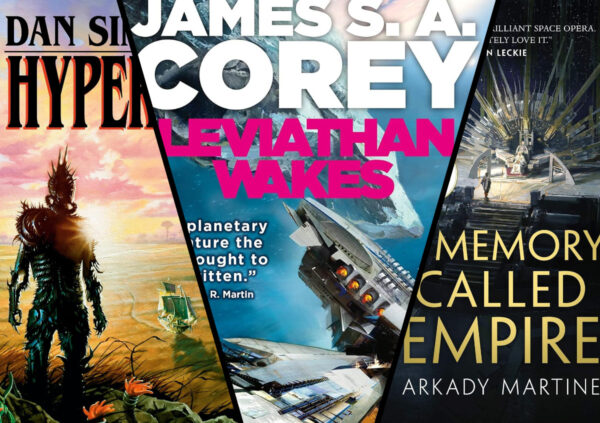
Hyperion is probably Simmons’ best novel, and it’s one of the few science fiction books I’d hand to someone who doesn’t read science fiction at all.
The setup is that seven pilgrims are traveling to the Time Tombs, a set of structures on the world of Hyperion that are moving backwards through time, and where a creature called the Shrike kills almost everyone who goes near it. Each of them has asked to be sent, and none of them will say why. On the voyage out, they agree to tell each other their stories, and those stories are the book.
What makes it work is that Simmons writes every tale in a different mode, and he’s good enough to pull all of them off. The Priest’s Tale arrives as a found journal. The Soldier’s Tale is a war story with a genuinely strange love affair inside it. The Poet’s Tale is a filthy, very funny satire about writing for money. And the Scholar’s Tale is about a father whose daughter is aging backwards, losing a day of memory every day, heading toward infancy, and it’s as sad as anything the genre has produced.
If you’ve come here from horror, the Priest’s Tale is the reason to pick this book up. Father Duré travels to a remote plateau and finds a tribe carrying something called a cruciform, a parasite that will not let its host stay dead, and his account of what that actually means for the people carrying it is one of the most disturbing things I’ve read in science fiction. It works completely on its own if you never read another page.
It won the Hugo and the Locus, I’ve set it with its peers on my list of the best space opera books, and the one honest warning is that it ends mid-story. The Fall of Hyperion (1990) resolves it and is a different kind of book, conventional third-person rather than nested tales, and most readers rate it below the first while agreeing it is necessary. Endymion (1996) and The Rise of Endymion (1997) follow two hundred years later. Consensus is that they are considerably weaker, that the second pair exists to answer questions the first pair was stronger for leaving open, and that a reader who stops after The Fall of Hyperion has lost nothing.
The Ilium/Olympos Duology
Ilium (2003)

Ilium opens the later cycle, and it is the most ambitious thing he attempted. The Trojan War is being fought on a terraformed Mars, observed by a resurrected twentieth-century Homer scholar, while the Greek gods run it using technology. Elsewhere, sentient robots from the moons of Jupiter discuss Shakespeare and Proust, and on a depopulated Earth a handful of surviving humans live in comfortable ignorance.
Ilium won the Locus Award and was a Hugo finalist. Olympos (2005) completes the pair, and it is where the consensus turns: the resolution is widely considered rushed and the ideas outrun the ending. Read Ilium, decide for yourself about Olympos, and know that the first volume’s audacity is the attraction either way.
The Horror
This is the underrated half of the catalog, and it is a substantial career on its own: four Bram Stoker Awards, a World Fantasy Award and a Locus Award for best horror novel. The wider canon it belongs to is on my list of the best horror books.
Carrion Comfort (1989)

A small number of people possess what the novel calls the Ability: they can enter another mind and drive it completely, and the victim does what they are told and remembers choosing to do it.
The book opens in Chelmno, with an SS officer using the Ability inside a camp. It then moves to the present, where three of them meet annually to play a game in which the pieces are people they have arranged to have killed, scored by method.
What lifts it above the premise is the scale. These are not monsters in hiding. They are old, rich and thoroughly embedded, and the argument the novel makes is that unlimited power over other people is not exotic, it is what wealth already looks like with a single restraint removed.
Bram Stoker Award for Best Horror Novel and the British Fantasy Award. Seven hundred pages and relentless rather than slow.
Song of Kali (1985)

His first novel, and the one that reads least like the rest of him.
What almost every summary leaves out is that Robert Luczak brings his wife and his seven-month-old daughter with him, and that the book is a novel about a father before it is a novel about a cult. The turn, when it comes, is domestic. Everything the goddess material has been building is spent on one family, and the last third is a man trying to get something back that cannot be got back.
Simmons wrote it after his own trip to Calcutta and has been open that he loathed the place. That is the engine and it is also the fault line. The city here is not a setting with dark corners, it is presented as actively rotting whoever enters it, and the criticism that has followed the book for forty years is fair rather than squeamish. Read it knowing the author is not describing a place so much as discharging a reaction to one.
World Fantasy Award, and Dean Koontz called it the best novel in the genre he could remember at the time. It never became a series and Simmons never repeated the formula, which for a debut this successful says something.
Summer of Night (1991)

Elm Haven, Illinois, 1960. Five boys on their summer holidays, and Old Central School, which is due for demolition and has something in the bell tower.
The comparison to It is unavoidable and the publication dates are close. Simmons’s version is the tighter book: one summer rather than two timelines, and a small-town childhood observed rather than assembled from nostalgia.
Locus Award for Best Horror Novel. A Winter Haunting revisits one of the boys as an adult and Children of the Night uses another, and neither is necessary.
The Historical Fiction
The Terror (2007)

Two Royal Navy ships looking for the Northwest Passage, stuck fast in the ice north of King William Island from 1846, and a hundred and twenty-nine men who never came home.
Francis Crozier is why this novel works, and he is the reason to read it here rather than anywhere else. He is Irish, Catholic, from Banbridge, in a service run by English gentlemen who have passed him over for command twice and will do it again. He is drinking himself to pieces when the book opens and he runs out of whisky about a third of the way through, so a substantial stretch of the novel is a man withdrawing from alcohol while trying to keep two hundred people alive. And he is also, by a distance, the most competent officer present, and nobody senior to him has ever thought so.
Simmons gives the expedition three separate ways to die and lets them compete. What the men expect to kill them is the thing on the ice. What is actually working is the food, and the cold, and the discipline of a service that would rather follow a dead man’s orders than admit the plan has failed.
Adapted by AMC in 2018 as a ten-part series, which is very good and shorter by a long way. If you are handing one of the Dan Simmons books to somebody who reads neither science fiction nor horror, hand them this.
Drood (2009)

Drood is a novel about professional envy, told by a man who has spent his career being the second-best novelist in the room and knows it. Wilkie Collins is on enough laudanum to see a green-skinned woman on his staircase, he loves Dickens, he would like Dickens to die, and he is aware of both. The frame is the last five years of Dickens’s life, after the Staplehurst rail disaster, and a figure called Drood who may be a monster, a mesmerist, or a symptom.
Eight hundred pages of that voice is either the appeal or the reason to skip it, and there is no middle position. Consensus treats it as the best of the late historicals for readers who can live inside an unreliable narrator that long.
The Abominable (2013)

The Abominable is a 1925 Everest expedition, and the mountaineering detail is excellent, pitch by pitch, oxygen set by oxygen set, in the alternate aftermath of the Mallory disappearance. Three climbers and their patroness hunt the mountain for a dead man and find a reason to wish they had not.
Consensus is that the last act turns into a different and less interesting novel, swapping dread for a thriller plot, and this is the one to skip if you are not already committed. Readers who come for the climbing stay happy longest, because the climbing is the book, and the Everest-history texture holds even where the plot wanders off the rope.
The Crook Factory (1999)

The Crook Factory is the Hemingway book the intro promised: Havana, 1942, and the FBI man sent to babysit Ernest Hemingway’s amateur counter-espionage ring, which really existed, crewed by fishermen, jai alai players, and a priest, while the novelist hunted German submarines from his fishing boat, which he really did.
Simmons plays it straight as a spy thriller and lets the absurdity of the history do the comic work. Consensus rates it mid-shelf and better than its obscurity, and for readers working through the historicals it is the light one between The Terror’s ice and Drood’s opium. Hemingway himself is the draw: vain, generous, impossible, and written by someone who has clearly weighed every biography.
The Fifth Heart (2015)

The Fifth Heart was his last novel: Sherlock Holmes, in America, investigating a death in Henry James’s circle, with Henry James as the unwilling Watson and the small problem that Holmes has begun to suspect he is a fictional character.
It is long, digressive, and built for readers who enjoy the metafictional game as much as the mystery, which is exactly how the reception split. As a closing statement from a career spent borrowing other writers’ furniture, Homer, Chaucer, Dickens, Keats, it is at least perfectly in character, and the obituaries singled it out as the fitting last move. Completists and Holmes readers first, with the long James pastiche as the reward for patience.
The Short Fiction
Prayers to Broken Stones (1990)

Prayers to Broken Stones won the Bram Stoker Award for Best Collection, and it opens with “The River Styx Runs Upstream,” the story Harlan Ellison pushed into print, about a family who have their mother brought back. “This Year’s Class Picture,” found in later collections, took a Stoker of its own: a teacher still holding class in a post-apocalyptic town, with pupils who are no longer alive, and it is the single story of his most often anthologized.
The collection shows the whole later career in seed form, horror, SF, and the historical impulse side by side, with Ellison’s introduction preserving the workshop legend in amber. The right buy for readers who want to know what the fuss was about before the fat novels.
Lovedeath (1993)

Lovedeath collects five novellas on the title’s two subjects, and “Dying in Bangkok” took another Stoker: a vampire story rebuilt around disease and sex tourism that remains one of the nastiest, saddest things he wrote. “The Great Lover,” set in the Great War trenches, points straight at the historical novelist he was becoming.
The format suited him. At novella length the research density that bloats some of the late books stays load-bearing, and consensus rates this among the strongest single volumes in the catalog. Horror readers should not skip it on the way to the big titles.
Dan Simmons: Deep Dive & FAQ
What to Skip
Flashback (2011) is the political one, a near-future America collapsed and addicted to a drug that lets users relive memories, and it was received badly on both literary and political grounds. It is the most divisive thing he wrote and it is not where anybody should start.
The Endymion pair, as above, unless the first two have left you needing answers. The Joe Kurtz crime novels are competent and are not why anybody reads him.
What Runs Through Simmons’s Books
The first constant is literature as load-bearing structure. The Dan Simmons books run on other books: Keats holds up the Cantos, Homer and Shakespeare run Ilium, Dickens and Collins power Drood, and the method is always the same, a genre engine bolted to a canon-sized obsession. Nobody else in the field made the English syllabus this dangerous.
The second is research worn as armor. Whether the subject is Arctic provisioning, Everest logistics, or Hemingway’s boat, the books are built on a teacher’s preparation, and the pleasure is watching the detail hold weight. The fault that follows is the same habit unchecked: the late books sometimes file the research where the story should go.
The third is competence against institutions. Crozier against the Admiralty, the pilgrims against church and empire, even Hemingway against the FBI: the recurring Simmons figure is the capable professional inside a system that promotes its own mythology over its own survival. That the author spent eighteen years in a school system before the career began is worth exactly one footnote, and this is it.
Prizes and Honors
The cross-genre haul is the story: the World Fantasy Award for Song of Kali as a debut, the Hugo and Locus for Hyperion, the Bram Stoker and British Fantasy Awards for Carrion Comfort, the Locus horror win for Summer of Night, a Stoker for the Prayers to Broken Stones collection and more for the short fiction, and the Locus for Ilium. Four genres, each with hardware.
What he never collected was the long-series annuity his publishers wanted, and the obituaries in 2026 treated that as the point of the career rather than its gap: a writer who kept winning the awards for first books in forms he then declined to repeat.
Which Dan Simmons Editions to Buy
Nothing in the catalog requires edition hunting. The Cantos circulate in uniform paperbacks and ebook omnibuses, the horror novels rotate through reissues whenever AMC or Hollywood touches something adjacent, and The Terror exists in a tie-in edition whose cover you can ignore. Prayers to Broken Stones is the one that drifts in and out of print, and used copies are cheap.
The practical advice is the reading order above rather than any printing: buy by appetite, one shelf at a time.
Simmons on Screen
The screen record is one excellent adaptation and a long development graveyard. AMC’s The Terror (2018) compressed the novel into ten episodes, kept Crozier at the center, and stands among the best genre television of its decade. Its later anthology seasons left Simmons behind. Hyperion has been in development at one studio or another for most of this century, famously announced and never delivered, which given the nested structure may be the material defending itself.
The safe prediction his readers keep making: the books most likely to be filmed next are the historicals, because the research is already a production bible.
Questions About Dan Simmons
Where Should I Start With Dan Simmons?
Hyperion for science fiction, Carrion Comfort for horror, The Terror for neither. The catalog is built for picking by appetite, not reading straight through.
Do I Need to Read All Four Hyperion Books?
Hyperion and The Fall of Hyperion are one complete story. The Endymion pair is for readers who need the universe’s questions answered and is widely rated a clear step down.
Is the Terror Based on a True Story?
On the real Franklin expedition of 1845-48, two ships and a hundred and twenty-nine men lost in the Arctic, with the creature and Crozier’s inner life as Simmons’s additions. The history alone accounts for most of the horror.
What Awards Did Dan Simmons Win?
The World Fantasy Award for Song of Kali, the Hugo and Locus for Hyperion, Bram Stoker and British Fantasy Awards for Carrion Comfort, a Locus for Summer of Night, a Locus for Ilium, and multiple Stokers for the short fiction. Few writers have matched the spread.
Why Is Song of Kali Controversial?
Because its Calcutta is written as an actively malevolent place, out of the author’s openly acknowledged loathing after his own visit, and the forty-year criticism of that portrait is fair. The entry above says read it knowing what it is.
Is Drood Worth 800 Pages?
If an envious, laudanum-soaked Wilkie Collins narrating his love-hate for Dickens sounds like a voice you could live in, yes. If not, no, and there is genuinely no middle position.
When Did Dan Simmons Die?
In February 2026, in Colorado, at seventy-seven, leaving one of the genre’s most deliberately unrepeatable catalogs.
Where to Go Next
If Hyperion worked on you, read The Fall of Hyperion and then stop, or go to Ilium if you want the other big structure. If the Priest’s Tale was the part that got you, go to Carrion Comfort, because the horror is where that instinct lives. And read The Terror regardless, because it is the one book of his that requires no tolerance for either genre and it is among the best historical novels of its decade.
Beyond him, the epic shelf Hyperion sits on is mapped on my best space opera books list, the horror canon is on my best horror books list, and the other great Keats-and-cathedrals builder of the era has his page at my Frank Herbert books guide.