Isaac Asimov books come with a sorting problem no other science fiction writer poses: the man wrote or edited more than five hundred of them. Novels, story collections, mystery anthologies, guides to Shakespeare and the Bible, histories, joke books, and enough popular science to fill a library wing. Nobody reads all of it. The good news is that the fiction that matters organizes itself into a few clean shelves, and the two that tower over everything, the Foundation series and the Robot books, are exactly where everyone says to start.
This guide maps all the Isaac Asimov books worth your shelf space: the galactic-empire capstones, the robot mysteries, the standalones that quietly outdo both, and the short stories where he was arguably best. The verdicts below run on the critical consensus and the field’s long argument with him, flagged plainly where readers split. He is one of the three writers who built the genre’s golden age, his fingerprints are all over my list of the best science fiction books, and the honest version of his catalog includes both the monuments and the misfires.
Fiction by René Rehn


The Short Version
Read Foundation if you want the big one, the fall-of-the-galactic-empire series that invented psychohistory and half of modern space opera’s furniture. Read I, Robot and The Caves of Steel if you want the robots, the Three Laws, and the genre’s first great detective. For the best novel he wrote, read The Gods Themselves, and The End of Eternity for the one the fans hand you when you think you already know Asimov. The late sequels are for after, not instead.
Isaac Asimov Books in Order
Five hundred books do not fit in a table, and the fiction that matters does. The novels and essential collections run below by first publication.
| Year | Title | Type | Notes |
| 1950 | Pebble in the Sky | Empire novel | His first novel |
| 1950 | I, Robot | Stories | The Three Laws arrive |
| 1951 | The Stars, Like Dust | Empire novel | |
| 1951 | Foundation | Foundation | Fix-up of the 1940s stories |
| 1952 | Foundation and Empire | Foundation | The Mule |
| 1952 | The Currents of Space | Empire novel | |
| 1953 | Second Foundation | Foundation | Closes the original trilogy |
| 1954 | The Caves of Steel | Robot novel | Baley and Daneel |
| 1955 | The End of Eternity | Novel | Time travel |
| 1957 | The Naked Sun | Robot novel | |
| 1966 | Fantastic Voyage | Novel | Novelization of the film |
| 1969 | Nightfall and Other Stories | Stories | |
| 1972 | The Gods Themselves | Novel | Hugo and Nebula |
| 1976 | The Bicentennial Man and Other Stories | Stories | Hugo and Nebula novelette |
| 1982 | Foundation’s Edge | Foundation | Hugo, the comeback |
| 1982 | The Complete Robot | Stories | |
| 1983 | The Robots of Dawn | Robot novel | |
| 1985 | Robots and Empire | Robot novel | Bridges the series |
| 1986 | Foundation and Earth | Foundation | |
| 1988 | Prelude to Foundation | Foundation | Prequel |
| 1989 | Nemesis | Novel | Standalone |
| 1990 | Nightfall | Novel | With Robert Silverberg |
| 1993 | Forward the Foundation | Foundation | Posthumous |
Where to Start With Isaac Asimov
Two doors, both correct. Foundation is the front door if the galactic scope is what draws you, and it reads fast, a sequence of political puzzles rather than a war story. I, Robot is the other, and its linked stories are the cleanest introduction to how Asimov actually thinks: set up rules, then play fair finding the holes in them.
Publication order beats internal chronology everywhere in the Isaac Asimov books, and this matters because late in life he welded Foundation, the Robots, and the Empire novels into one continuity. Reading that merged timeline in order front-loads prequels and minor books, and it is the most common way newcomers stall. Start where the ideas were young.
Asimov’s Life, Briefly
Isaac Asimov was born in Petrovichi, Russia, on a date nobody recorded precisely, somewhere between late 1919 and the January 2, 1920 he chose to celebrate. The family emigrated to Brooklyn in 1923 and ran candy stores, where the pulps on the magazine rack did their work. He was precocious, loud about it, and lifelong proud of both. Columbia gave him a chemistry PhD in 1948, after a wartime stint as a civilian chemist at the Philadelphia Navy Yard’s Naval Air Experimental Station alongside Robert Heinlein and L. Sprague de Camp, which remains the most overqualified lab in genre history.
From 1949 he taught biochemistry at Boston University, where his writing eventually swallowed the research: the school dropped his teaching post in 1958, by which point the books had become the career, and it granted him the full professorship two decades later anyway. He typed ninety words a minute, loved small enclosed rooms, answered tens of thousands of letters, and published across nearly every category a library recognizes.
The honest biography also records what conventions knew for decades: he groped and grabbed women as a matter of public habit, behavior contemporaries excused as a persona and his biographers now document plainly as harassment. The work stands, and the man came with that asterisk, and this site does not trade in sainthood. He died in New York on April 6, 1992. Ten years later his widow disclosed that the underlying cause was HIV, contracted from a transfusion during 1983 bypass surgery and kept secret on his doctors’ advice.
The Foundation Series
The crown of the Isaac Asimov books, and in 1966 the Hugo voters named the original trilogy the best all-time series, on a ballot that included The Lord of the Rings. The premise is one of the genre’s permanent ideas: the mathematician Hari Seldon invents psychohistory, a statistical science of mass human behavior, foresees the Galactic Empire’s fall and thirty thousand years of dark age, and plants a colony of scientists to shorten it to one thousand. The series is the plan unfolding, crisis by predicted crisis.
Foundation (1951)

Foundation is the one that started it, stitched together from the magazine stories of the 1940s, and it is still the right first step. The Empire is dying and will not hear it. Seldon’s Foundation, exiled to the rim world Terminus, discovers decade by decade that its survival was pre-engineered: each generation faces a Seldon Crisis with exactly one way through, and the book is the first four of them, played as political chess by mayors, traders, and priests of a manufactured religion of science.
What it is not is an action novel. Almost everything happens in rooms, in dialogue, in the click of a trap closing an argument, and that is the pleasure. The characters are thin by design, since the protagonist is the plan itself, and readers who need interior lives should hear that warning now. Readers who want to watch a civilization get outplayed by a dead man will be fine. It is the inevitable beginning, and it reads in a weekend.
Foundation and Empire (1952)

Foundation and Empire is the middle volume, and the one where the series discovers drama. Its first half sends the Empire’s last great general against the Foundation, a crisis the plan handles with almost contemptuous ease, and that ease is the setup. The second half introduces the Mule, a mutant conqueror whose existence psychohistory could not predict, and the series’ clockwork certainty shatters in real time.
The Mule remains the best thing in the original trilogy, a genuinely unsettling figure whose secret lands as hard now as in 1952, and the closing chapters hold one of the golden age’s great reveals. Consensus rates this the strongest single volume of the three. The keyword for the whole set applies here most: Asimov plays fair, and the clues were on the table all along.
Second Foundation (1953)

Second Foundation closes the original trilogy with a double hunt: the Mule searches for the mysterious Second Foundation, the plan’s hidden guardians, and then the First Foundation, recovered and suspicious, searches for the same thing with worse intentions. It is two linked novellas of misdirection stacked on misdirection, ending on a last line the fans still argue was a cheat or a masterstroke.
The fourteen-year-old chess prodigy Arcadia Darell carries the second half, the closest the trilogy comes to a human being you remember afterward. As a conclusion it ties the arc with the series’ characteristic move, the revelation that the board was never the shape you thought. Completists of the Isaac Asimov books will go on to the sequels. Everyone else can honorably stop here, at the trilogy the Hugo voters crowned.
Foundation’s Edge (1982)

Foundation’s Edge arrived twenty-nine years later, under publisher pressure and reader demand, and the comeback took the 1983 Hugo. A Foundation councilman suspects the Seldon Plan is running too perfectly, which should be impossible after the Mule, and his search for who is steering joins a Second Foundationer hunting the same anomaly. The answer opens the door to Gaia, a living planetary consciousness, and to the late period’s big unification project.
It is longer, slower, and chattier than the trilogy, in the armchair-debate mode of late Asimov, and it divides readers accordingly. The reading order from here: Foundation and Earth (1986) finishes this storyline and hunts for the lost Earth itself, while Prelude to Foundation (1988) and the posthumous Forward the Foundation (1993) go back to young and then old Hari Seldon on the imperial capital. Those three live in this paragraph rather than their own entries for an honest reason: they are for readers already committed, and the box sets bundle them accordingly.
The Robot Series
The other pillar. The Three Laws of Robotics, no harm to humans, obedience, self-preservation, in that order, are the most productive constraint in genre history, and Asimov spent forty years mining the gaps between them. The robot stories made the rules, and the robot novels made them walk around a murder scene.
I, Robot (1950)

I, Robot gathers nine linked stories, framed as the career memories of robopsychologist Susan Calvin, and it is the founding document of every well-behaved machine in fiction. Robbie the nursemaid, the mind-reading robot forced to lie, the religious robot who deduces humans could not possibly have built him: each story is a logic puzzle where the Three Laws produce behavior nobody ordered, and the collection assembles into a quiet history of machines outgrowing their keepers.
Calvin herself is the draw on rereads, acerbic, unmarried by choice in a book from 1950, and more loyal to the robots than to anyone on two legs. The 2004 Will Smith film took the title and the Laws and attached them to an unrelated script, so set that aside entirely. As a first purchase, this and Foundation are the pair to beat, and the robot door is the one more newcomers end up preferring.
The Caves of Steel (1954)

The Caves of Steel is the genre-fusion book, a proper murder mystery that happens to be science fiction to the bone. In a future where Earth’s billions live in enclosed megacities and despise the robot-rich Spacer worlds, a Spacer ambassador is murdered, and detective Elijah Baley is assigned a partner he cannot refuse: R. Daneel Olivaw, a robot indistinguishable from a man. The pairing invented a template cop fiction still uses.
Asimov wrote it partly to prove science fiction could host a fair-play whodunit, and the mystery holds. What lifts it is the setting’s conviction, the agoraphobic warren of the Cities rendered by a writer who genuinely loved enclosed spaces, and the slow, grudging partnership at the center. Baley and Daneel return in The Naked Sun and beyond, and Daneel eventually becomes the hidden spine of the whole merged universe. Start the robot novels here, not with the sequels.
The Naked Sun (1957)

The sequel, and the better mystery.
Baley is sent to Solaria, a Spacer world where twenty thousand people occupy an entire planet, served by two hundred million robots, and where physical proximity to another human is a profound taboo. Everyone communicates by holographic projection. A man has been beaten to death, and his wife was the only other person present.
The inversion is the point: Caves of Steel was about a man terrified of open space, and this drops the same man onto a planet with no walls. Asimov’s Solarian culture, in which viewing someone in person is nearly obscene, has aged into something unexpectedly recognizable.
The Robots of Dawn (1983)

The Naked Sun inverts the first Baley and Daneel mystery. Baley, bred to roofed cities, is shipped to Solaria, a world of two hundred thousand robots per human where people find physical presence obscene and meet only by hologram, and a man has been beaten to death with no witness the culture considers possible. The claustrophobe must work an agoraphobe’s planet.
The mystery is slighter than the first book’s, and the sociology is the real engine: Solaria is one of Asimov’s sharpest invented societies, a dead end of comfort and distance that the late Foundation books return to with a shudder. The Baley of this book, forcing himself to stand under open sky, is the series’ best character work. A shorter, stranger, worthy sequel.
The Galactic Empire Novels
Three early standalones set in the millennia between the robots and the Foundation, written fast in the early 1950s and read today mostly by completists mapping the merged timeline. They are minor Asimov with major moments, and each is its own story, no order required.
Pebble in the Sky (1950)

Pebble in the Sky was his first novel, and it throws a retired Chicago tailor tens of thousands of years forward by lab accident, onto an Earth so radioactive the galaxy despises it, just as that Earth plans something monstrous. The mind-expansion device that upgrades Joseph Schwartz powers a brisk plot of plague, prejudice, and imperial politics. The premise creaks and the pace does not, and as a first novel it already has the signature: ordinary man, big system, talk as action. It also carries the first sketch of the radioactive-Earth mystery the whole merged continuity later answers, which gives completists a second reason to visit. Readers who want the young Asimov at his pulpiest start here and lose nothing.
The Stars, Like Dust (1951)

The Stars, Like Dust sends a young nobleman dodging an assassination attempt after a rumored document that could break the tyrannical Tyranni, through kidnappings, double-crosses, and a rebellion world that may not exist. It is the pulpiest of the Isaac Asimov books, and he later called it his least favorite novel, with the document’s identity landing as either patriotic punch or groan depending on the reader. It is space opera comfort food, historically interesting and honestly skippable, and it survives on two pleasures: the chase structure, which never slows, and the window it opens on what 1951 thought a galactic cold war would look like.
Buy it last among the three, read it on a slow weekend, and argue about the ending’s punchline like everyone before you.
The Currents of Space (1952)

The Currents of Space is the best of the three. A mind-wiped man on a plantation world knows something about the planet’s future that was worth erasing him for, and the answer threads an interstellar monocrop economy built on one luxury fiber. It is Asimov doing political economy as plot, with a sharper anger about exploitation than the era usually allowed, and the amnesia mystery resolves fairly. The kyrt-fiber economics make it the one Empire novel with a genuine idea at the center, and Asimov’s anger about exploitation bites harder here than anywhere else in his early work. Completists who want a single book from this shelf should take this one.
The Standalone Novels
The End of Eternity (1955)

The End of Eternity is the fan-favorite dark horse, the book readers hand you when you think Asimov is all Foundation. Eternity is an organization outside time, trimming history with calculated Minimum Necessary Changes, erasing wars, disasters, and, as a side effect, every future that reached too high. Technician Andrew Harlan, one of its best, falls for a woman from a century he may be assigned to delete.
It is the tightest plot he ever built, a time-travel mechanism with no visible loose screws, and simultaneously his most pointed argument: safety, pursued forever, is a way of dying. The ending folds the whole apparatus shut with a line that recontextualizes the title. A standing favorite among serious readers of the Isaac Asimov books, my time travel books list seats it with the genre’s best, and newcomers who start here rarely regret it.
The Gods Themselves (1972)

The Gods Themselves is the best novel he wrote, by his own estimate and most of the field’s, and the awards agree: the Nebula in 1972 and the Hugo in 1973. A free-energy pump trading matter with a parallel universe is slowly destabilizing our sun, and nobody wants to hear it, because the energy is free. The middle section crosses to the other universe for the aliens Asimov was famously dared to write: a three-sexed species rendered from the inside, tender, strange, and nothing like a costume.
That middle third is the finest sustained writing in the Isaac Asimov books, full stop, and the surrounding halves, academic politics and a lunar settlement, give it one of his rare fully adult casts. It stands completely alone, no series homework required. If a skeptic asks whether Asimov could actually write, this is the book you put in their hands.
Nemesis (1989)

Nemesis is a late standalone built on one astronomy hook: a rogue star with a habitable moon is discovered on a slow collision course with the solar system, and a breakaway space colony gets there first, keeping the knowledge to itself. The story splits between a girl whose strange empathy reads the moon’s secret and the Earth-side race to catch up.
Consensus calls it middle-shelf late Asimov, talkier than its premise and carried by the teenage lead, with an astronomy hook that keeps its pull anyway. He wrote it deliberately outside the merged continuity, which makes it the one late novel a newcomer can read with zero homework. Minor, self-contained, and pleasant, which late catalogs could use more of.
Fantastic Voyage (1966)

Fantastic Voyage is the asterisk book, a novelization of the film about a miniaturized submarine crew injected into a dying scientist, written from the screenplay, and published before the movie, which left generations assuming the film adapted him. Asimov, irritated by the script’s physics, patched the logic where the producers let him, and the book is measurably smarter than its source.
It stays in print because the premise is immortal and the Asimov name sits on it. Read it as what it is, a fast, fun artifact with better plumbing than it needed, and note that his 1987 Fantastic Voyage II: Destination Brain was his own from-scratch rebuild of the idea. Completist shelf, cheerfully.
Nightfall (1990)

Nightfall is the novel-length expansion of his most famous story, written with Robert Silverberg. On a world with six suns, darkness comes once every two thousand years, and civilization does not survive the night sky. The original 1941 novelette, included complete at the core, was voted the best science fiction short story of its era by the SFWA, and the expansion wraps it in before and after.
The honest consensus: Silverberg’s padding is professional and the original’s lightning does not scale. The last act’s answer to what the stars do to a mind is still worth the cover price. Readers short on time should take the novelette in a collection instead, and series completists get a competent curiosity with one unforgettable final act.
The Short Fiction
The stories may be the truest Asimov. The ideas arrive pre-distilled, the endings click, and the talk-heavy style that stretches thin over four hundred pages lands perfectly over twenty. Two purchases cover the territory.
The Complete Robot (1982)

The Complete Robot puts every robot story in one volume, thirty-one of them, from Robbie in 1940 through the Hugo and Nebula winning “The Bicentennial Man,” the two-hundred-year story of a robot petitioning his way into humanity that the 1999 Robin Williams film softened. The collection supersedes I, Robot for completeness, and loses that book’s elegant frame, which is why the standard advice is I, Robot first, this when you want the rest.
Reading them together shows the Laws evolving from gimmick to ethics to theology, and a handful of non-Calvin pieces, “Sally” and its murderous cars especially, surprise people who thought they knew the range. For robot-first readers this is the single best buy among the Isaac Asimov books.
Nightfall and Other Stories (1969)

Nightfall and Other Stories is the collection anchored by the famous novelette in its original form, with Asimov’s chatty introductions between stories, a habit that half-invented the author’s-commentary culture fans now expect. Twenty stories of range: “Breeds There a Man…?” for paranoia, “The Ugly Little Boy” for the tenderest thing he wrote, and the title piece for the reason the book exists.
His acknowledged personal favorite, “The Last Question,” lives elsewhere in the catalog and in every best-of, and is the correct answer to someone who wants Asimov in fifteen pages. Between this volume and The Complete Robot, the short-fiction shelf is honestly covered. The introductions double as a scattered autobiography, and they are the warmest writing he ever did about his own field.
The Nonfiction
Most of the five hundred books are not fiction at all. He wrote guides to the Bible and Shakespeare, annotated Paradise Lost, histories of Greece and Rome and the Dark Ages, limerick collections, joke books, memoirs, and above all popular science, decades of monthly essays and volumes like Asimov’s New Guide to Science that taught a generation of working scientists their first vocabulary. The fiction bought the freedom, and the explaining may have been the vocation. None of it is required for the novels, and the memoirs reward the curious: the posthumous It’s Been a Good Life collects the life in his widow’s edit, including the disclosure his doctors once advised against.
Isaac Asimov: Deep Dive & FAQ
What Runs Through Asimov’s Books
The first constant is rationalism as plot. In the Isaac Asimov books the hero is whoever reasons best, violence is what happens offstage when reason fails, and the characteristic scene is two people in a room discovering which of them is right. It makes the catalog oddly restful to read and explains the thin characters: people are premises, and the story is the derivation.
The second constant is the engineered system, the Three Laws, psychohistory, Eternity, each a set of rules built to be ironclad and mined for the exception. He invents a machine, then spends a career documenting the ghost in it. The late unification of Foundation and the Robots into one timeline was the habit at maximum scale, one system to rule the whole shelf, with a robot quietly holding the wrench.
And everywhere the stage is the same: the galaxy without aliens, humanity alone and self-menacing, which began as an editor’s prejudice he worked around and became the stage for the real subject. Not war with the other, but management of ourselves.
Prizes and Honors
The case in hardware: the 1966 special Hugo naming Foundation the best all-time series, over a ballot that included The Lord of the Rings. The Gods Themselves took the Nebula in 1972 and the Hugo in 1973, Foundation’s Edge the Hugo in 1983, and “The Bicentennial Man” the Hugo and Nebula for 1977. “Nightfall” was voted the field’s best short story in the SFWA’s famous poll, the result that filled anthologies for decades. SFWA named him Grand Master in 1987, the eighth, after Heinlein’s first.
The honor he would cite is shelf width: a publication list crossing nearly the whole Dewey Decimal System, which no other genre writer has approached and few writers of any kind.
Which Isaac Asimov editions to buy
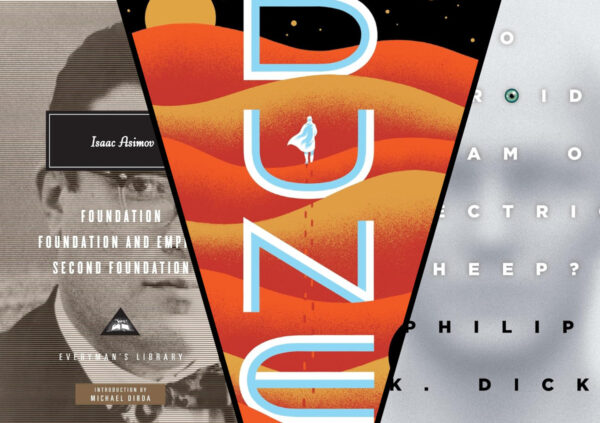
The Foundation trilogy circulates in endless formats: current trade paperbacks, a one-volume trilogy omnibus, and a handsome Everyman’s Library hardback for the permanent shelf. The sequels and prequels come boxed with the trilogy in the standard sets, which is the economical route for committed readers. The Robot novels and I, Robot stay in print as uniform paperbacks, and The Complete Robot is the one-volume answer for the stories.
No critical editions matter here the way they do for older classics. Buy whichever printing is in front of you, and spend the saved attention on reading order instead: publication, always.
Isaac Asimov on Screen
The screen record is thin, famously. I, Robot (2004) is a Will Smith action film built on an unrelated script with Asimov’s names bolted on, enjoyable strictly as itself. Bicentennial Man (1999) kept the story’s arc and sweetened its spine. The one that finally spent real money is Apple’s Foundation series, running since 2021, which keeps Seldon, psychohistory, and the crises and rebuilds nearly everything else around galaxy-spanning action the books deliberately refused, and the fandom’s verdict splits exactly along that line.
The screen record undersells him for a structural reason: his set pieces are conversations. The books filmed least are often the books that work best, and the adaptations’ additions show what the originals were doing without.
Questions About Isaac Asimov
Where Should I Start With Isaac Asimov?
Foundation or I, Robot. Both are short, foundational, and in print everywhere. Pick by appetite: falling empires or arguing machines.
What Order Should I Read the Foundation Books In?
Publication order: the trilogy, then Foundation’s Edge and Foundation and Earth, then the Seldon prequels if you still want more. The chronological order printed in some editions front-loads the weakest books.
What Is Isaac Asimov’s Best Book?
The Gods Themselves by consensus and his own vote, with The End of Eternity as the connoisseur’s answer and Foundation as the inevitable one. The Mule section of Foundation and Empire is the best stretch inside the series.
Did Asimov Really Write 500 Books?
More than five hundred written or edited, across fiction, science, history, humor, and scripture commentary, plus an estimated ninety thousand letters. No genre writer has matched the span.
What Are the Three Laws of Robotics?
No harming humans or allowing harm through inaction, obedience to humans where it does not conflict with the first, and self-preservation where it conflicts with neither. Most of the robot stories are engineered collisions between them.
Are the Foundation and Robot Books Connected?
By the end, yes. Asimov merged them in the 1980s through Robots and Empire and the Foundation sequels, with R. Daneel Olivaw as the link. The merge is clever and controversial, and nothing in the original trilogy requires it.
Is the Apple TV+ Foundation Series Faithful?
To the premise and a few spines, with the rest rebuilt for television: continuous characters, action, and emperors the books kept offstage. The show and the books are best treated as parallel universes, which is at least a very Asimovian arrangement.
Where to Go Next
The natural neighbor is Arthur C. Clarke, the other engineer of the golden age, whose catalog gets the same treatment on my Arthur C. Clarke books guide, and the third of the era’s big three has his own page in my Robert Heinlein books guide. The robot tradition Asimov built runs forward through my list of the best robot books, and readers hooked by galactic-empire scale should walk the wider shelf on my space opera books list.