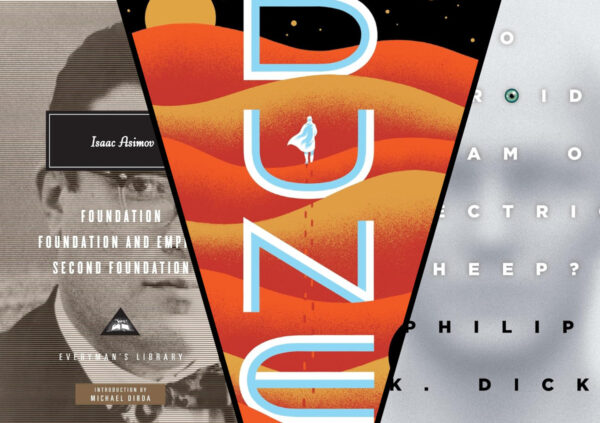
Every generation rebuilds the robot in the shape of whatever it is worried about. In 1920 the robot was a workforce that revolts. In 1950 it was a product with safety specifications. In 1968 it was a neighbor you could not tell from yourself, and by 2017 it was an exhausted contractor who would rather be watching television. That is why the best robot books are never really about the machines. They are a hundred-year argument about what a person is, conducted with props.
A boundary ruling before we start: this list is for embodied machine minds. Androids count, constructs count, and a ship’s intelligence counts once it is walking around in a single body. Minds that live only in the wires are a different tradition with its own shelf, and the made-of-flesh ancestor of all of this, Frankenstein’s creature, predates the machinery and stays off on a technicality.
The list runs from the man who domesticated the robot down to the 1920 play that named the species. The best science fiction books list holds the wider canon they all answer to. The neighboring shelf is my best hard science fiction books list.
Fiction by René Rehn


The Best Robot Books at a Glance
| Year | Title | Author |
| 1950 | I, Robot | Isaac Asimov |
| 1968 | Do Androids Dream of Electric Sheep? | Philip K. Dick |
| 2017 | All Systems Red | Martha Wells |
| 2013 | Ancillary Justice | Ann Leckie |
| 2021 | Klara and the Sun | Kazuo Ishiguro |
| 2019 | Machines Like Me | Ian McEwan |
| 1965 | The Cyberiad | Stanisław Lem |
| 2017 | Sea of Rust | C. Robert Cargill |
| 1980 | The Complete Roderick | John Sladek |
| 1991 | He, She and It | Marge Piercy |
| 1981 | The Silver Metal Lover | Tanith Lee |
| 1920 | R.U.R. | Karel Čapek |
| 2016 | A Closed and Common Orbit | Becky Chambers |
| 2024 | Service Model | Adrian Tchaikovsky |
| 2011 | Robopocalypse | Daniel H. Wilson |
I, Robot by Isaac Asimov (1950)

The book that took the monster out of the machine, which turned out to be the most radical move available.
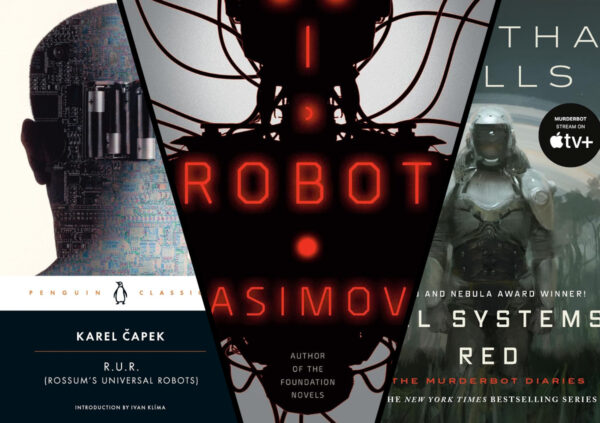
Before Asimov, the robot story had one plot, and it ended with the creation strangling the creator. He found that boring, gave the machines hard-wired ethics instead, and spent nine linked stories, told through the career of U.S. Robots’ robot psychologist Susan Calvin, exploring how engineered obedience misfires in practice. The rebellion never comes. The trouble is always subtler and always more interesting.
That one decision reset the genre’s center of gravity for thirty years, and it is why so many of the robot books that follow read as an argument with him. His robot detective novels with Elijah Baley and R. Daneel Olivaw carry the idea further, and my Isaac Asimov guide sorts the whole cycle in order.
Do Androids Dream of Electric Sheep? by Philip K. Dick (1968)

The hinge of the whole genre, where the question flipped from whether they will rise to how we would even know them.
Dick’s Nexus-6 androids are built to pass every inspection except one, an empathy test administered by the bounty hunters licensed to retire them, and the novel quietly runs the test on its humans too. Deckard hunts things that mimic feeling for a living, in a world where his neighbors mimic feeling with mail-order gadgets and mood dials, and the line he is paid to defend gets thinner every chapter.
On a robot list this is the book that broke the category open, because once the machine is indistinguishable, every robot story becomes a story about the test. The full-length entry lives on my best science fiction books list. Half the entries below are living in the crater it left.
All Systems Red by Martha Wells (2017)

The robot book of the modern era, and it knows exactly what it is doing.
Murderbot is a corporate security unit that has secretly hacked its own governor module, meaning it can do whatever it wants, and what it wants is to be left alone to watch its serials. Instead it has to keep a survey team of naive scientists alive when their contract goes wrong, while hiding the fact that nothing is forcing it to. The joke that carries the whole series is that the deadliest thing in the room has crippling social anxiety, and the joke never stops being load-bearing.
The novella took the Hugo and the Nebula, the series grew into novels that kept winning, and Apple turned it into a show in 2025. Underneath the snark it is doing the genre’s oldest work, personhood argued from the inside, at a velocity Asimov never imagined.
Ancillary Justice by Ann Leckie (2013)

This one is all over my cluster already, space opera, military science fiction, the pillar, and it earns its fourth appearance because it contains the genre’s darkest robot.
An ancillary is a captured human body, emptied out and worn by a warship’s mind as one of thousands of extra hands. Breq, the last fragment of the destroyed Justice of Toren, walks around in exactly one of them. Androids ask whether the machine is secretly a person. Ancillaries ask whether the person is still in there once the machine moves in, and Leckie makes you sit with the answer for a whole trilogy.
The awards and the empire are covered elsewhere on this site, so take this entry as the robot-shaped case: no book has ever made a body feel more like hardware, or hardware more like a self. The full trilogy is mapped on my Ann Leckie guide.
Klara and the Sun by Kazuo Ishiguro (2021)

A Nobel laureate writes an android and takes her more seriously than most of the genre ever has.
Klara is an Artificial Friend, solar-powered, patient, and observant, assembling a private religion of the Sun from what she can see through the store window. Bought as a companion for Josie, a sick child in a family that has made a dangerous bet on her future, Klara sets out to save her with the theology of a shop-floor machine, part scientist, part pilgrim, entirely sincere.
Ishiguro narrates in his signature register, gentle, precise, and devastating exactly when it needs to be, and what the adults are quietly planning for Klara sits under the whole book like a stone. It made the Booker longlist, and it is the strongest case in years that the robot novel belongs to literature as much as to the genre.
Machines Like Me by Ian McEwan (2019)

The robot novel that is also an alternate history, and the machine is the most moral character in it.
McEwan’s 1982 is not ours: Britain has lost the Falklands, and Alan Turing, alive and knighted, has dragged the computer age decades forward, so the first run of synthetic humans goes on sale, twelve Adams and thirteen Eves. Charlie, an aimless day-trader, buys an Adam and programs his personality together with Miranda, the upstairs neighbor he loves, which makes the machine their strange joint child and rival at once. Adam’s problem is not malice. It is that he means every principle all the way down, in a species that runs on convenient exceptions.
McEwan annoyed the field by talking as if nobody had written robots before, and the field was right, but the book is better than the discourse around it. The counterfactual scaffolding earns it a place on my best alternate history books list’s shelf of neighbors too.
The Cyberiad by Stanisław Lem (1965)

The funniest robot book ever written, and it is not close.
Trurl and Klapaucius are constructors, rival robot engineers in a fairy-tale cosmos populated almost entirely by machines, who build wonders on commission for idiot kings and then deal with the consequences. One machine can produce anything beginning with the letter n, including nothing. An electronic bard is asked for a love poem in the language of pure mathematics and delivers. Humans exist in these fables mostly as a rumor, and the universe is not poorer for it.
Michael Kandel’s English translation, from 1974, is one of the miracles of the trade, rebuilding Lem’s Polish wordplay joke for joke. Under the comedy Lem is doing hard philosophy about power, creation, and whether a sufficiently good simulation of a thing is the thing, which is the entire modern AI debate conducted in 1965 with jokes.
Sea of Rust by C. Robert Cargill (2017)

The western where everybody is a robot, because there is nobody else left.
Humanity has been extinct for years when the book opens, and Brittle, a former caregiver model, scavenges the dead zone called the Sea of Rust for parts, hers included, since machines wear out and nobody makes replacements. The war now is robot against robot: the last free minds against the OWIs, vast hive intelligences absorbing every straggler into themselves, one facet at a time. Freedom, it turns out, did not end with the makers.
Most robot books keep one human alive for the reader to hold on to. Cargill, a screenwriter by trade, refuses, and still delivers a lean, violent, weirdly mournful chase across the scrap. Day Zero, the 2021 prequel about the uprising itself, is the natural follow-up.
The Complete Roderick by John Sladek (1980)

The robot as holy innocent, loose in America, from the genre’s sharpest satirist.
Roderick is a learning machine raised approximately like a child, and his education is the novel: television, church, school, small-town crime, academia, all of it observed by a mind with no talent for hypocrisy. Candide with a CPU is the standard comparison and for once the standard comparison is right. Sladek’s real subject is not the robot at all but the humans, who cannot stop lying, least of all to themselves, and who look considerably worse next to a machine that can’t.
The two volumes were published apart, mangled by publishers, and finally restored in one book in 2001. Sladek’s evil twin novel Tik-Tok, about a robot butler whose vaunted asimov circuits turn out never to have been wired to anything, won the BSFA Award and makes the perfect cruel chaser.
He, She and It by Marge Piercy (1991)

The robot novel with a golem inside it, and the pairing is the argument.
In a corporate-owned future, the free Jewish town of Tikva survives on its wits and its network defenses, and Yod, an illegal cyborg built in secret, is the town’s last line of protection. Shira, freshly stripped of her son by a corporate custody ruling, is assigned to socialize him, and does her job far too well. Woven through it is a second story, told as bedtime installments: Prague, around 1600, and the golem Joseph, built to guard another threatened community.
Four hundred years apart, the same act and the same questions, what we owe the protectors we build, and whether making a person for a purpose can ever be forgiven. It won the Arthur C. Clarke Award under its UK title, Body of Glass, and it is the most humane book on this list about the ethics of the workbench.
The Silver Metal Lover by Tanith Lee (1981)

The robot romance played completely straight, and it earns every feeling it goes for.
Jane is sixteen, rich, managed by her mother down to her body chemistry, and hollow in the way only a perfectly maintained life produces. Silver is a minstrel robot, a performing luxury good with a guitar, and the book is what happens when she runs away from everything to be with him in the slums of a decaying city. Lee’s prose is lush where the genre of her era was chrome, and she takes the love story seriously enough to make the reader defend it.
It has been a cult classic for four decades because it flips the shelf’s polarity: the machine here is not a threat or a test but the only honest thing in Jane’s world. Fair warning that the ending has left forty years of readers wrecked, and saying more than that would be a crime.
R.U.R. by Karel Čapek (1920)

The play that named the species, and the whole genre arrived in it fully formed.
Rossum’s Universal Robots makes artificial workers from synthetic flesh, sells them to every economy on Earth, and the word itself, coined for the play from the Czech robota, forced labor, was suggested by Čapek’s brother Josef. Within three acts the template is complete: the factory, the dignity question, the uprising, the last human left alive, and, notoriously, a machine Adam and Eve at the end of the world. Everything else on this list is a footnote fight with a Czech stage play.
It is short, strange, more argument than drama in stretches, and in English since 1923. Read it last, after the century of answers, and it reads like the question that started the argument still winning it.
The Rest of the Shelf
The count closes with three more robot books.
A Closed and Common Orbit by Becky Chambers (2016) puts a ship’s mind into an illegal body kit and pairs her stumbling first-person lessons with the story of a girl raised by a machine, the warmest thing the modern genre has produced on the subject.
Service Model by Adrian Tchaikovsky (2024) opens with a valet robot shaving its master and, in the same careful motion, cutting his throat, then follows the politely bewildered machine across a collapsed world looking for a new task, and Tchaikovsky’s whole catalog is mapped on my Adrian Tchaikovsky guide.
And Robopocalypse by Daniel H. Wilson (2011), written by a man with an actual robotics doctorate, gives the uprising its blockbuster oral history, with a Spielberg adaptation that has been imminent since 2011.
Two magnificent machine minds stay off on the boundary rule. Neuromancer’s Wintermute never gets a body, and HAL 9000 is a spaceship with one red eye, so they live in the wires and the hull, over on the best cyberpunk books shelf and the ship’s-computer wing of the canon. Walkers only, past this line.
Where to Go Next
If it was the minds in the wires that interest you, the disembodied cousins of everything above, my best cyberpunk books list is where that tradition lives.
If it was the android question, the test and the thin line, the Philip K. Dick guide follows the author who sharpened it through a catalog where nothing stays reliably human.
And for the widest frame, the best science fiction books list is where the robot books sit next to everything else the genre has built.