Adrian Tchaikovsky may be the most productive writer of genuinely good science fiction and fantasy alive. He publishes several books a year, has done for over a decade, and the alarming part is how few of them are bad. Since his 2008 debut he has produced a ten-book insect-based fantasy epic, a Clarke Award-winning saga about uplifted spiders, a Hugo-winning series, and a long shelf of standalones ranging from robot comedies to planetary horror, and he shows no sign of slowing down. The catalog is so large and so varied that the single hardest thing about the Adrian Tchaikovsky books is knowing where to start, which is exactly what this guide is for.
The through-line, if there is one, is the natural world. Tchaikovsky studied zoology and psychology, and his real subject is alienness, what a genuinely non-human mind might be like, whether it belongs to a spider, an octopus, a robot, or an insect-kinden warrior. He writes better non-human points of view than almost anyone in the genre, and once you know that, the sprawling catalog starts to make sense as one long inquiry from many angles. On my best science fiction books list, Children of Time takes a well-earned place, and this page maps the rest of the shelf by what kind of reader you are. The neighboring shelf is my best hard science fiction books list.
I haven’t read the whole enormous output, and at his rate almost nobody has. Where the assessments below rest on critical consensus rather than my own reading, the text flags it.
Fiction by René Rehn


The Short Version
Start with Children of Time if you want the science fiction, and it is the best entry point to the whole catalog, a patient, brilliant novel of evolution and first contact. Start with Shadows of the Apt, beginning with Empire in Black and Gold, if you want the epic fantasy and have the appetite for ten books. Start with a standalone, Elder Race or Service Model or Dogs of War, if you want to sample his range in a single sitting. And be warned about the spiders, because they are coming.
Adrian Tchaikovsky Books in Order
The complete list would fill the page, so the table carries the series anchors and the essential standalones. At his pace, it dates faster than any other table on this site, which is its own kind of recommendation.
| Year | Title | Series | Notes |
| 2008 | Empire in Black and Gold | Shadows of the Apt 1 | The debut |
| 2014 | Seal of the Worm | Shadows of the Apt 10 | Closes the epic |
| 2015 | Guns of the Dawn | Standalone | Fantasy |
| 2015 | Children of Time | Children of Time 1 | Clarke Award |
| 2017 | Dogs of War | Dogs of War 1 | |
| 2019 | Children of Ruin | Children of Time 2 | BSFA Award |
| 2019 | Cage of Souls | Standalone | Clarke shortlist |
| 2020 | The Doors of Eden | Standalone | Sidewise Award |
| 2021 | Shards of Earth | Final Architecture 1 | BSFA Award |
| 2021 | Elder Race | Novella | Hugo finalist |
| 2022 | City of Last Chances | Tyrant Philosophers 1 | BSFA Award |
| 2022 | Children of Memory | Children of Time 3 | |
| 2023 | Lords of Uncreation | Final Architecture 3 | Closes the trilogy |
| 2024 | Service Model | Standalone | Hugo finalist |
| 2024 | Alien Clay | Standalone | Hugo finalist |
| 2025 | Shroud | Standalone |
Where to Start With Adrian Tchaikovsky
Start with Children of Time, unless you know yourself to be a fantasy-first reader, in which case Empire in Black and Gold, or a commitment-averse one, in which case Elder Race. The catalog sorts by appetite rather than quality, and the quality floor is the famous thing about him.
The honest warning for completists: there is no catching up. He writes faster than almost anyone reads, and the right relationship with the Adrian Tchaikovsky books is a standing subscription rather than a conquest.
Tchaikovsky’s Life, Briefly
Adrian Czajkowski was born in June 1972 in Woodhall Spa, Lincolnshire, of Polish descent, and publishes under the spelling Tchaikovsky because his first publisher judged the original too hard to sell, a decision he has noted with varying grace since. He read zoology and psychology at Reading, which turned out to be the entire creative program in two subjects, and then spent the better part of two decades as a legal executive with a Leeds firm, writing around the job.
The two biographical engines are visible in everything. The zoology supplies the minds, spiders, octopuses, corvids, dogs, and the gaming supplies the worlds: Shadows of the Apt grew out of a role-playing campaign he ran at university, and he has stayed a tabletop and live-action gamer, which explains the catalog’s unusual comfort with systems. He kept the day job until late 2018, by which point Children of Time had won the Clarke Award and the output had become a running industry joke, several books a year, across genres, without a visible drop in standard.
The honors have piled up accordingly, a Clarke, BSFA awards across three different series, Hugo shortlistings for novels and novellas, and one Hugo win, for the Children of Time series in 2023, which he later disavowed over that year’s Chengdu ballot controversy, a stance consistent with a writer whose books keep siding with the inconvenient principled. He lives in Leeds, and the books keep coming.
Children of Time and Its Sequels
The trilogy runs Children of Time, Children of Ruin, Children of Memory: the science fiction masterwork, sold separately, started here.
Children of Time (2015)

The premise is one of the best in modern science fiction. A far-future terraforming project seeds a planet with a virus meant to uplift monkeys into intelligent servants of humanity. The monkeys die in transit. The virus takes hold in spiders instead, and over the following millennia, each chapter jumping whole generations ahead, a spider civilization develops language, mathematics, faith, and at last a technology of its own, while the last remnants of a collapsed human race sleep through the millennia aboard a dying ark ship, searching for a world to land on. The two stories move toward a meeting neither species is ready for.
What makes it work is the trick Tchaikovsky pulls on the reader. You come to the spider chapters braced to be disgusted, and you leave them caring more about the spiders than the humans, which is the entire argument of the book made experience rather than lecture. The novel took the Arthur C. Clarke Award, and its sequels widen the same method to other uplifted minds, octopuses in Children of Ruin, which took the BSFA award, stranger things still in Children of Memory, without ever repeating themselves. It is the best of the Adrian Tchaikovsky books to hand a science fiction reader, and my best science fiction books list has more on why.
Shadows of the Apt
Ten books, beginning with Empire in Black and Gold (2008). The fantasy epic.
Empire in Black and Gold (2008)

His debut series, and the one that first built his reputation, is a ten-volume epic set in a world of “kinden,” human races that each take on the traits and abilities of an insect: Beetle engineers, Wasp soldiers building an empire, Ant city-states with hive coordination, Spider aristocrats who scheme. The organizing idea is a divide between the Apt, who understand machinery but cannot work magic, and the Inapt, for whom the reverse is true, and the series charts an industrial-age war of conquest across a genuinely original world that grew out of a role-playing game Tchaikovsky ran at university.
It is a big commitment, and the honest note is that it starts as competent adventure and deepens considerably as it goes, rewarding readers who stay with it across the full ten, from this volume through Seal of the Worm (2014). For a fantasy reader who wants a complete, self-contained epic with world-building unlike anything else on the shelf, it delivers, but it asks for real time. Consensus rates it a grower, strongest in its back half.
The Standalones
This is where a new reader can test the water cheaply, because Tchaikovsky is superb at the standalone, and each of these shows a different facet: the perspective games, the humor, the moral seriousness, the evolutionary imagination.
Elder Race (2021)

Elder Race is the pick for many: a short, sharp novel about an anthropologist from a high-tech civilization mistaken for a wizard by the low-tech world he is studying, told in alternating chapters that make the same events read as science fiction and as fantasy at once, a small marvel of perspective.
It runs novella-length, earned a Hugo shortlisting, and doubles as the clearest statement of his favorite trick, the same reality honestly described by two incompatible vocabularies. The anthropologist’s clinical depression, managed by implant and written from inside, gives the comedy of errors a quietly serious spine. If a ten-book epic or a trilogy feels like too much to gamble on an unfamiliar writer, this is the honest way in.
Service Model (2024)

Service Model is a robot comedy about a valet-bot looking for purpose after the end of the world, warm and funny and quietly sad, following the impeccably mannered Charles through the wreckage of a humanity that mostly stopped showing up for its appointments.
It reads as his Wodehouse-does-Beckett experiment, picked up a Hugo shortlisting, and consensus rates it the gentlest door into the catalog, the one to hand readers who think they dislike robot stories. The jokes are load-bearing: every absurdity is a systems failure described honestly, which is the Tchaikovsky method wearing a butler’s gloves, and the quiet grief under the comedy is what readers report remembering a year later.
Dogs of War (2017)

Dogs of War asks what moral and legal status an uplifted, weaponized animal soldier should have, through the eyes of a very good dog who wants to be good. Rex is seven feet of engineered bioform with a gun on his back and a master whose orders are starting to conflict with what good means, and the novel runs his awakening against a war-crimes tribunal’s question: is he a weapon or a person?
Consensus places it with his best standalones, and the sequels, Bear Head and Bee Speaker, extend the argument without being required. Among the Adrian Tchaikovsky books it is the moral-philosophy entry, and Rex’s voice, simple, earnest, devastating, is the reason it gets pressed into hands.
The Doors of Eden (2020)

The Doors of Eden is a big, generous standalone about parallel evolution and the many ways intelligence might have arisen on Earth, braiding cryptid-hunting students, an MI5 analyst, and a rogue physicist into a tour of alternate Earths where other lineages, trilobites, rats, stranger things, got their turn at civilization.
The interleaved natural-history essays are the secret star, a zoologist openly enjoying himself, and the book took the Sidewise Award for alternate history. Consensus calls it baggier than his tight novellas and worth it for the sheer speciation of ideas. It is the standalone for readers who want maximum Tchaikovsky per volume.
Guns of the Dawn (2015)

Guns of the Dawn is the standalone his fantasy readers hand people: a Napoleonic-flavored war novel in which a gentlewoman is conscripted into the swamp-front infantry of a losing war, musket drill, class comedy, and a romance that never softens the mud. It reads as his Austen-meets-Sharpe experiment and is routinely named among his best single books.
Consensus has only climbed since publication, and for readers circling the big series it is proof of range at one volume’s cost. The quiet subject, as usual, is systems: who a war actually spends, and what the people doing the spending tell themselves.
Cage of Souls (2019)

Cage of Souls is the dying-Earth one: a last city on a cooling planet, a political prisoner shipped to a jungle prison called the Island, and a narrator whose education keeps being less useful than he hopes. It is his longest standalone, made the Clarke shortlist, and wears its Gene Wolfe and New Crobuzon debts openly, which for readers of this site is a recommendation with an address.
Consensus rates it slow to start and cumulative in effect, with the prison’s ecology, human and otherwise, doing the work epics usually need trilogies for. It is the standalone for readers who want atmosphere over velocity.
The Space Opera and the New Fantasy
The honest caveat about the recent flood is simply that quality this consistent at this speed is unheard of, and while not every book is a masterpiece, the strike rate is remarkable, and none of the recent work is a bad place to follow him once one of the entry points above has hooked you.
Shards of Earth (2021)

Shards of Earth opens the Final Architecture trilogy, his big modern space opera: generations after moon-sized entities called Architects began resculpting inhabited planets into dead filigree, a salvage crew’s navigator, engineered in a vanished war program, starts sensing that they are coming back.
It took the BSFA award, and the trilogy, through Eyes of the Void to Lords of Uncreation, is the most conventionally exciting entry point in the Adrian Tchaikovsky books for a reader who wants starships and scale. Consensus praises the crew chemistry, the Firefly note done with British restraint, and rates the trilogy’s ambition as the real draw: the Architects are a genuinely alien answer to why civilizations get erased.
City of Last Chances (2022)

City of Last Chances opens the Tyrant Philosophers, his acclaimed recent fantasy sequence, denser and more political: the occupied city of Ilmar seethes under the Palleseen, an empire that conquers in the name of perfection, exporting correctness by filing system and firing squad, and the novel rotates through thieves, priests, students, and collaborators as an uprising assembles itself by accident.
It won the BSFA award, the sequence has run on through House of Open Wounds and beyond, and consensus calls it his most ambitious fantasy since the Apt, a mosaic novel where the city is the protagonist. The empire of mandatory reason is his sharpest invention in years, and the books keep refusing it easy villainy.
Alien Clay (2024)

Alien Clay is planetary science fiction about a prison colony and a genuinely alien ecology: a dissident xenobiologist is shipped to a labor camp on Kiln, where the local life builds itself from cooperating parts, and the regime’s demand for orthodox findings collides with what the planet actually is.
It earned a Hugo shortlisting, and consensus reads it as the catalog’s most direct political novel, the ecology and the authoritarianism arguing with each other on every page. The ending lands the thesis with unusual force, and extends his lifelong preoccupation with minds unlike our own into biology that refuses the category of individual at all.
Shroud (2025)
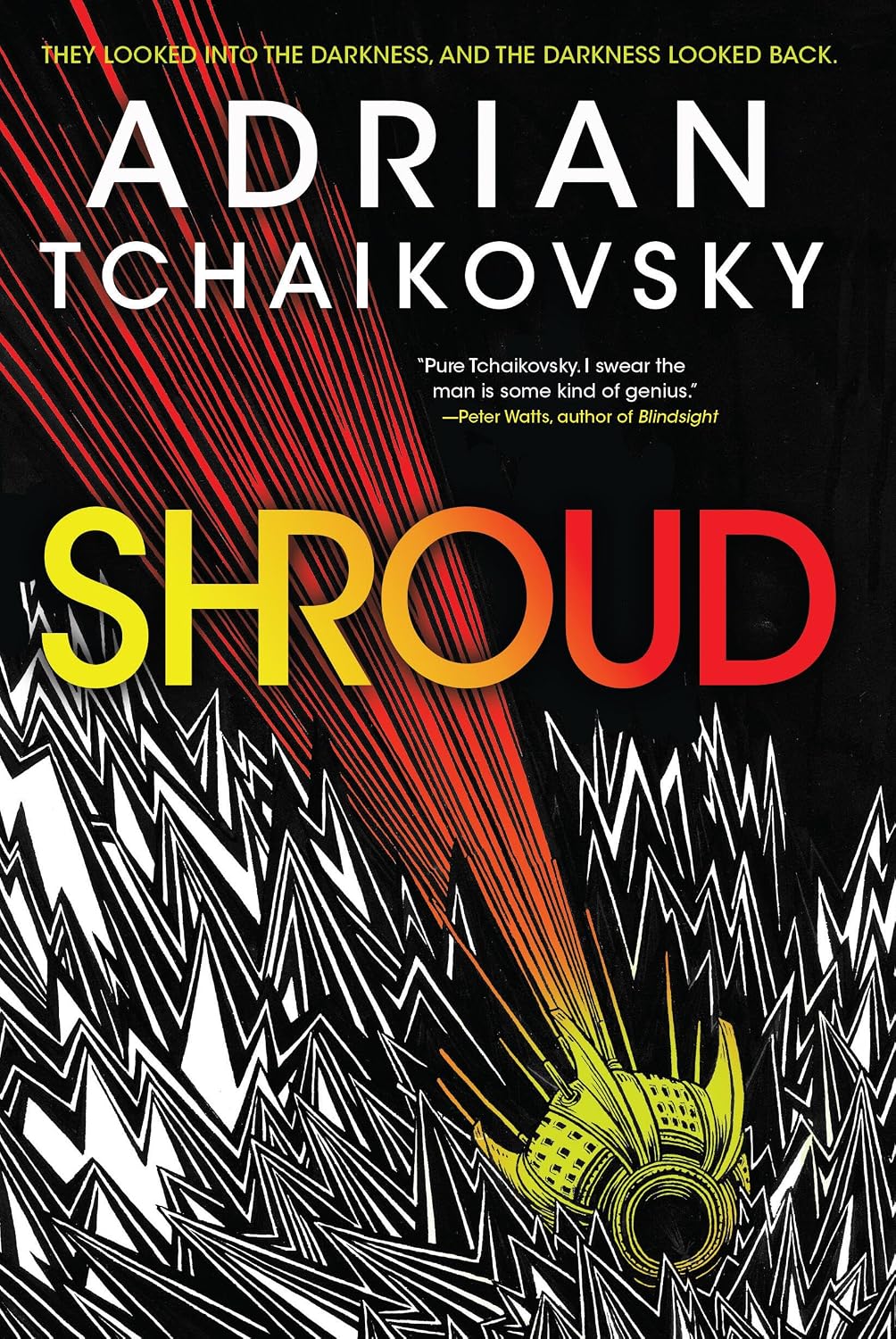
Shroud strands humans on a hostile world among creatures that sense in ways they cannot: a lightless moon, electromagnetic dark, and two survivors crossing it in a crippled pod while something outside learns to talk back. It is first contact run as survival horror, with the alien chapters doing the signature Tchaikovsky move of making the incomprehensible legible without ever making it human.
Early consensus places it with Children of Time among his best pure-SF novels, award shortlists already accumulating, and it is the strongest recent proof that the pace has not cost the standard. It is the one to read when you want him at maximum alien.
Adrian Tchaikovsky: Deep Dive & FAQ
What Runs Through Tchaikovsky’s Books
The first constant is minds unlike ours, taken seriously. The signature Tchaikovsky unit is a point of view that should be a gimmick, a spider, a dog, an octopus collective, a depressed anthropologist’s implant, written with enough zoological and psychological rigor that it becomes the book’s argument: intelligence has more shapes than the one reading this. No working writer does it better, and the Adrian Tchaikovsky books add up to a comparative anatomy of thinking.
The second is systems over chosen ones. Wars, empires, prisons, and ecologies run on rules his plots honor, a gamer’s respect for mechanics, and his revolutions are won by coordination rather than destiny. The villains are usually orthodoxies, the Palleseen’s filed perfection, the camps of Alien Clay, systems that cannot tolerate other minds, which loops back to the first theme.
The third is the pace as a feature. The output is the joke, and underneath it is a method: each book runs one experiment, cleanly, and ships. Read in bulk, the catalog feels less like a shelf than a research program, which from a zoologist turned legal executive is exactly what it is.
Prizes and Honors
The hardware spans every lane he works: the Arthur C. Clarke Award for Children of Time, BSFA novel awards for Children of Ruin, Shards of Earth, and City of Last Chances, three different series honored, the Sidewise for The Doors of Eden, Clarke and Hugo shortlistings across the standalones, and Hugo novel shortlistings for Service Model and Alien Clay in the same year, which is the productivity joke told in award form.
The complicated one is the 2023 Hugo for Best Series, won by Children of Time at the Chengdu Worldcon and later disavowed by Tchaikovsky himself over the ballot’s documented irregularities, a fact this site reports plainly because he did.
Which Adrian Tchaikovsky Editions to Buy
Everything current is in print in uniform trades, the Children of Time and Final Architecture books in matching sets, and the only practical notes are completist ones: Shadows of the Apt runs ten volumes and is cheapest gathered in its publisher bundles, and the novellas, Elder Race among them, are slim physical volumes that read fastest in ebook.
The name on the spine is the one buying trap: older Polish-market and early editions under Czajkowski are the same author, and secondhand hunters should search both spellings.
Tchaikovsky on Screen
Nothing has reached a screen yet, and Children of Time has been in development at one studio or another for years, the uplifted-spider problem being exactly the kind of thing announcements enjoy more than productions. The books most often named as naturally filmable, Dogs of War, Elder Race, Shroud, are the compact ones, and the honest bet mirrors the Stephenson page: the ideas will keep arriving in other writers’ scripts until someone finally pays for the source.
Questions About Adrian Tchaikovsky
Where Should I Start With Adrian Tchaikovsky?
Children of Time for science fiction, Empire in Black and Gold for the fantasy epic, Elder Race or Service Model to sample him in one sitting. The catalog sorts by appetite, and the floor is high everywhere.
Do I Have to Like Spiders to Read Children of Time?
No, and mild arachnophobia is almost the ideal starting condition, because the book’s whole trick is converting it. Readers with the severe version report the octopus sequel is the safer door.
How Many Books Has He Written?
Dozens and counting, across science fiction, fantasy, novellas, and series, at a pace of several a year since 2008. The table above carries the anchors, and completism is a subscription rather than a destination.
What Awards Has He Won?
The Clarke for Children of Time, BSFA awards for Children of Ruin, Shards of Earth, and City of Last Chances, the Sidewise for The Doors of Eden, and a 2023 Hugo for the Children of Time series that he later disavowed over the Chengdu ballot controversy, plus a stack of shortlistings that grows yearly.
Are the Children of Time Sequels as Good as the First?
Children of Ruin took the BSFA and runs the method on octopuses, and Children of Memory divides readers as the strangest and most ambitious of the three. Consensus: read the first unconditionally, continue if the method delights you.
Is Shadows of the Apt Worth Ten Books?
For epic-fantasy readers who want a finished, original world, yes, with the honest note that it starts as competent adventure and becomes something richer in the back half. Everyone else should meet him in the standalones first.
Why Is He Published as Tchaikovsky Instead of Czajkowski?
His first publisher anglicized the spelling for the shelves, and the name stuck across markets. Same author under both, which secondhand searches should remember.
Where to Go Next
If Children of Time was the one that got you, the wider tradition of intelligent, idea-driven science fiction is the home shelf, and my best science fiction books list is where that whole tradition lives. If it was the first-contact strangeness, the encounter with a genuinely alien mind, my best hard science fiction books roundup gathers the novels that chase it hardest, and the field’s other great practitioner of patient otherness has her page at my Ursula K. Le Guin books guide.
And if the galaxy-spanning scale of the Final Architecture is what you want more of, the best space opera books list is where the Adrian Tchaikovsky books connect to the widest tradition in the genre.