Alternate history has a dirty secret, and it is that the changed event is the least interesting thing in any good example of the form. Anyone can flip a battle. The books that last use the flip as an instrument, and what they measure is us: the best alternate history books are really about the world we actually got, made suddenly visible by taking it away. Even Winston Churchill played the game, contributing an essay in 1931 written from inside a world where Lee won at Gettysburg, in which a historian speculates, wrongly and revealingly, about the world where he lost. The trick is that old, and that good.
Two scenarios dominate the shelf, an Axis victory and a surviving Confederacy, and that is not laziness. Those are the twentieth century’s open wounds, the nearest misses, the places where readers can still feel the timeline creak. A good list has to reckon with both without drowning in either, so this one ranges from occupied San Francisco to a Yiddish-speaking Alaska, a plague-emptied Europe, and a papal England running on steam.
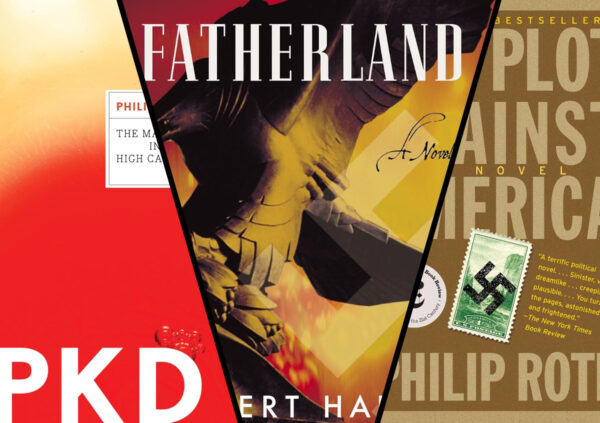
One boundary ruling before we start: the divergence here has to be historical, not magical. Dragons at Waterloo and gentleman magicians raising the dead are historical fantasy, a different pleasure for a different day. What counts is history broken by history, which is also what separates the genre from time travel stories, where the past usually heals. The field even has its own prize for all this, the Sidewise Award, named for Murray Leinster’s 1934 story “Sidewise in Time.” The list runs from the Hugo-winning anchor of the whole genre down to the 1939 book that started it, with my best science fiction books list as the spine behind it. The neighbouring shelf is my best time travel books list.
Fiction by René Rehn


The Man in the High Castle by Philip K. Dick (1962)

The anchor of the entire genre, and the book that proved the counterfactual could carry serious literature.
The Axis won, America is carved between a Japanese Pacific coast and a Nazi east, and Dick ignores every invitation to write a war story. He stays small instead: a forger of pre-war Americana, a Japanese trade official, a judo instructor in the neutral zone, people keeping their heads down in a world that has moved on without them. Passing between them is The Grasshopper Lies Heavy, a banned novel imagining an Allied victory that does not match ours either.
What hooked me, and the long version of that verdict is on my best dystopian books list, is the vertigo of watching characters inside one counterfeit history debunk our own as implausible fiction. Dick composed the novel by throwing the I Ching, and so, inside the story, did the author of the Grasshopper book, which tells you how deep the game goes. It won him the Hugo, the ending lands on the odd side of bold in my book, and the Philip K. Dick guide maps where it sits in his catalog.
Fatherland by Robert Harris (1992)
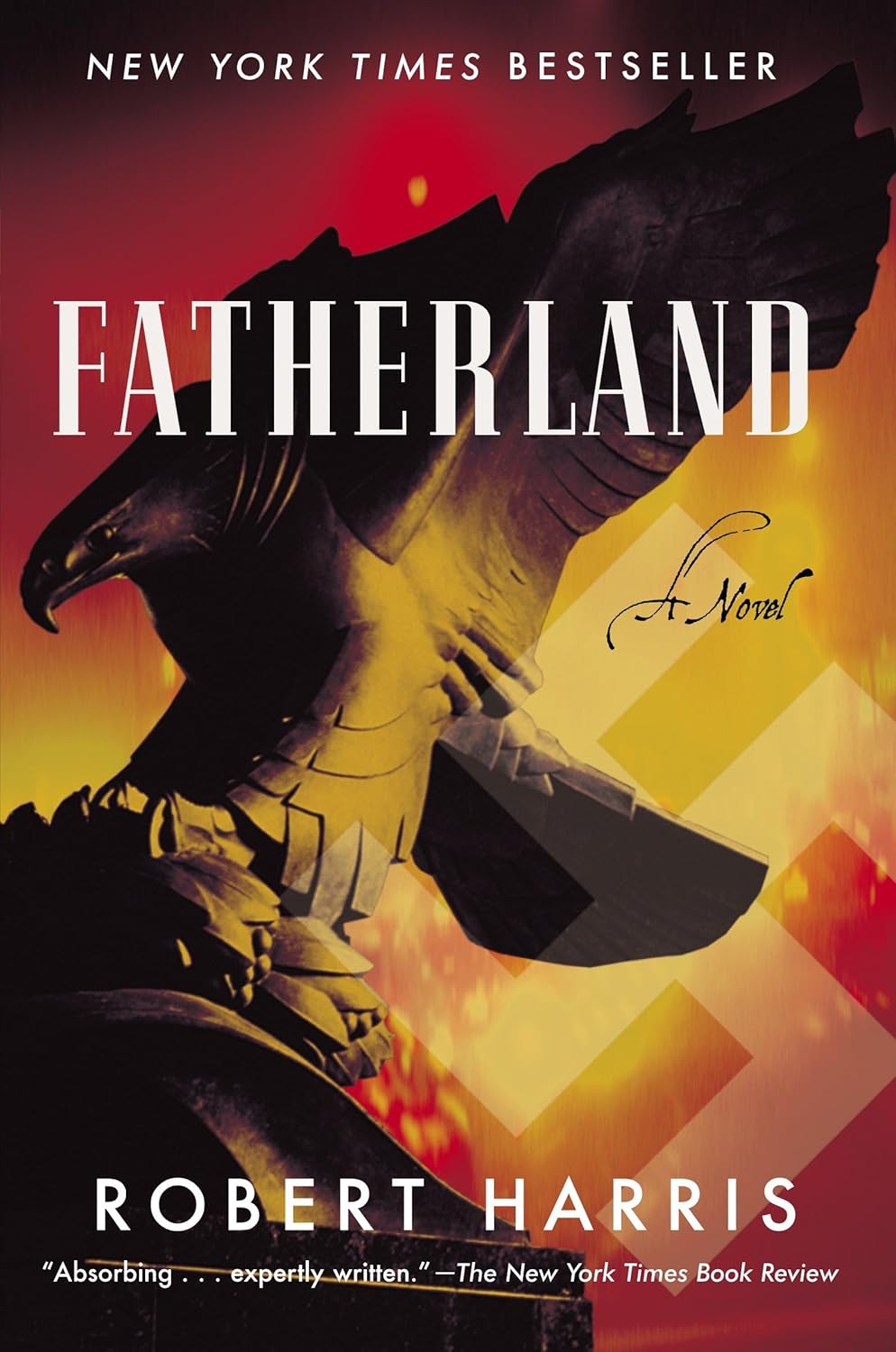
The bestseller that took the Germany-wins premise mainstream, and it still works as a pure thriller.
Berlin, 1964. The Reich won in Europe, the war in the east grinds on out of sight, and detective Xavier March catches a body on the eve of Hitler’s seventy-fifth birthday, days before a detente summit with an aging President Joseph Kennedy. The corpse is a retired party official, more follow, and the trail runs toward the minutes of a 1942 conference at a lakeside villa called Wannsee. March’s world does not know what we know, and the engine of the novel is watching a decent policeman dig up the fact his whole civilization is built on burying.
Harris came out of political journalism, the procedural detail is immaculate, and the book sold in the millions and became an HBO film in 1994. Len Deighton’s SS-GB did the occupied-Britain version as a police procedural back in 1978 and makes the natural chaser. Between them they own the noir end of the shelf.
The Plot Against America by Philip Roth (2004)

The literary heavyweight, and the most frightening book here precisely because so little changes.
In 1940, Charles Lindbergh, aviator, hero, and open admirer of the Reich, beats Roosevelt for the presidency, signs friendly understandings with Berlin and Tokyo, and America begins a slow, folksy, deniable slide into official antisemitism. Roth tells it through his own childhood self, a boy in a Jewish neighborhood of Newark watching his parents lose the argument about whether it can happen here, and the domestic scale is the whole point. No tanks in the streets, just relocation programs with friendly names and neighbors who stop meeting your eye.
Consensus rates it among the best of late Roth, history keeps renewing its relevance, and HBO adapted it in 2020. Of all the alternate history books, this is the one that reads like memory instead of speculation.
The Yiddish Policemen’s Union by Michael Chabon (2007)

A hardboiled murder mystery set in a country that never existed, and the most complete genre crossover on this list.
The divergence is a real historical footnote: a 1940 proposal to settle Jewish refugees in Alaska, which in our world died in committee. In Chabon’s it passed, Israel fell in 1948, and a Yiddish-speaking metropolis grew up in Sitka, now sixty years old and about to revert to the United States. Homicide detective Meyer Landsman, drunk, divorced, and living in a flophouse hotel, catches the murder of a junkie who was once the chess prodigy some believed might be the Messiah.
Chabon plays the noir completely straight, the slang is an invented Yiddish-English argot that carries half the world-building, and the book took the Hugo, the Nebula, and the Sidewise, the genre’s own award. It is alternate history as elegy, a whole culture imagined so it can be mourned.
Bring the Jubilee by Ward Moore (1953)

The Confederate-victory masterpiece, written before the subgenre had a name, and it still has the best sting in the tail.
Hodge Backmaker grows up in a United States that lost the War of Southron Independence at Gettysburg and has spent the decades since as a broken, indentured backwater while the Confederacy runs half the hemisphere. He wants nothing from life but books, talks his way into a scholars’ commune called Haggershaven, and eventually stands in front of a machine that can put a historian on the field of the battle that ruined his country.
Saying what happens next would spoil one of the genre’s foundational endings, so I will only say the novel is framed as a manuscript written from nowhere, and the frame is the point. Everything the form can do with regret and causality is already here, in 1953, in under two hundred pages.
The Guns of the South by Harry Turtledove (1992)

The famous one from the genre’s busiest specialist, and the premise sounds like a joke right up until it is not.
Time-traveling white supremacists from twenty-first-century South Africa hand Robert E. Lee’s army a supply of AK-47s, and the South wins the war. That is the pulp half. The other half is what makes the book: Lee, written with real care as a man of his era, wins his country and then has to govern it, learns what his benefactors actually believe and where they come from, and is pushed toward a reckoning with slavery that victory makes unavoidable rather than moot.
Turtledove holds a doctorate in Byzantine history and has spent an entire career on the counterfactual shelf, and by his own account this is his best-known book. For the meticulous, wargamed end of the alternate history books, where the research is half the pleasure, it remains the standard.
11/22/63 by Stephen King (2011)

The biggest mainstream hit the genre ever had, and technically a time travel novel that earns its place by taking the consequences seriously.
Jake Epping, a Maine schoolteacher, is shown a pantry in the back of a diner that opens onto one specific minute in September 1958, resetting with every trip. He takes on the obvious mission, five years undercover in the past to stop Lee Harvey Oswald, and King’s best move is making history itself the antagonist: the past resists being changed and fights back harder the bigger the change, with coincidence, accident, and violence.
Consensus puts it near the top of late-period King, the Texas stretch doubles as one of his warmest love stories, and Hulu adapted it in 2016. The final act, where the novel at last shows its counterfactual hand, is the reason it belongs on this list and not just on his.
The Years of Rice and Salt by Kim Stanley Robinson (2002)

The biggest canvas in the genre, and the book that asks what world history looks like with Europe simply removed.
The Black Death kills not a third of Europe but nearly all of it, and Robinson then writes seven hundred years of the world that grows in the gap, a history of Chinese, Islamic, Indian, and Native American civilizations exploring, colonizing, industrializing, and warring in Europe’s absence. The structural gamble is reincarnation: the same small cluster of souls returns in every era, so ten linked novellas become one continuous argument about progress, faith, and whether history has a direction at all.
It was a Hugo finalist, it is demanding, and the honest note is that some stretches read like the most fascinating textbook ever written. Readers who need plot bounce off it. Readers who want the full scale of what the form can attempt tend to name it in their top handful.
Pavane by Keith Roberts (1968)

The most beautiful book on this list, and the deepest of its deep cuts.
Elizabeth I is assassinated in 1588, the Armada lands, and four centuries later England belongs to a Church that has kept technology on a leash. The result is a twentieth century of steam road trains hauling freight across Dorset, semaphore towers run by a jealous guild, and an Inquisition with teeth. Roberts tells it as linked novellas he calls measures, following haulers, signalmen, monks, and a rebellious heiress, and the prose sits closer to Thomas Hardy than to anything else in the science fiction of its decade.
A coda quietly reframes everything that came before, and arguing about what it means is part of the book’s cult. Among British readers of a certain vintage this is the touchstone, the best-kept secret among the alternate history books, and it deserves to be far better known than it is.
The Alteration by Kingsley Amis (1976)

The wittiest book here, built on the cruelest single choice.
The Reformation never happened. In the England of 1976 the Church rules everything from Rome, science is throttled, electricity is suspect, and ten-year-old Hubert Anvil has the finest treble voice anyone has heard. The Church would like to preserve that voice, permanently, and the whole novel hangs on whether a boy can be talked, flattered, and maneuvered into surgical castration for the glory of God while the adults around him weigh his manhood against his art.
Amis plays the world-building as black comedy with a razor in it, and the joke connoisseurs love is that Hubert’s contraband reading includes a forbidden counterfactual novel called The Man in the High Castle, by one Philip K. Dick. It won the John W. Campbell Memorial Award, and with Pavane it makes a perfect double bill of England-under-the-mitre what-ifs.
The Iron Dream by Norman Spinrad (1972)
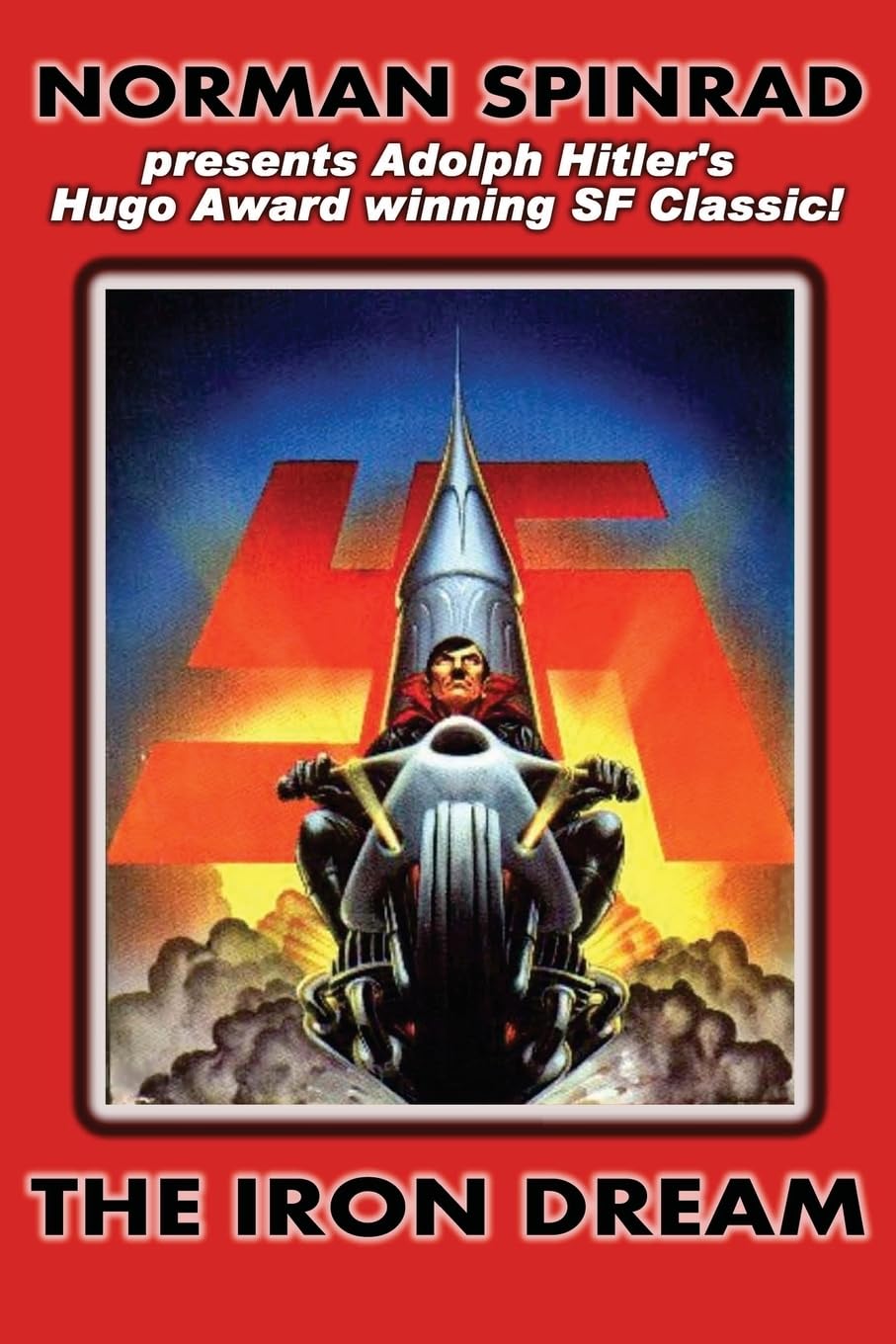
The most dangerous idea in the genre, executed as a book-length trap.
The premise: Adolf Hitler emigrates to America in 1919, never enters politics, and dies in 1953 as a minor pulp illustrator and science fiction hack. The Iron Dream presents his final novel, Lord of the Swastika, a lurid post-apocalyptic power fantasy about a genetically pure hero purging a mutant menace, complete with breathless prose, adoring followers, and a triumphant ending, followed by a deadpan afterword from a fictional academic who almost gets the point. Spinrad’s argument is that the fascist aesthetic was already living comfortably inside pulp heroic fantasy, and the book makes you feel it working on you.
The reception proved him right from both directions. It earned a Nebula nomination and the Prix Apollo, the American Nazi Party reportedly put it on a recommended reading list without noticing it was aimed at them, and West Germany kept it on the index of media deemed harmful to minors from 1982 until a court challenge freed it in 1990. Writing from Germany, I find that last fact almost too on the nose. No other book in the genre has ever been misread so instructively.
Lest Darkness Fall by L. Sprague de Camp (1939)

The founding text of the modern genre, and still a ridiculous amount of fun.
Martin Padway, an American archaeologist, is knocked back to Rome in the year 535, does the arithmetic on what is coming, and decides the Dark Ages are simply not going to happen. His weapons are double-entry bookkeeping, distilled brandy, the printing press, and the semaphore telegraph, and the pleasure of the book is pure competence, a man bootstrapping the sixth century one invention at a time while Gothic kings and Byzantine generals keep interrupting.
Mark Twain ran the gag first with A Connecticut Yankee in 1889, as satire. De Camp, writing for the pulps in 1939, played it straight and rigorous enough to found a genre, and everything above, the wounds, the elegies, the traps, descends from this cheerful little machine. Start anywhere on this list. End here, at the root.
The rest of the shelf
Three more alternate history books belong in the count. The Difference Engine by William Gibson and Bruce Sterling (1990) runs the counterfactual through Victorian England, Babbage’s computer built a century early and the surveillance state arriving with it, and it doubles as the turning point of a whole adjacent genre, a story told in full on my best steampunk books list, with its place in Gibson’s own run covered on the William Gibson guide. Farthing by Jo Walton (2006) opens the Small Change trilogy with a country-house murder in a Britain that made peace with Hitler in 1941, a cozy mystery whose coziness rots off the page as the fascism closes in. And The Calculating Stars by Mary Robinette Kowal (2018) drops a meteorite on Chesapeake Bay in 1952, dooms the climate, and forces the space race decades early with women in the cockpit, taking the Hugo, Nebula, and Locus in a single season.
Two edge cases stay off only by the boundary rules. Colson Whitehead’s The Underground Railroad turns the railroad into literal trains and tips over into fable, and Susanna Clarke’s Jonathan Strange and Mr Norrell breaks history with magic rather than history, which puts it on another shelf entirely. Both are superb. Neither is quite this genre.
Where to go next
If it was the occupied-America dread of Dick and Roth that got you, the sibling shelf is my best dystopian books list, where the nightmares arrive without needing a divergence.
If the counterfactual itch runs wider, into first contact and far futures and everything else the form can do, the best science fiction books list is the spine the whole genre hangs from.
And if it was Dick himself, the strangeness underneath the premise, the Philip K. Dick guide maps the rest of a catalog in which no reality stays load-bearing for long.