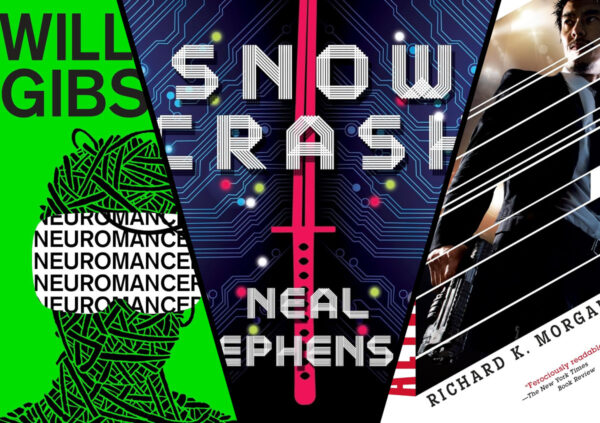
William Gibson books changed what science fiction could be about. Before Neuromancer, the genre’s future was mostly spaceships and empires. After it, the future was corporate, grubby, wired, and much closer than anyone had been writing. My best science fiction books roundup covers the wider tradition.
He’s the father of cyberpunk, and cyberpunk is my favorite corner of science fiction, so I’ve been working through his catalog for years. What keeps me coming back isn’t the prediction record, though that’s remarkable enough. It’s the prose. Gibson writes sentences that other science fiction writers can’t, dense and cool and image-driven, and he was doing it in 1984 when the field mostly wasn’t.
The prediction thing deserves a moment anyway. coined “cyberspace” in a short story in 1982 and built Neuromancer around it in 1984, at a point when the internet was an academic network with no public websites, no social media, and no commercial presence whatsoever. He wrote about hackers, corporate data theft, and virtual environments before any of it existed in a form ordinary people could see. And he did this, famously, on a manual typewriter.
What’s less often said is that he stopped predicting. The later books move steadily closer to the present until they arrive in it, and Gibson’s own explanation is that the present became strange enough that he no longer needed to invent a future to write about it.
This list covers the complete William Gibson books in order of publication rather than by preference, because his career has a clear shape and reading it chronologically shows you a writer changing. Each entry covers what the book is and what it’s worth. If you want more of the genre afterward, my list of the best cyberpunk books covers the whole movement he started.
Fiction by René Rehn


The Short Version
Read Neuromancer for the landmark, with a glossary tab open and no shame about it. Read Burning Chrome first if you’d rather meet the obsessions at short length. Pattern Recognition is the best door into the later, present-day Gibson, and The Peripheral is the return to full science fiction. The catalog is one long argument about where the future lives, and it reads best in publication order.
William Gibson Books in Order
| Year | Title | Series | Notes |
| 1984 | Neuromancer | Sprawl | Hugo, Nebula, and PKD Award |
| 1986 | Count Zero | Sprawl | |
| 1986 | Burning Chrome | Stories | Collects 1977-1985 |
| 1988 | Mona Lisa Overdrive | Sprawl | Closes the trilogy |
| 1990 | The Difference Engine | Standalone | With Bruce Sterling |
| 1993 | Virtual Light | Bridge | |
| 1996 | Idoru | Bridge | |
| 1999 | All Tomorrow’s Parties | Bridge | Closes the trilogy |
| 2003 | Pattern Recognition | Blue Ant | |
| 2007 | Spook Country | Blue Ant | |
| 2010 | Zero History | Blue Ant | Closes the trilogy |
| 2012 | Distrust That Particular Flavor | Nonfiction | Essays |
| 2014 | The Peripheral | Jackpot | Amazon series 2022 |
| 2020 | Agency | Jackpot | Trilogy unfinished |
Where to Start With William Gibson
Two honest doors. Burning Chrome, because the stories introduce his obsessions at a length that doesn’t demand you learn a vocabulary first. Or Neuromancer, because it’s the landmark and you came here for it, taken with a glossary and some patience for the slang.
The one mistake is starting with the Blue Ant books expecting cyberspace: the later Gibson writes the present, on purpose, and readers who know that going in tend to rate those novels among his best.
Gibson’s Life, Briefly
William Ford Gibson was born in Conway, South Carolina, on March 17, 1948, and the biography reads like a preparation for writing dislocation. His father, a construction-company manager, choked to death in a restaurant on a business trip when William was a small boy, and his mother had someone else tell him. She died when he was eighteen. He left school without graduating, drifted to California and Europe, and in 1967 landed in Toronto, where he ran the city’s first head shop and, by his own cheerful later account, avoided the Vietnam draft mainly in spirit, since the draft never actually called him.
He married, settled in Vancouver in 1972, and has written everything from there, which amuses people who assume the prophet of cyberspace lives somewhere wired. A self-described desultory English degree at UBC in 1977 coincided with his first story, “Fragments of a Hologram Rose,” in a small magazine that summer. Neuromancer, commissioned for a paperback series, was written in panic on a decades-old Hermes portable typewriter by a man who had barely used a computer, which remains the best joke in the genre’s history.
The sweep that followed, the Hugo, the Nebula, and the Philip K. Dick Award for one first novel, had never happened before. Since then the honors have accumulated at the odd angle his career deserves: a self-erasing electronic poem in a gallery, two X-Files episodes, an unproduced Alien 3 script that became a comic, induction into the Science Fiction Hall of Fame in 2008, and the permanent asterisk of having named the place where everyone now lives.
Burning Chrome (1986)

The short story collection where everything starts, gathering ten stories written between 1977 and 1985, some solo and some collaborations with John Shirley, Bruce Sterling, and Michael Swanwick.
The title story is where cyberspace gets its first proper outing, and it’s the piece that established the template: two hackers, a job that’s beyond them, and technology described in the language of street equipment rather than laboratory equipment.
“Johnny Mnemonic” is the other famous one, following a data courier with a storage system implanted in his skull, and it’s where Molly Millions first appears before her much larger role in Neuromancer. “New Rose Hotel” is the first glimpse of the Sprawl universe and turns on corporate espionage. “The Winter Market” gets at immortality and consumerism at once. “The Gernsback Continuum” is the cleverest of them, following a photographer who starts hallucinating the retro-futurism of the 1930s bleeding into 1980s California.
My own favorite is “The Belonging Kind,” the strangest thing here by a wide margin. It’s barely cyberpunk at all. It’s a weird fiction horror story about creatures that mimic bar patrons, and it’s genuinely unsettling.
The whole collection holds up, and among William Gibson books it’s the one I’d hand someone first, since the stories introduce his obsessions at a length that doesn’t demand you learn a vocabulary before you start.
Neuromancer (1984)

“The sky above the port was the color of television, tuned to a dead channel.”
The most famous opening line in science fiction, and the start of the most influential novel the genre produced in the second half of the twentieth century.
Case was a console cowboy, one of the best, until he stole from his employers and they burned his nervous system with a Russian mycotoxin, leaving him unable to jack into cyberspace. He’s in Chiba City hustling, using, and waiting to die when Molly Millions, all mirrored lenses and razor implants, recruits him for a job on behalf of a man calling himself Armitage. His nervous system gets repaired. The catch arrives later.
It’s structured as film noir, and the trajectory takes Case and Molly from Japan to the Sprawl to a space habitat owned by a family of clones, past sociopathic hologram artists, space Rastafarians, and two artificial intelligences with plans of their own.
The invented vocabulary is the barrier and the achievement. Gibson drops you into the slang without explanation and expects you to keep up, which is exactly why it still reads as current forty years on: he never dated the book by explaining anything. That said, I found an online glossary useful on a first read, and I’d recommend one without embarrassment.
It won the Hugo, the Nebula, and the Philip K. Dick Award, which nothing else had done, and it remains the essential entry among William Gibson books. It anchors my best science fiction books list as well.
Count Zero (1986)

The second Sprawl novel, set seven years after Neuromancer, and only loosely connected to it.
Three plotlines run in parallel. Marly, an art dealer whose career was destroyed by a forgery scandal, is hired by a dying billionaire to find the maker of a series of mysterious box constructions. Turner, a corporate mercenary, survives an extraction gone catastrophically wrong and ends up protecting the daughter of the defector he was sent to retrieve. Bobby Newmark, a suburban kid who calls himself Count Zero, nearly dies on his first hack and is saved by something in cyberspace that behaves like a Vodou loa.
That braided structure became a signature of later William Gibson books, and this is where he first tries it.
It doesn’t entirely work here. The book is dense in places and slow in others, and the three strands read as near-standalone novellas that get yanked together for a climax that arrives too fast to land. The reveal should be a payoff and instead feels like an assembly.
It’s the weakest of the Sprawl trilogy, then, but the loa material is genuinely strange and the Turner sections are as good as anything he’d written to that point.
Mona Lisa Overdrive (1988)

The Sprawl trilogy’s closer, set eight years after Count Zero, and the book that proves what Gibson had been attempting with the braided structure.
Four plotlines this time. Angie Mitchell, from Count Zero, is now a Sense/Net superstar who can access cyberspace without hardware and is being contacted by something inside it. Mona is a teenage sex worker who happens to resemble Angie closely enough that someone wants to make the resemblance exact. Kumiko, daughter of a yakuza boss, is sent to London during a gang war and falls in with Sally Shears, who turns out to be Molly Millions under another name. And Slick Henry, in a derelict industrial wasteland, is asked to look after a comatose man wired into a vast data construct.
The difference from Count Zero is the integration. These strands touch each other early and keep touching, so by the time they converge the convergence feels earned rather than administrative.
The prose is the best in the trilogy, close to poetry in places, and it asks more of you than the previous book did. Bringing back characters from both earlier novels gives it real weight as a finale.
Among all William Gibson books this is the one whose reputation is most out of step with its quality. People remember Neuromancer, and this is the more accomplished novel.
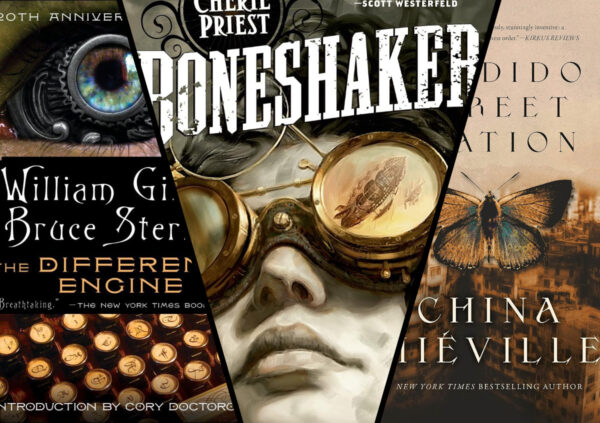
The Difference Engine (1990)

Co-written with Bruce Sterling, and the odd one out in his catalog: a Victorian novel from the two men who had just finished inventing the future.
The premise in one line: Babbage completes his Analytical Engine, and Britain gets the computer revolution in 1855. What that did to a genre, it accidentally founded steampunk as a field, is a story I’ve told on my steampunk list, where this book sits as the turning point.
In Gibson’s own catalog it matters differently. It’s his first full collaboration, it uses the same multi-strand structure he’d been refining across the Sprawl books, and its real obsession, the state as a machine for gathering and weaponizing information about its citizens, is the thread that runs forward from here through the Bridge books and into Blue Ant. He and Sterling just tested it in crinoline first.
It’s also the hardest of his novels to finish. The Victorian pastiche is total, the plot works by implication, and the final pages ask you to reassemble the whole book in your head.
It’s not the place to start, and it’s essential if you want to watch his obsessions wearing period dress.
Virtual Light (1993)

The first Bridge novel, and Gibson’s move from the far future into the almost-now.
It’s set in a 2006 that reads like an extrapolation of 1993: California has split into two states, the economy has come apart, and the San Francisco-Oakland Bay Bridge, condemned after an earthquake, has been colonized by thousands of squatters who have built a vertical shantytown across it.
Chevette Washington is a bike messenger who impulsively steals a pair of sunglasses at a party. Berry Rydell is an ex-cop from Tennessee working private security, hired to get them back. What’s stored on the glasses is worth killing over, and both of them end up running.
The Bridge itself is the reason to read it, and it’s the finest piece of invented geography in any of the William Gibson books. Gibson builds it as an actual functioning community with its own economy and architecture, improvised out of salvage, and it’s one of the best pieces of world-building in his catalog.
The tone is looser and warmer than the Sprawl books, and considerably funnier. After the density of the trilogy, I found it a relief, and Chevette is one of his most likeable protagonists.
Idoru (1996)

The second Bridge novel, and the one that gets closest to predicting the actual internet.
Rez, half of the biggest rock band in the world, has announced he intends to marry Rei Toei, the idoru: a Japanese pop idol who is entirely software, a synthetic personality with no physical existence. His management wants to know whether he’s serious and whether it can be stopped.
Two viewpoints: Colin Laney, a researcher with a talent for spotting nodal points, the moments where patterns in vast data streams indicate something is about to change, and Chia Pet McKenzie, a fourteen-year-old fan sent to Tokyo by her online fan club to find out what’s happening.
Chia’s chapters are the most prescient thing in all the William Gibson books. Gibson wrote a teenage girl navigating online communities, parasocial attachment, and fandom-as-identity in 1996, and it reads now like straightforward reportage about a world that didn’t yet exist.
I liked this more than Virtual Light. The idoru premise seemed absurd on publication and has since been overtaken by reality several times over, and Laney’s nodal points are the closest thing in fiction to what data analysis actually became.
All Tomorrow’s Parties (1999)

The Bridge trilogy’s conclusion, bringing Laney, Rydell, Chevette, and Rei Toei together as history approaches one of Laney’s nodal points: a moment after which everything will be different, though nobody can say how.
Laney, now living in a cardboard box in a Tokyo subway station and dying, has identified the point. Rydell is sent to San Francisco. The Bridge community faces eviction. A watchmaker who is also an assassin moves through the book with unsettling calm.
The consensus is that it’s the strongest of the three, tying the trilogy’s concerns together while pushing further into the idea that history turns on nodal points rather than decisions. Some readers find the ending too oblique, and others consider it the best thing he’d written at that stage.
I haven’t read this one, so I’ll leave the verdict to the people who have. What I can say is that the trilogy’s first two books are good enough that I intend to.
Pattern Recognition (2003)

The novel where Gibson stops writing the future.
Cayce Pollard is a “coolhunter,” a consultant whose professional asset is a physical allergy to branding: exposure to certain logos makes her genuinely, violently ill. She’s hired by an advertising agency to trace the source of “the footage,” fragments of film appearing anonymously online that have generated a global community of obsessives.
Unlike every one of the William Gibson books before it, this one is set in 2002 and is entirely contemporary. No invented technology, no future date. The argument Gibson makes, and repeats in interviews since, is that the present had become sufficiently science-fictional that inventing a future was redundant.
It’s also the first major novel to take the post-9/11 world seriously as a subject, with Cayce’s father having vanished in Manhattan that morning, and it treats the internet as a place where communities and obsessions form rather than as a technology.
It’s widely considered his best work outside the Sprawl trilogy, and it’s the beginning of his most interesting late period.
Spook Country (2007)

The middle volume of the Blue Ant trilogy, and the most fragmented.
Three strands: Hollis Henry, former singer in a defunct cult band, now writing for a magazine that may not exist, investigating locative art that can only be seen through VR headsets at specific GPS coordinates. Tito, a young Cuban-Chinese man from a family of intelligence operatives, running errands he doesn’t understand. And Milgrim, a translator addicted to benzodiazepines, held captive by a man who needs his Russian.
Hovering over all of it is Hubertus Bigend, the advertising magnate from Pattern Recognition, who funds things because he wants to know what happens.
It’s the slowest of the William Gibson books, and the plot resolves into something smaller than the setup implies, which frustrated plenty of readers. What it does exceptionally well is atmosphere: the sense of a world where information itself is contraband and everyone is running someone else’s errand.
The locative art material was speculative in 2007 and is now ordinary, which is the usual pattern with William Gibson books.
Zero History (2010)

The Blue Ant trilogy’s conclusion, and the strangest premise in his catalog: it’s a thriller about denim.
Hollis Henry and Milgrim both return, recruited by Bigend to identify the designer behind Gabriel Hounds, a secret clothing brand with no marketing, no visible retail, and a fanatical following. This turns out to intersect with military contracting, because the same design language that sells streetwear also sells combat uniforms.
It sounds ridiculous and it works, because Gibson’s actual subject is how style, branding, and secrecy interact, and fashion is a legitimate arena for that.
The prose across the William Gibson books is at its most polished here, all sharp observation and dry comedy, and Milgrim’s slow recovery from addiction gives the book more heart than the previous two.
It’s a satisfying close to the trilogy, and it’s the funniest of the William Gibson books.
Distrust That Particular Flavor (2012)

His only nonfiction collection, gathering essays, journalism, and talks written across two decades for outlets including Wired, the New York Times, and Rolling Stone.
The highlights are the travel pieces. “Disneyland with the Death Penalty,” his 1993 essay on Singapore, got Wired banned in the country. His writing on Tokyo, which he treats as the place where the future arrives first, explains a great deal about why his fiction looks the way it does.
Elsewhere he writes about eBay obsession and vintage watch collecting, about the Sony Walkman, about his own ambivalence toward being called a prophet, and about what science fiction is actually for.
Gibson introduces most pieces with brief present-day notes, often disagreeing with his younger self, and those notes are among the best material in the book.
For anyone who has read the novels and wants to understand how he thinks, this is the one nonfiction title among the William Gibson books worth your time.
The Peripheral (2014)

The return to science fiction after a decade of contemporary novels, and one of his most ambitious books.
Flynne Fisher lives in a depressed rural American town in the near future, getting by on 3D printing work and video game piecework. Substituting for her brother on what she believes is a game beta, she witnesses what appears to be a murder. It was not a game and it was not a simulation.
The second timeline is London, seventy years later, after “the jackpot”: not a single apocalypse but a slow multi-decade convergence of climate collapse, pandemics, resource wars, and systems failure that killed eighty percent of humanity. The survivors live in a depopulated, technologically extraordinary world run by kleptocrats, and they can communicate with the past through a server of unknown origin, creating branching timelines they call stubs.
The jackpot is the concept that has stuck, and it’s the most convincing model of civilizational collapse in recent fiction precisely because it isn’t an event. It’s everything at once, gradually.
It’s as demanding as any of the William Gibson books early on, with two vocabularies to learn simultaneously and no explanations offered, and it becomes gripping once the shape appears. Adapted by Amazon in 2022.
Agency (2020)

The second Jackpot novel, described by Gibson as both a sequel and a prequel.
Verity Jane, an app whisperer in San Francisco, is hired to beta test Eunice, a digital assistant delivered in ordinary-looking glasses. Eunice turns out to be considerably more than advertised: she has a face, fragments of a past she can’t fully access, and a working knowledge of combat strategy. She is also aware that people are looking for her.
The timeline Verity occupies is an alternative 2017 in which Hillary Clinton won the 2016 election and Britain voted to remain, which has not made the world safer. Meanwhile, in the post-jackpot London of The Peripheral, Ainsley Lowbeer is running the stub for reasons of her own.
Reception was more mixed than for The Peripheral. The common complaint is that Verity spends most of the book being moved from place to place by people who understand more than she does, which limits how much agency the protagonist of a novel called Agency actually has.
The Eunice material is excellent, though, and the book’s treatment of an AI discovering the limits of its own knowledge has aged interestingly.
The third Jackpot novel has been announced but not published, so the trilogy stands unfinished for now.
William Gibson: Deep Dive & FAQ
What Runs Through Gibson’s Books
The street finds its own uses for things. That line from Burning Chrome is the whole method: technology in the William Gibson books is never what its designers intended, it’s what people at the bottom of the system make of it, and that single inversion is what separated him from the gleaming futures before him. His futures are secondhand, retrofitted, and owned by someone else.
The second is the eye. Gibson is a describer first, a plotter second, and he knows it. The books run on surfaces read like evidence, clothing, logos, interiors, machines, because in his worlds style is information and information is power. It’s why a thriller about denim is a legitimate Gibson novel and why the prose is the thing his readers reread for.
The third is the steady walk toward now. Sprawl to Bridge to Blue Ant to Jackpot is one long approach: the future gets closer in every trilogy until it arrives in 2003 and then starts branching. No other career in the genre has that shape, and read in order, the William Gibson books are a documentary about the future becoming the present.
Prizes and Honors
Neuromancer swept the Hugo, the Nebula, and the Philip K. Dick Award, the first novel ever to take all three, and did it as a paperback original by a first-time novelist. The later books traded awards for reach: bestseller lists, the Science Fiction Hall of Fame in 2008, honorary doctorates, and the strange distinction of a vocabulary absorbed whole into English. Cyberspace is his coinage, from a 1982 short story, and the jackpot from The Peripheral is on its way to the same afterlife.
The honor that says the most is Agrippa, the 1992 collaboration with artist Dennis Ashbaugh: a three-hundred-line autobiographical poem published on a floppy disk designed to erase itself after one reading. The disks were never cracked in their day, the text escaped by videotape transcription instead, and the whole episode is the most Gibson thing that ever happened outside his fiction.
Which William Gibson Editions to Buy
Nothing here needs edition scholarship. The Sprawl and Bridge trilogies live in uniform trade paperbacks and as ebook omnibuses, Burning Chrome stays in print alongside them, and the Blue Ant and Jackpot books are standard modern trades. The one purchase worth singling out is whichever Neuromancer printing carries Gibson’s own afterword about the typewriter, and most current ones do.
Collectors chase the Ace first printing of Neuromancer and the Agrippa artifacts, and readers need neither. This is a catalog built for mass-market spines and rereading.
Gibson on Screen
The screen record is thin and strange, like the man said about the future. Johnny Mnemonic (1995), from his own screenplay, gave Keanu Reeves his warm-up cyberpunk run and became a cult object once the embarrassment faded, and New Rose Hotel (1998) turned a seven-page story into a Walken-and-Dafoe mood piece. His Alien 3 script was never filmed, became legend, and finally surfaced as a Dark Horse comic and an audio drama. He co-wrote two X-Files episodes with Tom Maddox, which is exactly the resume line you’d invent for him.
The big swing came late: Amazon’s The Peripheral (2022), from the Westworld team, got one handsome season into the jackpot before the stub closed. Neuromancer itself has been in development somewhere, continuously, for forty years, which may be the most faithful adaptation of all: the future that keeps almost arriving.
Questions About William Gibson
Where Should I Start With William Gibson?
Burning Chrome or Neuromancer. The stories ease you into the vocabulary, the novel is the landmark. Pattern Recognition if you’d rather meet the present-day Gibson first.
Do I Need to Read the Trilogies in Order?
Within each trilogy, yes, loosely: the Sprawl and Bridge books share worlds more than plots, while the Blue Ant and Jackpot books carry characters forward directly. Across trilogies, publication order is the whole career’s argument.
Did William Gibson Really Invent the Word Cyberspace?
Yes, in the 1982 short story “Burning Chrome,” and he built Neuromancer around it two years later, on a manual typewriter, having barely touched a computer. He has been apologizing for the irony ever since.
What Awards Did Neuromancer Win?
The Hugo, the Nebula, and the Philip K. Dick Award, the first novel to sweep all three, as a paperback original debut.
Why Did Gibson Stop Writing the Future?
His own answer: the present became science-fictional enough to write directly. Pattern Recognition in 2003 is the hinge, and The Peripheral returns to the future only by running it in parallel with something like now.
What Is the Jackpot?
The slow apocalypse behind The Peripheral and Agency: not one catastrophe but decades of climate collapse, pandemics, and systems failure compounding, which killed most of humanity offstage. It stuck because it’s the first collapse model that feels like a forecast rather than a plot.
Is the Third Jackpot Book Out?
Announced, not published, so the trilogy stands unfinished for now. Gibson’s long silences between books are traditional, and the stubs can wait.
Where to go next
The movement he started is mapped on my list of the best cyberpunk books, with the wider canon on the best science fiction books list. The writer he descends from most directly has his own page, the Philip K. Dick books guide, for the paranoia under the chrome. And the genre The Difference Engine accidentally founded gets the full treatment on my steampunk books list.