Steampunk got its name as a joke. In April 1987, K. W. Jeter wrote a letter to Locus magazine noting that he, Tim Powers, and James Blaylock were all writing Victorian-set fantasies with anachronistic technology, and suggested that if cyberpunk was the thing everyone was talking about, then perhaps what the three of them were doing should be called steampunks. Three friends in Orange County named a genre in a magazine letter, and the name stuck harder than any of them expected. The steampunk books that followed have been arguing with that letter ever since.
What steampunk books describe: a nineteenth century that developed technology it never actually had, or a world running on that principle. Steam, brass, clockwork, analytical engines, airships. The good steampunk books do something with that beyond decoration, which is worth saying because a great many don’t.
Two things about the lists you’ll find elsewhere. Most of them include The Diamond Age, and The Diamond Age is a nanotechnology novel set in a future where one cultural faction has chosen to dress and behave like Victorians. No steam, no anachronistic machinery, no alternate nineteenth century. It’s a superb book and it belongs on a cyberpunk list, which is where I’ve put it. The Golden Compass gets the same treatment on those lists, and it’s a fantasy with a zeppelin in it.
The other pattern is that half of them are dominated by paranormal romance in corsets. That’s a real category with real readers and it isn’t what this list is for, though the best of it is here.
Twenty-four steampunk books, chronological, starting with the ones that existed before there was a word for them. For the wider canon, my list of the best science fiction books is the spine this hangs off.
Fiction by René Rehn


The Best Steampunk Books at a Glance
| Year | Title | Author |
| 1895 | The Time Machine | H. G. Wells |
| 1870 | Twenty Thousand Leagues Under the Sea | Jules Verne |
| 1979 | Morlock Night | K. W. Jeter |
| 1987 | Infernal Devices | K. W. Jeter |
| 1983 | The Anubis Gates | Tim Powers |
| 1986 | Homunculus | James P. Blaylock |
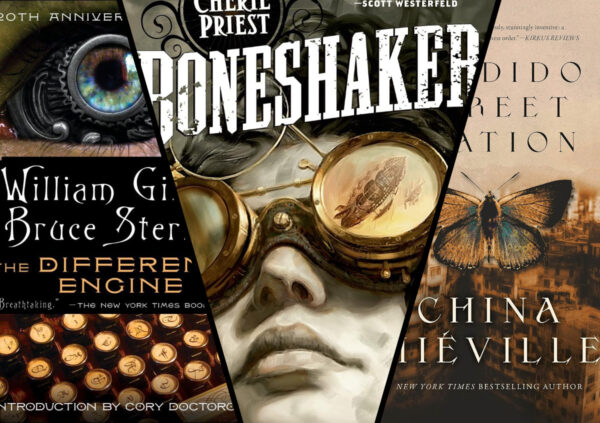
| 1990 | The Difference Engine | Gibson and Sterling |
| 2000 | Perdido Street Station | China Miéville |
| 2007 | The Court of the Air | Stephen Hunt |
| 2009 | Boneshaker | Cherie Priest |
| 2009 | Leviathan | Scott Westerfeld |
| 2001 | Mortal Engines | Philip Reeve |
| 2010 | The Half-Made World | Felix Gilman |
| 2012 | The Peculiar | Stefan Bachmann |
| 2015 | The Watchmaker of Filigree Street | Natasha Pulley |
| 2015 | The Aeronaut’s Windlass | Jim Butcher |
| 2016 | Everfair | Nisi Shawl |
| 2009 | Soulless | Gail Carriger |
| 2010 | Dreadnought | Cherie Priest |
| 2004 | The Iron Council | China Miéville |
| 2017 | Clockwork Boys | T. Kingfisher |
| 2008 | The Alchemy of Stone | Ekaterina Sedia |
| 2010 | The Strange Affair of Spring Heeled Jack | Mark Hodder |
| 2008 | Steampunk | ed. Ann and Jeff VanderMeer |
Proto-Steampunk
The Time Machine by H. G. Wells (1895)

Not steampunk, and the book the founders were all writing back to.
The Time Traveler builds a machine in a Victorian workshop out of brass, nickel, ivory, and quartz, and demonstrates it to a room of skeptical professional men before traveling to the year 802,701 and finding humanity split into two species.
Everything steampunk novels later borrowed is here: the gentleman inventor, the workshop, the technology built from materials a Victorian could actually name, and the assumption that an individual with sufficient ingenuity can construct the impossible in his own home.
Wells was writing about class, not gadgets. But the machine itself, described in loving physical detail, with a saddle and levers, is the founding object of the entire aesthetic.
Twenty Thousand Leagues Under the Sea by Jules Verne (1870)

The other ancestor, and the more direct one.
The Nautilus is the first great machine in fiction that a reader is invited to fall in love with. Verne tours you through it compartment by compartment, the salon with its pipe organ, the observation windows, the engine room, and the whole novel treats the vessel less as transport than as a character with moods and secrets of its own. That reverence for the beautifully engineered object is the emotional core of every steampunk book since.
The genre’s better instincts start here too. Nemo uses his technological edge against an imperial world that wronged him, and in Verne’s original conception he was a Polish nobleman avenging himself on Russia. The publisher forced the change to keep the book saleable. The anti-imperial thread the best modern steampunk has picked up was in the source from the beginning.
Read it as the origin of both the aesthetic and its conscience.
The Founders (1979–1990)
Morlock Night by K. W. Jeter (1979)

The book that started it, by the man who named the genre eight years later.
It picks up where The Time Machine ends: the Morlocks have taken the machine, traveled back to Victorian London, and begun an invasion. The resistance involves King Arthur, reincarnated, and a sewer system beneath the city that turns out to be considerably stranger than it should be.
It’s a rough novel and Jeter has been open about that. What matters is the move it makes, taking a Victorian text and continuing it with modern sensibilities and anachronistic mechanics, which is the template every steampunk book since has worked from.
It’s historically essential to steampunk books as a category, and it’s a fast read.
Infernal Devices by K. W. Jeter (1987)

Jeter’s better book, published the same year as the letter that named the genre.
George Dower has inherited his father’s watchmaking shop and none of his father’s genius, which becomes a problem when clients arrive wanting devices repaired that he cannot begin to understand. The plot involves a fish-worshipping cult, an automaton violinist, a village of amphibious people, and a device whose purpose is best not spoiled.
The comedy is the surprise. Jeter writes Dower as a bewildered, faintly useless man being dragged through a mechanical conspiracy, and the tone is closer to Wodehouse than to anything grim.
Among steampunk books this is the one that best captures the pleasure of not understanding your own equipment.
The Anubis Gates by Tim Powers (1983)

The best of the founding texts and one of the best time travel novels ever written.
Brendan Doyle, a Coleridge scholar, is hired to accompany a group of wealthy tourists through a temporal gate to attend a lecture by Coleridge in 1810. He is stranded there. What follows involves Egyptian sorcerers, a body-swapping werewolf, a beggars’ guild, a poet who is not what he appears, and a clown on stilts named Horrabin.
Powers works from the documented record inward, arranging the real dates, deaths, and letters until the supernatural reading becomes the economical one. The plotting is extraordinarily tight. Everything set up in the first hundred pages detonates in the last hundred.
It won the Philip K. Dick Award, and of all the steampunk novels here this is the one to read first.
Homunculus by James P. Blaylock (1986)

The third founder, and the most purely charming of them.
A dirigible has been circling London for fifteen years with a dead pilot at the controls. A hunchbacked millionaire wants what’s aboard. So does an evil evangelist reanimating corpses, and so does the Trismegistus Club, a group of amateur scientists and eccentrics led by Langdon St. Ives.
Blaylock writes the Victorian London of steampunk books as a place of cluttered rooms, bad weather, and men arguing about theories over pipes, and his comedy is gentler and stranger than Jeter’s. The plot is deliberately absurd and assembled with real care.
It won the Philip K. Dick Award, and the St. Ives stories that follow are all worth reading.
The Difference Engine by Gibson and Sterling (1990)

The novel that took steampunk from a private joke among three friends to an actual movement.
Babbage’s mechanical computer gets built, and everything downstream of that changes. Byron leads a government of Industrial Radicals. Engine-literate clerks form a new professional class. The state maintains files on its citizens as punch-card decks, and the smog over London is thick enough to kill.
What two cyberpunk writers brought to the Victorian setting was suspicion. The founders wrote adventures. Gibson and Sterling wrote about data as an instrument of control, and their London is a surveillance state that arrived eighty years early because the machinery permitted it.
Ada Byron is the hinge of the plot, and a stolen set of cards is the object everyone is chasing. The three-part structure follows different characters and the connections between them are left for the reader to assemble.
The prose pastiche is thorough, the plotting is oblique, and the closing sequence is genuinely strange. More people cite this novel than finish it, and it’s still the point where steampunk stopped being three friends and became a field. Gibson’s whole run is on my William Gibson books guide.
The Movement (1991–2010)
Perdido Street Station by China Miéville (2000)

Included, and worth explaining why, because purists will object.
New Crobuzon is a vast industrial city running on steam, coal, and clanking machinery, where analytical engines think, constructs labor, and the militia enforce order through brutality and thaumaturgy. Isaac Dan der Grimnebulin, a disreputable scientist, takes a commission from a bird-man who has had his wings cut off, and in the process releases something that feeds on dreams.
The objection: it’s a secondary world, not an alternate nineteenth century, and Miéville has been openly hostile to steampunk’s nostalgic tendencies and its fondness for imperial aesthetics.
That hostility is precisely why it belongs here. Perdido takes the machinery and strips out the romance: the technology is filthy, the industry is powered by exploitation, and the city is a monument to what actually happens when a society industrializes without restraint. It’s steampunk with the goggles knocked off.
Miéville’s other work sits closer to weird fiction, and his debut King Rat is straight urban fantasy. This is the one that engages the tradition. The dark-fantasy reading of Bas-Lag is on my dark fantasy books list.
The Court of the Air by Stephen Hunt (2007)

It’s underread, it’s ambitious, and it holds one of the most thoroughly built worlds in steampunk books.
The Kingdom of Jackals runs on steam and is defended by the Court of the Air, an aerial intelligence service, against threats including a communist theocracy and something considerably older. Two orphans, Molly and Oliver, turn out to matter enormously to all of it.
Hunt crams in more invention than most steampunk novels attempt: steammen with their own religion, airships, feral aristocrats, and an underground civilization, and the world-building is genuinely dense rather than decorative.
The plotting is chaotic and the exposition is heavy. The invention rate is higher than almost anything else here.
Boneshaker by Cherie Priest (2009)

The book that brought steampunk to a mass American audience, and the one that moved it out of London.
An inventor’s machine has destroyed downtown Seattle and released a gas that turns people into the walking dead. Sixteen years later the ruined city is walled off, and Briar Wilkes goes in after her teenage son, who has gone looking for evidence that his father wasn’t a monster.
Priest’s contribution is relocating steampunk books to the American West and the Klondike gold rush, which suits it far better than anyone expected: airships, gas masks, improvised machinery, and a frontier economy built on a poisonous resource.
It won the Locus and was nominated for the Hugo and Nebula. The Clockwork Century books that follow are stronger on setting than on plot.
Leviathan by Scott Westerfeld (2009)

Young adult, and one of the best-conceived alternate histories in the genre.
The First World War is fought between Clankers, whose Germanic powers use enormous walking machines, and Darwinists, whose British forces use fabricated living creatures. The Leviathan itself is an airship-sized whale ecosystem. Aleksandar, son of the assassinated Archduke, is on the run. Deryn is a girl disguised as a boy in the British Air Service.
The Clanker-versus-Darwinist split is the cleverest idea here: two incompatible technological philosophies mapped onto the actual alliances of 1914, with real historical figures woven through.
Keith Thompson’s illustrations are integral rather than decorative. It’s written for teenagers and the world-building beats most adult steampunk books.
Mortal Engines by Philip Reeve (2001)

Also young adult, also better than it needs to be, and genuinely one of the great science fiction premises.
Cities move. After an apocalypse called the Sixty Minute War, London is a mobile predator on tracks that hunts smaller towns, consumes them for resources, and absorbs their populations. This is Municipal Darwinism, and it is running out of prey.
Tom Natsworthy is a lowly apprentice historian who falls off London and has to survive the ground. What follows is far darker than the marketing suggests: Reeve kills people freely, the ideology of Municipal Darwinism is examined properly, and the quartet’s ending is bleak and earned.
The imagery of a city with jaws is the most memorable thing in steampunk books, and the technology is scavenged rather than gleaming, which is a welcome corrective.
The Half-Made World by Felix Gilman (2010)

The most original thing anyone has done with the aesthetic, and criminally underread.
The West is literally unfinished, still forming at the edges, and two forces are fighting for it. The Line is an industrial power of demonic locomotives and smoke-choked stations that spreads by building. The Gun is a scattered force of agents carrying weapons possessed by demons who whisper to them. Between them, a psychologist travels west with a patient who may know something that could end the war.
Gilman’s Line is the best thing in modern steampunk novels: industrialization as an actual malevolent entity, and the horror of a machine civilization that grows because growth is all it can do.
It’s literary, it’s strange, and it’s nothing like the corsets-and-goggles material that dominates the shelves.
The Modern Era (2010–2020)
The Peculiar by Stefan Bachmann (2012)

Written when the author was sixteen, which is annoying, and it’s very good.
England has been occupied by faeries since they arrived and lost a war, and the industrial north is now a place where changelings, half-faery, half-human children, are hunted and despised. Bartholomew is one of them. In London, a disgraced politician investigates a series of murdered changelings.
The faery-industrial collision is fresher than anything else in recent steampunk books: Bachmann writes magic and machinery as mutually corrosive rather than complementary, and the Victorian class dynamics map onto the human-faery hierarchy with real bite.
It’s marketed to children and it’s considerably nastier than that suggests.
The Watchmaker of Filigree Street by Natasha Pulley (2015)

The most literary entry, and the one that treats the machinery as a metaphysical problem.
Thaniel Steepleton, a telegraph clerk in the Home Office, finds a watch in his rooms that he didn’t put there, and it saves his life during a Fenian bombing. Tracking down its maker leads him to Keita Mori, a Japanese watchmaker in Knightsbridge whose devices are impossibly sophisticated and who appears to remember the future.
Pulley writes clockwork as something closer to prophecy than engineering, and the novel’s central question, whether a man who remembers all possible futures has any moral agency at all, is handled with real seriousness.
It’s slow, it’s atmospheric, and it’s better written than most steampunk novels. Katsu the mechanical octopus is the best invented creature in modern steampunk books.
The Aeronaut’s Windlass by Jim Butcher (2015)

The most purely entertaining modern entry, from the author of The Dresden Files.
Humanity lives in enormous Spires above a surface too dangerous to inhabit, traveling between them by airship, with combat conducted using crystals that power weapons and shields. Captain Grimm’s privateer is damaged in an engagement and he’s recruited into a mission for the Spirearch.
Butcher writes action better than almost anyone in the genre, and the airship combat is genuinely thrilling. The talking cats, actual characters with an entire feline political culture, are either the best or worst thing in the book depending on your tolerance.
It’s the least thematically ambitious of these steampunk books and comfortably the most fun.
Everfair by Nisi Shawl (2016)

The most politically serious steampunk novel ever written, and a direct answer to the genre’s imperial problem.
It’s an alternate history of the Congo, in which Fabian socialists and African-American missionaries buy land from Leopold II and found Everfair, a haven for escaped slaves and refugees from his atrocities. Steam technology, dirigibles, and mechanical prosthetics develop there, in the hands of the people the real history destroyed.
Shawl’s argument is that steampunk books have always been nostalgic for an era defined by colonial extraction, and that you can’t write about Victorian technology honestly without writing about the Congo. The novel spans decades and dozens of viewpoints, which makes it diffuse in places.
It was Nebula nominated, and it’s the most necessary book on this list.
Soulless by Gail Carriger (2009)

The best of the romance-driven steampunk, included because it does its thing extremely well.
Alexia Tarabotti is a spinster in an alternate Victorian London where vampires and werewolves are integrated into society, and she has no soul, which cancels supernatural powers on contact. She accidentally kills a vampire at a party and is investigated by Lord Maccon, a werewolf who works for the government and is extremely irritating.
Carriger is genuinely funny and the comedy-of-manners structure carries it. The world-building, a Britain whose empire was built partly on supernatural advantage, is cleverer than the cover suggests.
If the paranormal romance element isn’t for you, skip it. If it is, this is the well-made version and the best of the romance-driven steampunk novels.
Dreadnought by Cherie Priest (2010)

Priest’s second appearance and the better novel.
Mercy Lynch is a Confederate nurse who receives word that her estranged father is dying in Seattle, and travels across a Civil War-torn continent by dirigible and rail. The Dreadnought is the Union armored train that carries her through the final leg, and something aboard it is being transported under guard.
The travelogue structure works beautifully, showing a war-torn America from a series of moving vehicles, and Mercy is the best character Priest has written: competent, exhausted, and politically compromised in ways the novel doesn’t resolve.
It’s better plotted than Boneshaker, and it’s among the better-written steampunk books of its decade.
The Iron Council by China Miéville (2004)

Miéville’s second appearance, and the most explicitly political thing in steampunk.
A railway is being pushed across a continent by New Crobuzon’s government, using conscripted labor, prostitution, and violence to keep the work moving. The workers revolt, seize the train, and drive it into the wilderness, becoming a permanently mobile commune that the city has been hunting ever since.
The perpetual train is one of the great images in the genre, and the novel is openly about labor history, strikes, and revolutionary failure. Miéville is a Marxist academic and this is the book where that shows most.
It’s structurally difficult and the least accessible of his Bas-Lag novels. It’s also the only one of these steampunk books that takes seriously who actually built the railways.
Clockwork Boys by T. Kingfisher (2017)

Short, funny, and a useful corrective to the genre’s self-seriousness.
A forger, an assassin, a paladin who has lost his god, and a scholar are sent on a suicide mission to discover the origin of the Clockwork Boys, enormous mechanical warriors destroying their country. All of them are carrying a magical parasite that will eat them if they desert.
Kingfisher writes character comedy better than she writes machinery, and the appeal is entirely in the group dynamic: four unwilling people who come to like each other despite considerable effort not to.
It’s light, it’s quick, and it’s warm all the way through, which almost no other steampunk novels are.
The Alchemy of Stone by Ekaterina Sedia (2008)

The most underrated steampunk novel of the last twenty years.
Mattie is an intelligent automaton, freed by her creator but with her heart key still in his possession, working as an alchemist in a city where mechanics and alchemists are locked in political struggle and the gargoyles who built the place are turning to stone.
Sedia writes Mattie’s position, legally free, physically dependent on a man who can switch her off, as an argument about autonomy that never becomes a lecture. The city is beautifully realized and the ending is genuinely upsetting.
This is the steampunk book for the reader convinced the genre is all costume.
The Strange Affair of Spring Heeled Jack by Mark Hodder (2010)

The most enjoyable alternate history in the genre, built on a real Victorian urban legend.
Sir Richard Francis Burton, the actual explorer, is appointed as Britain’s first King’s Agent and assigned to investigate Spring Heeled Jack, a figure leaping across London terrorizing people. His partner is Algernon Swinburne, the actual poet, who is a masochist and an alcoholic and delighted to be shot at.
Hodder’s alternate 1861 is more inventive than most steampunk novels manage: genetically engineered messenger parrots that swear at recipients, steam-powered penny farthings, and an explanation for Spring Heeled Jack that reframes the entire timeline.
It won the Philip K. Dick Award, and Burton and Swinburne are a superb double act.
Steampunk edited by Ann and Jeff VanderMeer (2008)

The anthology that defined steampunk books for a generation of readers.
It gathers the founders alongside later writers, and the VanderMeers’ selections carry real authority, since they’ve done more than anyone to map the genre’s boundaries. Standouts include Ted Chiang’s “Seventy-Two Letters,” which is the best steampunk short story ever written, Mary Gentle’s “A Sun in the Attic,” and Paul Di Filippo’s “Victoria.”
The two essays on steampunk in pop culture and comics are the best short introductions to the movement available.
The follow-up volumes cast wider and include work that’s only marginally steampunk, which is a feature rather than a bug if you want to see where the boundaries actually sit.
If you’re starting from nothing: The Anubis Gates first, because it’s the best novel here, then The Difference Engine for the movement’s turning point, then The Half-Made World and Everfair for what the genre can do when it stops being nostalgic.
Where to Go Next
The suffix came from cyberpunk, and the cyberpunk list covers the movement that lent it. The Victorians who provided everything else have author pages of their own: Jules Verne and H. G. Wells.