Cyberpunk books get reduced to an aesthetic. Neon, rain, chrome limbs, a hacker in a coat. That imagery came from somewhere, and the somewhere was a small group of writers in the mid-1980s who were having a specific argument with the rest of science fiction and lost patience with being polite about it. For the broader field, my best science fiction books list is the map. The wider canon sits on my William Gibson books in order list.
Their case, roughly: science fiction had spent decades imagining the future as something governments would build, clean and rational and administered from above. That wasn’t going to happen. The future would be built by corporations, arrive unevenly, and be repurposed on the street by people it wasn’t designed for. Technology wouldn’t liberate anyone. It would be one more thing you had to survive.
Bruce Sterling put the manifesto in the preface to Mirrorshades in 1986 and gave the movement its working definition: high tech and low life. Gibson gave it the images. Everyone since has been arguing with both.
This list covers the movement properly, which most don’t. That means the writers who were actually in it, including the ones who get dropped from these lists, the prehistory that made it possible, the Japanese and global strands, and what happened after the movement burned out and the ideas turned out to be right.
One deliberate exclusion, since you’ll notice it missing. Ready Player One turns up on nearly every list like this one and it isn’t here, because it isn’t cyberpunk. Its virtual world is a playground rather than an economy: nobody is exploited by it, nobody is trapped in it, and the book has no curiosity about who built the thing or what it costs the people living underneath it. The protagonist wins by knowing trivia. Cyberpunk is about power and bodies, and that book is about being rewarded for liking the right films.
I also just didn’t rate it. The prose is flat, the plot meanders from one reference to the next without a genuine turn or twist anywhere in it, and I’ve rarely been so bored by a novel that busy.
Twenty-six cyberpunk novels, roughly chronological, starting before the movement existed. For the full canon beyond the movement, my list of the best science fiction books is the place to start.
Fiction by René Rehn


The Ancestors
The Stars My Destination by Alfred Bester (1956)

Cyberpunk before anyone had the word, and the book Gibson has repeatedly named as foundational.
Gully Foyle is left to rot in the locker of a wrecked ship, watches a passing vessel register him and move on, and spends the rest of the book taking his revenge at full burn. Bester builds the world on jaunting, teleportation by pure intention, and follows the fallout wherever it leads: shipping lines dead overnight, houses sealed like vaults, whole new categories of crime.
The corporations are dynastic. The protagonist is a monster who improves only by becoming a better monster.
When Foyle’s senses start bleeding into one another, the words themselves scatter and reform across the page, and nothing in a 1956 magazine had ever looked like it. Every element cyberpunk books would later claim is already here: the antihero, the corporate feudalism, the body modification, the sensory overload.
Do Androids Dream of Electric Sheep? by Philip K. Dick (1968)

Dick is cyberpunk’s other ancestor, and this is the novel the movement borrowed most from.
Rick Deckard retires escaped androids for a police department in a poisoned San Francisco, doing dirty work for institutions whose shape he never sees, in a world where the authentic and the synthetic have stopped being distinguishable in any way that matters.
The cyberpunk inheritance is everything except the computers: the corporate manufacture of people, the protagonist as compromised contractor, and the sense that reality itself is a commercial product.
Blade Runner did more than the novel to establish the visual language of cyberpunk books, but the book’s obsession with empathy as a measurable, fakeable commodity is what the writers actually took.
City Come A-Walkin’ by John Shirley (1980)

The book that has the best claim to being the first cyberpunk novel, published four years before Neuromancer, and almost nobody has read it.
A San Francisco club owner is visited by an entity calling itself the City: the collective consciousness of an urban environment, made flesh, wearing mirrorshades. It wants help fighting the syndicates and the credit system taking the city over.
Shirley was a punk musician before he was a novelist, and it shows in a way none of the movement’s other books manage. The music is real, the anger is real, and the prose has the ragged energy of something written fast.
Gibson wrote the introduction to a later edition and called it a source. Shirley is the most consistently overlooked figure in cyberpunk, which is strange given he got there first.
The Movement (1984–1990)
Neuromancer by William Gibson (1984)

The novel that made the genre and still the one everything is measured against.
Case is a burned-out console cowboy whose nervous system was deliberately damaged as punishment for stealing from his employers. Molly Millions, a street samurai with blades under her fingernails and mirrored lenses grafted over her eyes, recruits him for a job that will fix him, on behalf of an employer whose identity is the novel’s engine.
Gibson wrote it having barely touched a computer, and coined cyberspace two years earlier in a short story. That’s the important thing about it: what he got right was the texture of a networked world rather than its parts list, the corporate power, the data crime, the sense that the future would be assembled from cheap components by people with no stake in it.
The prose is the other half, and no cyberpunk novels since have matched it. Dense, cool, image-driven, closer to Chandler than to anything in the genre at the time, and forty years on it still reads as current because Gibson never explained anything and therefore never dated it.
The slang takes fifty pages. A glossary is no shame. His full catalog is on my list of William Gibson books in order.
Count Zero by William Gibson (1986)
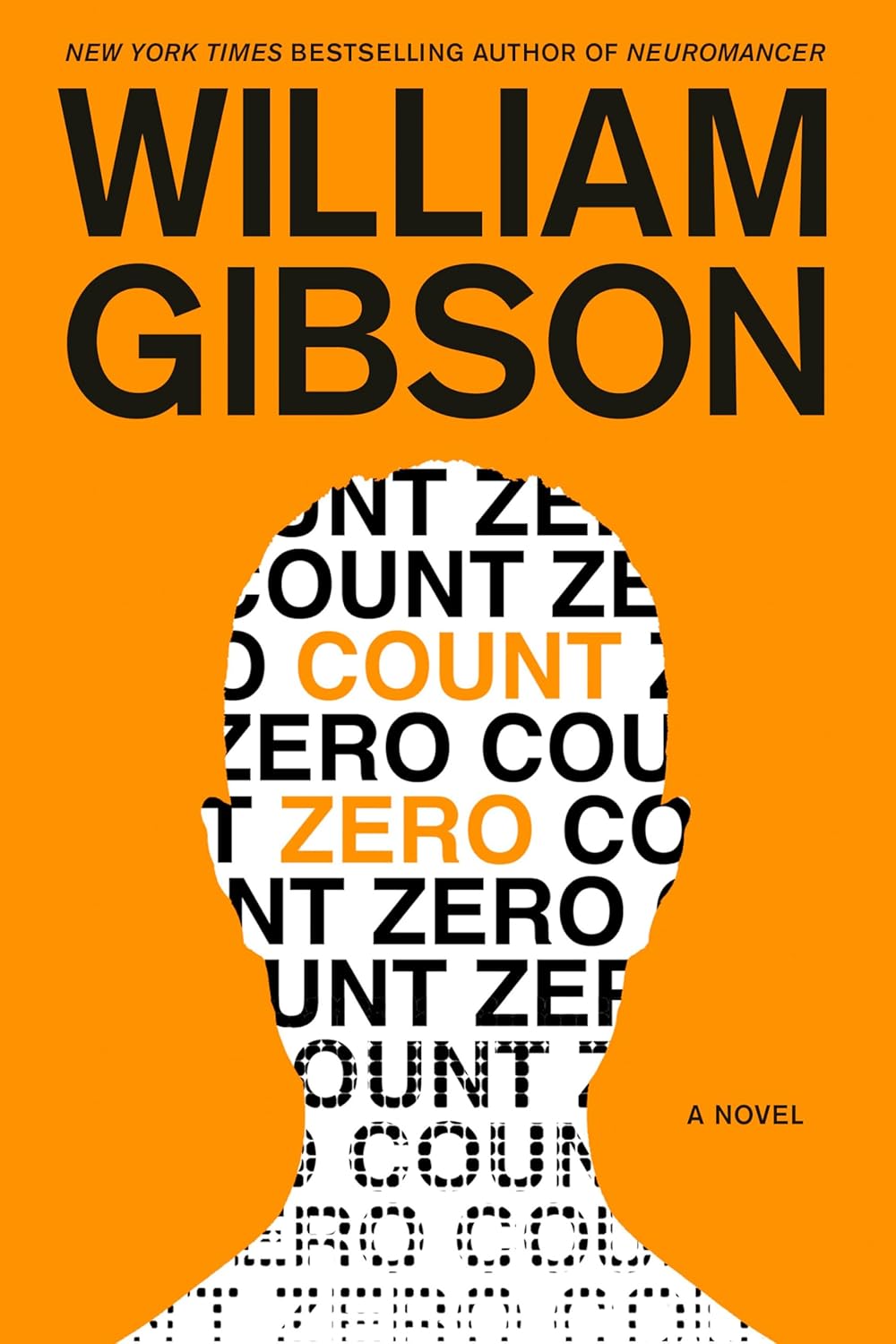
The second Sprawl novel, and the one where Gibson works out how to braid multiple stories.
Three plotlines this time: an art-world commission, a corporate extraction gone wrong, and a teenage hacker in the suburbs who flatlines on his first run and comes back owing his life to something in the net.
That last element is the reason to read it. Gibson populated cyberspace with entities modeled on Haitian religion, which is a far stranger and better idea than the AIs everyone else was writing, and it reframes the network as a place with its own inhabitants and obligations.
It’s the weakest of the Sprawl trilogy, since the strands don’t cohere until a climax that arrives too fast, and it’s still better than most cyberpunk novels written since.
Mona Lisa Overdrive by William Gibson (1988)

The Sprawl trilogy’s closer and the most accomplished of the three.
Four plotlines now, spread from a simstim star’s entourage to a yakuza daughter hiding in London to a scrapyard in the industrial wastes, with characters from both earlier books walking back into the story under new names.
Where Count Zero yanked its strands together at the end, this one weaves them from the start, and the payoff carries actual weight because of it. It has the strongest prose of the three Sprawl books.
Among cyberpunk books this is the one whose reputation most undersells it.
Mirrorshades: The Cyberpunk Anthology edited by Bruce Sterling (1986)

The movement’s manifesto and its best single volume.
Sterling assembled twelve stories and wrote a preface that did more to define cyberpunk than any novel did, laying out the high-tech-low-life formulation and positioning the movement explicitly against what he saw as science fiction’s exhausted establishment.
The contents are the actual canon: Gibson’s “The Gernsback Continuum,” Sterling’s own work, Pat Cadigan, Rudy Rucker, John Shirley, Lewis Shiner, Greg Bear, Marc Laidlaw, and Tom Maddox.
If you want to understand what cyberpunk books were as a movement rather than a mood, this is the primary document, and it’s cited in academic work on the genre more than anything else in it. The spiritual sequel, Rewired, covers the postcyberpunk generation.
Schismatrix by Bruce Sterling (1985)

Sterling’s own fiction is stranger and more ambitious than his reputation as the movement’s theorist suggests.
Humanity has split into two factions: the Shapers, who modify themselves genetically and psychologically, and the Mechanists, who use prosthetics and computers. Abelard Lindsay lives for centuries across the solar system as a diplomat, con artist, and revolutionary, moving between factions as both become obsolete.
It’s cyberpunk’s most thorough working-out of what body modification actually leads to, and the timescale gives Sterling room to show ideologies rising and dying. Aliens arrive partway through and treat the entire human conflict as a trading opportunity.
It’s denser and colder than Gibson, and no cyberpunk novel packs more ideas per page.
Synners by Pat Cadigan (1991)

Cadigan was the only woman in the core movement, is routinely dropped from lists like this one, and wrote the best novel about what the technology does to bodies.
A company has developed sockets that allow direct brain-to-network connection, letting music video directors transmit imagery straight from the mind. The technology has a flaw. When someone dies while connected, something gets loose in the network.
What sets it apart is the physicality. Cadigan is interested in the meat: the surgery, the infections, the strokes, the way the characters’ bodies fail while their minds are elsewhere. Gibson’s cyberspace is transcendent; Cadigan’s is a workplace injury waiting to happen, and no other cyberpunk books get the body this right.
She won the Arthur C. Clarke Award for it and again for Fools. She’s been called the Queen of Cyberpunk and remains the most underread major figure in it.
Software by Rudy Rucker (1982)

The weirdest thing the movement produced, and the funniest.
Cobb Anderson built the boppers, self-replicating robots that won their independence on the moon. Now he’s old, broke, and drinking on a Florida beach when a bopper offers him immortality: they’ll copy his brain. The catch is what they have to do with the original.
Rucker was a mathematics professor writing about computation, consciousness, and the transferability of the self, and he did it as gonzo comedy rather than noir. The boppers argue about philosophy. Bodies are disposable and messy.
It won the first Philip K. Dick Award and the Ware tetralogy that follows gets progressively stranger. Nothing else in cyberpunk sounds remotely like Rucker.
Islands in the Net by Bruce Sterling (1988)

Sterling again, and the novel that predicted the most.
Laura Webster works for a corporation that has replaced the nation-state as the organizing unit of society, sent to negotiate with data havens: offshore territories selling information laundering, banking secrecy, and untraceable networking to whoever pays.
Written in 1988, it anticipated data havens, information warfare, corporate diplomacy, and the collapse of state authority into distributed private power with an accuracy that’s slightly unnerving. Sterling’s future is less neon than Gibson’s and considerably more plausible.
It’s the most politically intelligent of all the movement’s cyberpunk novels.
Hardwired by Walter Jon Williams (1986)

The purest expression of cyberpunk as pulp, and hugely enjoyable for it.
Cowboy runs contraband across a broken North America in a hovertank, jacked directly into the vehicle through a socket at the base of his skull. Sarah is an assassin with a weaponised implant in her throat. The orbital corporations won the war and own everything below.
Williams isn’t doing what Sterling and Cadigan are doing. He’s writing a fast, violent, technically detailed adventure that takes the genre’s furniture seriously and builds a proper thriller with it.
It’s the one among these cyberpunk books that most directly influenced tabletop gaming and, through that, the visual culture that followed.
The Japanese Strand
Ghost in the Shell by Masamune Shirow (1989)

Manga rather than prose, and impossible to leave off honestly, because its influence on what cyberpunk became is enormous.
Major Motoko Kusanagi leads Public Security Section 9 in a Japan where most people have cyberised brains and prosthetic bodies, and where the crimes worth investigating are increasingly crimes against the definition of a person. The Puppet Master case turns on whether a program that has become self-aware constitutes a life.
Few cyberpunk books match Shirow’s technical density, with pages of footnotes about the hardware, and his central question is the genre’s question at its sharpest: what remains of you when every component has been replaced.
The 1995 film shaped The Matrix directly. Read the manga for the philosophy and the density. For the wider tradition it sits in, my list of the best manga has the map.
All You Need Is Kill by Hiroshi Sakurazaka (2004)

Japanese cyberpunk’s best novel-length work, and the source for Edge of Tomorrow.
Keiji Kiriya dies on his first deployment against alien Mimics, wakes up the day before, and dies again. And again. The loop is the plot, and the mechanised infantry, the corporate military structure, and the treatment of soldiers as replaceable components are pure cyberpunk logic.
Sakurazaka writes the repetition as grinding rather than clever, and the novel is honest about what happens to a person who has died three hundred times.
It’s short, brutal, better than the film, and proof that cyberpunk novels travel.
Harmony by Project Itoh (2008)

The most sophisticated post-cyberpunk novel out of Japan, written by a man dying of cancer while he wrote it.
After a global catastrophe, society has organized around health as the supreme value. Everyone carries WatchMe, a system monitoring their body and behavior, and social pressure toward wellness is total and cheerful and inescapable. Tuan and her friends attempted suicide as teenagers, as the only act of rebellion available.
Itoh’s target is the benevolent surveillance state rather than the corporate dystopia, which turned out to be the more accurate prediction. The book is formatted as marked-up text in an emotion-tagging language, which sounds gimmicky and isn’t.
He died at 34. This is the best thing he wrote and one of the finest cyberpunk novels of the century.
Post-Cyberpunk (1992–2019)
Snow Crash by Neal Stephenson (1992)

The novel that both perfected the genre and made fun of it, and the one most people read second.
Hiro Protagonist delivers pizza for the Mafia in a Los Angeles carved into corporate franchise enclaves, and is a warrior prince in the Metaverse, the shared virtual environment Stephenson named and described closely enough that an entire industry has been chasing it since. A drug called Snow Crash is circulating that damages people in the virtual world and the physical one simultaneously.
The core idea is genuinely wild and the reason it lasts: a linguistic virus operating on the brainstem like machine code, tied to Sumerian myth and the Tower of Babel as an actual historical infrastructure failure in human language.
My reservation is that the book leans hard on being cool. Hiro’s swords, the skateboard courier with the harpoon, the relentless surface style, all of it is doing style-over-substance work that sits oddly against how smart the central premise is. That’s the criticism cyberpunk books always attracted, and Snow Crash supplies the ammunition.
The Babel material survives the posturing. Read it for that.
The Diamond Age by Neal Stephenson (1995)

Stephenson’s better novel and the one that took cyberpunk somewhere new.
Molecular assemblers have ended material scarcity, and society has reorganised into self-selected tribes, the most powerful of which are the neo-Victorians. An engineer makes an illicit copy of an interactive educational book for his own daughter; the copy reaches Nell, a girl from the slums, and her education by the Primer is the novel’s spine.
The nanotech is worked through properly, but the interesting part is the argument: that in a world where anyone can have anything, culture and discipline become the only scarce goods, and the neo-Victorians know it.
The ending is a famous mess. Everything before it is Stephenson’s best work and among the smartest cyberpunk novels of the nineties.
Altered Carbon by Richard K. Morgan (2002)

The novel that dragged cyberpunk into the twenty-first century, and the most purely entertaining book here.
Consciousness can be digitised and stored on a cortical stack, so bodies are sleeves you wear and death is only permanent if someone destroys the stack. Takeshi Kovacs, an ex-UN special forces operative, is downloaded into a new body on Earth to investigate the apparent suicide of a man wealthy enough to have backed himself up.
Morgan takes the premise somewhere properly dark: if the rich can live forever and the poor can be stored on a shelf, the class structure calcifies into something permanent. The Meths, named for Methuselah, are among the better villains in modern science fiction.
It’s violent, hardboiled, nastier than the Netflix series, and the book that proved cyberpunk books still had life in them. It won the Philip K. Dick Award.
Accelerando by Charles Stross (2005)
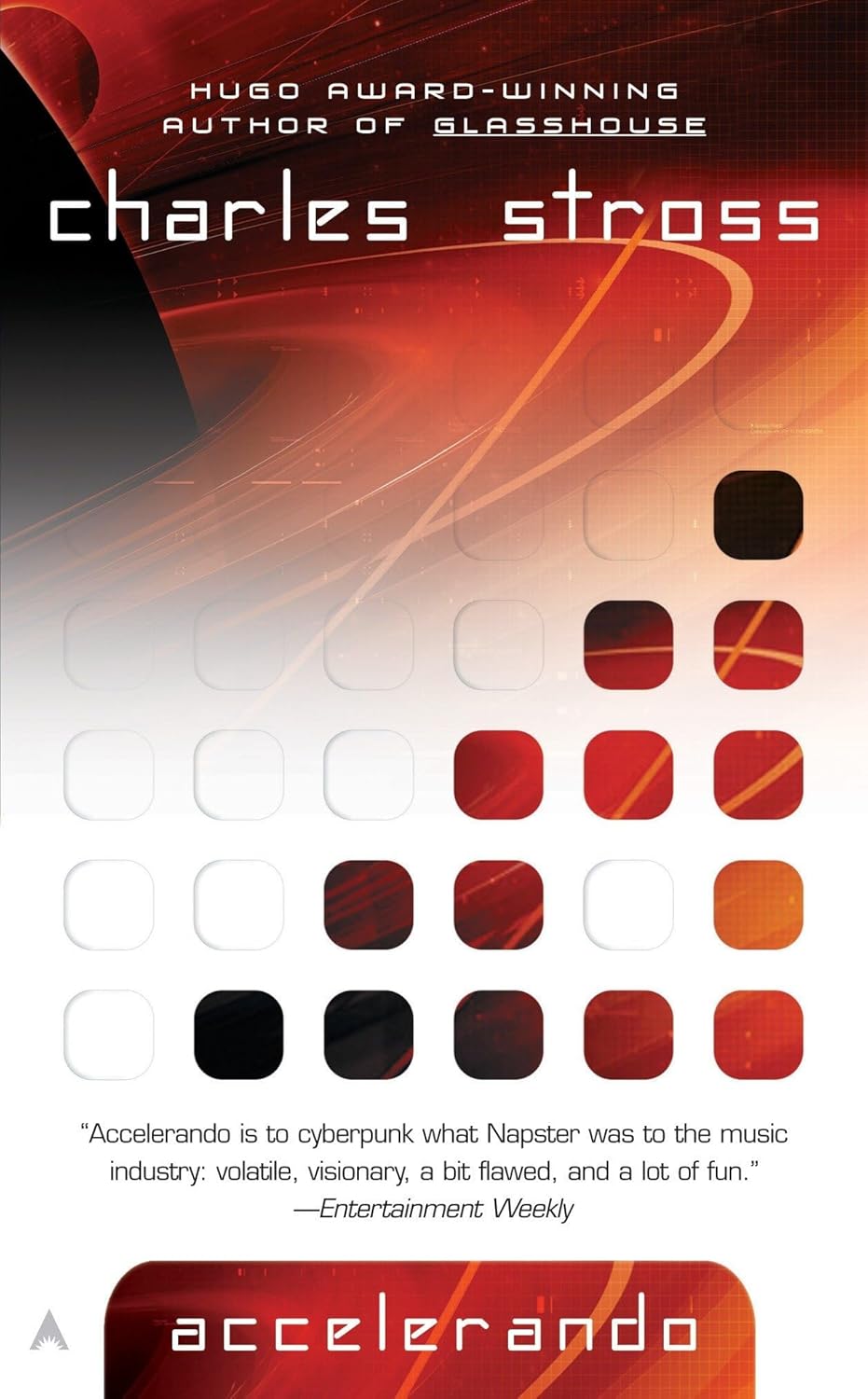
The most idea-dense book in post-cyberpunk, covering three generations across the technological singularity.
Manfred Macx is a venture altruist who gives away business models and lives entirely through his augmented reality glasses. His daughter and granddaughter inherit a solar system being disassembled by uploaded intelligences building computronium out of the planets.
Stross throws more concepts per page than anyone since Rucker, and the novel’s argument has aged much better than the transcendent version of the singularity: his is economically driven, chaotic, and full of legal disputes.
It’s exhausting and it means to be, which is true of the best cyberpunk novels. He released it free online.
Halting State by Charles Stross (2007)

Stross again, doing cyberpunk as police procedural, written in second person throughout.
A bank inside a massively multiplayer game has been robbed by a party of orcs, and the theft turns out to matter enormously in the physical economy. Three characters investigate: a police sergeant, a forensic accountant, and a games programmer.
The second person is the point, since it puts you in the position of a player character, and Stross’s near-future Scotland, with its ubiquitous augmented reality and its distributed everything, is the most convincing extrapolation of smartphone culture written before smartphones existed.
It’s also very funny, and it holds the best technological prediction record among these cyberpunk books.
River of Gods by Ian McDonald (2004)

Cyberpunk relocated to India, and the best argument that the genre didn’t have to stay in Chiba City and Los Angeles.
It’s 2047, the hundredth anniversary of independence, and India has fragmented into competing states negotiating drought, water politics, and a treaty limiting artificial intelligence. Ten narrators carry the story: a politician, a comedian, a set designer for a soap opera whose actors are entirely synthetic, an American physicist, and an AI hunter.
McDonald writes Indian futures with specificity rather than exoticism, and the novel’s aeai characters and its third-gender nutes are among the more thoughtful things the genre has done with identity.
It remains the most underrated of all recent cyberpunk novels.
Rainbows End by Vernor Vinge (2006)

The Hugo winner about augmented reality, written before the technology existed.
Robert Gu, a poet with Alzheimer’s, is cured by new medicine and wakes into a world he can’t operate in: everything is overlaid with wearable-mediated data, his grandchildren live in layered realities he can’t perceive, and he has to go back to school to learn to function.
The premise is inspired, because it lets Vinge explain a saturated technological environment to a reader through a character who genuinely doesn’t understand it either.
The library scene, in which a physical building is being destructively digitised while competing belief-communities fight over the outcome, is one of the best sequences in modern science fiction.
Infomocracy by Malka Older (2016)

Cyberpunk’s political descendant, and the sharpest recent entry.
The nation-state has been replaced by microdemocracy: the world divided into units of a hundred thousand people, each voting for whichever government it wants, with a global information bureaucracy managing the data. An election is approaching and someone is manipulating it.
Older worked in humanitarian aid and the novel reads like it: the logistics of running a global election, the information warfare, and the campaign staffers doing unglamorous work are all rendered with a professional’s eye.
It answers the question of what cyberpunk politics looks like after corporations finish winning.
Gnomon by Nick Harkaway (2017)

The most formally ambitious cyberpunk novel of the last decade.
Britain is governed by the System, a perfect participatory democracy underwritten by total surveillance, in which citizens vote constantly and the Witness sees everything. Diana Hunter dies under interrogation, and an inspector reviewing the recording of her mind finds four other lives inside it.
Harkaway nests those narratives inside each other, a Greek financier, an Ethiopian painter, a Roman alchemist, and an intelligence called Gnomon, and the connections between them are the puzzle.
It’s long, dense, and demands attention. It’s also the best of the cyberpunk books about consensual surveillance, which is the form surveillance actually took.
The Peripheral by William Gibson (2014)

Gibson’s return to the mode he invented, thirty years on.
Flynne Fisher scrapes by in a hollowed-out American county, covering a shift in what her brother told her was a game beta, and watches someone die in a way no game would bother to render. Nothing about it was a game.
Seventy years on, in a London thinned out by the slow catastrophe everyone calls the jackpot, the kleptocrats who inherited the wreckage have learned to reach back into an earlier timeline and hire it.
What the jackpot is, and why it’s the most convincing collapse in recent fiction, I’ve covered on my Gibson list. Here the point is simpler: this is Gibson writing about a networked present he can now observe rather than invent, and he’s still ahead of everyone else writing cyberpunk novels.
Void Star by Zachary Mason (2017)

The most beautifully written cyberpunk novel, and the least known.
Three characters in a near future of climate refugees, sea walls, and AIs whose reasoning has become genuinely opaque to their makers: a woman with a memory implant who can interface with the machines, a favela-raised thief, and a bodyguard for the very rich.
Mason has a doctorate in computer science and wrote The Lost Books of the Odyssey, and the prose here is closer to literary fiction than genre. The AIs are convincingly alien in a way most fictional AIs aren’t, because Mason writes them as systems whose internal logic diverged from ours a long time ago and nobody noticed.
It’s slow, cold, gorgeous, and the best-written of these cyberpunk books.
If you’re starting from nothing, read Neuromancer, then Mirrorshades for the movement, then Snow Crash and Altered Carbon to see where it went. Then Cadigan and Shirley, because everyone skips them and they shouldn’t.


