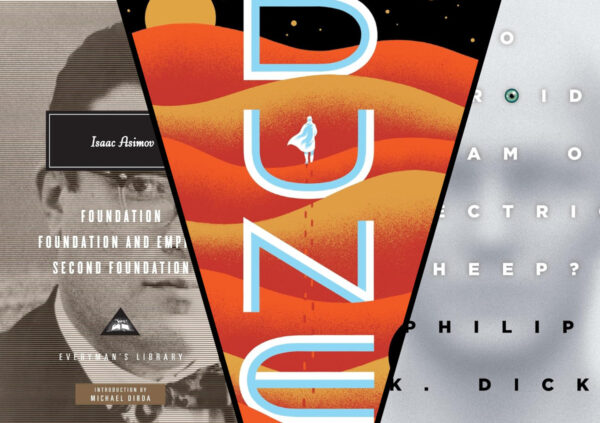
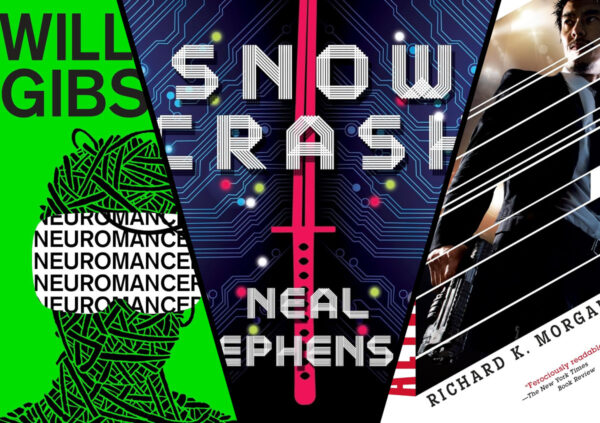
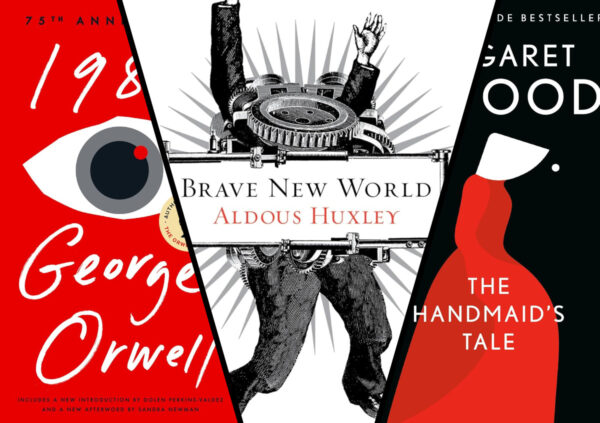
The problem with the Philip K. Dick books is the sheer volume and the unevenness. He wrote fast, often on amphetamines, frequently for a few hundred dollars a book, and the catalog swings from the genuinely great to the barely readable, sometimes inside the same novel. Loving Do Androids Dream of Electric Sheep? tells you almost nothing about whether you’ll survive the late religious work. So this page sorts it: where to start, what’s essential, and which of the forty-plus novels are for people who already know they need all of it.
I haven’t read the whole catalog, and nobody sane starts by trying to. Where a verdict below rests on the critical consensus instead of my own reading, the text says so plainly.
One thing the uneven reputation hides: no other writer of his era is this alive right now. Hollywood has adapted him more than a dozen times, the Library of America shelved him beside Melville, and the questions his books never stopped asking, what is real and what is human, read less like paranoia every year. Two of the Philip K. Dick books sit on my list of the best science fiction books of all time, and the dystopian shelf would be thinner without him too.
Fiction by René Rehn


The Short Version
Read Ubik if you want the purest hit of what Dick does, reality collapsing a floor at a time under people who can’t stop taking notes on it. Read Do Androids Dream of Electric Sheep? if Blade Runner brought you here, knowing the book is a different and arguably better thing. Read The Man in the High Castle for the masterpiece of craft, A Scanner Darkly for the saddest and most personal one, and VALIS only when you are ready to watch the author take the wheel of his own breakdown.
Philip K. Dick Books in Order
The count of his published novels lands at forty-four or forty-five depending on who is counting and what counts, with lost manuscripts and posthumous releases blurring the edge. The table runs the novels by first publication, mainstream work included.
| Year | Title | Type | Notes |
| 1955 | Solar Lottery | SF novel | His first |
| 1956 | The World Jones Made | SF novel | |
| 1956 | The Man Who Japed | SF novel | |
| 1957 | Eye in the Sky | SF novel | |
| 1957 | The Cosmic Puppets | SF novel | |
| 1959 | Time Out of Joint | SF novel | |
| 1960 | Vulcan’s Hammer | SF novel | |
| 1960 | Dr. Futurity | SF novel | |
| 1962 | The Man in the High Castle | SF novel | Hugo Award |
| 1963 | The Game-Players of Titan | SF novel | |
| 1964 | Martian Time-Slip | SF novel | |
| 1964 | The Simulacra | SF novel | |
| 1964 | Clans of the Alphane Moon | SF novel | |
| 1964 | The Penultimate Truth | SF novel | |
| 1965 | Dr. Bloodmoney | SF novel | |
| 1965 | The Three Stigmata of Palmer Eldritch | SF novel | |
| 1966 | The Crack in Space | SF novel | |
| 1966 | Now Wait for Last Year | SF novel | |
| 1966 | The Unteleported Man | SF novel | Later expanded as Lies, Inc. |
| 1967 | The Zap Gun | SF novel | |
| 1967 | The Ganymede Takeover | SF novel | With Ray Nelson |
| 1967 | Counter-Clock World | SF novel | |
| 1968 | Do Androids Dream of Electric Sheep? | SF novel | Became Blade Runner |
| 1969 | Ubik | SF novel | |
| 1969 | Galactic Pot-Healer | SF novel | |
| 1970 | Our Friends from Frolix 8 | SF novel | |
| 1970 | A Maze of Death | SF novel | |
| 1972 | We Can Build You | SF novel | |
| 1974 | Flow My Tears, the Policeman Said | SF novel | Campbell Memorial Award |
| 1975 | Confessions of a Crap Artist | Mainstream | The only one published in his lifetime |
| 1976 | Deus Irae | SF novel | With Roger Zelazny |
| 1977 | A Scanner Darkly | SF novel | BSFA Award |
| 1981 | VALIS | SF novel | |
| 1981 | The Divine Invasion | SF novel | |
| 1982 | The Transmigration of Timothy Archer | Novel | His last |
| 1984 | The Man Whose Teeth Were All Exactly Alike | Mainstream | Posthumous |
| 1985 | Radio Free Albemuth | SF novel | Written 1976, posthumous |
| 1985 | Puttering About in a Small Land | Mainstream | Posthumous |
| 1985 | In Milton Lumky Territory | Mainstream | Posthumous |
| 1986 | Humpty Dumpty in Oakland | Mainstream | Posthumous |
| 1987 | Mary and the Giant | Mainstream | Posthumous |
| 1988 | The Broken Bubble | Mainstream | Posthumous |
| 1994 | Gather Yourselves Together | Mainstream | Posthumous |
| 2007 | Voices from the Street | Mainstream | Posthumous |
| 2011 | The Exegesis of Philip K. Dick | Journals | Edited selection |
Where to Start
Start with Ubik or Do Androids Dream of Electric Sheep?. Both are short, both are peak Dick, and they split the two halves of him neatly: Ubik is the reality-collapse machine, Androids the moral exhaustion. The Man in the High Castle is the best-built novel he wrote and works as a first book for readers who want craft over chaos.
Do not start with VALIS, whatever anyone tells you. It is the record of a mind interrogating its own visions, and it only lands once you have read enough ordinary Dick to feel the ground he is pulling out from under you.
And a practical warning the fans learn early: the catalog’s middle is a minefield of books written in weeks. The tiers below exist so you hit the live ones.
Dick’s Life, Briefly
Philip Kindred Dick was born in Chicago on December 16, 1928, six weeks premature, with a twin sister, Jane, who died six weeks later. The lost twin never left the work, surfacing in phantom siblings and divided selves for the next fifty years. The family ended up in Berkeley, where Dick went through high school, lasted a few weeks at the university, and settled into the record-store and radio culture that furnished half his later characters.
He sold stories at a ferocious pace through the 1950s, wrote novel after novel through the 1960s on speed and deadline pressure, and married five times. The paranoia that powers the books had real-world food: in November 1971 his house was burgled and his safe blown open, a case the police never solved and at one point suspected him of staging. He hit bottom in Vancouver in 1972 and went through a Canadian rehab program before starting over in Southern California.
Then came the event the late books orbit. In February and March of 1974, after a delivery girl’s fish pendant caught the sun, Dick experienced weeks of visions he spent the rest of his life interpreting, eight thousand handwritten pages of interpretation he called the Exegesis. Whether it was revelation, temporal lobe epilepsy, or the mind of a great paranoid novelist turning on itself is exactly the question the VALIS novels refuse to settle. He died of complications from a stroke in Santa Ana on March 2, 1982, at fifty-three, less than four months before Blade Runner opened. He saw only test footage of its Los Angeles, and said the screen looked exactly as he had imagined it.
The Essentials
Seven books, and any shelf of Philip K. Dick books that wants to deserve the name starts here. These are the ones where the ideas, the craft, and the strange tenderness all arrive together.
Ubik (1969)

Ubik is the purest Philip K. Dick novel, and the one to hand anyone who asks what the fuss is about. Glen Runciter runs a firm of anti-telepaths hired to protect corporate privacy. A job on the Moon goes wrong in an explosion, and from that moment reality starts expiring around his team like bad produce: cigarettes crumble, coins show the wrong faces, time slides backward toward 1939. The only thing pushing back is Ubik, a product that appears in a different form in every chapter’s mock advertisement.
It is funny, frightening, and completely in control of a premise that should be uncontrollable, with the famous half-life concept, the dead kept in chatty cold storage, doing load-bearing work. Time magazine put it on its list of the hundred best English-language novels, one of the few genre books there. If you read one Philip K. Dick novel, the consensus and I agree it should probably be this one.
Do Androids Dream of Electric Sheep? (1968)

Rick Deckard is a bounty hunter in a San Francisco choked with radioactive dust, hunting six escaped Nexus-6 androids nearly indistinguishable from people. The world’s real status economy is animals: almost all of them are dead, owning a live one is the ultimate marker of worth, and Deckard is quietly ashamed of the electric sheep on his roof. The one thing separating human from android is empathy, measured by a test and worshipped through Mercerism, a strange shared-suffering faith practiced through a device with two handles.
The film kept the premise and threw away the point. Ridley Scott made a noir about what it means to be human. Dick wrote something quieter and bleaker about moral exhaustion, where empathy is a burden rather than a virtue and the androids are less villains than a mirror. It’s the book to read second if Blade Runner brought you here, because it is not the same story and it is arguably the better one. I’ve given it its full due on my best science fiction books list, so this is the short version.
The Man in the High Castle (1962)

The Axis won. In 1962’s America, the Reich holds the East Coast, Japan administers the Pacific states, and a strip of the Rockies stays nominally free. Through a handful of small lives, a judo instructor, a forger of fake Americana, a Japanese trade official, circulates a banned novel describing a world where the Allies won, written by a recluse known as the man in the high castle.
The genius is the doubling. Dick wrote the book consulting the I Ching, and a character inside it wrote the book-within-the-book the same way, so the novel is a work of alternate history that contains its own alternate-alternate history and quietly suggests neither layer is the real one. It took the Hugo in 1963 and remains the most disciplined thing he ever wrote. The Amazon adaptation that ran from 2015 to 2019 expanded it into something much larger and more action-driven. The novel is subtler, stranger, and shorter. The long version of my verdict is on my best dystopian books list.
A Scanner Darkly (1977)

An undercover narcotics agent called Fred wears a scramble suit that hides his identity even from his handlers, and his assignment is to surveil a drug house. Its central figure is Bob Arctor, who is Fred. Substance D, the drug everyone in the house is on, severs the brain’s hemispheres, and the novel watches one man split into the watcher and the watched until neither half recognizes the other.
It’s built from Dick’s own years inside the California drug scene of the early 1970s, and it closes with an author’s note listing friends of his, by name, who were dead or permanently damaged by drugs, with his own name on the list. Richard Linklater’s 2006 rotoscoped film is unusually faithful. Read as a novel it is the saddest thing in the catalog, a book about self-surveillance and loss written by a man who had watched it happen and knew he was one of the casualties. It took the British Science Fiction Association’s award, and of all the Philip K. Dick books it is the one that earns the word tragic.
The Three Stigmata of Palmer Eldritch (1965)

The Three Stigmata of Palmer Eldritch is the scariest thing he wrote, and the most prophetic about where the fake-worlds idea could go. Colonists on Mars, drafted and miserable, escape their shacks through Can-D, a drug that translates them into a shared dollhouse idyll back on Earth. Then the industrialist Palmer Eldritch returns from the edge of the solar system with a rival product, Chew-Z, and an offer that amounts to eternal life inside worlds he owns. His three stigmata, the artificial eyes, the steel teeth, the mechanical hand, start showing up inside everyone’s visions, including the ones that should be private.
This is the book where Dick’s theological horror arrives fully formed, a decade before the visions that would make it personal. It is disorienting by design, openly about transubstantiation gone wrong, and widely considered the hinge between early thriller-Dick and the metaphysical writer of the later years. Consensus rates it major and demanding in equal measure. Read it once Ubik and Androids have shown you the moves, not before.
Flow My Tears, the Policeman Said (1974)

Jason Taverner is a television star with thirty million viewers, and one morning he wakes in a flophouse in a police state where no record of him exists. No file, no birth certificate, nobody who has heard of him, in a surveillance society where being unrecorded is itself a crime. The title’s policeman is General Felix Buckman, whose strange, grieving chapters quietly steal the novel.
The setup is pure premise-machine, and what distinguishes it is the melancholy, a police state rendered through two lonely men on opposite sides of it, ending on one of the oddest acts of tenderness in the genre. It won the John W. Campbell Memorial Award in 1975, the closest thing to establishment recognition Dick got in his lifetime, and its grief-soaked second half reads differently once you know the Exegesis was two years away. Among the celebrity-erasure stories the genre keeps retelling, the original still cuts deepest.
Martian Time-Slip (1964)

Martian Time-Slip is the best of his Mars books and the great sleeper in the catalog. Its colony is a dusty failure of plumbers’ unions and land speculation along a canal system nobody maintains, and the novel orbits Manfred, a boy whose autism, in the book’s conceit, is a displacement in time. Through him the characters begin slipping into entropy-visions the book calls the tomb world, rendered in some of the most unsettling repeated prose Dick ever wrote.
Consensus has climbed steadily on this one, and many serious readers now place it just under the big four. It is also the clearest early statement of his lifelong sympathies: the schizoid repairman, the predatory businessman, the child nobody will listen to. The honest caveat is the period handling of autism, which is a 1964 theory deployed as metaphysics and reads as such. As a novel about time, failure, and real estate on a dying frontier, it has few equals in the Philip K. Dick books or anywhere nearby.
The VALIS Years
In early 1974, recovering from dental surgery, Dick experienced the visions he came to call 2-3-74, and spent his last eight years writing toward an explanation. The books from this period are not like other books, his or anyone’s. They are the work of a novelist using fiction as an instrument on his own experience, and they divide readers absolutely.
VALIS (1981)

VALIS is the centerpiece, and the strangest major novel American science fiction has produced. Horselover Fat is cracking up after a friend’s death and believes a pink beam of light has fired divine information into his head. The narrator, a science fiction writer named Philip K. Dick, tells Fat’s story with rueful care, and the book’s first great move is that they are openly the same person. The second is that the novel knows every skeptical explanation you could offer and offers them first.
What follows is a quest through Gnostic theology, a film that may contain transmissions, and a two-year-old who may be the savior, all conducted in the funniest, most self-lacerating prose of his career. To some readers the VALIS material is his masterpiece, the point where the lifelong question of what is real stops being a game. To others it is the record of a mind coming apart. Both camps are describing the same pages. What everyone agrees on is that it is the worst possible place to start, because it only lands once you have read enough ordinary Dick to feel the ground he is pulling out from under you.
The Divine Invasion (1981)

The Divine Invasion is the middle book of what became the VALIS trilogy, and the one that plays it as straight science fiction. God has been in exile on a colony world, and the novel smuggles him back to an Earth run by a merged church-state, in the body of an unborn child whose mother dies en route. It is the Nativity rebuilt from Gnostic parts, with a damaged guardian, a dream-tutor, and one of Dick’s eeriest inventions, a recording artist whose lute songs seem to come from somewhere realer than the world.
Consensus calls it the weakest of the three late novels and still essential for anyone invested in the project, because it shows the 2-3-74 material disciplined back into story. Readers who found VALIS too naked often like this one better than the critics do.
The Transmigration of Timothy Archer (1982)

The Transmigration of Timothy Archer is his last completed novel, published weeks after his death, and a surprise at every level: a mainstream book narrated by a woman, Angel Archer, widely considered the best character he ever wrote. Her father-in-law, the celebrity Episcopal bishop Timothy Archer, is losing his faith to a set of newly discovered scrolls that seem to predate the sayings of Jesus, and losing his family to his own charisma. The bishop is drawn closely on Dick’s friend James Pike, down to the fatal trip into the Judean desert with two bottles of soda and a map.
There is no science fiction in it at all, and it is one of the finest things he wrote, grief-stricken, witty, and kind. As the closing panel of the VALIS trilogy it reframes the whole project: after two books of cosmic machinery, the last word goes to the skeptic who loved the believers and buried them. If the late Dick has a case for literature with no asterisk, Angel Archer is the case.
Radio Free Albemuth (1985)

Radio Free Albemuth is the first run at the VALIS material, written in 1976, shelved, and published three years after his death. Here the premise plays as political thriller: America has fallen to President Ferris F. Fremont, a paranoid demagogue built from recognizable parts, and an alien satellite is beaming resistance instructions into the head of a Berkeley record executive named Nicholas Brady. His best friend, a science fiction writer named Philip K. Dick, watches and eventually pays for it.
Next to VALIS it is plainer and more earnest, a dissident novel about living under an informer state, and that is exactly its value: you can see the raw experience before the irony armored it. The 2010 film adaptation came and went quietly. For completists of the Philip K. Dick books it is required, and for VALIS skeptics it is sometimes the version that finally clicks.
The Exegesis of Philip K. Dick (2011)

The Exegesis is not a novel, and it is not for beginners. From 1974 until his death Dick wrote roughly eight thousand pages of private notes trying to explain 2-3-74 to himself, theory after theory, night after night, and this volume is the edited selection that finally reached print in 2011. It is repetitive, brilliant, self-aware, and exhausting, often within one page, with Dick regularly demolishing last night’s cosmology before breakfast.
Nobody should read it before the novels, and no serious reader of the late novels can skip it entirely, because it shows the furnace the books were forged in. Dip, don’t march. As a document of a first-rate imagination applied full-time to its own experience, there is nothing like it in American letters.
The Deeper Catalog
Ten more that earn their shelf space, in rough order of consensus standing. This is where the completist tier starts, and it is deeper than the famous four suggest.
Time Out of Joint (1959)

Time Out of Joint drops Ragle Gumm into a tidy 1950s town where he makes his living winning a newspaper puzzle contest, every day, for years. Then a soft-drink stand dissolves in front of him into a slip of paper reading SOFT-DRINK STAND. The town is a stage set built around his talent, and the novel is the genre’s original suburban-reality-is-fake machine, a premise half of Hollywood has been strip-mining since.
The last act turns oddly stiff once the explanation arrives, which consensus forgives for the forty perfect pages in the middle. Anyone tracing The Truman Show’s family tree ends up here, and the book’s quieter pleasure is its painted-from-life 1950s surface, the suburb Dick actually lived in, rendered with the affection he usually reserved for things about to dissolve.
Dr. Bloodmoney (1965)

Dr. Bloodmoney is his post-apocalypse, subtitled How We Got Along After the Bomb, and against every expectation it is warm. The bombs fall early, and the book settles into the Marin County aftermath, a barter world of small farms and radio from a satellite endlessly circling with the last DJ aboard. The cast includes a phocomelic repairman with strange abilities and the guilt-mad physicist of the title. It is Dick’s most humane large cast, and the rare apocalypse more interested in rebuilding than rubble. My post-apocalyptic books list seats it among the genre’s foundations, and readers who know Dick only as a paranoiac should start here to meet the gentler writer underneath.
Now Wait for Last Year (1966)

Now Wait for Last Year catches Earth between two alien powers in a war it chose badly, while the drug JJ-180 unsticks its users in time with every dose. Dr. Eric Sweetscent patches up the planet’s industrialist leader while his estranged wife doses herself, and him, into disaster. Consensus rates it the best of the mid-sixties rush after Stigmata, with one of Dick’s rawest marriages at its center and an ending, delivered by a robot cab, that readers quote decades later. The war plot creaks, and the human machinery inside it does not. Readers who want one book from the overlooked middle sixties should take this one and thank the robot cab afterward.
Eye in the Sky (1957)

Eye in the Sky begins with a particle accelerator accident that drops eight visitors through the floor, and they wake inside a world running on one of their number’s beliefs, a paranoid religious crank’s cosmos where prayer works and sin shows. Each escape lands them in the next passenger’s private reality, including a sexless prude’s world and a communist’s America of secret-police shadows.
It is the first time Dick found his great subject, subjective worlds imposed on others, and played it as farce. It reads dated in its 1950s furniture and fast and funny anyway, and historically it is the door to everything after. The Christian-fundamentalist cosmos of the first section remains one of his sharpest jokes about whose reality gets enforced.
The Penultimate Truth (1964)

The Penultimate Truth keeps most of humanity in underground tanks, building robots for a world war they watch on screens, while the surface, long since at peace, has been carved into private parks by the elite who keep the war footage coming. It is the big Dick lie-structure at national scale, fed by his real fury at propaganda, and its premise has been borrowed so often that newcomers may feel they have read it before. Consensus calls the execution mid-tier and the idea immortal, and completists and dystopia readers get the most from it. The documentary-fabrication subplot, speeches ghostwritten for a leader who may not exist, lands harder now than it did in 1964.
Clans of the Alphane Moon (1964)

Clans of the Alphane Moon opens on an abandoned psychiatric colony moon that has organized itself into functioning clans by diagnosis, paranoids running security, manics running industry, schizophrenics as the visionary caste, and Earth wants its moon back. Into this arrives a miserable CIA marriage on its last legs and a telepathic Ganymedean slime mold with the book’s best lines. It is the broadest comedy among the Philip K. Dick books, tasteless by design and weirdly tender about its central divorce, which was his own, barely disguised. It is minor, memorable, and funnier than its premise has any right to be, and the slime mold alone has carried its reputation through sixty years of word of mouth.
Galactic Pot-Healer (1969)

Galactic Pot-Healer follows Joe Fernwright, who mends ceramics in a future that needs nothing mended, until a godlike alien called the Glimmung recruits him, along with a menagerie of other obsolete craftsmen, to raise a drowned cathedral on a water world. It is Dick’s most openly fable-shaped novel, half comic allegory about work and worth, half theology with tentacles, and it ends on one of the quietest gut-punches in the catalog, a single made object judged on its merits. Consensus splits between charming-minor and secretly-major, and the pot-healer’s last scene settles it for most people. Read it after the heavy theology of the late books and it plays like the same questions set to lighter music.
A Maze of Death (1970)

A Maze of Death lands fourteen colonists on the planet Delmak-O with no idea why they were sent, and they start dying. The theology is the hook: this is a universe where prayer is routed through satellites and God demonstrably answers, which makes the murders stranger rather than easier. The ending reframes everything with a mechanism Dick would perfect in the VALIS years, and the book’s bleakness is unusual even for him, written, he said in its foreword, out of real despair. It is a tight, nasty, underrated machine for readers who want the dark end of the shelf, and its closing mechanism, once seen, retroactively sharpens every page.
We Can Build You (1972)

We Can Build You watches a failing electric-organ company pivot to simulacra and build a perfect Abraham Lincoln, who promptly develops the melancholy to match, while the narrator falls for the firm’s brilliant, schizoid designer Pris. Written in 1962 and shelved for a decade, it is the quiet prequel-in-spirit to Androids, with Pris’s name and type carried forward.
The Lincoln is among the most touching machines in the genre, and the book around him is a sad, odd character study that barely pretends to be science fiction. Readers come for the robot and stay for the heartbreak, and Dick’s own fondness for the book, shelved a decade by publishers who could not place it, is easy to understand once Pris starts talking.
Solar Lottery (1955)

Solar Lottery is the first novel, set in a future where the world’s leadership is assigned by randomizing lottery, and the legal counterweight is a public, televised assassination challenge against the sitting Quizmaster. A young idealist signs on to the old regime the day power flips, and the book runs his divided loyalties at pulp speed. The van Vogt influence shows everywhere, and so does everything that would become Dick, the games, the fakes, the small man inside the vast system. It is historically indispensable, honestly mid-shelf, and short enough that completists lose nothing by starting at the start. The televised assassination convention alone shows how early the reality-as-spectacle obsession arrived.
The Mainstream Novels
Through the 1950s Dick wrote realist novel after realist novel about garage owners, record clerks, and miserable marriages in California, and publishing turned down every one. A single exception reached print while he lived, and the rest surfaced after his death as a shadow catalog: Puttering About in a Small Land, In Milton Lumky Territory, Humpty Dumpty in Oakland, Mary and the Giant, The Broken Bubble, and the rest. Consensus treats them as a fascinating minor literature about postwar small-business America, written by a man the genre had already claimed.
Confessions of a Crap Artist (1975)

Confessions of a Crap Artist belongs to Jack Isidore, who collects facts the way other people collect stamps, believes most of them, and narrates his sister’s disintegrating Marin County marriage with an innocence the book weaponizes. It is the one mainstream novel published in Dick’s lifetime, and the best of them by common consent, cruel, funny, and strangely loving toward its crackpot witness, whose name Dick reused for the most purely good character in Androids. France filmed it in 1992 as Confessions d’un Barjo. For readers who want to know what Dick saw when he looked at ordinary life, this is the unfiltered view: the fakes and delusions are all still here, just wearing aprons.
The Short Stories
The novels get the fame, and a startling share of the films come from the short fiction, written at volume for the 1950s magazines. “We Can Remember It for You Wholesale” became Total Recall, “The Minority Report” and “Paycheck” and “Adjustment Team” became the films you know, “Second Variety” became Screamers, and “Impostor” got its own feature. The stories are premise-machines, pure and fast, and the best of them hold their twist endings against seventy years of imitation.
The Collected Stories of Philip K. Dick (1987)

The Collected Stories is the complete short fiction, well over a hundred stories across five volumes, first assembled in 1987 and reissued in various dresses since. Volume by volume you can watch the pulp writer become the metaphysician, and the hit rate in the early volumes is higher than his reputation for unevenness suggests. For most readers the five-volume wall is the endgame purchase rather than the entry point, and it rewards exactly that kind of commitment. The early volumes also hold the pleasures his novels rarely slow down for, tight premises like “Roog” and “The Father-thing” landing in under fifteen pages, and the introductions alone justify the shelf space.
Selected Stories of Philip K. Dick (2002)

Selected Stories is the sane single volume, holding the film sources, the acknowledged classics like “The Days of Perky Pat” and “Second Variety” and “The Electric Ant,” and the strangest of the theological late pieces. Editions vary in exact contents, and any of them puts the essential short Dick on one shelf-spot. If the novels hooked you and you want the concentrate, start the stories here and upgrade to the five volumes when you catch yourself rationing. The twist endings that Hollywood keeps buying read even better at their original length, where the paranoia has no time to dilute.
Philip K. Dick: Deep Dive & FAQ
What Runs Through Dick’s Books
Two questions run through everything, asked for thirty years: what is real, and what is human. The first produces the fake worlds, the drugs, the simulated towns, the realities that expire mid-chapter. The second produces the empathy tests, the androids, the simulacra Lincolns, and the conclusion the books keep reaching, that humanity is a behavior rather than a birthright, and machines sometimes manage it where people fail.
Around those two questions the constants gather: little-guy protagonists, repairmen and pot-healers and record clerks rather than captains. Entropy as a physical presence, the drift of everything toward what Androids calls kipple. Wives and marriages rendered with painful honesty. God bothering people through cheap commercial channels, a spray can, a pink beam, a lute song, because in Dick the sacred arrives through trash or not at all.
And under all of it sits, decades before the terms existed, the experience of living inside systems that lie: curated feeds, manufactured consensus, personalized realities. The Philip K. Dick books aged into relevance the way almost nothing else from the era did, which is why the adaptations never stop coming.
Prizes and Honors
In his lifetime, modest: the Hugo for The Man in the High Castle in 1963, the John W. Campbell Memorial Award for Flow My Tears, the Policeman Said in 1975, the British Science Fiction Association Award for A Scanner Darkly, and a devotion in France, where the Metz festival honored him and his catalog stayed in print, that long predated his American standing.
After his death, the vindication arrived at scale. The adaptations made him Hollywood’s most-mined author of ideas, and in 2007 the Library of America took him in, the first science fiction writer in the series, eventually collecting thirteen of the novels across three volumes. The annual Philip K. Dick Award, founded in his memory, now marks exactly the kind of brilliant paperback original he spent his life being.
Which Philip K. Dick Editions to Buy
The Library of America set is the keeper: three volumes, thirteen novels, the canonical texts of everything from High Castle through the VALIS trilogy. For reading copies, the Mariner trade paperbacks cover the catalog in a uniform design and stay in print. The Exegesis exists in one edition and needs no shopping advice beyond a sturdy table.
For the stories, the five-volume Collected Stories is the complete answer and the Selected Stories the practical one. Secondhand hunters should know the old Ace and DAW paperbacks are charming, acidic, and falling apart, which is a very Dickian way for a library to behave.
Dick on Screen
The screen record is enormous and wildly uneven. Blade Runner (1982) started it, released months after his death, with Blade Runner 2049 (2017) as the rare sequel that honors its source’s melancholy. Total Recall came twice, in 1990 with the Schwarzenegger grin and in 2012 without the fun. Minority Report (2002) is the best pure thriller of the set, A Scanner Darkly (2006) the most faithful page-for-page, and The Adjustment Bureau (2011) the most romantic betrayal of its source. Paycheck, Next, Impostor, Screamers, and Radio Free Albemuth fill out the list, and France’s Confessions d’un Barjo (1992) remains the only mainstream-novel adaptation.
Television finally matched his scale: Amazon’s The Man in the High Castle ran four seasons from 2015 to 2019, expanding the novel far past its borders, and the anthology Electric Dreams (2017) adapted ten of the stories. The pattern across all of it holds: the premises survive the trip, the sadness usually does not. The reliable move is to read the book first, since the book is almost always stranger than the film.
Questions About Philip K. Dick
Where Should I Start With Philip K. Dick?
Ubik or Do Androids Dream of Electric Sheep?. Both are short and essential. The Man in the High Castle if you want his most disciplined novel first. Never VALIS.
What Is Philip K. Dick’s Best Book?
Consensus circles Ubik, The Man in the High Castle, and A Scanner Darkly, with Three Stigmata and VALIS as the dark-horse votes. Ubik is the most common single answer.
How Many Novels Did Philip K. Dick Write?
Forty-four or forty-five published novels depending on how you count the posthumous and collaborative ones, plus well over a hundred short stories. A handful of 1950s manuscripts are lost entirely.
Did Philip K. Dick See Blade Runner?
Only test footage. He died of stroke complications on March 2, 1982, less than four months before the premiere, after telling the production the footage looked exactly as he had imagined his city.
What Actually Happened to Him in 1974?
In February and March 1974 he experienced weeks of visions and spent his last eight years interpreting them in the eight-thousand-page journal he called the Exegesis. VALIS is the novel of it, Radio Free Albemuth the first draft, and he himself never settled on one explanation, revelation, illness, or both.
Are the Philip K. Dick Books Connected?
No shared universe, but one shared argument. Ideas, names, and obsessions migrate between books, Pris and the Isidores and the fake worlds, and the VALIS trilogy plus Radio Free Albemuth form a loose cycle around 2-3-74.
Why Are There So Many Philip K. Dick Movies?
Because he wrote premises, and premises travel. The empathy test, the implanted vacation, the pre-crime bureau, the unreliable town. Hollywood keeps the setups and usually discards the despair, which is why the books remain stranger than their adaptations.
Where to Go Next
The nearest neighbor on this site is Ursula K. Le Guin, his Berkeley High classmate, whose The Lathe of Heaven is the best Dick novel he never wrote, and my Ursula K. Le Guin guide covers it alongside everything else. The aesthetic he seeded grew into cyberpunk, mapped on my list of the best cyberpunk books, and William Gibson’s wing of it gets the full treatment on the William Gibson books guide. For the political-nightmare side of him, the wider tradition is on my list of the best dystopian novels.