Time travel is the genre of regret. Strip away the machinery and every one of these stories is about the same ache, the wish to stand in a moment again and do it differently, and the best time travel books almost all arrive at the same cruel finding: the past defends itself. What a time travel story really builds is not a vehicle but a rulebook, one way or round trip, fixed history or fluid, machine or affliction, and the rules a writer picks are a philosophy wearing a plot. Slaughterhouse-Five’s author has a shelf of his own: my Kurt Vonnegut guide.
It is also half of a sibling pair. Alternate history breaks the timeline and moves into the wreckage. Time travel visits, and pays for the visit. When a book does both, the way 11/22/63 does, both shelves get a claim, and my best alternate history books list has already staked one.
The fifteen below run from the mainstream giant of the modern genre back to the 1895 machine that started the clock, with the strange, the buried, and the outright horrifying in between.
Fiction by René Rehn


The Best Time Travel Books at a Glance
| Year | Title | Author |
| 2011 | 11/22/63 | Stephen King |
| 1969 | Slaughterhouse-Five | Kurt Vonnegut |
| 1979 | Kindred | Octavia Butler |
| 1992 | Doomsday Book | Connie Willis |
| 2003 | The Time Traveler’s Wife | Audrey Niffenegger |
| 1986 | Replay | Ken Grimwood |
| 2014 | The First Fifteen Lives of Harry August | Claire North |
| 1983 | The Anubis Gates | Tim Powers |
| 2013 | The Shining Girls | Lauren Beukes |
| 1955 | The End of Eternity | Isaac Asimov |
| 1889 | A Connecticut Yankee in King Arthur’s Court | Mark Twain |
| 1895 | The Time Machine | H. G. Wells |
| 1970 | Time and Again | Jack Finney |
| 2019 | This Is How You Lose the Time War | Amal El-Mohtar and Max Gladstone |
| 2024 | The Ministry of Time | Kaliane Bradley |
11/22/63 by Stephen King (2011)

Fresh from a full entry on my alternate history list, and it belongs here just as much, because the craft is all in the time travel.
The rules are the cleanest in the genre. A doorway in a diner storeroom leads to the same 1958 minute every time, each new trip erases the last one, and coming back always costs two minutes of the present, no matter how many years were spent on the other side. King then does the thing almost nobody does: he makes his traveler live the past at full length, five years of teaching, dancing, and falling in love in small-town Texas, all of it rent paid toward one afternoon in Dallas.
The consensus take, that this is the best late King by a comfortable margin, holds up. Read it here for the machinery, read the other entry for what the changed world costs, and notice how carefully the two halves are the same lesson.
Slaughterhouse-Five by Kurt Vonnegut (1969)

The greatest time travel novel that never explains itself, and the one that sits closest to home for me.
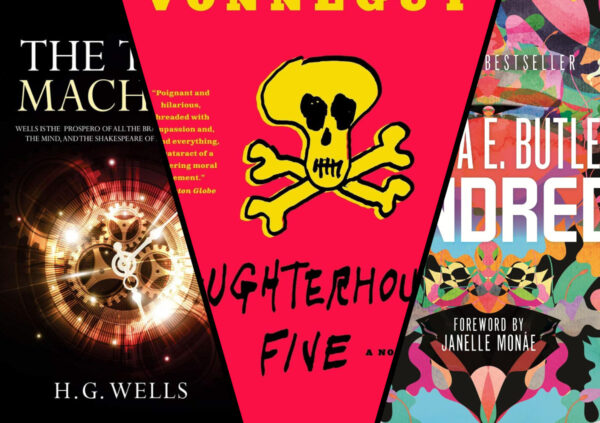
Billy Pilgrim has come unstuck in time. He does not ride the years, they happen to him, optometry practice, plane crash, the war, an alien zoo on Tralfamadore, all shuffled together like a dropped deck. The Tralfamadorians see every moment at once, which makes death a comma instead of a period, and the novel never rules on whether they are real or the last shelter a broken mind could build. That refusal is the whole book, and time travel has never been put to a sadder or better use.
Dresden, where I’m from, is the crater at the center of it. Vonnegut survived the firebombing as a prisoner in the meat locker the title names, and it took him twenty years to write the thing, which is, more or less, the plot. It made a Vonnegut reader out of me for life, even if it isn’t my favorite of his. That’s Cat’s Cradle, and my Kurt Vonnegut list makes the case.
Kindred by Octavia Butler (1979)

The most serious book the genre has ever produced, because it gives the trip to the one person the past is armed against.
Dana, a Black writer in 1976 Los Angeles, is pulled backward to a Maryland plantation whenever Rufus, the enslaver’s son who will become her ancestor, is about to die. Every other traveler on this list owns a machine, a doorway, or at least a condition. Dana is summoned, the way you summon a tool, and the trips strip her of everything the genre usually hands out, the tourist’s distance, the visitor’s immunity, the return ticket that brings all of you home.
Butler uses the device with total precision: the question is never how the time travel works but what surviving it costs, and the answer arrives in the first line and gets worse from there. The full masterpiece case is on my Octavia Butler guide, where it leads the catalog for good reason.
Doomsday Book by Connie Willis (1992)

Time travel as an academic discipline, complete with permission forms, and the past declining to respect any of it.
In Willis’s 2054, Oxford historians visit the past the way field researchers visit a dig site, and Kivrin Engle has fought for years to be dropped into the fourteenth century. A technician’s error sends her to 1348 instead of 1320, which any medievalist will tell you is the wrong year to be in England, and while the Black Death closes around her, a modern epidemic quarantines the Oxford that could retrieve her. The two outbreaks, centuries apart, run in parallel until they rhyme.
It won the Hugo and the Nebula, it is long and it earns it, and the bells at the end will stay with you. To Say Nothing of the Dog, her comic Victorian follow-up in the same setting, took a Hugo of its own and is the recovery read.
The Time Traveler’s Wife by Audrey Niffenegger (2003)

The blockbuster that smuggled hard genre mechanics into every book club on Earth.
Henry has Chrono-Displacement, a genetic condition that tears him out of the present without warning and drops him, naked, somewhere in his own timeline. Clare lives their marriage in order. He does not. Niffenegger builds the romance out of the asymmetry, a love story where one partner keeps vanishing and the other keeps waiting, and plays the paradoxes completely straight while the prose stays warm.
The honest note is that Henry first meeting Clare as a child reads more uncomfortably now than it did in 2003, and the discourse about it is worth having. It remains the great weeper of the time travel books, a sequel, Life Out of Order, has finally materialized after two decades, and the novel is far better than the film that came off it.
Replay by Ken Grimwood (1986)

Ask longtime readers of time travel books for the buried classic and this is the answer, every time.
Jeff Winston dies of a heart attack in 1988, mid-argument with his wife, and wakes in his college dorm in 1963 with his forty-three years of memory intact. He does what you would do, the sports bets, the stocks, the different women, the different lives, and then he dies in 1988 again, on schedule, and wakes again, and each replay starts a little later than the last. The window is closing and the book is about what a person does when even infinity has a deadline.
It won the World Fantasy Award, it quietly invented the structure Groundhog Day made famous, and it remains the genre’s best answer to its own daydream. The first hundred pages are wish fulfillment. Everything after is the bill.
The First Fifteen Lives of Harry August by Claire North (2014)

The loop turned into espionage, played across centuries, between two people who keep being born.
Harry August dies in 1989 and is born again in 1919, same body, same life, all memories intact, one of the rare recurring people who live history on repeat. The Cronus Club, their quiet mutual-aid network, passes messages up and down the centuries by whispering to children and listening to the dying, and through that channel comes a warning: the end of the world is arriving sooner in every generation. The cause is another player, someone Harry knows, and the duel between them is fought across whole lifetimes.
North took the Campbell Memorial Award for it, and the pleasure is watching the loop premise scale up from self-improvement to a chess game where the board is the twentieth century.
The Anubis Gates by Tim Powers (1983)

The adventure masterpiece, and the past as a haunted house with strict rules.
Brendan Doyle, a scholar hired to escort millionaire time-tourists to an 1810 Coleridge lecture, misses the ride home and is stranded in a London that turns out to have a secret interior: sorcerers in the employ of a wounded Egypt, a beggar underworld with its own guilds, a body-swapping killer called Dog-Face Joe, and a poet who doesn’t exist yet whose verses Doyle knows by heart. Powers plots like a watchmaker, and every loose thread turns out to be a loop that clicks shut.
It took the Philip K. Dick Award and it founded a whole school of secret-history fantasy. If the entries above are about whether the past can be changed, this one is about the older suspicion that the past is already stranger than the record admits.
The Shining Girls by Lauren Beukes (2013)

Most time travel books use the device for wonder. This one hands it to a predator.
Harper Curtis, a Depression-era drifter, finds a House in Chicago whose front door opens onto other decades, and the House wants him to use it: inside are trophies from girls he has not killed yet. He steps across sixty years the way other men cross the street, murdering the “shining” ones, young women burning with potential, until Kirby Mazrachi survives him in 1989 and starts hunting a killer whose evidence makes no chronological sense.
Beukes runs it as a serial-killer procedural where the impossibility is the clue, and the time travel makes the horror worse instead of softer, every victim’s future already visited and spent. Apple filmed it in 2022 with Elisabeth Moss. It is the entry on this list built like a horror novel, which is exactly why it’s here.
The End of Eternity by Isaac Asimov (1955)

The ancestor of every time bureaucracy in fiction, written before the genre knew it needed one.
Eternity is an institution that stands outside history and edits it, tiny calculated interventions, century by century, to sand the catastrophes off the human story. Andrew Harlan is one of its technicians, very good at his job, until he falls for a woman from a century scheduled for revision. Every time agency that came after, the academic drop teams, the immortals’ clubs, the ministries two entries down the shelf, is running on Asimov’s floor plan.
It is tight, cold, and genuinely suspenseful, with a final turn that lands the whole structure at a different angle, and the price of a perfectly curated history turns out to be the best idea he ever had. My Isaac Asimov guide calls it possibly his best novel, and the long case lives there.
A Connecticut Yankee in King Arthur’s Court by Mark Twain (1889)

The first great time travel novel in English, six years before anyone built a machine for it.
Hank Morgan, a Hartford factory superintendent, takes a crowbar to the head and wakes in Camelot, where he uses an eclipse to con his way into power and sets about industrializing the sixth century, newspapers, telephones, bicycles, gunpowder. Twain’s target is the romantic medievalism of his own day, and for most of the book the joke is on the knights. Then the joke walks into the machine guns, and the ending goes darker than anything else he wrote.
Mark Twain worked out, before the genre existed, both of its favorite fantasies, the modern man remaking the past and the past refusing to stay remade, and he priced them honestly.
The Time Machine by H. G. Wells (1895)

The root of it all: the book that argued time was a dimension and then built the vehicle.
Wells opens with an inventor lecturing his dinner guests on four-dimensional geometry, which means the genre’s first scene is also its first rules argument, and then sends him to the year 802,701, where humanity has split along the fault line of Victorian class into two species with an arrangement between them that gets worse the longer you look. It is under a hundred pages and it contains the machine, the term, the far future, and the genre’s abiding pessimism, all invented at once.
Where it goes after that is the most quoted ending in early science fiction, and since my H. G. Wells guide has already lingered on that final beach, I’ll only say the genre has spent a century trying to get back to it. Twain got the joke in first. Wells wrote the rulebook and started the clock. End of the line.
The Rest of the Shelf
Three more time travel books complete the fifteen.
Time and Again by Jack Finney (1970) sends its illustrator to the New York of 1882 by self-hypnosis in an apartment at the Dakota, recreates the era at documentary density with period photographs printed right in the text, and has been the genre’s beloved comfort read for fifty years, written by the same man who gave horror Invasion of the Body Snatchers.
This Is How You Lose the Time War by Amal El-Mohtar and Max Gladstone (2019) sets two rival agents, Red and Blue, leaving taunting letters for each other across a burning timeline until the taunts turn into something else, took the Hugo and the Nebula for best novella, and then hit the bestseller lists a second time in 2023 when a single ecstatic tweet from a Trigun fan account resurrected it four years after release.
And The Ministry of Time by Kaliane Bradley (2024) pulls Commander Graham Gore out of the Franklin expedition, the same doomed voyage Dan Simmons froze solid in The Terror, and hands him to a modern London ministry and the civil servant assigned to acclimate him, half spy novel, half romance, and the freshest thing the genre produced this decade.
Two juggernauts sit just past the boundary. Outlander runs on a door made of standing stones, but the point on the far side is the marriage, so it belongs to the romance shelf that adopted it. And the loops that never leave a single day, the tradition Edge of Tomorrow filmed from Hiroshi Sakurazaka’s light novel All You Need Is Kill, compress the genre down to one repeating battle, close cousins rather than residents.
Where to Go Next
If it was the changed world rather than the trip, the sibling shelf is my best alternate history books list, where the divergence sticks and everyone has to live in it.
If The Shining Girls was the pull, the best horror books pillar is the shelf that hunts back, and it’s the side of the site I come from.
And for the widest frame, everything here answers to the best science fiction books list, the parent shelf where the time travel books live among everything else the genre runs on.