Octavia Butler books have a reputation for being difficult to navigate, which is mostly a publishing problem rather than a Butler problem. Her novels were issued and reissued under shifting series names, one of them has been out of print at her own insistence for forty years, and the various lists online can’t agree whether she wrote twelve books or twenty-two. The wider canon sits on my climate fiction list. Her work also anchors my best dystopian books list, which is where the Parables belong as much as here.
The actual figure is twelve novels and two story collections, a small enough body of work to cover completely, which is what this guide does, and nearly all of it is worth your time.
She won two Hugos and two Nebulas, was the first science fiction writer to receive a MacArthur Fellowship, and spent most of her career writing at two or three in the morning before shifts in factories and temp jobs. She died in 2006 at fifty-eight, with the Parable series unfinished.
Fiction by René Rehn


The Short Version
Read Kindred first, then Wild Seed, then Dawn, then the Parables when you’re ready for them. That’s four books out of fourteen and it’s the core of what she did. The complete catalog fits on one shelf, and the entries below cover every volume of it, including the one she refused to let anyone reprint.
Octavia Butler Books in Order
| Year | Title | Series | Notes |
| 1976 | Patternmaster | Patternist | Her first novel |
| 1977 | Mind of My Mind | Patternist | |
| 1978 | Survivor | Patternist | Suppressed by Butler, never reprinted |
| 1979 | Kindred | Standalone | |
| 1980 | Wild Seed | Patternist | |
| 1984 | Clay’s Ark | Patternist | |
| 1987 | Dawn | Xenogenesis | |
| 1988 | Adulthood Rites | Xenogenesis | |
| 1989 | Imago | Xenogenesis | |
| 1993 | Parable of the Sower | Parable | |
| 1995 | Bloodchild and Other Stories | Stories | Expanded 2005 |
| 1998 | Parable of the Talents | Parable | Nebula Award |
| 2005 | Fledgling | Standalone | Her last novel |
| 2014 | Unexpected Stories | Stories | Posthumous |
Where to Start
Kindred, and the consensus on this is close to unanimous for good reason. It’s self-contained, it’s her most accessible prose, and it exposes you immediately to what she does: unflinching writing about power, survival, and complicity, with no comfort offered.
Two alternatives depending on what you want. If you’d rather have the science fiction than the historical novel, start with Dawn. If you want to know why she’s being read more now than she was in her lifetime, start with Parable of the Sower, which was published in 1993, set in 2024, and has become genuinely uncomfortable to read.
Do not start with the Patternist books in internal chronological order. They were written across fifteen years, the early ones are much weaker, and the sequence rewards reading it in publication order if at all.
Butler’s Life, Briefly
Octavia Estelle Butler was born in Pasadena, California, on June 22, 1947, and raised by her widowed mother, who cleaned houses. Painfully shy and slowed by dyslexia, she grew up in the Pasadena Central Library and started writing at ten, on a Remington her mother bought her, because the science fiction she could find had nobody like her in it. The education was scraped together: an associate degree from Pasadena City College in 1968, night classes, and then the Open Door Program of the Screen Writers Guild, where Harlan Ellison noticed her and pushed her toward the Clarion workshop, where she sold her first stories.
What followed was a decade of the hardest apprenticeship in the genre’s modern history. She worked the jobs that would let her keep her mind, dishwashing, telemarketing, warehouse and factory floors, and got up before dawn to write ahead of her shifts. Patternmaster sold in 1976, Kindred arrived in 1979, and the books came steadily through two more decades, respected, taught, and never quite paying.
The institutions caught up late and then all at once: the Hugo and Nebula wins in the mid-1980s, the MacArthur Fellowship in 1995, the first ever given to a science fiction writer, and the PEN lifetime achievement award in 2000.
She died on February 24, 2006, at fifty-eight, after a fall outside her home in Lake Forest Park, Washington. The afterlife has been larger than the life: her papers at the Huntington Library now draw a steady traffic of scholars, reportedly among the busiest collections in the building, Parable of the Sower hit the New York Times bestseller list in 2020, fourteen years after her death, exactly as she had once written down that it would, and in 2021 NASA named the Perseverance rover’s Mars landing site Octavia E. Butler Landing.
The Standalone Novels
Kindred (1979)

Her masterpiece and the book most people arrive through.
Dana is a Black writer in Los Angeles in 1976 who is pulled without warning to a Maryland plantation in 1815, where she saves a drowning white child. She returns to her own time within minutes. Then it happens again, and again, each time when the boy’s life is in danger, and she works out that Rufus is her ancestor and that she is being summoned to keep him alive long enough to father her family line.
The mechanism is never explained and doesn’t need to be. What Butler is doing is refusing every consolation the time travel novel usually offers: Dana has no special knowledge that helps her, no ability to change anything, and no protection. She is a Black woman on a plantation and the plantation treats her accordingly.
The most devastating material is about accommodation. Dana becomes useful to Rufus, then necessary to him, and the novel is precise about how survival requires participating in the system that’s destroying you.
Butler herself resisted calling it science fiction and preferred “grim fantasy,” which is a useful description of most of the Octavia Butler books. It’s the most-taught of the Octavia Butler books and it deserves the position.
Fledgling (2005)

Her last novel, published a year before her death, and the strangest thing she wrote.
Shori wakes with no memory, severe injuries, and an appetite. She appears to be a ten-year-old Black girl. She is a fifty-three-year-old Ina, a member of a symbiotic vampire species, and the melanin she carries, the result of a genetic experiment, allows her to survive daylight, which is why someone has murdered her entire family.
Butler takes the vampire apart and rebuilds it as biology: the Ina need human symbionts, the relationship is chemically addictive in both directions, and the novel is genuinely interested in whether consent is possible when one party’s saliva creates dependency.
That question makes it uncomfortable in ways some readers can’t get past, and Shori’s apparent age is part of the discomfort by design. It’s a flawed book with a real argument in it, the last of the Octavia Butler books published in her lifetime, and it was intended as the first of a series.
The Patternist Series
Five books written between 1976 and 1984, covering four thousand years of a telepathic lineage. Publication order is the right order, and one volume is missing on purpose.
Patternmaster (1976)
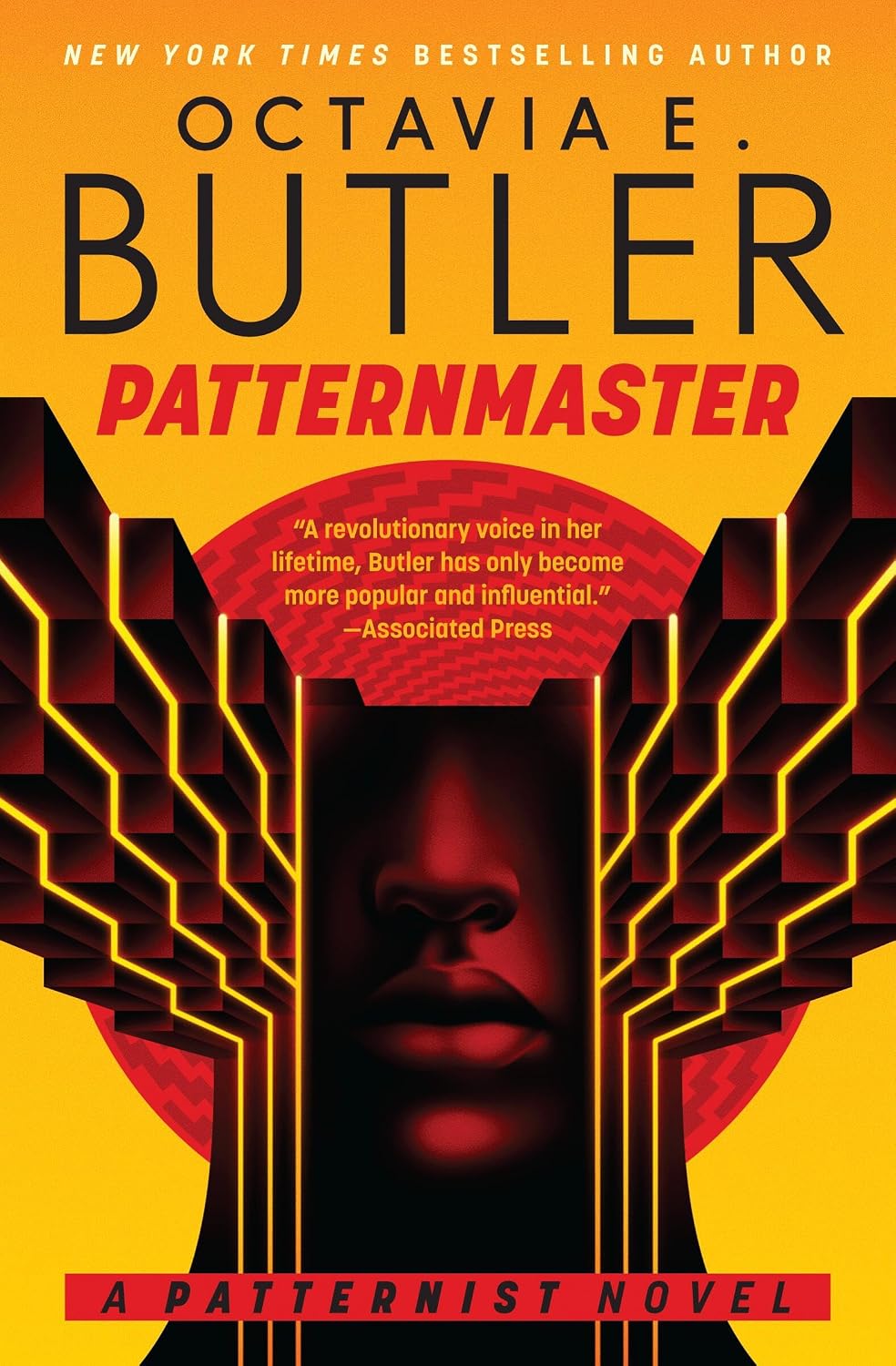
Her first published novel, set furthest in the future, and much thinner than what came after.
Telepaths rule the world through the Pattern, a network linking their minds under a single Patternmaster. Ordinary humans are servants. Beyond the borders live the Clayarks, mutated by an alien disease. Teray discovers he is a candidate to inherit the Pattern and that his brother intends to prevent it.
It’s a slim, fast book with an obvious debt to the pulp tradition she grew up reading, and it’s the weakest of the Octavia Butler books. Its value is as the seed of everything after it: the later Butler books in the sequence exist to explain how this world came about.
Mind of My Mind (1977)

The enormous step up, and the book where she becomes herself as a writer.
Doro is a four-thousand-year-old being who survives by moving between bodies, killing each host in the process, and who has spent millennia breeding humans for psychic ability the way you’d breed livestock. Mary is his most successful product. When she comes into her power, she links other telepaths into the first Pattern, and acquires something Doro has never faced.
The relationship between them is the best thing in the early Butler: he owns her, she knows it, and the novel is about the precise moment ownership becomes negotiable.
Doro is the best villain in the Octavia Butler books because his cruelty is agricultural rather than malicious.
Wild Seed (1980)

The best of the Patternist books and the one to read if you only read one.
It goes back to seventeenth-century West Africa, where Doro encounters Anyanwu, a shapeshifting healer who is three hundred years old and cannot be killed by anything he has. He wants her for his breeding program. She has no way to refuse and no way to be destroyed, and the novel follows their relationship across two hundred years, from Africa to a plantation in colonial America to nineteenth-century Louisiana.
It’s a battle between two immortals in which neither can win and neither can leave, and Butler uses it to write about slavery, ownership, and the specific bargains people make when the alternative is worse.
Anyanwu is the best character in any of the Butler books. This is the novel that made her reputation among readers who knew.
Clay’s Ark (1984)

The most physically disturbing thing she wrote.
Eli Doyle is the only member of his crew to walk away from the crash, and what he brings back with him from the Proxima system is a microorganism that has already rewritten him. It sharpens the senses, strengthens the body, drives its hosts to reproduce, and produces offspring that are quadrupedal and intelligent and not human by any definition.
He has done the arithmetic. If he goes into a city the species ends within a year. So he stops in the Mojave, builds a compound, and starts taking people off the highway, because the compulsion to spread cannot be resisted, only aimed.
Butler alternates between the ranch and a doctor and his two daughters being driven toward it, so you spend the novel knowing precisely what is going to happen to people you’ve come to like.
Nobody in it is a villain. Every person infected does the least harm available to them, and the arithmetic still gets worse.
Survivor (1978), the one she suppressed

The book that makes complete lists of the Octavia Butler books disagree with each other.
A human missionary colony flees a ruined Earth and lands between two warring alien societies. Alanna, the human protagonist, is taken in by one of them and must decide where her loyalties sit.
Butler disowned it. She refused to allow reprints during her lifetime and it has never been reissued, which is why it’s the rarest and most expensive of her books. Her stated objection was that it was, in her words, her “Star Trek novel,” humans traveling to another planet and finding people they can mate with, which she considered a lazy premise she should have known better than to use.
Readers who track it down generally report that it’s a competent early novel with real Butler material in it. Whether reading a book its author actively suppressed is something you want to do is a question worth sitting with.
The Xenogenesis (Lilith’s Brood) Trilogy
Three books published 1987-89, later collected as Lilith’s Brood, and her most sustained piece of thinking.
Dawn (1987)

Humanity destroyed itself in a nuclear war. Lilith Iyapo wakes two hundred and fifty years later aboard a living ship belonging to the Oankali, an alien species that has salvaged the survivors, healed the planet, and kept everyone unconscious in the interim.
The Oankali are gene traders. Their biological imperative is to merge with other species, and they have already made the decision: humanity will be interbred with them, the hybrid children will not be human, and there is no version of events in which the species continues as it was. In exchange, they’ve cured cancer, extended lifespans, and made Earth habitable again.
They are not cruel. They are entirely certain they are helping. Lilith is selected to wake and prepare other humans for a bargain nobody agreed to.
Of all the Octavia Butler books this is the one that thinks hardest about consent, and it refuses to let you settle on a position. The Oankali have saved the species. They are also conducting a species-wide violation with total confidence in their own benevolence.
Adulthood Rites (1988)

The second volume, following Akin, the first male human-Oankali construct, who is kidnapped as an infant by resister humans, the people who refused the trade and now live in villages, sterile, aging, and stealing children.
Akin’s position lets Butler write the argument from both sides. He is Oankali enough to understand why the trade is necessary and human enough to understand why the resisters would rather die than accept it.
The middle volume of a trilogy is usually the weakest. Among the Butler books this one is the most morally complicated.
Imago (1989)

The conclusion, narrated by Jodahs, the first construct ooloi, the Oankali third sex, the gene manipulators, and the thing the resisters fear most.
Jodahs is a genuinely alien narrator: it perceives cellular structure by touch, it can heal or reshape flesh, and its adolescence is dangerous to everyone near it because it hasn’t learned control.
Butler’s achievement is that by the third book you’re reading from inside a perspective that would have been horrifying in the first, and it feels reasonable. That’s the trilogy’s whole method.
The Parable Series
Two books, and a third she was never able to finish.
Parable of the Sower (1993)

She began it in 1989 and set it in a year that has since arrived.
Robledo is a walled cul-de-sac twenty miles from Los Angeles, and the wall is the only thing separating a few families from everything outside it. Water costs more than food. The police charge a fee to attend. Employment means signing yourself over to a company town where the debts outlast you. Lauren Olamina is fifteen, the preacher’s daughter, and the most clear-eyed person in the neighborhood about how long the wall will hold.
She also has hyperempathy, a delusional condition inherited from a drug her mother took, which forces her to feel any pain she can see. In a landscape where violence is constant and public, that is close to a death sentence.
The novel is her journal, and the journal form is the quiet achievement. Diary novels usually strain to justify the device. This one earns it completely, because record-keeping is exactly what a founder does, and the book you’re holding is Earthseed’s first artifact. What Earthseed is, and why it works as fiction, I’ve covered on my climate fiction list, where this book anchors the whole canon.
What belongs here is its strange place in her shelf. On publication it was a New York Times Notable Book and nothing more, and the breakthrough arrived without her. In 2020, twenty-seven years after publication and fourteen after her death, Sower reached the New York Times bestseller list for the first time, a goal she had written down for herself and never lived to see met. Lauren is her most complete protagonist, a fifteen-year-old written without a single false note of precocity, and the book keeps finding the readers its author was promised.
Parable of the Talents (1998)

The sequel, and the more prescient of the two.
Earthseed has established a community. Then a presidential candidate wins on a platform of restoring America to greatness, his followers form a movement that operates outside the law, and the community is destroyed, its adults collared as slaves and its children taken for reassignment.
It’s narrated in part by Lauren’s estranged daughter, which turns the book into an argument about whether Earthseed was worth what it cost the people closest to its founder.
It won the Nebula, and of all the Octavia Butler books it’s the one people quote at each other now. She wrote it in 1998 and readers keep sending each other photographs of the relevant page.
She attempted a third volume for years and could not write it. Parable of the Trickster exists only as fragments, published in her archive papers, and her difficulty with it is documented in her own notes.
The Short Fiction
Bloodchild and Other Stories (1995, expanded 2005)

The essential collection and the fastest way to know whether Butler is for you.
The title story won both the Hugo and the Nebula. Humans on an alien world exist under the protection of the Tlic, an insectoid species that requires a mammalian host for its eggs, and the story follows a boy on the night he learns exactly what the arrangement involves. Butler was irritated that people read it as slavery. Her stated intention was a story about a man becoming pregnant, and about love that involves genuine bodily cost.
“Speech Sounds,” which won a Hugo, is set after a pandemic that has destroyed language and follows a woman navigating a Los Angeles where nobody can read or speak.
Each story comes with an afterword explaining where it came from, and two essays on writing close the collection. It’s the best single volume of the Octavia Butler books to own.
Unexpected Stories (2014)

A posthumous release containing two previously unpublished pieces from early in her career: a novella, “A Necessary Being,” and a short story.
“A Necessary Being” is set in the Patternist-adjacent world of Survivor and is genuinely good: a chieftain of a species whose skin color signals rank encounters a wanderer whose coloring makes him a candidate to rule, and must decide whether to capture and enslave him.
It’s slight, the novella is stronger than Survivor itself, and it’s the only legal way to read anything from that setting.
Octavia Butler: Deep Dive & FAQ
What Runs Through Butler’s Books
The first constant is power, written from underneath. Every Octavia Butler book is an examination of a rigged arrangement, slavery, breeding programs, gene trade, company towns, symbiosis, conducted from the position of the person with the least room to move. Her question is never whether the system is wrong, which is settled on page one, but what survival inside it costs, and she is the hardest-headed writer the genre has produced on the difference between consent, accommodation, and surrender.
The second is the body as the battlefield. Change in Butler is biological before it is political: infection, hybridity, pregnancy, hyperempathy, chemical dependency. Where her peers wrote minds and machines, she wrote flesh being renegotiated, usually without permission, and the squeamish grandeur of the Xenogenesis books has no parallel on anyone else’s shelf.
The third is the refusal of comfort. No Butler novel ends with the system overthrown. They end with her people alive, compromised, and carrying the future anyway, which is why Lauren Olamina’s God is Change and why the books have aged forward instead of backward. She called herself a pessimist if she wasn’t careful, and the books are what being careful looked like.
Prizes and Honors
The awards came for the short fiction first: a Hugo for “Speech Sounds” in 1984, then the Hugo and Nebula pair for “Bloodchild,” and the Nebula for Parable of the Talents at the decade’s end. In 1995 the MacArthur Foundation made her the first science fiction writer ever granted its fellowship, the so-called genius award, and in 2000 the PEN American Center added its lifetime achievement award.
The posthumous honors say more about where her standing is now: the Huntington Library archive that opened to scholars in 2010 and became, by the library’s own accounts, one of its most consulted collections, the 2020 bestseller list she had predicted for herself in a notebook, and the Mars landing site that has carried her name since 2021. No other writer in this cluster has a working rover parked at their monument.
Which Octavia Butler Editions to Buy
The practical news is that the catalog is nearly all in print in uniform trade editions. The Patternist books circulate collected as Seed to Harvest, minus the suppressed Survivor, and the Xenogenesis trilogy as the Lilith’s Brood omnibus, which is the sensible way to buy both sequences. The Parables and Kindred are everywhere, including handsome recent hardback reissues, and the Library of America began collecting her in 2021, which settles the canonization question in hardware.
Survivor is the exception by design: never reprinted, only findable secondhand at collector prices, and her estate has honored her refusal. The graphic-novel adaptations of Kindred and Parable of the Sower by Damian Duffy and John Jennings are legitimate doors in for readers who want them.
Butler on Screen
The screen record is thin so far, and not for lack of trying: Hollywood optioned her for decades without delivering. FX’s Kindred arrived in 2022 as an eight-episode season that reworked the novel’s frame, drew respectful-to-mixed notices, and ended after one season. The Duffy and Jennings graphic novels remain the most faithful adaptations in any visual medium, and further Butler projects keep being announced, which is its own kind of verdict: the books read as urgently filmable and keep proving harder than they look.
Her real screen presence is the one she predicted in a journal: readers putting photographs of her pages on the internet every time the news catches up to the Parables.
Questions About Octavia Butler
Where Should I Start With Octavia Butler?
Kindred, almost without exception. Dawn if you want the aliens first, Parable of the Sower if you want the book everyone is reading now. Then Wild Seed, and you’ll finish the shelf on your own.
What Order Should I Read the Patternist Books In?
Publication order: Patternmaster, Mind of My Mind, Wild Seed, Clay’s Ark, or honestly just Mind of My Mind and Wild Seed, which carry the sequence’s real weight. The internal-chronology order printed in some editions front-loads the weakest book.
Why Is Survivor Out of Print?
Butler suppressed it herself, calling it her “Star Trek novel” and a lazy premise, and refused reprints for the rest of her life. Her estate has honored that. Secondhand copies run to collector prices, and “A Necessary Being” in Unexpected Stories is the only in-print visit to that corner of her universe.
Is Kindred Science Fiction?
Butler preferred “grim fantasy,” since the time travel is never explained and never matters. Shelve it wherever, it remains the most-taught book she wrote and the best first Butler.
What Awards Did Octavia Butler Win?
Hugos for “Speech Sounds” and “Bloodchild,” a Nebula for “Bloodchild” and another for Parable of the Talents, the first MacArthur Fellowship given to a science fiction writer in 1995, and PEN’s lifetime achievement award in 2000. NASA named the Perseverance landing site after her in 2021.
Did She Finish the Parable Series?
No. Parable of the Trickster defeated her across years of attempts, and the fragments sit in her Huntington archive. The two published Parables stand complete as a pair, ending on exactly the unresolved note the books argue life actually has.
Is Earthseed a Real Religion?
It is now adjacent to one: readers have founded real communities around its verses, which would not have surprised her. In the books it is Lauren’s invention, built from the one Butler axiom the whole shelf shares: God is Change.
Where to Go Next
The Parables’ wider tradition is mapped on my best dystopian books list, and the climate canon Sower anchors is on my climate fiction list. Among writers, the natural next page is my Nnedi Okorafor books guide, the author most often shelved beside her, on a shelf Okorafor has fair reasons to resist, and the other great builder of thought-experiment societies has her page at my Ursula K. Le Guin books guide.