Climate fiction books get treated as a recent invention. Most lists on the subject start with Parable of the Sower in 1993 or The Windup Girl in 2009, as though writers only noticed the weather once the science did. My post-apocalyptic list roundup covers the wider tradition.
They didn’t. Climate fiction books go back much further: Ballard flooded London in 1962. John Christopher killed every grass on earth in 1956, which is a food-system collapse novel written before anyone said “food system.” The genre has seven decades of history behind it, and reading it in order shows you something the recent books can’t: that the anxiety changed shape long before the evidence did.
There’s a definitional argument worth flagging too. Some people insist cli-fi is distinct from science fiction, more literary, more concerned with human psychology than with mechanism. Others think that’s a marketing distinction invented to make the subject respectable. Both positions are represented here, because the genre genuinely contains both kinds of book, and pretending otherwise would leave out half of it.
What has changed recently is the direction. Climate fiction spent decades imagining collapse, and the last ten years have produced a real countercurrent: books about response, adaptation, and the possibility that people might actually do something. That strand gets its own section at the end, and it’s where the genre is going.
Twenty-five climate fiction novels, chronological. For the field beyond the climate shelf, my list of the best science fiction books has the map.
Fiction by René Rehn


Before It Had a Name (1956–1987)
The Death of Grass by John Christopher (1956)

The first great food-collapse novel, and the founding text for everything in this genre about scarcity.
The premise is a single deletion. A virus takes the grass family, all of it, which means rice, wheat, barley, oats, and corn, and Christopher follows the arithmetic outward from there: Asia starves first, the news arrives in Britain as something happening to other people, and the government’s contingency plan turns out to be worse than the famine. The whole catastrophe runs on the fact that a species nearly three billion strong had quietly bet everything on one botanical family, and nobody thought of it as a bet.
What the book does with that premise, the speed at which its ordinary characters shed their decency on the road north, is the reason it’s also on my post-apocalyptic list, and I’ve covered that side of it there.
It has nothing to say about carbon and everything to say about what a single agricultural failure does to a society dependent on continuous supply. That makes it the founding climate fiction novel about scarcity.
The Drowned World by J. G. Ballard (1962)

The first climate change novel proper, and the strangest one ever written.
Solar storms have stripped the ionosphere, temperatures at the equator run past a hundred and thirty degrees, and the meltwater has buried Europe’s cities under silt-choked lagoons where iguanas sun themselves on the balconies of drowned office blocks. Kerans is a biologist attached to a survey unit cataloguing what has moved into the water.
Ballard, crucially, assigns no blame. The cause is astronomical, nobody is at fault, and there is no version of the story in which anything is stopped or reversed. That frees him to write about something else entirely: the effect of the new climate on his characters’ minds, which are sliding backwards down the spine toward a state their bodies remember and they don’t.
Written in 1962, before anyone framed warming as a political question, and the closest the genre has to a work of psychiatry.
The Sea and Summer by George Turner (1987)
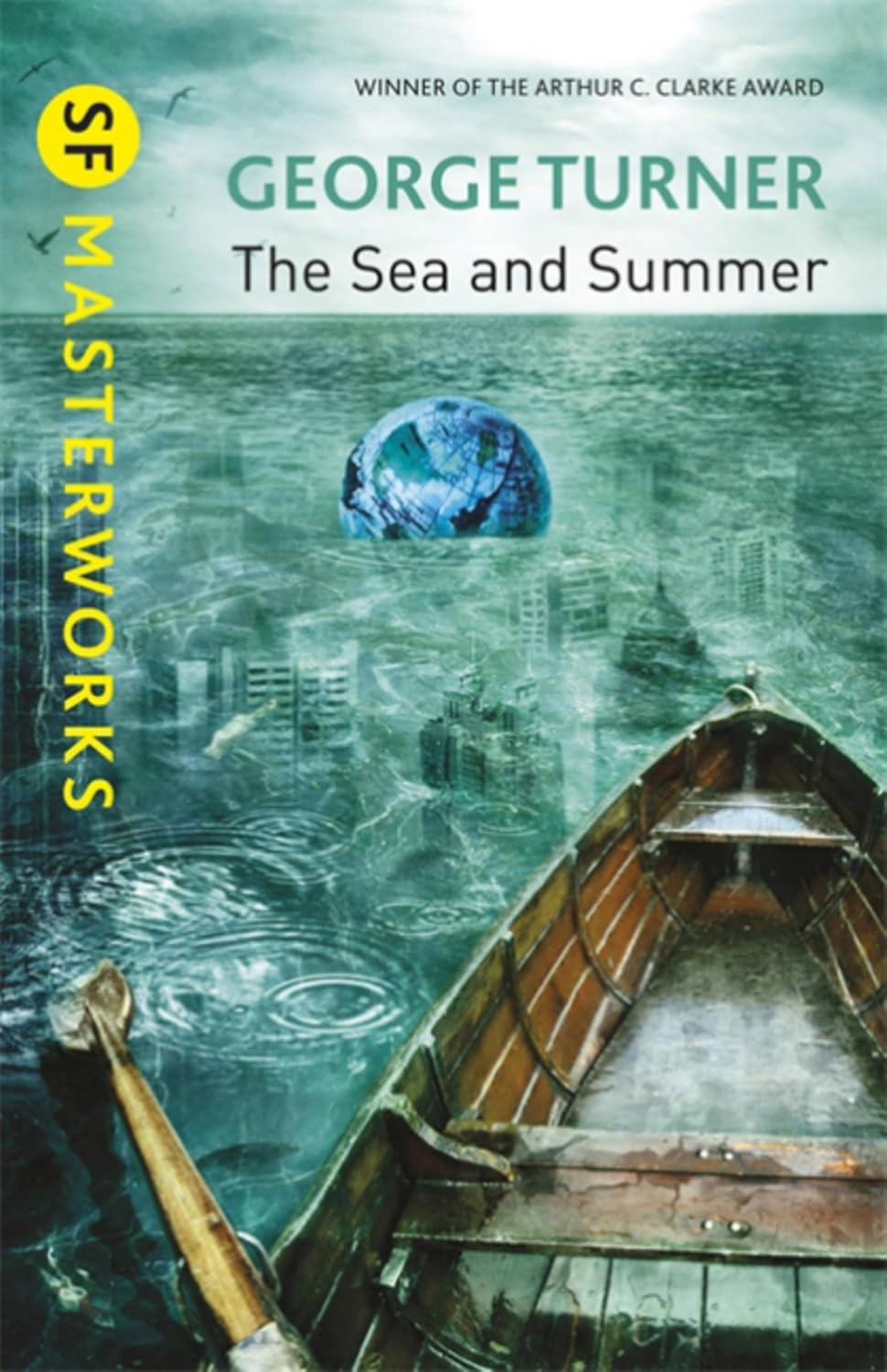
The most prescient climate novel ever written and almost nobody has read it.
Melbourne in the 2040s has been partly drowned, and society has split into the Sweet, the employed ten percent, and the Swill, ten million people warehoused in decaying high-rise towers in the flooded zones. The novel follows a family that falls from one category into the other.
Turner was Australian, wrote it in 1987, and got the shape of it right: not a sudden catastrophe but a slow economic sorting, with the sea rising in the background while the real crisis is unemployment, housing, and a state that has quietly stopped pretending it will help everyone.
It won the Arthur C. Clarke Award, and it predicted more than any other climate fiction book of its decade. The framing device, set centuries later among people studying our era, gives it a melancholy that the immediate story doesn’t need but earns anyway.
Nature’s End by Whitley Strieber and James Kunetka (1986)

A curiosity worth knowing about, and genuinely ahead of its time.
Set in 2025, it describes a world of collapsing ecosystems, toxic air, mass extinction, and a charismatic movement proposing voluntary mass suicide as the only viable response to overpopulation. The protagonist is a “documentary” journalist investigating it.
The prose is uneven and the plotting is thriller-standard. What’s remarkable is the texture: the pollution masks, the environmental refugees, the sense of a species arguing about whether it deserves to continue.
It’s long out of print and easy to find secondhand, and it’s a genuine artifact of the moment climate fiction went mainstream.
The Genre Arrives (1993–2012)
Parable of the Sower by Octavia E. Butler (1993)

Butler finished it in 1993 and aimed it at 2024, and the years since have mostly kept her appointment.
The novel is Lauren’s journal, and what she is doing in it is building a religion. Earthseed begins as private notes, God is Change, shape God, and by the end it is a functioning belief system with converts, a destination, and a purpose: that humanity’s role is to take root among the stars because Earth is finished.
Butler’s insight is that the practical and the spiritual are the same problem here. Lauren’s community needs water, seeds, defensible ground, and a reason to keep walking north, and the reason is not optional. The book takes religion seriously as infrastructure.
Her hyperempathy, feeling the pain of anyone she can see, makes her a catastrophically vulnerable person in a landscape full of injured strangers, and Butler never uses it for sentiment.
The sequel, Parable of the Talents, was written in 1998 and centers on a politician promising to restore a lost America. Read both. I’ve mapped her whole catalog on my Octavia Butler books guide.
The Windup Girl by Paolo Bacigalupi (2009)

The book that asked what an economy is after the oil runs out, and answered in more detail than anyone before or since.
Bacigalupi’s Thailand runs on muscle and heat. Energy is stored in springs, the springs are wound by genetically engineered elephants, and the joules those animals produce are the unit everything else is priced in. Shipping has gone back to sail, computers are treadle-powered luxuries, and the great crime of the age is burning more calories than you generate. The novel never states its thermodynamics; it just refuses, on every page, to let anything move without accounting for what moved it.
Anderson Lake is a foreign company man hunting a hidden seedbank through that economy, and the plot around him, trade politics, an Environment Ministry at war with a Trade Ministry, a coup, is really a fight over who controls the only forms of wealth left: genes and joules.
Emiko, the engineered woman the title refers to, is where the systemic and the personal meet, and her thread is the novel’s cruellest and best.
It shared the Hugo with Miéville’s The City & The City, which tells you something about how strong that year was. The biotech side of the world belongs to biopunk, where I’ve covered it; this entry is for the energy accounting, which no other climate fiction novel has matched.
Oryx and Crake by Margaret Atwood (2003)

The MaddAddam trilogy’s opener and Atwood’s most thorough piece of world-building.
Crake is the reason this belongs on a climate list rather than a general dystopia one. He is a brilliant, affectless young man who has looked at the trajectory, the heat, the extinctions, the diseases, the consumption, and concluded that the species is the problem and that the humane response is a replacement. He builds the successor species himself. The removal of the incumbent one follows.
Around that, Atwood builds an ecology of invented organisms that are all plausible and all commercial: pigoons grown to host human organs, rakunks bred as pets, ChickieNobs cultured as protein without a bird attached. The biotech is not a metaphor; it’s an industry doing what industries do.
Jimmy, who becomes Snowman, is Crake’s friend and the novel’s failure of nerve made flesh: a man who saw everything and did nothing because he was in love and out of his depth.
The Year of the Flood and MaddAddam retell the same collapse from other positions, and the trilogy is better read whole.
Flight Behavior by Barbara Kingsolver (2012)

The best literary climate novel, and the one that takes rural America seriously.
Dellarobia Turnbow is a young mother in Appalachian Tennessee, trapped in a marriage she entered at seventeen, walking up the mountain behind her farm to meet a man she shouldn’t. Instead she finds the entire monarch butterfly migration, millions of them, roosting on a hillside where they have never been and cannot survive the winter.
Kingsolver was trained as a biologist and the science is precise. What makes the novel exceptional is the social observation: the scientists who arrive can’t communicate with the community, the media wants a photograph, the church wants a miracle, and Dellarobia’s family is one bad season from losing the farm regardless of what the butterflies mean.
It’s the sharpest thing in climate fiction about why climate communication fails.
Odds Against Tomorrow by Nathaniel Rich (2013)

Climate fiction from the perspective of the people monetising it.
Mitchell Zukor is a mathematical prodigy hired by a consultancy that sells worst-case scenario projections to corporations, indemnifying them against catastrophe. He is exceptionally good at imagining disaster. Then a hurricane hits New York exactly as he predicted, and his firm’s clients are protected while the city drowns.
Rich’s target is the financialisation of risk: the discovery that catastrophe is a market, that being right about it is lucrative, and that accurate prediction does nothing whatsoever to prevent the thing predicted.
Written before Sandy and published after, and few climate fiction novels have been overtaken by events this precisely.
The Water Knife by Paolo Bacigalupi (2015)

Bacigalupi’s second appearance, and the best thriller in climate fiction books.
The Colorado River has failed. Phoenix is dying, Las Vegas is surviving by cutting other cities’ water rights, and Angel Velasquez is a “water knife,” an operative who enforces those rights with violence. A journalist and a Texan refugee get caught in a hunt for documents that would reorder the whole system.
It’s the rare climate fiction novel that works as straight noir, fast and brutal, built on genuine western water law: the doctrine of prior appropriation, the Colorado River Compact, and the fact that the legal machinery for this fight already exists.
The Texan refugee camps are the most disturbing material, climate migration handled as a domestic American problem rather than something happening elsewhere.
Memory of Water by Emmi Itäranta (2012)

The quietest book here and one of the most beautiful.
Noria Kaitio is training as a tea master in a future Scandinavia under Chinese military rule, where fresh water is rationed by the state and possessing a private source is a capital crime. Her father has shown her a hidden spring. The novel is what she does with that knowledge.
Itäranta wrote it simultaneously in Finnish and English, and the prose has a spare, translated quality that suits the subject entirely.
Among climate fiction books it’s unusually small: a domestic story about a family, a village, and an unbearable secret, and it’s far more affecting than most of the large-scale disaster fiction around it.
The Contemporary Wave (2015–2023)
New York 2140 by Kim Stanley Robinson (2017)

The best novel about what daily life looks like after the water arrives and everyone adapts anyway.
Manhattan is fifty feet under. The city has not been abandoned; it has become a “SuperVenice,” with canal traffic, skybridges between towers, and a functioning economy in the intertidal zone where property law is genuinely unclear. The novel follows the residents of one building: a building manager, two hackers, a police inspector, a market trader, and a media personality.
Robinson’s argument is that people accommodate almost anything, and that the interesting question isn’t the disaster but the finance. The plot turns on housing, insurance, and an attempted assault on the mechanisms that let capital profit from catastrophe.
It’s long, digressive, and very funny in places. It’s the best of these climate fiction novels about climate as an economic condition rather than an event.
The Ministry for the Future by Kim Stanley Robinson (2020)

The most discussed climate novel of the decade, and barely a novel at all.
It opens with a heat wave in Uttar Pradesh that kills twenty million people in a week, written in a single unbroken chapter that is the most frightening thing in modern fiction. Then it becomes something else: an institution established under the Paris Agreement to represent future generations, and a two-decade account of how the world might actually respond.
That account includes long stretches of economics, monetary policy, geoengineering, and meeting minutes. There are chapters narrated by a carbon atom and by the concept of the market. Whole sections read like a policy briefing.
Cutting it for that would be like cutting Moby-Dick for the whaling chapters. The digressions are the book: Robinson is arguing that the response to climate change is necessarily bureaucratic, financial, and unglamorous, and the form enacts the argument.
It’s the most important climate fiction novel yet written, and not the most enjoyable one.
The Overstory by Richard Powers (2018)

The Pulitzer winner, and the most ambitious formal experiment in the genre.
Nine characters, each introduced in a self-contained story of novella length, all connected by trees. An engineer whose family has photographed the same chestnut for a century. A scientist who discovers that trees communicate and is destroyed professionally for saying so. A student who dies briefly and hears voices. They converge on a campaign of forest activism that ends badly for most of them.
Powers’s argument is that human timescales are the problem, that we cannot perceive processes slower than a lifetime, and that this incapacity is why nothing gets done. The novel’s structure, which asks you to hold nine separate lives across decades, is trying to train that perception.
The tree science is real and drawn from Suzanne Simard’s research. It’s the most beautiful of these climate fiction books.
Bewilderment by Richard Powers (2021)

Powers again, shorter and sadder.
Theo Byrne is an astrobiologist who models the atmospheres of hypothetical planets, raising a nine-year-old son who is undiagnosably distressed by the extinction crisis and being threatened with expulsion. Theo enrols him in an experimental neurofeedback treatment that trains his brain on recorded patterns from his dead mother.
The novel runs the planetary and the personal against each other: Theo describes imagined worlds to his son at bedtime while the actual one degrades and the administration defunds the research that might have helped.
It’s a climate fiction novel about grief that uses the crisis as ground rather than subject, and the ending is devastating.
The High House by Jessie Greengrass (2021)

The most quietly frightening entry, and the best written.
Caro, her small brother Pauly, and two locals live in a house on a hill in Suffolk, prepared in advance by Pauly’s mother, a climate scientist who knew what was coming, built a mill and a generator and a vegetable garden, and then left to keep working and never came back.
The floods arrive. The novel is what happens in the house afterwards: the tidal calculations, the food arithmetic, the slow discovery of what a stockpile actually means when there is no resupply.
Greengrass writes in long, precise sentences about small domestic facts, and the horror is entirely in the arithmetic. It’s the closest thing climate fiction has to a chamber piece.
Migrations by Charlotte McConaghy (2020)
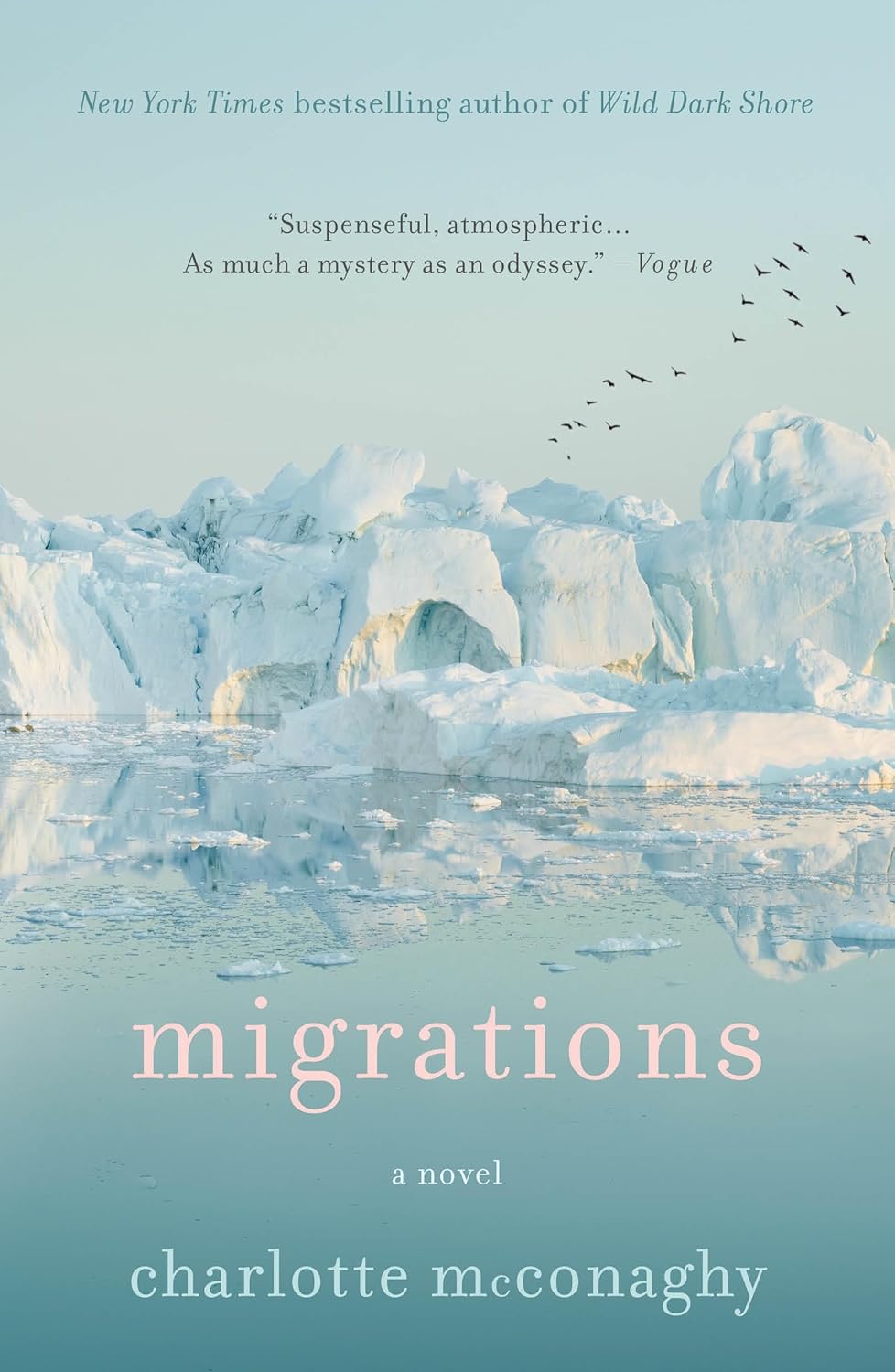
The best-selling literary cli-fi novel of recent years, and it earns it.
Franny Stone talks her way onto a fishing boat by promising the crew that following the last flock of Arctic terns to Antarctica will lead them to the last fish. The animals are almost all gone. Her past, delivered in fragments, is worse than the reader initially assumes.
McConaghy’s achievement is making extinction feel like a personal bereavement rather than a statistic, and the migration structure, following birds who are following instincts toward a place that may no longer support them, carries the metaphor without stating it.
The nature writing is superb, and few climate fiction novels hide a mystery this well.
Gun Island by Amitav Ghosh (2019)

The most globally-minded climate novel, by a writer who has argued that literary fiction failed at this subject.
Deen Datta, a rare book dealer, follows a Bengali folk legend from the Sundarbans to Los Angeles to Venice, encountering climate migration, human trafficking, wildfires, and species displacement at every stage. Improbable coincidences accumulate until they stop feeling coincidental.
Ghosh wrote a nonfiction book, The Great Derangement, arguing that the modern novel is structurally incapable of representing climate change because it deals in the individual and the probable. Gun Island is his attempt to write past his own objection, deliberately embracing the improbable.
Whether it succeeds is arguable. The attempt is the most intellectually serious thing in climate fiction books.
Weather by Jenny Offill (2020)

The shortest book here and the most accurate about how it actually feels.
Lizzie is a university librarian who takes a side job answering mail for a climate podcast, and the novel is her fragmented notes: paragraphs of a few lines each, covering her brother’s addiction, her son, her marriage, and a growing background hum of dread she cannot address or escape.
Offill’s form is the argument. Climate anxiety doesn’t arrive as a plot; it arrives as intrusion, interrupting ordinary life at random and then receding because the school run still has to happen.
It’s very funny, and it cuts far deeper than its size suggests. No climate fiction novel better captures the psychology of knowing and continuing anyway.
Blackfish City by Sam J. Miller (2018)

The most inventive setting in recent climate fiction novels.
Qaanaaq is a floating city near the Arctic Circle, built after the Climate Wars, powered by geothermal vents and run by absentee shareholders whose identities nobody knows. A woman arrives on the deck of a boat with a killer whale beside her and a polar bear on a chain, and the city starts remembering something it had agreed to forget.
Miller builds the city’s politics properly, housing scarcity, algorithmic property management, a disease transmitted sexually that leaves victims with other people’s memories, and the nanobonded characters are a genuinely fresh idea.
It was Nebula nominated, and it sits closer to cyberpunk than most climate fiction books.
The Deluge by Stephen Markley (2023)

The most comprehensive American climate novel, and the longest.
It spans 2013 to 2040 across a large cast: a scientist whose modeling is ignored, an activist who moves toward violence, an addict, a political operative, and a rising authoritarian movement. Markley tracks the politics year by year, and the escalation is unnervingly plausible.
At nearly nine hundred pages it demands commitment, and some readers find the ensemble structure diffuse. What it does better than anything else is show climate as a political process: the lobbying, the compromises, the difference between what is necessary and what is achievable.
It’s bleak, it’s angry, and it’s the most thorough attempt in climate fiction to imagine the next twenty years.
The Hopeful Turn
A Psalm for the Wild-Built by Becky Chambers (2021)

The book that made solarpunk a category people actually read.
On the moon Panga, humanity underwent a transition centuries ago: the robots achieved consciousness, were released from labor, and walked into the wilderness. Humans then rebuilt their society around sustainability and sufficiency. Dex is a tea monk, moving from village to village and listening to whoever sits down at the wagon, until a robot steps out of the wilderness wanting to know what humans require to be well.
There is no conflict. There is barely a plot. What there is instead is a functioning post-scarcity ecological society described in enough practical detail to feel possible, and two characters having a long conversation about purpose.
It’s the clearest statement of what solarpunk wants: not a fixed world, but one that fixed itself and is only now asking what all the repair was in service of.
Termination Shock by Neal Stephenson (2021)

The geoengineering novel, and the one that takes unilateral action seriously.
A Texas billionaire builds an enormous sulfur cannon and begins injecting aerosols into the stratosphere to cool the planet, without asking anyone. The novel follows the consequences: the Netherlands is delighted, India is furious because it disrupts the monsoon, and the question of who owns the sky turns out to have no legal answer.
Stephenson’s premise is that geoengineering is cheap enough for a wealthy individual to attempt, which is true, and that the resulting international crisis is the actual story.
It’s baggy in the usual Stephenson way and the technical material is genuinely educational. No other climate fiction novel has taken solar radiation management this seriously.
The Lost Cause by Cory Doctorow (2023)

The most politically specific hopeful novel, and the angriest.
A Green New Deal has passed. Decarbonisation is underway, refugees are being housed, and the work is being done, and a coalition of billionaires and reactionaries is trying to sabotage it, because the transition threatens them more than the disaster does. Brooks Palazzo is a young man in Burbank caught between his activist grandmother’s legacy and his dead grandfather’s politics.
Doctorow’s argument is that the technical problems are solved and the obstacle is entirely political, which makes this the rare climate novel about implementation rather than warning.
It’s didactic and it knows it. It’s also the only one of these climate fiction books that treats the transition as work rather than miracle or catastrophe.
The Future by Naomi Alderman (2023)

Climate fiction as a thriller about the people building the bunkers.
Three tech billionaires have private survival plans and predictive systems that will tell them when to run. A small group, including the estranged daughter of one of them and a survivalist forum moderator, decides to intervene.
Alderman’s target is the specific pathology of the prepper elite: people with the resources to fix the problem who have instead invested in outlasting it, and the ideology that lets them believe this is rational.
The plot mechanics are thriller-standard and the satire is precise. It’s the best climate fiction novel about the class that will be fine.
Two notes on scope. Solarpunk is where the hopeful strand mostly lives, and it’s largely short fiction rather than novels: anthologies like Sunvault, Multispecies Cities, and the Grist Imagine 2200 collections, which are uneven the way anthologies always are and where the genre’s newest ideas surface first. I’ve covered that movement separately on my list of the best solarpunk books.
And several of the best climate books are nonfiction: Jeff Goodell’s The Water Will Come, Elizabeth Kolbert’s The Sixth Extinction, Helen Macdonald’s Vesper Flights. Lists like this one include them constantly. They’re excellent and they aren’t fiction, which is what this page covers.
If you’re starting from nothing: Parable of the Sower for the foundational text, Flight Behavior for the human scale, The Ministry for the Future for the argument, and A Psalm for the Wild-Built if the rest of it has left you needing somewhere to stand.


