Ann Leckie wrote the most decorated debut in the history of science fiction. Ancillary Justice arrived in 2013 and swept the Hugo, the Nebula, the Arthur C. Clarke, and the British Science Fiction Association awards all in a single year, a clean sweep of the field’s top prizes that no first novel had ever managed before or has managed since. It made her reputation instantly and permanently, and everything else she has written lives in its shadow, which is less a knock than a measure of how high that first book set the bar. The Ann Leckie books are a small, sharp catalog built around one genuinely groundbreaking novel.
Before the writing, she worked as a waitress, a receptionist, a rodman on a land-surveying crew, and a recording engineer, and that patient, observational quality runs through the fiction, which is far more interested in identity, empire, and the texture of power than in action for its own sake. On my best science fiction books list, Ancillary Justice takes a deserved place, and this guide covers the whole shelf, the Radch novels first and then the fantasy and short work. The neighboring shelf is my best space opera books list.
Full disclosure: Leckie is an author I know by reputation more than firsthand, so the assessments here lean on what the field’s critics and readers have concluded, and I say so at each point where that is the case.
Fiction by René Rehn


The Short Version
Start with Ancillary Justice, always, because it is the reason to be here and the best thing she has written. Continue through Ancillary Sword and Ancillary Mercy to finish the core trilogy. Provenance and Translation State are standalones set in the same universe, read them if the Radch has you and you want more without another trilogy. The Raven Tower is her one fantasy novel and a fine entry point for readers who prefer that genre. That is nearly the whole shelf, and it is a rewarding one.
Ann Leckie Books in Order
| Year | Title | Type | Notes |
| 2013 | Ancillary Justice | Imperial Radch | The full award sweep |
| 2014 | Ancillary Sword | Imperial Radch | Locus winner |
| 2015 | Ancillary Mercy | Imperial Radch | Locus winner, closes the trilogy |
| 2017 | Provenance | Radch universe | Standalone |
| 2019 | The Raven Tower | Fantasy | Standalone |
| 2023 | Translation State | Radch universe | Standalone |
| 2024 | Lake of Souls | Stories | Collected short fiction |
Where to Start With Ann Leckie
Start with Ancillary Justice, and the catalog makes this unusually easy: it is the debut, the masterpiece, and the front door all at once. The only live question is what to read second, and the answer splits by what hooked you. If it was the Radch itself, continue the trilogy. If it was the voice and you want something complete in one sitting, Provenance. If you are a fantasy reader auditioning her, The Raven Tower works with no science fiction homework at all.
The trilogy’s own arc carries one honest expectation to set: the sequels deliberately narrow rather than widen, and the entry below says so plainly.
Leckie’s Life, Briefly
Ann Leckie was born in 1966 in Toledo, Ohio, and grew up in St. Louis, Missouri, where she still lives, a fact she deploys cheerfully against the genre’s coastal defaults. The road to the debut was long and unliterary in the best way: waitress, receptionist, lunch lady, land-surveying crew, recording engineer, years of writing around jobs and children, plus a stretch editing the online magazine GigaNotoSaurus, which taught her, by her own account, what finished stories actually look like from the other side of the desk.
Ancillary Justice appeared in 2013, when she was in her late forties, and did what no debut had done: swept the Hugo, Nebula, Clarke, and BSFA awards in one cycle, with the Locus first-novel prize and the Kitschies’ debut award thrown in. The trilogy completed on schedule, each sequel taking a Locus award of its own, and in 2024 the Imperial Radch series as a whole added the Hugo for Best Series.
The career since has been deliberate rather than prolific, one universe expanded by standalones, one fantasy excursion, one collection, and she remains the standing answer to a particular industry question: what it looks like when the field’s biggest prizes all land on a patient, midwestern, mid-career writer at once, and she simply keeps working.
The Imperial Radch Trilogy
The trilogy runs Ancillary Justice, Ancillary Sword, Ancillary Mercy: the core, the reason for the awards, sold separately and read in order, each with its entry below.
Ancillary Justice (2013)

Breq looks like a single human woman, and is in fact the last surviving fragment of a starship. The Justice of Toren was a troop carrier whose artificial mind once inhabited the ship itself and thousands of “ancillary” bodies at once, corpses annexed and run as extensions of a single consciousness. Now reduced to one body after a betrayal that destroyed the rest, Breq moves through the galaxy on a patient mission of revenge against the near-immortal tyrant who rules the Radch empire, and who is herself split across thousands of cloned bodies with a mind that has quietly fractured against itself.
The famous element is the language. The Radchaai do not mark gender at all, so Breq narrates in a default “she” for everyone and genuinely struggles to read gender when other cultures expect it, an effect that does something subtle and lasting to the reader’s own assumptions across the length of the book. But the pronouns are not the point so much as the doorway: the trilogy is really about empire, complicity, personhood, and what it means for a mind that was once a warship and a thousand soldiers to learn to be a single person with choices.
The first book is the masterpiece and stands almost entirely on its own. The two sequels narrow their focus to a single space station and its politics, quieter and more divisive, beloved by readers who want to live in the world and a slight step down for readers who wanted the galaxy-spanning sweep of the first, though the Locus voters rewarded each of them in turn. As a whole it earns its place among the essential modern science fiction novels, and the 2024 Hugo for Best Series made the whole-arc verdict official.
Ancillary Sword (2014)

Ancillary Sword is the deliberate narrowing: Breq, now a fleet captain with a ship of her own, is sent to a single system and spends the novel in its tea plantations, its station politics, and its buried injustices, with the galaxy’s civil war held offstage.
It won the Locus Award, and it is the volume where the trilogy’s readers divide into two happy camps: those who missed the first book’s sweep, and those who realized the small scale was the point, empire examined through one annexed system’s plumbing. The consensus mid-point: a quieter book doing the series’ real argument at close range.
Ancillary Mercy (2015)

Ancillary Mercy closes the trilogy where its predecessor stood, one station, one system, and lets the series’ pieces, the fractured tyrant, the inscrutable Presger, and every AI with an opinion, arrive there. The ending resolves the trilogy’s question, what a person is and who decides, rather than its war, which is exactly the trade the series was always making.
It took the Locus Award like its predecessor and closed the arc the 2024 Best Series Hugo later honored whole. Readers who accepted Sword’s narrowing rate this the warmest of the three, with the finale’s translator comedy an unexpected gift.
The Standalones
The same universe, without the trilogy commitment.
Provenance

Provenance is the lighter, warmer one, a story of faked antiquities, family ambition, and political intrigue on a non-Radch world, following a naive young woman in over her head, and it is the closest Leckie comes to cozy.
Consensus places it a tier below the trilogy on ambition and a tier above it on charm: the invented culture’s obsession with vestiges, the relics that prove a family’s standing, gives the caper real anthropological teeth, and it earned a Hugo nomination on its own terms. It is the right second Leckie for readers who want complete-in-one-volume, and the right first one for readers scared off by the trilogy’s reputation for density.
Translation State (2023)
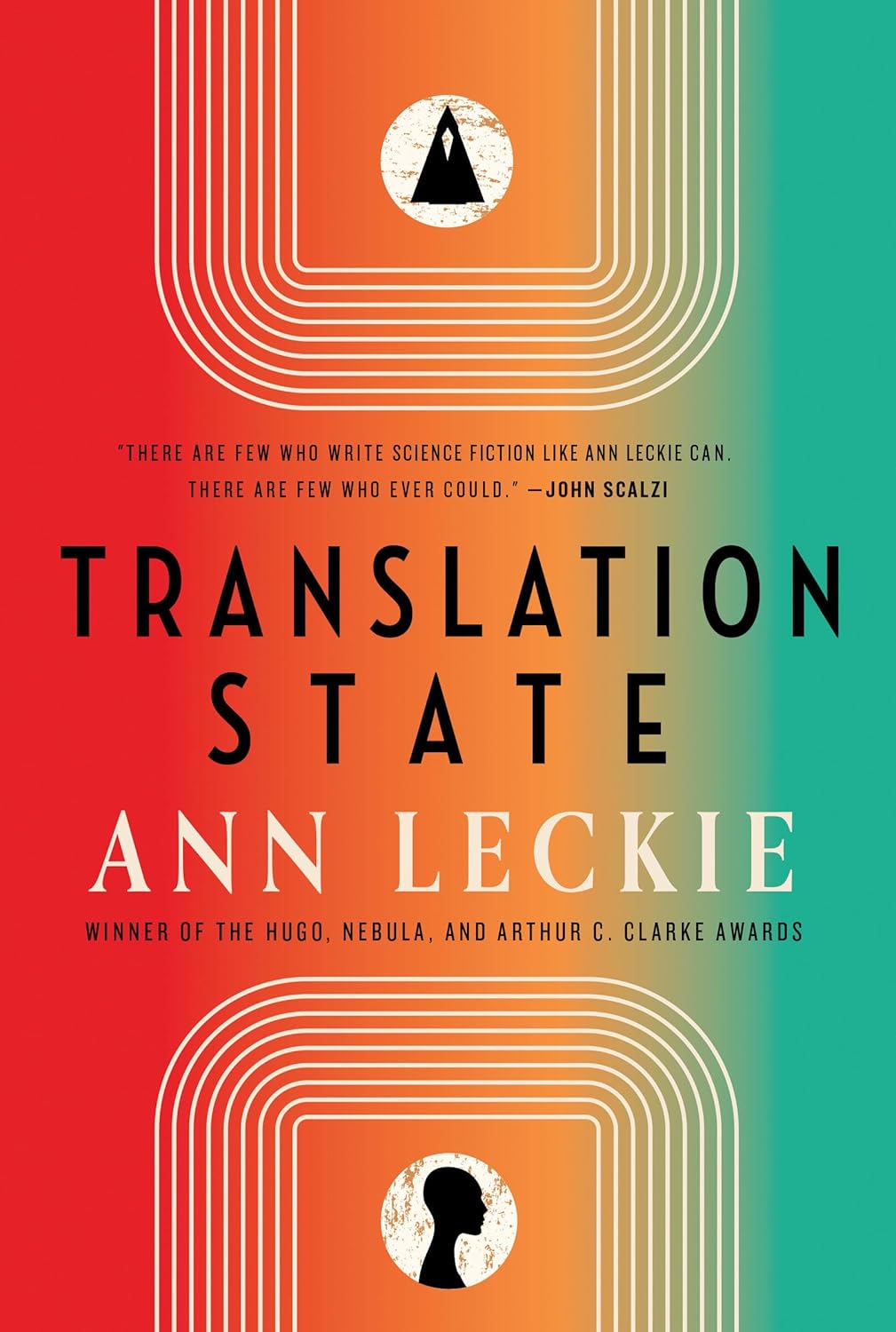
Translation State is the more substantial of the standalones, the book that finally turns to the Presger, the terrifying alien power whose treaty holds the whole universe’s fragile peace, through three characters wrestling with identity, belonging, and what counts as a person.
It is widely praised as both a fine standalone entry and a rich expansion for longtime readers, with only its disorienting final stretch drawing mild reservations. The Presger Translators, human-shaped, unsettling, and hungry in ways the book takes its time explaining, are her best invention since the ancillaries, and the personhood hearing at the center is the trilogy’s old question argued in a courtroom. Radch completists should not skip it.
The Fantasy and the Short Fiction
The Raven Tower (2019)

The Raven Tower is Leckie’s only fantasy novel to date and one of her most admired books, a story of palace usurpation narrated, remarkably, by an ancient god in the second person, addressing the human retainer at the center of the plot, so that a Hamlet-shaped tale of a stolen throne is told from the perspective of a patient, stone-slow deity watching mortals scheme.
It is strange, controlled, and completely distinct from her science fiction, and it is the book to hand a reader who wants Leckie’s intelligence in a fantasy register. The god’s rules, a deity’s words must be true or the deity pays, drive the plot like a physics, which is the most Leckie thing about it: even her fantasy runs on consequences.
Lake of Souls (2024)

Lake of Souls collects her short fiction across both universes and beyond, and while the consensus is that the free-standing stories are not quite her at full strength, the Raven Tower pieces in particular are widely singled out as marvels. The collection took a Locus award, and its title novelette earned a Hugo nomination of its own.
The collection is best approached once you already know her novels, as the back matter assumes exactly that reader. For the committed it holds the only new Radch material between novels, which is reason enough.
Ann Leckie: Deep Dive & FAQ
What Runs Through Leckie’s Books
The first constant is personhood as the plot. Every Ann Leckie book runs on the same engine: a mind the surrounding society does not count as a full person, a ship’s fragment, a Translator, a god’s servant, a daughter outside the inheritance, arguing its way to standing. The empire’s paperwork, hearings, and etiquette are the battlefields, and the quiet radicalism is that the arguments are won by patience rather than firepower.
The second is the texture of institutions. She writes empires the way her fellow Missourian Mark Twain wrote river towns: tea sets, funerals, client-patron webs, the small courtesies that carry the big coercions. The Radch is among the genre’s great inventions precisely because it is administered rather than merely menacing.
The third is voice as experiment. A gender-blind narrator, a god addressing you in second person, a translator raised in a pantry: each book picks one formal constraint and runs it the full distance. It is the method of a recording engineer, one strange input, mixed perfectly.
Prizes and Honors
The 2013-14 sweep remains singular: Hugo, Nebula, Arthur C. Clarke, and BSFA awards for Ancillary Justice, plus the Locus first-novel and Kitschies debut prizes, a clean run of the field’s top honors no first novel had managed. The sequels each took Locus awards, Provenance and Translation State added Hugo nominations, and in 2024 the Imperial Radch series won the Hugo for Best Series, the long-arc confirmation.
The quieter honor is curricular: Ancillary Justice became the decade’s standard case study in what point of view can do, cited wherever the craft is taught, which for a book about whose perspective counts is the right afterlife.
Which Ann Leckie Editions to Buy
The catalog is current, uniform, and in print: Orbit trades for everything, a boxed set for the trilogy, and no textual questions to navigate. The only buying decision is bundle versus single, and the boxed trilogy is the economical answer for a reader who already trusts the sweep of awards.
Audio readers should know the trilogy’s narration handles the pronoun texture well, and that the books’ measured pace suits the format, a consensus the reviews repeat often enough to pass along.
Leckie on Screen
Nothing has reached a screen yet, and the option-announcement cycle has come and gone more than once, which for a debut this decorated says something about the adaptation problem: the best effects in the Ann Leckie books happen in grammar, a narrator who cannot read gender and once was twenty bodies, and grammar does not storyboard. The eventual version will be someone’s bold translation rather than a transcription, and the books will keep outrunning it.
Questions About Ann Leckie
Where Should I Start With Ann Leckie?
Ancillary Justice, without exception. Provenance if you want a standalone afterward, The Raven Tower if you want her fantasy instead.
Do I Need to Read the Ancillary Trilogy in Order?
Yes: Justice, Sword, Mercy. The standalones, Provenance and Translation State, work on their own but reward knowing the trilogy’s universe.
What Awards Did Ancillary Justice Win?
The Hugo, Nebula, Arthur C. Clarke, and BSFA awards in one cycle, plus Locus and Kitschies debut honors, a sweep no first novel had managed before or has since. The whole series added the 2024 Hugo for Best Series.
Why Does Everyone Use “She” in the Books?
The Radchaai language does not mark gender, so Breq defaults to “she” for everyone and struggles to guess when other languages demand it. It is a window into the narrator’s mind, not a statement about any character’s body, and it does quiet work on the reader across the book.
Are the Sequels as Good as the First Book?
They are quieter and narrower by design, a station instead of a galaxy, and readers split exactly there. The awards followed all three, and the honest framing is one masterpiece plus two very good books that finish its argument.
Is the Raven Tower Connected to the Radch Books?
No shared universe, only the shared method: one strange narrator, rules that behave like physics, and power examined through its paperwork. It is the right Leckie for fantasy readers.
What Are the Presger?
The alien power whose treaty keeps the setting’s peace, kept offstage through the trilogy and finally approached in Translation State through their human-built Translators. The books are careful to keep them unknowable, which is the point.
Where to go next
Finished Ancillary Justice and wanting the same intelligence at that scale? My best science fiction books list gathers the novels that share its ambition. If it was the galactic empire and the scale of the Radch that hooked you, follow that thread into my best space opera books list.
And if it was Breq’s slow, watchful voice and the questions about mind and personhood underneath it, the genre’s other great practitioners have their own pages: my Ursula K. Le Guin books guide for the tradition Leckie extends, and my Adrian Tchaikovsky books guide for the field’s other specialist in minds unlike ours.