Nobody finishes Flowers for Algernon and reaches for just anything next. The book leaves a specific wound, and readers hunting for books like Flowers for Algernon are usually asking for one of four things: another rise-and-loss arc, another voice that carries the whole structure of the story, another experiment with a person trapped inside it, or simply another book this gentle with its characters while it breaks you. This list serves all four, and says which is which. For the broader field, my best dystopian books list is the map.
Two pieces of history worth having first. Keyes traced the story to his own classroom, a struggling student who told him he wanted to be smart, and the question of what that wish would actually cost took him years to answer. And when the story first went out in 1959, an editor offered to buy it on the condition that Charlie keep his intelligence and get the girl. Keyes kept refusing that trade for the rest of his career, and the refusal is the book. The novel itself has a full entry on my best science fiction books list. This page is for what you read after.
No algorithm assembled what follows. These are matched by hand, by what each one actually shares with Keyes, the arc runs from the direct heirs through the voices and the declines to the experiments, and one entry is nonfiction, because the truest book like it happens to be a case history.
Fiction by René Rehn


Books Like Flowers for Algernon at a Glance
| Year | Title | Author |
| 1991 | Understand | Ted Chiang |
| 1968 | Camp Concentration | Thomas M. Disch |
| 1954 | Brain Wave | Poul Anderson |
| 2002 | The Speed of Dark | Elizabeth Moon |
| 1937 | Of Mice and Men | John Steinbeck |
| 2003 | The Curious Incident of the Dog in the Night-Time | Mark Haddon |
| 2007 | Still Alice | Lisa Genova |
| 1973 | Awakenings | Oliver Sacks |
| 2005 | Never Let Me Go | Kazuo Ishiguro |
| 2000 | Lying Awake | Mark Salzman |
| 2001 | The Dark Fields | Alan Glynn |
| 2014 | The Girl with All the Gifts | M. R. Carey |
| 2006 | The Echo Maker | Richard Powers |
| 2014 | Elizabeth Is Missing | Emma Healey |
| 2020 | Piranesi | Susanna Clarke |
Understand by Ted Chiang (1991)

The direct heir, and the only story that seriously tries to write the view from the summit.
Leon Greco, brain-damaged in a drowning accident, is given an experimental hormone therapy that repairs him and then keeps going. Where Keyes wisely kept genius-Charlie legible, Chiang commits to the impossible job: rendering what it is like inside an intelligence pulling away from human range, the pattern-sight, the self-modification, the loneliness of having no peer. Then Leon discovers there is one other patient like him, and the novella becomes a duel between two post-human minds with opposite ideas about what a mind is for.
It sits in Stories of Your Life and Others, the collection most readers buy for the story that became Arrival, and this is the one they end up rereading. If the ascent was the part of Flowers that gripped you, start here.
Camp Concentration by Thomas M. Disch (1968)

The dark twin, written in the same decade and the same diary form, with the mercy removed.
Louis Sacchetti, a poet imprisoned as a conscientious objector, is transferred to a secret facility where the inmates have been infected with Pallidine, a syphilis-derived agent that turns them into geniuses and kills them inside a year. The book is his journal, and the prose swells with alchemy, Marlowe, and terror as the drug takes hold. Keyes wrote an experiment with a tragedy inside it. Disch wrote an atrocity with geniuses inside it, and his fury at what institutions do with human material is the whole engine.
It is the great sour masterpiece of the intelligence story, criminally under-read, and the closest thing on this list to Flowers’s formal trick played in a minor key.
Brain Wave by Poul Anderson (1954)
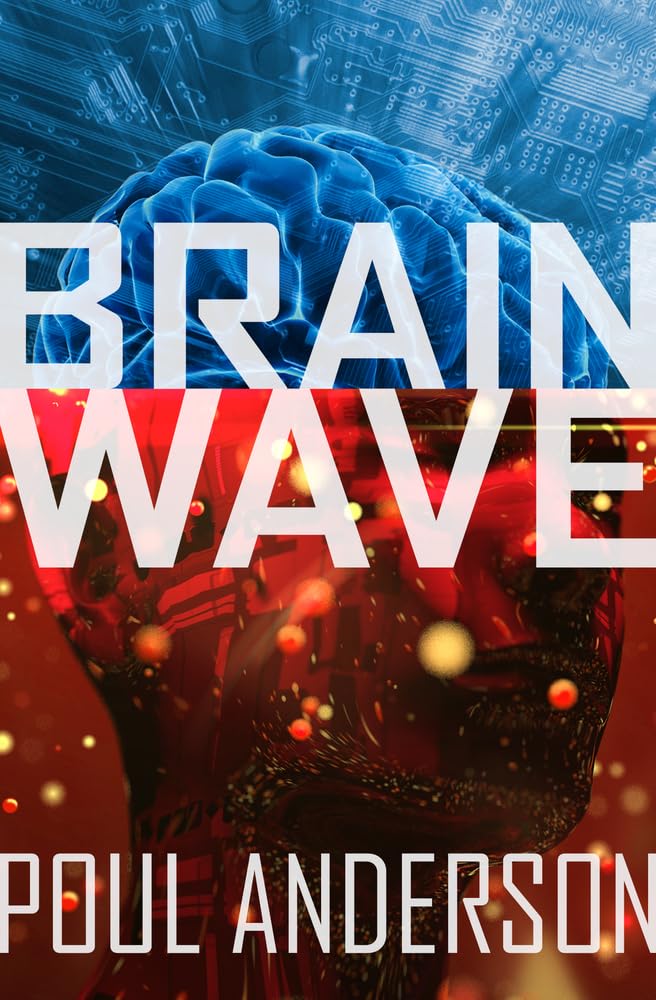
The premise turned inside out and scaled to the planet, five years before Charlie’s first report.
Earth drifts out of a galactic field that has been damping neural activity since before humans existed, and every mind on the planet, human and animal, multiplies overnight. Anderson follows the whole ladder: scientists ascending past genius, livestock refusing the slaughterhouse, and Archie Brock, a farmhand the old world called simple, who wakes into competence while civilization dissolves around everyone who thought intelligence was the thing they had over him.
Archie is the reason the book belongs here. He gets Charlie’s arc run in reverse and in company, and Anderson, early and fast and barely two hundred pages, asks what happens when the rising tide lifts every mind at once and the answer is nothing comfortable.
The Speed of Dark by Elizabeth Moon (2002)

The book that asks Charlie’s question in the modern vocabulary, and refuses to answer it for him.
Lou Arrendale is an autistic pattern analyst in a near future where his cohort is the last of its kind, younger cases are treated in infancy, and his employer begins pressuring the unit to accept an experimental adult cure. The novel lives inside Lou’s precise, orderly, fencing-practiced mind while he weighs the offer, and Moon, who wrote it drawing on raising her own autistic son, makes the stakes exact: the treatment might give him ease and take the person doing the choosing.
It won the Nebula, and it is the necessary companion piece because it centers the thing Flowers could only gesture at, consent. Charlie signed his name to a form he could not evaluate. Lou can evaluate everything except who he’d be on the other side.
Of Mice and Men by John Steinbeck (1937)

The ancestor, and the pairing every English teacher already knows by heart.
Lennie Small is big enough to buck barley for two men and understands the world like a child, George does the understanding for both of them, and the dream that keeps them moving is a little farm where nobody can throw them off. Steinbeck’s subject is the same one Keyes picked up twenty years later: how small the world makes itself around a large gentle man it has decided not to understand, and what protection costs the people who offer it.
The two books get assigned together for a reason, and the reason is that they end in the same place, with love and harm in the same gesture. If you were assigned one in school, the other is the unassigned half of the lesson.
The Curious Incident of the Dog in the Night-Time by Mark Haddon (2003)

Proof that the voice-as-architecture trick works even when the voice never changes at all.
Christopher Boone, fifteen, finds his neighbor’s dog dead in the garden and opens a murder investigation in the style of his hero Sherlock Holmes, complete with diagrams, math problems, and chapter numbers that run in primes. The case cracks open his parents’ lives instead, and the second half sends him on a journey to London that the book makes as huge and hostile as any quest, because the telling is calibrated entirely to the teller.
Flowers taught the genre that the report itself can be the story. Haddon’s novel is the most successful application of that lesson in this century, and its Christopher stands with Charlie among fiction’s great first persons.
Still Alice by Lisa Genova (2007)

Charlie’s final stretch, expanded to a whole novel, written by a neuroscientist, and true to the last page.
Alice Howland is a fifty-year-old Harvard linguistics professor when early-onset Alzheimer’s begins taking the words first, and the novel stays locked to her point of view the entire way down. Genova, who holds a Harvard doctorate in neuroscience, self-published it after the industry passed, and readers made it a bestseller because it does the unbearable thing honestly: the mind reporting on its own subtraction, with the reader able to see what the narrator no longer can.
Of all the books like Flowers for Algernon, this is the one that runs the last movement of Keyes’s arc at full length, and the Julianne Moore film, good as her Oscar-winning performance is, softens what the book will not.
Awakenings by Oliver Sacks (1973)

The nonfiction entry, because the truest book like this one actually happened.
In 1969, at a Bronx chronic-care hospital, Oliver Sacks gave L-DOPA to patients frozen for decades by the sleeping sickness of the 1920s, and they woke. The case histories record the summer of returns, speech, movement, appetite, personality, whole selves surfacing after forty years, and then the tolerances, the side effects, the retreats. Sacks writes his patients as people first, and the arc of gift and withdrawal is the Algernon curve with names and dates attached.
Keyes built the most famous tragedy in science fiction on a shape that medicine already knew. This is the book that shows the shape in the wild, and it will rearrange how you read the novel’s second half.
Never Let Me Go by Kazuo Ishiguro (2005)

The experiment administered kindly, which turns out to be the cruelest available setting.
Kathy H. looks back on Hailsham, the school that raised her and her friends with art classes and health checks and almost enough truth, and her memoir does the opposite of Charlie’s reports: his documented a mind changing week by week, hers documents a heart holding perfectly still while understanding arrives. The institution never raises its voice. That is the horror.
What the two books share is the subject’s-eye view of a project that considers itself humane, and the love stories conducted entirely inside its walls. The full entry, and the dystopian case for it, is on my best dystopian books list. This shelf claims it for Kathy’s voice.
Lying Awake by Mark Salzman (2000)

The gift-with-a-price argument distilled to a hundred and eighty perfect pages.
Sister John of the Cross, a cloistered Carmelite in Los Angeles, has spent years in spiritual dryness when the visions arrive, radiant, wordless certainties that also make her the convent’s first published poet. Then the headaches are diagnosed: temporal-lobe epilepsy, operable, with the strong likelihood that removing the seizures removes the grace. The novel is her decision, and Salzman keeps it small, quiet, and completely merciless.
It is Charlie’s bargain in reverse, surrender the extraordinary thing to keep the ordinary self, and it proves the Flowers dilemma doesn’t need a laboratory. A hospital consent form does fine.
Limitless by Alan Glynn (2001)

The thriller remake of the arc, with the ascent as a high and the decline as a withdrawal.
Eddie Spinola, a stalled Manhattan copywriter, gets a pill called MDT-48 from his ex-brother-in-law and becomes, for stretches of hours, the smartest man in any room, languages in days, markets on instinct, a book finished in a week. Glynn plays the rise as intoxication and then runs the Keyes curve as pharmacology: tolerance, blackouts, a dwindling supply, and the arithmetic of how many pills stand between Eddie and what he was.
Filmed in 2011 as Limitless, and reissued under that title, but the novel is considerably darker than Bradley Cooper’s grin. It is the intelligence tragedy rebuilt as a page-turner, and the engine still runs on Charlie’s fuel.
The Girl with All the Gifts by M. R. Carey (2014)

The horror version, and the one where the gifted child gets to keep her mind.
Melanie is ten, brilliant, devoted to her teacher Miss Justineau, and wheeled to class each morning strapped into a chair at gunpoint, because Melanie is a subject, and what she is a subject of unfolds with real care. The base falls, the survivors take to the road, and the novel becomes a running argument about whether she is a child, a specimen, or a weapon, with Melanie fully aware the argument is happening over her head.
The tenderness between subject and teacher is the most Charlie-and-Alice relationship anyone has written since the original, transplanted into a horror novel that earns both words. This is the entry closest to my side of the bookshelf, and it closes the list on purpose.
The Rest of the Shelf
The last three books like Flowers for Algernon on the count.
The Echo Maker by Richard Powers (2006) turns a truck-flip survivor’s Capgras delusion, the certainty that his sister has been replaced by a double, into a National Book Award winner about how thin the self’s evidence really is, with a Sacks-like neurologist whose own identity frays on contact with the case.
Elizabeth Is Missing by Emma Healey (2014) hands a murder mystery to Maud, a narrator with dementia who keeps her clues on notes in her pockets, and lets the fog of the telling become the plot.
And Piranesi by Susanna Clarke (2020) gives its flooded, statue-lined house a narrator whose radiant innocence turns out to be a wound, taken memory rather than granted intelligence, and took the Women’s Prize doing it.
Two near-misses that readers hunting books like Flowers for Algernon keep proposing, for honesty’s sake. A Clockwork Orange runs a state experiment on a mind with the sympathy pointed the other way, and it already has a full entry on my best dystopian books list. And The Minds of Billy Milligan is Keyes’s other famous book, a nonfiction account of a multiple-personality case, fascinating and completely different in kind, strictly for the completists.
Where to Go Next
If it was the science fiction of it, the machine of the premise rather than the wound, Flowers holds its full entry on my best science fiction books list, in the company it earned.
If it was the institution, the experiment with people inside it and the paperwork that makes it possible, the best dystopian books list is built from that material.
And if Melanie was the one that got you, my best horror books list is home ground for me, and the door is open.