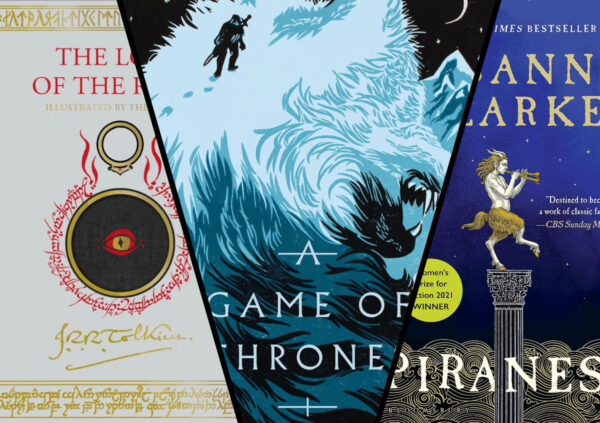
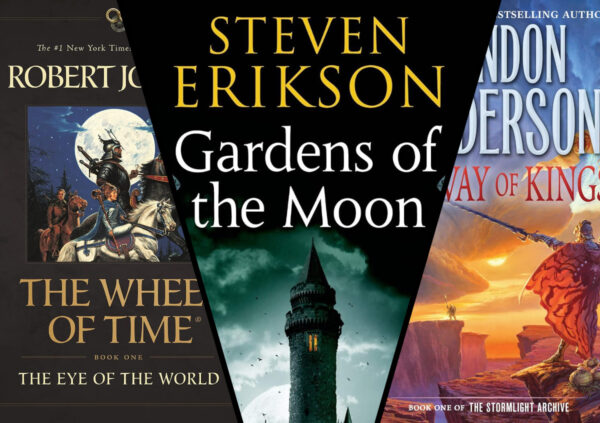
Guy Gavriel Kay books occupy a shelf nobody else is on: novels that read like the finest historical fiction until the second moon rises. A critic once described the method as history with “a quarter-turn to the fantastic,” and Kay has embraced the phrase, with good reason. Moorish Spain, Byzantium, Tang China, Renaissance Italy: he borrows our history, renames it, and turns it a quarter of the way toward dream.
The credentials behind that method are singular in the genre. As a young philosophy student, Kay spent a year in Oxford helping Christopher Tolkien edit The Silmarillion, and he has since built sixteen novels, an Order of Canada, a World Fantasy Award, and translations into thirty languages on the opposite approach from Tolkien’s: where the master invented a mythology, the apprentice works from ours.
There’s a practical gift in that method too, the same one his entry on my best fantasy series list flags: almost everything he writes stands alone and finishes. The newest novel arrived just last year, the old ones never went stale, and the only real question is which door to walk through first, an argument his readers have kept warm for thirty years and this page will referee honestly.
Fiction by René Rehn


The Short Version
Start with The Lions of Al-Rassan, the most-recommended door and the book his readers most often crown, or with Tigana if you want the emotional maximum first. The Fionavar Tapestry, the early trilogy, is his Tolkien mode and nothing like what followed, so save it for curiosity. Under Heaven opens the China diptych and makes the best door for readers coming from straight historical fiction. The Sarantine Mosaic is one story in two volumes, the only true read-in-order work of his mature career. The late Mediterranean books read in any order, Written on the Dark (2025) is the newest, and nothing on the shelf requires anything else.
Guy Gavriel Kay Books in Order
Sixteen novels and one book of poetry, by first publication.
| Year | Title | Series or type | Notes |
| 1984 | The Summer Tree | The Fionavar Tapestry, book 1 | His debut |
| 1986 | The Wandering Fire | The Fionavar Tapestry, book 2 | Aurora Award |
| 1986 | The Darkest Road | The Fionavar Tapestry, book 3 | |
| 1990 | Tigana | Standalone | Aurora Award |
| 1992 | A Song for Arbonne | Standalone | |
| 1995 | The Lions of Al-Rassan | Standalone | |
| 1998 | Sailing to Sarantium | The Sarantine Mosaic, book 1 | |
| 2000 | Lord of Emperors | The Sarantine Mosaic, book 2 | |
| 2003 | Beyond This Dark House | Poetry | His one poetry collection |
| 2004 | The Last Light of the Sun | Standalone | |
| 2007 | Ysabel | Standalone | World Fantasy Award |
| 2010 | Under Heaven | Standalone, Kitai | Sunburst Award |
| 2013 | River of Stars | Standalone, Kitai | Centuries after Under Heaven |
| 2016 | Children of Earth and Sky | Standalone, linked world | |
| 2019 | A Brightness Long Ago | Standalone, linked world | |
| 2022 | All the Seas of the World | Standalone, linked world | |
| 2025 | Written on the Dark | Standalone, linked world | His newest |
Where to Start With Guy Gavriel Kay
The classic answer is a coin flip between The Lions of Al-Rassan and Tigana, and the loser of the flip goes second. Lions is the one that persuades: the cleanest demonstration of the method, with the magic pared down to almost nothing. Tigana is the one that overwhelms, Kay at full flood. Most readers who finish either come back for the other within the year.
There are two other doors worth naming. Readers who come from historical fiction and feel wary of fantasy furniture should start with Under Heaven, where the research wears the crown. And readers raised on epic trilogies who want Kay at his most traditional can start where he did, with The Summer Tree, knowing it represents nothing that came after.
One warning applies at every door. The style is consciously beautiful, openly emotional, built for the lump in the throat, and it divides readers cleanly into the devoted and the allergic. Bring your tolerance for beauty played fortissimo, because the Guy Gavriel Kay books never apologize for aiming at your heart, twice a chapter, on purpose.
Guy Gavriel Kay’s Life, Briefly
Guy Gavriel Kay was born on November 7, 1954, in Weyburn, Saskatchewan, and grew up in Winnipeg, where he studied philosophy at the University of Manitoba. In 1974 Christopher Tolkien, who knew of him through a family connection, invited the young Canadian to Oxford to help edit his father’s unpublished mythology into the book that became The Silmarillion. Kay worked with him through 1974-1975, and Christopher Tolkien later wrote that almost every substantial change made in constructing the text was discussed with Kay.
Kay has said the year taught him the lesson underneath his whole career: that great books are not born brilliant but built, through rewriting and drudgery and mistakes. He came home, took a law degree at the University of Toronto in 1978, was called to the Ontario bar in 1981, and spent years as principal writer and associate producer of the CBC’s The Scales of Justice before The Summer Tree launched his fiction career in 1984.
Tigana, in 1990, marked the turn from invented mythology to history, and he has worked the same seam ever since, a novel every three years or so, each one researched like a dissertation and written like a poem. He published his single collection of poetry, Beyond This Dark House, in 2003. The honors kept pace: he was made a Member of the Order of Canada in 2014, holds an honorary doctorate from the University of Manitoba, and in 2021 delivered the Tolkien Lecture at Pembroke College, Oxford, closing a circle that opened in 1974.
The Fionavar Tapestry (1984-1986)
Before the quarter turn, Kay wrote the full turn. The Fionavar Tapestry is high fantasy at maximum proof, written by the man fresh from the Tolkien papers and sounding like it, and it remains the one corner of the shelf that works as a strict read-in-order trilogy. It gets one entry here, anchored on the first volume, because the three books are one story and almost nobody seeks the later volumes on their own.
The Summer Tree (1984)

The Summer Tree opens Kay’s debut trilogy by sending five Toronto university students across the void to Fionavar, the first of all worlds, of which every other world, ours included, is an imperfect echo. What begins as an invitation to a festival becomes a war for the world itself, gods and goddesses in play, and each of the five is claimed by the world in a different way, through sacrifice, grief, power, or destiny. The mythology is openly woven from Celtic and Norse sources, with the Arthurian legend pulled in as the trilogy grows, and the whole thing is pitched at an operatic intensity most debuts would not dare.
Read it in strict order: The Wandering Fire (1986), which won the Aurora Award, and The Darkest Road (1986) complete the story, and neither stands alone. The trilogy has sold over a million copies and stays genuinely beloved, but it is honestly flagged everywhere, including here: this is a different writer from everything after, maximalist where the later Kay is precise, derivative by open design where the later Kay is sui generis. Among Kay’s novels it is the origin, not the sample, and readers who want his Tolkien mode get exactly that, at full volume.
The First Quarter Turn (1990-1995)
Three standalone novels, each set in a renamed corner of medieval Europe, and between them the whole argument for Kay’s method. Tigana also holds the standalone slot in my epic fantasy books lineage, the proof that an epic can be complete in one volume.
Tigana (1990)

Tigana is the book where Kay became Kay, and its premise remains one of the genre’s very best: a conquering sorcerer-king punishes the province that killed his son by erasing its name, not from maps, from minds, so that no one born outside Tigana can hear the word at all, and a generation of survivors carries a homeland that cannot be spoken. On a peninsula that resembles Renaissance Italy, split between two foreign sorcerers, a small band of exiles works to bring the spell down.
It’s a novel about memory as territory, culture as the thing tyranny actually targets, and the moral cost of resistance as much as the crime, with the conqueror Brandin written so humanly that readers have argued about him since 1990. It won the Aurora Award and was a World Fantasy finalist, and it is Kay at full flood, the lushness and the grief turned to maximum. That is precisely why it splits the vote with Lions: Tigana overwhelms where Lions persuades. The ending stays sealed here, as it should everywhere. His readers reread it with a protective devotion no other book on this shelf gets.
A Song for Arbonne (1992)

A Song for Arbonne turns the method on the troubadour courts of medieval Provence. Arbonne is a southern land of music, courtly love, and a goddess served by priestesses, watched hungrily from the north by Gorhaut, a kingdom of one god, one king, and a war it needs somewhere to point. Blaise, a northern mercenary with a buried name, takes service in the south and lands in the middle of a decades-old feud between two lords who loved the same woman, while the larger war gathers over everyone.
This is the quietest of the early quarter-turn novels, slower to ignite than Tigana and gentler in its payoff, and the consensus ranks it a step below the two crowns. Its loyalists, a minority but a devoted one, point at the court intrigue, the music, and the late chapters, which land with full Kay force. For readers drawn to the troubadour world, chansons and courts of love and all, no other fantasy novel takes that culture half as seriously.
The Lions of Al-Rassan (1995)

The Lions of Al-Rassan is the door, and the book most readers crown. This is Kay’s Reconquista: a peninsula of three faiths sliding toward holy war, and at its center three people, a soldier of genius, an exiled courtier-poet-assassin of another faith, and a woman physician caught between them, who together embody everything the coming war will make impossible. The magic is barely a whisper here, one gifted child, nothing more, which makes it the cleanest demonstration of what Kay actually does: the tragedy is history’s, the people are his.
The friendship at the novel’s center is one of the genre’s great doomed relationships, written with the full knowledge that history has already voted, and the physician Jehane, who anchors it all, is routinely named among the genre’s great adult heroines. The ending plays a structural trick on the reader’s heart that his fans famously refuse to describe to newcomers, and it stays undescribed here too. If someone asks this site for one Kay, this is the answer, exactly as my series list said first. Among the Guy Gavriel Kay books it is the one that persuades skeptics, historical fiction readers, and genre lifers alike.
The Sarantine Mosaic (1998-2000)
The Sarantine Mosaic is one story published in two volumes, and the one place on the mature shelf where order is mandatory. Both halves are in print on their own, each was a World Fantasy finalist in its year, and each gets its entry below, but buy them together and read them as the single novel they are.
Sailing to Sarantium (1998)

Sailing to Sarantium sends Crispin, a brilliant, grieving mosaicist from a half-ruined western province, east to the capital of the world. Sarantium is Kay’s Byzantium under an emperor and empress turned a quarter from Justinian and Theodora, a city of chariot factions, court theology, and holy art, where an invitation from the throne is equal parts honor and death sentence. Crispin travels through a countryside where the old pagan powers are not as gone as the new faith insists, and the encounter he has on the road is one of the most numinous scenes Kay has written.
Know going in that this is half a book by design. It builds the city, the court, and the dome Crispin is summoned to decorate, and then hands everything to the second volume mid-stride. Readers who treat it as a complete novel come away baffled, and readers who have Lord of Emperors waiting tend to call the pair peak Kay. The craft-as-devotion theme, an artist making something that outlasts empires, is the heart of the whole Mosaic.
Lord of Emperors (2000)

Lord of Emperors finishes what Sailing to Sarantium builds, and most readers rank it the stronger half. A physician from the eastern empire arrives in Sarantium as the court’s rivalries sharpen into conspiracy, the chariot factions edge toward riot, and Crispin’s dome rises tile by tile while the world that commissioned it starts to move beneath him. Everything the first volume placed on the board gets spent.
What elevates the second half is how completely the personal and the political interlock: medicine, racing, mosaic, and statecraft each get the full Kay treatment as crafts practiced by people who know what mastery costs, and the last hundred pages run the full register, intrigue to grief to a quiet coda that readers cite among his finest endings, no details offered. The two-volume whole stands with Tigana and Lions in most rankings of Kay’s novels, and some longtime readers put it first. Start with Sailing to Sarantium, always.
Two Detours (2004-2007)
After the Mosaic, Kay wrote his coldest book and then his lightest: a Viking-age novel in the same world, and a contemporary fantasy set in the south of France that quietly reaches back to his debut trilogy.
The Last Light of the Sun (2004)

The Last Light of the Sun takes the quarter turn north, into the Viking age. Three cultures share its stage: the Erlings, sea raiders a quarter-turned from the Norse, the Anglcyn under King Aeldred, a scholar-king rebuilding his realm after near-conquest and modeled openly on Alfred the Great, and the Cyngael of the western valleys, Kay’s Welsh, poets and cattle thieves living beside a faerie world that is dangerously real here. A young Erling fleeing slavery and a Cyngael prince marked by an encounter with that other world carry the braided story.
This is the rawest and least ornamented of Kay’s novels, scaled to farms and fjords rather than empires, and the common verdict calls it minor Kay, which mostly means the register is harsher and the glamour deliberately stripped. The faerie thread runs stronger than anywhere else on the mature shelf. Its warmest champions tend to be saga readers, and people who found the Mediterranean books too upholstered often rank it far above its reputation.
Ysabel (2007)

Ysabel is the odd one out, a contemporary fantasy set in present-day Provence, and it won Kay the 2008 World Fantasy Award for best novel. Ned Marriner, fifteen, is in Aix-en-Provence while his photographer father shoots the cathedral, and he and an exchange student stumble into something very old: two men out of the province’s deep past who have contended across the centuries for the same woman, in lives that keep returning. When the old story reaches into the photo crew itself, Ned’s own family history turns out to be tangled in it.
The book reads younger and lighter than anything else on this page, closer to a young adult novel in pace and voice, and some longtime readers consider the award generous. It is also, quietly, a Fionavar coda: characters from the trilogy surface here, decades on, and reading Fionavar first deepens the book considerably. Take it as the dessert course of the Guy Gavriel Kay books, best eaten after Fionavar rather than before.
The China Diptych (2010-2013)
Two linked standalones move the method east, to Kitai, Kay’s quarter-turned China, separated by about four centuries. Under Heaven comes first and should be read first, though each stands fully alone, and for a strand of his readership these two, not the Mediterranean books, are the summit.
Under Heaven (2010)

Under Heaven opens with one of the great premises in modern fantasy. Shen Tai, second son of a dead general, has spent two years in the mountains at Kuala Nor, burying the bones of the soldiers, his father’s and the enemy’s alike, who fell there by the tens of thousands a generation ago. The ghosts of the unburied cry every night. For this act of piety, a foreign empress sends him a gift of two hundred and fifty Sardian horses, a fortune so vast it makes him instantly one of the most consequential and most endangered men in the empire, and he must ride back into the capital’s politics to survive his own reward.
Kitai here is Tang China at its golden apex, turned a quarter toward the fantastic, with the An Lushan rebellion looming under a changed name, and the research is so deep the book doubles as a love letter to Tang poetry. It won the Sunburst Award and was a World Fantasy finalist. The pacing is stately, the long courtly middle asks patience, and the payoff repays it with interest. For historical fiction readers, this is the single best door into Kay’s novels.
River of Stars (2013)

River of Stars returns to Kitai roughly four centuries on, in an empire modeled on Song China: smaller, wealthier, haunted by the glory of the dynasty Under Heaven portrayed, and so frightened of its own soldiers that it has made weakness a policy. Ren Daiyan, an outlaw turned officer who believes he was born to win back the lost northern rivers and mountains, rises as that policy meets its consequences, and Lin Shan, a poet educated like a man in a world that punishes her for it, cuts her own path through the court. She is widely read as a version of the great Song poet Li Qingzhao, and her chapters are some of Kay’s best writing about art.
This is the more elegiac half of the diptych, a book about how empires remember themselves, and readers split on it along exactly that line: some find it colder and more distant than Under Heaven, others call it the deeper work. The consensus pairs them as near-equals. Read Under Heaven first and the echoes land as designed.
The Late Mediterranean Books (2016-2025)
Kay’s late run circles the Renaissance Mediterranean of his shared world. Children of Earth and Sky, A Brightness Long Ago, and All the Seas of the World are loosely linked, sharing a generation of merchants, mercenaries, and artists and a handful of recurring characters, but each stands alone and they read in any order, publication order being the gentlest. Written on the Dark, the newest novel, stands adjacent in the same world, in its France rather than its Italy.
Children of Earth and Sky (2016)

Children of Earth and Sky braids five lives across a quarter-turned sixteenth-century Adriatic. Seressa, Kay’s Venice down to the name’s echo of La Serenissima, sends out spies and merchants. The raider town of Senjan, drawn from the historical uskoks, sends out Danica Gradek, a young woman with a bow, a dead family to avenge, and no patience for anyone’s rules. And an ambitious minor artist named Pero Villani is dispatched east on a commission nobody sane would want: to paint the portrait of the grand khalif whose armies took Sarantium within living memory.
The pleasure here is the weave, small lives bumping the hinges of history, and the honest reservation is the same thing: with five protagonists and half a sea of stage, the book is episodic, and some readers find no single thread grips like Tigana or Lions. It was Kay’s first novel after the Order of Canada, and it opened the late period’s loosest, warmest mode. No other fantasy at this level gives you the full trade-routes-and-spycraft texture of the era, and that texture is the book.
A Brightness Long Ago (2019)

A Brightness Long Ago is the late-period book most often called a masterpiece, and the most intimate thing Kay has written since Tigana. An aging court councillor named Guidanio Cerra looks back on his youth: a tailor’s son educated above his station, pulled into the orbit of Adria Ripoli, a duke’s daughter who has chosen danger over the lives allowed to women of her rank, and caught between two brilliant mercenary commanders, Folco Cino d’Acorsi and Teobaldo Monticola, whose lethal feud is drawn from the real rivalry of Federico da Montefeltro and Sigismondo Malatesta.
Set decades before Children of Earth and Sky in Kay’s Renaissance Italy, it is a book about chance, memory, and the moments a life pivots on, narrated with an old man’s tenderness for everything lost. The plot is slighter than the early epics and moves in set pieces, a horse race, a night pursuit, and readers wanting momentum sometimes stall. Those tuned to its key tend to place it among the best Kay books of all, and I’d point anyone who loved the voice of the early novels straight at it.
All the Seas of the World (2022)

All the Seas of the World opens with a night landing on a dark coast and a contract: Rafel ben Natan, a Kindath merchant and sometime corsair, and Nadia, a woman who escaped slavery and shed her birth name with it, have been hired to assassinate the ruler of a North African city. The job goes sideways in the way Kay jobs do, leaving them rich, exposed, and suddenly relevant to powers on every shore of the Middle Sea.
This is the most relaxed of the late three, a book of voyages, markets, and second chances whose real subjects are exile and the question of where home is when yours was taken, carried by the Kindath experience of expulsion that echoes the Jewish history it is turned from. Figures from A Brightness Long Ago move through it, five years on, and spotting them is part of the pleasure. The episodic drift is real, and the stakes stay personal rather than imperial, which some readers count against it. As a closing movement to the trilogy-that-isn’t, it lands with quiet weight.
Written on the Dark (2025)

Written on the Dark, published on May 27, 2025, is the newest of the Guy Gavriel Kay books and proof the method has not dulled. The setting is Ferrieres, his quarter-turned France in the years of its long war with Angland: a mad king on the throne, rival royal dukes circling the regency, and a hard winter in the capital. Thierry Villar, a tavern poet modeled on François Villon, is lifted out of a planned burglary and into the investigation of a royal duke’s murder in the street, a crime drawn from a real assassination that pushed France toward civil war, with invasion gathering behind it.
Reviewers noted it is markedly shorter and tighter than his recent novels, praised the characters as some of his most memorable, and it has already been shortlisted for the 2026 Aurora Award. Early fan consensus ranks it mid-shelf Kay, which on this shelf still clears most of the genre’s ceilings. The poet’s-eye view of power, verse quoted in taverns while dukes decide who burns, is the book’s particular gift, and admirers of the quarter turn at its most historical should not wait for the paperback.
Guy Gavriel Kay: Deep Dive and FAQ
What Runs Through Guy Gavriel Kay’s Books
A first-time reader hits a fork early in any Kay novel: you can read him as historical fiction with a twist of fantasy, playing the decoding game, Esperaña for Spain, Seressa for Venice, this poet for that one, or as fantasy that happens to stand on a historical template, and both games are fully supported. The renaming isn’t coyness. It buys him the novelist’s freedom inside history’s weight, real stakes, real texture, real grief, without the biographer’s chains, and he has said as much: he steeps himself in a period and then twists it just that little bit.
The fantastic itself stays deliberately thin, usually one thread of the numinous, a ghost, a vision, a second moon in the sky, enough to keep the world tilted and no more. Underneath, the same subject recurs for forty years: memory, and what power does to it. Tigana names it outright, the Kitai books mourn it at the scale of dynasties, and the late novels are literally narrated as acts of remembering. Most of the post-Fionavar books share, loosely, a single world across its centuries, which rewards the long-haul reader with echoes and requires nothing of anyone else.
And then there is the style, the other signature: consciously beautiful, openly emotional, built for the lump in the throat. It is the most divisive thing about him and the most essential, and this site’s roster has already told you which side it’s on.
Prizes and Honors
Ysabel won the World Fantasy Award for best novel in 2008, one of five times Kay’s novels have been finalists for the award, with Tigana (1991), Sailing to Sarantium (1999), Lord of Emperors (2001), and Under Heaven (2011) the others. At home he has won Canada’s Aurora Award twice, for The Wandering Fire in 1987 and Tigana in 1991, with nominations running all the way to Written on the Dark in 2026, and Under Heaven took the 2011 Sunburst Award. The International Goliardos Award recognized his contribution to the literature of the fantastic. In 2014 he was made a Member of the Order of Canada, cited for his contributions to speculative fiction as an internationally celebrated author.
Which Guy Gavriel Kay Editions to Buy
This is an easy shelf to buy. The novels are standalones, so there are no box sets to hunt and no matching-spines problem, and as I write this the whole catalog is readily available new in trade paperback and ebook in North America. Tigana’s anniversary trade paperback, issued by Penguin’s Berkley line in 1999, has been the standard US copy for decades. The recent novels, Written on the Dark included, appear first as Viking hardcovers in Canada, with trade paperbacks following.
The Sarantine Mosaic should be bought as both volumes at once, since the first ends mid-story by design. The one genuinely elusive item is Beyond This Dark House, the 2003 poetry collection, which can take some hunting secondhand and is for completists, though the poems’ imagery will feel familiar to anyone who knows the novels.
Questions About Guy Gavriel Kay
What Is the Best Guy Gavriel Kay Book?
The Lions of Al-Rassan is the book his readers most often name, with Tigana the passionate second and the Sarantine Mosaic and Under Heaven right behind. There is no wrong answer among those four. A Brightness Long Ago is the late-period pick, increasingly named alongside the classics.
Where Should I Start With Guy Gavriel Kay?
The Lions of Al-Rassan or Tigana, and the one you skip goes second. Historical fiction readers do best starting with Under Heaven. The only poor first choice is the Fionavar trilogy, which is early, Tolkien-shaped, and unrepresentative of everything after.
Do Guy Gavriel Kay’s Books Need to Be Read in Order?
Almost none of them. The exceptions: the Fionavar Tapestry is a strict trilogy, the Sarantine Mosaic is one story in two volumes, and River of Stars lands better after Under Heaven. The late Mediterranean books share characters but read in any order.
Did Guy Gavriel Kay Really Work On the Silmarillion?
Yes. In 1974-1975, as a philosophy student invited through a family connection, he lived in Oxford assisting Christopher Tolkien in editing J. R. R. Tolkien’s unpublished writings into the book published in 1977. Christopher Tolkien later wrote that almost every substantial change made in constructing the text was discussed with Kay.
What Does “A Quarter Turn to the Fantastic” Mean?
It is a critic’s description of Kay’s method, one he has embraced: he writes real historical periods, Moorish Spain, Byzantium, Tang China, under changed names, with only a thin thread of the supernatural. The result reads as historical fiction turned slightly toward dream, free to invent where a historical novelist cannot.
Are Kay’s Books Connected to Each Other?
Loosely. Most of the novels from The Lions of Al-Rassan onward share one world across many centuries, with Sarantium its pivot, and the late books share characters outright. Ysabel quietly connects to Fionavar. Every book is still built to stand alone, and the links are rewards, not requirements.
Has Anything by Guy Gavriel Kay Been Filmed?
Not yet. Rights have moved over the years, most prominently a 2017 television option on the Fionavar Tapestry by Temple Street, the Canadian company behind Orphan Black, and reported earlier film options on Ysabel and The Last Light of the Sun, but as of late 2026 no adaptation has publicly reached production.
What Is Guy Gavriel Kay’s Newest Book?
Written on the Dark, published May 27, 2025: a murder investigation in the wartime winter of his quarter-turned France, led by a tavern poet modeled on François Villon. It was shortlisted for the 2026 Aurora Award. As of October 2026 no follow-up novel has been announced.
Where to Go Next
The natural first stop is the shelf Kay apprenticed on: the J. R. R. Tolkien books guide covers The Silmarillion he helped Christopher Tolkien assemble, which reads differently once you know a future novelist was in the room. For the other great literate epic of character and grief, the Tad Williams books guide covers Memory, Sorrow, and Thorn, and readers who love Kay’s patient, emotionally saturated mode tend to thrive in the Realm of the Elderlings, mapped in the Robin Hobb books guide. And if you want to see where the quarter-turn worlds sit against the whole canon, the best fantasy books list puts the field side by side.