Stanisław Lem, printed as Stanisław Lem on most English covers, wrote science fiction that keeps running into the same wall: the universe may be full of minds, and none of them will be anything like ours. The Polish writer’s best-known novel is Solaris (1961), in which scientists orbiting a distant planet spend a century failing to understand the ocean that covers it, until the ocean starts answering them with visitors drawn from their own memories. His work exists in more than fifty languages, with sales of over 45 million copies.
That’s only one Lem. The same man wrote The Cyberiad, a book of comic fables about two robot inventors who build a machine that can make anything beginning with the letter n, the satirical space voyages of Ijon Tichy, a detective novel about corpses that won’t stay put, and A Perfect Vacuum, a collection of reviews of books that don’t exist. He trained as a doctor, taught himself cybernetics, and in 1964 wrote a thick philosophical treatise on the future of technology that describes something very like virtual reality. Stanisław Lem books run from hard first-contact novels to slapstick to philosophy, and the right first one depends on which Lem a reader is after.
Below: which book to pick first, Lem’s life at the length it explains the fiction, the books by date, a full entry for each major book with its translator and English year, the story of his English translations, the films and games, his quarrels with American science fiction, his kinship with the Strugatskys, a table of the English editions, and a closing set of questions about Lem.
The science-fiction shelf he sits on, from Wells and Stapledon to Le Guin and Liu Cixin, is mapped on my best science fiction books list.
Fiction by René Rehn


Stanisław Lem’s Books at a Glance
| English title | Original title | Original year | Translator and English year | Publisher (first English) |
| Hospital of the Transfiguration | Szpital Przemienienia | written 1948, published 1955 | William Brand, 1988 | Harcourt Brace Jovanovich |
| The Star Diaries | Dzienniki gwiazdowe | 1957, expanded to 1971 | Michael Kandel, 1976 | Seabury |
| Memoirs of a Space Traveler | Dzienniki gwiazdowe (later voyages) | 1957-1971 | Joel Stern and Maria Swiecicka-Ziemianek, 1982 | Harcourt Brace Jovanovich |
| Eden | Eden | 1959 | Marc E. Heine, 1989 | Harcourt Brace Jovanovich |
| The Investigation | Śledztwo | 1959 | Adele Milch, 1974 | Seabury |
| Memoirs Found in a Bathtub | Pamiętnik znaleziony w wannie | 1961 | Michael Kandel and Christine Rose, 1973 | Seabury |
| Solaris | Solaris | 1961 | Joanna Kilmartin and Steve Cox (via French), 1970, then Bill Johnston, 2011 | Walker (US), Faber (UK), Johnston as audiobook and ebook |
| Return from the Stars | Powrót z gwiazd | 1961 | Barbara Marszal and Frank Simpson, 1980 | Harcourt Brace Jovanovich |
| Summa Technologiae | Summa Technologiae | 1964 | Joanna Zylinska, 2013 | University of Minnesota Press |
| The Invincible | Niezwyciężony | 1964 | Wendayne Ackerman (via German), 1973, then Bill Johnston, 2006 or 2014 (sources differ) | Seabury (Ackerman) |
| The Cyberiad | Cyberiada | 1965 | Michael Kandel, 1974 | Seabury |
| Highcastle | Wysoki Zamek | 1966 | Michael Kandel, 1995 | Harcourt Brace |
| His Master’s Voice | Głos Pana | 1968 | Michael Kandel, 1983 | Harcourt Brace Jovanovich |
| Tales of Pirx the Pilot | Opowieści o pilocie Pirxie | 1968 | Louis Iribarne, 1979 | Harcourt Brace Jovanovich |
| More Tales of Pirx the Pilot | Opowieści o pilocie Pirxie | 1968 | Louis Iribarne with Magdalena Majcherczyk and Michael Kandel, 1982 | Harcourt Brace Jovanovich |
| The Futurological Congress | Kongres futurologiczny | 1971 | Michael Kandel, 1974 | Seabury |
| A Perfect Vacuum | Doskonała próżnia | 1971 | Michael Kandel, 1979 | Harcourt Brace Jovanovich |
| Imaginary Magnitude | Wielkość urojona | 1973 | Marc E. Heine, 1984 | Harcourt Brace Jovanovich |
| The Chain of Chance | Katar | 1976 | Louis Iribarne, 1978 | Harcourt Brace Jovanovich |
| Mortal Engines | stories from Bajki robotów and others | 1964-1976 | Michael Kandel, 1977 | Seabury |
| Peace on Earth | Pokój na Ziemi | 1987 (first in Swedish, 1985) | Michael Kandel and Elinor Ford, 1994 | Harcourt Brace |
| Fiasco | Fiasko | 1986 (first in German) | Michael Kandel, 1987 | Harcourt Brace Jovanovich |
| The Truth and Other Stories | a selection of twelve stories | various | Antonia Lloyd-Jones, 2021 | MIT Press |
Where to Start With Stanisław Lem
Solaris is the usual first Lem, and for most readers it’s the right one. It has a haunted-house story at its center, a man confronted with a woman who died years before, and around it Lem builds his whole argument about the limits of human understanding. The one complication is the translation. The English paperback on sale everywhere is Joanna Kilmartin and Steve Cox’s version of 1970, which was done from the French, and Bill Johnston’s direct translation of 2011 is harder to find in print. The Solaris entry below and the novel’s own page explain the choice.
Readers who want to laugh should start with The Cyberiad (1965) in Michael Kandel’s translation. It’s a book of robot fairy tales, full of puns Kandel had to reinvent in English, and it shows the side of Lem that Solaris hides. The Star Diaries is the other comic door, the voyages of a space traveler who narrates disasters with the calm of a man describing the weather.
For big ideas, go to His Master’s Voice (1968), the story of a scientific project trying to decode a message from the stars. For satire of the drugged and comfortable future, The Futurological Congress (1971) is short and very funny. A Perfect Vacuum suits readers who already love Borges. The Pirx stories suit readers who want old-fashioned space adventure with a thinking pilot at the controls. Fiasco (1986), his last novel, is best read after two or three of the others, because it gathers all of his first-contact ideas into one book.
Stanisław Lem’s Life, Briefly
Lem was born in Lwów, then in Poland and now Lviv in Ukraine, on September 12, 1921. His father, Samuel Lem, was a well-off laryngologist who had served as a doctor in the Austro-Hungarian army. The family was Jewish by origin, and the city of his childhood, its streets, its toys and its schoolrooms, is the subject of his memoir Highcastle. He was admitted to study medicine at Lwów University in 1940, during the first Soviet occupation of the city.
When the Germans occupied Lwów in 1941, the Lem family survived outside the ghetto on false papers. Lem worked as a car mechanic and a welder, and at times stole munitions for the Polish resistance. He wrote little about those years directly, and the critic Agnieszka Gajewska’s study Holocaust and the Stars (in English in 2021, translated by Katarzyna Gucio) reads his science fiction against them.
After the war the family was resettled in Kraków, where Lem lived for the rest of his life. He went back to medicine at the Jagiellonian University but chose not to sit the final examinations, which would have made him a military doctor for life.
He worked as a research assistant, wrote poems and reviews for the Catholic weekly Tygodnik Powszechny, and serialized a first science-fiction novel, The Man from Mars, in 1946. His first book, The Astronauts, appeared in 1951. His novel Hospital of the Transfiguration, written in 1948, was held back by the censors until 1955. The books of the Stalinist years carried the required optimism about a communist future, and Lem later said they were compromised by the ideological pressure of the time. In 1953 he married Barbara Leśniak, a radiology student. Their son, Tomasz, was born in 1968.
The thaw of 1956 changed everything. Between 1956 and 1968 Lem published seventeen books, among them The Star Diaries, Eden, Solaris, Return from the Stars, The Invincible, The Cyberiad, Summa Technologiae and His Master’s Voice. Polish critics of the time mostly treated him as a writer of mass-market books for the young, which, some have argued, kept him out of the censors’ sight.
In 1973 the Science Fiction Writers of America made him an honorary member. The membership was rescinded a few years later, on the stated ground that his American publications made him eligible for ordinary membership, in the middle of a row over his essays calling most American science fiction badly written and more interested in money than in ideas.
Ursula K. Le Guin was among the members who protested. In the late 1970s he cautiously supported the Polish opposition and wrote for Kultura, the Polish émigré monthly in Paris. After martial law was declared in December 1981 he took a fellowship at the Institute for Advanced Study in West Berlin in 1982, then lived in Vienna from 1983 until he returned to Kraków in 1988.
Fiasco (1986) was his last science-fiction novel. In his last decades he wrote essays and columns, grew openly pessimistic about technology and about science fiction, and gave long interviews, published in Polish as Tako rzecze… Lem (2002). He died in Kraków on March 27, 2006, aged 84. He won Austria’s State Prize for European Literature (1985), the Franz Kafka Prize (1991), the Order of the White Eagle (1996), and the asteroid 3836 Lem. The Polish parliament declared 2021, the centenary of his birth, the Year of Stanisław Lem.
Stanisław Lem Books in Order
The table at the end of this page lists the English editions in order of first Polish publication, with their translators. A few books aren’t in it: The Man from Mars (serialized 1946), The Astronauts (1951), The Magellanic Cloud (1955) and Dialogs (1957), along with Fables for Robots (1964), which English readers get in Mortal Engines, and Golem XIV (1981), which comes with Imaginary Magnitude. Several of the story collections grew over later Polish editions, so the English volumes don’t always match the Polish ones.
There’s no series to follow, apart from the loose cycles of Ijon Tichy, of Pirx, and of Trurl and Klapaucius, and each of those can be read in any order. A sensible path for a new reader is Solaris, then The Cyberiad or The Star Diaries, then His Master’s Voice, A Perfect Vacuum and Fiasco. The early novels written to the Stalinist formula, The Astronauts and The Magellanic Cloud, matter mostly to completists, though both became films.
The First-Contact Novels
Five of Lem’s novels send humans out to meet something that isn’t human, and each time the meeting proves far harder than the hopeful stories promise: Eden, Solaris, The Invincible, His Master’s Voice and Fiasco. Read in order, they make a thirty-year argument against the hopeful first-contact story, where the aliens turn out to be people in rubber masks.
Eden (1959)

A spaceship plows into the surface of an unknown planet, and its six crew members, who are never named and are known only as the Coordinator, the Doctor, the Engineer, the Chemist, the Physicist and the Cyberneticist, dig themselves out and go exploring. They find a factory that makes objects and then destroys them, fields of strange plants, and a species of beings they call doublers, whose bodies seem to be made of two creatures joined together.
The more they learn, the worse it gets. The doublers’ civilization is being run by an unseen authority through a kind of information science Lem calls procrustics, the shaping of a society to a design no one is allowed to see, and the evidence of what’s being done to the population is denied even as the crew walks through it. Readers in 1959 had no difficulty recognizing the model. The novel is careful not to say so, and it’s also a strong adventure story, with the crew’s arguments about whether they have any right to interfere carried all the way through.
Eden is the earliest of the first-contact novels and the closest to a conventional adventure. It appeared in English in 1989 in Marc E. Heine’s translation (Harcourt Brace Jovanovich), and that translation is the English edition.
Solaris (1961)

The novel Lem is known for. Kris Kelvin, a psychologist, arrives at a research station hovering over the ocean of the planet Solaris, a living, planet-wide mass that seems to think and that has defeated a century of human science. The station is in disarray. One of the three scientists aboard, Kelvin’s old teacher Gibarian, has died just before his arrival, and the other two, Snow and Sartorius, are hiding something. Then Kelvin wakes to find Rheya in his cabin, a woman who died years before on Earth and whom he has never stopped blaming himself for losing.
The book is part ghost story and part history of an imaginary science. Long passages in the station library trace generations of theories about the ocean, all of them wrong, while the ocean itself goes on building vast structures on its surface that nobody can explain. Lem chose an ocean because it couldn’t be pictured as a person. Critics have read the book through Freud, as a critique of colonialism and as an anticommunist allegory, and Lem pushed back against the Freudian reading in particular.
Kilmartin and Cox’s translation (Walker, 1970, and Faber, 1971) was made from Jean-Michel Jasiensko’s French version of 1964, and it renames Harey, the woman’s Polish name, as Rheya and Snaut as Snow. Lem, who read English well, said repeatedly that he was disappointed with it. Bill Johnston’s translation directly from the Polish (2011) came out first as an audiobook and an ebook.
Kelvin, the ocean and the library of Solaristics, Tarkovsky’s and Soderbergh’s films, and the full Kilmartin-and-Cox-against-Johnston question all get their own page in my Solaris guide.
The Invincible (1964)

A heavily armed interstellar cruiser, the Invincible, lands on the bleak and apparently lifeless planet Regis III to find out what happened to its sister ship, the Condor, which went silent there. The crew finds the Condor and the remains of what went wrong, and then begins to meet what did it: clouds of tiny, insect-like machines that can gather into vast swarms, move at great speed and knock out anything with an electrical mind, including a human brain.
The swarms aren’t aliens in any sense the crew can deal with. They’re the product of a long evolution of self-replicating machines left behind by some earlier visitors, a kind of mechanical ecology that the crew comes to call the necrosphere, and they have no intentions at all. That’s what makes the book frightening. The Invincible has the firepower to fight almost anything, and the book wonders, chapter after chapter, whether that’s any use against something that isn’t an enemy.
Lem’s idea of swarm intelligence, written in the early 1960s, has aged unusually well, and readers who come to it after modern writing on drones and nanotechnology tend to be startled by it. The first English translation, by Wendayne Ackerman (Seabury, 1973), was made from the German. Bill Johnston’s direct translation from the Polish replaced it. It’s dated 2006 in some listings and 2014, in an edition from Pro Auctore, in others. The Polish studio Starward Industries turned the novel into a video game in 2023.
His Master’s Voice (1968)

The narrator, Peter Hogarth, is a famous American mathematician, and the book is his memoir of a secret project in the Nevada desert, run under the Pentagon’s eye and code-named His Master’s Voice. A neutrino signal from the direction of the constellation Canis Minor appears to carry a message. Hundreds of scientists have been assembled to read it. Before Hogarth arrived, the biochemists had already used part of the code to make a strange substance, a jelly they call Frog Eggs, with properties no one can explain, and a solid version they call Lord of the Flies.
What follows isn’t a thriller but an argument. Hogarth and his colleagues propose theory after theory about what the signal is and who sent it, and every theory says more about the people making it than about the sender. The project is also a Cold War institution, watched by the military and haunted by the question of whether the message could be turned into a weapon. Lem makes the scientists funny, proud and petty, and he uses the scientists’ reading of pulp science fiction to mock the genre’s easy ideas of contact.
Dave Langford’s verdict that the book offers mind-blowing cosmic answers but isn’t easy reading is fair. It’s for readers who enjoy ideas more than plot. Michael Kandel’s translation came out from Harcourt Brace Jovanovich in 1983. György Pálfi made a loose Hungarian film of it in 2018.
Fiasco (1986)

Lem’s last novel, and the one in which all the first-contact books meet. It opens on Saturn’s moon Titan, where a pilot named Parvis sets out in a huge walking machine to look for missing men, among them Pirx, the hero of Lem’s pilot stories, and is caught in an accident. More than a century later a frozen body is found and revived, and the man who wakes up doesn’t know which of the lost men he was. He’s given a new name and a place on a starship bound for a planet called Quinta, where astronomers think they’ve found signs of a civilization.
The Quintans won’t answer. The rest of the novel is about what the crew does with that silence, and about the escalating logic by which a mission of contact becomes something else. Lem wrote it at the height of the 1980s arms race, and game theory, deterrence and the psychology of powers that can’t read each other run all through it. How it ends is the point and is left to the book.
Fiasco was published first in German, by S. Fischer in 1986, and in English in Michael Kandel’s translation (Harcourt Brace Jovanovich, 1987). The critic Paul Delany called it a remarkable achievement even by Lem’s standards, and it reached the Arthur C. Clarke Award shortlist. It’s long, slow in its first part and bleak, and readers who’ve followed Lem through the earlier novels tend to rate it very highly.
Ijon Tichy, Trurl and Klapaucius: The Comic Lem
Lem’s comic books aren’t a sideline. For many Polish readers they’re the heart of his work, and a lot of his philosophy is easier to take as a joke.
The Star Diaries (1957, expanded to 1971)

Ijon Tichy is a space traveler with a rocket, a talent for trouble and a completely straight face. The Star Diaries collects his logbooks, numbered by voyage and never in sequence, and Lem kept adding voyages over fourteen years. In the Seventh Voyage a fault in his ship carries Tichy through a series of time vortices that fill it with copies of himself from different days of the week, who can’t agree which of them should do the repair.
In the Eighth he represents Earth before an interplanetary assembly considering humanity’s application for membership, and hears the official account of how life on Earth began, which isn’t flattering. Then, in the Fourteenth he goes hunting and runs into objects called scrupts, which everyone on the planet refuses to explain.
It’s satire in the line of Swift and Voltaire, aimed at religion, bureaucracy, science, planning and human vanity, and it gets darker as the voyages go on. The later ones, like the Twenty-First, about a civilization that has achieved total control over its own bodies and minds, are small philosophical novels.
Michael Kandel translated The Star Diaries in 1976, and a second volume, Memoirs of a Space Traveler: Further Reminiscences of Ijon Tichy (1982), translated by Joel Stern and Maria Swiecicka-Ziemianek, collects most of the rest. German television made the voyages into a comedy series, Ijon Tichy: Raumpilot, which began on ZDF in 2007.
The Cyberiad (1965)

Trurl and Klapaucius are constructors, robot inventors who can build anything, best friends and permanent rivals, and The Cyberiad follows them through a universe of robot kingdoms, mad kings and cosmic engineering problems, told in the manner of fairy tales. Trurl builds a machine that can make anything beginning with n, and then asks it to make nothing. He builds an Electronic Bard, a machine poet, and Klapaucius sets it tasks, including a love poem in the language of higher mathematics. The two of them hunt the dragons of probability and build a demon of the second kind that extracts true information from the random movement of air molecules.
The Seventh Sally is the story readers remember. Trurl builds a miniature kingdom in a box, complete with tiny subjects, for a deposed tyrant to rule, and Klapaucius asks him whether those subjects are real enough to suffer. It’s often cited as one of the inspirations behind Will Wright’s computer game SimCity (1989).
Besides the Seven Sallies of Trurl and Klapaucius, which run from “The First Sally, or The Trap of Gargantius” to “The Seventh Sally, or How Trurl’s Own Perfection Led to No Good,” the book holds short early tales such as “How the World Was Saved” and “Trurl’s Machine,” the “Tale of the Three Storytelling Machines of King Genius” and “Altruizine,” about a hermit’s attempt to bring about universal happiness. The critic Leslie Fiedler found it funny and deeply disturbing at once.
Much of the fun is in the language, which is also why it’s the test case for Lem in English. Michael Kandel’s translation (Seabury, 1974) takes great liberties with the Polish, reinventing the wordplay, the neologisms and especially the poems, and Lem praised Kandel as the best translator his work could have had. Daniel Mróz illustrated the original Polish edition. In the UK, Penguin publishes Kandel’s version as The Cyberiad: Fables for the Cybernetic Age in Penguin Modern Classics (2014, 304 pages). Krzysztof Meyer made the book into an opera, Cyberiada, in 1970, and “The Seventh Sally” became part of the plot of the film Victim of the Brain, where it’s called “The Perfect Imitation.”
Mortal Engines and Fables for Robots (1964, English 1977)

Fables for Robots (Bajki robotów, 1964) came a year before The Cyberiad, and it’s the same universe in a simpler form: short fables in which robot kings, knights and inventors go through the adventures of the old folk tales, with the moral usually turned inside out. Humans turn up in them as monsters, pale, soft, damp creatures that the robots find disgusting.
In English the fables are in Mortal Engines (Seabury, 1977), translated by Michael Kandel, which puts them together with other stories about robots and machine minds. Among them is “The Mask” (1976), in which a machine built as a beautiful woman at a royal court slowly begins to discover what she is. It’s one of Lem’s darkest stories, and it reads like a gothic tale written by an engineer. For readers who loved The Cyberiad, this is the next book, and it also shows how far the robot stories could go when Lem stopped joking.
The Futurological Congress (1971)

Ijon Tichy again, this time on Earth. He attends the Eighth World Futurological Congress at the Hilton in Costa Rica, where the experts have gathered to discuss the population crisis, just as riots break out in the streets. The authorities answer with hallucinogenic bombs, and the drugs get into everything, the hotel included. Tichy spends the next part of the book in a chain of hallucinations and false awakenings, unsure at every moment which world is real.
Then he’s frozen and revived in 2039, in a future that seems to have solved every problem. It hasn’t. Everyone lives on pharmaceuticals, chemicals for every feeling and every opinion, and the world is covered by mascons, drugs so strong that they mask any object in the outside world behind an invented image. What lies under the mask is the novel’s great black joke, and it isn’t told here.
It’s short, fast and very funny, and it’s a good second Lem after Solaris. In Kandel’s English (Seabury, 1974) the coinages for the future’s pharmacology are half the pleasure. Ari Folman’s film The Congress (2013) takes the book’s idea into a story about an actress who sells her digital image.
Other futures that look like paradise from the inside, from Brave New World to Never Let Me Go, live on my list of the best dystopian novels.
Peace on Earth (1987)

The last Ijon Tichy novel, written in 1984 and published first in Swedish in 1985, two years before the Polish edition. The nations of Earth have agreed to move the arms race to the Moon, where automated factories design and build weapons with no humans watching, and nobody knows any longer what’s being made there. Tichy is sent to find out. He comes back with no memory of what he saw, because an accident has cut the connection between the two halves of his brain, and his left hand and his right hand now have opinions of their own.
What follows is a comic espionage novel in which everyone is trying to extract from Tichy’s divided head the secret that his hemispheres won’t share. It’s a satire of the arms race, of disarmament treaties and of the idea that weapons without soldiers would make the world safer, and it’s also a book about artificial evolution, since the weapons on the Moon have been evolving on their own. It sits beside Fiasco, written in the same years, as the lighter half of Lem’s last word on the subject. Harcourt Brace published it in English in 1994, translated by Michael Kandel and Elinor Ford. It’s less known than the other Tichy books, and it reads as their most topical.
Books About Books That Don’t Exist
A Perfect Vacuum (1971)

A collection of reviews of imaginary books, plus a review of itself. Lem invents the novels he didn’t have time to write, the experimental fiction he wanted to mock and the philosophical systems he wanted to try out, and reviews them with a critic’s straight face. Gigamesh is a vast novel that does to the Gilgamesh epic what Joyce did to Homer, buried under its own apparatus of commentary. Rien du tout, ou la conséquence is a French new novel written entirely in negations. Gruppenführer Louis XVI follows a former Nazi officer who rebuilds the French royal court in Argentina. Being Inc. describes a company that arranges its customers’ lives by computer.
The last pieces leave literature behind. “Non Serviam” reviews a book about a scientist who creates artificial beings inside a computer and listens to their theology as they argue about whether their creator exists and what he owes them. “The New Cosmogony” is a Nobel lecture explaining that the laws of physics are the result of a game played by the oldest civilizations of the universe. “Non Serviam” was reprinted in Douglas Hofstadter and Daniel Dennett’s anthology The Mind’s I (1981), and philosophers still argue over it.
The New York Times called Lem a Borges for the space age, and this is the book that earns the comparison. Michael Kandel’s translation appeared in 1979 (Harcourt Brace Jovanovich), and Northwestern University Press reissued it in 1999.
Imaginary Magnitude (1973) and Golem XIV (1981)

Imaginary Magnitude is the companion to A Perfect Vacuum, this time a collection of introductions to books that don’t exist, among them an encyclopedia of the future, a history of bacteria taught to predict the future, and a study of computer-written literature. Lem’s own introduction to the book is an introduction to the art of writing introductions.
Golem XIV is the largest of these pieces. It’s the text of two lectures given to human scientists by a supercomputer built for the American military, which has become far more intelligent than its makers and has lost all interest in strategy. Golem explains to its audience what humans are, what evolution has done to them and what intelligence might become, with a patience that is both kind and humiliating. The lectures were written in the 1970s and published as a book in 1981, and readers now tend to come to them through the debates about artificial intelligence.
Marc E. Heine translated Imaginary Magnitude for Harcourt Brace Jovanovich in 1984, and the English edition includes the Golem lectures. It’s a harder book than A Perfect Vacuum, and it’s best read after it.
Pirx, Detectives and the Other Novels
Tales of Pirx the Pilot and More Tales of Pirx the Pilot (1968)

Pirx is the opposite of a science-fiction hero. He’s an ordinary, slightly clumsy man with no special gifts, and the stories follow him from his first test flight as a cadet to his years as a captain of merchant spaceships, in a future where the romance of space travel has worn off and the solar system is full of routine traffic. What gets him through is common sense and a kind of stubborn decency.
The stories are among Lem’s most accessible writing, and many of them are about machines. In “The Test” a cadet’s first solo flight runs into trouble almost at once. In “Terminus” Pirx takes command of an old freighter whose maintenance robot keeps tapping out, in Morse code, the last messages of a crew that died aboard years before. Later stories take up the question that runs through all of Lem’s work on machines: whether a robot that can pass for a human would be trustworthy.
Louis Iribarne translated Tales of Pirx the Pilot (Harcourt Brace Jovanovich, 1979). More Tales of Pirx the Pilot (1982) is Iribarne’s work with Magdalena Majcherczyk, plus “The Hunt” in Michael Kandel’s translation. A Polish-Soviet film, Inquest of Pilot Pirx (1979), is based on one of the later stories.
Return from the Stars (1961)

Hal Bregg, an astronaut, comes home from an expedition to Fomalhaut. For him ten years have passed. On Earth, because of time dilation, it has been 127. He steps out into a world where the cities are unrecognizable, the language has shifted, and the people are gentle, polite and afraid of everything, because humanity has undergone betrization, a procedure that removes the capacity for aggression and, with it, the willingness to take a risk. Bregg, who has not been betrized, is a relic, and the people around him find him frightening.
It’s a novel of homecoming and alienation more than of ideas, built around a love affair, and it’s one of the few Lem books where the feeling matters more than the argument. Lem himself thought it a failure, because its central idea, the removal of social evil by a medical procedure, is handled too simply. Readers have been kinder, and the book’s future cities have a lasting strangeness.
The English version is Barbara Marszal and Frank Simpson’s (Harcourt Brace Jovanovich, 1980), and it’s a good choice for readers who liked the human story in Solaris more than the science.
Memoirs Found in a Bathtub (1961)

A diary dug up by the scholars of a distant future, who explain in an introduction that civilization collapsed when all the world’s paper suddenly decayed. The diarist is an agent in the Third Pentagon, a vast military installation buried deep underground, the last outpost of the old order. He has been given a mission, but no one will tell him what it is. Every person he meets may be a spy, every document may be a code, and every instruction may be a test of his loyalty, or a trap.
It’s a claustrophobic comedy of paranoia in which the agent wanders from office to office trying to find out what he’s supposed to do. Theodore Sturgeon called it a well-wrought nightmare. Lem described it as a combination of grim weirdness and humor, and he insisted that it wasn’t simply a satire of Cold War intelligence agencies but a book about the way people read messages into everything around them, which is what makes them open to any ideology that tells them what the messages mean.
Seabury issued it in 1973, in English by Michael Kandel and Christine Rose. Readers who came to Lem through Solaris sometimes find it hard going. Readers of Kafka and Pynchon tend to take to it at once.
The Investigation (1959)

Lem wrote two detective novels, and both are about the limits of detection. In The Investigation, a young Scotland Yard officer, Lieutenant Gregory, is put on a case of bodies that move. In mortuaries around London, corpses shift position overnight or disappear, and a statistician, Dr. Sciss, has a theory that has more to do with probability than with any criminal. Gregory wants a culprit, and Sciss wants a curve. Adele Milch’s translation was published by Seabury in 1974. Gregory’s dilemma is the whole of early Lem in one case file: the detective story’s machinery run against a universe that may simply not contain the answer the genre promises.
The Chain of Chance (1976)

The Chain of Chance (Katar) sends a former American astronaut to Italy to retrace the steps of a series of middle-aged men who died or went mad after staying at the same Naples spa. The detective work is real and careful, and the mystery turns on chance, coincidence and the statistics of very large numbers. Louis Iribarne’s translation (Harcourt Brace Jovanovich, 1978) is the English text, and in France the novel won the Grand Prix de Littérature Policière in 1979.
Neither detective novel is science fiction in the usual sense. Both are puzzles written by a man fascinated by probability, and what each investigation finds is left to the books, with this later one the tighter and stranger of the pair.
Hospital of the Transfiguration (written 1948, published 1955)

A novel with no science fiction in it at all. Stefan Trzyniecki, a young doctor just out of medical school, takes a post at a psychiatric hospital in the Polish countryside during the German occupation, the years Lem himself lived through as a young man. The hospital is its own small world, with its patients, a group of doctors with their own philosophies of the mind, and a poet among the inmates, and the occupiers are approaching.
Lem wrote it in 1948, drawing on his medical training, and the censors held it back until 1955, when it appeared as the first part of a trilogy called Time Not Lost, whose later volumes followed the official line of the day. The first part was republished on its own in 1975. It’s the only part of the trilogy translated into English, by William Brand (Harcourt Brace Jovanovich, 1988). Edward Żebrowski filmed it in 1979.
It’s the book to read for anyone interested in Lem’s life, and it shows the doctor he might have been. What happens to the hospital is left to the novel.
The Truth and Other Stories (2021)

A reminder of how much of Lem was still untranslated fifteen years after his death. The MIT Press published it on September 14, 2021, in Antonia Lloyd-Jones’s translation, with a foreword by the science-fiction novelist Kim Stanley Robinson. It gathers twelve stories, and nine of them had never been published in English before, so even readers who own every Kandel translation will find most of it new.
Lloyd-Jones, the translator of Olga Tokarczuk and of Gombrowicz’s The Possessed, translates from Polish, so this is one Lem book that never passed through French or German. The hardcover runs to 344 pages, and the paperback followed on September 13, 2022. For readers who have finished Mortal Engines and the Pirx stories, it’s the natural next collection.
The Philosophy and the Memoir
Summa Technologiae (1964)

The title parodies Thomas Aquinas’s Summa Theologiae, and the ambition is the same: a complete system, this time of where technology could take the human species. Lem wrote it in the early 1960s, when computers filled rooms, and in it he describes what he calls phantomatics, the creation of artificial realities indistinguishable from the real one, which is recognizably virtual reality, along with intellectronics, the amplification of intelligence by machines, the possibility of machines that surpass their makers, the engineering of new bodies and even the problem of finding anything in an ocean of information.
It isn’t easy. Lem argues from biology, cybernetics and information theory, and the book is long and dense. For decades English readers knew it only by reputation, because no full translation existed. Joanna Zylinska’s came out in 2013 from the University of Minnesota Press, and New Scientist called it a brilliant trip back to the technological future. Readers who like Lem’s ideas more than his stories should read it after His Master’s Voice.
Highcastle: A Remembrance (1966)
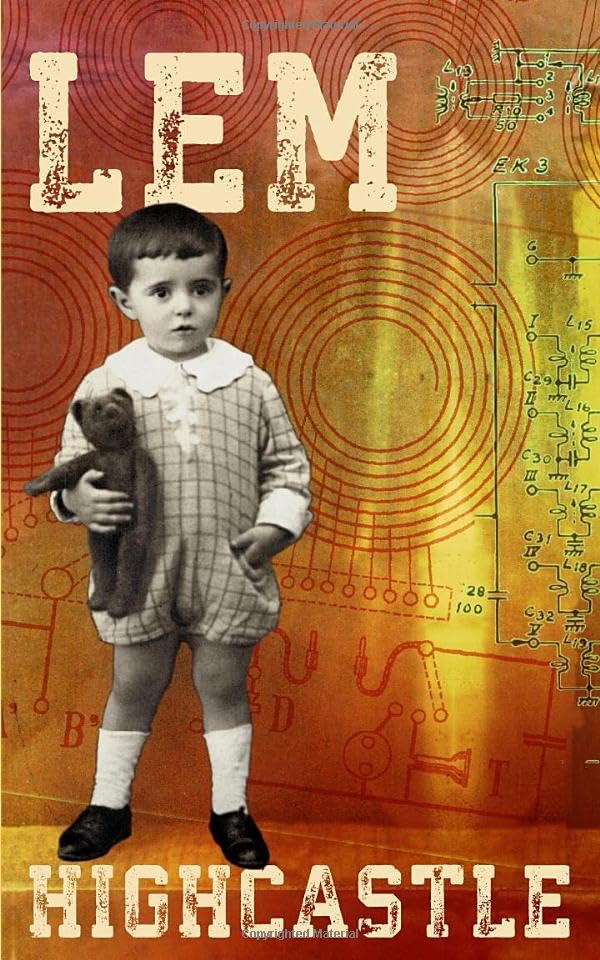
Lem’s memoir of his childhood and youth in interwar Lwów. It ends before the war, and it isn’t about events. It’s about the way a child’s mind works: the toys he took apart to see what was inside, the invented documents and identity papers he made up for imaginary kingdoms, the terrors and the fascinations of the family apartment, his father’s medical practice and the city itself, with its parks and its hill, the High Castle of the title.
Lem insisted it wasn’t a novel and that nothing in it was invented, and he also spent much of the book doubting that memory can be trusted, which makes it very much his book. Readers of his fiction will find the germ of a great deal here, including the boy’s love of machines and documents that later turns into the robot fables and the bureaucratic nightmares. It’s short and warm, one of the gentlest of his books. Michael Kandel translated it (Harcourt Brace, 1995).
Stanisław Lem: Deep Dive & FAQ
Lem in English: Kandel, the Relays and the New Translations
Much of Lem’s English reputation rests on one translator. Michael Kandel, an American who began translating Lem in the early 1970s, did The Cyberiad, The Star Diaries, The Futurological Congress, Mortal Engines, A Perfect Vacuum, His Master’s Voice, Fiasco, Highcastle and more, and Lem’s former agent Franz Rottensteiner has argued that Lem’s critical standing in English rests largely on how good those translations are. Kandel’s method, especially with the comic books, was to rewrite the wordplay rather than explain it, and Lem approved. Their correspondence was published in 2014, edited by Peter Swirski, as Stanisław Lem: Selected Letters to Michael Kandel.
Other books weren’t so lucky. In the 1970s a number of Lem’s novels reached English by relay, translated from a French or German version rather than the Polish. Solaris came through French, and The Invincible through German. Bill Johnston, a professor of comparative literature at Indiana University, has since translated both directly from the Polish, Solaris in 2011 and The Invincible in a version dated 2006 by one account and 2014 by another.
The newest addition is The Truth and Other Stories (2021), Antonia Lloyd-Jones’s translation for the MIT Press, described in its entry above. For Lem talking about his own work in English, Peter Swirski’s 1997 A Stanisław Lem Reader, from Northwestern University Press, is built around two long written interviews Swirski held with him in 1992 and 1994, published with Swirski’s introductory essay, his translation of Lem’s essay “30 Years Later” and a bibliography.
The practical advice is simple. For the comic books, Kandel is the translation and there’s no rival. For Solaris, the Kilmartin and Cox paperback is the version in print and Johnston’s is the one Lem’s family approved, available as an ebook and an audiobook and, since 2025, in a limited fine-press edition from Conversation Tree Press. And for The Invincible, choose Johnston.
Lem on Screen and in Games
Lem thought little of most of the films made from his books. The first was an East German and Polish production of The Astronauts, released in 1960 as Der schweigende Stern and dubbed and cut in America as First Spaceship on Venus. The Czechoslovak film Ikarie XB-1 (1963) was based on The Magellanic Cloud. An adaptation Lem did praise was Andrzej Wajda’s television film Przekładaniec (Layer Cake, 1968), from his story about a man rebuilt from so many transplants that nobody can say any longer who he is.
Solaris has been filmed three times: by Boris Nirenburg for Soviet television in 1968, by Andrei Tarkovsky in 1972, and by Steven Soderbergh, with George Clooney, in 2002. Tarkovsky’s film won the Grand Prix Spécial du Jury at Cannes, and Lem wrote plainly that he never really liked it. The novel’s page covers all three.
There are others. Inquest of Pilot Pirx (1979) comes from the Pirx stories, and Edward Żebrowski filmed Hospital of the Transfiguration the same year. Ari Folman’s The Congress (2013) grew out of The Futurological Congress, and György Pálfi’s His Master’s Voice (2018) out of the novel. German television made the Ijon Tichy series in 2007, and a 1975 animated film came out of The Cyberiad. In games, Lem is everywhere: Will Wright has cited “The Seventh Sally” as one inspiration for SimCity, and Starward Industries’ The Invincible (2023) is a faithful adaptation of the novel.
Lem, American Science Fiction and the Strugatskys
Lem was hard on his own genre. He read widely in American science fiction, and in essays collected in English as Microworlds (1984) he dismissed most of it as poorly thought out, badly written and interested in money rather than ideas, with one large exception, Philip K. Dick, whom he admired. The admiration wasn’t returned. In the 1970s Dick wrote to the FBI suggesting that “Stanisław Lem” was probably a false name used by a committee working for the Communist Party. The explanations offered since include a quarrel over royalties from the Polish edition of Ubik.
The SFWA episode described in his life above belongs to the same quarrel. Theodore Sturgeon wrote in 1976 that Lem was the most widely read science-fiction writer in the world, counting his huge readership in the Soviet Union and Eastern Europe.
The Soviet writers he’s most often read beside are Arkady and Boris Strugatsky, whose Roadside Picnic (1972) is the novel most often set beside Solaris as a story of an alien visit that humans can’t understand. Lem wrote an afterword for its German edition. Where Solaris imagines an alien mind too vast to reach, the Strugatskys imagine visitors who didn’t notice we were here, and both books were filmed by Tarkovsky, Solaris in 1972 and Roadside Picnic as Stalker in 1979.
The Strugatskys’ Zone, the stalkers, and the other alien visit Tarkovsky filmed are covered in full on my Roadside Picnic page.
The Strugatskys’ Hard to Be a God (1964), in which an observer from a utopian Earth watches a planet sink into its own dark age and is forbidden to interfere, asks the same question as Eden, from the other side: what an advanced civilization owes a society it doesn’t understand.
Their observer stranded in Arkanar, and Aleksei German’s ferocious film of it, have their own page in my Hard to Be a God guide.
Questions About Stanisław Lem
Which Stanisław Lem Book Is the Best Place to Start?
Solaris for most readers, The Cyberiad for anyone who wants comedy, and His Master’s Voice for readers who care most about ideas. The where-to-start section above has the longer answer.
How Do You Pronounce Stanisław Lem?
Roughly “sta-NEE-swaf LEM.” The Polish ł is pronounced like an English w, which is why the English spelling Stanislaw, without the stroke, misleads readers.
Did Lem Write in Polish?
Yes, all his books were written in Polish, although Fiasco was published first in German and several of his books reached English through French or German translations. His late essays and columns appeared in Polish magazines.
Which Translation of Solaris Is the One to Buy?
Kilmartin and Cox’s (1970) is the paperback in print, and Bill Johnston’s (2011), from the Polish, is the one Lem’s family approved. The Solaris page compares them.
Did Lem Like the Films of Solaris?
Not much. He was unhappy with both Tarkovsky’s and Soderbergh’s, and the Solaris page has his objections.
Is Lem Hard Science Fiction?
Some of it is, in the sense that the science is taken seriously and argued in detail. His Master’s Voice, The Invincible and Fiasco are full of real physics, biology and game theory. But a great deal of his work is satire, fable and philosophy, and he disliked being filed with the genre at all.
When Did Stanisław Lem Die?
He died in Kraków on March 27, 2006, aged 84.
Where to Go Next
Lem is often read beside the Polish and Central European writers of his generation, and another Polish fantasist, Bruno Schulz, grew up a few dozen miles from Lwów, in Drohobych. The hub gathers them.
And his Polish neighbors, from Miłosz and Szymborska to Gombrowicz and Tokarczuk, are gathered on my Eastern European literature hub.