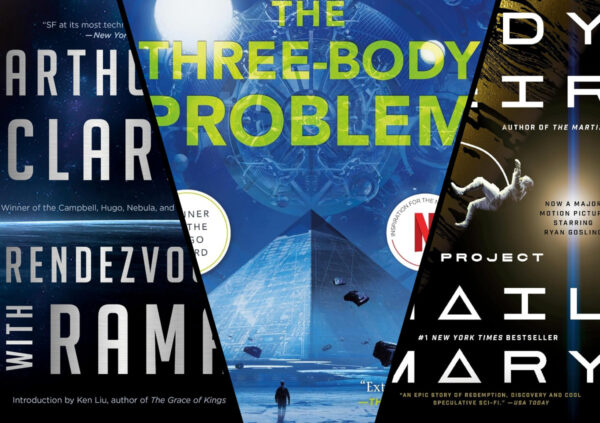
The Three-Body Problem is the novel that opens Liu Cixin’s trilogy, and it starts somewhere very few science-fiction novels start: Tsinghua University in Beijing in 1967, at the height of the Cultural Revolution. A young woman named Ye Wenjie, trained in astrophysics, watches a crowd of Red Guards turn on her father, a physics professor. Decades later, a nanomaterials researcher in present-day Beijing starts seeing a countdown that nobody else can see. The two threads meet at a secret military base in the mountains, a radio signal sent into space, and a video game that shouldn’t exist.
It was serialized in China in 2006, came out in English in 2014 in Ken Liu’s translation, and in 2015 became the first novel by an Asian writer to win the Hugo Award for Best Novel. Since then it has picked up a former US president as a fan, a thirty-episode Chinese TV series and a Netflix show from the makers of Game of Thrones.
This page covers book one on its own terms: the premise without spoilers, who’s who, the game inside the book, the real physics behind the title, the ideas underneath, how the English edition rearranged the chapters, the prizes, the screen versions and other adaptations, how long it takes to read, and which edition to buy. Nothing here gives the ending away.
The whole trilogy in reading order, plus Liu Cixin’s short fiction and the rest of his books, is covered on my Cixin Liu books guide.
Fiction by René Rehn


What the Three-Body Problem Is About
The book runs on two timelines. The first is Ye Wenjie’s. After what she sees in 1967, she’s sent to a labor brigade in Inner Mongolia, cutting timber, with a record that marks her as politically unreliable. Her training in astrophysics gets her transferred to Red Coast Base, a secret installation on a mountaintop with an enormous radar dish, where nobody will tell her what the dish is for.
The second timeline is contemporary. Wang Miao is a researcher working on an ultra-strong nanomaterial, and one day a police officer and a pair of military officers turn up at his door. Leading scientists around the world have been dying, some of the best physicists alive among them, and the authorities want Wang to join a group called the Frontiers of Science, whose members seem connected to the deaths. Then the countdown starts appearing in the photos Wang takes, and later in his own eyes.
The official Tor jacket copy gives away the big premise, so there’s no harm in saying it here: a signal sent from Earth during the Cultural Revolution is picked up by an alien civilization on the brink of destruction, and that civilization decides to come. How that happened, who answered, and what the aliens are doing in the meantime is the mystery the rest of the book unpicks. The three body problem of the title is the aliens’ problem, as much as it is Newton’s.
Who’s Who
- Wang Miao: a nanomaterials researcher and keen amateur photographer, the book’s eyes in the present day.
- Shi Qiang, called Da Shi: a blunt, chain-smoking police detective who sees through people faster than the scientists do, and the book’s most popular character by some distance.
- Ye Wenjie: an astrophysicist whose life began to break in 1967, and the center of the Cultural Revolution chapters.
- Ye Zhetai: her father, a physics professor.
- Yang Dong: Ye Wenjie’s daughter, a string theorist, part of the mystery Wang is pulled into.
- Ding Yi: a theoretical physicist who was close to Yang Dong.
- General Chang Weisi: the army officer running the investigation into the scientists.
- Shen Yufei: a physicist and member of the Frontiers of Science.
- Wei Cheng: Shen Yufei’s husband, a withdrawn mathematical prodigy with an obsession of his own.
- Mike Evans: the son of an American oil magnate, who meets Ye Wenjie in the 1970s and becomes a radical environmentalist.
- Lei Zhicheng and Yang Weining: the officers in charge of Red Coast Base.
The Three-Body Game
About a third of the way in, Wang is given access to a virtual reality game called Three Body. He puts on a haptic suit and a headset and finds himself in a world with a sun that behaves wrongly. Sometimes it rises and sets on a steady schedule, the Stable Eras, when civilization can grow. Sometimes the sky goes haywire, days last months, the sun vanishes for years or scorches the land, and those are the Chaotic Eras. The people of the game survive the bad times by dehydrating themselves into rolled-up husks and waiting, then soaking themselves back to life when the weather settles.
The goal of the game is to work out what the sun is doing. Each time a civilization fails, the game restarts with a new one, numbered, and the players walk among avatars of real historical figures: King Wen of Zhou, Mozi, Confucius, Copernicus, Galileo, Newton, the emperor Qin Shi Huang. The most famous sequence has Newton and John von Neumann persuade the emperor to turn his army of millions into a working computer, each soldier a logic gate holding a flag. It’s the passage readers quote most, and the one that tends to win over people who found the opening chapters slow.
Who built the game, and why it recruits the players it does, is one of the book’s central mysteries.
The Real Three-Body Problem, Briefly
The title comes from physics. Two bodies orbiting each other under gravity, a planet and its star, follow a neat, predictable path that Newton could solve. Add a third body and the math stops cooperating. In the 1880s Henri Poincaré showed that there’s no general formula that gives you the positions of three gravitating bodies for all time, and his work on the problem is usually counted among the foundations of chaos theory. Small differences in the starting positions grow into completely different outcomes, so long-range prediction fails.
Liu takes that and makes it a planet’s weather. A world orbiting three suns can never know what tomorrow’s sky will do, and a civilization living there has every reason to look for somewhere else to go. Alpha Centauri, the nearest star system to our own, really is a triple system, which is where the novel places the aliens.
What the Book Is About Underneath
The novel’s big ideas can be named without giving away its mystery.
The first is science under pressure. The book opens with a physicist denounced for teaching relativity, and it keeps asking what happens to science when something more powerful than the scientists decides what they’re allowed to know. In the present-day thread the same question comes back in a stranger form, as the researchers Wang meets begin to doubt that their experiments mean anything at all.
The second is progress, and how fragile it is. In the game, civilization after civilization builds itself up during the good years and is wiped out when the sky turns, and the book treats technology as the thing every civilization needs time to build and can’t count on getting. Its questions about how fast humanity can advance, and what could hold it back, run straight into the two sequels.
The third is scale. Liu has often described his fiction as coming from awe at the size of the universe, and something close to fear of it, and The Three-Body Problem is built to make human history look small against the cosmos without making it matter less. That’s the tradition Kirkus placed it in when it compared the book to “top-notch Arthur C. Clarke or Larry Niven,” with a perspective rooted in Chinese history.
Serialized in 2006, a Book in 2008
Liu Cixin wrote The Three-Body Problem (in Chinese, 三体, Santi) while he was working as a computer engineer at a power plant in Shanxi province. He had been publishing short fiction for years, most of it in Science Fiction World (科幻世界), the Chengdu magazine that was the center of Chinese science fiction, and the novel ran there in installments through 2006. Chongqing Press published it as a book in 2008, followed by The Dark Forest the same year and Death’s End in 2010. Together the three make up the series called Remembrance of Earth’s Past in English, though almost everyone calls it the Three-Body trilogy.
Ken Liu’s Translation and the Chapters That Moved
The English translation, by the American writer and translator Ken Liu, came out from Tor Books in November 2014. Ken Liu was already known for his own fiction: his story “The Paper Menagerie” was the first work of fiction to win the Hugo, the Nebula and the World Fantasy Award. He added footnotes on Chinese history and a translator’s postscript, and he’s the reason the book reads as smoothly as it does in English.
The English edition also puts the chapters in a different order. In the Chinese serialization and book, the story opens in the present with Wang Miao, and Ye Wenjie’s Cultural Revolution chapters appear in the middle as flashbacks. In the English version they come first, so the book begins in 1967.
According to Liu Cixin, that was always where he wanted the book to open. The chapters were moved in the Chinese edition because the Cultural Revolution was a sensitive subject for publication, and the translation restored the order he’d intended. It makes a real difference to the reading experience. English readers know from page one what Ye Wenjie has lived through, while Chinese readers of the first edition met her as an elderly scientist first.
How It Was Received
The Three-Body Problem was already a phenomenon in China before the translation. In English it was nominated for the Nebula Award for Best Novel, and at Sasquan, the 2015 World Science Fiction Convention in Spokane, it won the Hugo Award for Best Novel, the first win in that category by an Asian author.
It only reached the Hugo ballot through the side door. The 2015 nominations were dominated by the Sad Puppies and Rabid Puppies slates, and when Marko Kloos withdrew his slated novel Lines of Departure from the final ballot, The Three-Body Problem took its place. Then it won.
The Hugo is the best known of its prizes, not the first. In China it had already won the Galaxy Award, the country’s leading science fiction prize, in 2006.
In English it was also a finalist for the John W. Campbell Memorial Award and the Locus Award and a nominee for the Prometheus Award in 2015, and the translations kept collecting honors abroad: Germany’s Kurd Laßwitz Award for best foreign work and Spain’s Premio Ignotus (both 2017), Italy’s Premio Italia for best international novel (2018) and Japan’s Seiun Award for best translated novel (2020). The “Arthur C. Clarke Award (2018)” on some lists is the Arthur C. Clarke Foundation’s Award for Imagination in Service to Society, given to Liu himself, not the British Clarke Award for the year’s best novel.
The famous readers followed. George R. R. Martin championed it on his blog during the 2015 Hugo season. Mark Zuckerberg made it a pick for his A Year of Books club in October 2015. Barack Obama talked about the trilogy in a January 2017 interview with Michiko Kakutani in the New York Times, calling it “wildly imaginative” and adding that the scope was immense and that reading it made his day-to-day problems with Congress seem “fairly petty.” The Netflix showrunners later said they asked Obama for a cameo and got a polite no.
Readers who come to it now often describe the same experience. The opening is harrowing, the middle is a slow police procedural with odd science, and then the game and the big ideas take over and the pace picks up sharply. Some readers find the characters thin next to the ideas, which is the most common complaint about the book, and one Liu’s admirers tend to concede.
The Three-Body Problem on Screen
The first adaptation was a feature film that has never come out. Yoozoo Pictures (Youzu) produced it with Zhang Fanfan directing and Feng Shaofeng and Zhang Jingchu in the leads, and it was shot in Heilongjiang between March and July 2015 for release in 2016, then 2017. It was postponed indefinitely, amid reports of internal reshuffling at the company and a poorly received first cut, and it has never been released.
The Chinese series Three-Body (三体) premiered in January 2023 on CCTV and Tencent Video. Directed by Yang Lei, it runs thirty episodes and covers the first book only, with Zhang Luyi as Wang Miao and Yu Hewei as Shi Qiang. Its big selling point is fidelity: it follows the novel closely, keeps the Chinese setting and gives the game sequences plenty of room. It later streamed in the US with English subtitles on Peacock.
Netflix’s 3 Body Problem premiered on March 21, 2024, created by David Benioff, D.B. Weiss and Alexander Woo, and it’s a much freer adaptation. The main differences from the book:
- The present-day story moves from Beijing to London, and the lone Wang Miao becomes the Oxford Five, a group of friends who studied physics together. Auggie Salazar (Eiza González) takes over Wang’s nanomaterials research and his countdown.
- Several of the five are drawn from characters in the later books, pulled forward, and season one weaves in material from The Dark Forest and Death’s End as well as book one.
- Da Shi becomes Clarence, a British investigator played by Benedict Wong.
- Ye Wenjie’s 1960s story stays in China, with Zine Tseng as the young Ye and Rosalind Chao as the older one. Jonathan Pryce plays Mike Evans and Liam Cunningham plays Thomas Wade, a character from the later books.
- The eight episodes move fast and cut much of the book’s procedural middle. The game survives, with some of its most memorable images.
As of September 2026, season two has finished filming. Netflix renewed the show after its first season, production began in Budapest in November 2025 and wrapped in February 2026, and the second season has been announced for 2026, with a third, reportedly final season to follow. Season two is shorter: six episodes, down from eight, as a crew wrap photo showing episodes 201 to 206 confirmed in March 2026, and the third season is expected to run five. No premiere date had been announced by late summer 2026.
A separate animated series from Bilibili, released in 2022, drew mainly on The Dark Forest.
Off the screen, the book has spread in almost every other format:
- A digital comic serialized on Tencent Comics from 2019.
- A 100-episode Mandarin radio drama in six seasons on the audio platform Ximalaya.
- My Three-Body, a fan-made animation built in Minecraft by the creator Shenyou, which grew popular enough to be officially sanctioned and remade in computer animation.
- Rendezvous with the Future (2022), a BBC Studios documentary series released on Bilibili, which uses Liu’s fiction as a way into real science.
How Long Is the Three-Body Problem?
The Tor paperback runs about 400 pages. The original unabridged audiobook, read by Luke Daniels, is 13 hours and 25 minutes, and there’s a newer recording read by Rosalind Chao. The first hundred pages are the heaviest going, and most readers say it speeds up considerably once the game appears.
Which Edition of the Three-Body Problem to Buy
There’s only one English translation, Ken Liu’s, so the only real choice is format and country.
Paperback and Hardcover

The standard edition for most readers, with Ken Liu’s footnotes and translator’s postscript.
The Trilogy Boxed Set

If you already know you’re in for all three, the boxed set of The Three-Body Problem, The Dark Forest and Death’s End is the cheapest way to get the lot.
Audiobook, Read by Luke Daniels

The original 2014 recording from Macmillan Audio. A good choice for the procedural middle stretch, and Daniels handles the long cast well.
Audiobook, Read by Rosalind Chao

A second unabridged recording from Macmillan Audio, released on February 27, 2024, a month before the Netflix series premiered, and read by Rosalind Chao, who plays the older Ye Wenjie in the show. Wikipedia dates it 2023, but the release announcements give February 2024.
Reading Order and Other Questions
Do You Need to Read the Whole Trilogy?
The first book resolves its own mystery, but it’s the opening of a much bigger story, and most readers go straight on to The Dark Forest and Death’s End. Many readers say the second book is where the series becomes what it’s famous for. The full reading order sits on the parent page.
Why Is the Series Called Remembrance of Earth’s Past?
That’s the English rendering of the Chinese series title, 地球往事 (Diqiu wangshi). Tor used it on the English covers, but in English the series is far more often called the Three-Body trilogy or the Three-Body series, after book one.
Who Translated the Other Two Books?
Joel Martinsen translated The Dark Forest (2015), and Ken Liu came back for Death’s End (2016).
Should You Watch the Show First?
The Netflix version reorders and combines so much that it won’t spoil the book’s structure, but it does reveal the book’s central mystery early. The Tencent series follows the book scene by scene, so it’s best watched afterward.
Where to Go Next
If the physics is what hooked you, the hard science fiction shelf is the natural next stop. The science-first end of the genre, from Clarke to Egan, is gathered on my hard science fiction list.
For a different take on alien contact where the visitors don’t care about us at all, the Strugatskys got there first. For first contact run in the opposite key, the Strugatskys’ Zone and the aliens who left their litter behind are on my Roadside Picnic page.
The later books go far bigger in scale, and so does the space opera shelf. Fleets, empires and centuries-long wars across the galaxy live on my space opera books list.
And for the rest of the Chinese shelf, from the classics to contemporary fiction, see the Chinese literature hub. And the wider national tradition, from the classical novels to today, is mapped on my Chinese literature hub.