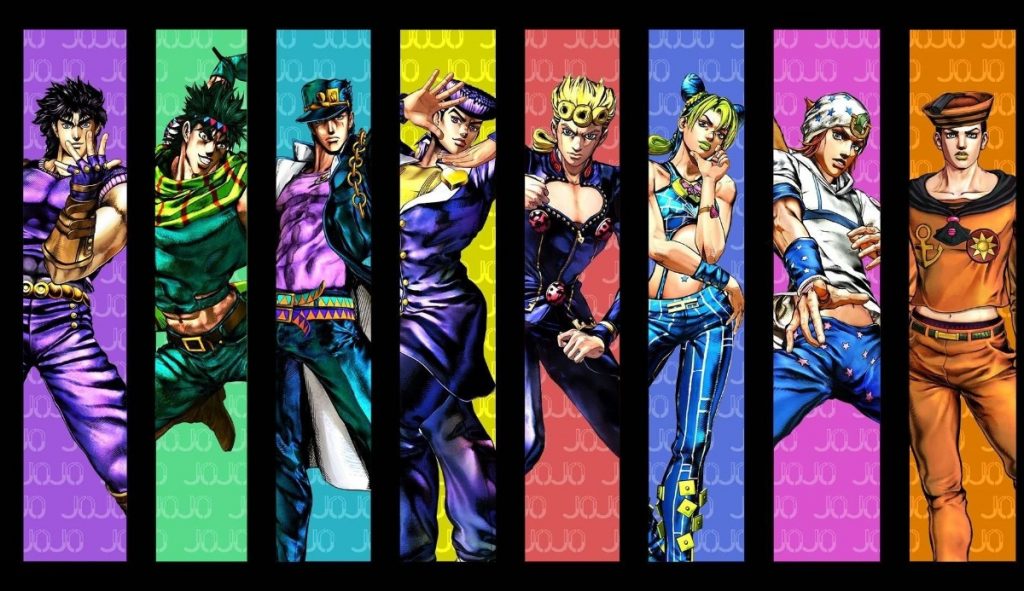
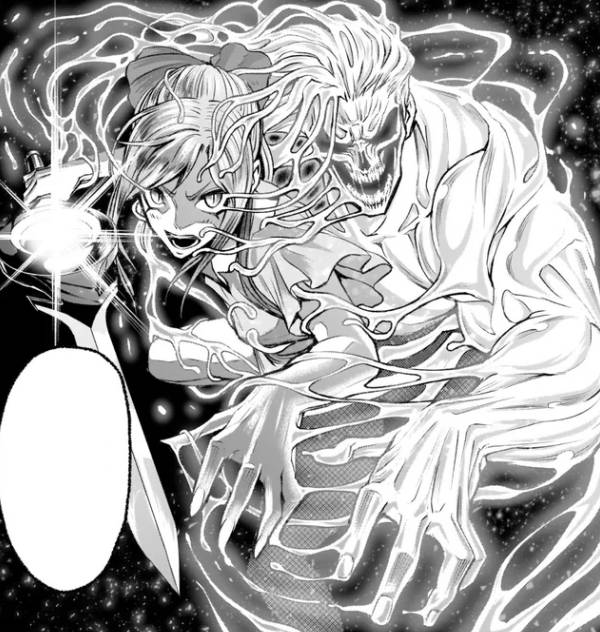
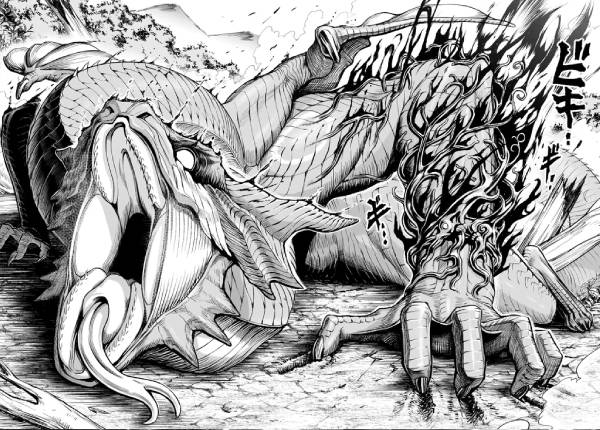
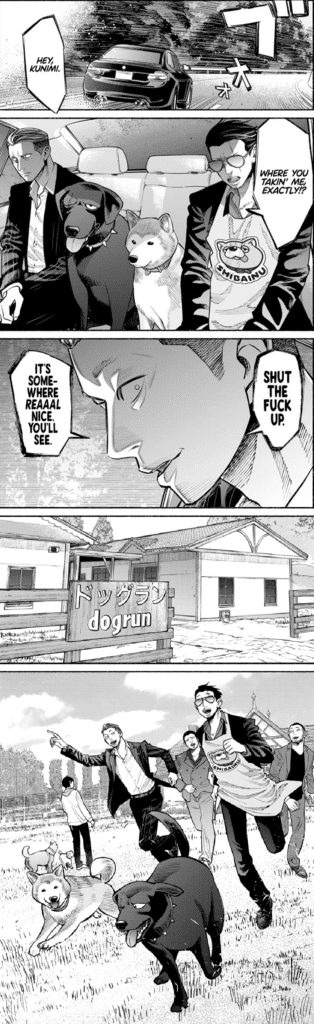
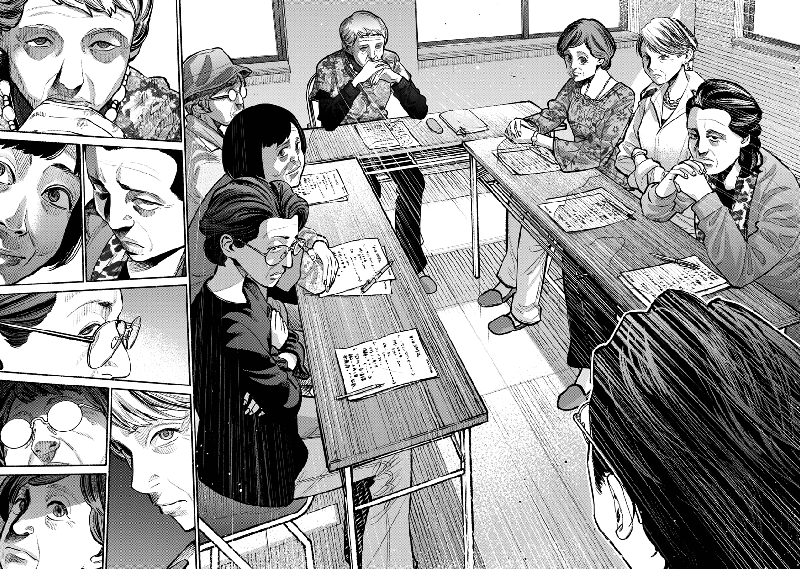
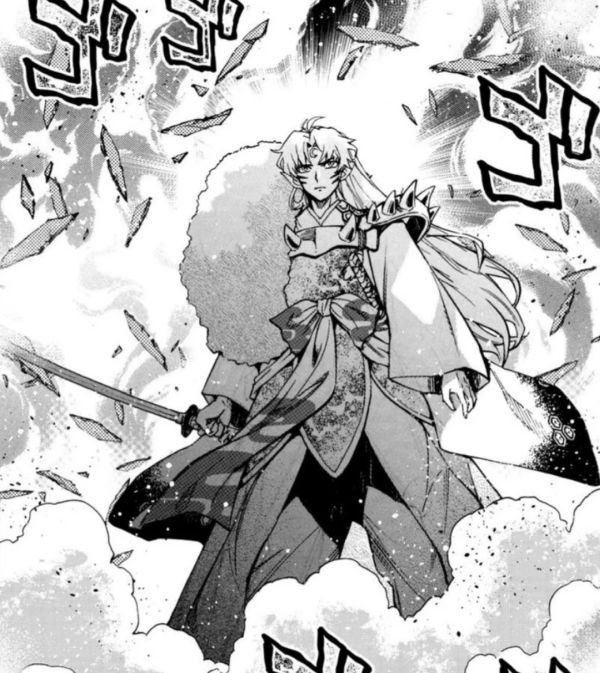
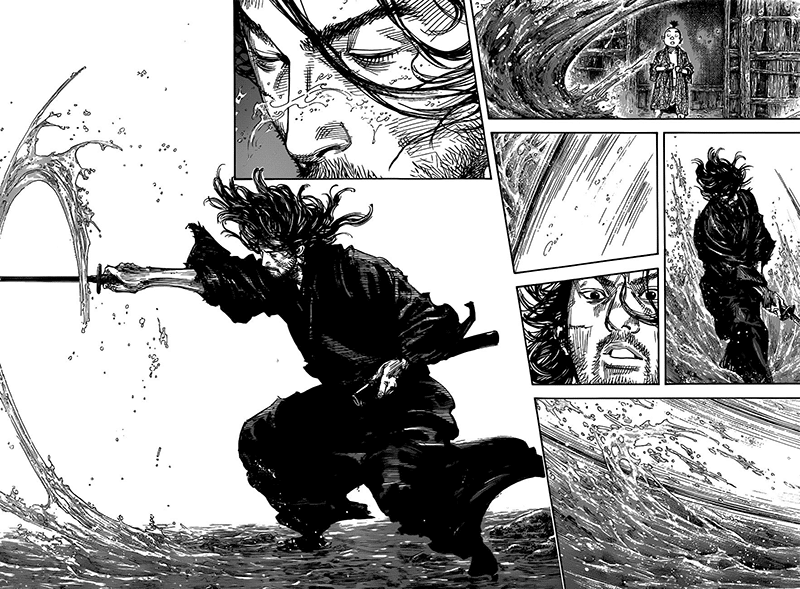
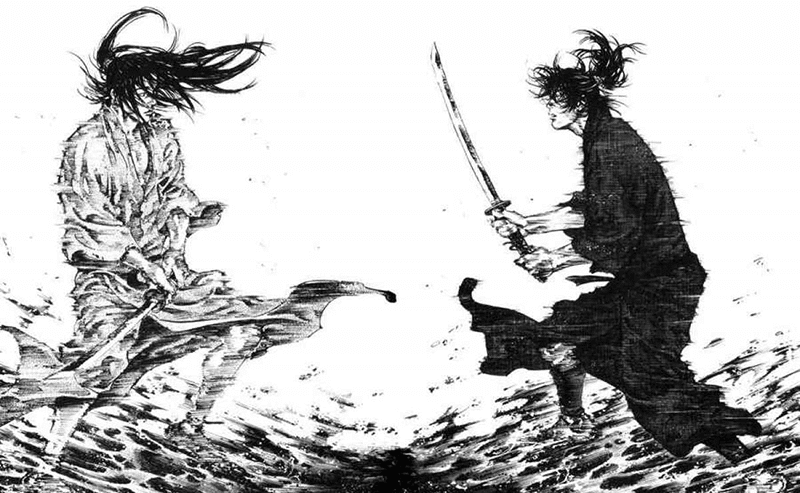
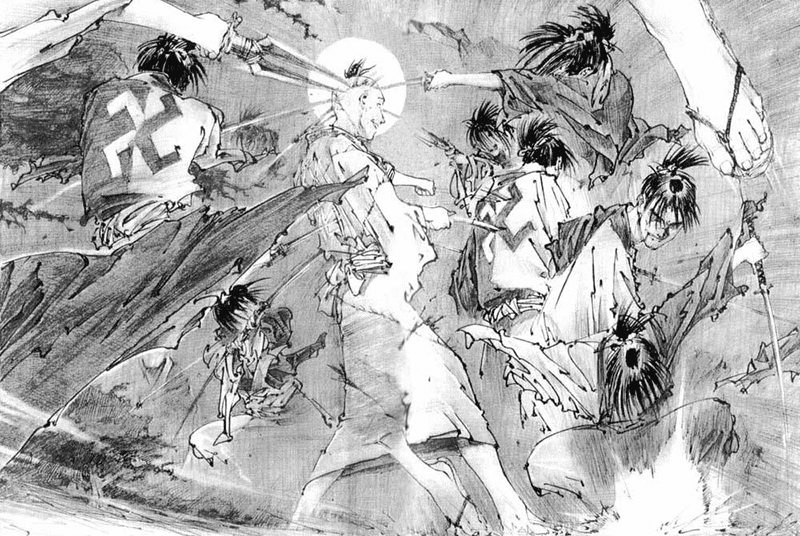
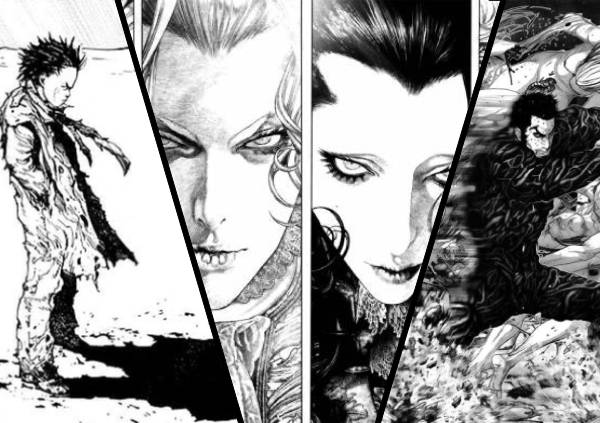
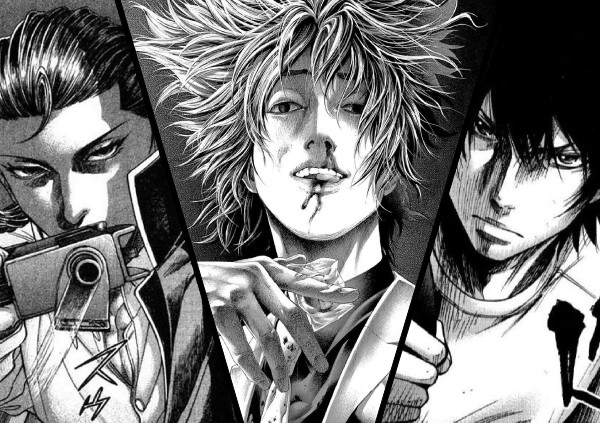
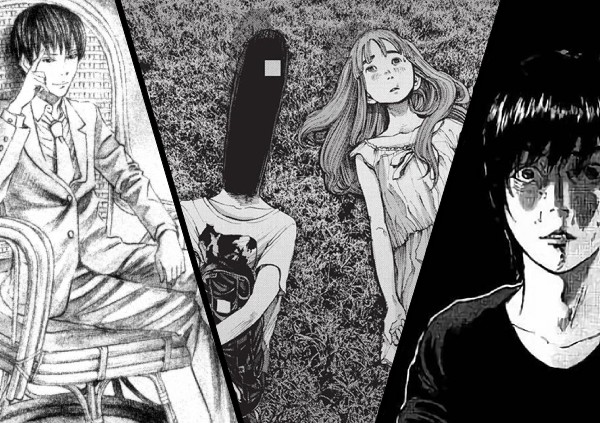
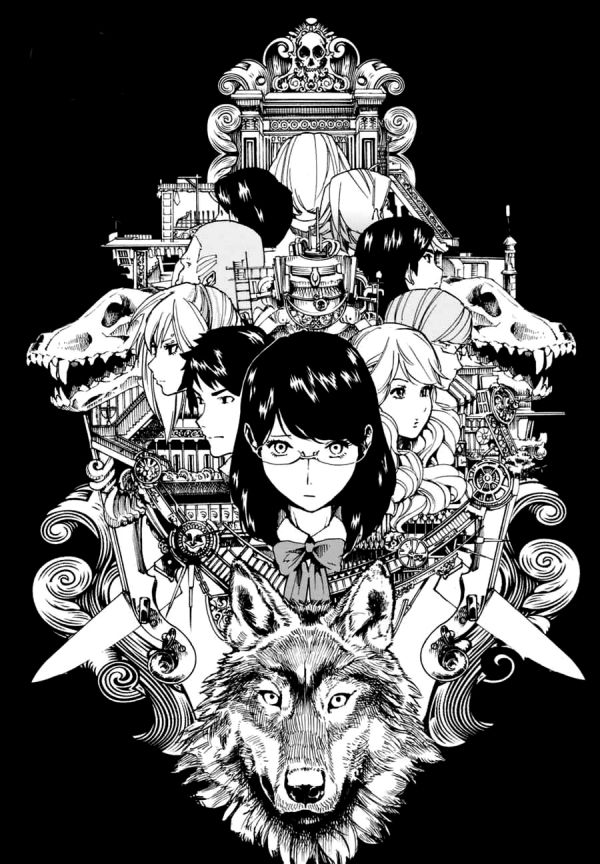
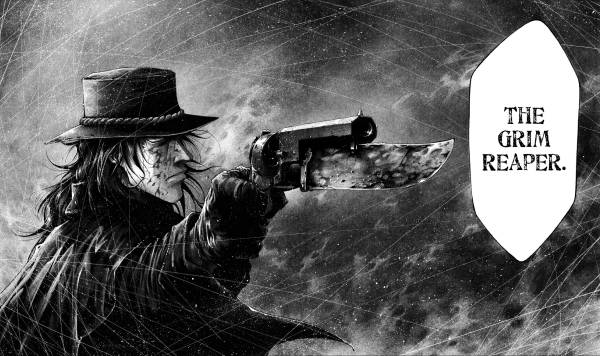
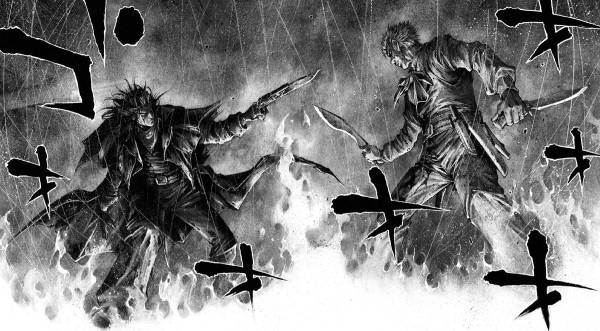
JoJo’s Bizarre Adventure has become one of the most popular manga of all time, thanks not only to its fantastic adaptation but also to Hirohiko Araki’s genius, creativity, and inventiveness. What started as a gothic 1980s battle shonen about vampires gradually transformed into one of the most unique series in manga.
One reason JoJo’s Bizarre Adventure is so beloved is that it isn’t one continuous story. It’s divided into nine main story arcs (Parts 1–9), each set in different time periods and locations. That constant reinvention is true across all JoJo parts, and it’s a big reason the series stays so fresh.
It’s easily one of the most creative series ever made, and it’s among my favorite manga of all time.
Hirohiko Araki – Jojo’s Bizarre Adventure
That said, some parts of JoJo’s Bizarre Adventure are better than others. Below, I rank all JoJo parts from weakest to strongest, based on how well each one lands in terms of characters, pacing, fights, and the electrifying weirdness that defines JoJo. If you want to see why Steel Ball Run is my pick for the best JoJo part, read on.
Phantom Blood is the very first JoJo part. While it’s a classic in its own right, it’s also the weakest overall.
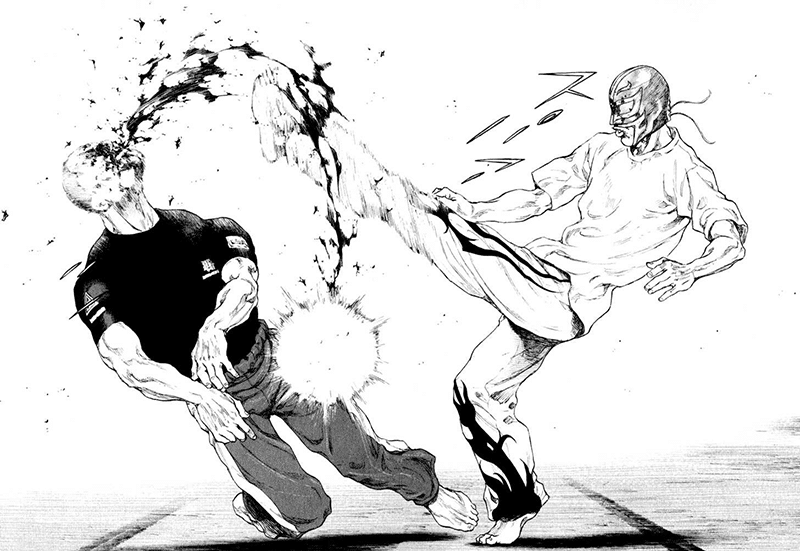
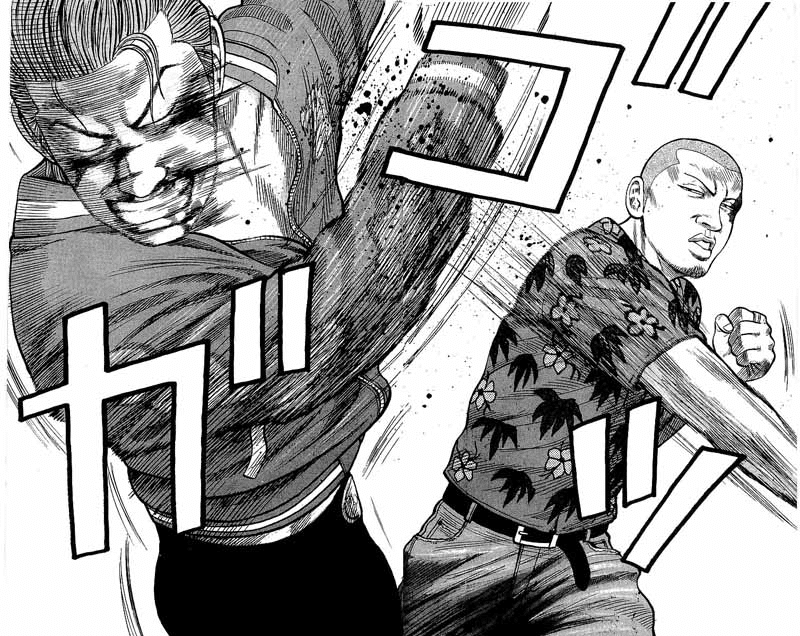
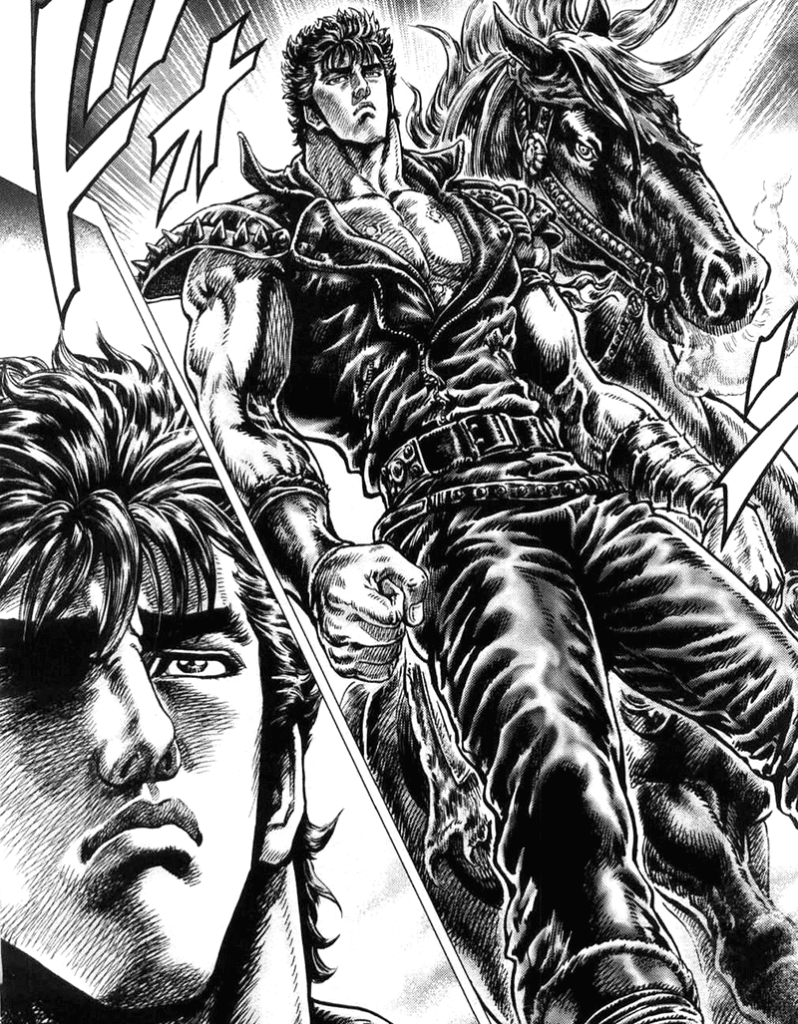
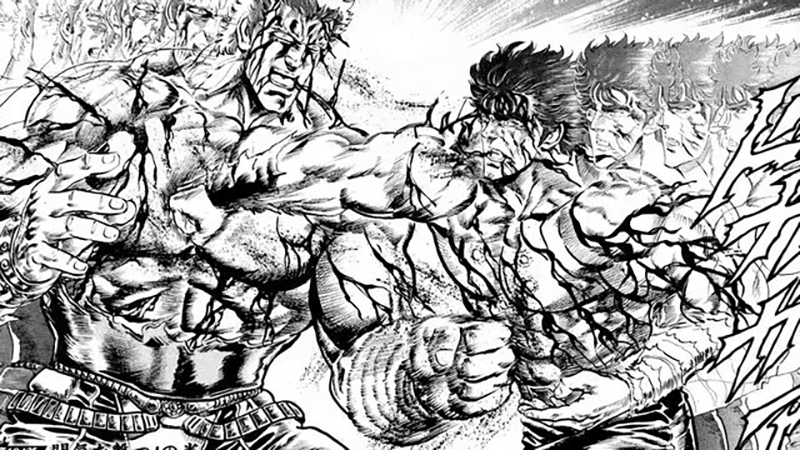
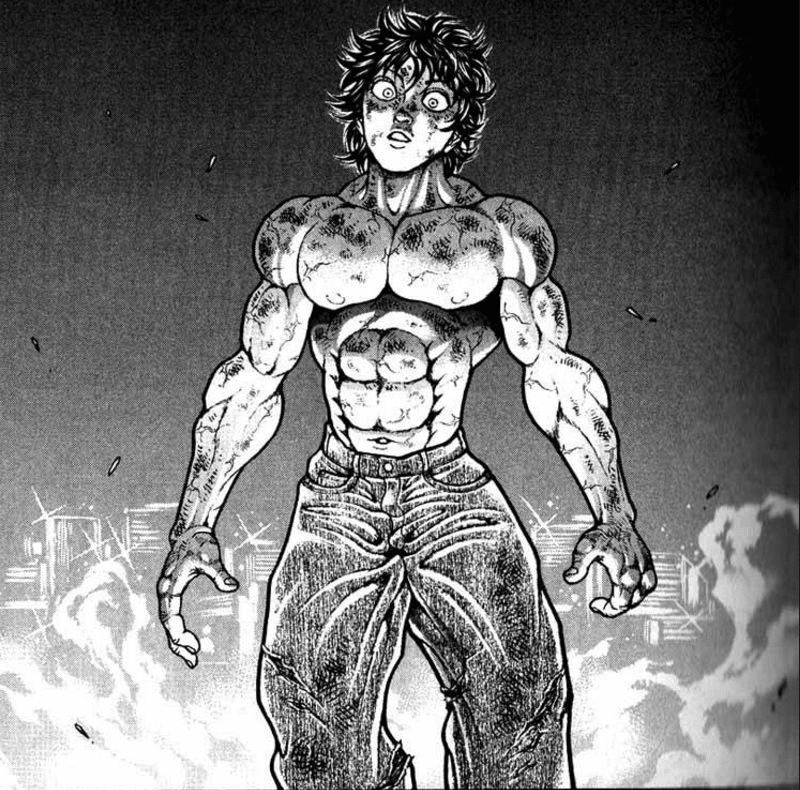
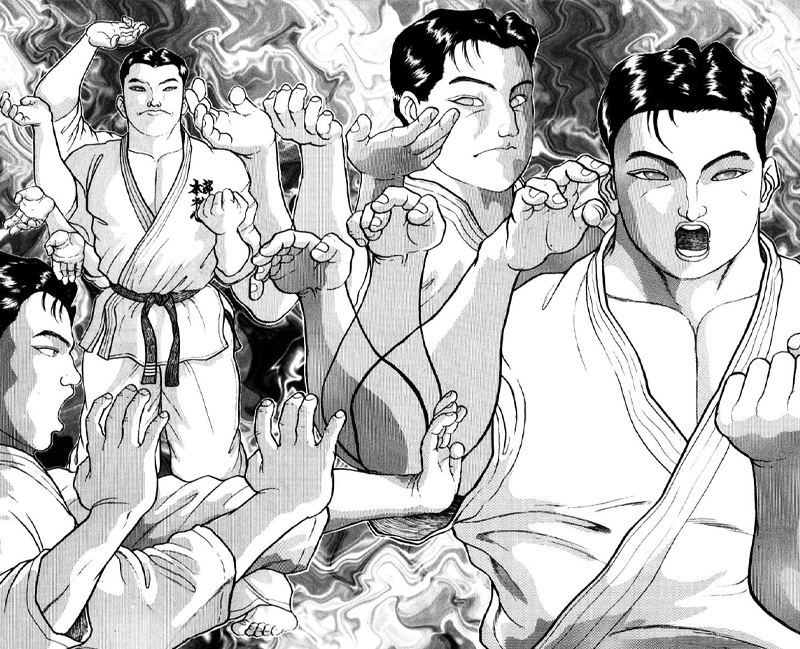
The first thing you notice is how much it feels like a product of its era. The style and art feel closer to other 1980s battle shonen manga than what JoJo later becomes, with the same heavily muscular character designs and a greater focus on straightforward man-to-man fights. In that sense, it’s reminiscent of Fist of the North Star.
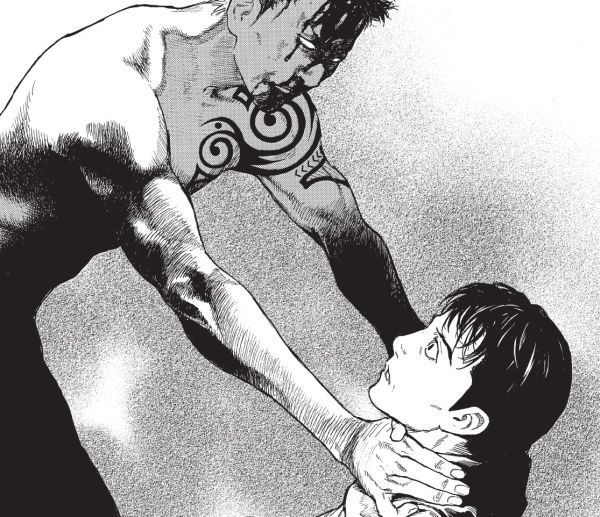
Set in late 19th-century England, Phantom Blood follows Jonathan Joestar and his adoptive brother, Dio Brando, a charming and talented young man whose family has fallen into ruin. Dio isn’t just ambitious. He’s ruthless, and he never shies away from terrible deeds to reach his goal of taking the Joestar fortune. When that plan fails, he turns to a mysterious stone mask and becomes a vampire, forcing Jonathan into a fight that starts as revenge and quickly becomes a battle to stop something far worse.
On paper, it’s a great setup: drama, betrayal, and brutal clashes with vampires. In execution, though, Phantom Blood can feel bland and formulaic. Outside of its period setting, it doesn’t stand out among other manga of its time, especially when compared to the creativity and weirdness of later JoJo parts. Jonathan has the same issue. He’s an archetypal good guy, but he’s also fairly straightforward, and he doesn’t have the personality edge that later JoJos bring to the table.
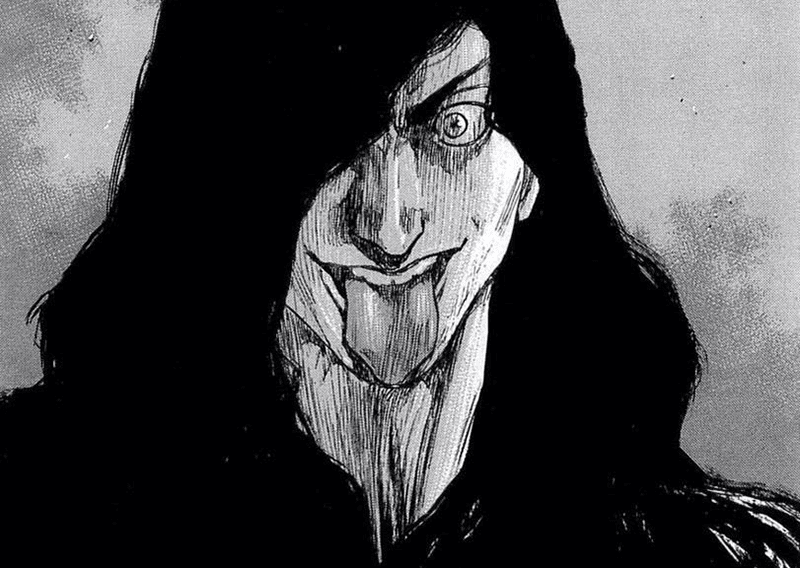
The high point is easily Dio. He absolutely steals the show. Even as Jonathan’s pure-evil counterpart, his Machiavellian scheming makes him an incredibly entertaining villain. That’s why Phantom Blood ends up at the bottom of my JoJo parts ranked list.
Battle Tendency is the second part on my JoJo parts ranked list, and it follows Joseph Joestar, Jonathan’s grandson. This one might surprise some fans, since Part 2 is beloved by a lot of the community, but it never fully clicked for me.
This time, the story delves into the origin of the stone mask and introduces its creators as the main antagonists: the Pillar Men, a race of ancient superhumans.
Battle Tendency doesn’t reinvent the series so much as refine what Phantom Blood started. It hits many of the same basic beats, but it handles them better and makes the whole ride more entertaining. The biggest improvement is the protagonist. Joseph is a clear step up from Jonathan. He isn’t a hero in shining armor. He’s a cocky trickster who wins through ploys, tricks, and psychology, and that shift makes the fights much more interesting because they rely less on sheer force and more on him outsmarting the enemy.
The problem is that a lot of what surrounds Joseph feels weaker. Part 2’s supporting cast is pretty thin overall, and some of it can be complicated, like Stroheim, the Nazi character who’s weirdly prominent. The art style has improved, but it still has that classic 1980s look that doesn’t stand out much on its own.
The Pillar Men didn’t do much for me either. They have their motifs and ideals, but as antagonists they often feel like they exist primarily as superhumans to be defeated, rather than characters with the kind of personality and presence later JoJo villains bring.
And while Joseph is definitely an improvement over Jonathan, he can also be a little jarring. He’s cocky to the point of arrogance, and some of his ‘gotcha’ moments feel less like clever strategy and more like unrealistic cop-outs or straight-up deus ex machina.
So no, I don’t think Battle Tendency is bad, and I understand why it’s so popular. It just didn’t work for me the way it does for a lot of other JoJo fans.
Stardust Crusaders was the first big JoJo part, and the one that truly put the series on the map. Even today, it’s still arguably the most well-known part overall. The main character, Jotaro Kujo, has likewise become one of the most popular JoJos of all time, helped by the fact that he reappears in later parts.
Character-wise, Jotaro is a major step forward. He initially comes across as a hot-headed delinquent, but he can be surprisingly smart, and he ends up feeling like a well-rounded mix of Jonathan and Joseph. The supporting cast is also one of the best in the series. Joseph is great as always, and characters like Avdol, Kakyoin, and Polnareff all bring their own personalities and Stand abilities to the group, which makes both the team dynamics and the battles far more engaging than in earlier parts.
The premise is simple and instantly compelling: Dio is back. When Joseph learns this, he’s hell-bent on revenge, and he enlists Jotaro, who has recently developed a Stand. This is the single change that redefined JoJo forever. Stands are physical manifestations of a character’s life force that grant them superhuman abilities, and their importance to the series can’t be overstated. They became the defining power system from this point onward, and they’re what allowed Araki to create increasingly complex, creative battles.
Once Jotaro agrees to help, the story turns into a globe-spanning adventure, with the crew traveling from Japan to Egypt to defeat Dio once and for all. That journey gives Stardust Crusaders a great sense of scale and momentum, and its legacy is unmistakable.
Stardust Crusaders frequently appears high on JoJo parts ranked lists, but I’ve always felt it’s a bit overrated. The pacing is off, especially in the first half, and it takes a while to really get going. There are also a few plot points that could be cut without losing anything.
The art is another mixed bag. It’s a clear improvement over Phantom Blood and Battle Tendency, but it still feels old-fashioned, with the same emphasis on buff, muscular character designs. And while Stands are a fantastic addition, you can also tell Araki was still testing the waters. Here, they can be hit or miss, especially early on. Some fights feel gripping, others feel more like rough experiments.
Still, Stardust Crusaders is a fantastic JoJo part. The cast is strong, the adventure vibe is great, and it laid the groundwork for everything that followed. It’s just not as refined as the parts that came after it.
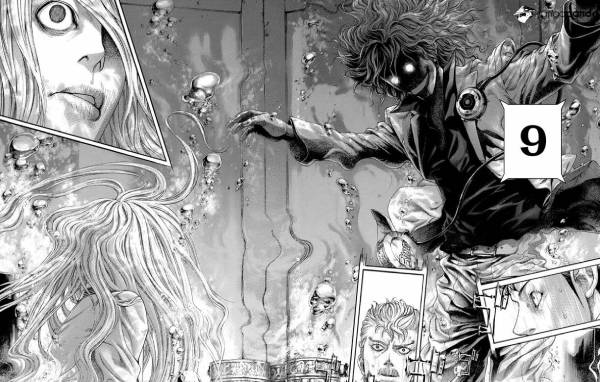
Hirohiko Araki – JoJo’s Bizarre Adventure: Part 9 – The JOJOLands
The JOJOLands is the newest JoJo part, centering on Jodio Joestar, and it’s a testament to the fact that Araki can still reinvent the series more than three decades into its run. It feels strikingly modern, but it’s still purely JoJo in the way it escalates tension, twists expectations, and builds conflict around strange rules.
Set in Hawaii, Part 9 doesn’t revolve around a heroic quest but around money, ambition, and crime, and follows a cast that’s willing to break the law to get ahead. When they come upon a strange lava rock tied to wealth, they run into people who’d do anything to get their hands on it. It’s a simple hook, but it creates a central mystery that keeps the early arcs moving. This makes it likely it’ll eventually place higher on this JoJo parts ranked list.
Jodio is a great protagonist. He’s less righteous and more volatile and calculating, and he’s willing to escalate violence without hesitation. This gives the part an edge that earlier ones didn’t have. The supporting cast is equally strong, with a unique group of characters all with their own motivations and loyalties.
Araki’s art remains fashion-focused and expressive, and the Stands are as bizarre as ever. Still, as fresh and confident as The JOJOLands feels, it’s too early for me to make a full judgment yet.
Hirohiko Araki – JoJo’s Bizarre Adventure: Part 6 – Stone Ocean
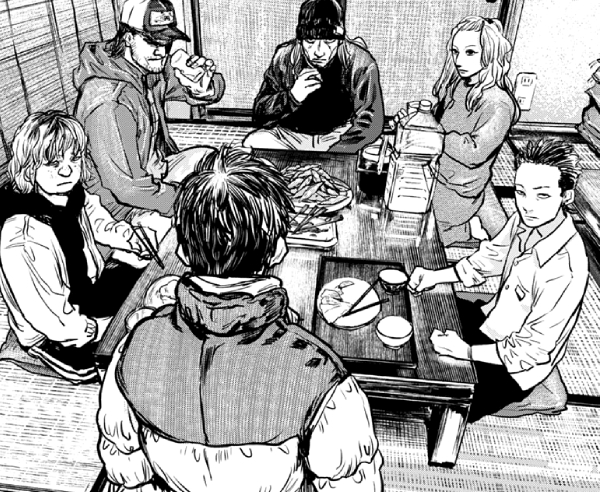
Stone Ocean is the first part to feature a female JoJo, Jolyne Cujoh, the daughter of Jotaro Kujo. After being framed for a murder she didn’t commit, she’s sent to Green Dolphin Street Prison, only for her conviction to be revealed as part of a much bigger conspiracy tied to Dio’s legacy, orchestrated by one of his disciples: Father Enrico Pucci.
On the premise alone, the prison setting is a fascinating choice. The mystery surrounding Jolyne’s framing, the prison itself, and Pucci’s larger plan is handled well and keeps the part engaging.
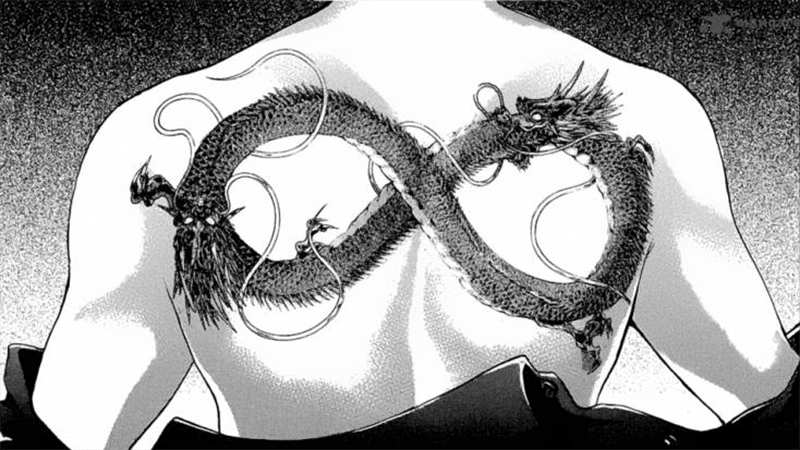
Stone Ocean is also, in my opinion, the weirdest entry on my JoJo parts ranked list. It features some of the most bizarre Stands Araki has ever created, including Weather Report and Dragon’s Dream, which can genuinely be hard to wrap your head around at first. But that strangeness isn’t really a downside. If anything, it leads to some great, dynamic, and inventive JoJo fights that feel unlike anything in the earlier parts.
The cast is just as strange when compared to earlier parts, to the point that Stone Ocean’s crew can almost feel alien. For me, it’s a mixed bag. I really liked characters like Weather Report and Ermes Costello, but I can’t say the same for Emporio or Anasui, which made the ensemble feel less consistent than the better JoJo groups.
Even though I enjoyed Stone Ocean overall, I still had some issues with it. The first is the prison setting itself. It’s intriguing at the start, but over time it felt the story stagnated because it was so locked to one location. After coming straight from Part 5’s beautiful setting, it can feel a bit uninspired, like the part is suffering from same-location syndrome.
The other issue is the weirdness. Weird and bizarre ideas are obviously the point of JoJo, and I’m usually a big fan of that, but Stone Ocean occasionally takes it a bit too far. This is especially true of the ending, which I enjoyed for its boldness, but it’s also easy to see why it remains controversial among fans.
Hirohiko Araki – JoJo’s Bizarre Adventure: Part 8 – JoJolion
JoJolion is the most recently completed JoJo part.
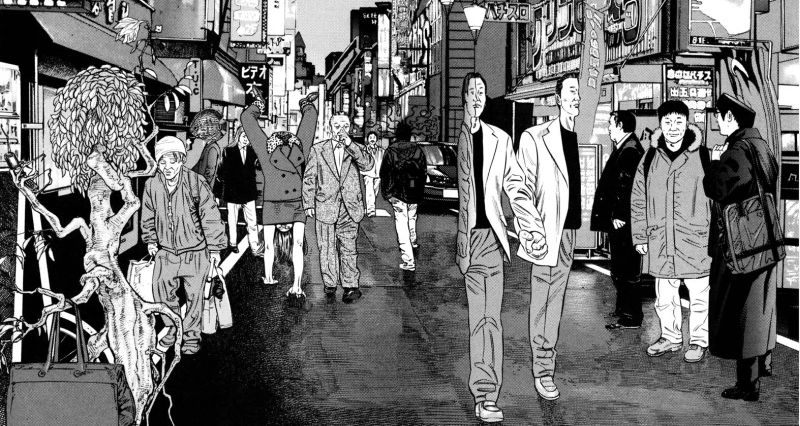
This part returns to Morioh, but not the Morioh from Diamond Is Unbreakable. It’s set in the alternate universe continuity that Steel Ball Run introduced, and it follows a different version of Josuke Higashikata. The most interesting part is that this Josuke is entirely shrouded in mystery. He wakes up near a strange landmark that’s appearing all over town, with no memories of who he is, and the story follows him as he tries to regain his memories and identity. That amnesia angle makes him a genuinely unique protagonist, since he’s essentially a blank slate with no background.
JoJolion was also my first venture into JoJo by complete accident. I randomly picked a manga to read, and it happened to be JoJolion, which meant I was diving into Stands, JoJo logic, and the alternate universe with no context. Needless to say, it was weird as hell. I knew nothing about the series, so the whole experience felt like a fever dream in the best way. It also worked, because once I realized it was the eighth part of a much larger franchise, I went back and read the entire series from the beginning.
As for JoJolion itself, the art is absolutely fantastic, and it has the expressive, modern JoJo look that feels even more bizarre than a lot of what came before it. The Stand fights are easily the highlight. They’re consistently inventive and well-done, and a lot of them feel like Araki is fully in his element, building conflicts around strange rules and creative problem-solving.
The mystery is also engaging. JoJolion keeps you wondering what’s really going on, and as it unfolds, things only get stranger. That said, some later revelations didn’t land for me as strongly as the initial setup, and the amnesiac protagonist angle is also a mixed bag. At times, it felt like too much of the story was focused on Josuke trying to learn who he is, which made the plot feel more singular and intimate than some of the bigger, more exciting narratives in other parts.
My biggest issue, though, is the main antagonist, who ended up feeling almost unrelated to a large chunk of the story, and the way he only fully entered the picture in the final chapter made the overall arc feel less cohesive.
Overall, I still had a blast with JoJolion. It has brilliant Stand concepts, fantastic battles, and a strong-mystery-driven atmosphere, but it didn’t make it to the top of my JoJo parts ranked list.
Hirohiko Araki – JoJo’s Bizarre Adventure: Part 4 – Diamond Is Unbreakable
While Part 3 – Stardust Crusaders introduced Stands, Part 4 – Diamond Is Unbreakable is when JoJo truly became what it’s known for today by changing almost every prior convention.
The biggest shift is the setting. Instead of a globe-spanning quest to stop a megalomaniac villain, Diamond Is Unbreakable drops you into the small Japanese town of Morioh. Josuke Higashikata isn’t driven by revenge or a grand mission either. He’s a normal high schooler, and that change makes the story feel much more grounded, centering on the strange events, local mysteries, and creeping oddities in one town. The supporting cast fits that tone perfectly, too, since most of them are just regular people and students who get pulled into the increasingly bizarre events around them.
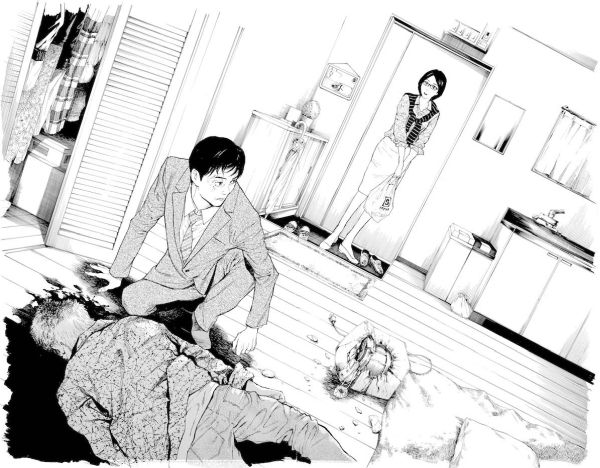
At first, the story revolves around Jotaro Kujo arriving in Morioh to track down the Bow and Arrow, an artifact capable of awakening Stands in others. Diamond Is Unbreakable truly shines in its second half, which is why it frequently appears at the top of JoJo parts ranked lists. That’s where the part reveals Yoshikage Kira, one of JoJo’s most beloved antagonists and a genuinely fascinating character. Kira isn’t trying to rule the world. He just wants to preserve his quiet, normal life while continuing his private pleasures of murder. That grounded motivation makes him even creepier than many larger-than-life JoJo villains, and it gives the whole part a steady, escalating tension.
Diamond Is Unbreakable is also a turning point visually. It starts out closer to Part 3’s look, then gradually shifts into the more effeminate, fashion-heavy, and bendy character designs that would dominate the series going forward.
Stands evolve just as dramatically. This is where they become more defined and, frankly, more interesting. Straightforward combat Stands take a step back, and you see weirder, more utilitarian abilities that turn fights into problems to solve rather than brute-force brawls.
Overall, Part 4 is one of the greatest JoJo parts for its intimate setting, the way it reshapes the series’ identity, and of course, for Yoshikage Kira.
Hirohiko Araki – JoJo’s Bizarre Adventure: Part 5 – Golden Wind
It was a tough choice picking the #2 spot among the best JoJo parts between Diamond Is Unbreakable and Golden Wind, but eventually Golden Wind pulled through.
Interestingly, this is a JoJo part that’s almost entirely removed from the rest of the series, apart from a few cameos. It centers on Giorno Giovanna, the illegitimate son of Dio, who plans on taking over the Neapolitan mafia and becoming a ‘Gang-Star’. That goal immediately puts him into conflict with other Stand users, and eventually with the boss of Passione itself, Diavolo, the very man Giorno intends to replace.
Giorno is a solid protagonist. He’s intelligent and calm, with a strong sense of pride and justice, and he has a clear ambition that drives the entire narrative. That said, he’s also frequently outshined by the people around him, and the most important of them is Bruno Bucciarati. Introduced as a minor antagonist, Bucciarati quickly becomes Giorno’s biggest ally and essentially steals the show. There’s a reason he’s often called the ‘true’ protagonist of Part 5.
The group that gathers around them is a ragtag bundle of misfits, each with their own quirks, motivations, goals, and, of course, Stands. They’re among the best ensembles in all of JoJo, and the character dynamics are a constant delight. Even when the story slows down, their chemistry keeps it entertaining.
Visually, Golden Wind is stunning. The art feels like the perfection of what Araki developed in Part 4, and the Italian setting has that Greco-Roman beauty that makes the whole arc feel stylish and larger-than-life.
The true high point, though, is the fights. The Stand abilities here are among the most creative, complex, and interesting in the entire series, and the battles are consistently dynamic and gripping.
What really makes them stand out is how often they’re team fights. A lot of the best encounters aren’t one-on-one. They’re two-on-two, or a shifting group struggle, which gives the action a tactical edge and makes it feel fresher than what came before.
My criticisms are minor, but they’re worth mentioning. The first is Diavolo. He looms over the story as an ever-present threat, constantly referenced and built up, but he doesn’t fully step into the spotlight until late in the arc. The second is that some Stand abilities can be genuinely hard to understand. Gold Experience is one example, and King Crimson is infamous for being one of the most confusing Stands in the series.
Even with those issues, Golden Wind is fantastic and deserves its high spot on this JoJo parts ranked list. It has an incredible cast, great character dynamics, and some of the most dynamic fights JoJo has ever delivered.
Hirohiko Araki – JoJo’s Bizarre Adventure: Part 7 – Steel Ball Run
Steel Ball Run is a fan favorite, and it’s easy to see why so many people consider it the peak of the series. It feels like a culmination of everything Araki created up to that point, and in my opinion, it’s still the best JoJo part.
In many ways, Steel Ball Run works as a soft reboot. It takes place in an alternate universe, complete with alternate versions of familiar names and ideas, but it’s also confident enough to stand entirely on its own.
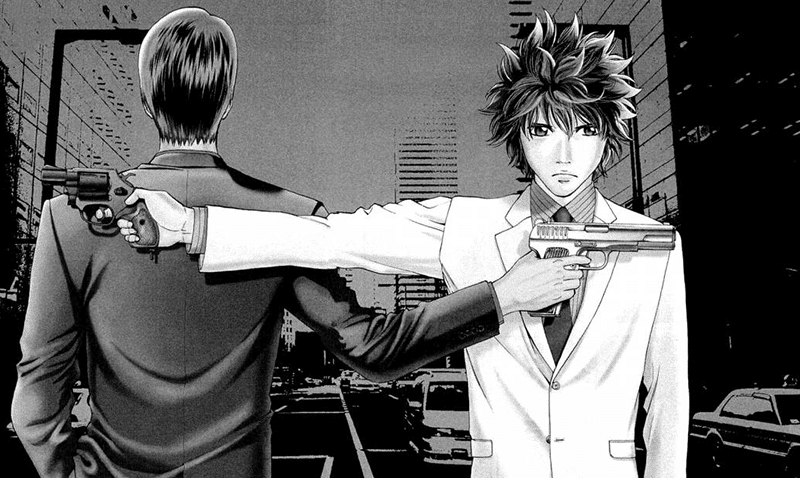
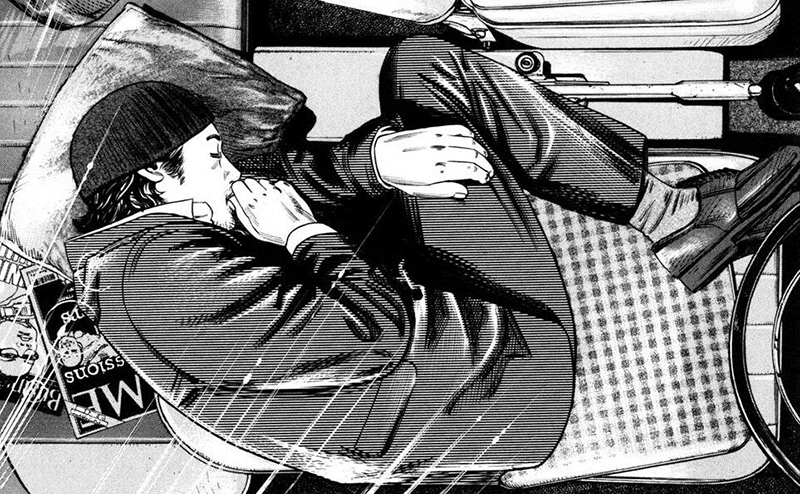
The protagonist is Johnny Joestar, an alternate-universe version of Jonathan, and he’s introduced in a way that immediately sets this part apart. Johnny is a paraplegic former jockey who comes to watch a transcontinental horse race across the United States: the Steel Ball Run. Before the race begins, he meets Gyro Zeppeli, a mysterious competitor who wields steel balls as his weapon. After a duel where Gyro demonstrates his strange technique, the Spin, Johnny briefly regains the use of his legs, and the two team up to enter the race together.
The framing alone is brilliant. The race keeps the pacing high even before the main plot kicks in, because there’s always a tangible sense of movement, pressure, and competition. And once the stakes rise, it gets even better. The horse race isn’t just a race. There’s a deeper motive behind it, and that’s where the part’s main antagonist enters the story: Funny Valentine, the President of the United States, who has his own larger goal tied to what the race is really about.
Where Steel Ball Run stands out the most is the characters. Johnny and Gyro are both fantastic, and they’re easily the best duo in all of JoJo. Their dynamic carries the part emotionally and narratively, and watching their relationship evolve is one of the most satisfying arcs in the entire series. On top of that, the roster of other participants is strong in its own right, with standouts like Sandman and Diego Brando adding constant tension and unpredictability.
Visually, this is also Araki at his best. The art is outstanding, and it feels like he’s perfected his style into something that’s consistently expressive and beautiful.
Then there are the battles. The Stands here are among the best in the series, and they lead to brutal, high-stakes fights that feel tense and inventive rather than repetitive. Gyro’s Spin is also a great addition, and it works as a clear homage to Hamon from the first two parts, while still feeling fresh.
Overall, Steel Ball Run is peak JoJo, and it’s why it sits at the top of my JoJo parts ranked list.
JoJo’s Bizarre Adventure has lasted for decades for one simple reason: it never lets itself get comfortable. Every major arc resets the series with a new time period, setting, and lead, which means it’s constantly reinventing itself without losing its unmistakable flavor.
That rotating lineup of protagonists is a huge part of why JoJo feels so addictive. Each JoJo has a different vibe and a different way of approaching conflict. Some are noble and traditional, some are loud and impulsive, some win through mind games, and some are so morally complicated they barely feel like heroes at all. Even when the premise shifts from part to part, the protagonist anchors the story, sets the tone, and determines how the series’ weirdness is expressed.
In this article, I’m ranking every JoJo protagonist and breaking down what makes each one work as a lead. I’ll talk about their personality, growth, strengths, weaknesses, and how well they carry their part overall. If you’re a fan of JoJo’s Bizarre Adventure, I hope you enjoy this ranking of all JoJo protagonists.
Mild spoiler warning: I’ll avoid major plot beats, but some character details are necessary to explain the ranking.
With that said, here’s my ranking of all JoJo protagonists (last updated: February 2026).
Jonathan Joestar is the protagonist of JoJo’s Bizarre Adventure: Part 1 – Phantom Blood.
He’s raised by his father alongside his adopted brother, Dio Brando. From the beginning, Jonathan comes across as a true gentleman, defined by honesty, kindness, and pride in the Joestar name. He’s also deeply selfless and courageous. He fights with honor and carries an unwavering moral compass.
Over the course of Phantom Blood, Jonathan grows from an innocent, naïve youth into a powerful and determined hero. In many ways, he’s the most traditional JoJo: a straightforward hero archetype who faces evil head-on and refuses to compromise on what he believes is right.
His rivalry with Dio Brando sits at the heart of Part 1 and drives the entire series forward. Dio’s influence doesn’t end with Phantom Blood either. His legacy hangs over the Joestar bloodline for generations, shaping later parts in ways that trace back to Jonathan’s original conflict.
That said, Jonathan is also the most traditional shonen protagonist in the lineup, and by far the least complex. Compared to the wildly distinct JoJos who follow him, he can feel too bland and too familiar, and he doesn’t stand out much from the other shonen protagonists of his era.
Hirohiko Araki – JoJo’s Bizarre Adventure: Part 8 – JoJolion
Josuke Higashikata, also known as Gappy, is one of the more unique JoJo protagonists, and he’s the main character of JoJo’s Bizarre Adventure: Part 8 – JoJolion.
On the surface, Gappy looks like a typical JoJo: physical strength, sharp instincts, and strong combat ability. What truly sets him apart, though, is the fact that he’s an amnesiac. JoJolion follows him as he tries to piece together who he really is, and that identity hunt becomes the core of both his character and the part’s mystery-driven structure.
Personality-wise, Gappy is a great mix of traits that don’t always sit comfortably together. He can be kindhearted and compassionate, but he can also be ruthless, brutal, and intensely logic-driven. That darker edge shows up most clearly in battle, where he often has no qualms about killing opponents in cold blood if he decides it’s necessary. Compared to many other JoJos, he feels less like a heroic ideal and more like someone operating on survival instincts and personal purpose.
His Stand, Soft & Wet, is also one of the most creative in the series. It lets him produce bubbles that can steal aspects or properties from anything they touch, which allows for some wildly inventive strategies. It’s the kind of ability that feels perfectly suited to JoJolion’s constant rule-bending fights, and it’s a huge reason the battles are consistently interesting.
That said, the amnesia angle is also what makes Gappy a relatively weak protagonist. Again and again, he ends up in conflicts he doesn’t fully understand, dealing with people and situations where the emotional stakes exist, but he doesn’t have the memories to connect with them. Still, that weakness feels intentional. It feeds directly into JoJolion’s atmosphere and its larger focus on identity, family, and truth-seeking, and it helps the story maintain that persistent feeling that something is always slightly out of reach.
Many people consider Joseph Joestar one of the best, if not the best, JoJo protagonists. He’s the lead of JoJo’s Bizarre Adventure: Part 2 – Battle Tendency.
Joseph is immediately more distinct than his grandfather. Where Jonathan is the straightforward gentleman hero, Joseph is a cocky, sarcastic trickster, and that shift gives Battle Tendency a much-needed breath of fresh air. He feels like the first JoJo who’s willing to be messy, annoying, and wildly entertaining all at once.
In battle, Joseph doesn’t just rely on physical strength or Hamon techniques. He wins through ploys, psychological tricks, and clever strategy, constantly outthinking opponents who are usually stronger than he is. That approach makes his fights feel different from Part 1’s more direct clashes, because the tension often comes from whether his mind games will actually pay off.
Over the course of the story, Joseph matures and becomes more capable and grounded than the impulsive young man he starts out as. Even so, he never truly loses that cocky jokester personality, which is a big part of why fans love him.
Personally, though, Joseph started to wear on me. His sarcasm and confidence are fun at first, but after a while they become tiring, especially when paired with his constant clever comebacks. Too often, his strategies didn’t feel like believable outplays so much as unrealistic cop-outs, or Araki leaning on a deus ex machina to let Joseph win.
So while Joseph is widely regarded as a fantastic JoJo protagonist, I never grew truly fond of him in the way other fans did.
Hirohiko Araki – JoJo’s Bizarre Adventure: Part 9 – The JOJOLands
Jodio Joestar is the protagonist of JoJo’s Bizarre Adventure: Part 9 – The JOJOLands, and he’s easily one of Araki’s best new-era leads so far. He’s a 15-year-old living in Honolulu, Hawaii, and unlike many earlier JoJos, he isn’t pulled into a grand heroic quest. He’s already operating on the fringes of crime, running jobs connected to the local underground drug trade, and chasing one specific outcome: getting filthy rich by any means necessary.
What makes Jodio stand out is his mindset. He leans into calculation and volatility over righteousness, and he can escalate to violence with almost no hesitation. That gives Part 9 a colder edge than a lot of earlier arcs, because Jodio doesn’t feel like a hero so much as a problem solver who’s willing to do awful things if he thinks it gets him closer to the goal. At the same time, he’s not portrayed as invincible or purely cool-headed. The story frames him as someone who struggles to feel genuinely happy, and he’s diagnosed with antisocial personality disorder by his school’s counselor, which adds an uncomfortable layer to how he relates to other people.
His Stand, November Rain, fits him perfectly. It generates localized rain that Jodio can manipulate, including adjusting its height and pressure to create crushing, selective downpours. It’s straightforward in concept but brutal in execution, and it supports the tactical, rule-based fights Araki is leaning into.
Because the JOJOLands is still ongoing, Jodio’s full character arc is still unfolding, so I can’t rank him higher just yet. The foundation is already strong, though: he’s ambitious, unstable, frighteningly pragmatic, and genuinely fresh compared to the JoJos who came before him.
Jotaro Kujo is the protagonist of JoJo’s Bizarre Adventure: Part 3 – Stardust Crusaders. He’s easily the most iconic and popular JoJo protagonist, and he shows up frequently in later parts, which only adds to how central he feels to the franchise.
As a lead, Jotaro works because he’s a strong middle ground between the first two JoJo protagonists. He has Jonathan’s steadiness and sense of duty, but he also has some of Joseph’s sharpness and attitude, just without the nonstop sarcasm and showboating. The result is a more well-rounded protagonist who feels tougher and less bland than Jonathan, while also being less exhausting than Joseph at his most cocky.
He’s also one of the strongest characters in the entire series, and his Stand, Star Platinum, is the reason. It’s one of the fastest and most powerful Stands in JoJo, and it makes Jotaro feel intimidating in almost every fight he’s in.
Character-wise, Jotaro stands out as a brash, stoic delinquent, and at first he can come across as cold and unlikable. But he develops noticeably over the course of Stardust Crusaders. He learns how to open up to others, shows more of his softer side, and gradually settles into a strong sense of justice that becomes one of his defining traits.
That said, Jotaro never fully clicked with me the way he does for a lot of fans. In some ways, he ends up feeling a little too close to a traditional shonen protagonist. While his early edge is refreshing compared to Jonathan, he eventually settles into something that can feel almost as familiar and heroic as Part 1. I also think Star Platinum is part of the problem. It’s so overpowered throughout Stardust Crusaders that it can flatten tension, because you often feel like Jotaro has an answer to everything.
The best part of Jotaro, though, is his dynamic with Joseph. Their relationship adds a lot to his character, and their interactions give him more warmth and dimension than he would have otherwise. Overall, there are plenty of reasons Jotaro is as popular as he is, but I still find several other JoJo protagonists more interesting than him.
Hirohiko Araki – JoJo’s Bizarre Adventure: Part 5 – Golden Wind
Giorno Giovanna is the protagonist of JoJo’s Bizarre Adventure: Part 5 – Golden Wind. He’s tied to both Dio Brando and Jonathan Joestar, which immediately makes him one of the most interesting JoJos in the entire lineup.
As a protagonist, Giorno is strong in a quiet way. He’s intelligent and calm, with a deep sense of pride, justice, and almost unreal determination. He also has the type of willpower that makes him feel unstoppable once he commits to a goal. At the same time, he’s not as loud or distinctive as some other JoJo leads, and because of that, he’s frequently outshined by the cast around him.
Giorno’s backstory helps explain both his ambition and his values. Growing up, he endured poverty and neglect, and his decision to enter the mafia isn’t just about gaining power or money. He wants to take control of Passione so he can eliminate the drug trade, cutting out the source of the suffering he experienced himself and saw in others. That Gang-Star dream gives him a clear moral purpose even while he’s climbing through the criminal world.
His Stand, Gold Experience, is also one of the more complex and versatile abilities in the series. It can bring inanimate objects to life, which opens up an endless range of creative uses in battle. And by the end of Part 5, it evolves even further into something that’s arguably the most powerful Stand in all of JoJo’s Bizarre Adventure.
What makes Giorno especially interesting, though, is that his strong moral compass doesn’t make him gentle. He’s ruthless when he needs to be, and at times he can feel almost comparable to Dio in how coldly decisive he is. He doesn’t shy away from fights, and he has no problem killing if he thinks it’s necessary.
That said, the greatest strength of Golden Wind isn’t Giorno alone. It’s the character dynamic around him. His interactions with the rest of the cast make Part 5 such a delight to read and one of the strongest arcs in the series. And among that cast, Bruno Bucciarati stands out the most. He’s easily one of the best characters in all of JoJo, and he’s a big reason Part 5 hits as hard as it does.
3. Josuke Higashikata (Part 4 – Diamond Is Unbreakable)
Hirohiko Araki – JoJo’s Bizarre Adventure: Part 4 – Diamond Is Unbreakable
Josuke Higashikata is the protagonist of JoJo’s Bizarre Adventure: Part 4 – Diamond Is Unbreakable.
The first thing you notice about Josuke is how different he feels from earlier JoJo protagonists. He isn’t a gentleman like Jonathan, and he isn’t a larger-than-life badass on a globe-spanning mission like Jotaro. He’s just a normal high schooler living in Morioh, and that is a big reason why Part 4 feels so intimate compared to the arcs that came before it.
His Stand, Crazy Diamond, reflects that shift perfectly. Instead of being a pure combat monster like Star Platinum, it’s closer to a support Stand, with the ability to repair objects and even heal people by restoring them to a previous state. It can still be used offensively, but its core ability feels more personal and small-town than the brute-force powers that dominated the earlier parts.
As a character, Josuke can also be a little perplexing, and that’s not a bad thing. Early on, he comes across as impulsive and even a little vain, and he’s sometimes overshadowed by the personalities around him, especially by characters like Rohan Kishibe and Koichi Hirose. But that dynamic makes him feel grounded, like someone who exists inside a community rather than dominating every scene.
Josuke’s friendly, upbeat nature makes him easy to like, and he has a talent for turning strangers into friends. At the same time, he can get serious in an instant when something crosses a line. Unlike Jotaro, though, he isn’t the type to charge blindly into danger. He avoids fights when he can, and when he does step up, it usually feels motivated by loyalty or emotion rather than ego or a need to prove himself.
All those traits, both the flaws and the strengths, are what make Josuke one of the more interesting and well-developed JoJo protagonists. His character development is a big part of it. Over the course of Diamond Is Unbreakable, he matures noticeably and grows into a more level-headed, compassionate young man, shaped by his friendships and by his connection to his estranged father, Joseph.
Despite his rough edges, or maybe because of them, Josuke remains a fan favorite and one of the most beloved JoJo protagonists.
Hirohiko Araki – JoJo’s Bizarre Adventure: Part 6 – Stone Ocean
Jolyne Cujoh is the only female JoJo and the protagonist of JoJo’s Bizarre Adventure: Part 6 – Stone Ocean.
At first glance, Jolyne can come across as a lot like her father. She has that same sharp edge, with a snappy, sassy attitude and a tendency to hit back when she’s pushed. But there’s more to her than that, and in my opinion, she ends up being a more interesting character than Jotaro because we get to see her change so dramatically over the course of her part.
Her Stand, Stone Free, is also a perfect fit for that kind of protagonist. It gives her control over strings and even allows her to unravel parts of her own body into them, which makes it incredibly versatile. She can use it for stealth and utility just as easily as combat: hiding, pickpocketing, eavesdropping, creating traps, and even swinging around the environment. It’s one of those Stands that gets more impressive the more creative she becomes.
The biggest reason Jolyne stands out, though, is her character development. Stone Ocean starts with her as a lost young woman who’s been framed for murder and thrown into prison, and it ends with her becoming a badass and the leader of her allies. You can feel that growth in everything, from how she carries herself to how she talks to how she handles both friends and enemies when the pressure rises.
In fights, Jolyne consistently shows a strategic mind. She doesn’t just rely on toughness or raw power. She uses Stone Free in clever, flexible ways, adapting to whatever insane situation Araki throws at her. That creativity makes her a formidable opponent, and it also makes her battles some of the most interesting and unique in all of JoJo.
Jolyne stands out among JoJo protagonists not only because she’s the only female JoJo, but also because her arc is one of the strongest in the series. Her growth feels earned, her fights are consistently inventive, and she’s easily one of the most memorable leads.
Hirohiko Araki – JoJo’s Bizarre Adventure: Part 7 – Steel Ball Run
Johnny Joestar is the protagonist of JoJo’s Bizarre Adventure: Part 7 – Steel Ball Run.
Set in an alternate timeline, Johnny is essentially a counterpart to Jonathan Joestar. He’s a former jockey whose life is shattered after a riding accident leaves him paralyzed from the waist down. Compared to earlier JoJos, he starts from a much darker, more fragile place, and Steel Ball Run doesn’t shy away from showing how bitter, stuck, and directionless that leaves him.
After meeting Gyro Zeppeli, Johnny enters the Steel Ball Run with one driving hope: finding a way to heal his legs. That goal shapes his entire arc. Johnny’s story is, at its core, a journey of self-improvement, a slow climb out of despair, and a fight to overcome both his limitations and his disability. Because of that, his struggles feel more personal and relatable than most JoJo arcs, and it turns him into an incredibly compelling protagonist.
In battle, though, Johnny is anything but gentle. He can be ruthless, and he has no qualms about killing when he decides it’s necessary. His Stand, Tusk, reflects that edge. It lets him fire his fingernails like bullets, and it evolves over multiple Acts, each one more powerful than the last. While Tusk isn’t as broadly versatile or conceptually weird as some other JoJo Stands, Johnny still becomes a formidable opponent because of how decisively he uses it.
Johnny can also be off-putting early on. He’s selfish, bitter, and sometimes outright unlikable. But the story makes it easy to understand where that ugliness comes from, and it never feels like cheap edginess. It feels like someone coping badly with having their entire identity ripped away.
And over the course of Steel Ball Run, that version of Johnny slowly changes. He grows into a more compassionate, confident young man, and you get to watch him genuinely earn that transformation step by step. A huge part of that growth comes from his relationship with Gyro, which is one of the best dynamics in all of JoJo. Gyro isn’t just his ally. He’s a mentor and a friend, and he pushes Johnny toward becoming someone better than the person he started as.
For all of those reasons, Johnny Joestar is my favorite JoJo protagonist and one of the greatest characters in all of JoJo.
I’m not a sports fan, and I don’t usually go out of my way to look for sports manga. Still, every once in a while, I run into a series so sharp and compulsively readable that I get pulled in anyway, even if I couldn’t care less about the sport itself.
The best sports manga aren’t really about games. They turn competition into obsession. Rivalries, training, ego, self-image, and the quiet fear of losing what you’ve built take center stage. The matches matter, but they’re usually there to show character dynamics, momentum shifts, and breaking points.
This list is short for a reason. I only want to focus on series I genuinely enjoyed, from iconic classics to raw outliers and a few more somber picks that still deliver the same intensity.
Mild spoiler warning: I’ll focus on how each manga handles pressure, progression, and character drama, but I may mention early plot details when necessary for context.
With that said, here are the best sports manga I’ve read (last updated: January 2026).
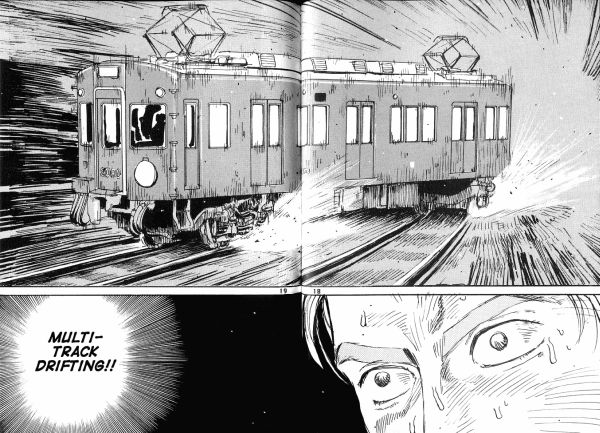
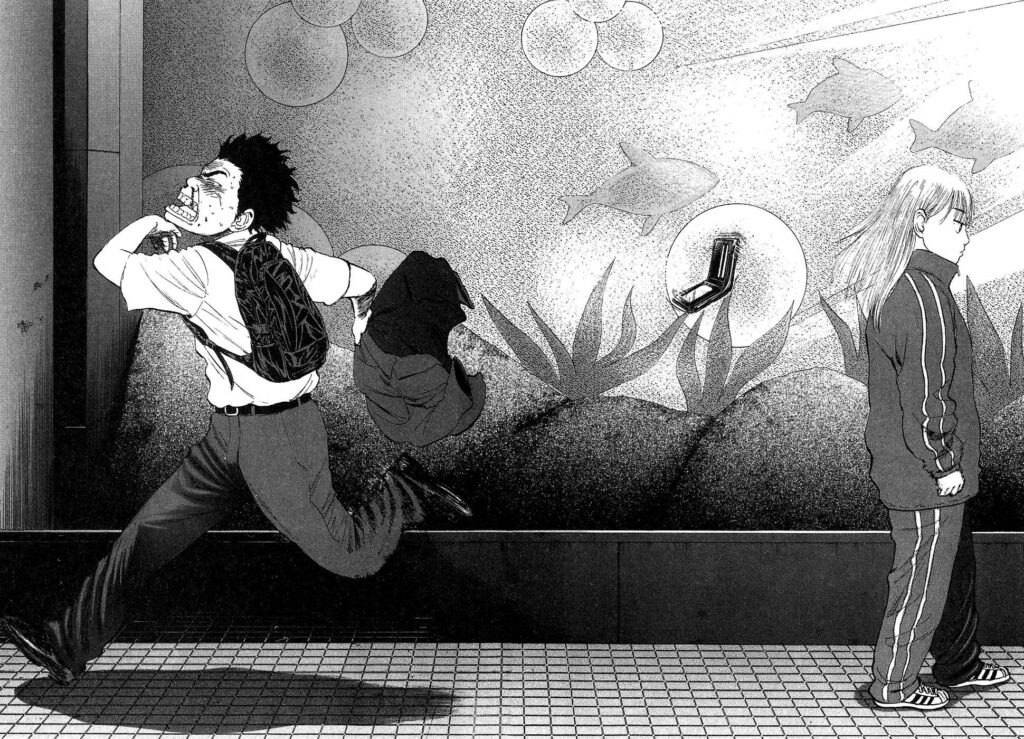
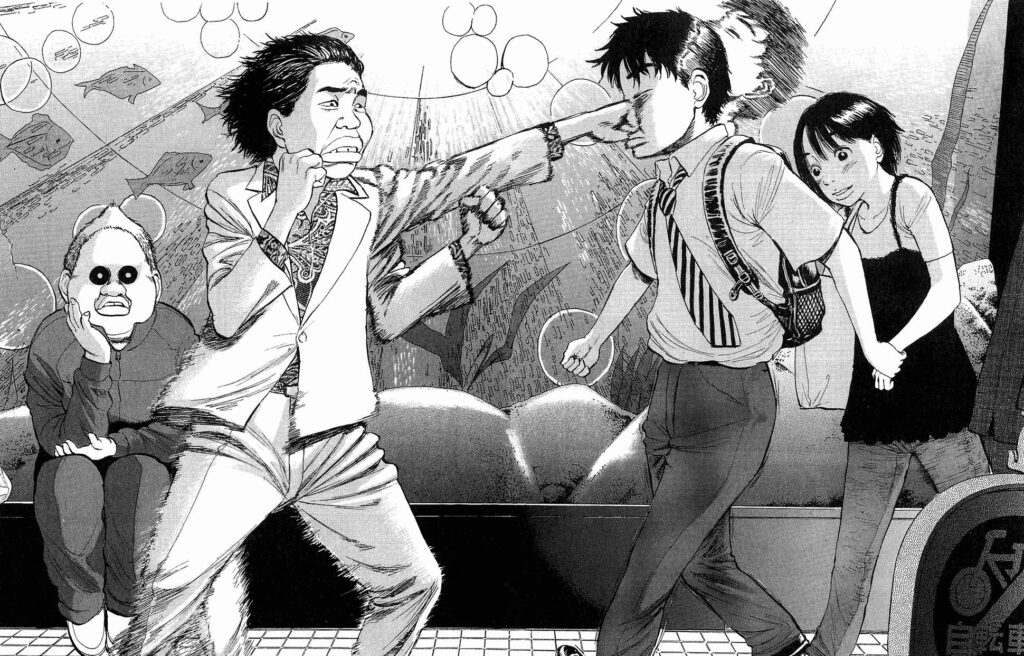
Densha De D might be the weirdest sports manga pick on this list, but it earns its spot for being one of the funniest parodies I’ve ever read. It takes the basic appeal of Initial D: high-speed duels, exaggerated techniques, and the constant tension that a single mistake can cost you the race. Then it pushes it straight into absurdity. A single change makes it genius: the racers aren’t driving cars. They’re driving trains.
That’s the entire joke, and it works. Densha De D treats rail lines like mountain passes, turns drifting into a battle-winning skill, and commits so hard that it becomes genuinely exciting in its own ridiculous way. Even if you’ve never touched a racing manga, you’ve probably seen its legacy through the infamous “multi-track drifting” meme, which still feels surreal in context.
The only downside is that it’s ultimately a gag concept. It’s short and it isn’t aiming at anything beyond the core joke. Still, as a quick hit of pure nonsense, it’s hard to beat.
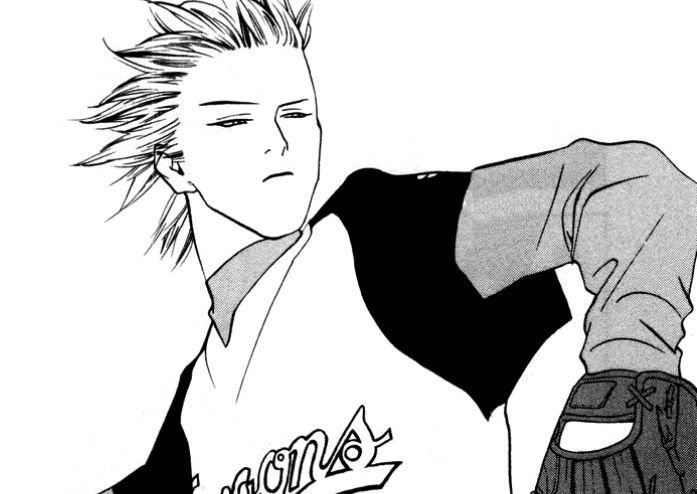
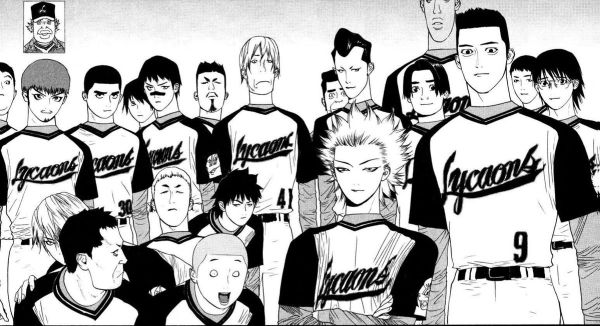
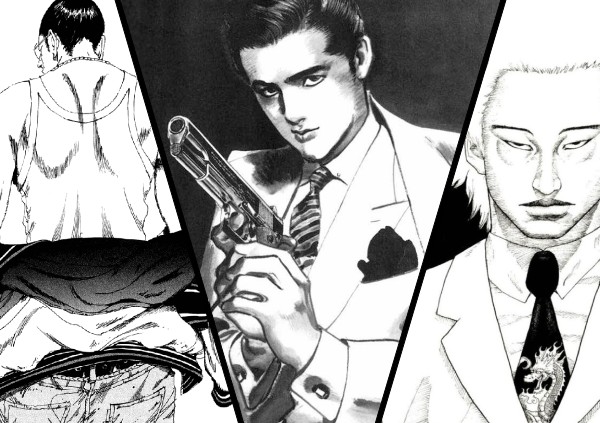
One Outs is an outlier on this list, written by Shinobu Kaitani, the creator of Liar Game. It’s technically a sports manga, but it plays more like a high-stakes gambling thriller that just happens to take place on the baseball field. The hook is as simple as it can be: Tokuchi Toua isn’t a powerhouse pitcher. He’s cold, calculated, brilliant at reading people, and treats every inning like a con.
The story’s pressure comes from the contract he signs. Tokuchi gets paid for every out, but loses a brutal amount for every run he gives up, turning each game into a financial wager. That structure gives the series its momentum. You’re not just watching him beat opponents, you’re watching him navigate sabotage, corruption, and teammates who don’t trust him, while he’s still trying to stay ten steps ahead. Games rarely feel like routine because the threat isn’t only the batter in front of him. It’s the entire system trying to undermine him.
What really sells it is how shameless it is about mind games. Every arc is built around some new angle, weakness, or dirty trick that Tokuchi can exploit, and the fun is in seeing how he constantly bends the rules of the game. The downside is that some of the scenarios feel a little too constructed, and the supporting cast can come off as thin for a series that leans so heavily on Tokuchi’s charisma.
Still, as a baseball manga built on tension and psychological warfare, it delivers.
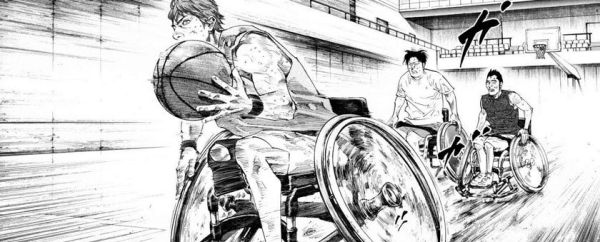
Real is what happens when a sports story stops chasing the winning play and instead focuses on something harder: recovery. Takehiko Inoue takes wheelchair basketball and turns it into a test for identity, pride, and the ability to keep moving forward when your body, reputation, and future have taken a serious hit. It’s easily one of the most ambitious and mature sports manga I’ve ever read, and it doesn’t need constant matches to feel intense.
Instead of leaning on hype speeches or flashy techniques, Real focuses on the grind behind the scenes. Training means repetition, pain management, rehabilitation, and building confidence one day at a time. When the story drops into a game, the tension hits differently. Every possession feels earned, not because of the score, but because playing becomes proof that these characters still have something to fight for.
What makes it stand out is how human it is. The leads are flawed and painfully human, and the early chapters can be rough because they start at such a low point. That slow-burning setup pays off, but readers expecting Slam Dunk-style momentum and constant action might not stick with it. It also doesn’t help that the series’ publication has been irregular at best.
That said, Real is perfect for readers who want sports manga with real weight, honesty, and the kind of pressure that doesn’t disappear after the game ends.
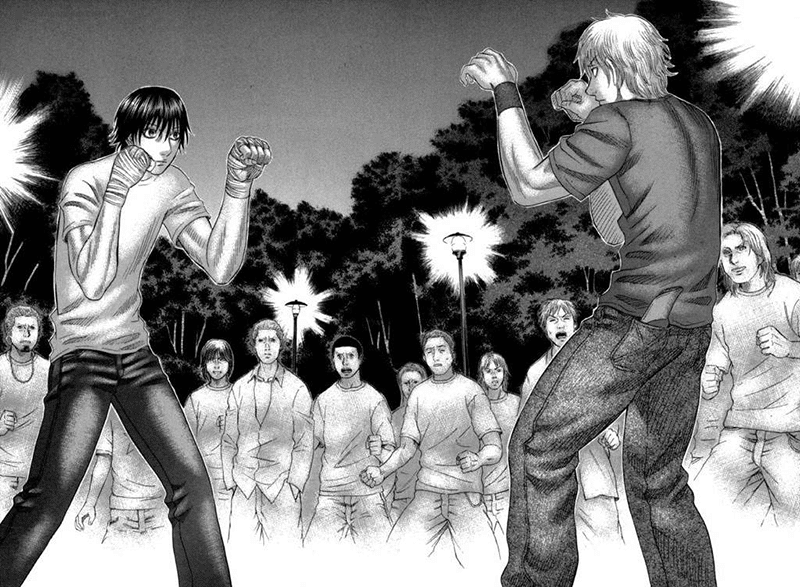
Holyland is a martial arts pick more than a sports manga, but it earns its place because it treats street fighting like a real discipline. Every technique has a purpose. Every exchange has consequences. The tension comes from the same place great competition stories always do: preparation, pressure, and whether you can execute a technique when it actually matters.
The story centers on Yuu Kamishiro, a bullied teenager with nowhere to fit. Instead of trying to find new friends, he focuses on boxing and trains a single punch to perfection. Then he tests it in fights without refs, rounds, or mercy. That structure keeps the series moving. Every confrontation feels like a test, and the cost of losing isn’t embarrassment. It’s injury, fear, and the humiliation of being reminded you don’t belong.
What makes Holyland stand out is how grounded the combat is. Everyone here is human. There are no power-ups and no mythical techniques. Distance, timing, and positioning matter. Even a single mistake can flip an entire fight. Kouji Mori also takes the time to break down the technique behind each move, which gives the violence a convincing sense of cause and effect, even if those explanations occasionally slow down the pacing.
The character work is as important as the fights. The streets are populated with other isolated people chasing their own version of purpose, and the rivalries hit hard because they’re tied to identity, not trophies. The series’ main downside is repetition. Holyland often moves in cycles of confrontation and aftermath, so the structure can feel familiar over time.
What it nails, though, is that locked-in mentality of fights where survival and self-worth blur together.
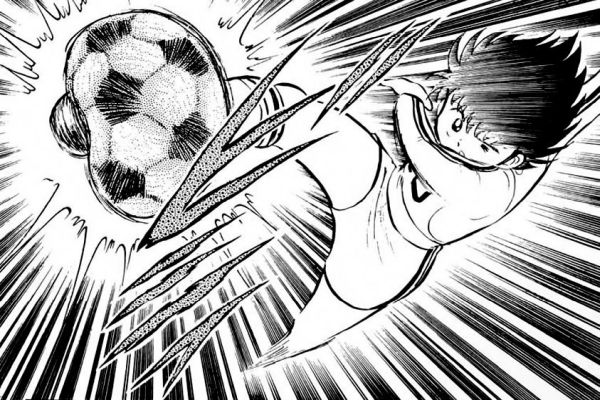
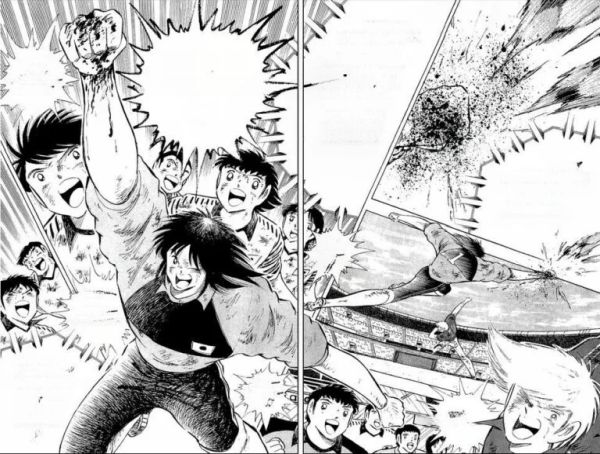
Captain Tsubasa was one of the first anime I ever watched as a kid, so nostalgia definitely plays a role. Still, revisiting it now, it holds up for the same reason it hooked me back then. It understands that the best sports manga are built on momentum, rivalry, and pressure, not necessarily realism.
The setup is straightforward: Tsubasa Ozora is a boy with an obsessive love for soccer and enough natural talent that he quickly becomes his team’s star player. What makes it work is how quickly every match turns personal. Opponents aren’t just obstacles. They’re prideful strikers, legendary keepers, and future rivals who want to crush him as much as they want to win. That constant friction gives the manga real tension, even when you can feel the story pushing toward more extreme moments.
Captain Tsubasa also shamelessly leans into power fantasy. Techniques get ridiculous, shots rip apart the net, and the drama is consistently dialed up. Characters play through injuries, illness, and impossible situations as if it were a matter of willpower, and the reversals come hard and fast. The downside is obvious: this is not grounded, tactical soccer. It’s exaggerated, melodramatic, and deliberately larger than life.
The best way to read it is as soccer filtered through pure shonen intensity. It’s hard not to get swept up in it.
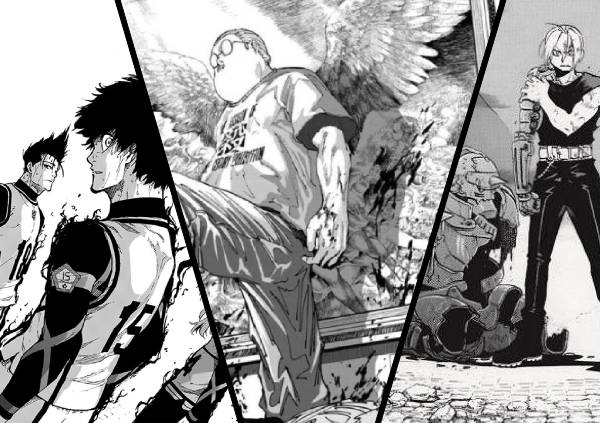
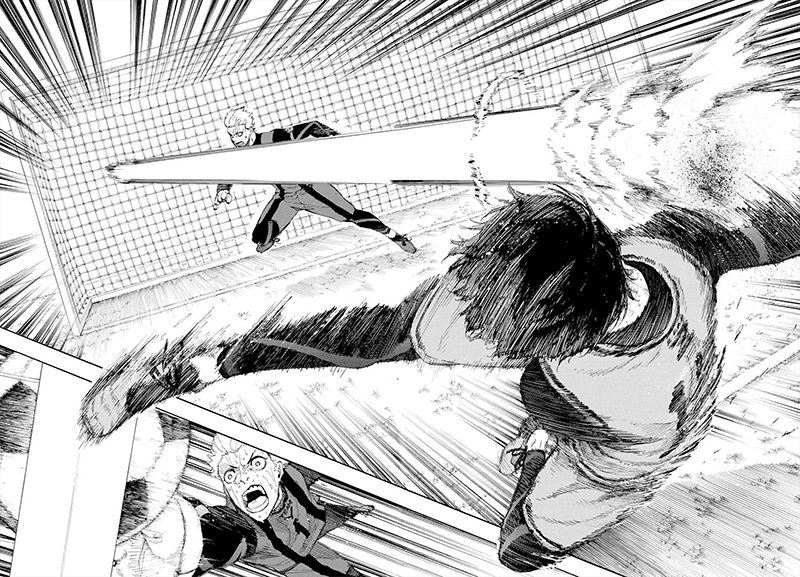
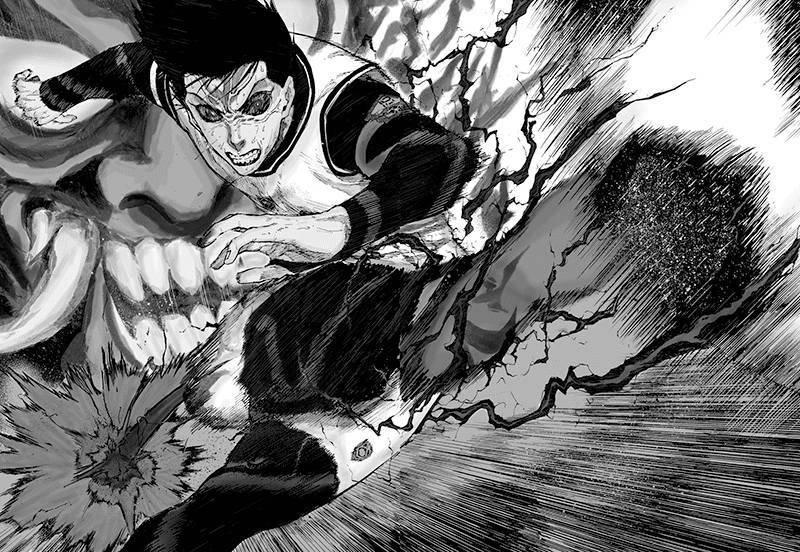
Despite not being a sports fan, Blue Lock is one of those rare series I’ll keep up with weekly, no matter what. It’s a sports manga built like a battle shonen, with constant escalation, sharp rivalries, and the kind of tension that feels closer to a deathmatch than a team sport.
The premise is ruthless but instantly gripping. Japanese soccer lacks a world-class striker. For this reason, the eccentric coach Jinpachi Ego recruits hundreds of talented young strikers and throws them into a locked-down training program until only one comes out on top. Everyone else is cut off from the dream for good. That single rule changes everything and turns soccer from a sport into a brutal survival game. Every play becomes personal, every mistake has consequences, and teamwork becomes nothing more than a temporary alliance that’s abandoned the moment it stops being beneficial.
What makes Blue Lock so addictive is how it visualizes pressure and improvement. Characters don’t just get better. They evolve through breakdowns, awakenings, and self-reflection. Players develop signature weapons and learn to read the field, turning games into tactical and psychological showdowns. The art sells the intensity, too. It’s loud, stylized, and pure hype, depicting characters with glowing eyes during moments of realization, egos as monstrous auras, and match-defining shots as metaphorical beasts.
The cast is another strength. Blue Lock throws a group of intriguing and sometimes exaggerated characters into a confined space, lets their egos collide, and shows us the fallout. Rivalries are ubiquitous, and the series keeps introducing new threats and players to force the main cast to adapt or be left behind. If there’s one problem with Blue Lock, it’s exaggeration. The feats are ridiculous and the drama runs hot, but realism was never the point.
Blue Lock is soccer not as a team sport, but as rivalry, ambition, and pure hype. Once you’re a few chapters in, it’s hard to put down.
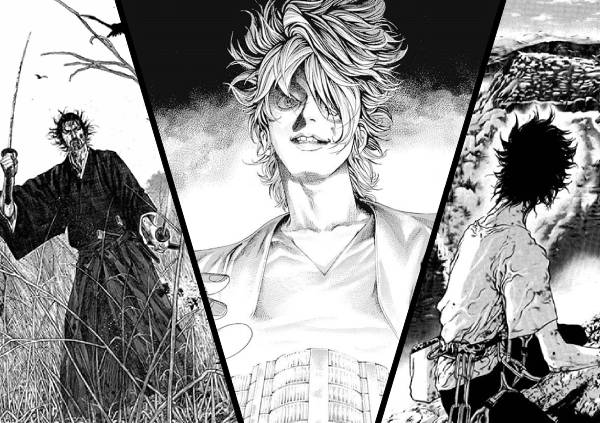
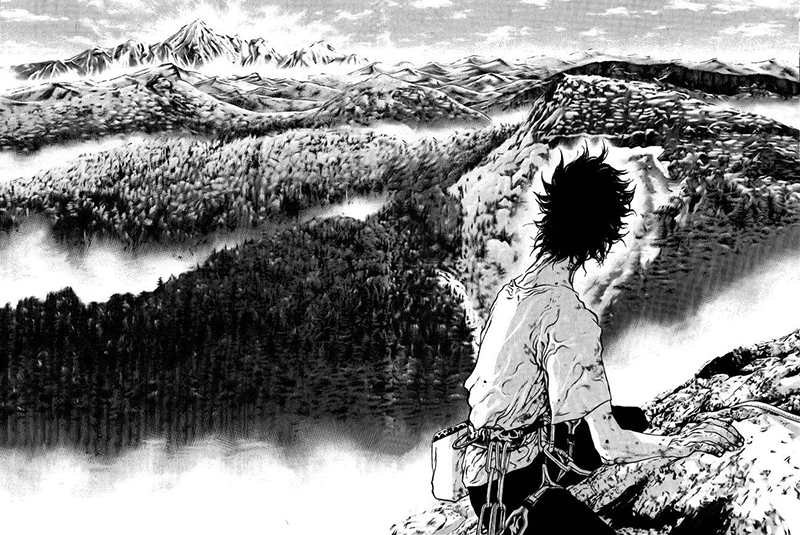
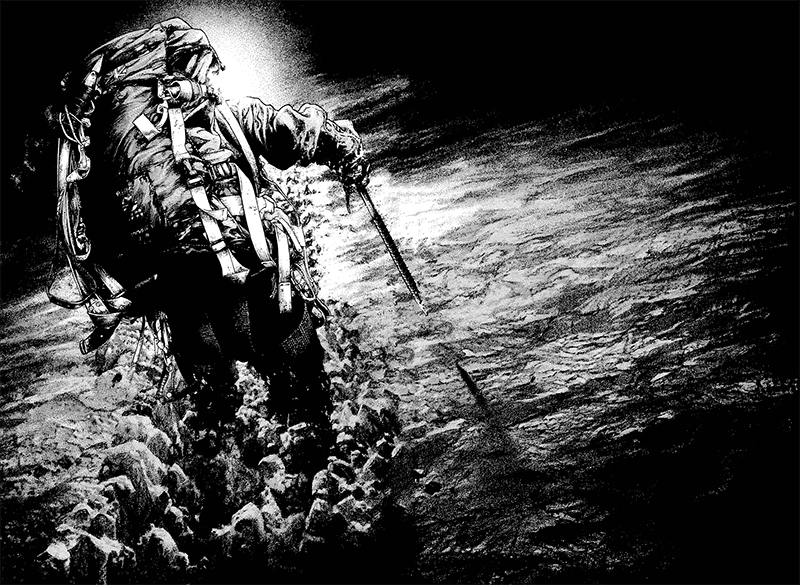
Shinichi Sakamoto’s masterpiece, The Climber, takes mountaineering and turns it into something harsher than competition. It’s a sports manga about obsession, isolation, and the thin line between discipline and self-destruction, all told through some of the most striking artwork in manga.
Buntarou Mori starts out as a detached teenager with no clear direction until a random challenge forces him to climb. Something clicks immediately. From there, the series treats growth the way real sports do, not as a training montage, but as repetition, risk assessment, and the slow improvement of the mind. Mori isn’t chasing trophies or rewards. He’s chasing feeling, control, and the kind of purity where nothing exists except you and the mountain in front of you.
That’s where the pressure comes from. The Climber doesn’t need scores, competitions, or rivals, because the stakes are physical and absolute. Weather, fatigue, and solitude become the real opponents. Even small decisions carry weight, and the tension comes from how easily confidence can become a trap. When the manga leans into silence, it only makes the danger louder.
Sakamoto’s art elevates the manga from great to exceptional. Mountains feel vast and indifferent, and the climbs have a brutal clarity that makes you understand why someone devotes their life to them. Literary quotes and metaphors are frequently woven into the narrative, giving the entire work an almost poetic feel.
The downside is that The Climber is less of a traditional sports manga and more a character study focused on Mori’s journey, so it won’t satisfy readers who want rivalry-driven competition.
Still, the tension never lets up, and mountaineering has never been more beautiful on the page.
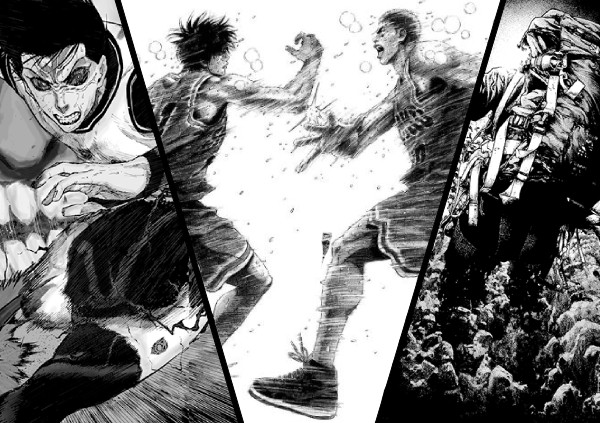
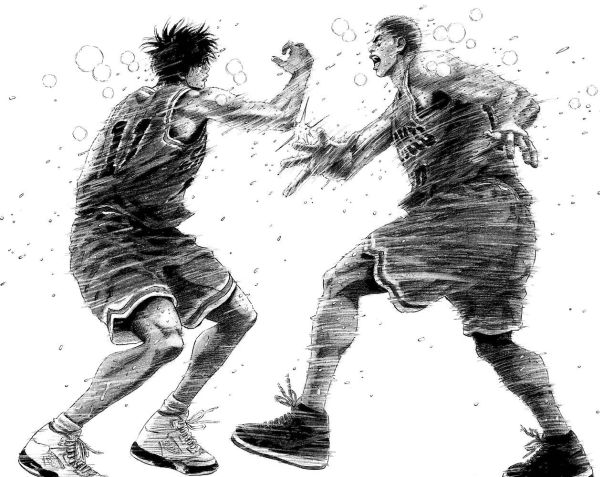
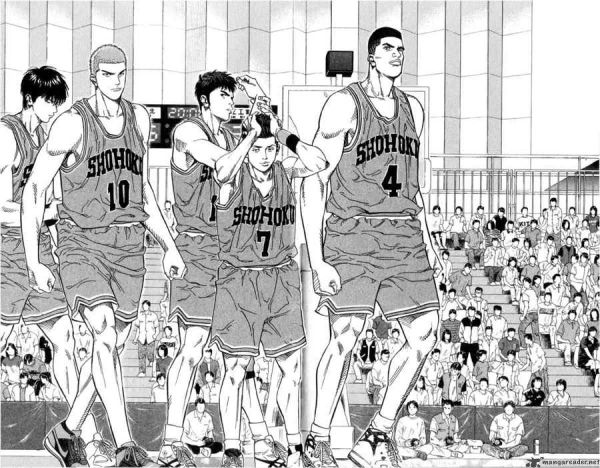
I have no attachment to basketball at all. I’ve never even watched a full game, and I still ended up binge-reading Slam Dunk because it was impossible to put down. It’s the rare kind of sports manga that doesn’t rely on you caring about the sport. The real hook is momentum, tension, and character dynamics.
It starts out deceptively simple. You get a loud, delinquent protagonist, a simple setup, and a lot of comedy. It works, but it doesn’t feel like a masterpiece yet. The shift happens when the core team locks into place. From that point on, Slam Dunk turns basketball into pure pressure, with games that constantly grow more gripping through exhaustion, fouls, reversals, and rival teams that feel as alive as the main cast.
What makes the games so tense is how physically grounded they are. Players get tired. Mistakes snowball. A few bad minutes can destroy a lead, and the series treats rebounds, positioning, and defense as seriously as scoring. Slam Dunk also nails rival dynamics without turning them into gimmicks. Pride, insecurity, and hunger for recognition sit underneath almost every clash, which gives the tension real emotional weight.
The biggest downside is that the early chapters are lighter and more comedic than what the series becomes later, and some character beats are very much of its era. Once the story clicks, it easily earns its reputation as one of the best sports manga of all time.
Drama manga can be among the most gripping stories, not because they rely on spectacle, but because they feel personal. At their best, they turn ordinary choices into turning points, then follow the fallout. The result is the kind of emotional momentum that pulls you through fast, then lingers afterward.
This list focuses on stories that earn their weight through character writing. Some titles lean grounded and realistic, built around relationships, work, ambition, and the quiet pressure of growing up. Others push deeper into shame, obsession, and psychological collapse, where the drama comes from who a character becomes when they can’t escape themselves.
These drama manga aren’t all the same, and this list reflects that range. You’ll find gentler, reflective reads like Omoide Emanon and I Had That Same Dream Again, alongside sharper, more adult stories like Utsubora and Helter Skelter. And you’ll also see darker character studies like Blood on the Tracks and Oyasumi Punpun, where the drama feels like a slow suffocation rather than a single breaking point.
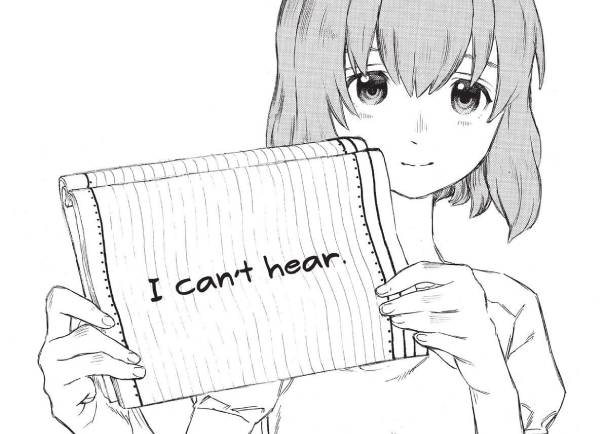
A few standouts that define the list’s tone include Nana for messy relationship drama you can’t look away from, Solanin for post-college ennui, Blue Period for creative obsession, and A Silent Voice for guilt and redemption. On the heavier side, Freesia and Bokurano use high-concept premises to frame intimate tragedies, while Bokutachi ga Yarimashita turns one reckless choice into moral collapse.
What these series have in common is this: they take emotions seriously. Whether the story is quiet or chaotic, romantic or cruel, each one shows how identity and relationships warp under pressure, and how hard it is to undo the things you’ve said, done, or become.
Mild spoiler warning: I avoid major plot revelations, but I do reference themes and key moments to explain why each series belongs here.
With that said, here’s my ranking of the best drama manga (last updated: January 2026).
Some drama manga don’t hit you with big speeches or tear-jerking moments. They work in a quieter register, where mood does most of the heavy lifting, and the emotional afterimage is the point. Omoide Emanon is one of the clearest examples of that kind of storytelling. It’s brief, restrained, and strangely unforgettable.
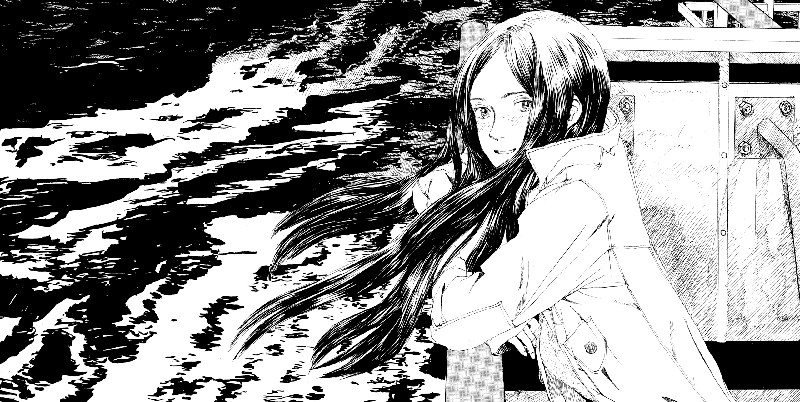
The premise centers on a young man who’s returning home after traveling, and on a ferry he meets a striking young woman who calls herself Emanon. They share a meal and start talking. What initially feels like a chance encounter with a faintly star-crossed vibe, slowly becomes something else. The conversation deepens, and the story takes on a more solemn shape, less like romance and more like being pulled into an extraordinary confession that you don’t know what to make of.
That’s the real appeal here. This is a drama manga built on longing and atmosphere, not melodrama. The ferry setting matters. The gentle motion, the sense of transit, and the feeling of life turning back toward home all reinforce the same undertone. Emanon herself carries that melancholy, too. She’s charismatic and warm, but there’s also something distant about her, almost ominous. By the end, what lingers is not a neat emotional resolution, but the feeling of having experienced something unique and rare, then being left alone with it.
These feelings are amplified by Kenji Tsuruta’s art. The characters are rendered with realistic detail, and the environments feel alive without calling attention to themselves. Facial expressions do a lot of quiet work, especially in the pauses between lines of dialogue. Emanon’s presence is particularly well handled, both alluring and slightly unreal, which keeps the tone balanced between intimacy and mystery.
Omoide Emanon is a drama manga that’s reflective, melancholic, and more interested in mood than plot escalation, which makes it an easy recommendation.
Ikigami works as dystopian fiction first, but it earns its place on a drama list because the cruelty is always personal. The premise is brutally simple. A government program randomly selects citizens between the ages of 18 and 24 to die for the stability of the nation, and they receive their notice exactly twenty-four hours beforehand. It’s a horrifying concept, but the real chill comes from how ordinary it feels. This is state murder as policy, wrapped in procedure, and accepted as normal.
The framework is bleak, but the series shines in its vignettes. Each chapter follows someone through their final day and lets the drama unfold in full, messy range. Some characters try to reconcile with old friends and family they’ve neglected for years. Others lash out, spiral, or get consumed by despair. A few decide to make the day count in ways that are unexpectedly tender. Even when the story tilts toward hope, it still carries an aftertaste of grief, because the clock never stops ticking. The best moments have a sad beauty to them, not because the manga romanticizes death, but because it shows how much people reveal when they no longer have the time to perform.
Ikigami also focuses on the social fallout. Once someone’s received their Ikigami, the world changes around them. Friends keep their distance. Employers treat them like an inconvenience. Family members sometimes react with selfishness or panic, and not always in the ways you want. The most unsettling moments aren’t always the breakdowns. They’re the ones where everyone behaves as if this system is simply part of life, as if moral outrage is childish, and resignation is maturity.
Kengo Fujimoto, the messenger who delivers the Ikigami notices, ties the whole structure together. He’s not framed as a savior, and the story doesn’t let him become one. He’s a cog in a machine he increasingly distrusts, forced to witness raw human consequences while doing his job. That tension gives the broader setup its own dramatic spin, even when the focus stays on the recipients.
As a drama manga about institutional cruelty with a focus on human response, Ikigami is one of the sharpest.
Solanin captures a slice of early adulthood that a lot of manga rarely touch on. It’s not about chasing a grand goal or surviving a dramatic crisis. It’s about the slow pressure of ordinary life, the way days turn repetitive, and the quiet fear that your best years are slipping into routine. Asano frames it with a light touch, but the emotional core is heavy because it’s built from familiar disappointment.
At its center is the relationship between Meiko and Taneda, a young couple straight out of college, working low-paying jobs, clinging to small dreams, and trying not to admit how uncertain everything feels. When Meiko quits her job on impulse, it’s not treated as a triumphant break from the system. It’s treated like what it is: a desperate attempt to get your agency back. Eventually, their shared love of music becomes a lifeline, not because it magically fixes anything, but because it gives hope a place to exist.
Solanin is a drama manga driven by mood. It pays attention to what people say when they’re tired, what they avoid saying, and how easily love turns into quiet resentment when money, time, and insecurity take center stage. The tension is not explosive. It’s the constant, low-grade anxiety of growing up, the feeling that you’re supposed to want or do something, and the shame of not knowing what it is.
Asano’s art is a huge part of why it works. His cityscapes feel alive, and his paneling lingers on routines but never makes them feel empty. Faces carry exhaustion and tenderness in equal measure, and the story often lets silence do the talking. That restraint gives the harder emotional turns their force. When grief enters the picture, the manga treats loss as something that sits beside daily life and changes the feel of everything.
What separates Solanin from many similarly grounded stories is its final note. It hurts, and it stays sad, but it’s also Asano at his most hopeful. The message isn’t that dreams come true. It’s that life keeps moving, even if nothing changes like you hoped, and there’s something quietly beautiful in learning how to move with it.
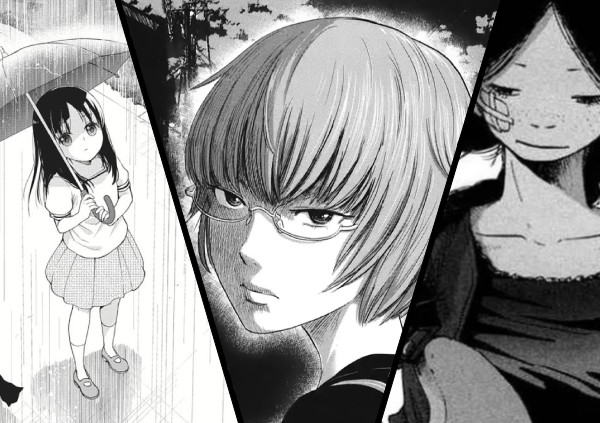
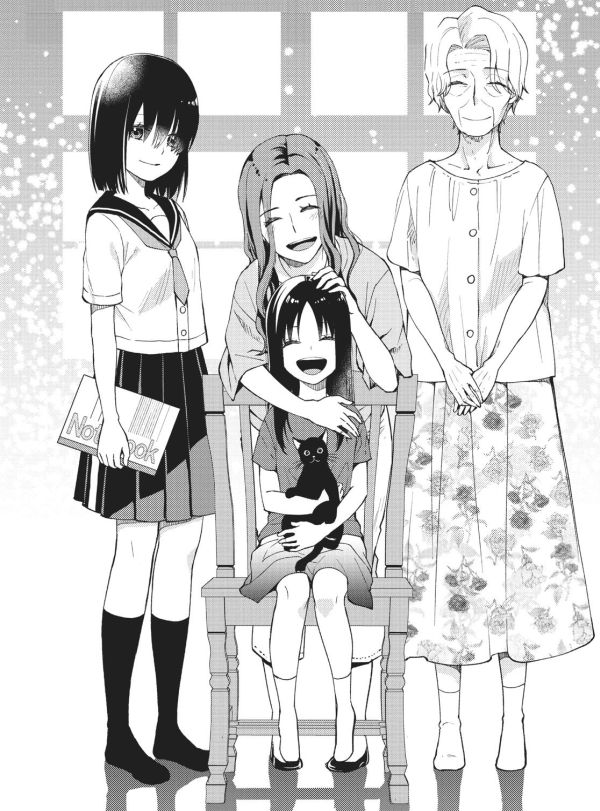
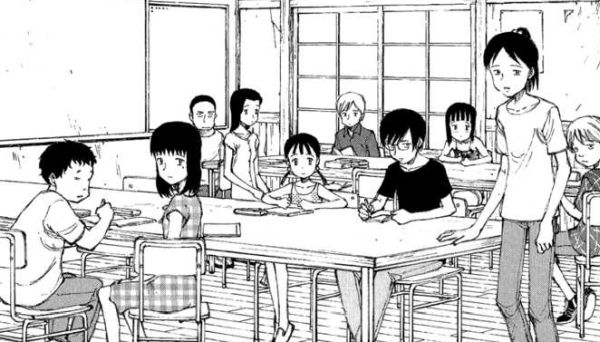
I found I Had That Same Dream Again by accident, and it hooked me almost immediately. On the surface, it’s a simple story centered on an assignment. An elementary school student named Nanoka is told to define what happiness means, and she treats the question with the same literal, defensive mindset she brings to everything. She’s prickly, self-protective, and quick to label herself as weird when she doesn’t want to engage with others.
It works because of who Nanoka meets while she’s trying to solve the assignment. Her life intersects with three very different people, each carrying their own private pain. There’s a cheerful woman who helps her save a cat, an elderly lady living quietly in the woods, and a high school girl Nanoka encounters at a moment that’s genuinely unsettling.
The story doesn’t turn those meetings into neat life lessons. Instead, it lets them accumulate before slowly hinting at what the story is really about.
This is a drama manga with a faintly whimsical structure. The conversations can feel a little storybook-like at first, as if you’re guided toward a message. If you don’t like sentimentality, you might bounce off it quickly. Still, that gentle tone is part of its charm because it makes the harder material easier to approach. Underneath the somber surface are touching themes like grief, loneliness, self-harm, and the long shadow of personal trauma. It’s not dark in the same way as the heavier entries here, but it’s quietly melancholic, and it knows how to land an emotional beat without turning it into spectacle.
The art is crisp, clean, and readable, which keeps the focus on expressions and small mood shifts. And once the narrative reveals how these encounters connect, the earlier weirdness feels purposeful rather than random.
If you want a drama manga that’s sad, reflective, and ultimately hopeful, I Had That Same Dream Again is an easy recommendation, especially if you’re in the mood for something tender.
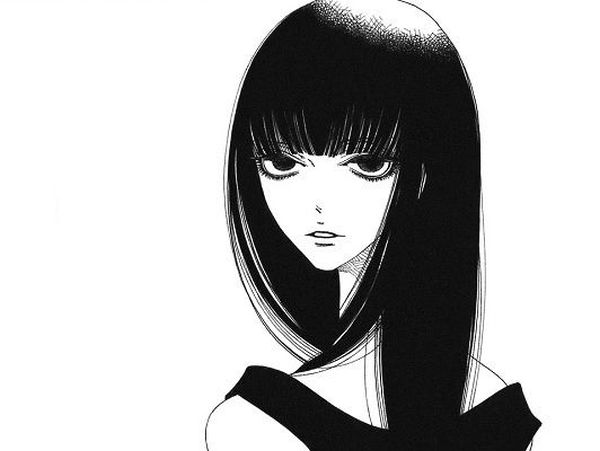
Utsubora: The Story of a Novelist is framed like a literary mystery, but it lands because it’s really a character study about creative decay and the collapse of identity. It’s one of those drama manga series where the plot beats matter less than the emotional ugliness underneath them. Nakamura isn’t interested in romanticizing the artist. She treats writing as pressure that amplifies insecurity, envy, and longing until a person can’t tell the difference between craft and identity.
The setup follows a novelist past his peak. Shun Mizorogi’s public attention is fading, and the relationship to his work feels less like pride and more like dependency. Then a young woman, Aki Fujino, enters his life and dies soon after. The story doesn’t treat it as melodrama but as an intrusion that exposes the fragility of Mizorogi’s self-control. When her twin sister, Sakura Miki, introduces herself to him, the series turns colder. Around the same time, Mizorogi’s newest work becomes the center of a plagiarism scandal. Authorship, imitation, and self-preservation become the real conflicts, and Mizorogi’s choices reveal who he is long before the plot confirms anything.
What makes it work as a drama manga is how thoroughly damaged everyone feels, but in a quiet, believable way. Mizorogi is afraid of losing his relevance and becoming ordinary, but he’s also ashamed of needing praise to feel alive.
Aki’s death hangs over the narrative like a moral accusation. Sakura, meanwhile, adds a sharper edge to it. The manga never slows down to explain any of this. It lets them surface through behavior, deflection, and manipulation.
Asumiko Nakamura’s linework is restrained but delicate, and faces often show an eerie calm even during emotionally charged moments. Eroticism feels cold and disconnected, less about pleasure and more about control. That restraint makes the story’s bleakness linger.
Utsubora: The Story of a Novelist succeeds as a dark, melancholic drama manga, using an intriguing mystery framing to expose artistic death and identity erosion.
Aku no Hana turns adolescence into the stage for a deeply psychological drama. It’s set in an ordinary town, with a normal middle school and plain classrooms, yet it feels suffocating in the way few coming-of-age stories manage. The drama doesn’t come from a grand tragedy. It comes from humiliation, exposure, and the sense that one impulsive choice can stain the person you thought you were forever.
Takao Kasuga is a kid who pretends to be sensitive and refined, but he’s quietly afraid that everyone notices how insecure he really is. That fear becomes the foundation for what follows. When his classmate Sawa Nakamura witnesses him committing a petty theft, she uses it to blackmail him. It doesn’t work because he’s afraid of being punished, but because it touches the softest part of his identity, his need to maintain the fragile self-image he built, and his need to be seen as normal.
That’s what makes this drama manga so effective. Nakamura treats transgression as a way to free herself, but in reality it’s just another form of captivity. Through her demands, she creates a private world where shame is not only punishment but a reason to belong. Meanwhile, Kasuga’s obsession with Saeki shows his desperate need for normalcy. Yet the more he chases her approval, the more obvious it becomes that he can’t undo what he did. Everyone in this manga is wearing masks, and Oshimi is ruthless about tearing them down.
The character writing keeps the series from feeling like a cheap provocation. Kasuga isn’t the victim he first appears to be, while Nakamura is much more than a deranged psychopath. They’re teenagers, full of raw emotions, and acting out of loneliness, resentment, boredom, and a hunger for meaning. The manga’s first half escalates in ways that can feel outrageous, but it also captures a truth about teenage logic. When you’re at that age, ordinary spaces start to feel suffocating, and even the smallest act can take on an unfathomable weight.
Oshimi’s art amplifies those feelings with vulnerable faces and heavy silences. The town feels exposed, as if rumors are spreading and everyone’s quietly judging.
The manga’s later chapters take a step back from the earlier, more outrageous escalation and instead shift into consequence and reflection. It’s less interested in shock than in what comes after. If you want a drama manga that’s emotionally punishing early on, but ultimately more hopeful than its reputation implies, Aku no Hana is among Oshimi’s most distinctive works.
Some people will see a title like Onani Master Kurosawa (literally Masturbation Master Kurosawa) and assume it’s either a raunchy gag manga or an edgy adult-themed work. That’s exactly why it works so well as a subversion. Beneath the provocative title lies one of the most tender coming-of-age stories and memorable drama manga I’ve ever read.
Kakeru Kurosawa is a fourteen-year-old loner with a superiority complex and a private habit he treats like a ritual, sneaking into a rarely used school bathroom every afternoon. He looks down on his classmates, confuses cynicism with intelligence, and hides behind his arrogance. When his classmate Aya Kitahara gets bullied, he decides on revenge in the most warped way he can. Then Kitahara discovers the truth, but instead of turning him in, she blackmails him into continuing. What starts as perverse vigilantism turns into a loop of guilt, shame, and escalating consequences.
The early chapters read like a crude parody of Death Note, with a self-important kid acting like a scheming mastermind. The impressive part is how gradually the series pivots. It stops caring about the deeds and focuses on what happens to a person who keeps rationalizing their worst impulses. Kurosawa isn’t treated as a misunderstood victim, and the story doesn’t rush his growth. It forces him to sit down, recognize his own ugliness, confront the damage he’s caused, and learn how to connect with people without judging them. Kitahara’s role deepens, too. She isn’t just a plot device but a character with her own fears, pride, and vulnerability.
The art supports that shift. Expressions carry the emotional load, the shading feels raw, and any sexual material is framed as unsettling rather than exploitative. That restraint lets the later chapters land as something genuinely heartfelt, even quietly inspiring, without pretending the early harm never happened.
I first read Onani Master Kurosawa almost two decades ago, and it still sticks with me. It’s a drama manga that takes an outrageous setup and turns it into a story about mistakes, accountability, and first love.
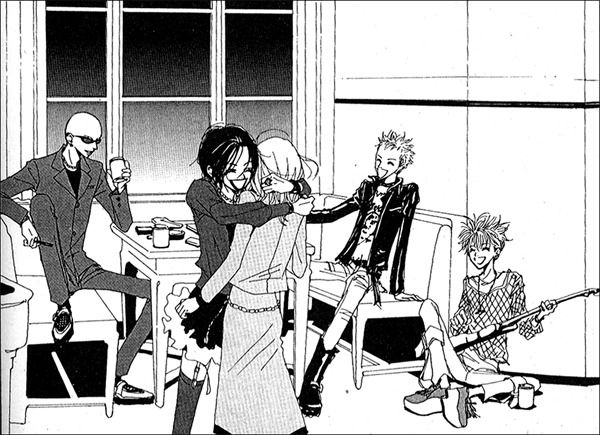
Nana looks deceptively simple at first. Two young women with the same name move to Tokyo, become roommates, and stumble into adulthood with the music industry as the backdrop. The early arcs can make it feel like a stylish slice-of-life romance with industry flavor. The longer you read, however, the clearer it becomes that this is one of manga’s most intimate relationship dramas, and one of the most emotionally draining reads in manga.
The two leads couldn’t be more different. Nana Osaki is a punk vocalist with a hard edge and a clear dream, the kind of person who turns pain into ambition and treats vulnerability like a weakness. Nana Komatsu, nicknamed Hachi, is a romantic drifter who wants love so badly she keeps mistaking longing for stability. Their friendship is the emotional center of the story, not because it’s wholesome, but because it’s honest. They need each other, they misunderstand each other, they hurt each other, but keep circling back the way real bonds do.
What makes Nana such a standout drama manga is how little it romanticizes its characters. Ai Yazawa writes people who are messy, impulsive, and sometimes selfish, but never fake. Everyone carries baggage. Everyone wants something that’s not easily available. The series explores cheating, codependency, addiction, grief, depression, and the slow erosion that sets in when love turns into a coping mechanism instead of a connection. The music industry element adds pressure and glamor, but the story’s real weight is domestic and emotional. It’s about the choices people make when they’re afraid, and the way those choices become identity.
Yazawa’s art is a huge part of the appeal. It’s elegant and sophisticated, making the emotional highs feel earned, and the lows quietly devastating. Somber scenes hit hard because the faces and body language are so expressive. You can tell when someone’s lying, and you can feel when they’re lying to themselves.
I first discovered Nana through its anime adaptation, and it still holds up as a fantastic entry point, but the manga goes further. It’s longer, more detailed, and ultimately darker. Even with its long hiatus, it’s a strong pick for fans of drama manga that treat love as something beautiful, destructive, and painfully human.
Nijigahara Holograph is notorious for being confusing, but that fractured structure is more than a gimmick and not there simply to make the story feel clever. It mirrors what the manga is actually about: trauma that doesn’t resolve cleanly, guilt that never fully leaves, and lives that keep circling back to the same damage from different angles. This is a drama manga where time feels less like a straight line and more like a loop.
In a small town, a quiet act of childhood cruelty turns into a haunting shadow that stretches across years, shaping relationships even when characters pretend they’ve moved on. What makes it feel suffocating is the ripple effect. Trauma doesn’t stay contained, but spreads outward, changing friendships, altering self-image, and shaping how people hurt others and themselves. There’s a generational undertone: parents who damage their kids without noticing, authority figures who normalize cruelty, and kids who inherit that violence and carry it forward.
Asano’s narrative is deliberately fragmented to reinforce those themes. Different viewpoints blur into one another, and scenes jump between timelines. It turns the manga into a puzzle of fragments, where cause and effect arrive out of order, and character motivations remain hidden. But even when the pieces finally click, there’s no relief. Understanding doesn’t redeem those characters. It only clarifies how trapped they are in patterns they can’t break, even when those patterns turn self-destructive.
It’s also one of the bleakest entries on this list. Atrocities are front and center, not as isolated shocks, but as symptoms of a world that’s cold and casually cruel. The setting looks ordinary, but it’s that seeming normalcy that makes it worse. Asano’s grounded and precise art makes people look like real people, streets like real streets, and the ugliness hits harder because nothing about the presentation suggests distance or fantasy.
That said, the manga isn’t uniformly hopeless. There are brief moments of tenderness, and a few characters reach toward something better. Others spiral into toxic relationships, or end in ways that feel brutally final. Nijigahara Holograph will frustrate readers who want clean answers or tidy timelines, but if you’re open to ambiguity and rereading, it’s one of the most devastating drama manga ever written. It’s not just about what happened. It’s about how long it keeps happening inside people.
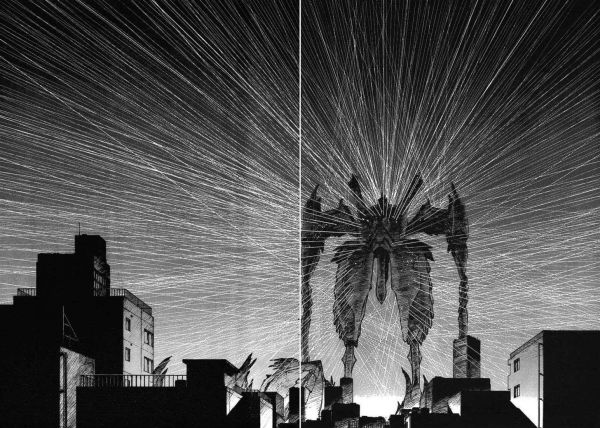
Bokurano might look like an odd fit on a drama list at first. It’s a science-fiction mecha manga about middle schoolers piloting a giant robot to protect the world. That premise usually comes with spectacle, wish fulfillment, and heroic arcs. Bokurano takes the opposite route. It uses the robot as a trap and builds a narrative about the cost of stepping into it.
The premise centers on a group of kids who stumble into a supposed game, agree to it, and only afterward learn what the agreement actually means. Each battle becomes a countdown. Heroism doesn’t remove the damage, and saving the world is neither clear nor glorious. Cities are leveled, people die, and the kids have to live with the fact that even victory doesn’t spare them. That’s where the drama comes from. The manga keeps asking what to do with your remaining time when you’re expected to die to save the world.
Bokurano is less a conventional narrative and more a chain of character studies, shifting from child to child, each with their own emotional backstory. Some spiral and lash out, some detach, and some search for meaning. The darkness isn’t confined to the cockpit either. Several children suffer from trauma shaped by toxic families, abuse, and exploitation. All of this makes the premise hit harder because it doesn’t play like a science-fiction epic.
I first encountered Bokurano through its anime adaptation, but it’s the manga version that fully commits to the bleakness. It leans hard into the uglier sides of the story and is more willing to show rather than hint at the darker themes. That said, Bokurano is a divisive series. It’s full of clunky philosophical interludes, characters who don’t act or talk like kids, plus a deadpan tone that can be jarring. For others, the emotional numbness is the point, showing the kids’ reaction to a situation too large for them to process.
Bokurano is a story that will stay in your mind. It’s less interested in saving the world and more in showing the cost, and how little comfort anyone gets in return. It’s a bleak drama manga that’s fatalistic, nasty, and focused on psychological erosion rather than catharsis.
Freesia is an odd fit if you expect drama to center on domestic realism or relationships. On the surface, it reads like a revenge thriller set in a near-future Japan that has legalized retaliation. If someone is murdered, the victim’s relatives are given the right to kill the offender, either by themselves or by hiring enforcers to do it for them. It sounds like justice, but the series treats it as something closer to institutionalized rot, a society turning its worst instincts into procedure.
Kano is one such enforcer, tasked with finding and killing people whose names have been approved for retaliation. Early on, the premise could’ve been played as catharsis, but Matsumoto never lets it become satisfying. The retaliations aren’t normal payoffs. They’re purely administrative. This is where Freesia becomes a drama manga. The emotional core isn’t the action but the consequences, and the way violence reshapes everyone involved.
The manga’s most distinctive choice is showcasing the inner workings of Kano’s mind. His delusions and hallucinations are constant and intrusive, bleeding into everything until he’s not sure anymore what’s real and what isn’t. Instead of giving you a safe, objective distance, the manga forces you to suffer through those episodes alongside Kano, which makes even the most mundane moments feel dangerous and wrong. Kano’s private life adds another layer of quiet tragedy. He’s a broken man trying to function, living with an elderly, demented mother, clinging to the idea of normalcy, and trying to maintain relationships without fully realizing how broken they are.
Around him, nearly everyone else feels damaged or numb. The retaliation law is supposed to bring justice, but only serves to multiply loss. Targets might be remorseful or products of the same brutal society that now condemns them, but none of that matters. It’s simply procedure, where guilt and innocence don’t matter.
The enforcers might even be more warped than the targets. Freesia is blunt about how this type of work burns empathy and leaves nothing but ugliness behind. Matsumoto’s art supports that bleakness. It’s gritty and claustrophobic, with a thin boundary between realism and surreal intrusions. When the manga leans into sexual themes or depictions of violence, it’s never exciting but grotesque, reinforcing how deep the world has fallen into darkness.
As a drama manga, Freesia is one of the harshest and most memorable examples of societal decay explored through the psychological collapse of its characters.
A Silent Voice starts in the one place most redemption stories avoid. Shouya Ishida isn’t introduced as misunderstood or misguided. He’s a bored kid who turns cruelty into entertainment when Shouko Nishimiya, a deaf girl, transfers into his class. What begins as teasing turns into bullying, and the manga isn’t shy about showing how ugly it gets. Teachers fail, classmates participate or stay quiet, and Shouko is forced to suffer through it until she leaves. Then the social order flips, and the class finds it convenient to pin everything on Shouya. The bully becomes the new target.
These early stretches can be a tough read, but they earn what comes next. We see Shouya years later, now in high school, isolated and steeped in self-loathing. He eventually decides to find Shouko and apologize, and this is where the series reveals its true subject. It’s not a story about bullying. It’s a drama manga about atonement, how messy and awkward it can be, and how saying sorry doesn’t undo what you did.
The reconnection is handled with restraint. Shouya doesn’t become a better person overnight. He’s anxious, defensive, and terrified of being rejected, and often behaves like someone trying to earn forgiveness rather than understand what forgiveness actually means. Shouko isn’t written as a saint either. She wants connection, but she’s also shaped by what happened, and her responses carry hesitation and contradiction. That complexity makes the relationship feel real instead of like pure wish fulfillment.
The supporting cast deepens the moral mess. Old classmates resurface with their own version of how the bullying went down, and the story shows how people rewrite the past to protect themselves. Some characters are sympathetic one moment and infuriating the next, which is exactly the point. Harm is communal, and denial is, too.
Ōima’s art matches the tone. It’s clean and understated, but pays close attention to posture, expressions, and small gestures, which matters because of Shouko’s deafness. Many panels linger on quiet moments, and silence itself becomes part of the emotional experience rather than empty space.
Not every plot thread gets equal closure, and the ending may feel abrupt if you want a neat resolution. Still, A Silent Voice is one of the most affecting modern coming-of-age stories because it refuses easy redemption. It’s a drama manga about consequences, empathy, and the fragile hope of rebuilding trust.
Genres: Drama, Romance, Slice of Life, Psychological
Blue Period is the kind of story that proves drama doesn’t need romance, tragedy, or betrayal to hit hard. Its tension comes from something quieter and more familiar: the slow panic of realizing you’re living on autopilot, then chasing a dream with everything you can, only to realize you might not be good enough. It’s a drama manga built around effort, identity, and the discomfort of starting from zero.
Yatora Yaguchi looks fine from the outside. He gets good grades, has friends, and knows how to play the role of a functional teenager. The problem is that none of it feels real to him. The numbness shifts when he notices a painting that awakens something in him he can’t explain. From there, the series doesn’t focus on a magical awakening, but on a decision to commit. Yatora dives into fine art with the desperation usually reserved for people trying to save themselves.
What makes Blue Period stand out is how unromantic it is about creativity. It treats art as a craft, meaning progress comes through mistakes, studies, ugly early attempts, and the slow work of developing an eye. The manga focuses heavily on process, and it’s honest about the emotional toll it takes. Envy, self-doubt, impostor syndrome, and the constant fear of wasting time all show up, not as dramatic twists, but as daily pressure. One of the series’ most memorable ideas is that you don’t need to be a genius if you’re willing to work until no one can tell the difference anymore. It’s a very specific mindset, but it captures the story’s core tension. How badly do you want to succeed, and what are you willing to sacrifice to earn it?
The supporting cast deepens that question. Each character reflects a different relationship to art, talent, privilege, insecurity, and expectations, which keeps the narrative from turning into a single-perspective, motivational arc. The struggles aren’t interchangeable artist problems, either. They feel personal, and sometimes ugly in ways that fit adolescence and ambition.
Visually, Yamaguchi balances expressive faces with dense, technique-heavy pages, but the clarity stays intact. The art keeps the focus on what matters: a person changing under pressure. Blue Period stands apart among modern drama manga for treating creative pursuit as both a lifeline and a grind.
Blood on the Tracks is proof that most frightening stories don’t need monsters. Shūzō Oshimi builds a drama around a single relationship, a tight bond between a mother and son that makes love, dependence, and fear inseparable. It can read like psychological horror, but the core is domestic. The terror comes from how ordinary the setting is and how plausible the emotional control feels.
Seiichi Osabe, a quiet middle-schooler, lives under the watchful eye of his mother, Seiko. At first, she appears affectionate, devoted, and overprotective in a way that feels almost normal. It’s a reminder of how care and possession can blur. All that changes during a family trip when Seiko does something so shocking it changes their entire dynamic. Seiichi becomes trapped and unable to explain what he witnessed to anyone. This turns the manga into a study of emotional captivity. Here, the worst punishment isn’t physical, but the rewriting of a child’s inner life.
Blood on the Tracks stands out for its pacing. Oshimi doesn’t rely on dialogue, but instead stretches simple moments until they become unbearable, letting heavy silences do the talking. Chapters may center on a single, harrowing expression. This doesn’t just make you understand Seiichi’s paralysis but share it. All this is reinforced by the art. The framing is tight. Close-ups of Seiko’s face dominate the page, and backgrounds fade. The meaning is instantly clear: the real danger is the person closest to you. Even when nothing happens, the atmosphere tightens, tension spikes, as if the unspoken is more terrifying than any action.
As a drama manga, Blood on the Tracks succeeds because it turns something foundational into something horrific. A parent is supposed to be the constant in a child’s world, the one place you can retreat to and feel safe. Oshimi corrupts that bond, showing us the long-term damage of such an upbringing. Seiichi isn’t simply scared. He’s conditioned to second-guess reality, to apologize for his feelings, and to accept emotional distortion as normalcy.
The final stretch deepens the tragedy by shifting into Seiichi’s later years, which shows that the entire experience doesn’t simply end because childhood ended. It also reframes Seiko. She’s not redeemed, but shown as someone who’s been broken long before she ever became a mother.
Blood on the Tracks is one of Oshimi’s most devastating works. It’s an intimate, controlled drama manga that’s emotionally brutal.
Genres: Drama, Psychological, Horror, Slice of Life
There are many manga that focus on showbiz, but Helter Skelter is among the darkest. A person is manufactured, polished, and sold, then discarded the moment she stops performing. Kyoko Okazaki doesn’t frame it as a tragic cautionary tale with a clean moral, but as a narrative that shows what happens when someone has been turned into an image long enough that no real self is left behind.
We get to know Liliko Hirokuma, Japan’s top model at the height of her career. Yet her perfection is a lie. Her body has been engineered through plastic surgery, and her public persona is sustained through constant monitoring, performance, and pressure to stay desirable. The story’s tension comes from deterioration, not a single scandal or downfall. When attention drifts toward younger faces, and her body begins to fail, her current lifestyle becomes impossible. The horror isn’t just losing fame, but that there’s no identity left once the spotlights turn away.
Okazaki never presents Liliko in a singular light, but depicts her as both predator and victim. She’s been shaped by obsession, exploitation, and an industry that rewards self-erasure. It’s her response to this that makes it worse. She turns fear into cruelty, following an ugly logic. If she’s being replaced, she’ll punish whoever’s been suggested as her replacement and take as many people down with her as she can. That’s where the drama sharpens, because it’s not insanity. It’s a symptom, a reaction to a system that trains people to treat themselves as a product.
The collateral damage is wide. Liliko’s assistant becomes entangled in a relationship built on manipulation, dependency, and substances. A young rival becomes a target, not because Liliko personally hates her, but because the industry decided she’s going to replace her. Even worse, the executives, photographers, and anyone else in the industry treat this with cold indifference. No one is shocked, no one cares. They’re only interested in money, and how long they can keep monetizing a product.
The manga’s raw and uneasy linework reinforces that instability. Faces look slightly off even in quieter moments. The art avoids glamor on purpose, constantly reminding us that the polished, perfect Liliko is a lie, and that what’s hidden beneath is coming apart.
Helter Skelter is an unforgettable drama manga that stands out for its depiction of showbiz as a horrifying culmination of vanity, image, and addiction.
Inside Mari starts with a premise that sounds like a cheap hook, then uses it to dig into something far more personal. A lonely college dropout wakes up in the body of a high school girl, and the story immediately raises the one question that matters: why and how did this happen?
Isao Komori is introduced as a shut-in. He’s withdrawn and has drifted into a routine of isolation, observation, and self-indulgence. His fixation on Mari begins as escapism, not romance. She represents the idea of normalcy he can’t seem to reach anymore. When the body swap occurs, it’s not framed as wish fulfillment. It plays like an invasion. Komori is dropped into a life he doesn’t understand, has to perform as Mari in public, and feels the constant friction between what he has to hide and what the world demands from him.
This is a drama manga disguised as a psychological mystery. The tension isn’t about solving the reason behind the body swap, but about identity buckling under pressure. Oshimi is interested in showing shame, repression, and dissociation, and uses them to depict scenes that are uncomfortable because they feel emotionally honest. Slowly, the story peels back its layers, and each new detail changes what came before, never through shock, but through accumulation.
Mari’s life becomes central to the narrative, reframing the premise without giving the reader easy answers. Family, school, and the roles people are forced to play matter as much as the mystery itself. Yori’s presence deepens the emotional core. She’s not merely there to help move the plot along, but brings her own baggage into the story. The relationship that forms around investigating the truth carries real dependency, distrust, and need.
Oshimi’s pacing is patient and controlled. Quiet moments, awkward pauses, and expressions that say more than dialogue ever could dominate the page. The clean linework and tight framing make ordinary streets and classrooms as oppressive as the idea of being trapped in a different body. That visual restraint keeps the story grounded even when the situation grows more unreal.
Inside Mari is the kind of manga where going in blind is part of the experience. If you want a drama manga that uses a strange setup to explore loneliness and identity, Inside Mari is a strong pick.
Oyasumi Punpun has a reputation that can almost feel mythic, as if it’s famous for being sad in a performative way. What makes it hit so hard is the opposite. Inio Asano doesn’t build devastation out of dramatic twists or constant catastrophe. He builds it out of erosion. This is a drama manga where life doesn’t collapse due to a single event, but warps a person over time through shame, neglect, and the echoes of early damage.
Punpun Onodera starts out as an ordinary child. He doesn’t have big dreams, just the same wants as any other child. This premise is the point. He’s not special or destined for tragedy. Instead, he shows how a child can be warped by broken adults, an unstable home, and relationships that bring more harm than relief. The early chapters feel deceptively quiet, but the accumulation is relentless. An awkward look, a harsh word, a moment of tenderness turned sour. Over time, those moments not only stack but corrupt.
What makes it all work is a singular visual decision. Asano renders Punpun and his family as caricatured bird figures, while his environments are drawn with intense realism. We see cramped apartments, harsh streets, and the oppressive texture of everyday life. This creates constant dissonance. Punpun doesn’t feel at home in his own story, but that distance makes his emotions more exposed. It’s almost as if the manga refuses to let him hide behind a human face, and lays everything bare for us to see.
The relationships are where the series becomes genuinely harrowing. Love rarely feels safe. Intimacy becomes tangled with dependency, jealousy, and desire. Many people long to be saved, but come to rely on those who need saving themselves. Characters are often both damaging and sympathetic, with Asano refusing to label or judge them. This ambiguity makes the story so draining because it’s exactly how real people act.
The manga’s later stretches swap slow suffocation for something louder and more chaotic. Yet as the story continues to escalate, it also starts feeling more melodramatic. Even then, it still fits the core theme. When depression turns outward, it becomes ugly, messy, and often irreversibly destructive.
Oyasumi Punpun is a drama manga that captures emotional collapse without romanticizing it. It’s one of the darkest stories in manga, not merely because it’s sad, but because it shows how low someone can fall, and despite everything they’ve done, life might just continue anyway.
Bokutachi ga Yarimashita is one of the sharpest manga I’ve read about guilt as a long-term condition. It doesn’t treat wrongdoing as a simple dramatic event followed by punishment or redemption. It treats it as something that contaminates the rest of your life, even when everything on the surface looks normal again. The tension isn’t external danger. It’s the psychological aftermath.
The manga follows Tobio Masubuchi and his friends, a group of teenagers who drift through school with a vague sense of boredom. They aren’t masterminds, and they aren’t hardened criminals. When they decide to get revenge against another school, it’s framed as an impulsive prank that feels satisfying in the moment. Then the situation escalates. The manga doesn’t bother with excuses and instead becomes an anatomy of what it means to live with a mistake you cannot undo.
Each of the friends copes in a different way, and that’s where the drama becomes intimate. One leans into denial and forced normalcy. Another chases distraction, sex, or opportunity, as if these things can drown out conscience. Others unravel quietly, trapped in paranoia and self-hatred, where even the most mundane interactions feel dangerous.
Instead of cheap melodrama, the manga focuses on shame. Many of the more pivotal scenes are built on what’s not said: the pause in conversation, the way friends avoid eye contact, or the forced normalcy because anything else would destroy the lie. All this is shown in the art. It’s not flashy, but it’s precise about facial expressions and body language people use to hide that they’re breaking apart.
What makes Bokutachi ga Yarimashita linger is its refusal to offer clean catharsis. There’s no redemption arc, and it doesn’t pretend that time heals. Years later, when everything seems normal again, the story insists on a harsh truth. Some damage never goes away. It becomes part of you, and the rest of your life is shaped by it.
Bokutachi ga Yarimashita is brutally human and stands apart as one of the sharpest drama manga for portraying consequences rather than spectacle.
Comedy is one of those genres that can work for almost anyone. That said, I rarely seek out comedy manga on purpose. Most of my reading leans darker and more serious. Still, every so often I stumble upon something so sharp, absurd, or aggressively unhinged that I can’t ignore it.
That’s what this list is for. These are my favorite comedy manga, and they range from straightforward gag comedy to satire, parody, and full-on chaos. Some of these stories are more conventionally funny. Others are the kind of funny that feels like the author is trying to fit as many crazy ideas into one series as possible.
Asobi Asobase is the purest gag manga on this list, a deadpan school comedy that turns simple games and conversations into escalating nonsense. Dementia 21 and The Legend of Koizumi take serious setups and push them to ridiculous extremes, making them work through sheer commitment. Then there’s Rosen Garten Saga, an explicit, hentai-adjacent sex comedy that’s wildly over-the-top. It won’t be for everyone, but if you like edgy humor with no restraint, it’s a standout.
All of these series are funny in different ways, whether they’re satirizing popular tropes, parodying genre conventions, or simply committing to the bit with total confidence.
Mild spoiler warning: I will keep descriptions tight and avoid giving away major jokes, but some setup is unavoidable when comedy is the point.
With that out of the way, here are my 12 favorite comedy manga (last updated: January 2026).
What a manga this is! The Mermaid Princess’ Guilty Meal takes one central idea and refuses to let you look away: what if a sweet, beloved mermaid princess mourned her fallen sea-creature friends by ordering them at a human restaurant, then accidentally discovers she loves the taste?
That’s the premise, and it’s a strong one. Era starts with sincere grief and ritual, then spirals into a weird mix of guilt, craving, and escalating commitment to paying her respects the only way she knows how. The humor comes from the disconnect. The series plays the situation straight just long enough for it to feel uncomfortable, then snaps back into deadpan absurdity before it becomes grim.
Structurally, it’s mostly episodic. You meet a new sea friend, get a quick glimpse of their personality and a hint of backstory, and then watch the punchline get served on a plate, sometimes with a surprisingly earnest aftertaste. That rhythm could’ve turned repetitive fast, but the manga keeps it moving with fresh creature concepts, a steady stream of small character bits, and a tone that’s silly without pretending the premise isn’t twisted. It even leans into the food manga angle with recipe-style extras, which somehow make the whole thing even funnier.
This core gag never changes, so if you binge it, the shock factor fades and you’ll notice the formula more. But as a short, complete comedy manga, it’s hard not to respect how confidently it commits to such a deranged hook, then finds room for warmth inside it.
If you want a comedy manga that leaves you laughing and wondering what you’re reading, this is a great pick.
At first glance, Reiwa Hanamaru Gakuen looks like a gentle slice-of-life story set at an all-girls school. The chapters are short, the concerns are small, and the tone is deliberately sweet. Students fuss over outfits, chatter about crushes, and treat sports day like the most important event on Earth.
Then the series shows you its cast, and you instantly realize the joke. These girls are all action-manga bruisers, with wide shoulders, giant biceps, and square jaws. Nothing else changes. Nobody comments on it. The story never winks at the reader. It just keeps playing classic school comedy beats with a lineup that looks like it came straight from a testosterone-soaked 1980s tournament arc.
This commitment is the entire joke, and it works because the manga understands timing. It doesn’t explain the premise or justify it. It lets the contrast do the work, and the fun is watching familiar moments become surreal purely through visual dissonance. A shy blush hits differently when it’s drawn on a bodybuilder’s face. A simple hairstyle debate turns into a showdown. Even the cute paneling feels like performance art.
There’s a limit, though. The central gag is so dominant that your enjoyment will depend on how much you like watching the same gag get remixed. In small bursts, it stays sharp. If you binge, you’ll notice that it often leans into the same shock of mismatch.
Still, if you like deadpan absurdity, parody that never breaks character, and a comedy manga that feels almost wholesome while looking completely wrong, this one’s an easy recommendation.
Before ONE became a household name through One Punch Man, he wrote Mob Psycho 100, a series that shares the same overpowered-protagonist setup but aims it at a very different punchline. Mob is a middle schooler with overwhelming psychic power who wants, more than anything, to be normal. To keep his abilities in check, he takes exorcism jobs under Arataka Reigen, a self-proclaimed esper with no powers, endless confidence, and a talent for talking his way through disasters.
The comedy here runs on the contrast: Mob’s quiet, restrained sincerity colliding with Reigen’s charisma, plus the constant whiplash between everyday self-improvement and supernatural chaos.
What makes it stand out as a comedy manga is how often it lets character dynamics do the work. The best jokes come from people overreacting, rationalizing, or clinging to pride in situations where pride should be impossible. It’s deadpan, it’s absurd, and it’s sharp about status, ego, and the little lies people tell themselves. At the same time, it has a surprisingly warm core. The series keeps pushing Mob toward growth that has nothing to do with being special, which gives the humor a grounded, human texture.
The main caveat is presentation. ONE’s art is expressive and effective, but it’s also rough. The balance also shifts over time toward bigger conflicts, so if you only want gags, it won’t stay purely episodic.
Still, Mob Psycho is a psychic spectacle with a mentor-student dynamic that never stops being funny, and it has a surprising amount of heart.
Ranma 1/2 looks like a classic martial arts series at first glance, but the fights are only half the point. Rumiko Takahashi uses martial arts to deliver comedy, rivalry, and romance, and the best jokes land because they’re built right into the action.
Ranma Saotome comes home from training. When he and his father arrive at the Tendo household, the key premise takes shape. Ranma is pushed into an engagement with Akane Tendo. Even worse, he’s suffering from a curse that turns him into a girl when splashed with cold water and back again with hot water. That single switch turns conversations into misunderstandings, turns pride into panic, and pushes every conflict into escalation comedy. The series doesn’t have to force jokes because the premise does most of the work.
A lot of laughs come from the cast. Nearly everyone is a dialed-up personality trait created to collide with each other. Ryoga’s famously terrible sense of direction is a prime example. He’s not just getting lost sometimes, he disappears across the country for days or even weeks at a time. Add in increasingly ridiculous martial arts styles, and you get a comedy that treats combat as both spectacle and vehicle for jealousy, insecurity, and one-upmanship.
Ranma 1/2’s main issue is repetition. The episodic chaos has appeal, but it can also keep the romance and the character dynamics stuck in place, and some of the era’s tsundere behavior can be grating. Still, when Takahashi wants to land something sincere, the series can be surprisingly heartfelt without losing its momentum.
If you’re looking for a martial arts series that’s readable, inventive, and consistently funny, Ranma 1/2 still holds up.
One Punch Man is a rare action-comedy that works because it’s both a parody and the thing it’s parodying. ONE’s core joke is simple: Saitama is so absurdly strong that he defeats every enemy with a single punch. The punchline is not just that he wins. It’s that he wins without even trying, while doing chores, shopping for groceries, or worrying about rent.
The comedy is built on contrast. The world treats heroism like an escalating hierarchy of titles, rankings, and hype, while Saitama is utterly bored by it all. Early on, that plays as tight, episodic humor, with massive, powerful monsters showing up at the worst time and being killed off in a single panel. As the series expands, it gets even funnier, but in a different way. Once Saitama joins the Hero Association as a low-ranking member, the focus shifts to a huge cast of heroes and villains. That broader focus builds tension but keeps the plot from staying static. Fights are pure spectacle, brutal and varied, showcasing different heroes’ abilities and techniques. That is, until Saitama arrives, often half-paying attention, accidentally saving the day, and nobody even noticing.
That broader perspective also introduces some of the best character-based comedy in One Punch Man. King is the standout example, a supposed legend whose reputation does all the work for him. Watching everyone misread his fear as intimidation is one of the series’ sharpest running gags.
The manga’s most glaring issue is pacing. Once the arcs get bigger, the story can spend long stretches away from Saitama, and the release schedule has a reputation for slowing down when revisions and redraws happen. Still, when this comedy manga hits its stride, the blend of spectacle and timing is hard to beat.
One Punch Man mixes superhero-spectacle with deadpan jokes, and it’s one of the easiest recommendations if you want comedy with real action.
Gintama is the kind of comedy that can do anything and still feel like itself. It’s long, messy in the best way, and constantly shifting gears between slapstick nonsense, sharp parody, and surprisingly sincere drama. If you only know it by reputation, the real appeal is how confidently it commits to extremes.
The manga is set in an alternate version of Japan’s Edo period under alien occupation. In this world, washed-up samurai Gintoki makes a living taking odd jobs with his crew, the Yorozuya. That framework allows the series to do whatever Sorachi wants that week. One chapter is built around a stupid misunderstanding. The next is a full parody of shonen tropes, pop culture, or the manga industry itself, complete with fourth-wall breaks and shameless running jokes.
What makes it work is the cast. Gintoki’s deadpan laziness, Shinpachi’s straight-man frustration, and Kagura’s feral chaos form the comedic core, but the supporting characters give the series its depth. Nearly everyone gets their own patterns, quirks, and callbacks, so the humor always feels fresh rather than repetitive. When the story leans into longer, more serious arcs, the stakes land because you actually care about the characters involved.
Still, Gintama is a vast series, and the humor is often reference-heavy, so not every gag will land cleanly if you’re not immersed in Japanese media. The tonal shifts can surprise new readers, even though they usually work.
Gintama is in a class of its own because it switches effortlessly between shonen chaos, heartfelt drama, and ridiculous comedy, sometimes all in a single chapter.
Great Teacher Onizuka is a 1990s school comedy manga with a premise that feels tailor-made for chaos: a former biker delinquent decides he wants to be a teacher, then gets assigned to a class famous for driving off every teacher who steps up in front of them. Onizuka is loud, crude, impulsive, and wildly unqualified on paper, which is exactly why the series works.
The comedy runs on escalation. Class 3-4 comes up with elaborate traps, humiliation campaigns, and social sabotage, while Onizuka responds with brute force, ridiculous stunts, and an instinct for turning any confrontation into a spectacle. The humor isn’t subtle. It’s full of reaction faces, public disasters, and problems solved in ways that shouldn’t be legal. At the same time, Tooru Fujisawa understands why this setup keeps readers hooked. Onizuka isn’t just a walking gag. He genuinely cares, and he will embarrass himself, take a beating, or even risk his job to protect a kid. Those sudden pivots into sincerity give the series heart and keep it from feeling empty.
The manga’s biggest issue is its age. GTO is very much a product of its time, and some of the sexual humor and voyeuristic gags haven’t aged well. If you have a low tolerance for sleazy jokes or borderline material played for laughs, it might take away from your enjoyment.
Still, if you want a comedy that’s over-the-top, surprisingly heartfelt, and built around an iconic main character, GTO more than deserves its reputation. It’s a story full of delinquent energy but with real mentorship at its core.
Asobi Asobase is what happens when a cute middle-school club setup turns unhinged without warning. It follows three girls in the Pastimers Club, where the official purpose is to kill time with small games and dumb activities. The real purpose is watching every harmless moment spiral into chaos.
The comedy comes from character contrast. Kasumi is the reluctant straight man who wants peace and quiet, Hanako is a polite-looking menace who switches from sweet to unhinged in seconds, and Olivia plays the foreign transfer student angle with a commitment that keeps generating misunderstandings. The chapters start with something small, like a playground game or a clubroom argument, then build momentum through escalating reactions, broken logic, and a level of emotional intensity that feels completely disproportionate to what is happening.
What makes it land is timing and expression. The art style is clean and cute, which only makes the sudden contortions, screaming faces, and sharp mood flips even funnier. It’s deadpan when it needs to be, loud when it should be, and it has a gift for turning throwaway dialogue into a punchline by pushing one beat further than you expect. Even when it dips into surreal side bits, it still feels like the same series because the core dynamic stays readable.
The manga’s at its best when it focuses on the central trio and the clubroom format. Later in the series, it keeps widening the cast and drifting into side tangents. As a result, the pacing gets muddled, and the ending might not hit as clearly if you’re attached to the original trio.
Asobi Asobase is a relentlessly silly comedy manga that keeps escalating even the simplest games, and it’s exactly the right kind of chaos.
Dementia 21 takes a premise that sounds wholesome on paper, before you realize this is a manga by Shintaro Kago. Framed as a story about elderly care and home visits, Kago turns it into a series of increasingly surreal escapades. It may be a comedy manga, but it makes you wonder just how bizarre comedy can become, and what it can get away with.
Each chapter follows Yukie Sakai, an aggressively upbeat caregiver who treats every assignment like a normal day at work, even when the situations are clearly absurd. This straight-faced professionalism is the joke. Kago keeps handing her patients and institutions that feel slightly off at first, then pushes them into outright derangement, often in ways that double as satire. You get the sense that this time his motive isn’t to gross people out to shock them. Instead, he’s taking today’s anxieties about aging, loneliness, bureaucracy, and modern technology and twisting them into jokes that land because they’re uncomfortably plausible.
The humor is deadpan and unhinged. One chapter reads like a workplace gag, the next becomes a dystopian scenario, and the one after feels like a deranged social experiment. Kago’s art helps a lot here. His details and panel control make the absurdity grounded, like you’re watching a nightmare presented as routine.
Still, this is a work by Shintaro Kago after all. Compared to his harsher works, Dementia 21 may be more accessible, but it still has his familiar edge, including occasional sexual undertones, cruelty played for laughs, and a lot of scenes that make you wonder just what you’re reading. If you want comfort comedy, this isn’t it.
As a surreal gag manga, however, Dementia 21 is one of the strangest and funniest I’ve read.
Rosen Garten Saga reads like a battle manga built from the worst possible idea and executed with far more craft than it has any right to. It’s essentially a tournament story that remixes the Nibelungenlied and other legends into a fantasy brawl, except nearly every heroic figure has been rewritten as a walking fetish. The result is a comedy manga that treats prestige myths like raw material for shameless parody.
The comedy comes from the clash between presentation and content. In other manga, characters give grand speeches about honor, destiny, and legacy, but here they’re about sexual preference and getting laid. The fights, while genuinely gripping and well-choreographed, are almost entirely centered around sexual humiliation, fetish logic, and the kind of escalation that will make you wonder how any of this is supposed to be serious. Rosen Garten Saga is also full of nudity, but it’s not trying to be seductive. The explicit content is used almost entirely to make the reader uncomfortable, which is exactly why it lands so well as a black comedy instead of straightforward eroticism.
What makes it surprisingly readable is how straight-faced it stays. The story is coherent enough to keep momentum, the cast is varied enough to keep the gags from feeling one-note, and the artwork is genuinely strong, with clean action staging and high-energy paneling that sells the absurdity rather than hiding it.
Rosen Garten Saga is an extreme, explicit comedy manga that depicts sexual violence and other adult content that will drive readers away almost instantly. But if you can handle the filth and want an unhinged fantasy parody that never breaks character, it is unforgettable.
The Way of the Househusband is built on a single joke, but somehow never gets repetitive. Tatsu is a retired yakuza legend who now treats domestic life as his full-time job. Cooking, cleaning, and neighborhood small talk all get framed with the intensity of an underworld showdown, right down to the posture, the glare, and the constant sense that violence is about to erupt.
It works because the manga commits fully to this tonal contrast. Tatsu never breaks character. He approaches the supermarket as if it’s hostile territory, speaks in an intimidating yakuza cadence while discussing meal prep, and turns basic etiquette into a code of honor. The punchline lands because the series plays everything straight. It’s not trying to convince you that the situation is normal. It insists that, to Tatsu, it’s life and death.
The episodic structure helps, too. Each chapter is a tight scenario with a clear setup and payoff, and the supporting cast keeps the jokes flexible. Other ex-yakuza drift in and out, and they all react to daily life as if they’re still stuck in that old world, which gives the series a steady supply of misunderstandings and overreactions.
Still, it’s a formula-driven series, so if you’re hoping for story progression or an overarching plot, The Way of the Househusband isn’t aiming for that. It’s about consistency, timing, and the pleasure of watching the same person collide with new everyday problems.
If you want a comedy manga that’s sharp, deadpan, and weirdly cozy without ever dropping its intimidating facade, this is as reliable as it gets.
The Legend of Koizumi is an unhinged political satire that never stops escalating. It starts with a ridiculous premise and treats it as gospel: international disputes aren’t settled through diplomacy, but through high-stakes mahjong matches.
The comedy comes from how aggressively serious it’s about something that shouldn’t be serious. Each match is staged like a shonen battle, complete with signature moves, dramatic narration, and power-ups that have no business being attached to mahjong. The manga also leans hard into caricature, turning recognizable public figures into larger-than-life characters with an almost mythic presence, and asks you to take it as fact.
Prime Minister Junichiro Koizumi sits at the center, but the real hook is the cast and the melodrama around the table. George W. Bush shows up with named techniques like the Bush Doctrine Riichi, or Vladimir Putin with his signature move, the Siberian Express. The table turns into a battlefield with an intensity that rivals other series’ final arcs.
After a short introduction, the series completely loses its mind. Koizumi is recruited for a Vatican-led counterattack against a new threat. In the manga’s world, the Nazis fled to the Moon and built the Fourth Reich. Now, the fate of the Earth is decided by a life-or-death mahjong tournament that goes completely off the rails. Figures like Mengele, Wagner, and Skorzeny enter the tournament. The Pope reenacts the first seven days of Genesis on the table. Hitler transforms into the Legendary Super Aryan. The key is that the manga never breaks character. It commits so hard to the straight-faced seriousness that it becomes the punchline.
Obviously, this might not be for everyone. This comedy manga uses real people as inspiration, including Nazis and Hitler, so it’s intentionally provocative. The humor can also feel one-note if you don’t like stereotypes, references, and constant escalation.
Still, The Legend of Koizumi is unforgettable as one of the greatest straight-faced, unhinged satires in manga.
Fantasy is one of the world’s most popular genres. There’s something endlessly compelling about stories filled with wizards, magic, and mythical creatures. The best fantasy manga do more than just sprinkle in spells or monsters. They invite you into worlds that feel alive, with their own rules, histories, and a sense of wonder.
This list covers a wide range of fantasy manga. There are shonen adventures set in sprawling magical worlds, built around battles and power systems, alongside whimsical coming-of-age tales and quieter, more contemplative stories that use fantasy settings to explore grief, purpose, and growing up.
What you won’t find here are darker, more twisted stories. If you’re looking for Berserk, Claymore, or Attack on Titan, you’ll find them on my best dark fantasy manga list.
And while there’s no shortage of fantasy manga out there, not all of them are worth reading. Plenty of series settle for familiar plots and settings, swapping in a few fantastical elements without doing anything interesting with them. For this list, I’m focusing on titles that stand out not just for their content, but for the worlds they create and the way they use fantasy to tell memorable stories.
Some series, like InuYasha, lean folkloric, bringing Japan’s mythic landscape to life through yokai, demons, and curses. Others, like Witch Hat Atelier or Delicious in Dungeon, start with classic fantasy premises, but then surprise you with their worldbuilding, creativity, and the kind of story they choose to tell. And then there are more somber picks like Frieren or To Your Eternity, which use magical settings to shed light on deeper themes without ever losing that sense of wonder.
All of these series have one thing in common: they make their worlds feel alive and worth exploring.
Mild spoiler warning: I’ll avoid major plot revelations, but I may mention some details to explain why each series earns its spot.
With that said, here are the best fantasy manga to read right now (last updated: January 2026).
Probably the most typical shonen entry on this list, Black Clover doesn’t pretend it’s doing something radically new. It’s an underdog story in a kingdom where power is public, ranked, and brutally unfair. It runs on the same idea that keeps many other long battle series enjoyable: the loud kid everyone dismisses refuses to stay down. Still, it’s a lot more effective than its premise suggests. It has a clean fantasy framework, satisfying momentum, and a magic-heavy setting that feels alive.
The Clover Kingdom’s most unique trait is that magic isn’t just an ability. It’s social status. Your grimoire is essentially your proof that you belong in this world, and Black Clover builds most of its tension around what happens when someone shows up without one. Asta’s lack of magic creates a clear source of friction. He’s not an underestimated genius so much as a visible contradiction the culture doesn’t have a place for. His rivalry with Yuno works for the same reason. It’s not mere jealousy, and it’s not a petty grudge. They’re both orphans, but one is gifted and one isn’t, and both are convinced they can make it to the top.
Once the Magic Knights enter the picture, the setting does real work. The squads all have different reputations within the same institution, and the series uses them not just to form teams, but to show how the kingdom is structured. It makes the world bigger than just a stage for power-ups. Even when Black Clover falls into standard shonen escalation, the conflicts are still tied to the setting’s assumptions about talent, lineage, and authority.
The other consistent strength is spell variety. Black Clover is at its most fun when it treats magic like a crowded ecosystem. Elemental matchups, specialized utility spells, support roles, and flashy combat applications show up often enough that it rarely feels like everyone’s doing the same thing. The series also knows how to pace itself. It moves quickly, doesn’t stop for long-winded explanations, and it reliably delivers a handful of big visual moments per arc that remind you why battle fantasy can work so well.
That said, the writing can be as conventional as the framework suggests. Asta’s personality is the biggest hurdle. He’s relentlessly loud, confident, and often grating early on. If you don’t like that type of protagonist, you may never fully settle into the series’ rhythm. The story also leans hard on familiar shonen tropes: sudden breakthroughs, emotional moments, and villains that exist to be defeated rather than explored. When the stakes escalate, the speed feels sharp. When it isn’t, the speed can make character growth feel compressed.
Still, if you read Black Clover with the right expectations, it delivers what it promises. It’s a straightforward, energetic fantasy manga that treats magic as the center of the world rather than decoration, and it’s easy to keep turning pages once the squads, rivalries, and larger conflicts appear. If you’re looking for a fast, accessible battle fantasy with lots of spellcraft, strong momentum, and a setting that runs on magic as culture, Black Clover is a solid fantasy manga pick.
Another fairly typical shonen entry, at least at first, Magi: The Labyrinth of Magic starts by leaning into the most comforting version of adventure. You get treasure-filled dungeons, strange relics, new companions, and a hero’s journey that feels deliberately old-fashioned in the best way. If you’ve read enough battle series, the early beats will feel familiar. What makes Magi worth staying with is how quickly it grows beyond that template. It begins as a quest, then quietly turns into a wider story about power, freedom, and what societies do when they decide someone is disposable.
The manga follows Aladdin, a young Magi, as he travels with his djinn companion, Ugo, in a story that carries nostalgic, storybook warmth. The dungeons are a big part of the initial appeal because they feel like actual fantasy spaces rather than mere fighting arenas. They have rules, traps, and a steady sense of discovery, with each new location offering a different kind of danger. The humor is also classic shonen, including broad reactions and occasional silliness, but it usually works and adds to the charm. Even in these lighter chapters, the series hints that the world isn’t fair, and that adventure is built on systems that benefit some people and crush others.
Where Magi stands apart is its ambition. It treats magic, wealth, and authority as interconnected rather than separate. The setting expands into multiple continents and ideological conflicts, and it does more than just name-drop politics. It shows how nations justify violence, how leaders manufacture legitimacy, and how people talk themselves into believing domination is for the greater good. The fantasy elements aren’t just spectacle. They power social control, and that’s why the series’ questions about slavery, freedom, and responsibility land harder than you’d expect from the opening arcs. It’s also unusually good at showing what happens after a dungeon is cleared and people have to decide who owns the treasure, who benefits from it, and who gets left behind.
The cast is a major reason the series works so well. Aladdin can be read as a more straightforward lead, but he’s surrounded by characters whose inner conflicts create real tension. Alibaba is the standout, both because he feels human in his insecurities and because his goals give the series an emotional spine. Morgiana’s arc adds stakes that aren’t abstract, pushing the series to confront what freedom means when your past keeps defining you. As the story broadens, Hakuryuu brings tragedy and obsession into the mix, and Sindbad evolves into a compelling wildcard, charismatic, strategic, and increasingly difficult to pin down morally. The result is a shonen ensemble that keeps changing instead of fitting into archetypal roles.
Still, Magi is uneven in its final third. As the scope escalates, it shifts toward flashier combat, heavier lore drops, and more rigid power mechanics. Because of this, some of the tighter storytelling that defines its middle stretches gets buried under long explanations. The ending is divisive for a reason. Depending on what you value most, it can feel abrupt, or it can feel like a step sideways from the themes that made the journey so compelling.
Magi delivers strong adventure momentum early, then earns its reputation through scale, culture, and bold thematic swings. If you want a fantasy manga that begins as a classic dungeon quest and grows into a larger story about empires, ideologies, and complicated people, Magi is an easy recommendation.
To Your Eternity is one of the most contemplative titles on this list, and it gets there by treating its central supernatural hook as the emotional heart instead of a power fantasy. Yoshitoki Ōima tells a story centered on an immortal being that can change shape, but the real focus is what that immortality does to the heart. The series is patient, frequently devastating, and quietly original in the way it uses fantasy to ask what a human life is worth when you can outlast everyone you love.
The premise is straightforward and almost minimalist. A mysterious entity comes into the world without identity, language, or emotion. It begins as a sphere, then cycles through forms that feel more like impressions than choices: a rock, moss, and a dying wolf. Eventually, it becomes a lonely boy in a frozen settlement, and from there the story opens into a long journey through different landscapes and communities. The being, later named Fushi, learns through contact. Each bond teaches it something it didn’t know, and each loss reshapes it in ways that are both literal and internal. Growth in this series is not about powers. It’s about learning to care, then learning what it costs to keep caring after someone’s gone.
What makes it work as a fantasy manga is the way the supernatural premise is integrated into the world’s emotional logic. Ōima isn’t interested in a decorative setting, and she’s not interested in treating death as cheap drama. The world feels alive, sometimes harsh, and sometimes unexpectedly tender, but always indifferent to the dreams and wishes of any single person. The earliest arcs are the strongest because they’re tight and let relationships develop naturally. Characters like Pioran, March, and Gugu are not just companions. They serve as the story’s emotional anchors, the people who give Fushi its first understanding of friendship, sacrifice, responsibility, and grief.
The art supports that tone without calling attention to itself. Landscapes can be stark, and character acting is expressive in a restrained way that makes the quiet panels land. The series is melancholic, but it’s not mean-spirited. Even when it leans into tragedy, it usually does so with patience, letting moments breathe long enough to feel honest. That balance is the reason the manga can hit so hard without ever turning into pure misery. It’s sad, yes, but it’s also deeply invested in connection, and the small kindnesses that keep people human in difficult circumstances.
The weaknesses appear when the scope expands. As the story moves across eras and introduces larger conflicts, it can fall into a repeating rhythm where new characters arrive only to serve as another inevitable loss. Once the pattern becomes too visible, the emotions can feel engineered. Some later stretches are also divisive in terms of pacing and resolution, especially when the series raises big questions that never receive satisfactory answers. Still, those issues don’t erase what the manga accomplishes at its best, and they don’t diminish how memorable its strongest earlier volumes are.
If you want a fantasy manga that prioritizes emotional weight over spectacle, this is the pick. It’s sincere, often heartbreaking, and unusually thoughtful about the way people change us even after they’re gone. Few fantasy manga manage a journey this distinctive.
Delicious in Dungeon looks like a familiar dungeon-crawl on purpose. You’ve got an adventuring party, a deep labyrinth, monsters to fight, and a clear reason to keep moving forward. Then it makes one decision that changes the entire tone of the journey: the group starts eating what they kill. That premise is funny on the surface, but it’s also the series’ best worldbuilding tool. Ryoko Kui treats the dungeon like an ecosystem with rules, and food becomes a way to study them up close. The result is a fantasy manga that feels warm, specific, and oddly believable, even when it’s serving you a recipe you’d never touch in your life.
The early chapters lean hard into the cooking hook, and they don’t rush past the gross part. Slimes, basilisks, living armor, and other classic monster designs are treated like ingredients, and the manga spends a lot of time on preparation, identifying edible parts, and the logic of survival when the alternative is starving. The humor works because the tone is matter-of-fact. The party debates monster cuisine the way you would debate camping food, and the grounded seriousness makes the absurdity land. Kui’s creature designs are a huge part of this. The monsters don’t feel random. They’re built around plausible physiology, which makes the cooking feel less like a gag and more like a look at how the dungeon actually functions.
What gives the series staying power is that it doesn’t remain a recipe-of-the-week comedy. Eventually, the main plot comes into focus, and the dungeon feels less like a stage for jokes and more like a place with history, danger, and consequences. The food remains central, but it stops being the only reason scenes exist. That shift is where Delicious in Dungeon becomes quietly impressive. It rewards attention, builds consistency into the world’s rules, then uses them to shape decisions and relationships. The writing gets sharper about cause and effect, which makes every new discovery feel earned rather than convenient.
The characters also improve as the story goes on. At first, the party looks like classic RPG class silhouettes. You recognize the type immediately, and in the early stretches they can feel like roles instead of people. The manga gradually fixes that through interactions rather than exposition. The group’s chemistry develops in small, realistic ways, and the warmth you feel isn’t sentimental. It comes from competence, stubbornness, and the strange intimacy of sharing meals in a place that wants to kill you. Even when the chapter is built around something disgusting, the tone is grounded in camaraderie, and that grounding keeps the comedy from turning into pure silliness.
The final arc pushes further into dramatic territory, and the culinary angle can feel less central than it was at the start. If you’re reading solely for the monster-cooking structure, this might create some friction. Still, the trade-off is worthwhile. As the plot gains momentum, the stakes sharpen, and the series lands as a complete adventure rather than a premise repeated endlessly. Even when the story gets more serious, it never fully abandons the idea that food is culture, and that sharing is one of the easiest ways to show group values.
If you want a fantasy manga that takes a familiar setting and makes it feel new through ecology, craft, and genuinely cozy group dynamics, this is an easy recommendation. It’s also a fantasy manga that understands survival isn’t only about fighting. Sometimes it’s about sitting down, eating together, and deciding to keep going.
Frieren: Beyond Journey’s End starts where most fantasy stories stop. The Demon King’s been defeated, the world’s saved, and the hero’s party is supposed to live happily ever after. Frieren is an elf mage, so her life stretches on for centuries, but the people she fought beside don’t get the same luxury. That simple imbalance gives the series its identity. It’s not a quest story so much as the aftermath of one, shaped by time, memory, and the slow realization that you can love people deeply without ever learning who they really were.
The premise hits fast and stays with you. Frieren travels with Himmel, Heiter, and Eisen at the end of their legendary journey, then watches the human members of her party grow old while she barely changes. Their deaths aren’t written as twists. They’re inevitabilities, and that’s the point. Frieren’s regret isn’t only grief. It’s embarrassment, too, the quiet shame of realizing she treated years as disposable because she assumed she would always have more. She was present for the grand moments, but absent for the small ones, and the series builds its emotional weight on what it means to notice that too late.
What makes Frieren one of the most distinctive entries in modern fantasy manga is how it uses familiar genre landmarks not as places for battles but to return to. Towns and side quests that would normally exist for a single arc become memories with context. Old battle sites feel like graves. Magic, meanwhile, is treated like a language Frieren has spoken for so long that she forgets how strange it looks to everyone else. The world’s rules aren’t delivered through exposition. They show up through routine: how humans fear demons, how communities rely on magic, and how people build lives around threats that return in cycles.
Early on, the series is uniquely compelling. It can be quiet, bittersweet, and genuinely funny in the same chapter, without announcing a tonal shift. Frieren’s deadpan perspective makes ordinary human urgency look ridiculous, and the story uses that gap in lifespan to highlight what people choose to value while they still can. Fern, her apprentice, gives the journey its grounding. She’s practical, disciplined, and emotionally direct in ways Frieren isn’t, and their dynamic turns the manga into something warmer than pure melancholy. Watching Frieren learn gratitude in small increments is the real progression here.
Visually, the manga matches that restraint with clean linework, character acting that’s soft and expressive, and an atmosphere that feels understated on purpose. Some locations can look plain compared to the manga’s more ornate fantasy spreads, but that simplicity fits a story built around fading recollection. The moments you remember are often the smallest ones: a gesture, a shared meal, an act of kindness that only becomes meaningful years later.
That said, Frieren doesn’t stay in its reflective lane forever. Later material leans more into shonen structure, including exams and more straightforward action beats. Depending on what you want, that shift can feel like a welcome change or a dilution of the series’ original magic. The antagonists are also uneven, occasionally hinted at as more complex than they appear, but not always explored with the same care the manga gives its human bonds.
Still, if you want a fantasy manga that feels like the echo of heroism rather than the battle itself, this one’s a rare find. It’s less about saving the world than learning how to live after you did, and why the people beside you matter while they’re still there. It’s a fantasy manga that lingers long after you’re done reading.
InuYasha is an outlier on this list, and that’s exactly why it belongs here. Rumiko Takahashi doesn’t build a world out of castles, elves, and wizard schools. She builds it out of yokai, demons, curses, and shrines. It’s the kind of folklore that makes the countryside feel haunted even in broad daylight. The supernatural isn’t a special occasion in InuYasha. It’s part of the environment, treated as ordinary, and that mythic texture gives the series an atmosphere different from standard fantasy settings.
Kagome, a modern girl, is dragged into a well and dropped into feudal Japan, where she becomes bound to the Shikon Jewel, a spiritual artifact that turns desire into power. When the jewel shatters, the core plot begins. The pieces scatter across the country, and Kagome has to work with InuYasha, a half-demon with a volatile mix of arrogance and vulnerability, to retrieve them before they fall into the wrong hands. From there, the manga settles into an episodic travel structure: new villages, new threats, new legends, and the steady sense that the land itself is full of hungry monsters.
What makes the series work is how naturally the cast fits that world. Even when the roles are straightforward, Takahashi is sharp at writing character fiction that feels human rather than mechanical. Kagome’s decency is not just a label. She has internal moments where you can see her choosing compassion, wrestling with jealousy, and learning what responsibility actually costs when people can die for it. InuYasha’s depth is more limited, but his rawness functions as its own kind of honesty. A lot of emotional weight is tied to the pull between Kagome and Kikyo, and while that love triangle can frustrate, it also gives the story a living, beating heart. The series is at its strongest when it slows down long enough to let those feelings breathe instead of sprinting to the next confrontation.
The other characters elevate the series further. Sesshomaru is the standout wildcard, not because he’s immediately likable, but because he expands the moral range of the world. He makes it clear that demons aren’t just evil, and his evolution across the series is one of Takahashi’s most satisfying character arcs. Naraku, meanwhile, is the kind of villain that defined an era of shonen. He’s manipulative, persistent, genuinely twisted, and keeps the chase sharp even when the story takes its time getting there. If you enjoy classic, long-running antagonists, Naraku is one of the best, especially in how he manipulates relationships instead of simply overpowering people.
The trade-off is length. InuYasha is long, and it doesn’t always manage that runtime well. Conflicts can drag, progress can come in frustratingly small steps, and the structure can feel repetitive in the latter half. Some action is also harder to track than more modern choreography. Still, the manga often feels more charming when it’s not rushing, when it takes a detour into local stories, or a lighter chapter that reminds you why the group’s dynamic works so well.
If you want a fantasy manga rooted in Japanese myth, with yokai-laced travel, romance, tension, and a long quest that actually reaches a full conclusion, InuYasha remains a compelling read. It’s also the kind of fantasy that can spark a lasting interest in folklore, simply because the world feels so alive.
As a writer, I’ve always had a weak spot for stories about books, and Magus of the Library is one of the rare stories that treats that obsession as an entire world. It’s a story about stories, set in a society where books aren’t a hobby or school requirement. They’re a civilizational force, guarded, curated, and rationed with the seriousness most settings reserve for crowns, relics, or weapons. If you want sweeping battles and nonstop action, this is not that kind of fantasy. If you want a fantasy manga that makes libraries feel sacred and turns access to knowledge into a matter of class and fate, it’s hard to beat.
The setup starts in the worst place a reader can be born: the slums. Theo Fumis lives in a remote village where the library may as well not exist. He loves books, but the people around him treat his love as pointless, and the system agrees. He’s bullied for his unusually long ears, marked as an outsider, and reminded daily that curiosity doesn’t count as status. The turning point arrives when a group of elite librarians from the Central Library pass through town. One of them, Sedona Bleu, lends Theo a cherished book, and that act does more than inspire him. It gives his dream a location. Aftzaak, the City of Books, stops being abstract and becomes a destination, and the story turns into a coming-of-age narrative built around discipline, education, and belonging.
What sets it apart is the care it puts into cultural logic. The world doesn’t lean on quick real-world analogies to make itself easy to digest. It builds outward through geography, customs, religion, and social systems that feel like they were there long before Theo was even born. Different people and races don’t read like a checklist of fantasy archetypes. They feel like part of a larger civilization with its own assumptions about language, class, and who deserves access to knowledge. Even the reverence for books is treated honestly. The manga keeps hinting that literature can be elevating and corrosive, a tool for liberation and a tool for gatekeeping, depending on who controls it.
Art is a major part of why the worldbuilding lands. It’s dense without feeling cluttered, and detailed without turning sterile. Clothing, interiors, cityscapes, and small objects have specific details that make the setting feel inhabited. There’s a whimsical edge to the designs at times, especially when the story leans into the romance of discovery, but the visuals never feel like decoration. They’re part of the beauty.
That said, the series demands patience. Early stretches can feel heavy with terminology, institutions, and texture, and this deliberate pace won’t work for everyone. The uniformed librarians can also blur together until you learn to recognize them by expressions, characterization, and voice. If you’re the kind of reader who wants immediate conflict and clear villain arcs, the careful build-up may feel slow.
Still, if you enjoy fantasy built on institutions, language, history, and the emotional weight of learning, Magus of the Library is deeply rewarding once you settle into its rhythm. It’s less a tale of conquest than a tale of entry, the long, methodical push toward a life that once felt impossible. If you’re looking for a fantasy manga that’s heartfelt, beautiful, and genuinely in love with books without turning into hollow symbolism, this one’s for you.
Witch Hat Atelier is one of the best modern examples of a magic school story done with real discipline. It looks like a classic coming-of-age fantasy on the surface, but its strongest choice is in how it treats spellcasting. Magic is not an inherited superpower used to justify power scaling. It’s a craft you can learn, practice, and misunderstand, and that single shift gives the world a rare sense of coherence. Coco isn’t special because she was born into it. She’s special because she wanted something badly enough to chase it, and because she’s willing to live with the consequences of what went wrong.
Coco begins as a curious girl who’s always been told she cannot become a witch. When she accidentally uncovers how magic works, she makes a mistake that’s both awe-inspiring and devastating. That’s where it becomes a classic apprentice story. Witch Hat Atelier is warm and human, but it doesn’t treat wonder as free. Adult witches step into Coco’s life, especially Qifrey, offering structure, training, and protection, but they also represent an institution with boundaries, taboos, and quiet hypocrisies. The series never forgets that rules are made by people, and people don’t always make rules for pure reasons.
The magic system is the clearest example of what makes this manga work. Spells are drawn as something you can create, not something you shout. The act of casting is visual, physical, and precise, which makes every lesson feel like genuine learning instead of narrative stalling. That precision also creates tension. Forbidden magic isn’t scary because it’s dark. It’s scary because you can see how easy it would be to bend a method, redraw a line, and create something catastrophic. The Brimmed Caps, a group pushing into banned techniques, function as a persistent threat because they turn the central question of magic into an ethical argument. Who gets access, who sets the limits, and what happens when someone refuses those limits?
Kamome Shirahama’s art is the other reason this series belongs on a best fantasy manga list. It’s unusually rich, with clothing, architecture, tools, and creature designs that feel cohesive rather than ornamental. Even quiet chapters have a strong sense of place, and the paneling sells motion and scale without relying on spectacle. It’s a rare series where worldbuilding isn’t only explained through dialogue, but visible in every corner of the room. You can feel the craft of the setting the way Coco feels the craft of spellcasting.
The character work keeps all that beauty from turning into mere presentation. Coco is earnest without being bland, and her growth comes from effort, mistakes, and stubborn empathy. Her fellow students give the apprenticeship setup real texture, especially when personalities clash. Agott can be hard to like early on, but her sharpness has purpose, and her development feels earned rather than flipped by a single speech. The series is also good at making the academy setting feel alive, with friendships, rivalries, and small humiliations that make the magic feel human.
If you want a fantasy manga that treats magic as something you can understand, fear, and shape, Witch Hat Atelier is one of the strongest modern picks. It’s gorgeous, yes, but it’s emotionally sincere and quietly ambitious about what a magical world should demand from the people living in it. It’s also the kind of fantasy manga that makes you want to reread pages just to see how spellcraft is drawn.
Few series build a fantasy world with rules as clear and consequences as sharp as Fullmetal Alchemist. Hiromu Arakawa takes a magic system and treats it like applied science, with laws that shape politics, war, and everyday life. Alchemy is not a vague force that does whatever the story needs. It’s a discipline with limits, costs, and ethics, and the manga never lets you forget what happens when people decide those limits shouldn’t apply to them.
Edward and Alphonse Elric commit a forbidden act of alchemy and pay for it brutally. Their search for a way to restore what they’ve lost gives the story momentum, but it’s only the surface layer. Amestris is one of the most distinctive settings in mainstream fantasy manga because it feels industrial and bureaucratic rather than medieval. Trains run, and the military has paperwork, ranks, and propaganda. Whole regions carry the scars of conquest. That grounded infrastructure makes the supernatural elements hit harder, because the world already feels functional before alchemy tears it apart.
Arakawa also makes history matter. The story’s present is haunted by atrocities that aren’t treated as background flavor. The Ishvalan War is not a convenient tragedy designed to spice up a side character. It’s a moral stain that reshapes how you read the heroes, the state they work within, and the people who refuse to forgive. Scar embodies that tension. He’s violent and frightening, but his anger has a logic the manga forces you to confront.
The villains are another reason the series holds up. The Homunculi aren’t just named enemies with special powers. Each one reflects an aspect of human desire pushed past sanity, and their presence ties the mystery to a larger question about what people become when they try to rewrite their own nature. Father, at the center of the conspiracy, works both as a puppet master and as a critique of ambition that wants results without responsibility. Even when the story escalates into bigger schemes, it rarely loses its emotional center, because those schemes are built from the same temptation that set the story in motion.
Edward and Alphonse remain the heart of the series throughout. Instead of invincible prodigies, they’re presented as teenagers living with trauma, pride, guilt, and a stubborn refusal to let their worst mistakes define their entire lives. The supporting cast reinforces that strength. Riza Hawkeye, Winry Rockbell, and Roy Mustang, in particular, give the world a sense of loyalty and conflict, while Shou Tucker shows how horrifying alchemy can become when used with cold, mundane cruelty. It’s one of the rare long shonen ensembles where most characters feel essential rather than decorative.
Arakawa’s art matches the storytelling. Action is staged with clarity, alchemy has visual weight, and character expressions carry quiet scenes without needing monologues. If there’s a drawback, it’s that the humor can be uneven, and some later sections move quickly because there’s so much to resolve. Still, as a complete adventure with consistent world rules, moral complexity, and an ending that feels earned, it stands out from similar battle shonen.
If you want a fantasy manga that treats magic as a system with real consequences and uses that system to tell a story about war, ethics, and human nature, Fullmetal Alchemist is still the standard.
Martial arts have long been a part of Japanese culture, so it’s no surprise that manga has produced so many memorable stories built around combat. The best martial arts manga do more than deliver brutal fights and high-stakes confrontations. They make techniques feel tangible on the page, whether that’s disciplined training, tactical matchups, or the ruthless logic of survival.
This list takes a broad view of the genre. You’ll find shonen battle and tournament staples alongside darker seinen, delinquent brawlers, and historical samurai stories. The common thread is intent. Each series treats fighting as more than background action and gives real attention to style, progression, and the mindset behind the violence, even when the combat is exaggerated or mythic.
Some series explore martial arts as a craft. Others use it as a tool to show character, obsession, and escalation. Samurai titles like Vagabond and Blade of the Immortal frame swordsmanship as a martial discipline shaped by era, reputation, and morality. Tournament-driven series like Kengan Ashura turn combat into a system where matchups and rule sets matter as much as raw strength. Street-fighting manga like Holyland or Crows strip everything down to reputation, fear, and what happens when people choose violence as their identity.
Not every story here treats martial arts as noble. Shamo and Shigurui, for example, dig into uglier impulses, showing how technique can become a tool for control, self-destruction, or cruelty. That range is part of what makes this corner of manga so enduring. Martial arts manga can be crowd-pleasing spectacle, but at their best, they also reveal what a person becomes when fighting is the only language left.
Mild spoiler warning: I’ll keep the discussion focused on combat and why each series belongs here, but I may mention certain plot details.
With that said, here’s my list of the best martial arts manga (last updated: January 2026).
History’s Strongest Disciple: Kenichi is about as close as you can get to a classic shonen training fantasy, pushed to an absurd extreme. It’s a pure zero-to-hero setup: a weak kid gets real instruction, learns real fundamentals, and survives long enough to apply it against opponents who should defeat him.
Kenichi Shirahama starts out as an easy target, the kind of guy who wants to change but doesn’t know how. After a brief, humiliating attempt to toughen up through his school’s karate club, he gets pulled into Ryozanpaku, a home dojo run by a group of martial arts masters. This shift is the series’ driving force. Kenichi isn’t gifted in the usual sense. He improves because he gets drilled, punished, corrected, and rebuilt by people who treat training like a science, even when the manga turns it into comedy.
What makes it worth including on a martial arts manga list is how much attention is given to technique and progression. The fights are readable and often genuinely gripping, and the series takes time to frame styles, habits, and counters so matchups feel real. Even when it exaggerates for spectacle, the fundamentals are still there. Kenichi loses because he doesn’t understand distance, timing, or intent, then wins later because he trains these specific gaps. That simplicity is part of the appeal, and it’s why it remains one of the more training-focused martial arts manga in long-running shonen.
Structurally, it can feel repetitive. One faction gets defeated, then a stronger one appears, and the cycle repeats. A lot of defeated enemies also side with the protagonists, which reduces tension over time. Character development rarely goes beyond them becoming stronger, and some of the eccentric side characters, like Nijima, can drift from funny into grating.
The biggest problem is the fanservice. It’s constant, loud, and often undercuts scenes that would work better without it.
Still, if you want a long-running shonen focused on training, clear choreography, and a likable cast, Kenichi remains a solid pick.
Over Bleed reads like a back alley fight video you were never meant to see. It starts with a familiar setup for street-fight stories, but quickly earns its place on a martial arts manga list by treating violence as ugly, opportunistic, and uncomfortably realistic.
Kei Nishijima is a bullied high schooler who has already learned the obvious lesson: nobody is coming to help him. After a breaking point and a failed suicide pact with his childhood friend Akira, Kei keeps moving through life like a ghost. Months later, he discovers an underground website called Over Bleed, a hub for recorded street fights. One of the fighters on the site, Bunen, looks uncannily like Akira. Kei’s response isn’t noble or healthy. He decides the only way to get answers is to join the fray and fight his way up until Bunen can’t ignore him any longer.
What makes Over Bleed stand out is how it depicts street fighting. The choreography is clean and easy to follow, but the tactics are mean and ugly. Kei scraps to win, not to impress. He bites, cheap-shots, targets weak points, and uses whatever is nearby when technique alone isn’t enough. That desperation is the point. These aren’t honorable matches with rules and referees. They are contests shaped by fear, adrenaline, and the constant question of who will go one step further. That gives this martial arts manga a harsher, more believable edge than most fighting series.
Due to its short length, the series stays focused. It doesn’t wander into long side stories, and it doesn’t dilute the core through filler. The downside is that the same tightness can make the ending feel abrupt. The finale lands, but its resolution can feel rushed for how intense the buildup is.
If you want a brutal, realistic street-fight story with sharp art and minimal padding, Over Bleed is a strong pick.
Ranma 1/2 is an outlier in the genre because the fighting is also the punchline. Rumiko Takahashi builds the series around a simple idea, then keeps finding new ways to push it into chaos without losing the core appeal: clean, readable action that treats martial arts as a flexible framework for comedy, rivalry, and romance.
Ranma Saotome returns from training in China with his father Genma, bringing two problems home. The first is an arranged engagement to Akane Tendo, set up by their parents. The second is a curse picked up during training that turns Ranma into a girl whenever splashed with cold water, while hot water reverses it. The gag never stops being funny, because Takahashi uses it to trigger misunderstandings, escalate challenges, and bait new rivals into fights that spiral far beyond the original dispute.
What earns Ranma 1/2 a spot on a martial arts manga list is how central combat remains even when the series is being ridiculous. The story runs on challenges. Characters express affection, jealousy, pride, and insecurity through violence, and the manga keeps inventing styles and techniques that are simultaneously over-the-top and oddly convincing.
Some of the later martial arts concepts move into self-parody. Especially when they lean into exotic hidden school absurdity, but that exaggeration is part of the tone. The fights still land because the choreography is staged clearly, the movements read well, and the comedic timing is built into the action rather than added afterward, which is why it remains such a distinctive martial arts manga even decades later.
The cast is intentionally extreme. Almost everyone is a walking personality trait designed to collide with someone else’s. That makes the episodic structure work, but it also means the romance can feel stuck in place. Akane is one of the characters that may test your patience. Her brash, tsundere behavior is era-defining, but it can become grating when the same story beats are repeated ad absurdum.
If you came to Ranma through the older anime adaptation, the manga offers a tighter experience. The original TV run also ended years before the manga was concluded, so it doesn’t cover the full story. Regardless, Ranma 1/2 still holds up as a martial arts comedy with unusually strong fight readability.
Gamaran is one of the purest tournament-focused fight series you can read. It’s set in the Edo period and treats swordsmanship like a competitive discipline, built around matchups, counters, and the idea that style matters. The story exists mostly as a framework for fights, which is exactly why it works. If you want a martial arts manga that prioritizes combat craft over drama, this one stays fully on target.
The premise is simple but functional. A powerful daimyo announces a succession tournament, and each of his sons must select a champion to represent them in lethal duels until only one contender remains. Naoyoshi Washitsu goes looking for a famed swordsman, only to end up bringing his son Gama into the competition instead. From there, the series becomes a steady climb through increasingly dangerous opponents.
Gamaran’s best quality is in how it treats variety. The roster is packed with distinct fighters, and the manga takes time to establish what makes each style threatening. That doesn’t mean long lectures or heavy narration. The explanations are practical and tied to what you’re seeing on the page, so technique never feels detached from the action. Weapons, ranges, grips, and timing all matter, and the fights are less endurance contests and more tactical exchanges, which is exactly what people are looking for in martial arts manga.
The art is strong when it counts. Quiet scenes are serviceable, but the duels are staged with clear momentum. Movement reads cleanly, impacts have weight, and bouts often end decisively instead of stretching into multi-chapter stalemates. That sense of speed and danger fits the setting, and it helps the tournament structure feel like a genuine elimination gauntlet.
The tradeoff is character depth. The series doesn’t aim for complex psychology, and much of the cast exists solely to embody a technique, a weapon, or a fighting philosophy. If you want layered development or surprise turns, you won’t find it here. If you want straightforward, well-executed swordfighting, Gamaran delivers.
Shamo is one of the bleakest entries you can put on a martial arts manga list because it treats fighting as a tool for domination, not self-improvement. The series does not ask you to root for its lead. It asks you to watch what happens when someone with talent uses it to take whatever he can.
Ryo Narushima is sixteen when he murders his parents and gets sent to a reformatory. Inside, he meets Kenji Kurokawa, a karate practitioner who recognizes his potential and teaches him how to survive. That training is not framed as inspirational. It’s practical, brutal, and shaped by the reality that weakness attracts predators. When Ryo is released, he carries that lesson back into the outside world with a kind of cold clarity.
The fighting in Shamo has an ugly edge that separates it from cleaner tournament manga. Ryo doesn’t compete to prove himself. He fights to get paid, to take control, and to avoid ever being cornered again. When he’s forced to use violence, he uses whatever works. There’s technique, but there’s opportunism, too. Reading an opponent matters, but so does a willingness to cross the line. That’s the point. Shamo shows the darker side of martial arts culture, the version tied to crime, exploitation, and people who treat combat as leverage. It makes this martial arts manga feel closer to moral collapse than a power fantasy.
What keeps it from feeling like edgy shock is that Ryo’s life is not glamorized. He’s isolated. The people around him tend to exploit him, fear him, or look for ways to profit from him. The manga keeps asking a simple question: what kind of future is available to someone society has deemed unforgivable? That tension gives the early stretch real weight, and it turns fights into symptoms of a deeper self-destructive trajectory.
The art fits the tone. It’s gritty and grounded, and it sells damage without romanticizing it. Fights are well choreographed and gripping, even if they cross the line of what’s allowed in martial arts matches.
The big drawback is the later shift in focus. The series pulls away from its sharp social bleakness and leans into broader, more mythical ideas like ki and less into grounded combat. For many readers, the first half is the reason Shamo stands out, while the second half turns away from what made it compelling in the first place.
Battle Angel Alita is cyberpunk first, but it earns its place here because the action is built around a specific fighting discipline rather than generic mecha battles. Yukito Kishiro gives Alita a martial art with its own identity, rules, and feel, which the series’ best fights use as a foundation.
The setup is simple. After discovering the remains of a female cyborg, cybernetics specialist Dr. Ido decides to rebuild her. She wakes up with no memories, a new body, and instincts she cannot explain, including a forgotten martial art called Panzer Kunst. Scrapyard, the city where the story takes place, is not a heroic place to start over. It’s a dense maze of factories, crime, and scavenged metal, where violence doubles as entertainment and economy.
Panzer Kunst is the reason this series fits on a martial arts list. In-universe, it’s described as a martial art developed for combat in zero gravity, originating on Mars, with techniques and ranks named in German. You don’t need to memorize the lore for it to work. You can feel it in the choreography. Alita’s movements are fast, fluid, and surgical, with a strong emphasis on angles, positioning, and disabling force rather than trading blows. When she fights larger opponents, the matchups are not solved by raw power so much as efficiency, reading the opponent’s intent, and using a machine body with purpose.
Kishiro’s art is strongest in motion. The series shows speed, impact, and mechanical damage with clarity, and the Motorball arc is the clearest example of that kinetic skill. The wider story is less about an end goal and more about identity, agency, and what it means to choose a life in a world that treats bodies as replaceable hardware. This character focus keeps the series from feeling empty.
There are rough edges. Some early art and character designs can veer into caricature, and Alita’s immaturity can be grating in stretches. As a stylish outlier within martial arts manga, Battle Angel Alita shows how a distinct combat system can elevate action into something memorable.
Naruto is a cornerstone of manga, but it belongs on this martial arts list for a specific reason: at its best, it treats combat like a craft. Early Naruto is built on timing, positioning, misdirection, and the idea that a fight can be solved through preparation and counters rather than raw force.
As an outcast with the Nine-Tailed Fox sealed inside him, Naruto Uzumaki is ostracized by his village and desperate to prove he deserves a place in it. He’s placed on Team 7 with Sakura Haruno and Sasuke Uchiha under the guidance of Kakashi Hatake, and the series quickly establishes how its action works. Shinobi combat is not just a contest of strength. It’s a mix of taijutsu, tools, deception, and techniques triggered through hand signs, with each fighter carrying a specific toolkit and temperament.
That foundation makes the early arcs feel unusually tactical for a battle shonen. Matchups depend on information. Traps matter. Small openings get exploited. Even when the setting leans into fantasy, the fighting often reads like a martial arts exchange, especially when taijutsu specialists appear and the manga centers on speed, form, and pressure. The Chunin Exams are the cleanest showcase of this approach, a tournament arc that emphasizes variety and fight logic without losing momentum.
Naruto’s main weakness is that this approach changes over time. As the story expands, the series gradually shifts away from grounded ninja problem-solving and toward larger, flashier power escalation. Fights become grander, but they lose some of the earlier tension that came from limitations, preparation, and clever counters. The same shift applies to Naruto himself. The underdog appeal is strongest early on, when growth feels earned through training and persistence, and weaker later, when the story leans more heavily on inherited power and late-stage power-ups.
Even with those issues, Naruto remains a defining martial arts manga for readers who value technique-driven action, tactical choreography, and a world where combat styles feel distinct. If you want the part of the series that best fits this list, the manga’s earlier portion is the clear recommendation.
Most people associate Dragon Ball with the series’ later direction: transformations, planet-level threats, and blinding energy blasts. This can obscure what makes this manga such a foundational read for combat fans. At the start, Dragon Ball is a lighthearted adventure series built around a young martial artist, constant training, and fights that feel closer to classic kung fu storytelling than modern power fantasy.
The series centers on Son Goku, a young boy who teams up with Bulma to search for the seven Dragon Balls. Their journey introduces them to a cast of rivals, teachers, and troublemakers. Those opening stretches lean heavily into comedy, folklore, and travel, but martial arts aren’t window dressing. They are the main language of conflict. Characters improve through practice, physical conditioning, and learning from better fighters. The series constantly frames strength as a craft rather than a birthright.
That focus peaks during the tournament arcs. Dragon Ball’s Tenkaichi Budokai, also known as the World Martial Arts Tournament, has fights that are still some of the cleanest examples of how to stage action on the page. Akira Toriyama’s paneling is crisp, movement is easy to read, and exchanges have a strong sense of rhythm. The best bouts aren’t just blurs of impact. They’re about timing, feints, and small advantages that turn into decisive moments. Even when techniques get exaggerated, the fights keep a grounded flow that many later imitators struggle to match, which is why Dragon Ball’s early run remains a must-read for fans of martial arts manga.
As the scope widens, the balance shifts. Combat becomes more spectacle-driven, with less focus on technique and more on overwhelming force. The martial arts foundation doesn’t disappear, but it becomes less central as energy blasts and escalation take over. The Dragon Balls themselves also change the tone of danger, since death and consequence can feel temporary. For some readers, that later direction is part of the fun. For others, it’s where the series loses the specific charm of its early, training-first identity.
Either way, Dragon Ball remains a key martial arts manga because it establishes many of the genre’s staples while still delivering some of the clearest and most dynamic fights in manga history.
Crows is delinquent violence in its purest form. It’s not a dojo story, and it’s not built around named techniques or formal schools. Instead, it treats street fighting as a culture, with its own hierarchy, reputation, and rules that only exist because everyone agrees they do. That’s exactly why it belongs on a martial arts manga list. The series is obsessed with the act of fighting and the social gravity it creates.
Harumichi Bouya transfers to Suzuran High, a school famous for producing delinquents and known for never crowning a single leader. Bouya has a simple plan: beat everyone and take the top spot. The manga wastes no time pretending this will be simple or tidy. Suzuran is packed with cliques, grudges, and rivalries that spill into the surrounding city, and Bouya’s ambition immediately drags him into shifting alliances and street wars.
The appeal is clarity of purpose. Crows doesn’t dilute itself with long side plots or melodrama. It delivers brawls, escalating conflicts, and the constant question of who can dominate. The fights are the highlight, and they are better choreographed than you might expect from an older delinquent series. Even without formal martial arts language, you can still feel technique in the way characters press forward, absorb damage, and look for openings. A good fighter is not just someone who hits hard. It’s someone who keeps their balance, reads the moment, and knows when to strike and when to disengage. Those instincts are the series’ real system, and they are what make this martial arts manga feel so satisfying despite its lack of formal combat schools.
The tone is another reason it works. For all the bruises and broken pride, Crows is strangely lighthearted. It’s loud, funny, and unexpectedly sincere about friendship and loyalty, with occasional flashes of vulnerability that keep the cast from feeling like interchangeable tough guys. The characters are also strong. Rival groups and fighters all have distinct looks and personalities, and Bouya is charismatic enough to carry the chaos without turning it into a generic power fantasy.
The art, however, is unmistakably early 1990s, rough in a way that can take a few chapters to get used to. There’s also the realism. Adults, teachers, and police may as well be nonexistent, which makes the public brawls feel like a stylized delinquent myth.
If you want street fights with energy, clear action, and a lot of personality, Crows is a classic.
Holyland treats street fighting as a refuge. Not in the romantic sense, but in the way desperate people carve out a place where they can exist without pretending. It’s a coming-of-age story told through bruises, fear, and whether you stand your ground or fold.
Yuu Kamishiro is a teenager who has no real place at school and no protection from bullying. Instead of chasing a new identity through clubs or friends, he chooses something narrower and more honest. He trains a single boxing punch until it becomes reliable enough to use in real fights. Once he steps into the streets, that decision sets the format of the series. Holyland isn’t about climbing a formal ladder. It’s about testing yourself against other isolated fighters, earning a name, and learning what violence actually costs.
The fights make it such a great martial arts manga, and they’re handled with a realism that feels unusually grounded. There are no superpowers, no mythical techniques, and no convenient invincibility. A good strike matters because of distance and timing. A mistake matters because you get hurt. Punches, kicks, holds, and counters are treated like tools with specific uses, not just flashy animations. Kouji Mori frequently pauses to explain what is happening and why a technique works, which can interrupt momentum, but it reinforces the idea that Yuu isn’t winning because he’s the protagonist. He’s winning through mechanics and willingness, which gives this martial arts manga a rare sense of physical consequence.
Character work carries as much weight as combat. Yuu doesn’t want glory. He wants to belong. The supporting cast is equally grounded, especially fighters like Masaki Izawa and Shougo Midorikawa, who make the streets feel populated with people who have different reasons for choosing violence. That focus comes with a structural downside. The story can feel repetitive because it’s often built around new confrontations and their emotional aftermath, rather than a single, escalating plotline.
If you want realistic street fights that double as a study of isolation and identity, Holyland is hard to beat.
Shigurui is samurai fiction with none of the usual romanticization. It treats swordsmanship as a discipline built inside a system of control, where obedience matters more than life, and honor is mostly a story powerful people tell to justify cruelty. If you want a martial arts manga that frames technique as something inseparable from hierarchy, politics, and obsession, Shigurui is one of the most uncompromising examples.
The opening is vivid and vicious. A daimyo hosts a martial arts tournament where duels are fought with real blades, and the story introduces two fighters whose bodies already show that this is far from a heroic age. From there, Shigurui spends less time chasing spectacle and more time explaining how men like this are created. Training is not portrayed as self-improvement. It’s ritual, indoctrination, and rivalry, shaped by dojo politics and the constant pressure to prove yourself in a world that punishes weakness.
The combat reflects that outlook. Duels are tense because they are decisive. Small choices in distance, timing, and intent matter, and when someone commits, the consequences arrive immediately. Rather than leaning on named techniques or flashy gimmicks, the series emphasizes the precision and ugliness of real swordplay. That restraint makes the violence hit harder because it feels like an extension of the society that produces it, not a separate layer, and that’s the reason this martial arts manga stays so disturbing.
Takayuki Yamaguchi’s art is obsessive, with a harsh beauty to faces, bodies, landscapes, and architecture that makes the setting feel real. It can switch from calm to horrific without warning, and that contrast is central to the manga’s tone. The same world that produces discipline and refinement also produces mutilation and degradation.
The story’s bleakness extends beyond the fighters. Shigurui is explicit about the role of women in this era. They’re treated as property or bargaining chips, which adds to the sense of spiritual rot rather than providing relief from it. The main structural weaknesses show up in the later volumes, which drift into unrelated side stories, and the conclusion, which feels abrupt. This is, in large part, because the manga adapts only the original novel’s opening chapter.
If you want a grim, historically flavored portrait of swordsmanship where martial skill is inseparable from brutality and power, Shigurui delivers that experience without compromise.
Tenkaichi is tournament spectacle turned up to an outrageous level. It takes historical swordfighters and martial legends, strips away most narrative weight, and builds a death-match bracket designed for maximum matchup hype. If you want a martial arts manga full of wild choreography, techniques, and the pure excitement of seeing styles collide, Tenkaichi knows exactly what it’s doing.
The manga is set in an alternate version of 1600, after Oda Nobunaga has unified Japan and decides the question of succession through a single contest. Sixteen warriors will fight to the death, and the winner’s patron gains control of the country. That setup is not subtle, but it doesn’t need to be. It functions as an excuse to stage duels between reimagined historical figures, the kind of clashes that carry instant meaning even if you only recognize a few names.
The roster is the main draw. Tenkaichi takes familiar icons and recasts them as extreme personalities and distinct fighting identities. Each competitor has a distinct design and combat philosophy, which keeps the fights from feeling like interchangeable violence.
The manga also leans heavily into technique. Even when a fighter is pushed into near-superhuman territory, their style is still anchored in something readable, whether that is weapon choice, footwork, or the logic of range and timing. That commitment to readable, style-driven combat is why Tenkaichi fits so naturally on a martial arts manga list, even when it gets ridiculous.
The art does much of the heavy lifting, and it delivers. Paneling is dramatic without becoming muddy, motion is fluid, and impacts land with real weight. The series is especially good at selling the moments when fighters get serious, revealing techniques and styles that push the series into mythic territory. That’s the appeal of tournament manga at its best, and Tenkaichi constantly aims for those moments.
The tradeoff is depth. Outside the fights, the story is mostly scaffolding. Some readers may find it refreshing; others will want stronger character arcs or a narrative beyond the tournament progression. Tenkaichi isn’t trying to be a complex historical drama, and it doesn’t pretend to be.
If you’re in the mood for brutal, stylish duels and legendary names turned into pure fighting identities, Tenkaichi is one of the most satisfying ongoing tournament reads currently.
Fist of the North Star is martial arts turned into a post-apocalyptic myth. It’s a foundational battle shonen that inspired countless modern manga, but reads like a pulp legend. If you want realistic combat, this series is not for you. If you want a martial arts manga where style feels like doctrine and every clash is treated as a matter of survival and pride, this is one of the genre’s defining works.
The setting is simple but effective. After a nuclear war, society has collapsed into a desolate wasteland, and the remaining order is enforced by gangs and warlords. Food and water are currency. Mercy is a weakness. In this world, we meet Kenshiro, the wandering heir to Hokuto Shinken, a pressure-point martial art that kills with surgical touches and grotesque certainty. The early stretch is episodic, built around towns in trouble and villains who need to be dealt with. Over time, the story expands as Kenshiro’s past, rivalries, and personal losses come into view, and the series becomes more tragic and operatic.
The combat is the selling point here. Fist of the North Star is not interested in competition or fair fights. It’s interested in domination. Hokuto Shinken and its rival schools are depicted as lethal systems with rules and lineages, and the manga treats each confrontation like a clash of doctrines. Kenshiro’s strikes are theatrical and brutal, but the series still frames them as technique, not magic. You’re meant to believe there’s an internal logic, that mastery produces control so absolute it becomes supernatural, which is exactly why it works so well as a martial arts manga even when it becomes absurd.
Tetsuo Hara’s art drops you into a detailed and bleak world full of characters with exaggerated muscles and stunningly rendered violence that can still surprise modern readers. It’s also unapologetically a product of its era. Emotions are huge. Masculinity is loud. People deliver speeches about honor and resolve, then explode someone’s body from the inside out via a single pressure point.
Kenshiro himself is more archetype than nuanced personality, a stoic savior defined by how others respond to him. The supporting cast carries much of the story, particularly major allies such as Rei and rivals like Raoh, who give the narrative weight beyond Kenshiro simply defeating villains.
If you want a post-apocalyptic epic where martial arts are mythic weapons and brutality is the point, Fist of the North Star is an undisputed classic.
Grappler Baki treats martial arts like a fever dream told with complete sincerity, and might be the clearest example of sheer insanity taken as fact. It’s loud, brutal, and frequently absurd, yet it rarely feels like a power fantasy in the usual shonen sense. The characters do impossible things, but they do them through technique, physiology, and sheer willpower as if the human body could be pushed to those extremes. That commitment makes Grappler Baki such a standout.
The story centers on Baki Hanma, a young martial artist who fights in the Tokyo Underground Arena to sharpen his technique, test his limits, and reach a single goal: facing his father, Yujiro Hanma, the so-called strongest creature on Earth. Yujiro is less a parent than a force of nature, and Baki’s progress is measured against the looming fact that his opponent is nothing short of a monster.
What makes the series work is its obsession with the mechanics of fighting. There are no energy blasts, no mythic techniques, and no power levels. Instead, Grappler Baki leans on striking, grappling, leverage, breath control, pain tolerance, and psychological warfare. It also loves explanations. Fights often pause to describe why a tactic works, what a stance implies, or how a body breaks under a specific kind of pressure. The logic is frequently exaggerated, sometimes to the point of comedy, but it’s still presented as martial truth. One character might improve a punch through visualization. Another might win through precise anatomical knowledge. Yujiro might even stop an earthquake with a single punch. Yet the manga never winks, never makes it pure parody, and instead fully commits.
The violence is part of the identity. Bones snap, flesh tears, and victories are often decided through damage rather than clean, technical wins. At the same time, the series is not only about cruelty. It’s also about personality. A huge portion of Grappler Baki’s charm comes from its cast of fighters, each with a distinct style, philosophy, and presence. Even side characters can feel iconic because they embody a specific approach to combat, whether that’s traditional technique, street pragmatism, or something stranger.
The biggest barrier is the art, especially early on. It looks rough and warped in ways that turn some readers away. As the series continues, the visuals become more refined and confident, but the earlier aesthetic is still a commitment.
If you want a martial arts manga that takes technique seriously while pushing it into outrageous territory, Grappler Baki remains one of the most entertaining long-running series in manga.
Vagabond frames swordsmanship as something closer to a lifelong discipline than a string of flashy duels. Takehiko Inoue’s adaptation of Eiji Yoshikawa’s Musashi is full of violence, but it doesn’t treat violence as triumph. Fights land with the weight of consequence, and the quiet stretches between them often matter just as much. The result is a martial arts manga that feels both brutal and meditative, and it earns that tone through patience rather than spectacle.
The premise introduces us to Shinmen Takezo, a reckless and angry young man obsessed with becoming the strongest. After war leaves him scarred and hunted, he’s given a new name, Musashi Miyamoto, and a chance to redirect his feral impulses into mastery. From there, the manga becomes a long study of what strength actually means, not just in the body, but in the mind. Musashi’s growth is not neat. It’s shaped by humiliation, fear, exhaustion, and the creeping realization that being invincible might be a hollow goal.
Combat in Vagabond is defined by restraint and psychology. Inoue rarely needs pages of explanation to show technique. The fights communicate through posture, distance, breathing, and the split-second shifts when duels are decided. Many clashes feel less like extended exchanges and more like pressure building toward a single decisive move. When the blades finally move, the violence is sudden, ugly, and final, which makes every hesitation feel crucial. The emphasis on intent, timing, and composure makes this martial arts manga so convincing even when the stakes are life and death.
The art is inseparable from the experience. Inoue’s brushwork can make a village road feel sacred, then turn a battlefield into mud and screaming bodies without changing the underlying realism. Close-ups linger on calluses, tension in the jaw, and panic behind the eyes. Swordsmanship reads like a physical craft, but also a mental condition.
Vagabond refuses to keep its focus on Musashi alone. Rival fighters and parallel lives complicate the idea of strength, offering different answers to the same question. That breadth can slow the pace, and some philosophical tangents border on pretentious, but the larger effect is a world where martial identity is never simple.
Even though Vagabond has been on indefinite hiatus since 2015, it remains one of the manga’s greatest achievements and essential reading for anyone interested in martial arts manga.
Blade of the Immortal is my favorite manga of all time, and it earns that spot because it never treats sword fights as clean, noble, or reassuring. It’s a revenge saga dressed in samurai clothing, but it rarely cares about bushido. What it cares about is what violence does to people, what it costs, and how a single grudge can draw an entire world of fighters into its wake.
Manji is an infamous killer cursed with immortality through bloodworms implanted in his body. Rin Asano is a teenage girl whose family was slaughtered by a renegade sword school, and she wants their leader dead. Manji becomes her protector, not because he’s righteous, but because he’s trying to atone. This setup might seem simple, but the series quickly becomes an ecosystem of different factions, hired killers, and personal grudges.
Where Blade of the Immortal stands apart as a martial arts manga is in the action. Samura doesn’t name techniques or get into long explanations. He relies on variety, rhythm, and brutality. Duels are savage and messy, the kind where footing slips, limbs come off, and people win through nerve, timing, and sheer refusal to give up. The series also features a broad array of weapon styles. You get traditional swordsmen, but also fighters using heavier blades, odd tools, chain-based weaponry, and even more outrageous forms. This makes matchups feel distinct, and it keeps the violence from collapsing into sameness.
The tone is another defining trait. Where Vagabond becomes quiet and meditative, Blade of the Immortal keeps its punk energy throughout. Characters curse, posture, and lash out like people trying to survive rather than symbols of a noble era. The cast is enormous and memorable, including antagonists who are not simple villains so much as people with differing philosophies and competing visions of strength. The gray morality is one of the series’ major strengths, even if a few moments, especially involving Shira, can feel difficult to stomach.
The early chapters are slower and weaker than what follows, but once the cast opens up, the series becomes hard to put down. If you want sword fights with real consequences and a world where every fighting style comes with a worldview, Blade of the Immortal remains one of the most distinctive and addictive martial arts manga ever drawn.
Kengan Ashura is a tournament manga with no interest in pretending it’s anything else. Plenty of series have great tournament arcs. Kengan builds an entire world where the tournament is the point, then commits to it with a roster so varied that every round feels entirely unique.
The hook is business, not honor. In this setting, major corporate disputes are settled through sanctioned fights between champions, overseen by the Kengan Association. Companies do not negotiate with lawyers so much as they invest in fighters, and that creates a fight culture built on money, reputation, and ruthless incentive. When Tokita Ohma enters the system as a corporate representative, the story quickly shifts from individual matches into the Kengan Annihilation Tournament, designed to decide the association’s leadership.
What makes it work is clarity and purpose. Kengan Ashura is a martial arts manga that prioritizes matchups, styles, and escalation with a tournament format, and it stays readable even when it gets extreme. Fights are brutal and often exaggerated, but they don’t rely on the usual power levels. The exaggeration comes from techniques pushed to extremes and bodies treated like weapons. You get signature techniques like the Kure clan’s Removal, Ohma’s Advance, and many others, but all of them are framed as martial concepts. The result is a fantasy edge without breaking the core appeal of hand-to-hand combat.
The roster is one of the biggest strengths. Fighters have distinct silhouettes, motivations, and approaches to violence, and the series takes time to give many of them a backstory or psychological hook. That investment matters because a tournament is only as good as its competitors. Kengan understands readers want distinct personalities, not flavor-of-the-week characters. The manga wants you to care about what each fighter represents, and why winning matters to them outside the tournament.
Visually, it’s a standout. The art is sharp and aggressive, built for impact and motion. Exchanges read clearly, transitions between grappling and striking are easy to follow, and finishing sequences hit with real weight. The staging also sells personality. You can often tell who someone is by how they stand, move, enter range, and what they choose to risk.
Kengan Ashura is continued in its sequel, Kengan Omega, which introduces more characters and takes on a more narrative-driven approach, but still focuses heavily on martial arts and brutal hand-to-hand combat.
If you want a story-driven drama, Kengan Ashura’s tournament focus may feel relentless. For fight fans, that relentlessness is part of the appeal. It’s a long, concentrated series of violent matchups with just enough character work to keep the cast meaningful, and it remains one of the best modern martial arts manga for readers who want little more than fights.
Death game manga are one of my favorite subgenres. They turn survival into a set of rules. Whether it’s an elimination game, a rigged social experiment, or a high-stakes gamble, the appeal is the same: people get trapped, pressure rises, and you see who can think clearly when everything’s on the line.
This list is short, but it covers the range that makes the subgenre so addictive. Some entries are brutal survival stories where the games end in death, like Alice in Borderland and Kamisama no Iutoori. Others lean into a different kind of punishment, where the damage is psychological, financial, or social, like Kaiji or Liar Game.
In recent years, death game manga have only gotten more popular, with mainstream hits like Netflix’s Squid Game putting elimination formats in the spotlight. But the subgenre is broader than that. Some series depict pure survival-of-the-fittest scenarios. Others build tension through mind games centered on deception, group psychology, and people exploiting the rules. And then you have hybrids, which push high-stakes gambling into something that feels dangerous even when the game isn’t openly a death match.
All of these series stand out for the twisted situations they throw their characters into. Whether the players are students, ordinary people, or seasoned gamblers, death game manga show how fast morality bends under pressure, and how far people will go to survive or come out on top.
Mild spoiler warning: I avoid major plot revelations, but I’ll touch on each series’ premise and the games involved.
With that said, here’s my list of the best death game manga (last updated: January 2026).
Jinrou Game takes the familiar Werewolf game and makes it literal. A group of high school students wake up trapped in an isolated space, assigned hidden roles as villagers or werewolves, and forced to follow rules that don’t bend. Every round tightens the noose, and the worst part is how quickly suspicion turns ordinary people into accusers, collaborators, or targets.
As a death game manga, it’s straightforward on purpose. The series sticks close to the villager’s perspective, which keeps the paranoia simple and readable instead of turning it into an elaborate mastermind narrative. Votes, nighttime murders, and the fear of being singled out do most of the heavy lifting. The plotting isn’t trying to reinvent the format, but it moves fast enough that predictability rarely has time to sour into boredom. It’s built to be consumed in one sitting, offering clean escalation and just enough small reveals to keep you flipping pages.
That speed comes at a trade-off. Character depth is limited, partly because the body count doesn’t give you much time to settle in. For some readers, that emotional distance is a weakness. For others, it’s part of the atmosphere, because it mirrors how the players feel. They’re confused, uninformed, and forced to judge people based on fragments. The art matches that approach. It’s solid and semi-realistic, more functional than striking, and it keeps the focus on expression and reactions over elaborate set pieces.
If you want a low-commitment death game manga, Jinrou Game works as a tight, accessible example of why social deduction games translate so well into manga. It won’t satisfy readers looking for deep psychological characterization or complex rules, but it’s a quick, readable spiral into group paranoia. If the setup grabs you, there’s more to explore afterward in follow-ups like Jinrou Game: Beast Side and Jinrou Game: Crazy Fox.
Doubt takes a familiar social-deduction format and turns it into a locked-room horror setup. The hook is the cell phone game Rabbit Doubt, where a group of rabbits has to identify the wolf hidden among them before they’re picked off one by one. When a handful of players meet up in real life, they end up trapped in an abandoned building, and the game restarts with real consequences.
What makes it work as a death game manga is how quickly it turns simple rules into paranoia. The group is small, the space is claustrophobic, and every conversation becomes a test of who’s performing and who’s panicking. Doubt wants you to play along, too. It gives you just enough information to form theories, then pressures you into second-guessing them as the situation deteriorates. If you liked the social suspicion of Jinrou Game, this hits the same nerve, even if Doubt leans more into horror.
It’s also a quick read, but that brevity is part of its appeal. The series moves fast, keeps the cast lean rather than deeply explored, and leans into a horror movie rhythm where personalities matter less than the shifting alliances. The rabbit imagery helps, too. Those masks and repeated game prompts become a nasty visual signal, and the art genuinely supports the tension, even if some of the violence can feel abrupt.
The main problem is that Doubt is stronger in the ride than in the explanation. The ending is divisive, and some later turns can feel more like escalation than careful payoff. If you want clever clueing and a perfectly logical solution, this might frustrate you. But if you want a short, twisted death game manga that delivers suspicion, confinement, and a steady spiral of mistrust, it’s still effective, especially in a single sitting.
Tomodachi Game works because it turns friendship into a liability. It starts with a setup that feels almost petty: five high school friends saddled with debt after their class trip money goes missing, but the series doesn’t stay small for long. The game they’re forced into is built to weaponize trust, turning every round into a test of who’s lying, who’s panicking, and who’s willing to sell others out to survive.
As a death game manga, this one leans more psychological than bloody. The tension doesn’t come from gore or elaborate traps. It comes from rules designed to cause social damage. Each challenge pushes the characters into situations where cooperation becomes a strategic pose instead of a real bond. If you like stories where manipulation matters more than physical prowess, Tomodachi Game is the right choice.
The core reason it stands out is the protagonist Yuuichi Katagiri. He isn’t written like a typical shonen lead. Even early on, you can tell he’s comfortable doing the ugly thing if it gets results, and half the thrill is watching him shift from mild-mannered friend to cold operator. The art sells that transformation well, especially in moments where he stops pretending and takes control. A lot of the suspense comes from the question of what kind of person he actually is, and how far he’ll go when the rules reward cruelty.
That said, Tomodachi Game has a real weakness: escalation becomes excessive. The series loves reversals, secret motives, and late reveals, and sometimes leans on retcons or shaky logic to keep the surprises coming. Over time, the constant twists can dull the suspense, because you start expecting the next big twist instead of feeling it. There’s also some fan service that can undercut scenes that would otherwise land harder.
Even with those flaws, it’s hard to deny the pull. Tomodachi Game stays addictive because its best rounds center on destroying established social dynamics, and the theme remains intact: what does friendship mean when trust has a price, and survival depends on betrayal.
Kaiji starts from an ugly place, which is exactly why it works. Itou Kaiji is a broke drifter with no plan and no discipline, and he keeps making the same mistakes. When a debt collector shows up and tells him he’s inherited a massive loan he co-signed for someone else, the series sets its tone immediately. There’s no safety net, only interest rates, pressure, and people waiting to profit from your panic.
The hook is clean: Kaiji is offered a way out, but the escape route is a rigged gambling environment designed to produce losers. That’s why it belongs on a death game manga list even without constant bloodshed. The stakes are systemic. Win and crawl back to normal life. Lose and you fall into deeper debt, humiliation, and forms of punishment that feel like social execution. The games are structured to make desperation visible, forcing players to calculate risk in public, betray each other under stress, and rationalize decisions they’ll regret five minutes later.
Kaiji’s biggest strength is that it makes strategy readable. Every round follows a clear logic, and the tension comes from watching Kaiji try to stay rational while his fear screams at him. Fukumoto lingers on thought processes, what-if scenarios, and split-second calculations, which turn simple mechanics into psychological warfare. You’re not just waiting to see who wins. You’re watching someone fight against his own impulses, and against the way the room turns cruel the moment money enters the equation.
The series also has a sharp moral core. Kaiji isn’t framed as a cold mastermind. He’s often kind-hearted in ways that get him punished, and he keeps wanting to believe other people can be decent, even when the environment rewards the opposite. That tension between trust and survival gives the manga its emotional bite, and it supports the wider critique running underneath: poverty and corruption aren’t abstract forces. They’re machines that turn people into predator and prey.
Fukumoto’s art can look odd at first, but it’s brutally effective at selling fear. Close-ups, sweat, and distorted expressions make every decision feel physical. If you enjoy Gambling Apocalypse Kaiji, there are also countless follow-ups in the broader Kaiji saga.
Battle Royale is the most brutal title on this list, and it isn’t brutal in a stylish, action-heavy way. It’s visceral, ugly, and often gratuitous, the kind of violence that’s meant to make you flinch instead of cheer. If you come to death game manga for pure survival pressure culminating in a sole survivor, this is one of manga’s most punishing reads.
Each year, a class of students is selected for a government program that strands them in an isolated location and forces them into a kill-or-be-killed scenario until only one remains. The rules are simple, but the psychological fallout isn’t. Battle Royale spends much of its time on how quickly group dynamics collapse. Alliances form, fracture, and turn ruthless. Some kids cling to decency, some freeze, and others give in to violence because it gives them the illusion of control. What sets the manga apart from many later imitators is how much space it gives its cast. As an adaptation of Koushun Takami’s novel, it leans into backstories, motivations, and personal relationships, which makes the deaths feel more personal. The result is a steady sense of dread, because you’re not just watching people die. You’re watching ordinary teenage conflict get warped by life-and-death paranoia.
Masayuki Taguchi’s art is a huge part of the impact. It’s detailed, unflinching, and designed to emphasize desperation. When it works, that brutality sells the horror of the scenario. When it doesn’t, the series tips into excess, including moments of needless sexualization, and some of the violence can feel more stylized than it should. Structural repetition is also an issue. The manga cycles through introductions, backstories, and sudden elimination. Another flaw is character design. Despite the cast being roughly the same age, some characters look far younger or oddly older, which can pull you out of the moment.
Still, the core experience lands. I also have a soft spot for it because Battle Royale is one of my favorite movies, and the manga scratches a similar itch while expanding the material in its own way. If you want a death game manga that’s uncompromising, nihilistic, and hard to forget, this one delivers.
Liar Game is one of the cleanest arguments that death game manga don’t need gore to feel vicious. Its threat isn’t violence or death, but a rule set built around deceit, where every round rewards manipulation, punishes trust, and turns basic decency into a tactical weakness.
The hook is simple but effective. Kanzaki Nao is drafted into a competition where the stakes are absurd sums of money, and the game is designed to make you lose them. Nao is painfully honest, almost pathologically so, which makes her the perfect target in a system that assumes everyone will lie. After she’s conned early, she recruits Shinichi Akiyama, a recently released con artist and master strategist. Their partnership becomes the series’ driving force. Nao anchors the moral dilemma, and Akiyama treats every room like a puzzle full of exploitable behavior.
What makes Liar Game work is the structure of its rounds. The games often begin with rules that seem manageable, then reveal hidden incentives that turn cooperation into a trap. Kaitani is good at building situations where the real problem isn’t the rules. It’s the people. Who panics first, overplays confidence, or hides behind fairness to control others. The suspense comes from watching Akiyama read motives, set traps, and anticipate counter-traps from opponents who are just as committed.
When the manga introduces other power players, the story shifts into psychological warfare. Some side characters are more archetypal than memorable, but the stronger arcs compensate by making group dynamics feel unstable and transactional. Even when the games get complicated, the tension stays rooted in social pressure, and the fear of being outmaneuvered in public.
Liar Game isn’t flawless. Rule explanations can run long, and if you don’t enjoy dense mechanics, the pacing will drag. The ending also feels smaller than the buildup suggests, like the series shies away from fully committing to its harsher themes. Still, as a death game manga built on strategy, bluffing, and human weakness, Liar Game is hard to beat.
A lot of death game manga keep things grounded, or at least plausible. Kamisama no Iutoori and its sequel reject that approach almost immediately. The series treats the collapse of normal life as a baseline, then builds its tension through absurdity, folklore, and games that feel like they were designed by someone cruel and childlike. It’s also my favorite manga in the subgenre, largely because it stays unpredictable without feeling random.
The story starts when a normal high school day is interrupted by a deadly children’s game, and then commits to escalation through variety. Each challenge starts as a recognizable activity or tradition, but twisted into a rule system where one misunderstanding can get you killed. The games are rarely about brute strength. They’re about noticing constraints and figuring out the real objective before panic turns into chaos.
The cast is a big part of why the series stays sharp. Instead of leaning into safe archetypes, it thrives on unstable personalities. Amaya sets the tone as a charismatic sociopath who treats the games like his personal playground, and the story shows how dangerous that mindset becomes to others who are trying to survive. Ushimitsu is the standout, though. He starts as a volatile wildcard and gradually becomes one of the series’ deepest and most nuanced characters. Not everyone lands so well. Akashi, Part 2’s protagonist, is a classic good-hearted lead, and that can feel a little odd next to the manga’s wilder elements.
It also helps that the series comes in two parts, with Kamisama no Iutoori Ni expanding the scope through a new group of players before circling back to the original plot. The jump in art between parts is noticeable. Part 1 is solid, while Part 2 is more detailed, more stylized, and better at showcasing high-pressure moments.
There are flaws. Some later games run long, and the ending remains divisive. Still, if you want a death game manga that leans into surreal cruelty, inventive rule design, and characters who feel one bad decision away from death, this is a strong pick.
Alice in Borderland drops its cast into an empty version of Tokyo and makes survival feel bureaucratic. You don’t just need to win a game to stay alive. You need to earn time, measured in visas, and once your time runs out, the punishment is absolute. That structure creates constant pressure because every victory is temporary, and every delay is a gamble.
The series’ smartest choice is how it categorizes its challenges. Each game is tied to a playing card suit and a difficulty rating. The suits usually tell you what kind of problem you’re walking into. Spades lean into physical prowess, diamonds reward logic, clubs are for teamwork, and hearts center on trust, empathy, and emotional vulnerabilities. That variety keeps the tension from flattening into a single rhythm. At times, the rounds are brutally simple, built around quick comprehension and fast movements. At others, they’re slower, more psychological, and more cruel, because they force the players to weigh survival against loyalty.
As a death game manga, it also avoids the trap of relying on a single omniscient genius to carry the suspense. Ryohei Arisu is smart and observant, but he isn’t a superhuman mastermind. He makes mistakes, hesitates, and acts like someone who’s trying to function under pressure. That grounded perspective helps the games land as real experiences rather than brutal puzzle showcases. It also leaves room for other players to matter, especially characters like Usagi or Chishiya.
Haro Aso’s art does a lot of work to sell the setting. The deserted cityscapes feel eerily calm, while the game spaces feel meticulously engineered. When violence arrives, it’s staged clearly, without turning the suffering into spectacle. The result is an atmosphere that stays tense even between games, because the world itself feels hostile.
The main downsides are pacing and focus. Later stretches can feel more episodic, shifting attention from the main cast to expand the world. Depending on your taste, that either deepens the world or loosens the tight momentum of the early arcs. The ending is also divisive. It fits thematically, but it might undermine the manga’s earlier tension and stakes.
If you want a survival thriller with clear rules, varied game design, and a strong sense of escalation, Alice in Borderland is one of the most competent death game manga out there.
If you want high-stakes gambling treated as a life-or-death scenario, Usogui is the standard. It treats games the way some manga treat combat, as a discipline with its own mechanics, tells, and counters. The difference is that the damage starts as psychological until it doesn’t. Every gamble has consequences enforced by an underground organization that doesn’t tolerate excuses.
Baku Madarame, the Lie Eater, enters these matches with an almost unnatural calm. He isn’t framed as a moral hero or a relatable underdog. He’s a specialist, someone who understands the most reliable weapon in a closed rule set is control of perception. The organization that oversees the gambles, Kakerou, matters because it turns them into binding contracts. Their referees don’t care who deserves to win. They care about every bet being honored, and that keeps the tension clean. When the rules are absolute, the only question is who can exploit them better.
Usogui can be deceptive at the start. The opening stretch is rougher and more survival-leaning, and the art is less refined early on. It’s not the series at its full strength. The shift happens once the games emphasize layered deception, hidden information, and strategy that unfolds over time. The Labyrinth arc is where the manga shows its real identity, built around cheating, double bluffs, and psychological pressure that keeps escalating without losing coherence.
From there, the manga becomes increasingly ambitious. The games grow more complex, but they remain readable. You can track why a move works, why a bluff lands, and why a mistake is fatal. The art evolves alongside the escalation. Panels get sharper, motions become clearer, and the pacing feels more controlled.
The peak arcs are famous for a reason. Air Poker is one of the most distinctive, high-tension gambles in manga, not because it’s complicated for its own sake, but because of the art direction, clever strategies, and constant reversals. Surpassing the Leader delivers the same pressure on an even larger stage, pushing the series toward its most extreme form of mind-game storytelling.
As a death game manga, Usogui is a rare example that keeps raising the ceiling. If you want psychological warfare treated with the seriousness of a duel, and you don’t mind a slower early stretch before it becomes addictive, this is a crowning achievement.
Depressing manga can be powerful, not because they aim to shock or devastate, but because they linger. They’re stories of emotional erosion and psychological collapse that stay with you long after you finish reading. They leave behind unresolved feelings, uncomfortable truths, and characters who don’t fully heal.
This list focuses on manga that confront depression head-on, whether personal, societal, or existential. Some explore it through trauma, guilt, and abuse. Others explore isolation, alienation, or the slow realization that life has become unrecognizable. These aren’t stories of momentary sadness. They’re defined by emotional weight accumulated over time, and the lasting damage it leaves behind.
These manga aren’t all the same, and this list aims to reflect that range. Some series are overtly bleak, filled with violence, cruelty, or relentless suffering. Others are quieter and introspective, centered on memory, regret, or the inability to move forward. What unites them isn’t just depression. It’s how it reshapes identity, relationships, and perception itself.
Several entries lean toward psychological horror. Blood on the Tracks depicts the slow warping of ordinary life and family bonds. Others, such as Yamikin Ushijima-kun and Nijigahara Holograph, expose the depth of human depravity, and show how easily ordinary people slide into despair. Works like Utsubora and Helter Skelter take a more intimate approach, focusing on characters in the art and entertainment industries, and how ambition and obsession gradually destroy them. You’ll also find character-driven narratives like Bokutachi ga Yarimashita and Boys on the Run, about ordinary people trapped in hells of their own making.
All of these depressing manga depict despair in different forms, but all land at the same devastating conclusions. Whether through intimate family drama, personal failure, or social decay, they show what happens when people stop believing change is possible.
Mild spoiler warning: I avoid major plot revelations, but I do reference themes and key moments to explain why each series belongs here.
With that said, here’s my list of the best depressing manga that linger (last updated: January 2026).
Boys on the Run earns its place on a depressing manga list because of its protagonist, not shock value or extreme tragedy. Watching 26-year-old Tanishi repeatedly sabotage his own life is exhausting, frustrating, and quietly devastating in a way that feels uncomfortably real. This is not a story about hitting rock bottom once. It’s about never climbing out in the first place.
At its core, Boys on the Run is a character study of what it means to stay stuck. Tanishi works a dead-end job, lives with his parents, and drifts through life with no real direction or confidence. Opportunities appear in front of him with surprising regularity, whether through romance, work, or boxing. Each time, he finds a way to ruin it. Not out of cruelty or malice, but out of insecurity, indecision, and an almost impressive inability to grow. The result is a portrait of a man trapped inside his own limitations.
What makes this manga so depressing is how recognizable it feels. Tanishi isn’t an outlier or an extreme case. He’s painfully normal. He lacks talent, charisma, and discipline, but he also lacks the insight to change. Watching him fail is infuriating, yet that frustration comes from proximity. Many readers will recognize a piece of themselves or others they know in his excuses, his self-pity, and his fleeting bursts of motivation that never last.
Rather than portraying depression as overt despair, Boys on the Run presents it as lethargy. Tanishi doesn’t collapse in a dramatic fashion. He simply stays where he is. His failures pile up quietly, turning embarrassment into shame and shame into resignation. Over time, it becomes clear that the most depressing aspect of life isn’t what happens to him, but that he never changes.
Kengo Hanazawa’s expressive and rough art style reinforces the tone. Faces contort with humiliation, panic, and brief flashes of hope that vanish moments later. Nothing feels glamorized. Boxing scenes, romantic moments, and workplace interactions all carry a raw awkwardness that mirrors Tanishi’s inner state. The manga often feels ugly, both visually and emotionally, but it feels honest.
This is a depressing manga at its most grounded. There are no grand metaphors or philosophical monologues, just a man failing in small, cumulative ways. Boys on the Run offers endurance more than catharsis or redemption. It asks the reader to sit in frustration, secondhand embarrassment, and the uncomfortable realization that some people never transform. They just keep going, unchanged.
For readers drawn to stories about quiet despair, personal stagnation, and the psychological toll of being ordinary, Boys on the Run is a painfully effective experience. It doesn’t aim for sadness. It just wears you down.
Bokurano sits in the same grim tradition as Evangelion, turning the idea of children piloting mechas into a horror premise rather than a power fantasy. The central hook is simple and cruel: a group of middle schoolers stumble into a game that asks them to pilot a massive robot to protect the world. Then the cost reveals itself, and what looks like an adventure becomes a nightmare.
What makes Bokurano a depressing manga isn’t just the inevitability baked into its premise, but the way it frames everything around it. Each fight is less about spectacle than consequences. People die, cities get leveled, and the kids are forced to reckon with the fact that heroism doesn’t erase the damage. The series keeps returning to the same quiet question in different forms: what do you do with your remaining time when the world expects you to die for it?
Bokurano works like a chain of character studies, shifting focus from child to child, each with their own emotional backstory. Some of the kids grasp for meaning, some detach, some spiral, and some lash out. The darkness isn’t confined to the cockpit either. Several children carry their own trauma into the story, and the manga doesn’t flinch from topics such as abuse, exploitation, and toxic families. That grounding makes the premise hit harder, because the suffering doesn’t feel like a science-fiction tragedy. It feels like human misery, using science-fiction as the lens.
I first encountered Bokurano through its anime adaptation, but it’s the manga version that fully commits to the bleakness. It leans hard into the uglier implications, and it’s more willing to sit in discomfort instead of only hinting at things. That said, it’s also a divisive work. The deadpan tone, the occasional clunky philosophical interlude, and characters who don’t react like real kids can be jarring. For others, the emotional numbness reads as the point, another symptom of a situation too large to process.
Either way, Bokurano leaves a mark. It’s less interested in saving the world than in documenting the cost, and how little comfort anyone gets in return. If you want a depressing manga that’s fatalistic, ethically nasty, and focused on psychological erosion rather than catharsis, this one is hard to forget.
Ikigami is depressing in a brutally clinical way. It doesn’t begin with a tragedy that spirals out of control. It begins with paperwork. In this world, the National Welfare Act selects a small number of young citizens to die for the stability of the country, and they are told exactly twenty-four hours before their death. The one-day countdown is brutal, but the deeper despair is what it implies: society has normalized state murder.
The manga centers on Kengo Fujimoto, a government messenger tasked with delivering the death notice called Ikigami. His job forces him face-to-face with people at their rawest. Each vignette follows a recipient’s final day, and the emotional range is what makes it hit so hard. Some characters try to repair past relationships, some rage against the system, and others simply collapse under the weight of knowing there’s no way out. Even the best outcomes carry a cold aftertaste.
What separates Ikigami from stories that use death as shock value is its focus on resignation. It’s not just about the fear of dying. It’s about how quickly people accept the unacceptable, and how isolation intensifies once the public knows they’ve received an Ikigami. Friends, employers, and even family members often react in ways that reveal selfishness, cowardice, or desperation. The most depressing moments aren’t always the ones where someone breaks down. They’re the moments where everyone behaves as if this is normal.
Fujimoto’s perspective adds another layer of numbness. He’s not a hero, and he isn’t framed as one. He’s a cog in an unfeeling machine, and the manga uses this to underline how systemic cruelty survives. Not through overt villains, but through ordinary people doing their jobs, repeating the same phrase, and pushing responsibility upward until no one feels accountable.
Motoro Mase’s grounded art style suits this tone. There’s no hint of melodrama. Faces carry subtle panic, denial, and shame, but this restraint makes the despair more believable. It’s bleak without being performative, and it lingers because it feels plausible as a thought experiment about societal control.
If you’re looking for a depressing manga that treats depression as societal, not personal, Ikigami is one of the sharpest examples. It isn’t asking whether life is fragile. It’s showing what happens when a country turns fragility into policy, and indifference becomes the norm.
Most people come to Berserk for the brutality, the creature design, or Kentaro Miura’s unmatched art. What hits harder is how relentless the series treats trauma as something you carry, not something you conquer. Beneath the battles and spectacle sits a story about emotional damage that shapes identity, intimacy, and perception.
The setting is bleak in a way that feels realistic rather than theatrical. War isn’t romanticized. Cruelty isn’t rare. Bands of mercenaries leave ruin behind, institutions that claim moral authority commit atrocities, and monstrous forces prey on people. The atmosphere matters because it never lets the characters feel safe. Recovery requires stability, and Berserk refuses to offer it.
Guts is the clearest example. His childhood is defined by violence and abuse, and the series doesn’t frame those experiences as mere backstory. They remain open wounds. You see it in how he reacts to closeness, how he panics during gentle moments, and in how quickly tenderness becomes unbearable. The early version of Guts, cold and abrasive, is less about edginess and more about survival. He’s built walls to protect himself from a world that’s only made him suffer.
The story’s central relationship with Griffith deepens that depression further. It’s not only a clash of ideals and ambitions. It’s a lesson in how trust can be used, and how betrayal can rewrite someone’s entire internal world. The aftermath of the Eclipse doesn’t just fuel revenge. It poisons everything around it, including the part of Guts that still longs for connection.
Casca’s arc is the cruelest extension of that theme. She’s introduced as capable and battle-hardened before her mind is fractured by an act of unfathomable violence. For a huge portion of the narrative, she exists as a living reminder that trauma can erase self.
That’s why Berserk belongs on a depressing manga list. Its sadness isn’t a single tragic event. It’s the long, grinding toll of survival in a world that keeps wounding you, and keeps finding new ways to reopen those wounds.
Genres: Horror, Dark Fantasy, Action, Tragedy, Psychological
Status: (continued by Kouji Mori after Kentaro Miura’s death)
Few manga capture the misery of adolescence like Aku no Hana. It isn’t tragic or sweeping. It’s suffocating, humiliating, and intimate, built out of the kind of mistake that feels small at first and life-defining a week later. For a story set in an ordinary middle school, it has some of the most emotionally punishing atmosphere in manga.
Takao Kasuga is introduced as a boy who wants to be seen as refined and sensitive, but is terrified of being exposed as strange or pathetic. That insecurity becomes the starting point of the series. A single impulsive theft, motivated less by lust and more by self-loathing and curiosity, gives Sawa Nakamura the leverage she needs. Her blackmail works because it hits something deeper than the fear of getting caught. It targets his desperate need to uphold the image he created of himself.
What makes Aku no Hana land as a depressing manga is how it treats rebellion as another form of captivity. Nakamura frames transgression as freedom, but her demands create a system where shame is both punishment and proof of belonging. Saeki, meanwhile, represents the fantasy of normalcy, and the more Kasuga tries to win her approval, the more he realizes he can’t go back to who he was. Nobody here feels stable. Everyone hides behind a facade, and the cracks are showing.
Shūzō Oshimi’s character work helps the manga stand out. Kasuga isn’t a sympathetic victim, and Nakamura isn’t a glamorous agent of chaos. They are emotionally raw kids, using whatever they can to create meaning out of boredom, grief, and resentment. The escalation in the first half might spiral into unrealistic territory, but it also shows how teenage emotions can make ordinary spaces feel like prisons.
The art style strengthens the claustrophobia. Faces are vulnerable and unflattering. Silences hang heavy. Small-town streets and classrooms feel exposed, as if there’s nowhere to hide from the prying eyes of others.
The latter half slows down and pivots into consequences, reflection, and rebuilding. It won’t satisfy readers who are looking for escalation, but it complements the first half in a way that feels earned, and even hopeful. Still, it’s the earlier stretches that linger, the part that turns self-discovery into something raw and painful.
Osamu Dazai’s No Longer Human has its reputation for a reason. It’s one of Japan’s defining portraits of shame, alienation, and self-erasure, and Usamaru Furuya’s modern manga adaptation doesn’t soften any of that. Framed as an online diary discovered by Furuya himself, the story reads like a document that was never supposed to be found, but still pulls you in deeper.
At the center is Youzou Ooba, a young man who experiences other people as a threat. His solution isn’t violence or rebellion. It’s performance. At first, he tries to get people to laugh and does whatever he can to keep his underlying panic at bay. Then he tries to overcome emptiness through sex, substances, and self-sabotage. The most depressing part isn’t any single moment. It’s the way Youzou’s life narrows until even ordinary days feel like a slow collapse.
Furuya’s strongest choice is how he treats Youzou’s destructiveness as not only personal, but also environmental. Bad influences matter, and so do social expectations, money, and the cruelty of other people who sense weakness and exploit it. Youzou isn’t romanticized as a doomed artist or a misunderstood genius. He’s someone who can’t hold on to stability, and who confuses intimacy with self-harm because that’s the only form of contact that doesn’t require real trust.
Visually, the adaptation stays grounded, but it knows when realism isn’t enough. At key moments, the art turns into metaphor, rendering Youzou as a puppet, or other people as invasive presences rather than individuals. These sequences reveal his inner state without ever spelling it out, making the manga’s bleakness feel real rather than theatrical.
If you’re looking for a depressing manga that focuses on sustained emotional erosion, No Longer Human stands out. It’s not a mere tragedy, and it isn’t interested in recovery. It’s a study of a mind trying to retreat from life, even when it’s begging to be saved. Other adaptations exist, including Junji Ito’s, but Furuya’s version feels closest to the novel’s depiction of depression as a long, humiliating unraveling.
Fire Punch earns its place on a depressing manga list through attrition more than through tragedy. Tatsuki Fujimoto builds a world where suffering is the norm. It starts with a brutal premise, then grinds it down until revenge, identity, and even hope evaporate.
Agni’s situation is the clearest example. Gifted with regeneration, he becomes the victim of punishment that never ends. His body won’t die. He’s trapped in constant, agonizing pain, but forced to keep going because stopping changes nothing. His drive isn’t heroism; it isn’t even dignity. It’s his way of clinging to the one person he loved. That makes Agni’s struggles less inspiring than unsettling.
Fujimoto’s setting amplifies that despair. Communities don’t just fail; they rot into systems that normalize atrocities. Cannibalism, exploitation, and public cruelty aren’t treated as exceptions. They’re treated as just another part of life. Fire Punch is bleak in a way that feels institutionalized, as if the world itself is designed to break people until morality vanishes.
Midway through, the manga turns into something even stranger. Togata arrives as a walking contradiction: funny, charismatic, deeply damaged, and obsessed with turning Agni’s suffering into a movie. That shift matters because it reframes the violence as spectacle. It’s as if the series is asking what it means to watch misery, turn it into a narrative, and keep demanding escalation. That said, Togata is also one of the most human characters in the story, not because they offer comfort, but because they represent another kind of trapped existence, rooted in a body and identity that can never be changed.
By the time the story pushes into its later arcs, the revenge structure has become hollow. Fire Punch becomes a study in what’s left when purpose collapses, and when survival stops feeling meaningful. That’s why it belongs among depressing manga, even if it’s chaotic and often absurd. The series doesn’t aim for catharsis. It goes for the numb aftermath, the kind that makes you sit and wonder what you just read.
Shūzō Oshimi has a talent for revealing the violence hiding inside ordinary life. Blood on the Tracks is his most intimate take on that idea, a story that treats the family home as a closed system where love, dependence, and fear become impossible to separate. It reads like psychological horror, but what makes it linger is how relentlessly depressing it is.
The setup is deceptively simple. Seiichi Osabe is a quiet middle-schooler living under the shadow of his mother, Seiko, whose affection is constant and smothering. At first, her control isn’t drenched in cruelty. It’s overprotective, possessive and hard to name. Then an early, shocking moment traps Seiichi in a relationship he can’t escape, and can’t explain to anyone. From there, it becomes a study of emotional captivity, where the worst punishment isn’t violence but the way a child’s sense of reality gets rewritten.
Oshimi weaponizes pacing. He stretches moments until they feel unbearable, letting silence do the work that dialogue usually covers. A single expression can dominate an entire chapter, and the effect is crushing. You don’t just understand Seiichi’s paralysis; you feel trapped in it. The art reinforces that claustrophobia through tight framing, lingering close-ups, and backgrounds that fade into irrelevance because the real threat is the person closest to you.
As a depressing manga, Blood on the Tracks hits harder because it corrupts something basic. A parent is supposed to be the one place you can retreat to without thinking. Oshimi turns that bond into a trap. Seiichi isn’t just frightened; he’s reshaped, trained to second-guess his instincts, and to apologize for his own fear.
The bleakness deepens when Seiko becomes more than a villain. Later revelations reframe her as someone profoundly damaged, the kind of person who needed help long before she had a child to cling to. That doesn’t soften or excuse what she does, but it makes the story even heavier. You’re not watching an evil presence invading a family, but one built around damage.
If you’re looking for psychological realism over plot mechanics, this is one of the most devastating examples of a depressing manga. It’s quiet, controlled, and emotionally brutal in ways that feel uncomfortably plausible.
Genres: Horror, Psychological, Tragedy, Philosophical, Slice of Life
Utsubora: The Story of a Novelist hitsharder than most stories about artists because it isn’t interested in romanticizing the creative life. It treats writing as something that magnifies insecurity, envy, and longing until a person confuses craft with identity. That’s why it belongs on this depressing manga list. The sadness here isn’t a single tragedy. It’s the slow discovery that life can be built around an illusion, and that the fall from it can be quiet, elegant, and final.
Shun Mizorogi is introduced as a novelist who’s already past his peak. The attention that once validated him is fading, and his relationship to his own work is deteriorating. When a young woman named Aki Fujino reaches out to him and then dies by suicide, the series doesn’t play it as melodrama. It’s presented as an intrusion that exposes how fragile Mizorogi’s sense of control is. Soon after, Aki’s identical twin Sakura Miki enters the story, and the manga turns into a psychological study of authorship, imitation, and identity. A plagiarism scandal surrounding Mizorogi’s latest work becomes the external crisis, but the real collapse is internal. He keeps choosing self-preservation over honesty, and then watches those choices destroy him.
What makes Utsubora so bleak is how thoroughly everyone feels damaged in their own way. Mizorogi’s desperation isn’t about poverty or survival. It’s desperation for relevance, the fear of becoming ordinary, and the shame that comes with needing praise to believe you exist. Aki’s absence haunts the narrative, reminding us of what happens when a person’s pain is ignored until it’s irreversible. Sakura’s presence adds a colder, more unsettling dimension, as if grief has become strategic. The story never needs to spell these themes out, but shows them via the character’s actions.
The art of Asumiko Nakamura is a huge part of this effect. The linework is delicate and restrained, and faces are drawn with a calm that feels almost eerie in dramatic scenes. That composure creates a lingering unease, as if people are merely watching as their lives derail. Even the eroticism carries a muted melancholy, as if it’s less about pleasure and more about connection.
Utsubora rewards careful reading, but it’s not a mystery for the sake of it. It’s a portrait of creative decay and identity erosion. It leaves you with the uncomfortable sense that the most catastrophic endings don’t arrive with noise or theatrics, but just happen quietly. It’s a devastating, depressing manga because it’s intimate, psychologically sharp, and artistically restrained.
A samurai manga can look like an odd pick for this list, but Shigurui earns its place through tone. It isn’t just violent. It’s emotionally devastating, built around a society where obedience is treated as a virtue, cruelty is routine, and human life is weighed against pride, status, and inheritance. The result is one of the coldest portrayals of power I’ve seen in manga, and one of the most punishing experiences on this depressing manga list.
The story opens with a spectacle that immediately exposes the era’s moral decay. The daimyo Tadanaga Tokugawa stages a tournament where men fight with real blades, and the first bout is between a one-armed swordsman and a blind, lame opponent. Shigurui works backwards to explain how those two men ended up in that position, and the answer isn’t romantic tragedy. It’s institutional conditioning. Dojo hierarchy, patronage, and political pressure turn people’s rivalries into something inescapable, and the manga treats it as a machine that grinds people down until they’re useful or ruined.
What makes the series so bleak is how it frames skill and discipline. A samurai’s dedication can be impressive, but Shigurui never lets admiration become comfort. Training becomes obsession, self-harm, and submission to a code that has no mercy for the weak. Gennosuke Fujiki and Seigen Irako read less like heroes and more like case studies in how a culture can distort ambition into self-destruction. Their rivalry isn’t a clash of ideals. It’s the predictable outcome of a system designed to manufacture violence and call it honor.
The treatment of women is just as bleak. Lady Iku and Mie aren’t allowed lives of their own the way men are. They’re property, leverage, or proof of legitimacy, which makes the setting’s brutality feel broader than swordplay. The point is clear: no one here is free, and bodies are controlled, traded, and punished.
Visually, the manga sharpens the despair. Takayuki Yamaguchi draws with obsessive clarity, making serene landscapes and architecture feel eerily calm beside sudden, surgical gore. The violence lands hard because it isn’t stylized as heroic. It’s matter-of-fact, anatomical, and brutal. Beauty and horror share the same page, but neither offers any relief.
Shigurui has structural flaws. Later sections drift into unresolved side plots, and the ending can feel abrupt, likely because the adaptation never covers the full scope of the source novel. Still, the conclusion it delivers fits the story’s main themes. There’s no catharsis, no redemption, and no real sense that anything could’ve turned out differently. If you want a depressing manga that treats despair as societal rather than personal bad luck, Shigurui is relentless.
Genres: Action, Historical, Drama, Tragedy, Martial Arts
Calling Yamikin Ushijima-kun bleak undersells what it’s doing. Manabe Shōhei builds the series around the moment people realize they’ve run out of options. The illegal loans are only the entry point. What follows is desperation, self-deception, and quiet collapse, where the real horror is how ordinary each downfall plays out. If you want a depressing manga that treats misery as routine rather than spectacle, this one is hard to top.
Ushijima’s business model is surprisingly simple in the most predatory way possible: crushing interest, short deadlines, and zero excuses. The people who take the deal aren’t thrill seekers. They’re addicts, fragile families, small-time dreamers, and exhausted workers who mistake a temporary fix for a way out. That mix matters, because the series isn’t just focusing on the foolish. It’s showing how easily shame, hubris, or bad luck can push someone into a system that’s designed to keep them there.
Each arc plays out like a case study in social failure. Debt isn’t treated as a number on a page, but as a force that reshapes identity. Characters lie to partners, abandon friends, double down on gambling, or accept humiliations they never would otherwise. Even when they choose their next steps, the choice is usually just another kind of damage. The manga keeps returning to the same brutal reality: repayment rarely means money alone. It means leverage, bodies, and dignity.
What makes the series especially grim is the wider ecosystem around Ushijima. He’s exploitative, and often cruel, but the story repeatedly introduces people who are worse, including scammers, violent criminals, and corporate predators who hide behind respectability. That escalation creates a bleak outlook. You might end up rooting for Ushijima, not because he’s redeemable, but because the surrounding world makes him almost sympathetic. It’s one of the manga’s sharpest points about morality in an environment that’s entirely rotten.
Manabe’s art reinforces that tone. People look tired, sweaty, and painfully real, and this ugliness never feels stylized. Scenes play out with an oppressive inevitability, as if society itself decides what happens to the people who fall behind.
The main criticism is also part of its identity: Yamikin Ushijima-kun can feel relentless. The series offers the occasional flicker of hope, but it’s comfortable pushing characters past the point where lessons are learned. That intensity is exactly why it belongs here. It’s a depressing manga that refuses to pretend consequences are neat, recoverable, and fair.
Nijigahara Holograph is infamous for how hard it is to follow, but that reputation can distract from what it’s actually doing. The confusion isn’t a gimmick. Inio Asano builds a story where trauma and guilt are never resolved, and where time feels like a loop the characters can’t escape. If you’re looking for a depressing manga that treats damage as permanent, this is one of manga’s harshest portraits.
The manga revolves around a small-town incident that doesn’t stay in the past. A childhood act of cruelty becomes a quiet shadow that later lives revolve around, even when characters pretend they’ve moved on. Nijigahara Holograph doesn’t frame trauma as a single defining moment, either. It spreads outward, shaping friendships, relationships, self-image, and the ways people hurt others or themselves. That ripple effect makes the narrative feel so suffocating.
Asano’s structure reinforces the emotional logic. Scenes jump between years without warning, points of view blur, and cause and effect often arrive out of order. You’re asked to assemble a meaning from fragments, but the act of assembling never produces relief. Characters aren’t redeemed through understanding what happened. They’re trapped repeating behavior that feels inevitable, even when it’s ugly or self-defeating.
The content is also relentlessly dark. Abuse, sexual violence, murder, and other atrocities appear not as isolated shocks, but as part of a world steeped in cruelty. What makes it especially bleak is the ordinariness around it. The town looks ordinary. The people look normal. The art is precise and grounded, which makes the eruptions of ugliness land harder because nothing about the presentation signals distance or fantasy.
Nijigahara Holograph will alienate readers who want clear answers or tidy timelines. It’s closer to a psychological study than a conventional plot, and it’s easy to finish it feeling unsettled, but not fully understanding it. But if you can tolerate the ambiguity, and are open to rereading, the experience is devastating in a way few manga attempt. It’s a depressing manga about generational trauma as a lingering condition. The worst isn’t what happened, but how it influences those who survived it.
Freesia isn’t depressing because it piles tragedy on top of tragedy. It’s depressing because it imagines a society that has legalized its worst instincts and then shows the psychological price for the people living in of it. Jiro Matsumoto frames the retaliation law as order, but it functions like a slow-acting poison. Once revenge becomes policy, violence stops being an exception and becomes institutional, and the people tasked with carrying it out rot along with the system.
The setup is deceptively simple. If someone is killed, the relatives or loved ones are granted the right to retaliate, either personally or through hired enforcers. Kano is part of that system, tracking down and killing people who’ve been designated as targets. It’s starts like a revenge thriller, but Matsumoto is after something uglier. The killings aren’t climactic payoffs. They’re administrative outcomes.
Kano’s perspective makes the entire world feel unstable. His hallucinations and delusions aren’t treated as stylish or dramatic twists. They’re presented as a constant condition that bleeds into everything until reality and disorientation become inseparable. The result is an unusually intimate depiction of mental illness, one that doesn’t offer the reader a safe, objective distance. You’re inside Kano’s head, forced to share his uncertainties.
What makes it hit harder is how little comfort anyone else provides. Nearly every character feels compromised, damaged, or numb. The law that’s supposed to balance loss multiplies it, pushing ordinary people into roles they won’t survive emotionally. Freesia’s normal ambiguity centers on that theme. Targets aren’t always monsters. Some are remorseful, some are pathetic, and some are products of the same society that doomed them. Yet none of that matters once your name is on the list. Guilt and innocence don’t matter. Procedure does.
Matsumoto’s bleakest insight is how this kind of work twists people over time. The retaliation enforcers aren’t stylized as antiheroes. They’re men whose sense of empathy has been burned away, sometimes violently. Mizoguchi is the perfect example. Now he’s a monstrous killer who loves hunting his targets and abuses his wife, he was once a loving husband. That contrast doesn’t redeem him. It shows how thoroughly the world has broken him.
The art matches the mood. Faces look worn down, streets feel claustrophobic, and the line between gritty realism and surreal hallucination is thin enough to blur at any moment. Sex and violence are depicted in ways that feel grotesque rather than exciting, reinforcing how dehumanized everyone has become.
Freesia stands out for how it explores societal decay through the inner collapse of its characters. It’s not a story about catharsis; it’s about a world that’s been stripped of all meaning.
Bokutachi ga Yarimashita is depressing in how it treats guilt not as a moment, but as a lifelong condition. Kaneshiro Muneyuki, best known for Blue Lock, wrote a story that’s far more intimate here. It’s a character study about ordinary teenagers who make one reckless choice, then discover that moving on doesn’t mean the weight disappears.
Tobio Masubuchi and his friends are entirely ordinary, drifting through high school and the rest of life with the same uncaring attitude. When one of them is humiliated by delinquents from another school, they decide on retaliation, more prank than crime. The point isn’t the scheme, but the moment it escalates. Once consequences arrive, the manga stops caring about excuses and documents the damage.
What follows is psychological erosion. Each character responds differently to the same guilt: denial, forced normalcy, impulsive self-destruction, or cold rationalization. None of it works. The longer they try to talk themselves out of responsibility, the more they spiral into panic, paranoia, and self-hatred. Bokutachi ga Yarimashita is a depressing manga because it understands how guilt shapes people, and how it becomes routine. It creeps into relationships, reshapes identity, and turns everyday moments into tests of whether you can live with it.
Kaneshiro’s writing stays close to the characters’ shame without turning it into melodrama. The tension often comes from what isn’t said or done: a laugh that’s a little too loud, a blank stare held too long, a conversation where everyone’s pretending they’re fine because admitting otherwise would shatter the illusion. The art supports that restraint. It isn’t flashy, but it’s sharp about body language, facial expressions, and the physical awkwardness of people trying to act normal while they’re unraveling.
The most punishing element is the lack of catharsis. This isn’t a redemption story, and it doesn’t offer emotional release. Even when life appears to stabilize, the story insists on a harsher truth: some wounds don’t heal, but become part of who you are. If you want a depressing manga about moral collapse and the aftermath of a single devastating choice, this one will linger long after you finish it.
Helter Skelter is one of the bleakest portrayals of the entertainment industry in manga, treating fame as a machine that first manufactures a person, then disposes of them once they stop selling. Kyoko Okazaki builds the story around that theme, and the result is less a cautionary tale than an analysis of what happens when identity is reduced to image.
Liliko Hirokuma exists at the peak of celebrity perfection, but that perfection is engineered. Her body has been reconstructed through surgery, and her public persona is maintained through constant performances. The early tension doesn’t come from a single scandal or dramatic turning point. It comes from deterioration. As her body begins to fall apart and attention starts to drift elsewhere, the life she built becomes impossible to sustain. That’s where the manga’s depression lives, in the realization that she has no stable self to retreat to once the world turns away.
Liliko is written as both victim and predator, and Okazaki never asks you to simplify her into one or the other. She’s clearly been shaped by exploitation and obsession, then discarded the moment she’s deemed useless. At the same time, she responds by turning her fear outward. Her cruelty has an ugly logic. If she’s going down, she’ll take others with her. Watching her spiral is devastating because it isn’t framed as madness coming from nowhere. It’s a survival reflex inside a system that rewards self-erasure until it stops being profitable.
What makes Helter Skelter stand out among depressing manga is how wide the collateral damage feels. Liliko’s collapse isn’t contained within her own inner life. She drags other people down with her, whether through manipulation, jealousy, or the sheer pull of someone trying to remain the center of the world. The story offers no comfort, no moral cleansing, and no tidy resolution. It lands on the uglier truth that some people are broken by what they’re made to be, and they break others in return.
Okazaki’s art reinforces that instability. The linework is raw and uneasy, with expressions that feel slightly off even in quieter moments. It isn’t aiming for glamor, and that choice matters. The visuals keep reminding you that the polished surface is a lie, and that the body and mind underneath are coming apart. Helter Skelter is a depressing manga that’s unforgettable for how it captures vanity, addiction, and the horror of being consumed by your own image.
Few manga commit to hopelessness as fully as Himizu. Minoru Furuya doesn’t treat despair as a dramatic spiral or a single breaking point. He presents it as a lived condition, a daily atmosphere that seeps into every thought, relationship, and decision. The result is a depressing manga in the most direct sense, not because of shock, but because it shows how misery can become routine.
Sumida’s goal is painfully modest. He doesn’t want greatness or escape, only a quiet, ordinary life with as little trouble as possible. Even that proves to be unattainable. He’s abandoned by his mother, trapped with an abusive alcoholic father, and left to grow up without stability, protection, or any adult safety net.
What makes Himizu hit so hard is how it captures the psychology of a person who feels spent. Sumida isn’t written as sympathetic, innocent, or purely a victim. He recognizes his own ugliness, but keeps repeating the same behavior anyway. The tension between self-awareness and powerlessness is where the manga’s depression takes shape. It’s not about a single traumatic event. It’s about what happens when a person believes nothing better is possible. The supporting cast reinforces the bleakness instead of offering relief.
The people around Sumida aren’t here to fix him or provide him with a path forward. They reflect different forms of the same problem: instability, denial, misplaced hope, and the kind of optimism that feels delusional when not even basic necessities are met. This never turns into melodrama. It stays cold, grim, and uncaring.
Furuya’s art is a major part of why the series feels so unpleasant, in the right way. Faces stretch and warp in moments of panic or humiliation, and the ugliness reads as emotional truth rather than stylistic noise. It’s a visual language that refuses comfort. Even when scenes are quiet, the expressions and body language suggest people are merely waiting for the next problem.
Himizu also denies the reader any form of release. There’s no breakthrough or happiness waiting at the end, no moral balance, and no sense that suffering produces wisdom. It’s a story about enduring, and sometimes failing to endure, with nothing guaranteed except the days continuing to tick by. If you want a depressing manga about alienation, self-hatred, and hopelessness, Himizu is one of the harshest examples in manga.
Genres: Psychological, Drama, Tragedy, Slice of Life
By reputation, Oyasumi Punpun is impossible to ignore. It’s often cited as the most devastating depiction of emotional collapse in manga, and it isn’t built on cheap tragedy. Inio Asano’s approach is slower, harsher, and more personal. This is a depressing manga where life doesn’t break in one moment, but erodes through neglect, shame, and the long aftermath of formative damage.
Punpun Onodera enters the story as an ordinary child with small hopes. That ordinariness matters because the manga never frames him as exceptional. Asano focuses on the mundane sources of ruin: a home defined by instability, adults who can’t protect anyone because they barely function, and relationships that offer comfort one moment and harm the next.
The early setup is understated, but the accumulation is relentless. Oyasumi Punpun isn’t about shocking events. It’s about drifting through life, and the tiny, quietly devastating moments that stack up until they consume you.
Asano’s most striking choice is visual. The environments are rendered with intense realism, down to cramped rooms and harsh urban details, while Punpun and his family appear as simplified, bird-like figures. It creates distance without making the emotions abstract. Punpun looks out of place in his own life, and that dissonance becomes the series’ quiet core.
The emotional weight comes from how unromantic the series feels. Depression isn’t a mood, and it isn’t a single traumatic wound. It’s guilt, desire that turns obsessive, and self-loathing that becomes normalcy. Many of the relationships are intimate in a way that feels dangerous, manipulative, and shaped by dependency, or the need to be saved by someone who themselves needs saving. Asano doesn’t offer moral clarity. People might be sympathetic and damaging in the same scene, and this ambiguity makes the story feel so real.
The final arc grows louder and more chaotic, and the escalation feels melodramatic compared to the earlier, quieter suffocation. For me, it works, but not consistently. When depression and self-hatred stop being internal, they become volatile, sometimes violent, and rarely reversible.
Oyasumi Punpun succeeds in showing the most intimate kind of darkness, the kind that doesn’t rely on spectacle to hurt. It’s less about sadness than the gradual loss of identity and the unsettling fact that life keeps going.
Stories about crime, criminal organizations, and the underworld have always fascinated me. There is something uniquely compelling about crime manga, whether it’s the characters they follow, the brutality they depict, or the slow moral decay that unfolds over time.
This list covers a broad range of crime manga, from organized crime and yakuza stories to crime noir and series centered on morally gray protagonists trying to get ahead at any cost. Each manga here stands out for how it portrays crime or the underworld, and how contact with that world shapes, distorts, or ultimately destroys the lives of those involved.
Crime manga have a long tradition in manga, dating back to the postwar era, and they remain a favorite among manga fans. Part of their appeal lies in their variety. Some focus on law enforcement and the pursuit of justice, others on gangsters clawing their way upward, and still others on the hidden parts of society where crime flourishes. Many of these stories explore how relying on violence, corruption, or exploitation inevitably carries a cost.
Some series, like Ichi the Killer or Homunculus, use crime as a framework for deeply uncomfortable psychological exploration. Others, such as Ikigami or Freesia, examine systemic rot and how society can warp its people. Manga like Yamikin Ushijima-kun delve into Japan’s underbelly, portraying the people who live and operate within it. There are also crime stories centered on investigation and law enforcement, such as MPD Psycho or A Suffocatingly Lonely Death, which focus on twisted cases and the people tasked with uncovering the truth.
All of these manga stand out for their distinct portrayals of crime. Whether they follow criminals, investigators, or ordinary people pulled into the underworld, they show what happens when lives collide with the darker corners of society.
Mild spoiler warning: I focus primarily on each manga’s criminal elements, but I may reference occasional plot details to explain why a series belongs here.
With that said, here’s my list of the best crime manga (last updated: January 2026).
The Way of the Househusband is easily the most atypical entry on this list. It’s a pure comedy manga, yet it more than earns its place among crime manga. Rather than showing criminal activity, the series sticks to everyday domestic life, but frames it with the gravity, tension, and visual language of a brutal underworld drama or yakuza thriller.
At the center is Tatsu, once known as the infamous Immortal Tatsu, a legendary yakuza feared throughout the criminal world. Now retired, he has chosen a different life as a devoted househusband. While the core joke never changes, the execution remains consistently sharp. Neighborhood encounters feel like territorial confrontations, grocery shopping resembles nerve-racking negotiation, and even the most casual conversations carry the weight of Tatsu’s violent history, even when they’re about nothing more than discounts or cleaning supplies.
What makes the series stand out is its complete commitment to tone. The manga never undercuts its own premise or breaks character for cheap laughs. Everything is played straight, which allows the contrast between subject matter and presentation to work.
The artwork plays a major role in selling this idea. Dramatic composition, clean lines, and exaggerated facial expressions mirror the visual intensity of serious action and crime manga. Mundane tasks are framed with a sense of suspense that gives even the smallest moments real weight. The art never feels cluttered, and the clarity of the panels keeps the pacing tight and punchy.
The supporting cast reinforces this theme, since many of them share a past similar to Tatsu. Former yakuza trying to go straight still react to one another as if violence is about to erupt at any moment. Miku, Tatsu’s wife, and his old associate Masa provide both warmth and grounding without diluting the absurdity.
While The Way of the Househusband does not explore crime in the traditional sense, it offers a unique and hilarious perspective on criminal identity and life after the underworld. It’s a fun read that turns crime-manga intensity into deadpan humor, and it’s one of the most consistently enjoyable comedy series out there.
Soil is an outlier on this list, and one of the strangest crime manga you’re likely to encounter. It begins as a grounded investigation before it gradually sheds structure, logic, and even reality itself. This turns a crime story into an exploration of collapse at every level.
The premise is simple. In the newly built and pristine Soil New Town, an entire family vanishes without explanation. Two detectives are dispatched to look into the case. Yokoi is volatile, deeply unpleasant, and barely functional, while Onoda acts as his more stable counterpart. Early chapters stick to standard police work and interviews, but the unease builds quietly. The town appears clean and ordinary, but something feels wrong right from the start.
As the investigation continues, the town’s secrets start to surface. Over time, the case itself stops making sense as absurd details begin to pile up. Instead of answers, each new revelation introduces further distortion. Eventually, the town itself collapses under the weight of absurdity, warping the story from small-town mystery into cosmic surrealism.
Atsushi Kaneko’s artwork reinforces that shift with precision. Early chapters use stiff, almost awkward compositions that feel intentionally restrained. As the story progresses, that restraint dissolves. Environments bend unnaturally, panel layouts become chaotic, and characters themselves turn into grotesque caricatures of themselves. This visual language mirrors the breakdown of reality, putting you in the same disoriented headspace as the series’ protagonists.
Characterization plays a major role in keeping the story unsettling. Yokoi, in particular, is difficult to sympathize with. He’s abrasive, impulsive, and morally compromised, yet impossible to look away from. Even worse are the inhabitants of Soil New Town. Portrayed as good, happy people early on, almost none of them are trustworthy, and all hide dark secrets of their own. While the disappearance is thought to be an isolated incident, it soon becomes clear that crime has infected almost the entirety of Soil New Town.
Soil ultimately abandons a clean resolution and leans completely into absurdity. The investigative framework disintegrates and is soon replaced by unanswered questions and surreal imagery. For some readers, this might feel too experimental. For others, it’s exactly what makes Soil so memorable. As a crime manga, Soil doesn’t offer justice or closure. It shows what happens when not only an investigation but any system meant to impose order and stability stops functioning.
Prophecy is a compact, contemporary crime manga that uses the internet as both weapon and battleground. Rather than focusing on traditional organized crime, it centers on vigilantism shaped by social media, anonymity, and collective outrage. The result is a grounded, sometimes uncomfortable look at how quickly public frustration can be weaponized.
The story follows a masked figure known online as Shinbunshi, or Paperboy, who broadcasts his actions while exposing everyday acts of cruelty, corruption, and abuse that often go unpunished. His targets, however, aren’t criminal organizations, but ordinary people, institutions, and systems that benefit from apathy or power imbalances. As his popularity grows, so does the severity of his actions, drawing the attention of the Tokyo Police Department’s Cybercrime Division and its driven, pragmatic leader, Erika Yoshino. What unfolds is less a mystery than a prolonged pursuit, ultimately shedding light on Shinbunshi’s real motives.
What makes Prophecy stand out among crime manga is its focus on process and consequence. The narrative rarely relies on twists. Instead, it builds tension through escalation. Each act invites a public reaction, which in turn fuels the next step. Shinbunshi’s actions resonate because they address real problems, yet the methods he uses to enforce accountability mirror the ones he claims to oppose.
The police presence is intentionally restrained and often frustrating to follow. Law enforcement is portrayed as rigid and reactive, struggling to adapt to crime that spreads via social media, comments, and viral attention. This imbalance reinforces the manga’s core idea: systems built for physical crime falter when faced with digital mob mentality.
Visually, the manga maintains a clean, realistic style that supports its modern setting. Character designs avoid exaggeration, grounding the story in something that feels close to everyday life. Screens, message boards, and online commentary are integrated directly into panels, reinforcing how deeply digital space shapes perception and action.
Prophecy is not a masterpiece, but it does exactly what it sets out to do. It offers a focused examination of vigilante crime in the internet age, raising questions about responsibility and public anger. For readers interested in a crime manga that engages with modern social dynamics rather than traditional underworld hierarchies, this is a solid, thought-provoking read.
MW stands as one of the earliest and most unsettling examples of adult crime manga, and it still feels confrontational decades after its initial release. Created by Osamu Tezuka in the 1970s, during the period when more adult stories were starting to break into the medium, it’s a bleak, nihilistic, pulpy work that feels foundational, even if it’s rough around the edges.
At the center is a deeply toxic relationship between Garai, a Catholic priest consumed by guilt, and Michio Yuki, a brilliant, beautiful criminal whose actions grow increasingly extreme. Rather than positioning crime as something to be solved, MW treats it as an expression of systemic rot. Yuki is less a conventional antagonist and more a mastermind able to exploit the weaknesses of everyone around him. His manipulation of Garai is relentless, blurring the line between obsession, coercion, and complicity.
The power dynamic between the two men drives the story more than any specific criminal scheme. Garai represents faith, denial, and self-deception, clinging to morality while enabling harm. Yuki, by contrast, embodies pure amorality. He is charming, cruel, and disturbingly empty, committing atrocities with no hesitation or remorse. Their bond is intentionally uncomfortable, especially because the manga engages so openly with sexual violence and manipulation for its era. Their shared backstory pushes into controversial territory, and it may be upsetting.
As a crime manga, MW is less interested in criminal procedures or investigation. Authority figures appear ineffective, systems are corrupt and indifferent, and violence escalates without ever offering catharsis. Yuki feels like a force of nature, almost unstoppable. His crimes feel inevitable and hollow, reinforcing the manga’s nihilistic worldview.
The artwork reflects the period it was created. Tezuka’s gekiga-influenced style gives many characters a cartoonish appearance that can clash with the disturbing subject matter. This dissonance can be jarring, especially during the story’s darkest moments. At the same time, his page composition remains strong, and the layered symbolism and visual metaphors add unexpected weight to key scenes.
MW is not without flaws. The pacing is slow, dialogue-heavy, and sometimes melodramatic. Yuki’s excesses and schemes often feel exaggerated to the point of unreality. Yet these qualities also contribute to its strange intensity. For readers interested in the roots of dark crime manga, and in seeing how far manga was willing to push its boundaries early on, MW remains a worthwhile read.
Ikigami approaches crime from an institutional angle rather than through criminals or investigators, which makes it one of the more unusual entries on this list. Instead of illegal acts committed in the shadows, it presents a society where the worst criminal is fully legalized and bureaucratic. The result is a restrained but deeply unsettling crime manga about power, obedience, and normalized violence.
The setting is a near-future Japan governed by the National Welfare Act, a law that mandates the random execution of a small number of young citizens each year. The stated purpose is social stability. Death is presented as a necessary sacrifice, without spectacle, and processed through paperwork. Kengo Fujimoto works as a government messenger tasked with delivering the official death notices, known as Ikigami, exactly twenty-four hours before the recipient’s death.
Rather than building a single escalating plot, it unfolds in self-contained vignettes focused on the notice recipients. Each vignette explores a different response to state violence. Some individuals attempt to reconcile with loved ones, others lash out, and some quietly collapse under the weight of the inevitable. Crime appears around the edges, but it’s rarely the focus. The real fault lies in the system itself, which treats human lives as nothing but an expendable tool.
Fujimoto’s role places him in a morally compromised position. He’s not a villain, but he’s part of an inhuman system. His growing discomfort mirrors the reader’s, showing how institutions rely on ordinary people to function. Authority in Ikigami is impersonal. There’s no single antagonist to confront, only laws, procedures, and social pressure. This absence of a clear enemy reinforces the manga’s bleak atmosphere.
The artwork is grounded and realistic, favoring body language and facial expressions over dramatic escalation. This approach suits the material perfectly. The emotional impact comes from quiet moments rather than spectacle, allowing each story to linger in the reader’s mind. While attachment to some of the characters suffers due to the episodic structure, many leave a lasting impression through small, human details.
As a crime manga, Ikigami stands out for reframing crime as a policy rather than personal deviance. It examines how cruelty becomes acceptable when it’s the law and how societies rationalize violence in the name of order. If you’re drawn to stories about systemic abuse of power, moral compromise, and institutional decay, Ikigami will stay with you.
My Home Hero is a domestic crime thriller that turns an ordinary family into unwilling participants in organized crime. Its hook is simple and brutally effective: a normal salaryman discovers his daughter has been abused, uncovers her boyfriend’s ties to a syndicate, and makes a desperate choice he cannot undo. From there, it becomes sustained pressure: one bad decision forces another, and survival depends on keeping the story straight while dangerous people ask more and more questions.
What makes it stand out among crime manga is how grounded the initial conflict feels. Tetsuo is neither a professional killer nor a hardened underworld figure. He’s a father with a strong sense of responsibility, a sharp mind, and no real experience with violence or fighting. This creates constant tension between capability and panic. The early cat-and-mouse dynamic works because the criminals feel plausible, patient, and threatening, but also because Tetsuo’s wins rarely feel clean. Even when he stays ahead, it’s through improvisation, emotional strain, and, occasionally, pure luck, rather than competence.
The moral tension is the series’ backbone. Tetsuo’s actions come from love and fear, but the narrative never lets him off the hook for what those actions require. The story also benefits from its focus on partnership. His wife, Kasen, is not a passive bystander. She becomes essential to the cover-up and the decisions that follow, which makes the family dynamic feel like a central part of a thriller rather than a mere background detail.
Structurally, the series is dialogue-heavy and detail-oriented, which suits the narrative. The suspense often comes from planning, interrogation, and small mistakes that could destroy everything. That said, this changes as the story expands. Later arcs become slower and more sprawling compared to the tighter, earlier ones, even if the core tension remains intact.
For readers who want a crime manga built around family, moral compromise, and sustained paranoia, My Home Hero delivers a tense, often exhausting ride that takes its premise seriously and commits to the consequences.
Ouroboros is a crime manga built on a simple but effective premise: one protagonist works inside the system as a Shinjuku police investigator, while the other is a member of the yakuza. That split perspective gives the series its identity. It’s not just about solving cases, but about how power operates in different layers of society, and how justice depends on who can get the right information first.
The story centers on Ryuzaki Ikuo and Danno Tatsuya, two men bound by a shared past. As children, they lived in an orphanage and were raised under the care of a woman who mattered deeply to both of them. When they witnessed her murder, their lives fractured, but they quickly formed a singular goal. They wanted the truth, and they wanted the person responsible. Because of that, one takes the police route; the other goes into the underworld. From here on out, the manga constantly plays with the friction between those roles.
Narratively, Ouroboros follows a more episodic rhythm, with casework and smaller investigations that establish the tone and the protagonists’ skill sets. This procedural approach is the manga’s true strength, not a weakness. It shows how both men navigate information, pressure, and influence, and it gradually builds credibility for the larger conspiracy the story is working toward. The overarching narrative tightens as clues accumulate and the scope widens. The mystery gains weight as it develops through steady exposure rather than sudden revelation.
The strongest element is the partnership itself. Ryuzaki and Danno are complex, and their cooperation feels uneasy by design. They operate under different rules, with different risks, and with different tolerances for compromise. That moral tension gives the story momentum. It’s also where Ouroboros mirrors classic police-and-underworld narratives the most, blending institutional investigations with criminal access in a way that keeps the stakes personal.
The art supports the grounded atmosphere. It’s not flashy, but it’s clear, readable, and realistic in character design, which fits the tone of the police and yakuza material. The cast also helps to carry the story forward. Side characters are well written, even when the story keeps you unsure what side they’re really on.
The manga’s biggest fault is that the story can lean too heavily into twists later on, and a few push closer to melodrama than realism.
The mix of episodic casework and long-term conspiracy makes Ouroboros a compelling read for anyone who likes crime stories with both street-level grit and bigger institutional rot.
Green Blood is another atypical entry on this list, not because it drifts away from crime, but because of its setting. Instead of the familiar terrain of Japanese cities, neon lights, and yakuza hierarchies, it drops the reader into post-Civil War New York, where poverty and gang violence collide in the Five Points district. The shift in location gives the manga a distinct flavor, turning it into a hard-boiled crime saga filtered through a Western noir lens.
At its core, Green Blood is built around two brothers, Brad and Luke Burns, whose lives have been shaped by the same slums but who’ve taken entirely different paths. Luke dreams of escaping the district and building something stable, while Brad has already become part of its violent underbelly. As an assassin for the Grave Digger gang, Brad embodies the underworld, where survival depends on reputation, brutality, and the ability to pull the trigger first.
This is a crime manga at its most direct. Power is held by gangs and opportunists, while the law feels distant and irrelevant. The Five Points functions like a closed ecosystem, with immigrants and the poor caught between forces they cannot control.
Green Blood also uses that environment to explore societal rot and the people stained by it. It’s especially interested in how far they will go to keep what little power they’ve managed to claim. This often results in bloody confrontations and shootouts where morality and allegiance don’t matter.
Masasumi Kakizaki’s artwork carries much of the atmosphere. The pages are dense with shadows and textures, evoking classic Western comics and old gangster films. Period details, from clothing to architecture to weapons, are handled with care, and the city feels alive and realistic rather than staged. Action scenes are choreographed with a cinematic clarity that makes the violence visceral without becoming messy. Even when the plot leans into familiar revenge tropes, the visual execution keeps it sharp.
Green Blood is not without limitations. Some side characters aren’t fully realized, and the story’s scope can feel too large for its five-volume run, especially as it approaches the finale. Still, the atmosphere is strong enough to carry those weaknesses. For readers who want a crime story defined by grit, brotherhood, and a sense of historical brutality, Green Blood offers a memorable detour from the usual settings, while staying firmly rooted in underworld drama.
A Suffocatingly Lonely Death is one of the purest investigation-driven entries on this list. Where many crime stories split their attention between multiple arcs, underworld factions, or shifting settings, this series builds its momentum around a single, grotesque case and the people caught in its gravity.
The story opens with a horrific case involving the murder of multiple children in a mansion, pulling detective Jin Saeki into an investigation that immediately feels wrong. The case isn’t flashy or designed to impress. It’s a slow-burn mystery. Saeki follows leads that rarely paint a clear picture, and interviews people who are damaged by buried trauma. Suspicion soon falls on Juuzou Haikawa, the mansion’s owner, a man tied to the witnesses’ past. Yet it remains uncertain whether he’s guilty, unhinged, or was manipulated by other forces.
What sets the manga apart from other crime manga is its restraint. The horror is rooted in realism rather than flashy escalation, which makes the atmosphere heavier. The most disturbing moments involve small details, unsettling implications, and the sense that the truth is buried deeper than originally thought. The pacing is methodical, allowing dread to build through procedure, dialogue, and slow revelations.
Character psychology is treated as evidence in itself. Saeki is not a detached genius solving a case from a distance. Instead, the deeper he digs, the more personally he becomes involved, first through the enigmatic Kanon Hazumin, and later his own brother’s connection to the case. At the same time, the manga’s scope slowly widens, as more characters and hints at a far deeper, overarching narrative are introduced.
Written by Hajime Inoryuu and illustrated by Shota Ito, the duo behind My Dearest Self With Malice Aforethought, the series carries a similar tension, but channeled through a slower, more grounded investigative structure. If you enjoy long-form mysteries where every answer adds more questions, and darkness comes from people, not monsters, A Suffocatingly Lonely Death is worth your time.
Shinjuku Swan is a crime manga set in a place other series rarely touch: the everyday workings of Tokyo’s nightlife. Instead of centering on detectives or yakuza bosses, it follows the people who profit from the gray zone between entertainment and exploitation, where money decides what’s permitted and violence functions as negotiation. Set in Kabukicho, the manga treats the red-light district as its own ecosystem, complete with rival factions, informal rules, and the constant threat of punishment for stepping out of line.
The protagonist, Tatsuhiko Shiratori, begins working as a scout for a talent agency, tasked with recruiting women for the adult entertainment industry. That premise alone makes the story uneasy in a way that’s different from other crime narratives. The series does not romanticize his work. It shows the manipulation, coercion, and predatory dynamics surrounding the business, and it makes clear that even legal operations can be deeply criminal in effect. Tatsuhiko is not a typical underworld operator, either. He enters this world with a stubborn sense of empathy and a naïve belief that he can protect people while still playing the game. The manga’s tension comes in large part from watching those ideals collide with a system designed to destroy them.
Power in Shinjuku is a volatile thing. Rival scouting companies fight for territory, hosts and agencies compete for influence, and the yakuza are an ever-present, final authority. Conflicts escalate through intimidation, bribery, betrayal, and shifting alliances, while victories are decided by resources and numbers. No group is clean, and even the characters who seem principled may be complicit, complicating any simple moral reading. This ambiguity is one of the series’ biggest strengths.
The cast is large, and the story grows more complex as it expands beyond its early arcs. Characters who initially appear one-dimensional gain nuance, and antagonists frequently become more unstable once their motivations surface. The writing shows characters through behavior and expression rather than exposition, which helps the series feel grounded even when the stakes rise.
Visually, the manga develops over time. Early chapters can look rough, but the artwork becomes increasingly detailed and consistent, especially in character design, clothing, and facial expressions. Wakui’s style captures weariness, calculation, and sudden violence with a realism that fits the setting. Most importantly, the series often emphasizes the aftermath of brutality rather than glamorizing the act itself.
For readers interested in crime manga that explore social decay through nightlife, exploitation, and territorial conflict, Shinjuku Swan offers a harsh, messy look at how the underworld functions when it’s embedded in everyday business.
My Dearest Self With Malice Aforethought is a psychological thriller that treats identity as its primary weapon. Rather than focusing on gangs, police procedure, or underworld hierarchy, it builds tension through disorientation, misdirection, and the slow realization that the protagonist’s life may be a lie. It’s one of the darker entries on this list, not because it relies on graphic violence, but because it frames crime as something intimate, personal, and difficult to escape from.
Eiji Urashima appears to be an ordinary college student until his reality collapses overnight. He wakes up with no memory of the last few days, and the gap in time is a major mystery to him. A stranger claims to be his girlfriend, he’s made the acquaintance of dangerous people, and small details suggest terrible things happened while he was absent from his life. From there, the story escalates into a cascade of revelations involving hidden motifs, false identities, and buried secrets.
What makes the series stand out among other crime manga is its relentless pacing. The first half is razor-sharp, with each new revelation reshaping the narrative. This constantly forces readers to reassess what they know, and the sensation of certainty never lasts long. This approach makes the manga addictive, though it may overwhelm readers who prefer a more methodical structure.
As the series progresses, the storytelling becomes more linear and resolution-focused. The chaos tightens into a clearer direction, giving themes and character arcs more room to solidify. Some of the electric tension of the earlier chapters fades, but the core mystery remains engaging, and the eventual payoff stands as a satisfying conclusion.
Shota Ito’s clean, realistic art style keeps the story grounded even as events become increasingly extreme. The setting feels tangible; the characters are expressive without exaggeration, and the paneling remains clear during moments that could easily become confusing. This clarity strengthens the psychological tension because it prevents the manga from slipping into theatrics. The tension here comes from plausibility, from the sense that the worst possibilities are not supernatural, but hidden within your own mind.
Written by Hajime Inoryuu and illustrated by Shota Ito, the series also serves as a stark contrast to their later work, A Suffocatingly Lonely Death. While that manga leans into procedurals and slow-burn tension, this one is twist-driven and aggressive, prioritizing momentum over restraint. For readers who want a fast-paced crime manga where secrets keep getting deeper rather than resolving quickly, My Dearest Self With Malice Aforethought is a grim, addictive read.
Genres: Crime, Psychological, Thriller, Mystery, Drama
Smuggler is proof that a crime story doesn’t need dozens of chapters to leave a mark. In only a single volume, Manabe Shōhei delivers a tight, grimy thriller that feels cinematic without relying on elaborate twists or an extended narrative. It’s fast, violent, and oddly funny in the darkest places, built around underworld logic where small jobs turn fatal because everyone involved is already desperate.
The setup is immediate and gripping. Yosuke Kinuta, a failed actor buried under debt, has run out of respectable options. When he accepts work with a corpse disposal group, the decision isn’t framed as a moral fall from grace. It feels like a necessity, an ugly job taken because there are no alternatives left. This grounded motivation is important because Yosuke serves as the story’s anchor among a cast of hardened criminals and cold-blooded killers.
The underworld in Smuggler is not a distant backdrop. It’s an active setting driven by competing factions, volatile egos, and opportunism. Yosuke’s role places him in a conflict he doesn’t understand, and that becomes increasingly dangerous. What begins as routine quickly transforms into mob warfare. When two ruthless Chinese assassins appear, the story becomes even more chaotic and unpredictable. The tension spikes when Yosuke makes a mistake that could cost him his life.
As a crime manga, Smuggler stands out through its character work. Manabe fills a short narrative with personalities that feel sharp and memorable, from hardened professionals who treat death like logistics to the assassins whose menace is inseparable from absurdity. There’s black humor threaded throughout, but it’s never used to soften the violence. It’s there to underline how warped these people are, and how normal brutality has become in their world.
Manabe’s art fits the tone perfectly. Faces look strikingly human but slightly grotesque, and the environments are detailed, dirty, and realistic. The paneling keeps the action clear and forceful, and the grounded visual style helps the more outrageous characters and moments to stand out even more.
Smuggler is the kind of manga you can finish in one sitting, but its key moments will linger long after. If you want a short crime manga with sharp pacing, morally compromised characters, and a strong finale, Smuggler delivers.
The Fable doesn’t revolve around crime so much as it lives in its aftermath. Its protagonist isn’t climbing the underworld or solving a case. Instead, he’s trying to survive a year without drawing attention, and that restraint becomes the story’s central theme.
Akira Saito, known in the criminal world as The Fable, is an infamous professional killer with a reputation that borders on myth. When his boss commands him to take a one-year sabbatical in Osaka, the rules are simple: don’t kill anyone. Akira and his partner, Youko, move under new identities and pretend to be siblings. The threat behind the order is obvious. If Akira breaks the rule, consequences will follow.
What makes the Fable stand out among crime manga is its tone and structure. Much of the story is about friction. Akira is hyper-competent, but socially alien. He can read danger instantly, yet struggles with basic human interaction, workplace etiquette, and the small negotiations of everyday life. The manga plays this contrast straight, creating a strange blend of deadpan comedy, slice-of-life routine, and sudden, sharply grounded violence. Humor comes from how sincerely Akira attempts to be normal, and how badly he fits the role.
At the same time, trouble doesn’t vanish just because he wants peace. Before long, tensions explode, and when violence hits, it lands heavier after the story’s long stretches of restraint.
The series also offers a rare perspective on professional criminality. Akira isn’t romanticized as a stylish hitman. He feels like a sharpened tool, and the story explores what happens when a person built for violence is forced to exist without it. That psychological angle is understated but persistent, especially as Akira forms fragile connections with people who have no idea what he really is.
Katsuhisa Minami’s artwork reinforces the grounded atmosphere. The realism is striking, capturing Osaka streets, cramped apartments, and subtle facial expressions with a precision that makes both comedy and danger feel plausible. Characters look distinctly human, and the visual restraint suits a story that relies on awkward silence as much as action.
The supporting cast adds a lot to the experience. Youko adds volatility and humor, while the yakuza, local gangsters, and ordinary citizens create a social web that constantly threatens to expose Akira’s true nature. It’s a crime manga full of tension, absurdity, and a genuine sense of realism that stays funny and quietly unsettling without feeling forced.
Gannibal is one of the more horror-leaning entries on this list, but it earns its place through how tightly it frames policing, dread, and the isolation of a closed community. It’s a rural noir crime manga that treats the countryside not as a refuge, but as a place where violence lies hidden behind tradition, politeness, and local authority.
The story follows Daigo Agawa, a police officer who transfers to a remote village with his wife and young daughter. On paper, it’s a quiet post, perfect for healing. In practice, it becomes a trap. The village operates by its own rules, and Daigo is an outsider in every way possible. His predecessor disappeared under suspicious circumstances, the residents are evasive, and the Goto family holds a level of influence that makes the police feel irrelevant. When a brutally maimed corpse appears, rumors and reality begin to blur, and Daigo is forced to consider a terrifying possibility that becomes harder and harder to dismiss.
What makes Gannibal stand out is its use of restraint. The manga is not driven by constant action. It’s driven by atmosphere, escalation, and the slow realization that institutional protection doesn’t exist here. Every conversation feels heavy with meaning. Every act of cooperation comes with a hidden cost. Daigo is surrounded by people who may be complicit, terrified, or both, and the lack of reliable allies turns routine investigation into something psychological and exhausting.
Masaaki Ninomiya’s artwork strengthens the realism. Faces are expressive and grounded, and the rural setting feels tangible rather than stylized. The violence, when it arrives, is shocking, but it’s not presented as spectacle. It has weight, and it leaves consequences. The contrast between scenic calm and human brutality makes the horror hit harder.
Daigo himself is not a clean hero. He’s flawed, stubborn, and sometimes reactive, which makes his fear and anger feel more credible. The Goto family, meanwhile, is not written as mere monsters. They are menacing, but they also feel like products of an environment where cruelty has become tradition.
Gannibal blends investigation with suffocating horror and social decay, delivering a tense, immersive descent into rural violence.
Homunculus is a borderline inclusion on this crime list, but it fits in a way that feels true to the genre’s darker edges. It’s primarily a psychological character study, yet it repeatedly brushes against exploitation, coercion, and the kind of moral decay that often sits beneath the surface of crime manga. Rather than presenting crime as a plot, it treats it as an environment that exposes what people will do when they believe no one is watching.
The story centers on Susumu Nakoshi, a man living in his car parked between a park full of the homeless and luxurious hotels. A medical student, Manabu Ito, approaches him with an offer: trepanation, a procedure that drills into the skull in the belief that it can expand consciousness. Nakoshi agrees after being promised payment, and the decision becomes the catalyst of everything that follows. Once the operation is over, he begins seeing grotesque distortions in the people around him, visions he comes to interpret as homunculi, manifestations of hidden selves, trauma, and self-deception.
What begins as a strange experiment quickly becomes an uncomfortable exploration of identity. Nakoshi’s ability reveals other people’s damaged selves, and the series repeatedly places him in situations where boundaries collapse. Some encounters drift into the criminal or predatory. Others slide into pure psychological horror, but the unifying threat is exploitation, both emotional and physical.
Hideo Yamamoto’s artwork is essential to the experience. Realistic character work is punctuated by surreal, often disturbing transformations that feel both symbolic and bodily. The homunculi designs are visual metaphors, but they are also viscerally grotesque, blurring the line between hallucination and reality. This ambiguity is intentional. The story never fully clarifies whether Nakoshi is accessing the truth or simply unraveling, and that uncertainty becomes part of the manga’s unsettling atmosphere.
Nakoshi and Ito are both compelling characters because neither is clearly sympathetic. They are both broken in their own way, and their interactions often reflect each other’s pain. This gives the manga more depth. As the series progresses, the narrative becomes increasingly surreal, culminating in a divisive ending that abandons neat explanations in favor of utter psychological collapse.
Homunculus won’t satisfy anyone looking for a traditional crime narrative. It’s unsettling, messy, and difficult to pin down, but as a crime manga overlapping with psychological horror, exploitation, and identity collapse, it’s one of the medium’s strangest descents.
Genres: Crime, Psychological, Horror, Philosophical, Drama
MPD Psycho is one of the most twisted crime manga on this list. It begins with brutal casework and gradually mutates into something far larger and more disturbing. It starts as a familiar detective narrative, which slowly transforms into a labyrinth of violence, identity fracture, and conspiracy. The result is neither comfortable nor clean.
The series follows Kazuhiko Amamiya, a man diagnosed with multiple personality disorder and working as a police detective. Early chapters often read like standalone investigations, each built around ritualistic crime scenes and grotesque murders. These cases aren’t presented as clever mysteries. They’re meant to feel contaminated. The violence is extreme, the motifs are often warped, and the atmosphere leans toward unhinged psychological horror.
Over time, the manga reveals these crimes are anything but isolated. A larger structure emerges, involving cult influences, manipulation, and experiments. The procedural framing dissolves as the story becomes more conspiracy-driven, and the reader is forced into a growing web of shifting motifs, characters, and organizations. This transition is where MPD Psycho becomes uniquely compelling, but also demanding. The narrative can be difficult to follow, especially as Amamiya’s identities shift and the distinction between personal trauma and manipulation dissolves.
The art by Shou Tajima is central to the experience. The linework is clean and grounded. When the manga becomes graphic, it’s graphic with intention. Violence isn’t decoration. It’s there to show how dehumanizing the world of the story is, and it mirrors its main theme of the fragility of the self. The visual clarity also helps anchor a narrative that constantly threatens to shift into chaos.
All of this is held together by Amamiya himself. His fractured identity is not a gimmick, but a thematic anchor that reinforces the manga’s obsession with control, coercion, and the ways people can be shaped by trauma. The story repeatedly raises the question of who is acting and who is being acted upon, which gives even its most outlandish elements a psychological foundation.
MPD Psycho rewards patience. It’s dense, bleak, and often brutal, but it’s also relentlessly inventive. For readers who can tolerate graphic violence and want crime manga that push standard investigation into conspiracy, identity collapse, and the uglier side of human behavior, this is one of the most compelling in the medium.
Monster is often called one of the greatest mystery thrillers in manga, but at its core it’s a crime story. The story revolves around a serial killer, institutional cover-ups, and a long pursuit that drags its protagonist through the darker corridors of post-Cold War Europe. It doesn’t focus on gangs or underworld hierarchy, but it belongs on a crime manga list because its narrative is shaped by violence and the systems that enable it.
The central figure is Dr. Kenzo Tenma, a Japanese neurosurgeon whose life derails after a single ethical decision. He chooses to save a young boy’s life instead of prioritizing that of an important politician, defying hospital pressure and paying for it professionally. Years later, the boy, Johan Liebert, resurfaces as a calculating killer, and Tenma is forced to confront the consequences of his compassion. The story becomes a manhunt that stretches across borders, with Tenma pursuing a person who functions less like a conventional villain and more like a moral catastrophe.
What makes Monster stand out among crime manga is its psychological focus. Johan is frightening not because he’s impulsive, but because he’s calm, intelligent, and persuasive. He does not rely on brute force. Instead, he manipulates people, isolates them, and nudges them toward their darker impulses as if testing how fragile the human mind really is. His crimes ripple outward, drawing civilians, police, and officials into situations where fear and self-interest override morality. The series treats evil as something that can be rational, socially contagious, and disturbingly ordinary once the right pressure is applied.
Tenma’s role adds a second layer of tension. He’s not a detective or a professional investigator. He’s a man guided by conscience, forced into choices that erode his certainty. The question driving the story is not whether he can catch Johan, but what justice looks like when you created the problem. Urasawa fills the narrative with morally compromised characters, many of whom operate within institutions that protect reputations rather than people. Police investigations, political maneuvering, and quiet corruption appear repeatedly, reinforcing the sense that crime is not only personal but also structural.
Urasawa’s artwork supports this realism. Character designs are grounded, expressions are subtle, and the pacing relies on slow dread rather than spectacle. Small conversations and empty spaces carry as much tension as overt violence, which makes each escalation feel earned. The story occasionally leans into coincidence, but its methodical structure and emotional weight keep it compelling throughout.
Monster is ultimately a crime manga about the fragility of empathy, moral decay, and the consequences of saving the wrong life. It’s one of manga’s defining thrillers.
Freesia is a psychological crime manga where violence is police and sanity is collateral damage. Its premise sounds almost procedural, but the execution is anything but clean. Jiro Matsumoto builds a world where crime has become part of the legal system, and the result is not order, but a society that’s spiritually exhausted and morally compromised.
In this dystopian Japan, retaliatory killing is legal. If a loved one is murdered, the victim’s family can legally kill the perpetrator in return, either personally or by hiring a government-approved executioner. Kano works inside that system, carrying out state-sanctioned killings that are framed as justice, but operate like revenge on paperwork. The story is not interested in debating the law in abstract terms. Instead, it shows what the law does to people, and how it normalizes violence until everyone involved becomes numb, warped, or hollow.
The setting is bleak and oppressive. War sits in the background as a constant condition rather than a plot point, and cruelty feels like routine. The atmosphere is reinforced by Matsumoto’s art, which is gritty, raw, and often deliberately ugly. Backgrounds can be intensely detailed, while faces are sometimes simplified to the point of eeriness, creating a visual dissonance that matches the story’s emotional instability. The manga’s reality also slips without warning. Scenes fracture, transitions feel abrupt, and the reader can never be fully certain what’s real and what’s filtered through damaged perception.
Kano’s mental state is the central reason for this. He experiences hallucinations, memory gaps, and a persistent sense that his mind cannot be trusted. This is what elevates Freesia. Instead of showing us Kano’s workings from an external perspective, Matsumoto pulls us into his fragmented consciousness, using confusion to showcase just how corrupted the world has become. Many other characters are similarly broken, not presented as exceptions but as the natural result of living in a society that has legalized murder as a coping mechanism.
One of the manga’s strongest choices is its moral ambiguity. While Kano and his colleagues are legal killers, the story frequently humanizes their targets, and even those who deserve retaliation are rarely simple monsters. Each killing carries its own tragedy, often exposing how easily victimhood and guilt can overlap. That complexity keeps Freesia from becoming a simple revenge fantasy and turns it into a portrait of a deeply rotten society.
Freesia is not an easy read. It’s surreal, depressing, and psychologically abrasive. Still, it’s unforgettable, and it stands out among crime manga precisely because it refuses any form of catharsis. If you’re drawn to stories about institutional cruelty, moral decay, and fractured identity, Freesia offers a bleak, hypnotic experience unlike any other.
Sanctuary is one of the defining crime and political thrillers in manga because it treats power itself as the subject. The series is built around the idea that crime is not limited to the underworld, but also embedded in boardrooms, government offices, and the quiet bargains that decide who gets to rule. Buronson and Ryoichi Ikegami turn that thesis into a sweeping dual narrative that moves between yakuza brutality and political ambition with equal confidence.
Akira Houjou and Chiaki Asami are two childhood friends whose goal is to drag Japan out of regression and remake it into their own sanctuary. They take opposite paths to get there. Houjou works to consolidate control over the yakuza through alliance, intimidation, and decisive violence. Asami, meanwhile, enters the realm of politics, aiming for the seat of prime minister, climbing through elections, influence, and backroom manipulation. Together, they represent two sides of the same coin, one legal on paper, the other criminal by definition, but the manga shows that both operate through the same ruthless logic.
This dual structure is Sanctuary’s greatest strength. The underworld side provides turf wars, gang negotiations, and the yakuza’s role as an informal power structure that shapes what the law can actually enforce. The political side focuses on campaigns, media, and institutional leverage, showing how public legitimization is manufactured. The rhythm works because each half complements the other. Government decisions begin to look like organized crime conducted in suits, and yakuza leadership begins to resemble political governance conducted through fear.
The supporting cast adds weight to the conflict. Rivals are ambitious and dangerous, and the story is filled with schemers who understand that ideology often functions as justification rather than motive. Isaoka stands out as a particularly formidable opponent, a character who encompasses the series’ core message that pragmatism and cruelty can thrive in any institution when the stakes are high enough.
Ikegami’s art style is clean, bold, and sharply composed, making every conversation feel like a confrontation, and power plays feel physical even before violence arrives. Diet chambers, smoky bars, Tokyo nightlife, and office interiors are drawn with cinematic confidence, reinforcing the story’s obsession with status, dominance, and larger-than-life characters.
Despite its strengths, Sanctuary is not without flaws. The further the story goes, the more it leans into operatic escalation and power fantasy. Some developments stretch plausibility, but it gives the series a certain type of pulpy charm. It’s less interested in realism and more in momentum and mythmaking. Its most jarring flaw is its dated depiction of women, who are painted as sex objects or love interests.
As a crime manga, Sanctuary stands out because it shows power moving through every layer of society, from alleyways up to the parliament. For readers who want a sweeping story of schemes, corruption, and charismatic antiheroes, it remains a cornerstone of the genre.
Ichi the Killer is one of the most infamous yakuza stories in manga, and it earns that reputation through how extreme it is. It’s a crime manga that doesn’t look away, presenting the underworld as a place populated by broken people who use violence as language, identity, and ritual. The content is graphic enough to repel many readers, but beneath that surface lies a bleak psychological portrait of trauma, sadism, and exploitation.
The narrative centers on two men who are equally disturbing, but for different reasons. Ichi is a traumatized killer whose brutality is overwhelming and seemingly uncontrollable, while Kakihara is a yakuza whose obsession with pain and cruelty borders on devotion. After Kakihara’s boss disappears, his search puts him in direct confrontation with Ichi, and the story becomes a collision of two equally broken minds. The yakuza structure functions as a framework, but the real conflict is internal. These characters are not fighting for money or territory in any conventional way. They’re chasing buried trauma, compulsion, and the next sensation that might make them feel alive.
What separates Ichi the Killer from more typical crime narratives is how it ties violence to psychology. The manga is explicit about torture, sexual abuse, degradation, and humiliation, but rarely treats these as shock devices alone. Instead, it forces us to look into the darkest corner of human society, where domination is power.
Yamamoto’s art is defined by clean linework, realistic character designs, and grotesquely warped facial expressions. Violence is depicted in unflinching detail, and often so exaggerated it feels surreal. It’s compelling and difficult to stomach, but that’s exactly the point. It’s not meant to glamorize, but to nauseate, and to force the question of how people can commit these deeds.
The story can be chaotic at times, and some plot elements remain messy or unexplained, but that disorder fits the material. Ichi the Killer is not tidy, and it doesn’t want to be. It’s an ugly, disturbing, and deliberately nihilistic story.
For readers who can tolerate the extreme content, Ichi the Killer offers a uniquely uncompromising look at yakuza violence and psychological ruin. It’s not a comfortable recommendation, but as a crime manga, it remains one of the genre’s most uncompromising works.
Manabe Shōhei’s Yamikin Ushijima-kun is my favorite crime manga, and it earns that place by being brutally honest about what crime looks like when it’s ordinary. There are no glamorous gangs, no stylized shootouts, and no comforting moral distance. Instead, it drops readers into the world of illegal moneylending and keeps the focus on the people who end up there, the predators who benefit, and the system that encourages them.
Kaoru Ushijima runs a loan shark business with terms that sound impossible: fifty percent interest due in ten days. The series makes it clear why anyone would accept that deal. Ushijima’s clients are not clever criminals chasing easy money. They are gamblers, addicts, exhausted workers, aimless young men, and people one bad decision away from total collapse. Debt is not treated as a mere number, but a chain that pulls people into worse and worse situations. It uses an episodic structure, showcasing different clients and how each one falls apart in a different way.
Ushijima himself is not a hero, and the manga does not ask you to pretend he is. He’s a professional predator preying on the weak, whose job it is to extract payment through intimidation, humiliation, and whatever other leverage works. The difference is that Ushijima is honest about what he does. His world is full of scammers, gangsters, pimps, and corporate sharks who operate with even less restraint, and that contrast becomes one of the series’ defining strengths. Over time, you may even find yourself rooting for Ushijima simply because he feels the least monstrous.
What sets Yamikin Ushijima-kun apart is its realism and its scope. It’s not only about loan repayment. It’s about the wider underworld that debt connects to, including organized crime, petty theft, prostitution, scams, and the quiet violence of social shame. The manga repeatedly shows how fast a life can unravel once someone is isolated, embarrassed, and short on options. Many arcs feel almost unbearably bleak, but that harshness is the point. The stories are not meant to comfort; they are meant to expose.
Manabe’s artwork reinforces the tone. Faces look like real people, often tired, crooked, or desperate, and the environment feels grimy and alive. The paneling is straightforward and functional, prioritizing clarity over style, which makes the violence and humiliation land harder. None of it feels theatrical; it feels possible.
As the manga progresses, it expands from short cautionary tales into longer arcs that track people’s downfall from beginning to end. These sections are where the series becomes genuinely unforgettable, because it shows not only what happens to people who cannot pay, but how they convince themselves that the next lie, the next scheme, or the next loan will fix everything.
Yamikin Ushijima-kun isn’t a pleasant read, but it’s one of the most uncompromising portraits of the Japanese underworld in manga. If you want a crime manga that feels grounded, bleak, and disturbingly plausible, it’s hard to top.