Peter Straub was the horror writer other horror writers pointed at when they wanted to argue the genre was literature.
That’s a slightly awkward reputation, and it was earned honestly. He started as a poet, published two literary novels that nobody bought, and turned to the supernatural on his agent’s suggestion because it might sell. It did, enormously, and he spent the next forty years writing books that used ghosts and murderers as apparatus for something considerably more complicated than a scare.
He’s also the writer most likely to lose a reader in the first hundred pages. The Peter Straub books are long, the structures are deliberately fractured, and he’s fond of nested narratives, unreliable accounts and stories told inside stories. When it works, as in Ghost Story, it’s as good as the genre gets. When it doesn’t, it’s a great deal of work.
He won the Bram Stoker Award four times, the World Fantasy Award three times, and edited the Library of America’s two-volume American Fantastic Tales, which is the sort of thing that happens to a horror writer roughly never.
He died in 2022. This is a guide to where to start.
I haven’t read these. What follows is the critical consensus.
Fiction by René Rehn


The Short Version
Read Ghost Story. It’s the one, it’s the most conventionally satisfying thing he wrote, and it’s the reason people know his name.
Then Koko if you want the crime novels, or Shadowland if you want the strange one.
The King collaborations are for people who’ve read both writers and want to see what happened.
How the Peter Straub Books Divide
They fall into three groups, and a reader who arrives for one is frequently baffled by the others. The early gothic novels, written while he was living in England. The Blue Rose crime trilogy, which has no supernatural content at all. And the late novels, where the fantastic comes back and the formal games get considerably stranger.
The two King collaborations sit outside all three.
The Essential
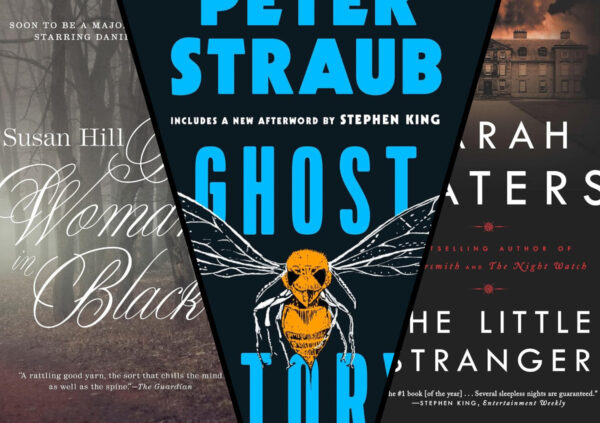
Ghost Story (1979)

In Milburn, New York, four old men gather on a regular schedule to trade frightening stories, under the name they gave themselves decades ago, the Chowder Society. Fifty years ago, something happened involving a young woman, they’ve never spoken about it properly, and one of them has just died.
It’s the most tightly built thing he wrote, and the opening half is as good as anything in his catalog. The frame is doing real work: a book about men telling ghost stories, in which the ghost story they keep avoiding is the one that matters, and Straub folds narratives inside each other until the reader sits several layers down.
The usual verdict grants that the midsection sprawls past its needs, and that the thing at the center of it all ranks with the great entities of the modern genre. It was a bestseller, it made his name in America, and it’s the book that made him and King friends.
Also on ghost books and paperbacks from hell.
Shadowland (1980)

Two boys at a brutal Arizona boarding school in 1958 become friends, and one of them, Tom Flanagan, gets invited to spend the summer at the house of the other’s uncle, who is a stage magician.
Coleman Collins is not a stage magician. Shadowland is a real place in Vermont where magic works, the summer is an apprenticeship, and Collins teaches them by telling stories, which the reader also receives, several of them versions of fairy tales that have gone wrong.
The structure is what people remember. Stories nest inside stories, characters from the tales walk into the house, and Straub never marks the transitions, so you lose track of which level you’re on at roughly the same rate Tom does.
It’s his most ambitious early book and his least commercial, and it followed Ghost Story directly, which can’t have pleased his publisher.
Neil Gaiman has called it a formative book. It divides readers completely, and its admirers are fierce.
Julia (1975)

His first supernatural novel, and it shows how much he learned in the four years before Ghost Story.
Julia Lofting leaves her husband after the death of her nine-year-old daughter, in circumstances the novel discloses slowly and which involve Julia herself, and buys a house in Kensington. There’s a child in the park across the road who shouldn’t be there.
The ambiguity is the whole book, and Straub keeps it open to the last page. Julia is grieving, medicated, isolated in a country not her own, and being systematically undermined by her husband and his family, all of whom want her declared incapable so they can control her money. Everything she perceives has an explanation available.
The London setting is exact. Straub was living there, and the Kensington and Notting Hill geography is real.
Filmed in 1977 as Full Circle with Mia Farrow, retitled The Haunting of Julia, and it’s very good and hard to find.
If You Could See Me Now (1977)

Miles Teagarden returns to the Wisconsin farming community where he spent his childhood summers, to keep a promise he made twenty years ago to his cousin Alison, who died the same night, that they would both come back to that spot on a particular date.
He arrives to find that the town remembers what happened and never accepted his account of it, and that children are being murdered while he’s there.
The novel runs two possibilities in parallel for its whole length. Either Alison has come back, or Miles is being framed by a community that decided he was guilty in 1955 and has been waiting for him.
What’s genuinely well done is the town. Straub grew up in Milwaukee and writes rural Wisconsin with no romance at all: the farms, the church, the tavern, the specific way a small place closes around an outsider.
It’s the last of the early novels before he became famous, and it’s the tightest of them.
The Blue Rose Trilogy
The Peter Straub books he cared most about, and the ones that cost him the largest share of his audience.
Koko (1988), Mystery (1990) and The Throat (1993), and they’re crime novels with the horror machinery still attached.
They connect loosely rather than sequentially. Characters recur, a phrase recurs, and a murder from the 1940s in a Wisconsin town called Millhaven runs underneath all three.
This is the work Straub cared most about, and it’s the reason serious critics took him seriously. He was moving deliberately away from the supernatural and toward the argument that the horror in American life is entirely available without it, and that a genre reader’s tools are the right ones for looking at it.
The trilogy is where the Vietnam material sits, where Tim Underhill first appears, and where the prose gets most ambitious.
It also cost him readers. People who arrived for Ghost Story didn’t want four hundred pages about a serial killer in Milwaukee, and the books sold well below his peak.
Start with Koko.
Koko (1988)

Four survivors of the same platoon meet at the dedication of the Vietnam Veterans Memorial in Washington in 1982, and work out that somebody they served with is killing people across Southeast Asia and leaving playing cards with the name Koko on the bodies.
They go looking for him themselves rather than telling anybody.
What happened at a village called Ia Thuc is the thing none of them will discuss and the thing the novel is actually about, and Straub releases it across four hundred pages in pieces, from four unreliable memories.
Tim Underhill appears here first and becomes the recurring figure across the rest of Straub’s career, including the late novels. He’s a novelist, gay, an addict at this point, and the closest thing Straub wrote to a self-portrait.
Nothing supernatural occurs anywhere in it.
It won the World Fantasy Award for best novel, which is an unusual outcome for a book with no fantastic content whatsoever.
Mystery (1990) and The Throat (1993)

The second and third of the Blue Rose books, and The Throat is the one his admirers consider his masterpiece.
Mystery is a detective novel set on a Caribbean island and in Millhaven, following Tom Pasmore, a teenager who becomes obsessed with an unsolved murder and gets taught investigation by an elderly recluse called Lamont von Heilitz. It’s the most conventionally plotted thing Straub wrote, and the pleasure is watching a boy learn a method.
The Throat brings Tim Underhill back to Millhaven, where the Blue Rose murders appear to have started again forty years after the originals, and the novel resolves what the first two books have been circling.
It’s also formally the strangest. Underhill is a novelist writing about events he’s inside, the reader gets his drafts, and the relationship between what happened and what he’s writing becomes the subject.
Straub said in interviews it was the book he was proudest of.
The King Collaborations
The two Peter Straub books most people have actually read, and they’re not really representative of either writer.
The Talisman (1984)

Written with Stephen King, and the collaboration worked because they were doing different things.
Jack Sawyer is twelve. His mother is dying in a hotel on the New Hampshire coast, and he sets out to walk to California, because a talisman there will save her. He can flip between our world and a parallel one called the Territories, where his mother has a counterpart who is a queen and also dying, and where the geography maps onto America, so a mile there is many miles here.
The road material is the best of it. Jack gets picked up, exploited, imprisoned in a religious institution for boys, and works in a bar in a town that isn’t right, and the American sections run considerably more frightening than the fantasy ones.
They wrote it by shuttling the manuscript electronically between their linked machines over three years, an exotic arrangement in 1984, and both declined ever to say who wrote what.
It sold enormously, and it reads more like King than like Straub.
Black House (2001)

The sequel, seventeen years later, and it’s a much stranger book than the first.
Jack Sawyer is now a retired homicide detective living in French Landing, Wisconsin, with no memory of the Territories, and a killer called the Fisherman is taking and eating children.
Two things make it work. The prose sits closer to Straub than The Talisman did, with a roving present-tense narrator that opens the novel by descending on the town from above and picking out details, which is Straub’s device rather than King’s.
And it’s explicitly a Dark Tower book. The Territories connect to the Tower, the Crimson King stands behind the Fisherman, the breakers appear, and a reader with no Dark Tower background will get most of it and miss the frame.
The Fisherman material is genuinely disturbing, and the Black House itself is the best haunted building either of them wrote.
A third volume was discussed for years. Straub died in 2022.
The Late Work
The last Peter Straub books, where he returned to the supernatural and to Tim Underhill at the same time.
Lost Boy Lost Girl (2003) and In the Night Room (2004)

The two late novels, both won the Bram Stoker Award, and they’re where Straub’s formal experimentation goes furthest.
lost boy lost girl has Tim Underhill returning to Millhaven after his sister-in-law’s suicide, and his nephew Mark then disappears, and the house Mark had become obsessed with may connect to a serial killer operating in the seventies.
In the Night Room is the strange one. It follows Underhill again, and also a children’s author named Willy Patrick whose husband and daughter were murdered, and the two of them meet, and the novel is about whether one of them is a character in a book the other is writing.
That’s the argument of the late work: a novelist inventing people is doing something with moral weight, and Straub takes it seriously enough to build a horror novel out of it.
They should be read in order and read together.
A Dark Matter (2010)

His last novel, and it returns to material he had been circling for decades.
Madison, Wisconsin, 1966. A charismatic figure called Spencer Mallon persuades a group of students to take part in a ritual in an agronomy meadow. Something happens. One student is found dead in circumstances nobody can explain, one goes permanently insane, and the others scatter and spend forty years not discussing it.
Lee Harwell, a novelist whose wife was there, sets out decades later to interview each of them and assemble what occurred.
The structure carries everything, and it’s the Rashomon problem done properly. Each account is complete, internally consistent and incompatible with the others, and Straub declines to arbitrate. Something did happen in that meadow, and what you end up holding is five different true versions.
The Skylark is a longer alternate version of the same novel, published separately by Subterranean, and readers who love this one should know it exists.
Where to Start
Read Ghost Story, and give it the first hundred and fifty pages, which is where it earns everything.
If the length is the obstacle, read Julia instead. It’s short, it’s a proper haunting, and it will tell you whether the voice works for you.
If Ghost Story lands and you want more, read Shadowland for the strange one or Koko for the serious one.
And read The Talisman whenever you want something that just moves.
The canon it belongs to is on my horror classics page. Ghost Story is the high-water mark of my ghost books list.