Robert Bloch wrote Psycho in about six weeks, sold the film rights for nine thousand five hundred dollars, and had no idea Hitchcock was the buyer.
That transaction is the single most famous fact about him, and it’s a poor summary of a sixty-year career. He published his first story at seventeen, in Weird Tales, as a teenage correspondent of Lovecraft’s. He wrote hundreds of stories, dozens of novels, and a great deal of television, including three Star Trek episodes. He won the Hugo. He served as president of the Mystery Writers of America.
The through-line across the Robert Bloch books is that he moved horror out of the supernatural and into the skull, and he did it early. By 1943 he was writing “Yours Truly, Jack the Ripper”, and by 1959 he had produced the novel that told American fiction the monster could be the man at the front desk. That shift belongs to him more than to anyone.
And he was funny, relentlessly, in person and on the page, and the puns are famous enough to count as a liability. He liked to describe himself as having the heart of a small boy, which he kept in a jar on his desk.
He died in 1994. The Robert Bloch books run to a very large catalog, and this is a guide to it.
I haven’t read these. What follows is the critical consensus.
Fiction by René Rehn


The Short Version
Read Psycho. It’s short, cold, better than its reputation as the film’s source, and the structural trick is Bloch’s rather than Hitchcock’s.
Then the short fiction, which holds most of his best work, and start with “Yours Truly, Jack the Ripper”.
The Essential
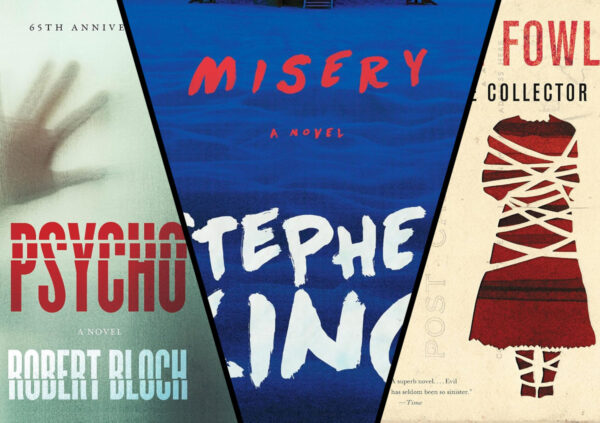
Psycho (1959)

A woman named Mary Crane walks out of her office with forty thousand dollars of a client’s money, points her car toward her boyfriend, and pulls in for the night at a quiet motel whose proprietor answers to his mother.
The famous structural trick belongs to Bloch. Cutting down the apparent protagonist a third of the way through was his decision, and what Hitchcock added was making the audience watch it happen instead of learning about it afterwards.
Norman on the page is another creature entirely. Middle-aged, heavy, unpleasant, a drinker with an amateur’s shelf of occult books, and the novel never once asks you to like him. Perkins played him boyish, and that changed the story permanently. The book is colder, and its psychology is harder to look away from.
The seed was Ed Gein, whose case had broken in Wisconsin two years earlier, a short drive from Bloch’s own town. By his own account, he knew almost none of the details then and built the novel from a single premise: that a man like that could be somebody’s neighbor, and nobody would know.
Also on psychological horror books and serial killer books.
Yours Truly, Jack the Ripper (1943)

Written in 1943 when Bloch was twenty-six, and it’s one of the most-reprinted horror stories ever published.
Sir Guy Hollis arrives in Chicago and tells a psychiatrist that Jack the Ripper is still alive, that the murders were ritual sacrifices intended to confer immortality, and that the pattern of similar killings across the world since 1888 proves it.
The psychiatrist humors him and agrees to squire him around the city’s bohemian parties looking for the man.
The premise is the invention. Bloch is the writer who turned the Ripper from a historical crime into a supernatural franchise, and every immortal-Ripper story since, including Star Trek‘s “Wolf in the Fold,” which Bloch also wrote, descends from this one.
The last line is the whole story, and it works even when you see it coming.
It has been adapted for radio, television and comics more times than anybody has bothered to count.
Old editions are out of print, but it’s worth tracking the story down.
The Short Fiction

This is where the bulk of the work sits, and where the range runs widest.
“Enoch” (1946) is the one horror readers name right after the Ripper story: a man with something living in his skull that tells him what to do. “That Hell-Bound Train” (1958) won the Hugo, a deal-with-the-devil story with a genuinely good exit. “The Skull of the Marquis de Sade” became a Hammer film. And the Lovecraft-circle material is worth knowing about: “The Shambler from the Stars” kills off a Lovecraft stand-in, Lovecraft answered with “The Haunter of the Dark” and killed a Bloch stand-in, and Bloch eventually wrote a third installment.
The Best of Robert Bloch and the two-volume Selected Stories of Robert Bloch are the collections to hunt for. Nearly all of it is out of print in individual volumes.
The Other Novels
The Scarf (1947)

His first novel, published in 1947, twelve years before Psycho, and the method is already in place.
Daniel Morley is a writer. He strangles women with a scarf, and he narrates the novel himself, and the opening line, in which he addresses the reader about fetishes, was startling enough in 1947 that his publisher demanded changes.
What earns it a place on this page is that Bloch is already doing the thing everybody credits to Psycho. The killer is ordinary, charming, professionally successful, and entirely reasonable in his own account, and there’s no supernatural element and no explanation offered beyond a childhood incident he mentions exactly once.
It’s a psychological crime novel from a decade when almost nobody wrote them from the inside.
The prose runs pulpier than the later work, and the structure sags in the middle.
Reissued by Hard Case Crime and easy to find.
Night-World (1972) and American Gothic (1974)

Two from the later career, and American Gothic is the one worth seeking out.
American Gothic runs on H. H. Holmes, the Chicago murderer who built a hotel during the 1893 World’s Fair with rooms designed for killing. Bloch fictionalizes him as G. Gordon Gregg and tells it through a young journalist who grows suspicious, and the research on the fair and the building is careful.
It marks the second time Bloch built a novel from a real murderer, sixteen years after Gein, and he said plainly that the American appetite for this material was itself his subject.
Night-World is a hospital thriller about an escaped patient, and it’s minor.
He published over twenty novels, and the settled view is that the short fiction is where he lives, and that the novels after Psycho mostly paid the bills between screenwriting jobs.
The Psycho Sequels

Two of them, published in 1982 and 1990, and the first exists because of the films.
Psycho II got written after Universal announced a film sequel without him, and Bloch’s version has nothing to do with theirs. Norman escapes the institution disguised as a nun, heads for Hollywood, and the novel turns into a satire about the film industry making a picture out of his crimes.
That’s a considerably more interesting idea than the one the film used, and Universal ignored it completely.
Psycho House is set at the motel, reopened as a tourist attraction, with a murder committed on the premises to promote it.
Both are minor, and both are about the same thing, the commercial exploitation of a real crime, and Bloch had a personal stake in that argument, having watched it happen to his own book.
Both are hard to track down, but Psycho II can be experienced as an audiobook on Audible.
Where to Start
Read Psycho. It takes an evening, and it’s a colder, meaner book than the film.
Then “Yours Truly, Jack the Ripper”, which takes fifteen minutes and is the best of the Robert Bloch books in miniature.
If those work, look for a collection rather than more novels, because the short fiction is where he lived.
And read The Scarf if you want to watch him run the Psycho play twelve years early.
For the wider canon, see my horror classics page. Psycho put the killer inside the house, and my serial killer books list follows that line.