For about forty years after she died, Shirley Jackson was filed as a writer of one very good short story and some spooky novels, a housewife in Vermont who turned out creepy tales between raising four children.
That was always wrong, and it’s now been comprehensively undone. Ruth Franklin’s 2016 biography did most of the work, the Library of America put her in the canon, and there’s an annual award named after her. What the reappraisal established is that Jackson wasn’t a horror writer who happened to be literary, or a literary writer who dabbled in horror. She was writing about the same thing the whole time, in every genre she touched, including the comic memoirs about family life that nobody reads anymore. horror books
The subject is a woman alone in a house, and what the house does to her, and what the people outside it are prepared to do if she stays strange for too long. gothic fiction
She received no awards, grants or fellowships in her lifetime, though “Louisa, Please Come Home” was an Edgar nominee in 1961, and the Edgar that “The Possibility of Evil” won came a year after her death. She died in 1965 at forty-eight. Six novels, two memoirs, and a body of short fiction that keeps getting better as the culture catches up to it. What follows is a guide to the Shirley Jackson books worth your time, and the order I’d take them in.
Fiction by René Rehn


The Short Version
Read The Haunting of Hill House. It’s the best haunted house novel ever written and the argument isn’t close.
Then We Have Always Lived in the Castle, which is her last novel, her strangest, and the one readers now rate highest.
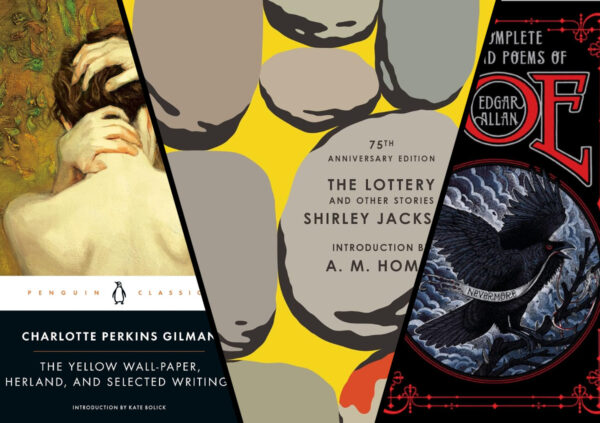
Then The Lottery and Other Stories, for the famous one and about fifteen others that deserve to be as well known.
Everything else is for people who want more, and there’s more worth having among the Shirley Jackson books than her reputation suggests.
The Essential Three
The Haunting of Hill House (1959)

Four people come to stay in a house that has a reputation. Dr. Montague is a scholar of the supernatural, Luke is the heir to the property, Theodora is bright and quick and cruel, and Eleanor has spent eleven years nursing her invalid mother and has nowhere to go and nothing of her own except a car she stole from her sister.
The famous thing about it is that almost nothing happens. There’s cold in one spot, and pounding on a door, and writing on a wall. No apparitions, no violence, no explanation. What the book does instead is watch Eleanor, who arrives lonely and desperate to belong and is delighted to be somewhere at last, and who becomes steadily less sure whether the house is doing something to her or she is doing it to herself.
Stephen King has called it one of only two great supernatural novels of the last century, alongside The Turn of the Screw, and Paul Tremblay’s line is that every other haunted house book stands in its shadow. horror classics The consensus is essentially unanimous, and the opening paragraph is one of the most quoted in American fiction.
It was a finalist for the National Book Award. Robert Wise filmed it in 1963 as The Haunting, which is very good, and Netflix made a 2018 series which is well-liked but shares little with the novel beyond a title and a house.
We Have Always Lived in the Castle (1962)

Her last completed novel, published three years before her death, and the one her readers have quietly promoted to the top over the last two decades. It rates higher than Hill House on Goodreads across a quarter of a million ratings.
Eighteen-year-old Merricat Blackwood keeps house with her sister Constance and their invalid uncle, in a big place set apart from a village that despises them. Six years before, arsenic at the dinner table killed most of the family; Constance stood trial and was acquitted. Merricat buries objects in the grounds and nails books to trees to protect the property, and narrates all of this in a voice of such flat cheerfulness that it takes a while to notice what you’re being told.
It’s the sharpest thing she wrote about the outside world. Hill House is about a house doing something to a woman. This is about a village doing it, and the horror is entirely human: neighbors who have decided a family is wrong and are waiting for permission.
The final act is one of the most unsettling in American fiction, and it is not unsettling for the reason you’d expect. Go in without reading a summary.
The Lottery and Other Stories (1949)

This is the one I’ve actually read from, and only the title story, so take the rest of this on the critical consensus rather than from me.
“The Lottery” deserves everything. A village gathers on a bright summer morning for an annual civic event. Everyone is cheerful, everyone knows the procedure, and the story tells you exactly what is going to happen from about the third paragraph without ever saying it, then lets you understand it about ninety seconds before it arrives. The flatness of the telling is the whole method. Nobody in it is evil. That’s the point, and it’s why it’s still the most effective piece of short horror written in America.
When The New Yorker published it in June 1948, it generated more mail than any piece of fiction the magazine had ever run. Jackson said afterwards that of the several hundred letters, thirteen were kind, and those were mostly from friends. Readers cancelled subscriptions. Some wrote to ask where the lottery was held so they could watch. Her own mother wrote to complain.
The collection around it is not padding. It was originally published as The Lottery, or, The Adventures of James Harris, and a figure of that name recurs through about half the stories, which turns a collection into something closer to a linked sequence. The consensus picks are “The Daemon Lover”, “The Renegade”, “Charles” and “The Summer People”, and the collection is rated higher than either famous novel by the people who’ve read all three.
The Other Novels
Four more, none of them famous, and the consensus on them is that they’re uneven rather than minor.
The Sundial (1958)

The Halloran family are gathered at the family estate for a funeral when Aunt Fanny goes into the garden, gets lost in the mist, and meets her dead father, who tells her the world is going to end and that everybody in the house will be spared.
She reports this at dinner. They believe her.
What follows is the funniest thing Jackson wrote and one of the strangest. The household, which is already a nest of mutual loathing, sets about preparing: cataloguing supplies, burning the library to make room, working out who else may be admitted, and quarreling constantly about the arrangements for a world they will inherit.
Nobody in the book is likeable. Mrs. Halloran, who has just possibly murdered her son, runs it as a small tyranny, and the novel treats the apocalypse as an opportunity for a power struggle.
Jackson never confirms whether Aunt Fanny is right, and the last pages are a party.
It is the least read of her novels and the one her admirers argue for hardest.
Hangsaman (1951)

Seventeen and bound for a small women’s college, Natalie Waite leaves a household run by her father, a minor writer who reads her diaries and has raised her to believe herself exceptional. The book opens at a garden party where something is done to her, rendered obliquely by Jackson and never revisited.
College brings no friends. Instead she builds an inner world where a detective interrogates her, fixes first on a young faculty wife, then on a girl named Tony whose existence is uncertain.
Nothing in Jackson frightens like the final section, Natalie and Tony walking into the night woods, and not one supernatural thing occurs in it.
Part of its source is the Paula Jean Welden case: a Bennington student who set out on the Long Trail in 1946 and never came back. Bennington was Jackson’s town, and her husband taught at the college.
Every dark academia novel descends from it.
The Bird’s Nest (1954)

Elizabeth Richmond is twenty-three, works in a museum, lives with an aunt, and has headaches, backaches and gaps in her memory. Then she starts receiving letters that appear to be from herself.
Four personalities emerge across the novel and Jackson gives each of them a section: Elizabeth, Beth, Betsy and Bess. Betsy is the one who escapes to New York looking for their dead mother, and her chapters are the best in the book.
Doctor Wright is the reason it belongs on any horror list. He is vain, self-congratulatory, comic, and utterly certain of his own competence, he treats the four as an interesting professional problem rather than as a person, he names them himself, and he decides which of them should be permitted to survive.
Jackson’s sympathy is entirely with the parts that do not want to be reconciled by him.
She wrote it before the popular fascination with the condition and it is considerably more serious than what followed.
The Road Through the Wall (1948)

Her first novel, published in 1948 in the same year as “The Lottery,” and it establishes the subject she spent the rest of her career on.
Pepper Street is a comfortable suburban block in California in 1936, with a wall at the end of it separating the residents from the poorer neighborhood beyond. The wall is going to be knocked through for a new road, and the novel follows about a dozen families across the summer that decision arrives.
There is no supernatural element and no crime until very late. What there is instead is the machinery of a community: who is invited, who is excluded, which family is Jewish, which child is fat, which mother is watching from which window, and how quickly the whole street can agree on a target.
Then a child goes missing.
It is drawn from the street in Burlingame where Jackson grew up, and her mother reportedly never forgave her for it.
The Memoirs

Life Among the Savages (1953) and Raising Demons (1957), and they are not what anybody expects.
These are domestic comedies about raising four children in a large decaying house in Vermont, written for women’s magazines, and they were far more commercially successful in her lifetime than the fiction. They are genuinely funny, in a register close to Erma Bombeck, and they sold on that basis.
They are also, read now, a document of the life that was destroying her. Jackson was managing a household, a serially unfaithful husband, four children, agoraphobia, and a village that disliked her, on amphetamines and tranquilizers, and producing this material to pay for it.
The books never say any of that. What they do is transform it into anecdote, which was the professional requirement.
Ruth Franklin’s biography A Rather Haunted Life (2016) is the essential companion and won the National Book Critics Circle Award.
Read the memoirs after the fiction, not before.
Collections and Where to Find Everything

Dark Tales (2016) is the cheap Penguin selection of the scariest short fiction among the Shirley Jackson books, and it’s the fastest way in if you don’t want to commit to the full collection.
Let Me Tell You (2015) and Just an Ordinary Day (1996) gather unpublished and uncollected material found by her children. Both are uneven by nature and both contain real finds.
If you want the definitive object, the Library of America’s Shirley Jackson: Novels & Stories runs to 827 pages and collects Hill House, Castle, The Lottery and a substantial amount besides. That’s the volume that formally ended the argument about whether she counted.

And if the fiction sends you looking for the life, Ruth Franklin’s Shirley Jackson: A Rather Haunted Life is the biography that caused the reappraisal. It’s very good on the marriage to the critic Stanley Edgar Hyman, whose infidelity and self-importance did real damage, and it’s better than most literary biographies at taking the work seriously as work.
Where to Start
The Haunting of Hill House, and read it in as few sittings as you can manage. It works on accumulation and it loses power if you put it down for a week.
Then We Have Always Lived in the Castle, which is the better novel by some readings and certainly the odder one.
Then the stories, where “The Lottery” is the entry point and about a dozen others are the reason to stay.
If those three work on you, the rest of the Shirley Jackson books are worth the time, and The Sundial is the one I’d take next.