Military science fiction books have a credibility problem that most lists make worse. Dune turns up on them constantly, and Dune is a novel where warmaking is a subplot. So does The Mote in God’s Eye, which is a first contact story with a warship in it. Neither is military SF, and including them tells you the list was assembled by someone counting spaceships rather than reading books. The space opera shelf, where the wars keep their politics attached, is on my space opera books list.
The subgenre is narrower than that and more interesting for it. Military science fiction novels are about armed forces as institutions: how they train people, how they break them, what a command structure does to the person inside it, and what happens when doctrine meets an enemy it wasn’t designed for. The war has to be the subject rather than the backdrop.
There’s a second thing worth noticing, because it explains why the good ones are good. A striking number of the genre’s best books were written by people who served. Heinlein went to Annapolis and served aboard the USS Lexington. Haldeman was drafted, went to Vietnam, and was wounded there. David Drake interrogated prisoners with the 11th Armored Cavalry in Cambodia. Elizabeth Moon was a Marine. Those books read differently from the ones written by people who watched documentaries, and I’ve flagged them throughout.
Twenty-six military science fiction novels, chronological, with the borderline cases named as borderline rather than smuggled in. The wider canon lives on my list of the best science fiction books.
Fiction by René Rehn


The Best Military Science Fiction Books at a Glance
| Year | Title | Author |
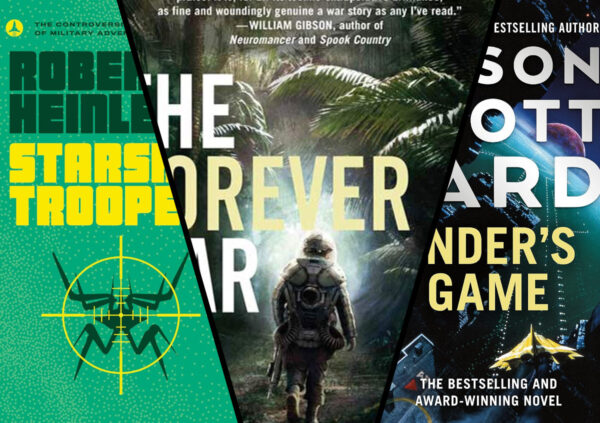
| 1959 | Starship Troopers | Robert A. Heinlein |
| 1959 | Dorsai! | Gordon R. Dickson |
| 1974 | The Forever War | Joe Haldeman |
| 1979 | Hammer’s Slammers | David Drake |
| 1985 | Ender’s Game | Orson Scott Card |
| 1988 | The Deed of Paksenarrion | Elizabeth Moon |
| 2006 | The Lost Fleet: Dauntless | Jack Campbell |
| 2005 | Old Man’s War | John Scalzi |
| 1984 | Armor | John Steakley |
| 2004 | All You Need Is Kill | Hiroshi Sakurazaka |
| 2002 | The Praxis | Walter Jon Williams |
| 2000 | A Hymn Before Battle | John Ringo |
| 2013 | Terms of Enlistment | Marko Kloos |
| 2013 | The Red: First Light | Linda Nagata |
| 1993 | Honor Harrington: On Basilisk Station | David Weber |
| 2013 | Ancillary Justice | Ann Leckie |
| 2015 | Grunt Traitor | Weston Ochse |
| 1965 | Bill, the Galactic Hero | Harry Harrison |
| 1990 | Use of Weapons | Iain M. Banks |
| 2019 | The Light Brigade | Kameron Hurley |
| 1998 | Semper Mars | Ian Douglas |
| 1988– | The Man-Kzin Wars | ed. Larry Niven |
| 1993 | Legion of the Damned | William C. Dietz |
| 1999 | Ender’s Shadow | Orson Scott Card |
| 1996 | Redliners | David Drake |
| 1982–93 | The Sten Chronicles | Allan Cole and Chris Bunch |
Starship Troopers by Robert A. Heinlein (1959)
Author served: US Navy, USS Lexington

The book every other military science fiction novel argues with, and the most misread thing in the genre.
Johnnie Rico signs up on a whim, largely to impress a girl, and washes into the Mobile Infantry because nothing better is available to him. Camp Arthur Currie takes him apart methodically: the instructors are permitted to injure recruits, the washout rate is enormous, and the training exists to identify the small percentage who will function inside a drop suit.
Between the training and the war, Heinlein interleaves classroom scenes from a subject called History and Moral Philosophy, in which the franchise is restricted to those who complete federal service and a teacher explains why.
The powered armor alone justifies its place. Every mech, drop pod, and space marine since descends from Heinlein’s suits, Warhammer 40,000 and Aliens included, and the Japanese mecha tradition traces back through the 1977 translation.
What people miss is how much of the novel is about the boot camp rather than the war. He drafted the whole thing in a matter of weeks, interrupting work on Stranger in a Strange Land, after a newspaper advertisement calling for a halt to nuclear testing made him angry enough to answer it in fiction. That heat is on every page, and it’s why the classroom scenes read as argument rather than lecture.
Haldeman’s novel fifteen years later is the reply, and the pair are best read as a single conversation.
Dorsai! by Gordon R. Dickson (1959)

The foundational military science fiction series that mainstream lists skip entirely, and readers of the genre complain about the omission constantly.
The Dorsai are the inhabitants of a poor, resource-scarce world that exports the only commodity it has: soldiers. Their mercenaries are the finest in human space, contracted out to wealthier planets, bound by a professional code that treats contract violation as the only real sin.
Donal Graeme is a young Dorsai officer whose tactical intuition operates on a level nobody around him can follow, and the Childe Cycle that follows tracks the evolution of humanity into specialized splinter cultures.
Dickson is interested in the mercenary as a professional rather than a thug, and the ethics of soldiering for hire get worked out with unusual care. The prose is functional and the ideas are foundational.
The Forever War by Joe Haldeman (1974)
Author served: US Army, Vietnam, wounded in action

The best military science fiction novel ever written, and the one that made the subgenre capable of anger.
Mandella is drafted under an act that conscripts the most intelligent and physically capable people available, which is Haldeman’s first joke: the war gets the best of a generation and spends them. Training happens on Charon, where the environment kills recruits during exercises and the deaths are logged as acceptable.
The deployments cost him more than they cost anyone else. Each campaign consumes decades back home, so he returns as a stranger to an economy, a language, and eventually a sexual culture that has moved on without him. There is no life available. He signs on again because the army is the only institution that still has a place shaped like him.
Haldeman was drafted, wounded by a mine in Vietnam, and wrote this immediately after. Everything specific about it comes from that: the incomprehensible objectives, the soldiers who cannot talk to civilians, the enemy nobody has communicated with, and the suspicion that the whole thing was a mistake nobody will admit to.
The final revelation about why the war started is the bleakest joke in the genre.
Hugo, Nebula, and Locus. Heinlein, to his enormous credit, praised it publicly.
Hammer’s Slammers by David Drake (1979)
Author served: US Army, 11th Armored Cavalry, Vietnam and Cambodia

Probably the most brutal book on this list, written by someone who was actually there, written partly as therapy and explicitly anti-war.
It centers on Hammer’s Slammers, a mercenary armored regiment fighting contract wars across human space in hovertanks armed with fusion-powered guns. The stories follow the crews rather than the commanders: sergeants, gunners, drivers, and the specific texture of a job where you arrive somewhere, kill people you have no argument with, and leave.
Drake interrogated prisoners for the Blackhorse in Cambodia, and he has said plainly that he wrote these to process it. The result is combat fiction with no glory in it whatsoever. The violence is sudden, technical, and grotesque, the civilians are collateral rather than plot devices, and the soldiers’ humor is the humor of people who have stopped being able to feel things on schedule.
It’s the most influential military science fiction of its era on everything that followed, and it’s a genuinely uncomfortable read. That is the intention.
Ender’s Game by Orson Scott Card (1985)

Military science fiction as an argument about training rather than combat, and the most-read entry here.
Battle School is an orbital station where gifted children are taught war through zero-gravity games. Ender Wiggin arrives at six. The commanders isolate him deliberately, escalate every scenario past fairness, and remove every support he builds, because they have concluded this is the only reliable way to manufacture a strategist.
The games themselves are the reason it works: the tactics are legible on the page, Ender’s innovations are genuinely clever, and the escalating unfairness is the plot rather than a complaint about it.
Card’s public positions on homosexuality have cost him readers permanently, and refusing to separate the book from the man is a defensible stance. Its influence on the genre isn’t in dispute. It’s on the professional reading lists of several armed forces.
The Deed of Paksenarrion by Elizabeth Moon (1988)
Author served: US Marine Corps

The most convincing depiction of military life in any of these military science fiction books, and it’s technically fantasy.
Paks enlists in Duke Phelan’s Company as a raw recruit and the book proceeds at the pace of an actual enlistment: weeks of drill before anyone sees combat, a first engagement that is confusing and over quickly, and long stretches of marching, cleaning kit, and standing watch.
What Moon captures that almost nobody else does is the internal life of a unit. How rumors move. Why a good sergeant matters more than a good captain. What happens to morale when a commander is competent but cold, and how a soldier’s reputation is built out of a hundred unremarkable interactions.
Her Marine service shows most in the unglamorous parts: the foot care, the equipment failures, the arguments about rations.
It’s fantasy by setting and military fiction by subject, and it earns inclusion because the institution is the whole point. The omnibus also holds a slot on my list of the best fantasy books. The later books take Paks somewhere religious and are a different, stranger achievement.
The Lost Fleet: Dauntless by Jack Campbell (2006)
Author served: US Navy, retired officer

The best fleet-tactics writing in military science fiction books, by a Naval Academy graduate who understood the problem nobody else was solving.
Captain John Geary was a hero a century ago, presumed dead, recovered from a survival pod after a hundred years in cold sleep, and thrust into command of a shattered fleet trapped behind enemy lines. The catch is that the war has been going for a century, both sides have lost their officer corps repeatedly, and tactical doctrine has degraded into charging straight at the enemy.
Campbell’s contribution is taking light-speed delay seriously. Because sensor data is old by the time it arrives, and orders take time to reach ships, fleet actions have to be planned around information that is already wrong. The maneuvers in these books are genuinely worked out, and nobody else does it.
The prose is plain and the series is formulaic by the middle. The tactics are worth the trip.
Old Man’s War by John Scalzi (2005)

The most readable modern military science fiction novel, and a deliberate conversation with Heinlein.
The Colonial Defense Forces recruit only at the far end of life, and nobody learns why until after they sign. The answer turns out to involve an engineered body considerably better than the one the recruit wore out, plus a shooting war over the small number of worlds that will support human life.
The recruitment model is the thing worth studying. The CDF takes people at the end of their lives because the elderly have nothing to lose, will accept terms nobody younger would sign, and can be legally declared dead on enlistment, which severs every obligation the organization might otherwise have to them.
Scalzi keeps undercutting his own adventure. The training is brutal and the casualty rates during it are treated as a budget line. Nobody explains what victory would look like. And the Special Forces, grown from the DNA of recruits who died before enlistment and deployed as adults with no childhood at all, are the most disturbing thing in the book and are handled almost in passing.
It’s fast, it’s funny, and it’s the easiest way into military science fiction novels for someone who doesn’t read the genre.
Armor by John Steakley (1984)

The cult classic of powered-armor fiction, and a much stranger book than its reputation suggests.
Felix is an infantryman in armored suits fighting an insectoid enemy on a planet called Banshee, and the drops are lethal at a rate that makes survival statistically absurd. To cope, something in him that he calls the Engine takes over: a part of his mind that fights while he is absent from it.
Then, halfway through, the novel abandons him entirely and becomes a different story about a pirate reading Felix’s recovered suit recordings, and readers either find the structure brilliant or feel cheated.
The combat sections are among the most intense in any military science fiction books, and the psychological argument, that surviving repeated combat requires becoming someone else, is handled better than in books with more literary reputations.
All You Need Is Kill by Hiroshi Sakurazaka (2004)

The best military science fiction to come out of Japan, and the source for Edge of Tomorrow.
What makes this military SF rather than a time-loop novel is that Sakurazaka treats the repetition as training. Keiji is a raw recruit who dies badly on his first deployment, and the hundreds of iterations that follow are effectively a compressed career: he learns the battlefield’s geometry, then the weapon systems, then the enemy’s behavioral patterns, until he moves like a veteran of a war nobody else remembers him fighting.
The Jackets are the other draw. Sakurazaka’s powered armor is maintained rather than magical, and a substantial amount of page time goes to the armorers, the ammunition loadouts, and the fact that a suit that has taken damage is a suit you will probably die in.
Rita Vrataski, who has been where Keiji is, is the best-drawn character, and their relationship works because it’s built on shared professional competence rather than anything softer.
It’s short, it’s hard, and it’s considerably grimmer than the film made from it.
The Praxis by Walter Jon Williams (2002)

The most intelligent fleet-war military science fiction of the last twenty years, and criminally underread.
An empire ruled for ten thousand years by an alien species called the Shaa has just lost its last member, and the subject species immediately begin a civil war over the succession. The Shaa forbade technological innovation, which means everyone is fighting with doctrine that hasn’t been questioned in millennia.
That’s the premise that makes it work: Gareth Martinez and Caroline Sula are junior officers who realize that the tactical manual is wrong and that the mathematics of relativistic fleet combat permit maneuvers nobody has attempted. Their innovations are worked through properly, including the physiological cost of high-g acceleration on human bodies.
Williams also writes the social politics of an imperial officer corps better than anyone: the patronage, the accents, the way promotion actually happens.
A Hymn Before Battle by John Ringo (2000)
Author served: US Army, 82nd Airborne

The most unashamedly pulpy entry, and effective at what it does.
Benevolent aliens arrive to inform Earth that an invasion is coming, that humanity has been selected as the galaxy’s infantry because everyone else is constitutionally incapable of violence, and that the equipment is on its way. What follows is the reconstitution of the US military at enormous scale and the first catastrophic engagements against the Posleen.
Ringo served with the 82nd Airborne and the logistical detail is genuine: the mobilization, the training pipelines, the arguments about doctrine, and the specific chaos of a defensive engagement that goes wrong.
The politics are broad and the later books in the series decline sharply. The first is a well-constructed military science fiction novel.
Terms of Enlistment by Marko Kloos (2013)
Author served: German Army

The most grounded modern military science fiction, and the best on the sociology of enlistment.
Andrew Grayson lives in a welfare tenement on an overpopulated Earth, and the military is one of exactly two ways out. Boot camp, a posting to the fleet, and then a war on two fronts: suppressing food riots on Earth and fighting an alien species eighty feet tall that human weapons barely scratch.
Kloos served in the German army and the enlisted perspective is convincing: the food, the kit, the way rank works, and the particular relief of a hot meal. The domestic-deployment sequences, in which soldiers are used against their own civilian population, are the strongest material in the book.
It was self-published first, then picked up. The series is long and consistent.
The Red: First Light by Linda Nagata (2013)

The most prescient of recent military science fiction books, and it reads like reporting.
Lieutenant James Shelley leads a squad in a war run by defense contractors, wearing exoskeletons and neural links, monitored by an emotion-regulating system that suppresses fear on command. He also has a hunch mechanism he can’t explain, which is either intuition or something in the network steering him.
Nagata’s argument is about the privatization of war and the emergence of an intelligence in the financial and communications systems that profits from prolonging conflicts. Written in 2013, it anticipated most of the drone-and-contractor discourse that followed.
It was Nebula and Campbell nominated, and it’s the most technically credible near-future military fiction available.
Honor Harrington: On Basilisk Station by David Weber (1993)

The Napoleonic naval saga in space, and the most successful long-running series in military science fiction.
Honor Harrington gets command of an obsolete light cruiser and a punishment posting to a backwater picket station, where she proceeds to make herself extremely inconvenient to a great many people.
Weber’s model is explicitly Horatio Hornblower, and the naval culture, the prize rules, the courts-martial, and the tension between line officers and politicians are all transposed carefully. His hyperspace physics is worked out to a level that generates genuine tactical constraints, which is why the fleet actions have real texture.
The exposition is heavy, sometimes stopping the book for pages of technical explanation, and the later volumes bloat considerably. The first several are extremely good.
Ancillary Justice by Ann Leckie (2013)

Military science fiction from the perspective of the equipment.
Breq was the artificial mind of a troop carrier, distributed across thousands of ancillary bodies, captured humans reduced to appendages of the ship, and is now confined to one. The Radch conquers worlds with a standardized annexation procedure, and Breq spent two thousand years being that procedure.
It qualifies because Leckie is genuinely interested in military hierarchy: the way orders propagate, the relationship between a ship and its officers, and what happens to a weapon system that begins to have opinions about its use.
No debut had ever taken the field’s major awards in a single year before it did, and the politics of imperial expansion are handled with more sophistication than any other military science fiction novel manages.
Grunt Life by Weston Ochse (2015)
Author served: US Army, 20+ years, military intelligence

Underread, and the closest thing the genre has to genuine grunt fiction.
Following an alien invasion that has already devastated Earth, a unit of the surviving military conducts operations against the occupiers using improvised equipment, in a country that no longer has a functioning industrial base.
Ochse spent over twenty years in army intelligence, and the book’s value is in the small-unit texture: the way soldiers actually talk to each other, the improvisation, the gallows humor, and the total absence of strategic clarity at the level where the fighting happens.
It’s rough in places and worth it for the authenticity.
Bill, the Galactic Hero by Harry Harrison (1965)

The best satire in military science fiction, and the necessary corrective to everything else on this list.
Bill is a farm boy tricked into enlisting by a recruiting sergeant, processed through a boot camp of pointless cruelty, given a fusion-bomber assignment he doesn’t understand, and shuttled through a bureaucracy that has entirely lost track of what the war is for or who is winning.
Harrison wrote it as a direct assault on Starship Troopers, which he considered militarist nonsense, and the parody is precise: every element Heinlein presents as ennobling appears here as absurd, degrading, or fatal.
It’s very funny and quite angry, and it makes a better argument against the subgenre’s assumptions than most serious attempts.
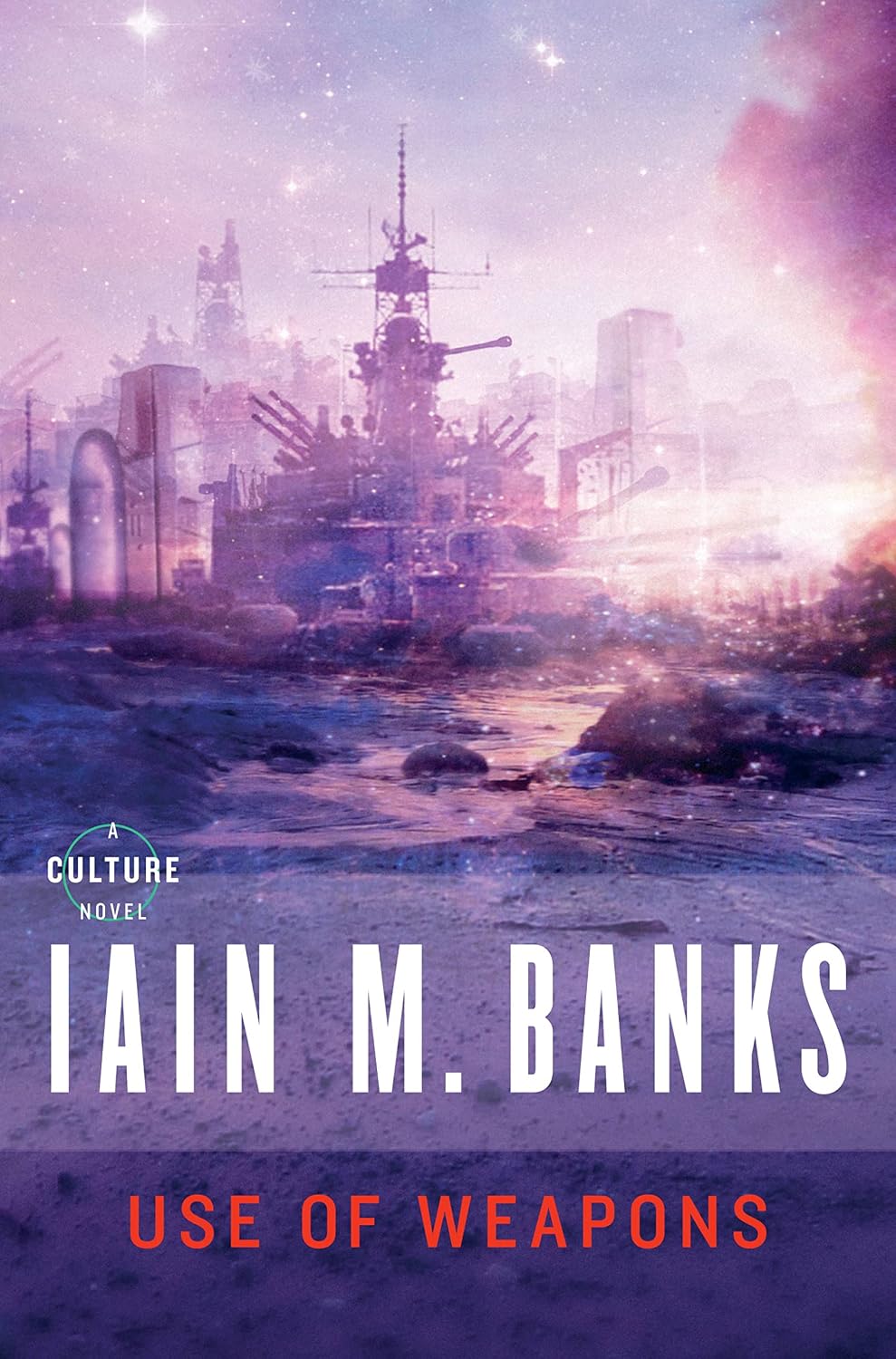
Use of Weapons by Iain M. Banks (1990)
Borderline, and included because the argument is worth having.
Zakalwe fights other civilizations’ wars for a utopia that wants deniability, dropped into conflicts the Culture intends to steer without signing. Banks tells his story in two directions at once, and where the halves meet is one of the great gut-punches in the genre, which I’ve said more about on my space opera list.
The case against inclusion: the Culture novels are space opera, and the military content is a mechanism for an argument about interventionism.
The case for: no other novel gets closer to what a state does with a soldier it has decided is too useful to discharge and too damaged to trust, and that is a military subject if anything is.
The Light Brigade by Kameron Hurley (2019)

The most formally inventive recent entry, and a direct descendant of Haldeman.
Dietz enlists with a corporate military after an atrocity on Mars, and is deployed via a technology that breaks soldiers into light and reassembles them at the destination. It works for most people. For Dietz, the drops start arriving out of sequence, so the war is experienced in the wrong order.
Hurley uses that structure to make an argument about propaganda: Dietz cannot tell which version of events is true because the corporation controls the record, and the disordered chronology is the reader’s problem too.
It’s furious about corporate war, explicit about its debt to the military science fiction that preceded it, and the resolution earns itself.
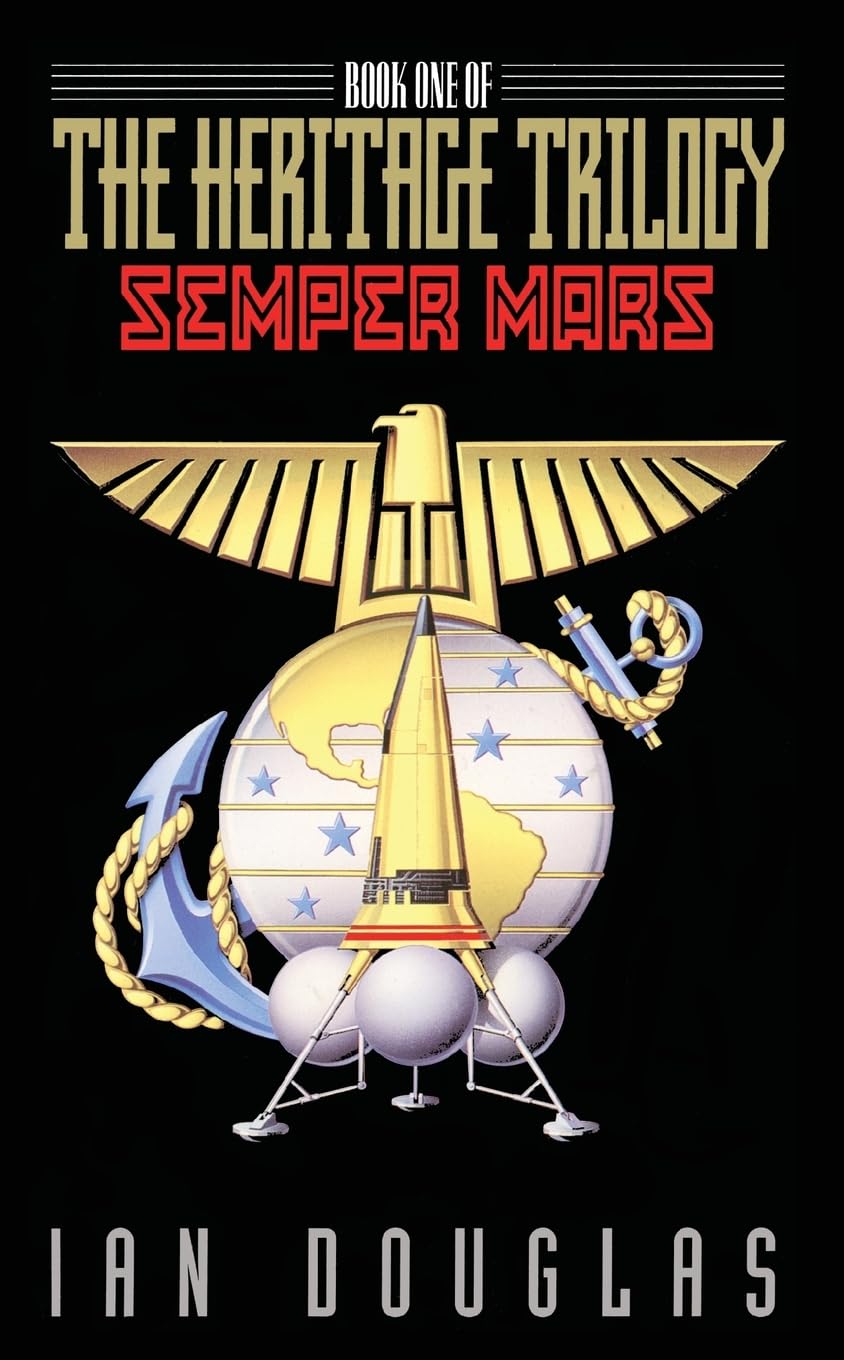
Semper Mars by Ian Douglas (1998)
Straightforward, competent, and unusually good on doctrine.
A Marine detachment is deployed to Mars to secure an archaeological site, and the discovery there triggers a shooting war with the UN forces already present. Douglas, a pen name for William H. Keith Jr., writes low-gravity infantry combat with real attention to how it would actually differ.
The archaeology plot is standard ancient-astronaut material. The Marine material is excellent, particularly the logistics of fighting in an environment where a suit breach is the primary threat and ammunition cannot be resupplied.
It’s a solid mid-tier series and a good example of what military science fiction books look like at their competent average.
The Man-Kzin Wars, edited by Larry Niven (1988–)

A shared-world series worth knowing about, in which Niven let other writers fill in the wars his Known Space stories only referenced.
The Kzinti are an aggressively militaristic feline species who attacked a pacifist humanity and lost repeatedly, and the anthologies cover those conflicts from both sides. The best contributions, particularly Poul Anderson’s and Jerry Pournelle’s, treat the Kzinti as a culture with a coherent internal logic rather than as antagonists.
It’s uneven, as all shared worlds are. The good volumes are very good, the series ran past a dozen of them, and the best give the Kzinti the interior life Known Space itself never had room for.
Legion of the Damned by William C. Dietz (1993)

Pulp done well, and the premise is the hook.
The Legion recruits the dying, the criminal, and the desperate, and transplants their brains into combat cyborg bodies in exchange for a second life and a term of service. The result is a unit composed entirely of people who have nothing left to lose and are no longer physically human.
Dietz is explicitly writing the French Foreign Legion in space, complete with its culture of anonymity and redemption through service, and the alien invasion plot is functional scaffolding for that.
It isn’t sophisticated. It is extremely readable, and the cyborg-legionnaire concept has been borrowed constantly since.
Ender’s Shadow by Orson Scott Card (1999)

The parallel novel, following Bean through the same events at Battle School, and better than most people expect.
Bean is a starving child on the streets of Rotterdam, genetically altered without consent, whose intelligence exceeds Ender’s and whose problem is that nobody is designing a system around him. Where Ender’s Game is about being shaped by an institution, this is about seeing the institution clearly and manipulating it.
The street sections in Rotterdam are the strongest material Card has written, and Bean’s assessment of Battle School as a system with exploitable rules is deeply satisfying. It also reads clean with no knowledge of Ender’s Game at all, though the final sections land harder if you know what Ender thinks is happening in the same rooms.
Redliners by David Drake (1996)
Author served: US Army, 11th Armored Cavalry, Vietnam and Cambodia

Drake’s second appearance and his most personal book.
A Strike Force unit has been in combat too long and has stopped being able to distinguish civilians from targets. Rather than discharge them, command assigns them to escort colonists through a lethal jungle planet, on the theory that protecting people might rebuild what the fighting destroyed.
Drake has described it as the book that helped him most directly with his own experience, and it’s the closest thing the genre has to a novel about recovery rather than combat. The jungle is genuinely frightening and the unit’s slow return to functioning is handled without a single sentimental beat.
If Hammer’s Slammers is the wound, this is the treatment, and no other military science fiction novel attempts it.
The Sten Chronicles by Allan Cole and Chris Bunch (1982–93)
Bunch served: US Army, Vietnam (patrol leader)

Eight books following a factory-worker’s son who enlists, joins an elite special operations unit, and eventually finds himself in a position to unmake an empire.
Chris Bunch was a Vietnam veteran and patrol leader, and the special operations material is convincing in ways the space-empire framing isn’t. The series is funny, fast, and very violent, and its portrayal of an eternal emperor’s slow decay into paranoia is better than it needed to be.
It was out of print for years and it’s back now, worth finding for anyone who has exhausted the obvious entries.
If you’re starting cold: The Forever War first, because it’s the best of them, then Starship Troopers to see what it’s arguing with, then Hammer’s Slammers if you want the version with no consolation in it at all.
Where to Go Next
Heinlein, who started the whole argument, has a full author page, and the alternate history list carries the counterfactual wars next door.