Space opera started as an insult. Wilson Tucker coined it in 1941, building it off “horse opera” and “soap opera,” and he meant something specific and dismissive: the hacky, grinding, outworn spaceship yarn. The stuff that filled magazines because it was easy to write and easier to sell. The space opera books below are the genre answering him. The wider canon sits on my best science fiction books list.
It took about forty years for the genre to take the term back, and the way it did that is the actual history of space opera books. The pulps established the furniture, galactic empires, faster-than-light travel, fleet actions, alien civilizations. Then a generation of writers arrived who could do everything the pulps did and also write properly, and the form turned out to be capable of far more than anyone had bothered attempting.
What makes something space opera rather than just science fiction set in space is scale and mode. The stakes are civilizational, the canvas is interstellar, and the interest is in politics, character, and consequence rather than in whether the physics checks out. That last part is why it sits opposite hard science fiction rather than inside it: space opera will happily hand you an FTL drive and get on with the story. My list of the best hard science fiction books covers the other tradition.
Twenty-nine space opera novels, chronological, from the pulp origins to now.
Fiction by René Rehn


The Best Space Opera Books at a Glance
| Year | Title | Author |
| 1928 | The Skylark of Space | E. E. “Doc” Smith |
| 1937–48 | The Lensman Series | E. E. “Doc” Smith |
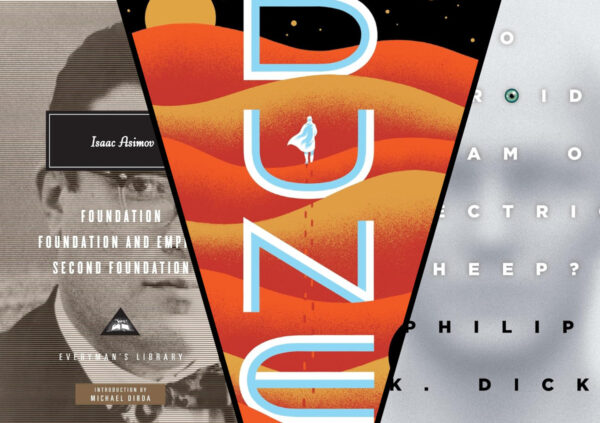
| 1951 | Foundation | Isaac Asimov |
| 1965 | Dune | Frank Herbert |
| 1966 | Babel-17 | Samuel R. Delany |
| 1969 | The Left Hand of Darkness | Ursula K. Le Guin |
| 1974 | The Mote in God’s Eye | Niven and Pournelle |
| 1981 | Downbelow Station | C. J. Cherryh |
| 1983 | Startide Rising | David Brin |
| 1980 | The Snow Queen | Joan D. Vinge |
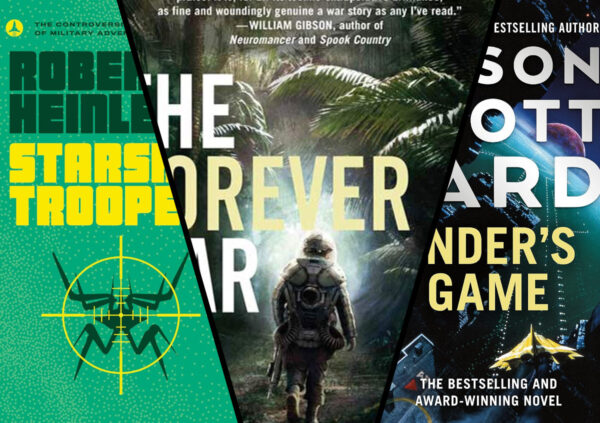
| 1985 | Ender’s Game | Orson Scott Card |
| 1987 | Consider Phlebas | Iain M. Banks |
| 1988 | The Player of Games | Iain M. Banks |
| 1990 | Use of Weapons | Iain M. Banks |
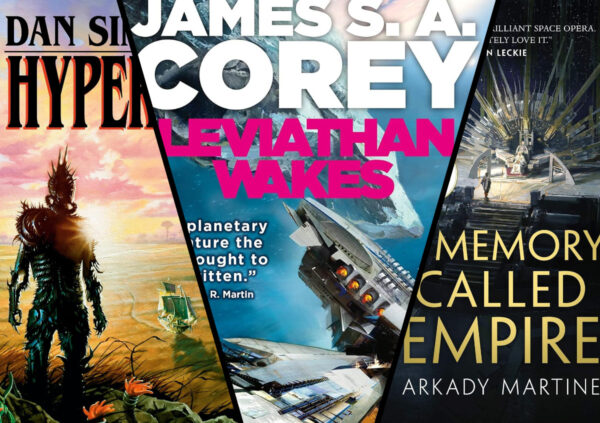
| 1989 | Hyperion | Dan Simmons |
| 1992 | A Fire Upon the Deep | Vernor Vinge |
| 1986– | The Vorkosigan Saga | Lois McMaster Bujold |
| 1990–96 | The Gap Cycle | Stephen R. Donaldson |
| 2000 | Revelation Space | Alastair Reynolds |
| 2005 | Old Man’s War | John Scalzi |
| 2011 | Leviathan Wakes | James S. A. Corey |
| 2013 | Ancillary Justice | Ann Leckie |
| 2014 | The Long Way to a Small, Angry Planet | Becky Chambers |
| 2019 | A Memory Called Empire | Arkady Martine |
| 2015 | Children of Time | Adrian Tchaikovsky |
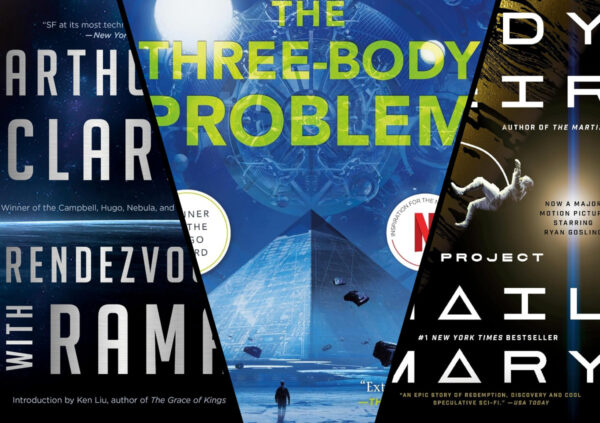
| 2008 | The Three-Body Problem | Cixin Liu |
| 2016 | Ninefox Gambit | Yoon Ha Lee |
| 2017 | The Stars Are Legion | Kameron Hurley |
| 2021 | Project Hail Mary | Andy Weir |
The Pulp Origins (1928–1965)
The Skylark of Space by E. E. “Doc” Smith (1928)

The book that invented the form, and it’s exactly as ridiculous as that origin suggests.
Richard Seaton, a government chemist, accidentally discovers a metal that releases limitless energy, builds a spaceship in his back garden with a wealthy friend, and pursues his kidnapped fiancée across the galaxy while a rival scientist tries to kill him. There are alien civilizations, ray guns, and casual travel between star systems within the first hundred pages.
Everything space opera books would spend the next century refining is here in raw form: the scale, the hardware, the interstellar politics, the sense that the galaxy is a place you can simply go. Smith had no interest in plausibility and enormous interest in wonder.
The prose is dreadful, the characters are cardboard, and the racial attitudes are 1928’s, which is true of most early space opera books. Read it as an artifact, briefly, and then read the Lensman books, which are better.
The Lensman Series by E. E. “Doc” Smith (1937–48)

The pulp series that actually holds up, and the direct ancestor of most galactic-scale fiction since.
Two ancient civilizations, the benevolent Arisians and the malevolent Eddorians, have been fighting a covert war for billions of years, breeding humanity as a weapon. The Galactic Patrol issues Lenses, psychic devices bonded to their bearers, to its best officers, and the series follows Kimball Kinnison up through escalating conflicts across an entire galaxy.
The escalation is the appeal. Each book raises the scale until entire planets are being used as projectiles, and Smith commits to it completely.
The influence is enormous and traceable. The Green Lantern Corps is the Lensmen with the serial numbers filed off. Star Wars, Babylon 5, and most fleet-based space opera novels descend from here. Even the term “space opera” as a compliment starts with people trying to explain why these books work despite everything.
The Foundation Trilogy by Isaac Asimov (1951)

The most influential idea in space opera books, and a novel that is almost entirely people talking in rooms.
Trantor is a world entirely covered by a single city, administrative heart of an empire spanning the galaxy, and it is dying without noticing. That image, the imperial capital as a sealed metal shell, forty billion bureaucrats deep, is Asimov’s real gift to the genre, and you can trace a line from it straight to Coruscant.
The books proceed in jumps of decades and centuries, following the colony Seldon planted at the galactic rim as it grows from a scholarly outpost into a trading power into something else again. Characters appear for one section and are gone.
Then the Mule arrives, a mutant whose existence psychohistory could not predict, and the series becomes considerably more interesting than its own thesis.
Asimov wrote it in his twenties, in installments, having read Gibbon on the fall of Rome. Every subsequent decaying-empire story in space opera books is working from this floor plan.
Dune by Frank Herbert (1965)

The book that taught space opera to take itself seriously, and the point where the pulp furniture became political economy.
Everything the Lensman tradition treated as decoration, Herbert treats as a system with a price. Faster-than-light travel exists, but only because Guild Navigators consume a drug that exists on one planet, which means every empire, house, and religion in the book orbits a single point of supply. The thinking machines are gone, outlawed millennia ago, so the computation gets done by Mentats, human beings trained into instruments. The feudal Great Houses aren’t a costume. They’re what you’d actually get when transport and information run through monopolies.
Paul Atreides walks into the middle of that machine as its designated victim and comes out the other side as its messiah, and the sequels spend thousands of pages establishing that this was the disaster, not the triumph.
Its full treatment, the ecology, the warning, the whole interlocking world, is on my main science fiction list. What matters here is the lineage: every space opera since that wants its empire to feel like it runs on something, from the Radch to the Hegemony to the Expanse’s water politics, is following the path this book cut.
The New Wave and After (1966–1988)
Babel-17 by Samuel R. Delany (1966)

The book that proved space opera could be avant-garde, written when Delany was twenty-three.
Rydra Wong is a poet and starship captain recruited to decode Babel-17, a transmission associated with a series of sabotage attacks. It turns out not to be a code but a language, and one whose structure alters the thinking of anyone who learns it.
Delany was working from the Sapir-Whorf hypothesis and treating linguistics as the technology the plot runs on. Around that he built a genuinely strange future: body modification as fashion, three-person marriages, a crew including discorporate ghosts.
It won the Nebula and reads like nothing else from its decade, space opera books included. Space opera novels that take language seriously essentially begin here.
The Left Hand of Darkness by Ursula K. Le Guin (1969)

Space opera as anthropology, and one of the most important novels the genre produced.
The Ekumen is Le Guin’s alternative to the galactic empire: not a government but a loose federation of worlds seeded by a common ancestor species, which sends single unarmed envoys rather than fleets, and waits. First contact becomes diplomacy conducted by one person over years.
That envoy is Genly Ai, and the world is Gethen, locked in an ice age and populated by people with no fixed sex. He arrives assuming he understands politics and spends the novel discovering that Gethenian statecraft operates on a system of indirect prestige he cannot parse and keeps violating.
The novel’s engine is political failure. Genly backs the wrong faction, gets his ally exiled, and is imprisoned in a labor camp, and the rescue that follows is a months-long haul across a glacier on foot.
Le Guin’s father was an anthropologist and it shows in the method: the culture comes first and the plot emerges from it. It took the Hugo and Nebula both.
The Mote in God’s Eye by Niven and Pournelle (1974)

The first contact novel every serious space opera list reaches for, and for once the consensus is right.
The Second Empire of Man has spent centuries reconsolidating after a civil war, and has never met another intelligent species. Then a light sail arrives from a nearby star, crewed by something long dead, and a warship is dispatched to make contact.
What follows is a diplomatic mission conducted under military rules, and the tension comes from the Navy’s certainty that any alien civilization is a strategic threat colliding with the scientists’ conviction that these particular aliens are delightful. Both turn out to be right.
The Moties have been carefully editing their own history for their visitors, and what they’re hiding is the novel’s whole argument. The biological machinery behind it belongs to the hard science fiction list, where I’ve covered it. Here it’s enough to say the reveal justifies the length.
The human cast is standard 1974 issue, the women particularly. Heinlein, who advised on the manuscript, thought it the finest thing he had read in the field.
Downbelow Station by C. J. Cherryh (1981)

The Hugo winner that made space opera books about logistics, and the entry point to the best-built future history in the genre.
Pell Station sits between Earth Company and the Union, and the novel covers what happens to a neutral station when a war it didn’t start arrives at its docks along with a refugee fleet. Cherryh writes it from the perspective of station administrators, merchant families, and displaced civilians rather than admirals.
Her Alliance-Union universe spans dozens of novels and is unusually rigorous about how interstellar civilization would actually function: station economics, the culture of merchanter families, and the fact that FTL travel wrecks people psychologically.
Cherryh gets named constantly by readers listing what mainstream lists omit, and they’re right to.
Startide Rising by David Brin (1983)

The middle book of the Uplift saga and the one that won the Hugo and Nebula both.
In a galaxy where every intelligent species was uplifted by a patron race, humanity is an anomaly with no patron and two client species of its own: uplifted dolphins and chimpanzees. The Streaker, crewed mostly by dolphins, discovers a derelict fleet that may belong to the original progenitors, and every major power in the galaxy comes hunting.
The dolphin crew is the achievement, and nothing else in space opera novels has attempted it. Brin gives them their own culture, their own poetry in Trinary, and psychological problems specific to being a species three centuries into sapience.
The Uplift books are the best treatment of galactic civilization as an actual bureaucracy with rules, patrons, and clients.
The Snow Queen by Joan D. Vinge (1980)

A Hugo winner that has quietly slipped out of the conversation, and shouldn’t have.
The planet Tiamat has a 150-year seasonal cycle, alternating between Winter, when offworlders exploit it for an immortality serum harvested from native sea creatures, and Summer, when the interstellar gate closes and the technology is stripped away. The Snow Queen intends to survive the transition by cloning herself.
Vinge built it on Hans Christian Andersen and on real anthropology, and the ecological argument, that the immortality trade is killing a sapient species nobody has bothered to identify as sapient, is handled without preaching.
It has one of the better-realized planets in the genre, and its politics of colonial extraction are sharper than most contemporary space opera books manage.
Ender’s Game by Orson Scott Card (1985)

The most-read space opera of its generation, and the one with a second novel hiding inside it.
The famous half is Battle School: the zero-gravity war games, Ender’s tactical innovations, the scenarios rigged further against him with every victory. The games are the reason the book sells to children and works for adults, because the tactics are legible on the page and the escalation never stops feeling personal.
The half people forget was the stranger prophecy. While Ender trains, his siblings Peter and Valentine stay on Earth and quietly take over global politics by publishing anonymous essays under the names Locke and Demosthenes, building competing constituencies until the pseudonyms have more power than governments. Card wrote influencer geopolitics in 1985, and that thread reads very differently now than it did then.
Card’s later public record has cost the book readers, and I’m not going to argue anyone out of that. Its position in the genre’s history stands either way, and the training-school machinery that made it famous is covered properly on my military science fiction list.
Consider Phlebas by Iain M. Banks (1987)

The first Culture novel, and the most important space opera of the last forty years starts here.
The Culture is a post-scarcity anarchist utopia run by hyperintelligent Minds, where nobody works, nobody is coerced, and everyone can be anything. Banks’s clever move is to tell his first Culture story from the perspective of someone who despises it: Horza, a shapeshifting mercenary fighting for the Idirans on the grounds that a machine civilization is an abomination.
That’s the argument the whole series runs on. Is a society this comfortable actually good, and what does it do to the people outside it? The Culture keeps intervening in less advanced civilizations for their own good, and Banks never quite lets it off the hook.
Consider Phlebas is the roughest of the Culture space opera novels. Start here for chronology or with The Player of Games for quality.
The Player of Games by Iain M. Banks (1988)

The best entry point to the Culture and the cleanest thing Banks wrote.
Jernau Gurgeh is the Culture’s finest game player, bored to the point of self-destruction, who is maneuvered by Special Circumstances into traveling to the Empire of Azad. Azad is organized entirely around a single game so complex that a person’s performance determines their social rank, and the Emperor is whoever wins.
The novel is an argument about whether a game can encode an ideology, and about the Culture’s habit of destroying societies it finds distasteful while maintaining that it did nothing.
Gurgeh is a genuinely good character, and the Azadian sections are among the best political writing in the genre.
The Modern Era (1990–2010)
Use of Weapons by Iain M. Banks (1990)
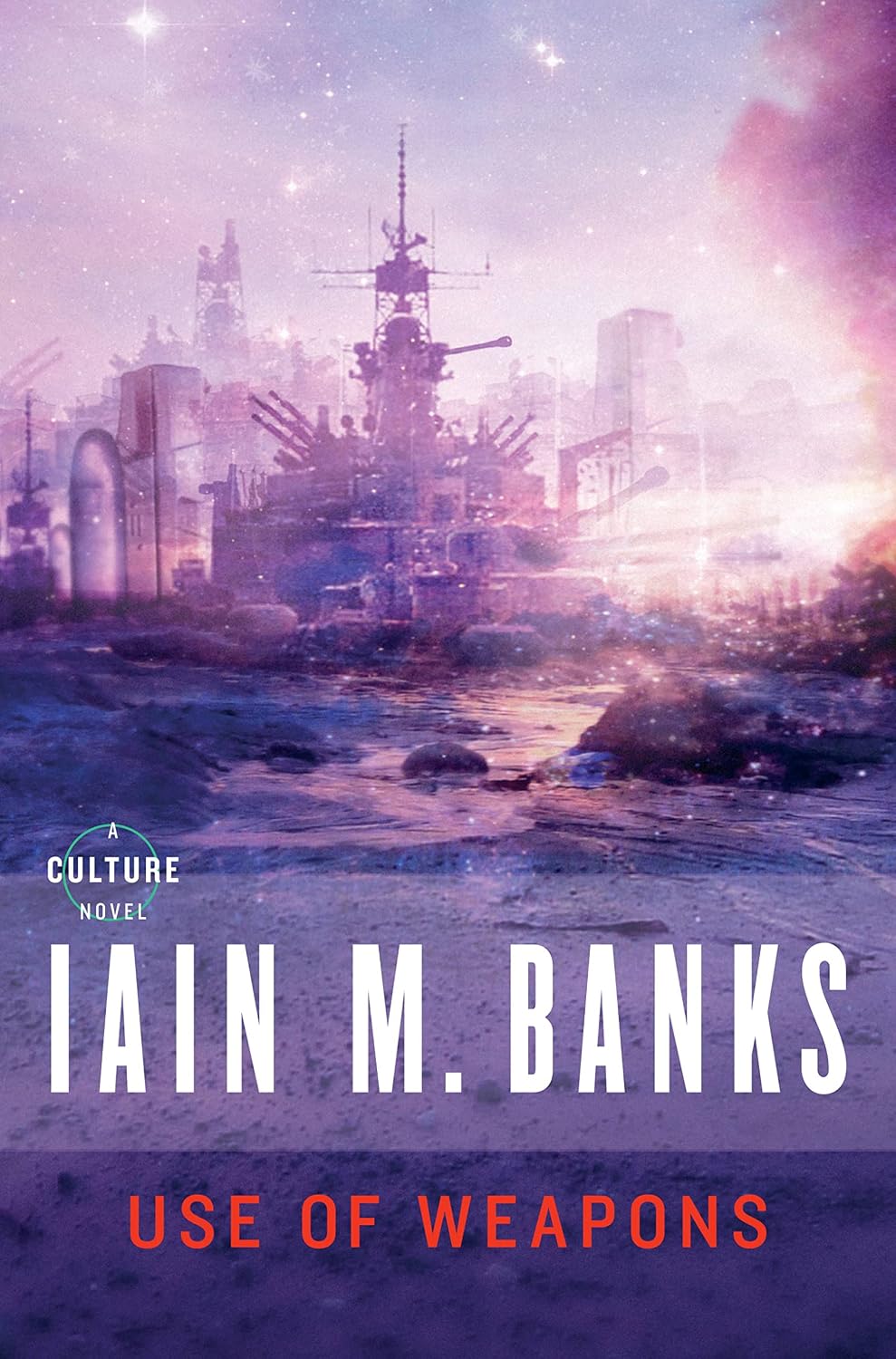
Banks’s masterpiece, and the most formally daring space opera novel ever written.
Cheradenine Zakalwe is a mercenary employed by Special Circumstances for the jobs the Culture won’t admit to. The novel runs two chronologies: one moving forward through his current assignment, and one moving backward through his past, meeting in the middle at the thing he did.
The reveal is genuinely one of the best in the genre, and it retroactively reorganizes everything you’ve read. The chair. That’s all I’ll say.
It’s also the Culture novel most interested in what a utopia does with people who are useful precisely because they’re damaged. Banks was writing about interventionism a decade before it became the central foreign policy argument of the age, which few space opera books were doing.
Hyperion by Dan Simmons (1989)

Space opera’s high-water mark for sheer structural nerve.
The Shrike is the best monster in science fiction: four-armed, wrapped in blades, moving backward through time, worshipped by a church that considers it an instrument of atonement. It waits at the Time Tombs on a backwater world that the Hegemony is about to lose to an invading fleet.
Seven people are sent there on a pilgrimage, each with a private reason, and the novel is what they tell each other on the way. Simmons switches register completely between accounts, one is epistolary horror, one is hardboiled detective fiction, one is a poet’s foul-mouthed memoir, and the effect is of reading an anthology that turns out to be a single argument.
The interstellar civilization behind it is exceptional: instantaneous travel through farcaster portals, a house whose rooms are on different planets, an AI collective whose relationship with humanity is not what anyone thinks.
Be warned that it stops rather than ends. You need The Fall of Hyperion, so buy them together.
A Fire Upon the Deep by Vernor Vinge (1992)

The cleverest structural idea in space opera books, and the novel readers name most often when mainstream lists omit it.
A research team excavating an ancient archive releases something that had been sealed there for five billion years. The Blight is a transcendent intelligence with no interest in negotiation, and it begins converting civilizations at the speed its substrate allows.
Two children escape in a ship carrying the only possible countermeasure and crash on a medieval world of pack-minded aliens, where they become assets in a war between rival kingdoms. Meanwhile a rescue expedition takes decades to reach them, and the galaxy above coordinates its response through a network of message boards that reads exactly like Usenet, complete with cranks, misinformation, and one poster who turns out to be the Blight.
Vinge’s structural conceit divides the galaxy into regions where different levels of technology are physically possible, which lets him run a medieval war and a transcendent AI apocalypse in the same book without either undermining the other.
It won the Hugo. A Deepness in the Sky is the companion and arguably the stronger novel.
The Vorkosigan Saga by Lois McMaster Bujold (1986–)

The most consistently enjoyable series in space opera, and the one with the best protagonist.
Miles Vorkosigan is born into the militarist aristocracy of Barrayar with brittle bones, stunted growth, and a society that historically killed infants like him. He compensates with a manic intelligence that makes him a brilliant strategist and a catastrophic liability, and across seventeen novels he accidentally founds a mercenary fleet, conducts espionage, and eventually has to grow up.
Bujold has won more Hugos than almost anyone, and the series moves through modes more freely than most space opera books dare: military adventure, comedy of manners, romance, murder mystery, all inside a coherent future.
Start with The Warrior’s Apprentice or Shards of Honor. Barrayar and Mirror Dance are the peaks.
The Gap Cycle by Stephen R. Donaldson (1990–96)

The nastiest space opera ever written, and one readers keep naming as an omission.
Donaldson built it on Wagner’s Ring cycle, and it opens with a scenario, a woman held captive and mind-wiped repeatedly by a pirate, that is genuinely difficult to read and is meant to be. Over five books the roles of victim, villain, and rescuer rotate completely, which is the entire structural point.
The technology is well-worked, the corporate politics are excellent, and the series’ willingness to make you complicit in your own early assumptions is unlike anything else in the genre.
Content warning is not a formality here. It’s brutal, deliberate, and among the most accomplished space opera novels nobody recommends.
Revelation Space by Alastair Reynolds (2000)

The darkest and most rigorous of the modern space operas, written by an actual astrophysicist.
An archaeologist on a dead world is investigating a civilization that was destroyed nine hundred thousand years ago at the exact moment it developed spaceflight. A lighthugger crew is hunting a man who might cure their captain’s plague. The answers converge on why the galaxy is so quiet.
Unusually for space opera books, Reynolds keeps to relativistic travel, which means centuries pass between star systems and his societies drift apart, and the Fermi paradox gets an answer that is properly frightening.
The Inhibitors are the best cosmic threat in modern space opera novels, and the atmosphere is closer to gothic horror than to adventure.
Old Man’s War by John Scalzi (2005)

The most readable modern space opera, and an open homage to and argument with Starship Troopers.
John Perry enlists in the Colonial Defense Forces on his seventy-fifth birthday, because the CDF only recruits the elderly and nobody knows why until you sign. The answer involves a new body, and then a war against a galaxy full of species competing for a very limited number of habitable worlds.
Scalzi writes fast, funny, dialogue-driven prose, and the book takes Heinlein’s premise somewhere considerably less certain about whether any of this is justified.
It isn’t attempting what the Banks or Reynolds space opera novels attempt, and doesn’t intend to. As an entry point to space opera books it’s close to ideal.
Leviathan Wakes by James S. A. Corey (2011)
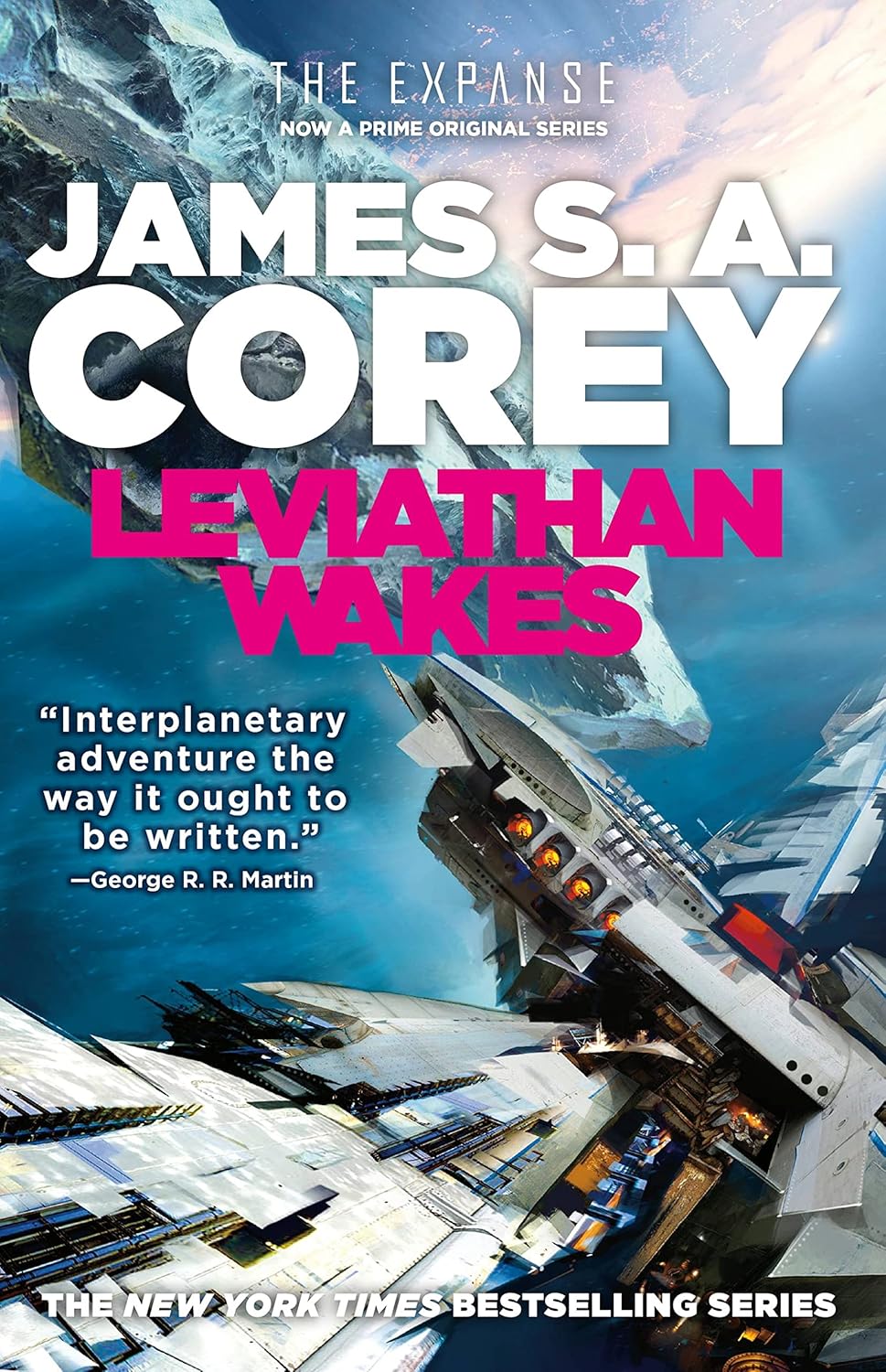
The best-executed modern space opera and the one that brought the form back to a mass audience.
Two men in alternating chapters. Jim Holden is an ice hauler’s XO with an unhelpful conviction that the truth should always be broadcast immediately, regardless of consequence. Detective Miller is a burnt-out Ceres cop assigned to find a rich family’s runaway daughter, a job he keeps working long after it stops being a job.
The Belters are the reason it works. Generations in low gravity have produced people who are tall, brittle, and physically unable to visit Earth, with their own creole and a permanent grievance against the inner planets who control their water and air. That’s a colonial relationship with actual teeth.
Corey, two writers under one name, one of them GRRM’s former assistant, write television-shaped chapters that end when something happens, which makes the thing almost impossible to put down.
Nine books, a complete arc, and an ending that was planned. Enough said.
The Contemporary Wave (2013–2021)
Ancillary Justice by Ann Leckie (2013)

Leckie’s empire annexes worlds the way a bureaucracy processes paperwork, and that’s precisely what makes it frightening.
The Radch’s procedure is standardized: bombardment where necessary, then administration, then the gradual absorption of the conquered population into a culture obsessed with propriety, porcelain, tea, and the correct performance of civilization. It isn’t cruel by policy. It simply works, which is worse.
Breq is what remains of a troop carrier’s mind after the ship was destroyed, walking around in a single body on a frozen backwater, buying a weapon and hunting someone. The revenge plot is straightforward. Everything around it is not.
The Lord of the Radch rules through thousands of linked clone bodies, and the discovery that those bodies no longer entirely agree with one another is the crisis the trilogy runs on: an empire whose single mind has begun arguing with itself.
The debut-awards sweep and the pronoun business are covered on my main science fiction list. This entry is for the empire, which is the best-imagined political machine in recent space opera novels.
The Long Way to a Small, Angry Planet by Becky Chambers (2014)

The book that made cozy space opera a category, and considerably better than that description suggests.
The Wayfarer is a tunneling ship that builds hyperspace routes, crewed by a mixed species crew who mostly like each other. A new clerk joins. They take a long job. Things happen slowly.
There’s barely a plot and that’s deliberate. Chambers is writing about how a functioning multispecies society would actually feel from inside, at the level of food, sex, religion, and workplace irritation, and the aliens are built from genuinely different biological premises rather than being humans with ridges.
Scalzi serialized it on his own website before Tor took it, the Hugo nomination followed, and it’s the most emotionally generous of these space opera books.
A Memory Called Empire by Arkady Martine (2019)

The best political space opera of the last decade, written by a Byzantine historian.
Mahit Dzmare arrives as ambassador from a small mining station to the enormous Teixcalaanli empire, carrying an outdated imperial-memory implant of her predecessor, who is dead under suspicious circumstances. She has to navigate a court where poetry is the medium of politics while working out who killed him and whether her own station is about to be annexed.
Martine’s academic background is doing real work: the empire’s cultural gravity, the way its literature makes colonized people want to belong to it, and the machinery of imperial succession are all built on genuine historical understanding.
It won the Hugo, and among recent space opera novels the sequel A Desolation Called Peace is equally good.
Children of Time by Adrian Tchaikovsky (2015)

The most patient first contact novel in the genre, and half of it is a horror story.
One thread of this novel belongs to a spider civilization, and I’ve covered what makes it extraordinary on my Adrian Tchaikovsky page. The other thread is the Gilgamesh, a converted ark carrying the last of humanity through space in cold storage, and it’s the thread that earns the book its place on a space opera list.
Holsten Mason is a classicist, thawed periodically across thousands of years to translate the dead language of the people who built the world they are approaching. Each time he wakes, the ship has degraded further, the command structure has calcified into something worse, and the gap between the crew and the cargo has widened. He ages a few decades over two millennia and watches his own species become unrecognizable.
The two threads are on a collision course from page one, and Tchaikovsky’s achievement is that by the time they meet, most readers have switched sides.
The ending is one of the most satisfying in modern science fiction, and it is not the ending the setup implies.
The Three-Body Problem by Cixin Liu (2008)

No translated work had taken the Hugo for Best Novel before this one, and its success opened Western publishing to a Chinese tradition that had been developing largely unread abroad.
Ye Wenjie is the most consequential character in modern science fiction. Having watched her father killed by ideologues and having spent years in a labor camp, she is given control of a radio telescope and the opportunity to answer a signal from another civilization, and she makes a decision about the human species on humanity’s behalf.
The first novel is largely terrestrial. It’s the trilogy that earns the space opera label, and the second book supplies the idea people actually remember: the dark forest, an answer to the Fermi paradox proposing that any civilization broadcasting its position is announcing itself to predators, and that silence is therefore universal and rational.
Liu thinks at scales almost nobody else attempts, up to and including the deliberate reduction of dimensions as a weapon.
His characters exist to hold ideas, and that loses some readers permanently.
Ninefox Gambit by Yoon Ha Lee (2016)

The strangest space opera of the last decade and the most rewarding if it clicks.
The hexarchate’s technology runs on consensus: weapons and FTL function only where the population observes the correct calendar, so heresy is literally a physics problem and calendrical deviation is a military threat. Kel Cheris, a disgraced infantry captain, is assigned to retake a fortress and given the resurrected consciousness of Shuos Jedao, a brilliant general who massacred two armies including his own.
Lee explains nothing. The mathematics of the calendar, the factions, the exotic weapons all arrive without gloss, and the first fifty pages are genuinely disorienting.
Push through and it’s the most original thing in modern space opera books, with a relationship between Cheris and Jedao that carries the whole trilogy.
The Stars Are Legion by Kameron Hurley (2017)

The only book on this list where the ships are alive, pregnant, and rotting.
The Legion is a fleet of organic world-ships decaying at the edge of the universe, crewed and ruled entirely by women, and everything aboard is grown, birthed, or recycled. Zan wakes with no memory and is told she’s the only one who can board the Mokshi, the one ship that can leave the Legion. She’s been told this before. The assaults keep failing, and her memory keeps being taken.
The middle of the book is the part nobody forgets: Zan is thrown down to the recycler at the ship’s core and has to climb back up through every layer of a living world, each with its own societies that have never seen the surface. As space opera goes it’s closer to a fever dream than to Banks, and the viscera splits readers right down the middle.
Hurley embraced the cover tagline, “Lesbians in Space,” and the book delivers it as war story rather than romance. Her military sci-fi novel The Light Brigade is the tighter book; this is the stranger one.
Project Hail Mary by Andy Weir (2021)

The most purely enjoyable space opera of recent years, and the cure for anyone who suspects the genre is homework.
A man wakes up not knowing his name, on a ship he doesn’t recognize, with two corpses for company. The memories return in chapters interleaved with the present, and what they reveal is a planet-wide emergency response conducted with unusual competence and one very difficult decision made about him without his consent.
What lifts it into space opera is what he finds out there, and the fact that Weir plays the encounter for delight rather than dread. The relationship at the center of the book is the warmest thing in recent science fiction and it is not with a human being.
Weir writes engineering problems as comedy and it works. Grace narrates his own catastrophes like a man describing a bad day at work.
If someone has decided the genre is homework, this is the corrective.
If you’re starting cold: Leviathan Wakes or Old Man’s War for pure momentum, The Player of Games for the argument, Hyperion for the ambition, and Ancillary Justice for what the form can do now.
Where to Go Next
Military science fiction overlaps this shelf constantly, and that list sorts the books where the fleet matters more than the opera. Dan Simmons, who sits near the top of this one, has a full author page.