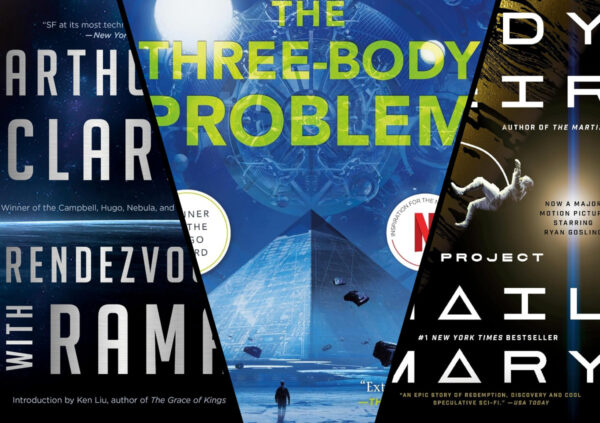
Cixin Liu wrote the book that turned Chinese science fiction into a worldwide phenomenon, the first novel translated out of any language to take the Hugo for Best Novel, and the one Barack Obama and George R. R. Martin both went out of their way to praise. The Three-Body Problem has sold well over a million copies in English, anchors a Netflix series renewed through its ending, and turned a former power-plant computer engineer from Shanxi into the most important science fiction writer working outside the English language. If you have heard one Chinese novel named, it is this one, and it is where the Cixin Liu books begin.
The reading situation is simpler than most authors on this site, because the essential Cixin Liu books are one trilogy, and everything else is a bonus. Remembrance of Earth’s Past, better known by the title of its first volume, runs three books and answers one question on the largest possible scale: what happens when humanity learns it is not alone, and that the neighbors are not friendly. Over on my best science fiction books list, The Three-Body Problem holds a place among the all-time greats. This guide covers the whole shelf, the trilogy first and then the standalones worth your time, with the neighboring tradition on my best hard science fiction books list.
A register note: I haven’t read the Cixin Liu books myself yet, the trilogy included, so every verdict on this page is the critical consensus and the shape of the reception, reported as honestly as I can manage rather than passed off as my own reading.
Fiction by René Rehn


The Short Version
Start with The Three-Body Problem and read the trilogy in order, because it builds into something no single volume delivers, and the second and third books are where most readers say it becomes great. Ken Liu’s translation of the first and third is the one to buy, with Joel Martinsen carrying the middle volume. Everything past the trilogy, Ball Lightning, Supernova Era, the short fiction, is for after you finish, not before.
Cixin Liu Books in Order
The table runs by first Chinese publication, with the English arrival noted, because the two timelines are a decade apart and both matter when you’re buying.
| Year | Title | Type | Notes |
| 2003 | Supernova Era | Novel | English 2019 |
| 2004 | Ball Lightning | Novel | English 2018, trilogy-adjacent |
| 2008 | The Three-Body Problem | Trilogy 1 | Serialized 2006, English 2014, Hugo 2015 |
| 2008 | The Dark Forest | Trilogy 2 | English 2015 |
| 2010 | Death’s End | Trilogy 3 | English 2016, Locus winner |
| 2017 | The Wandering Earth | Stories | Collected translation |
| 2020 | To Hold Up the Sky | Stories | |
Where to Start With Cixin Liu
Start with The Three-Body Problem, and there is no alternative answer worth taking seriously. The trilogy is the monument, it reads in publication order, and the standalones only pay out once the trilogy has taught you what Liu does.
The one genuine decision is pacing. The first book is the slowest and strangest of the three, half historical novel and half physics mystery, and a substantial share of readers who bounce off it would have loved what follows. The consensus advice, repeated across a decade of reviews and forums, is to finish book one even if it runs cold, because The Dark Forest is where the series becomes the thing people evangelize about.
Liu’s Life, Briefly
Liu Cixin was born in Beijing in June 1963 and raised in Yangquan, in coal-country Shanxi, where his parents had been sent to work in the mines, a dislocation of exactly the kind his most famous opening chapter runs on. He graduated as an engineer in 1988 and spent the next decades as a computer engineer at a power plant in Shanxi, writing fiction on the side while the plant’s systems ran, which is the biographical fact every profile leads with because it is simply too good: the galaxy-scale imagination clocking in at a provincial utility.
The Chinese genre knew him long before the West did. He won the Galaxy Award, Chinese science fiction’s top prize, nine times, and The Three-Body Problem was a sensation in serialization in 2006 and in book form in 2008, completing its trilogy by 2010. The English translation arrived in 2014, the Hugo followed in 2015, the first for any Asian writer and the first for a translated novel, and the catalog has been working its way into English out of order ever since.
The afterlife has been national-scale: The Wandering Earth, filmed from his short story, became one of the biggest films in Chinese box-office history in 2019 and made science fiction a state-endorsed export, and the Arthur C. Clarke Foundation honored him in 2018. He remains, by any measure of sales, prizes, or adaptation budgets, the most consequential science fiction writer outside the Anglosphere, and he still describes himself first as an engineer who writes.
Remembrance of Earth’s Past
The trilogy runs The Three-Body Problem, The Dark Forest, and Death’s End, and it is the whole reason to be here, each volume with its own entry below, and a sale-unit note: all three sell separately and as a boxed set, and the set is the economical answer for a reader who already knows they’re committing.
The Three-Body Problem (2008)
三体 · serialized 2006, book 2008 · translated by Ken Liu · 2014

It opens in the Cultural Revolution, with a young astrophysicist present as Red Guards club her father to death on a struggle-session stage, the trauma that leads her decades later, working at a secret military radio observatory, to make a choice about an incoming alien signal, one that will settle what becomes of the entire species. In the present day, a physicist is drawn into a wave of scientist suicides and a strange virtual-reality game set on a world orbiting three suns, where no stable orbit exists and civilizations are repeatedly incinerated and reborn as the suns wander.
What makes it work is the science, taken seriously as the source of the drama rather than the backdrop. This is hard science fiction in the truest sense, with orbital mechanics, particle physics, and radio astronomy driving the plot, and Liu’s refusal to stop short of an idea’s full conclusion is the whole appeal.
The honest caveat, and it is the one every reader should hear going in: the characters are thin. Liu writes ideas, civilizations, and cosmic forces far better than he writes people, the prose is functional rather than beautiful (a quality translation smooths but cannot hide), and readers who need someone to care about will feel it. Readers who came for the biggest ideas in modern science fiction will not mind at all. It won the Hugo, and my best science fiction books list has more on why it matters.
The Dark Forest (2008)
黑暗森林 · 2008 · translated by Joel Martinsen · 2015

The Dark Forest is where the trilogy becomes what its admirers promise, and saying too much about it spoils the first book’s ending, so this stays deliberately vague. It introduces the idea the whole series is remembered for, a chillingly logical answer to the question of why a universe full of life stays so silent, and builds it into a strategy for a war fought across centuries and light-years.
Consensus, and my own sense of the reviews, rates it the strongest of the three, the volume where the setup’s cold machinery starts paying out in full, and its central concept has escaped the books entirely, cited in actual debates about the Fermi paradox. The one practical note is the translation seam: Joel Martinsen carried this volume where Ken Liu did the other two, and most readers notice nothing while a vocal few prefer one hand or the other. Either way, nobody who finishes it stops the series here.
Death’s End (2010)
死神永生 · 2010 · translated by Ken Liu · 2016

Death’s End expands the canvas to a scale almost no other novel attempts, millions of years and the fate of the universe itself, and closes the story with an ambition that outruns nearly everything in the genre. It follows a new protagonist, an aerospace engineer named Cheng Xin, whose decisions frame the endgame of everything the first two books built.
A vocal minority finds the ending’s reach exceeds its grasp, and the larger camp calls it one of the great closing movements in science fiction. It took the Locus Award for best science fiction novel and was a Hugo finalist, and it is the reason the trilogy gets shelved beside the genre’s monuments rather than its hits. Read the trilogy for where this book goes, and clear an evening for the last hundred pages.
The Standalones
Ball Lightning (2004)
球状闪电 · 2004 · translated by Joel Martinsen · 2018

Ball Lightning is the one to read next after the trilogy, and it quietly shares a corner of the same universe, so trilogy readers get a bonus they will recognize. It follows a scientist obsessed with the natural phenomenon that killed his parents in front of him, and turns into a genuinely strange investigation of quantum physics and weaponized weather.
Consensus places it a clear tier below the trilogy and comfortably above most hard SF around it: the obsession-as-biography structure is Liu’s most sustained character study, and the final movement’s imagery, once seen, is not forgettable. English readers got it in 2018 in Joel Martinsen’s translation, and it works either as epilogue or as a lower-stakes audition for the big books.
Supernova Era (2003)
超新星纪元 · 2003 · translated by Joel Martinsen · 2019

Supernova Era is an earlier, rougher book with a killer premise, a cosmic event that will kill everyone on Earth over the age of thirteen within a year, leaving the planet to the children, and while the execution is uneven it is pure Liu in its willingness to follow a big idea anywhere.
The middle section, in which the inheriting children redesign civilization around what children actually want, swings between brilliant and bizarre, and the consensus reads it as juvenilia with flashes of the later master. It reached English in 2019 on the trilogy’s momentum. Completists and premise-collectors only, and both groups get their money’s worth.
The Short Fiction
Liu wrote short stories for years before the trilogy, winning China’s Galaxy Award again and again, and the collections are a good low-commitment way to sample him.
The Wandering Earth (2017)

The Wandering Earth gathers the best-known of the early stories, led by the title piece about engineers fitting the entire planet with fusion engines to escape a dying sun, which became one of the biggest films in Chinese box-office history and is the purest distillation of what Liu does: an idea so large it should not work as a story, made to work anyway.
The collection around it runs the same scale games across suns, mountains, and micro-civilizations, with the thin-character caveat applying at story length too. For readers deciding whether to commit to the trilogy, this is the honest free sample, and for finished readers it is the victory lap.
To Hold Up the Sky (2020)

To Hold Up the Sky collects a second decade of stories, assembled for English readers after the trilogy’s success, and the standouts, a village teacher’s last lesson becoming the species’ defense, an artist who sculpts with stars, run Liu’s signature move of welding the cosmic to the humble.
Consensus rates it slightly below the first collection, with the same highs and a longer tail, and the title selection shows how consistent the obsessions were long before the world was watching. Buy it second, after The Wandering Earth, if the stories turn out to be your format.
Cixin Liu: Deep Dive & FAQ
What Runs Through Liu’s Books
The first constant is scale without flinching. The signature Liu move is to take one physical idea, an unstable orbit, a silent universe, a planet as a vehicle, and follow it past the point where any other writer would cut away, out to the civilizational and then the cosmic consequence. The Cixin Liu books treat physics as destiny and humanity as one species among predators, and the cold is the point.
The second is the engineer’s romance. His heroes are scientists, soldiers, and administrators solving problems under deadline, his plots are projects, and the emotional register is awe at what coordinated competence can build, a sensibility closer to the genre’s golden age than anything written in English this century. The repeated caveat about thin characters is the bill for it.
The third is history as pressure. The Cultural Revolution opening is not decoration: across the catalog, civilizations behave the way traumatized people do, and the books keep asking what survival is worth and who gets to decide. That the biggest answer the series gives is also its most famous idea is exactly why the trilogy traveled.
Prizes and Honors
In Chinese, the record predates the fame: nine Galaxy Awards, the genre’s top national prize, across the pre-trilogy decades. In English, the landmark came in 2015, when The Three-Body Problem took the Hugo for Best Novel, the first win for an Asian writer and for a work in translation, with Death’s End adding a Locus win and a Hugo shortlisting in 2017. The Arthur C. Clarke Foundation honored him in 2018, a fitting pairing given how openly the books worship Clarke’s scale.
The other honor is unofficial: “dark forest” has entered the real vocabulary of Fermi-paradox debates, which is the kind of prize ideas win when they escape their books.
Which Cixin Liu Editions to Buy
The translation map is the whole buying guide. Ken Liu translated the first and third volumes, Joel Martinsen the second and Ball Lightning, and the Tor editions carry useful translator notes. One detail worth knowing: the English first volume opens with the Cultural Revolution chapters as the author originally intended, a structure the early Chinese editions had shuffled for political safety, so English readers are, for once, closer to the intended book.
The trilogy circulates in a boxed set, the standalones and collections in uniform trades, and there is no edition hunting to do beyond checking the translator’s name on the title page, which, as the Verne page on this site proves at length, is always worth the three seconds.
Liu on Screen
The trilogy has been filmed more than once, which tells you how much story is in it. Netflix’s 3 Body Problem, from the Game of Thrones showrunners David Benioff and D. B. Weiss with Alexander Woo, premiered in 2024, was renewed for a second and third season to carry the story through to Death’s End, and began filming Season 2 in Budapest in late 2025.
There is also a longer, more literal Chinese live-action series, Three-Body (2023) from Tencent, which sticks far closer to the novel and which purists tend to prefer, plus a Chinese animated adaptation. As ever, the books came first and go furthest. The screen versions are a way in rather than a substitute. Whatever is airing when you read this, the trilogy is the source.
The Wandering Earth (2019) and its 2023 prequel took the short story to the top of the Chinese box office and made Liu the face of a national film genre, loud, enormous, and sincere, exactly like their source.
Questions About Cixin Liu
Where Should I Start With Cixin Liu?
The Three-Body Problem, then the trilogy in order. The short fiction in The Wandering Earth is the only legitimate alternative door, as a sampler before committing.
Is the Dark Forest Really the Best One?
The consensus says yes, with Death’s End as the ambitious favorite of the trilogy’s defenders. Book one is the setup, and finishing it is the price of admission the series charges.
Do I Need a Physics Background?
No. The books explain what they use, and the difficulty is appetite rather than prerequisites: long chains of consequence, big casts, and ideas carried further than comfort. Readers who want character-first fiction struggle regardless of their physics.
What Is the Dark Forest Idea?
The trilogy’s famous answer to why the universe seems silent, built in the second book. Saying more spoils the first volume’s ending, which is exactly why the entry above stays vague. It has since been cited in real astrobiology debates by name.
Which Translation Should I Buy?
Ken Liu for books one and three, Joel Martinsen for book two, which is simply how the Tor editions come. The English first volume also restores the author’s intended opening, so anglophone readers are not getting a lesser text.
Netflix or the Chinese Series?
The Tencent Three-Body (2023) is longer and far more faithful, the Netflix 3 Body Problem (2024) faster, globalized, and renewed through the ending. Purists watch the former, newcomers the latter, and the books outrun both.
Is There Anything After Death’s End?
An authorized continuation exists, The Redemption of Time, written by the fan-author Baoshu and translated by Ken Liu, which began as fan fiction and was blessed into print. Consensus treats it as a curiosity for readers who cannot let go, not part of the monument.
Where to go next
The tradition the trilogy crowns is mapped on my best hard science fiction books list, and the wider canon on my best science fiction books list. For the scale-and-awe lineage he inherited, the natural pages are my Arthur C. Clarke books guide, the writer Liu names most readily, and my Isaac Asimov books guide for the civilizational chess. And the other great non-Anglophone title page in this cluster is my Three-Body Problem guide, which gives book one the full single-work treatment.