Neal Stephenson named the Metaverse thirty years before Silicon Valley started chasing it, wrote the novel Peter Thiel made required reading at early PayPal, and has spent a career producing enormous, brilliant, maddening books that readers finish and immediately want to argue about. He is the closest thing science fiction has to a house intellectual, a writer who will stop a cyberpunk thriller cold to explain Sumerian linguistics or the mathematics of cryptography, and who is somehow entertaining while doing it. Snow Crash made his name in 1992 and remains the door almost everyone comes in through, and it is the shortest, fastest, and most immediately fun of the major Neal Stephenson books.
Two things are true of this author at once, and an honest guide has to say both. He is one of the most intelligent and prophetic writers the genre has, and his books are long, dense, digressive, and famous for endings that arrive abruptly or not at all. Loving Snow Crash does not mean you will survive the thousand-page Baroque Cycle, and knowing which of his books suits which kind of reader is most of what this page is for. Two of my lists already seat Snow Crash, the best science fiction books list and the best cyberpunk books roundup, and this guide sorts the rest of the sprawl.
A note on the verdicts below: Snow Crash is the one I’ve read, and I have a real opinion about it that the entry reflects. For the rest of the catalog, what follows is the critical consensus and the shape of the reception rather than my own reading, and the text says so where it matters.
Fiction by René Rehn


The Short Version
Start with Snow Crash, the funny, propulsive cyberpunk satire that is his most accessible book by a wide margin. If you want more in that vein, The Diamond Age is the natural follow-up. If you want the techno-thrillers set closer to our own world, Cryptonomicon is the masterpiece, followed by Reamde. If you want the deep, demanding, philosophical Stephenson, Anathem and Seveneves are the summits. And go in braced for length and for endings that many readers find abrupt, because that is the toll for the ride.
Neal Stephenson Books in Order
The table runs the catalog by publication, pseudonymous collaborations included for the completists.
| Year | Title | Type | Notes |
| 1984 | The Big U | Novel | The campus satire he half-disowned |
| 1988 | Zodiac | Novel | The eco-thriller |
| 1992 | Snow Crash | Novel | Named the Metaverse |
| 1994 | Interface | Novel | As Stephen Bury, with J. Frederick George |
| 1995 | The Diamond Age | Novel | Hugo and Locus |
| 1996 | The Cobweb | Novel | As Stephen Bury |
| 1999 | Cryptonomicon | Novel | |
| 2003 | Quicksilver | Baroque Cycle | Clarke Award |
| 2004 | The Confusion | Baroque Cycle | Locus winner |
| 2004 | The System of the World | Baroque Cycle | Locus and Prometheus |
| 2008 | Anathem | Novel | Locus winner |
| 2011 | Reamde | Novel | |
| 2015 | Seveneves | Novel | Prometheus Award |
| 2019 | Fall; or, Dodge in Hell | Novel | |
| 2021 | Termination Shock | Novel | |
| 2024 | Polostan | Bomb Light | First of the cycle |
| 2026 | D | Bomb Light | Second volume |
Where to Start With Neal Stephenson
Start with Snow Crash, then triage by appetite. The catalog splits into three Stephensons, the cyberpunk satirist, the techno-thriller historian, and the philosophical world-builder, and the short version above maps the doors. The one route almost nobody survives is starting with the Baroque Cycle, three thousand pages of seventeenth-century science and finance that reward exactly the readers who already know they want it.
One more honest triage note: his endings are a genre of their own. Readers who need resolution should start with Reamde, the most conventionally finished of the major books, and treat everything else as journey-first fiction.
Stephenson’s Life, Briefly
Neal Stephenson was born on Halloween 1959 in Fort Meade, Maryland, into a family he has described as engineers and scientists all the way down, and the upbringing moved through college towns in the Midwest. At Boston University he started in physics, drifted to geography because the department had better computer access, and graduated in 1981, an origin story that explains most of the catalog by itself.
The first two novels, a campus satire and an eco-thriller, sank quietly, and Snow Crash (1992) changed everything: the Metaverse entered the language, Silicon Valley adopted the book as a blueprint it is still trying to build, and avatar took on its modern meaning largely through his pages. From there the books got bigger and the day jobs got stranger. He spent roughly seven years at Blue Origin in its early days working on propulsion ideas, served as Magic Leap’s chief futurist from 2014 to 2020, and in 2022 co-founded Lamina1, a blockchain project aimed at an open metaverse, the rare case of a novelist trying to ship his own premise.
The writing habit underneath has never changed: longhand first drafts, deep archival research, and a book every few years that requires its own shelf reinforcement. Polostan opened the Bomb Light cycle in 2024, with the second volume, D, following in 2026, and the career’s one constant is that nobody has ever accused him of thinking small.
The Cyberpunk Era
Snow Crash (1992)

The book that made him, the easiest way in, and cyberpunk’s great comedy.
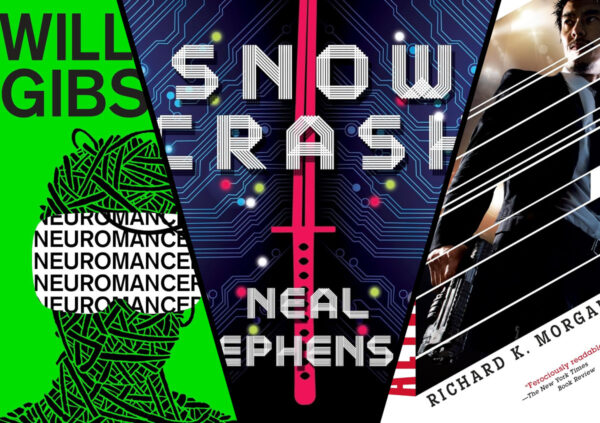
Hiro Protagonist, and yes that is his name, delivers pizza for the Mafia in a near-future America dissolved into corporate franchise micro-states, and moonlights as a hacker and swordsman in the Metaverse, the shared virtual world this novel both named and blueprinted in such detail that Silicon Valley has spent the thirty years since trying to make it real. When a new drug-slash-computer-virus called Snow Crash starts scrambling the brains of hackers in both the real world and the virtual one, Hiro and a teenage skateboard courier named Y.T. chase it down through a plot that runs on ancient Sumerian myth, neurolinguistics, and a great deal of very fast action.
What sets it apart from the cyberpunk that came before is the tone. Where the genre’s founders played it grim, Stephenson plays it as satire, fast, funny, and deliberately over the top. My own reservation, spelled out at more length on the cyberpunk list, is that the book works awfully hard at being cool, and that posturing sits at odds with the genuine intelligence of the premise underneath, which treats human language as a kind of deep firmware for the brain, with the myth of Babel recast as a virus hitting the species at the level of its source code.
The idea survives the swagger, and it is that idea, not the katanas, that makes the book last. Read it for the Babel material, and treat the abrupt ending as the first taste of a habit you will come to know.
The Diamond Age (1995)

His other cyberpunk-era masterpiece, and the one that won the Hugo.
Subtitled A Young Lady’s Illustrated Primer, it is set in a future remade by nanotechnology, where matter compilers can build almost anything and society has re-sorted itself into culture-based tribes called phyles. The heart of it is an interactive book, an AI-driven primer designed to educate a privileged girl, that falls instead into the hands of a poor one named Nell and raises her across the length of the novel, teaching her, and the reader, how a mind is actually made. It is richer and stranger than Snow Crash, deeper on its themes of education and class, and structurally more ambitious.
It also carries the classic Stephenson caveat in full: the ideas are dazzling, the middle is dense, and the ending is divisive even by his standards. Readers who want the intellectual payoff forgive it, and readers who need a clean resolution should know what they are getting. It won the Hugo and the Locus, and it is the natural second Stephenson after Snow Crash.
The Techno-Thrillers
Cryptonomicon (1999)

For many readers his single best book, and the pivot from science fiction into the techno-thriller.
It braids two timelines: World War II codebreakers and marines racing to keep the Nazis from realizing the Enigma cipher has been cracked, and their descendants in the late 1990s trying to build a data haven in Southeast Asia while hunting a fortune in buried gold. It is a nine-hundred-page novel about cryptography, information security, money, and war, and it is far more grounded than his earlier work, with barely a science-fiction element in it beyond the tech being slightly ahead of its moment.
This is the book the technology industry took to heart, cited by founders and engineers as formative, and it is where Stephenson’s gift for making genuinely difficult material thrilling reaches its peak. The honest note is scale: it is long even for him, and the plot digresses constantly into essays on subjects the author finds interesting, which is either the whole pleasure or a dealbreaker. It earned a place in the Prometheus Hall of Fame, and it leads directly into the Baroque Cycle, the three enormous historical novels that trace the same families and ideas back to the birth of modern science and finance.
Quicksilver (2003) and the Baroque Cycle

Quicksilver opens the most demanding commitment in the Neal Stephenson books: three volumes and roughly three thousand pages set between the 1650s and 1714, among natural philosophers, vagabonds, pirates, and financiers, with Newton, Leibniz, and half the age’s real geniuses in the cast. It is Cryptonomicon’s family tree planted in the actual birth of science, currency, and the modern world, written with total research conviction and no mercy about pace.
The awards took it seriously, a Clarke for Quicksilver and Locus wins for The Confusion and The System of the World, and the readership splits exactly where you’d expect: those who finish tend to call it his real masterpiece, and the attrition rate getting there is famous. The sale unit is three fat volumes, Quicksilver first, and the honest advice is to read Cryptonomicon beforehand as both audition and genealogy.
Reamde (2011)

Reamde is the one to hand a thriller reader: a thousand pages of globe-trotting pursuit kicked off when a ransomware scheme built inside an online game collides with Russian mobsters and then with something far worse, and a draft-dodging marijuana-smuggler-turned-games-mogul has to get his niece back.
Consensus calls it the least science-fictional and most conventionally satisfying of the major books, an airport novel executed with Stephenson’s research density, and the gamer-economy material was years ahead of the journalism. Readers who want the Big Ideas rank it lower, which is exactly why it is the right pick for readers who don’t.
The Deep End
Where the ideas get hardest and the payoff gets biggest.
Anathem (2008)

Anathem is set on another world where scientists and philosophers live cloistered like monks, sealed away from a chaotic secular society, until a discovery in the sky forces them out, and it builds an entire invented vocabulary and a genuine grounding in philosophy and physics into what is really a novel about the life of the mind. It is his most demanding book and, for many, his most rewarding.
The first hundred pages are the toll booth, a new language learned word by word, and the consensus is emphatic that the investment returns: the back half becomes an adventure built on Platonism and many-worlds physics, and the Locus voters gave it their award. For readers who suspect they are the target audience, they are, and they already know it.
Seveneves (2015)

Seveneves opens with one of the great hooks in modern science fiction, the Moon explodes on the first page for reasons never explained, dooming Earth and sending humanity scrambling to survive in orbit, and the first two-thirds are a masterpiece of hard-SF problem-solving, orbital mechanics as countdown thriller.
The final third jumps five thousand years forward and divides readers sharply, the abrupt-Stephenson move on the largest possible scale. It took the Prometheus Award, the first section alone has colonized a decade of engineering reading lists, and the fair summary of the split is that everyone should read the first two acts and voters disagree about whether the third is a flaw or the point.
The Rest of the Catalog
The remaining Neal Stephenson books reward the committed, and three of them earn entries of their own.
Fall; or, Dodge in Hell (2019)

Fall; or, Dodge in Hell tackles the digital afterlife at doorstop length: a games billionaire’s scanned brain is booted into a simulated world that grows from blank void into a mythology, half Silicon Valley satire and half Paradise Lost rerun, with the living world’s descent into forked realities running alongside.
Its reception split harder than anything since the Baroque Cycle, between readers who rate the Meatspace half among his sharpest futurism and readers who stall in the long mythic middle. Consensus advice mirrors the book’s structure: come for the near-future internet material, and know the Miltonic back half is a different novel wearing the same covers.
Termination Shock (2021)

Termination Shock takes on climate geoengineering with a Texan billionaire’s rogue sulfur gun and a cast that includes the Queen of the Netherlands, feral-hog hunters, and a Sikh martial artist caught in a Himalayan border performance war.
Consensus rates it mid-shelf Stephenson with first-rate set pieces, and its real distinction is the premise’s plausibility: unilateral solar geoengineering argued through infrastructure rather than lecture. The ending is, by his standards, almost orderly, which regular readers reported with some shock of their own.
Polostan (2024)

Polostan opened the Bomb Light cycle, a leaner historical-espionage mode following Dawn Rae Bjornberg, a young woman moving between revolutionary Russia and 1930s America in the run-up to the atomic age, with D (2026) continuing the cycle.
Early consensus likes the new discipline: a few hundred pages, a single viewpoint, and the research density intact, which for this author counts as minimalism. It is the rare late Stephenson a newcomer could start with, though the cycle’s open end argues for patience.
Before all of that came the apprentice work: The Big U (1984), a campus satire he kept out of print for years, and Zodiac (1988), a Boston eco-thriller whose chemistry-driven caper mode still has partisans. The two Stephen Bury thrillers written with his uncle, Interface and The Cobweb, round out the completist shelf. None is the place to start, and all confirm the pattern: enormous ambition, dazzling detail, and a reader’s mileage that depends entirely on tolerance for length and for his particular way of ending a book.
Neal Stephenson: Deep Dive & FAQ
What Runs Through Stephenson’s Books
The first constant is the explanation as action scene. The signature Stephenson unit is a character explaining something difficult, cryptography, monetary policy, orbital mechanics, Sumerian myth, at a length no editor would permit anyone else, welded to a plot moving fast enough to carry it. The Neal Stephenson books bet that understanding is a thrill, and for their readers the bet keeps paying.
The second is that systems beat heroes. His real protagonists are infrastructures, currencies, networks, archives, orbital habitats, and his people are the engineers and operators who build and game them. It is why Silicon Valley adopted him as a court novelist, and why the books now read as documentation for a world that arrived on schedule.
The third constant is the endings. The catalog’s one running controversy is structural: books that accelerate to a cliff edge and stop. The generous reading is that he writes systems, and systems don’t resolve, they hand off. The ungenerous reading is shorter. Either way, knowing it going in converts the flaw into a signature, which is what this page is for.
Prizes and Honors
The hardware tracks the career’s two halves: a Hugo and Locus for The Diamond Age in the cyberpunk years, then the historical turn sweeping the Clarke for Quicksilver and Locus awards for both Baroque Cycle sequels, with Anathem adding another Locus and Seveneves a Prometheus. Cryptonomicon’s Prometheus Hall of Fame induction formalized what the technology industry had already decided.
The uncollectible honors say more: Metaverse is his coinage outright, the modern sense of avatar spread largely through his pages, and both are taught in business schools that have never shelved a novel, and his side career as futurist-in-residence to rocket, AR, and blockchain companies means he may be the only writer on this site whose fiction keeps getting venture funding.
Which Neal Stephenson Editions to Buy
Nothing requires edition hunting, and mass matters more than printing: these are books to buy in whatever format your wrists prefer, and the ebooks exist for good anatomical reasons. The Baroque Cycle circulates both as three hardback bricks and split into eight paperbacks, same text either way, and Cryptonomicon’s current trades are uniform with the rest.
The one completist note is the Stephen Bury pair, reissued under his own name in some markets, and The Big U, which he allowed back into print reluctantly, a fact the introduction cheerfully admits.
Stephenson on Screen
Almost nothing of his has reached a screen, conspicuously, for a writer this cinematic on the page, and the explanation is the books themselves: the length defeats features and the digressions defeat showrunners. Snow Crash has cycled through development for three decades, announced and unannounced at studios and streamers, and remains unmade, while the properties it blueprinted, virtual worlds and their economies, got built as products instead, which is the most Stephenson adaptation imaginable.
His screen presence is the industry instead: Blue Origin’s early propulsion work, the Magic Leap years, Lamina1, and a standing gig as the futurist tech CEOs cite when asked what they’re building. The Metaverse pitch decks are the film rights, exercised.
Questions About Neal Stephenson
Where Should I Start With Neal Stephenson?
Snow Crash, then The Diamond Age for more cyberpunk, Cryptonomicon for the techno-thriller masterpiece, or Anathem for the deep end. Never the Baroque Cycle first.
What Is Neal Stephenson’s Best Book?
Cryptonomicon by the broadest consensus, Anathem among the devoted, Snow Crash by influence, and the Baroque Cycle from the readers who finished it. The honest answer is that the catalog has four best books depending on which Stephenson you want.
Did Stephenson Really Invent the Metaverse?
He coined the word and specified the thing in Snow Crash in 1992, down to avatars, real estate, and status mechanics, and the companies building virtual worlds have treated the novel as a requirements document ever since. He has spent recent years helping build open versions of it.
Why Do People Complain About His Endings?
Because the books famously accelerate and then stop, resolutions arriving abruptly or offstage. The Diamond Age and Seveneves are the canonical arguments. Readers either convert the habit into an accepted signature or they stop at two books, and both are reasonable.
Is the Baroque Cycle Worth It?
If Cryptonomicon delighted you, including its digressions, yes, and its finishers call it his real monument. If Cryptonomicon felt long, the Cycle is that cubed, and nothing downstream requires it.
Are the Stephen Bury Books Real Stephenson?
Half: thrillers co-written with his uncle J. Frederick George in the 1990s, leaner and more conventional than anything under his own name. Interface, about a presidential candidate with a chip in his head, has aged the better of the two. Completist territory.
Has Anything of His Been Filmed?
Effectively nothing: decades of announced Snow Crash projects have died in development, and the catalog’s length keeps defeating adaptation. The ideas got built as actual products instead, which may be the better legacy.
Where to Go Next
If Snow Crash and its neon future are what you want more of, the whole cyberpunk tradition it satirized and perfected lives on my best cyberpunk books list, with the father of it covered on my William Gibson books guide. If it was the hard science and the problem-solving of Seveneves, that appetite is served by the best hard science fiction books, where rigor is the whole point.
And if what hooked you was simply the scale of Stephenson’s ambition, the sense of a mind trying to fit entire fields of knowledge into a story, that is a particular pleasure the genre does better than any other, and the Neal Stephenson books are its most extreme expression. The wider canon is on my best science fiction books list.