The ghost story is the most disciplined form in horror, and the best ghost stories are the ones most people have never read properly.
Everyone knows the mode from Christmas Eve, from campfires, from a hundred anthologies with cobwebs on the cover. Far fewer have sat down with the writers who built it, and the difference between the folk version and the literary one is enormous. A real ghost story is closer to a card trick than to a monster movie. Something is glimpsed at the edge of the frame. Nothing is explained. The pleasure is in the withholding.
This list covers the short fiction specifically, because that’s where the form actually lives. Ghosts in novels are a different animal and mostly a different genre, and haunted houses have their own tradition. Both get their own guides.
Almost everything here is public domain, so I’ve linked each entry to a free text where one exists. Buy the collections if you want a shelf copy, and good editions exist, but paying to read M. R. James is strictly optional.
Some of these I’ve read and most I haven’t. I’ve marked which is which.
Fiction by René Rehn


The Founders
The writers who built the English ghost stories tradition between about 1840 and 1900, mostly for magazines, and mostly to be read aloud.
Sheridan Le Fanu

The best Victorian ghost story writer, and the one who worked out that the apparition should be attached to a guilty conscience rather than to a house.
“Green Tea” is the story to start with, the model for a great deal of what followed. A mild clergyman, Mr. Jennings, has been drinking green tea while working late on a study of pagan religion. He begins seeing a small black monkey, which keeps its distance and keeps him company, omnibus, study, church, always at the edge of sight. In time it starts speaking, and its conversation is worse than any attack would be.
Le Fanu never confirms demon or symptom, and Hesselius, narrating from his case files, diagnoses with total confidence and total inaccuracy, a joke Le Fanu declines to underline.
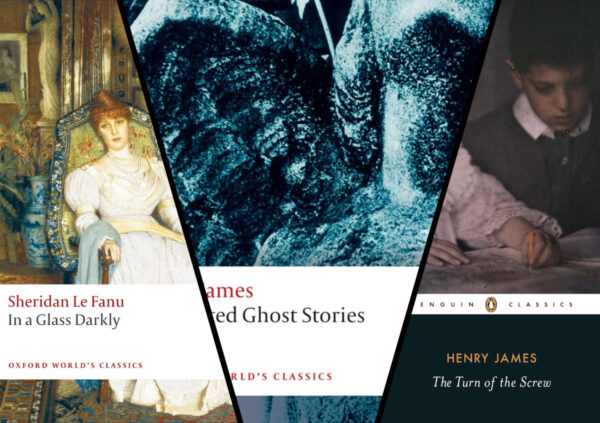
“Schalken the Painter,” “Carmilla” and “The Familiar” are the others in In a Glass Darkly, and the collection is held together by Hesselius’s case notes.
After his wife’s death he worked from his bed at night on quantities of strong tea, and the stories carry the hours.
Charles Dickens

Dickens invented the Christmas ghost story as a commercial proposition, and the entire English tradition of telling them in December follows from him rather than from folklore.
A Christmas Carol is a ghost story and the culture has sanded that off it. Marley’s face in the door knocker, the chain of cash-boxes and ledgers he forged in life and drags now, the arm coming out from under the third spirit’s robe: those are horror images and Dickens meant them.
The one to read for horror is “The Signal-Man.” A railway signalman in a deep cutting has been seeing a figure at the mouth of the tunnel, waving, before each disaster on the line. He tells the narrator about the previous two. Then he describes what it has been doing recently. It runs to about five thousand words, the ending is inevitable from halfway and lands anyway, and it is one of the best ghost stories in the language.
He also ran All the Year Round, commissioned ghost stories for the Christmas numbers every year, and paid well for them, which is why so much of the Victorian canon exists at all.
The Mount of Souls (1861)

Spain’s classic ghost story is short enough to read before the bells stop ringing. “El monte de las ánimas” is set in Soria on the night of All Saints, as the bells begin tolling for the dead. A hunting party rides home early, and young Alonso explains to his cousin Beatriz why nobody goes near the Mount of Souls tonight. Generations ago the Templars who held the land and the local nobles who hated them fought on that mountain until both sides were destroyed, and every year on All Souls’ Eve the dead ride out again among the ruins of the Templar chapel. Beatriz is beautiful, proud and a little cruel. She has lost a blue ribbon on the mountain, and she’d like it back.
Bécquer frames it as a story he heard in Soria and wrote down on the same night of the year, with the bells still going, and it has the shape of the best campfire ghost stories: a warning, a dare, and a long night alone in a bedroom while something moves in the dark. It first ran in a Madrid newspaper, usually dated to November 1861, and it’s one of the Leyendas that every Spanish reader meets in school. Its afterlife in horror is bigger than its length suggests. The director Amando de Ossorio named the legend, along with Night of the Living Dead, as the source of Tombs of the Blind Dead (1972), whose robed, eyeless Templars ride slow skeletal horses out of their tombs, and he made three sequels.
Two more of Bécquer’s legends belong on any shelf of ghost stories. “Maese Pérez el organista” (Master Pérez the Organist) takes place at midnight Mass on Christmas Eve in a Seville convent, where the city has come to hear a blind organist play, and it’s the gentlest ghost story he wrote. “El Miserere” sends a musician to a ruined Navarrese monastery on Holy Thursday night to hear the dead monks sing, and it’s one of the darkest.
In English, the easiest way in is Stanley Appelbaum’s Dover Rhymes and Legends (2006), which prints “The Mount of Souls” (under Appelbaum’s title, “The Forest of the Souls in Purgatory”) and “The Miserere” with the Spanish on the facing page. Fedorchek’s Legends and Letters (Bucknell, 1995) is the fullest selection and adds “Master Pérez the Organist,” and the 1909 Romantic Legends of Spain by Cornelia Frances Bates and Katharine Lee Bates is in the public domain. Bécquer’s ghosts reached an English ghost-story anthology early, in Harper’s Modern Ghosts (1890).
For the legends one by one, the poems and the English editions, see the Gustavo Adolfo Bécquer page.
The Golden Age
The ghost stories written between 1900 and 1930, when the form was at its most technically confident and its practitioners mostly knew each other.
M. R. James

The best writer of ghost stories in English, and the standard everyone else is measured against.
A medievalist at Cambridge, later a provost, he produced these as Christmas entertainments for friends gathered to listen, and the formula barely moves. A scholarly, comfortable man finds an object or a document he’d have been better leaving alone. Something notices. It follows him home.
“Oh, Whistle, and I’ll Come to You, My Lad” (1904) is the one to start with. A professor finds a bronze whistle in the ruins of a Templar preceptory on the Suffolk coast, blows it, and something occupies the spare bed in his hotel room. The image of the thing made of crumpled linen is one of the most frightening in the genre and James gives it about two sentences.
“Casting the Runes” (1911) is the other essential, about a scholar who gives a bad review to the wrong man and is handed a slip of paper he cannot get rid of. It became the film Night of the Demon.
“Count Magnus”, “The Ash-Tree”, “A Warning to the Curious” and “Lost Hearts” are the other names that recur.
Consensus. Worth adding is the technical point every critic lands on: a James monster tends toward hair, dampness, or cloth, and the reader meets it through the hand before the eye, if the eye gets anything at all.
Algernon Blackwood

Blackwood wrote the best ghost story in the language about a place rather than a person, which is why he sits slightly outside this tradition while belonging to it completely.
“The Empty House” is the conventional one and it is very good: an aunt and her nephew spend a night in a house where a murder happened, and Blackwood does the thing James does, which is give you almost nothing and let the sounds do the work.
But the reason he is here is John Silence, and specifically “Ancient Sorceries,” in which an Englishman stops overnight in a small French town and finds the inhabitants are not quite what they appear, and the whole thing turns on cats and on a memory that is not his.
Silence himself is an occult detective who takes no fees and treats what he calls diseases of the soul, and the collection was a commercial success that let Blackwood write full time.
He wrote well over a hundred and fifty stories and he is far better at atmosphere than at endings, which is the honest caveat.
Edith Wharton

The novelist of manners wrote some of the best ghost stories in the language, and she is comprehensively under-read in this mode.
“Afterward” (1910) is the finest. A couple buy an English country house and are told it has a ghost, but that you never know it was a ghost until long afterward. The story then delivers exactly that, and the delay is the horror.
“Kerfol” is a Breton story about dogs. “The Eyes” is about a man haunted by a pair of eyes that appear whenever he has done something he considers generous. “All Souls'” was her last story and is about a woman alone in a house where all the servants have simply gone.
Wharton’s ghosts are almost always about complicity and about what a comfortable life is built on, which is unsurprising from her and is not what most readers expect from a ghost story.
Oliver Onions

Name a best ghost story in English and “The Beckoning Fair One” gets the routine nod, from critics whose readers almost never follow through.
A novelist named Paul Oleron, mid-book, his heroine Romilly half on the page, moves into rooms in an untenanted London house. The novel halts. First he revises the manuscript, next he strips it back, finally he destroys it. The woman whose support has carried him watches their friendship rot. Meals lapse, outings lapse, and the strangest part lapses too: his sense that any of it is strange.
No name is given to what the house holds, no glimpse, no accounting. Research would find nothing: no prior tenant, no crime, no history at all. What exists is a presence that intends to have him alone, jealous equally of the flesh-and-blood woman and the invented one, and both are removed.
The mechanism gets rendered precisely: every act is Oleron’s own, and at each step he is certain the decision was his.
A hundred pages, and readable as a study of artistic failure with the ghost accepted or not.
E. F. Benson

The most consistently enjoyable ghost story writer of the Edwardian period, and the one to reach for after James.
Benson wrote around fifty of them across four collections while also producing the Mapp and Lucia comedies, which tells you about the range. He knew James at Cambridge and the debt is obvious, but he is warmer, funnier and considerably more willing to show you the thing.
“The Room in the Tower” is the famous one: a recurring dream about a house, a family, and being told to sleep in a particular room, which the narrator then encounters in waking life fifteen years later.
“Caterpillars” and “Negotium Perambulans” are the ones people find hardest to shake, and both involve infestation rather than apparition. “Mrs. Amworth” is the vampire story and it is set in a pleasant Sussex village with a bridge four.
He is more uneven than James and the best dozen are as good as anything in the tradition. The Wordsworth and Wildside collected editions are cheap and comprehensive.
W. W. Jacobs

One story, and no short horror in English is built more efficiently.
Jacobs was a comic writer, prolific and popular, who produced dozens of humorous nautical tales and is now remembered for four thousand words about a mummified paw.
The construction is why it belongs here. The setup takes a page: a talisman good for three wishes apiece to three men, a soldier who will only say that the previous owner finished with a wish for death, a fire, and Mr. White’s hand going in after it. The Whites wish for two hundred pounds, mortgage money, modest people wishing modestly, and the sum arrives as the factory’s compensation for Herbert.
The back half is the part everybody carries: a mother counting the wishes still owed, a father who identified the body and cannot make himself explain his refusal, and a knocking with no intention of running out of patience.
The door stays shut on the page. Whatever stands outside goes undescribed, and wish three is spent in white space.
Rudyard Kipling

Kipling wrote ghost stories throughout his career and almost nobody associates him with them, which is a gap worth closing.
“The Phantom ‘Rickshaw” is the Indian one and the best known: a man in Simla ends an affair badly, the woman dies, and afterwards he is followed everywhere by her rickshaw and its four dead bearers, visible only to him. Kipling leaves the reading open, and the man’s colleagues have a straightforward medical explanation that the story neither endorses nor dismisses.
“They” is the extraordinary one. A motorist gets lost in the Sussex countryside and comes to a great house with a blind woman living in it and children playing in the garden who never quite come close. What it is actually about becomes clear very late and it is devastating, and it was written after Kipling’s daughter died of pneumonia.
“The Mark of the Beast” is the nastiest, and it involves a drunk Englishman desecrating a temple in India and what is done to him afterwards. It is also unmistakably a story about colonial contempt, written from inside it.
Elizabeth Gaskell

Gaskell wrote a handful of ghost stories alongside the industrial novels, and the best of them is one of the cruellest things in the Victorian canon.
“The Old Nurse’s Story” is narrated by a servant to the children in her care, about a period fifty years earlier when she took a small girl to a bleak house in Northumberland with two elderly sisters and an organ that plays in the night with the pipes broken.
There is a child outside in the snow who wants to be let in, and the little girl can see her, and the nurse cannot at first.
What makes it work is that the ghost is a wronged child and the story is about what the household did to her mother, and Gaskell is entirely clear that the cruelty was social rather than supernatural. The old woman who caused it is still alive upstairs.
“The Poor Clare” and “Lois the Witch” are the other two worth finding, and Lois is a Salem story written by an English novelist in 1859 and it is very good.
Twentieth Century and After
Modern ghost stories keep the machinery and move it into housing estates, marriages and rented rooms.
The Turn of the Screw (1898)

The longest and most argued-about ghost story in the language, and it belongs on this page as the one that broke the form open.
Everything before it works on a shared assumption: the ghost is real and the question is what it wants. James removes that. Either Peter Quint and Miss Jessel are appearing to the children at Bly, or the danger to the children is the governess’s own conviction, and the text funds both cases in full while signing neither.
The reason the ambiguity holds rather than collapsing is that her self-audit arrives early. She puts the madness hypothesis to herself, gives it a fair hearing, and dismisses it, and every reader scores that dismissal differently.
Almost every ambiguous ghost story since is working with equipment James built here, and Hill House is the most obvious descendant.
James’s late style is the admission fee: sentences that circle back on themselves until part of the ambiguity is grammar as much as design.
It was published in a magazine as a serial and read at the time as a straightforward ghost story.
Robert Aickman

For his own work Aickman rejected the label ghost story in favor of strange stories, a distinction that turns out to be precise, not precious.
Explanation is what a ghost story does: an event occurred in this place, the dead want a specific thing, and the close delivers the what and the why. Aickman deletes the explanation, and not through coyness about an answer he privately holds. No answer exists inside the story to be held.
Start with “Ringing the Changes”, his most anthologized. Newlyweds arrive for their honeymoon in a little Suffolk coastal town to find every church bell going without pause, through the day and past dark, and no resident willing to say why. When the why comes, it is considerably worse than local custom.
“The Hospice” and “The Swords” are the other two everybody names, and both are in Cold Hand in Mine.
Beyond the fiction he co-founded the Inland Waterways Association, preserving much of Britain’s canal system, and his editorship of the first eight Fontana ghost story anthologies introduced a generation of British readers to M. R. James.
Shirley Jackson

Jackson’s short fiction is where her ghosts actually live, and the collections are considerably stranger than Hill House suggests.
“The Daemon Lover” is the one to read first and it is barely supernatural. A woman is getting married. She dresses, waits, and when her fiancé does not arrive she goes looking for him through the city, and everybody she asks gives her a slightly different account of a man who may or may not exist. It is the most upsetting thing she wrote after “The Lottery.”
“The Visit,” sometimes published as “The Lovely House,” is the actual ghost story: a girl visits a schoolfriend’s ancestral home, and the house is full of tapestries and mosaics depicting itself, and the family are charming, and something is very wrong with the arrangement.
The Lottery and Other Stories is the collection to buy. Just an Ordinary Day gathers the uncollected material, including several pieces her children found in a barn after her death.
Her ghosts are almost always a woman being erased by other people’s expectations, and the supernatural is optional.
More on the Shirley Jackson page.
Susan Hill

Hill set out in 1983 to prove the classical ghost story still had blood in it, and The Woman in Black is the result: the best one written since the war.
Arthur Kipps goes out to a house on a tidal causeway to settle a dead recluse’s papers, and the funeral’s uninvited guest in black follows him into the silence the locals keep. Twice a day the sea closes the road, and out on the marsh is a sound he hears once and then cannot stop hearing.
Every component is borrowed and every one is executed properly: the isolated house, the sea fret, the dog, the locked nursery, the pony trap.
Know that the stage play softens what the novel will not, and that of the screen versions, 1989’s television film is the one that frightens; the 2012 Radcliffe picture is merely the famous one.
The Small Hand, Dolly and The Man in the Picture followed and none of them reaches it.
Ramsey Campbell

The best living writer of the English ghost story, and the technique is at sentence level rather than in the plots.
Ordinary description comes out slightly wrong in Campbell’s hands. Corridors, shop fronts, a figure down the street, built so that the sentence unsettles ahead of your ability to say why, and on rereading, the line turns out to be up to something other than what you assumed. No other writer works this way, and the sharpness with which he divides readers follows from it.
The other thing he did was move the English ghost story out of the cathedral close and into a housing estate. Bus routes, shopping precincts, offices, damp Merseyside afternoons, and a wrongness that arrives in daylight.
Alone with the Horrors collects thirty years of short fiction, won the Bram Stoker Award, and is arranged chronologically so you can watch him stop imitating Lovecraft and become himself across about a hundred pages.
“The Companion” is the one people name first: a man visiting a decaying seaside funfair, and the ghost train, and what is riding with him.
He has been publishing since 1964 and is still working.
The Sound of His Horn (1952)

The strangest thing on this page, and a novella that has been quietly passed between readers for seventy years.
A British prisoner of war escapes through the wire and finds himself, somehow, in a Germany more than a century after a Nazi victory, on the hunting estate of a Reich Master Forester. The estate breeds humans for sport. They are conditioned, dressed as animals, released into the forest, and hunted with horns and dogs.
It is not a ghost story and it is here because of what it does with the ghost story’s equipment: a narrator recounting something impossible to a skeptical listener years later, a frame that never fully resolves whether any of it happened, and a horror that stays entirely in the register of a man describing what he saw.
Sarban was John William Wall, a British diplomat who published three books in his spare time under a pen name and then stopped writing entirely.
Kingsley Amis championed it for decades, and it has been in and out of print ever since without ever quite reaching an audience.
Ringstones and The Doll Maker are the other two.
The Best Anthologies

If you’d rather have one book than fifteen, three are worth the money.
The Oxford Book of English Ghost Stories, edited by Michael Cox and R. A. Gilbert, is the standard and covers roughly 1830 to 1955, including most names above.
The Penguin Book of Ghost Stories is the cheaper alternative and overlaps considerably.
Ghost Stories of an Antiquary is M. R. James’s first collection and the single best-value volume here, because it’s four or five of the greatest ghost stories ever written in about two hundred pages.
Where to Start
Read “Oh, Whistle, and I’ll Come to You, My Lad”. It costs twenty minutes and nothing else, and readers it leaves cold can safely skip the rest of the form.
Then “The Willows” for the version where nothing is explained and nothing appears, and “Afterward” for the version where the horror is that you didn’t notice at the time.
If you want the one nobody has read, it’s “The Beckoning Fair One”.
My best horror books list ranks the rest of the genre. When the haunting is the building rather than the dead, my haunted house books list takes over.