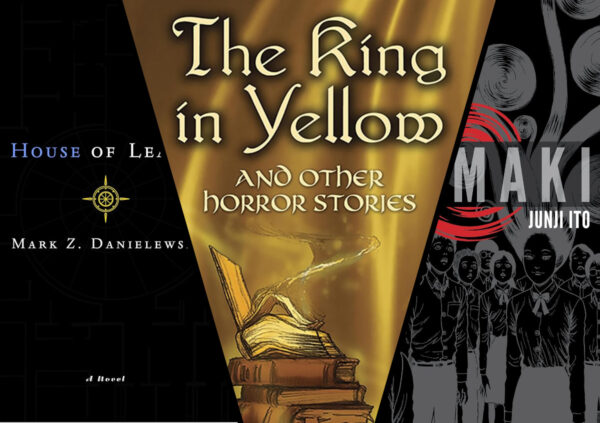
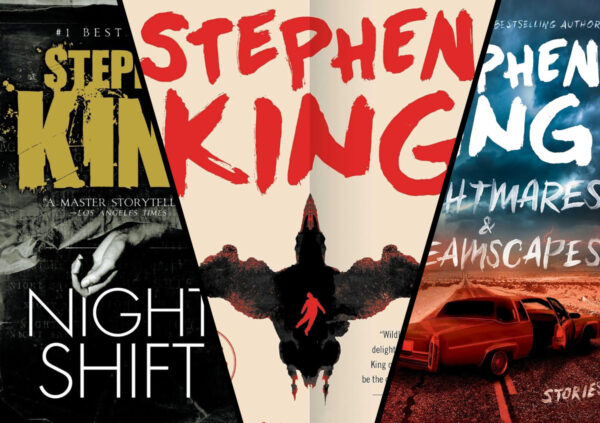
The best horror short stories do something no novel can, and that has always been true.
The novel has to sustain dread across four hundred pages, which means it has to keep explaining, and explanation is what kills a horror story. A short story can show you one thing at the edge of the frame and then stop. Almost every writer on this page wrote novels too, and almost none of those novels are as good as their horror short stories.
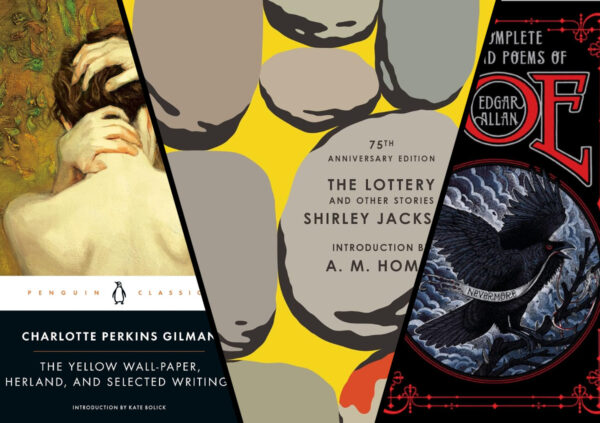
This is a cross-author list of horror short stories. One or two per writer at most, and where there’s a deeper guide on the site I’ve pointed to it rather than repeating myself. If you want the twenty best Poe tales specifically, or all six King collections ranked, those pages exist.
Almost everything before 1930 is public domain, so I’ve linked to free texts where they exist. Nobody needs to pay to read M. R. James.
A large share of these I’ve actually read, which is unusual for a list this wide. I’ve marked which.
Fiction by René Rehn


The Nineteenth Century
The horror short stories that built the form, most of them written for magazines with hard length limits, which is why they are as tight as they are.
The Tell-Tale Heart (1843)

The form this whole page celebrates begins with Poe, and nothing demonstrates it more cleanly than these two thousand words.
The narrator’s first move is to insist on his sanity. His second is to recount, calmly, how he murdered the old man he shared a house with and genuinely cared for, over nothing but the man’s eye, pale blue, filmed over. For seven nights, he tells you, he eased the bedroom door open one inch to look at that eye while its owner slept. Then comes the murder, then the dismemberment, then three floorboards lifted and replaced, all of it delivered without a tremor.
A neighbor’s report brings the police, who find nothing, so he invites them to sit awhile, placing his own chair directly over the boards, and beneath him, the heartbeat starts.
Whether the sound exists outside his skull, Poe declines to say. He doesn’t have to.
The whole modern unreliable narrator descends from this and “The Black Cat,” written the same year, and there is no precedent for either. Free everywhere, ten minutes.
Full ranking at the best Poe short stories.
The Yellow Wallpaper (1892)

For the summer, a physician installs his wife in a rented country house to recover from what he diagnoses as a temporary nervous depression. Work, writing and her own baby are all forbidden her. Her room is upstairs, behind barred windows, with even the bed fixed to the floorboards, and everyone tells her, warmly and often, how much better she’s doing.
What you’re reading is her secret journal, and page by page, the wallpaper moves in on her.
What makes it the best-constructed piece on this page is the prose. The entries start controlled and become shorter, then fragmentary, then stop using the first person consistently, so the reader watches the deterioration happen in the sentences rather than being told about it.
Nobody in it means her harm, which is the engine.
The rest cure was Weir Mitchell’s own invention and Gilman’s own prescription, and the story went to him personally, with her compliments. Six thousand words, free, and it takes half an hour.
The Monkey’s Paw (1902)

The most efficiently constructed short horror story in English at four thousand words.
A soldier home from India hands the Whites a dried paw worth three wishes to each of three owners. His own are spent, the first owner finished on a wish for death, and when he pitches the thing into the grate, Mr. White fishes it out.
The wish is the masterstroke of smallness. Two hundred pounds, mortgage money, and it is paid out next morning as the works’ compensation for Herbert.
Then the second half. Ten days on, the mother does the arithmetic. The father, who made the identification, cannot voice his objection. And the knocking begins, patient as weather, until the ending resolves into a race between a bolt and a wish.
Jacobs closes every shutter. The caller goes undescribed, the last wish is spent in silence, and four thousand words carry all of it.
Green Tea (1872)

Le Fanu’s best story and the one that moved the ghost from the house into the head.
Mr. Jennings is a mild, wealthy, unmarried clergyman who has been working late on a study of the religious metaphysics of the ancients, drinking a great deal of green tea to stay awake. On an omnibus one night he notices two small red circles in the dark, and they are the eyes of a small black monkey, and it gets off with him.
It never touches him. It sits at the edge of his vision, in his study, in the road, in his church. After some months it begins to speak, and what it says is worse than anything it does, because it is offering instructions.
Le Fanu leaves it genuinely open whether this is a demon or a symptom. Dr. Hesselius, the physician narrating the frame, is confidently wrong about almost everything, which is a joke the story never points at.
It opens In a Glass Darkly, which is assembled as his case notes. Free everywhere.
The Golden Age
The period when the best horror short stories were being written by people who mostly knew each other and were competing.
Oh, Whistle, and I’ll Come to You, My Lad (1904)

The most frightening thing M. R. James wrote, and it is thirty pages of a professor on a golfing holiday.
Parkins takes rooms at an inn on the Suffolk coast for a week of golf and is asked by a colleague to look at the site of a Templar preceptory nearby. Poking about in the ruins he finds a hole in a stone, and in it a bronze whistle with an inscription he cannot quite translate. He blows it.
What follows is the twin bed in his room, which is made up although nobody is using it, and which is disturbed each morning.
The apparition gets two sentences at the end and one detail, which is that it has a face of crumpled linen. That is all. No history, no motive, no explanation of what the whistle was for, and no image in the English ghost story works harder.
James wrote these to read aloud to friends at Christmas and set out his own rules, which every writer since has either followed or deliberately broken.
The Willows (1907)

Lovecraft ranked it first among all weird tales in the language, and the entire plot is two men pitching a tent on a sandbar.
The narrator and his Swedish companion are paddling the flooded Danube where it sprawls miles across the plain, a maze of sand islands smothered in willows, and they make camp on one of them. What happens next is simply that leaving proves impossible, first for a day, then for another.
No attack ever comes. What comes instead: willow branches stirring opposite the wind, a clean slit opening in the canoe’s hull, a paddle that vanishes and later returns, column-shapes climbing through the mist, and every morning, fresh funnel-shaped pits pressed into the sand around their tent.
It’s the Swede who deduces the rule, and the rule is the worst thing in the story: their danger scales with attention, so survival means not thinking about the very thing filling both their minds, a discipline no terrified man can simply switch on.
Blackwood made the same Danube run himself with a companion, and along the way, they came upon a corpse caught in the willow roots. Ninety minutes to read, free everywhere.
The White People (1899)

The strangest thing on this page and the one that has influenced the most writers who came after.
It opens with two men discussing the nature of evil, and one argues that real sin has nothing to do with crime, that a murderer may be no worse than an ox, and that true evil would be something more like a rose singing.
Then he produces a green notebook, and the rest is a sixteen-year-old girl’s diary.
She writes about games her nurse taught her, and places she goes on the hills, and the Aklo letters, and the Mao games, and the Chief Song. She does not explain any of it because she has known it since she was very small and assumes everybody does. The reader assembles what is happening from a child’s cheerful account of things she has no vocabulary to find strange.
Nothing is stated anywhere. The frame afterwards supplies one fact and stops.
Ligotti has called it the best horror story ever written. Free everywhere.
More on the Arthur Machen page.
The Repairer of Reputations (1895)

No nineteenth-century story handles an unreliable narrator better, and Chambers set it in a future twenty-five years out.
After a riding accident and a stay in an asylum, Hildred Castaigne emerged a different man. The 1920 America he narrates has legalized suicide, and the government’s first Lethal Chamber is being dedicated in Washington Square, and within the story, that much is real. There’s his cousin Louis, a soldier with a fiancée. And there’s Mr. Wilde, the repairer of reputations himself, up in his room with a ledger holding the whole city’s secrets and a cat that regularly savages him.
And there is, finally, the matter of his succession: the throne of America, which he considers his, and the crown he keeps locked in a safe.
Chambers leaves exactly enough solid ground to map the delusion from, on a reread: the Lethal Chamber checks out, Wilde exists and runs a business Hildred has completely misunderstood, and the crown locked in the safe is, in all likelihood, theatrical prop.
Underneath all of it is the play, which he has read.
More on the Robert W. Chambers page.
The Colour Out of Space (1927)

I’ve read the complete Lovecraft, and this one is the peak of it, and he thought so himself.
Out in the hill country beyond Arkham, on land soon to go under a new reservoir, a meteorite comes down on the Gardner farm. The Miskatonic men carry off samples that defy every test they run, and the stone itself dwindles away to nothing, but not before something has gone down into the well.
A year unrolls, and the story does nothing but observe it: crops growing huge and tasting of nothing, fruit rotting gray inside unbroken skins, the livestock changing shape a little at a time, and the family changing with them, until the day Nahum deals with what his wife has become by bolting a door on the second floor.
He wrote it in the flattest farm-report register he could manage, which is exactly why it lands, with almost none of the piled adjectives that make so much of his catalog a slog.
Nothing else in his work connects to it: no cult, no forbidden volume, no pantheon required, and the thing from the well never receives a name, because no name in the visible spectrum applies.
The Mid-Century
The Lottery (1948)

Three thousand words, published in the New Yorker in June 1948, and it generated more mail than anything the magazine had ever printed.
Three hundred villagers assemble on a bright June morning, the boys banking stones, the men on crops and taxes, and out comes the black box, splintered, much-patched, forever about to be replaced and never replaced.
No zealots, no coercion, no creed stated, no god named, no reason offered. A custom, neighboring towns mocked for dropping it, and a single objector, selected by the slip in her own hand.
Old Man Warner, seventy-seven lotteries deep, supplies the whole theology in one proverb linking June’s drawing to a heavy harvest.
The magazine’s mail broke records: cancellations, and letters asking where a lottery might be attended.
More on the Shirley Jackson page.
The Small Assassin (1946)

Alice Leiber has a difficult birth and comes out of it convinced her baby is trying to kill her.
Her husband is patient about this. The doctor is patient about it. Postpartum illness is the obvious explanation and everybody around her supplies it, kindly, repeatedly, and Bradbury lets that reading stand for as long as he can.
What makes it the best thing in The October Country is the argument the story eventually makes. A newborn arrives from perfect warmth and silence into cold, light, noise and hunger, in a body it cannot control, surrounded by enormous creatures it cannot understand. Bradbury’s proposition is that a rational infant would experience that as an attack and would respond accordingly, and that the only reason we assume otherwise is that babies are usually too weak to act.
It is the most upsetting thing he wrote and it works on anybody who has been near a newborn at three in the morning.
Written in 1946, and it has never been out of print.
The Beckoning Fair One (1911)

The ghost story English critics keep quietly ranking first, and the one readers keep not reading.
Novelist Paul Oleron, mid-manuscript on a heroine called Romilly Bishop, takes cheap rooms with good light in an empty London house, and the book stalls. Revision becomes cutting becomes burning. Meals lapse. Elsie, who has carried him for years, meets irritation, then cruelty, then a closed door.
The house discloses nothing: no prior tenant, no crime, no record. Only a jealousy that wants him undivided, and collects both rivals, the living woman and the written one.
Onions’s precision is the horror: every step is Oleron’s own, and each one feels to him freely chosen.
A hundred pages that also read, ghost optional, as the best account of artistic self-destruction in the language.
The Modern Era
Gramma (1984)

George is eleven and has been left alone with his grandmother for a couple of hours because his brother broke his leg and his mother had to drive to the hospital.
Gramma is enormous, blind, senile and bedridden in the back room. She has been in the house for years. George is afraid of her and is ashamed of being afraid of her, and his mother has told him she is only an old woman.
Then she stops making noise.
King keeps the entire story inside the boy’s head over about ninety minutes of real time, and the tension is almost unbearable because every step is something a child would actually do: standing in the doorway, calling out, deciding whether to go closer, working out how long until his mother is back.
The Lovecraft material underneath, about what Gramma was doing in Maine forty years earlier and what she got from the books, is delivered in three sentences and never expanded.
It is in Skeleton Crew. Adapted twice for television and both versions ruin it by showing you things.
Full ranking at the best Stephen King short stories.
In the Hills, the Cities (1984)

Two English tourists on a walking holiday in Yugoslavia are bickering about their relationship when they hear something from over a ridge.
The rival towns of Popolac and Podujevo meet every ten years for a contest. Each assembles its entire population, several thousand people, into a single enormous body, strapped and roped into position with the strongest at the base and children in the extremities, and the two giants wrestle.
Barker describes the engineering seriously. The training, the harness, the years of preparation, the discipline of thousands of people moving as one limb, and the pride of it.
Then one of them falls, and the physics of what happens to a body made of people when it collapses is worked through in detail.
It is the strangest thing in Books of Blood and the one nobody forgets. Barker published it at thirty-two, straight out of fringe theater, before anyone knew the name.
Nothing in the genre before or since resembles it.
More on the Clive Barker page.
The Hospice (1975)

The best of Aickman’s strange stories and the clearest demonstration of what the category means.
Driving back from a client visit, Maybury misjudges a turning, ends up in a district he doesn’t know with the fuel gauge dropping, and pulls in at a big house whose sign promises comfortable lodging and a good table.
Dinner arrives in portions no one could finish, yet the other guests eat like the starving, and a few of them, he notices, are secured to their chairs, a fact nobody at the table acknowledges. The telephone, he’s told, is out of order. His questions about getting back on the road are met not with refusal but with a polite failure to understand why anyone would ask.
No explanation ever comes. There’s no apparition, no threat, and the staff could not be more solicitous.
Aickman held that a story ought to be built like a dream: airtight in its own logic while you’re inside it, impossible to reassemble once you wake.
It is in Cold Hand in Mine, which won him the World Fantasy Award.
Survivor Type (1985)
Richard Pine is a surgeon, struck off for drug offences, who was smuggling two kilos of heroin by ship when it went down. He washes up on a bare rock in the Pacific with the heroin, a few supplies, and no prospect of rescue.
He keeps a diary, and the diary is the story.
We know he is a surgeon. He has the training and he has an anesthetic, and there is nothing else on the rock. The escalation is arithmetic and King works it through without flinching, and the appalling part is how reasonable each individual decision is.
The prose is what makes it. The entries begin as a competent professional taking stock and deteriorate at exactly the rate he does, until the last page is a few words repeated, and the syntax is the symptom rather than the description of one.
King has said in print that it may have gone further than he should have. It was rejected by several magazines before it found a home.
Twenty pages, in Skeleton Crew.
The Specialist’s Hat (1998)

Claire and Samantha are twins, installed for the season at Eight Chimneys, a rented house, along with their father, at work on a life of the poet who once owned the place, and a babysitter.
From the babysitter they learn a game named Dead, played by lying completely still, and she mentions that the poet’s own daughters played it before them. She also knows things about Eight Chimneys nobody could have told her, among them the location of the specialist’s hat, and its function.
At no point does Link say what’s going on. You piece it together from the game’s rules, and from the moment the twins lose the ability to tell each other apart.
Their mother died not long ago, a fact the story circles without ever facing, and that circling is what the story is about.
It won the World Fantasy Award for short fiction, it’s the piece Link’s readers name first, and she has called it the closest she has come to writing a straight horror story.
Nine pages, in Stranger Things Happen, which is free on her website.
The Bloody Chamber (1979)

A seventeen-year-old pianist marries a marquis three times her age who has been widowed three times, and goes with him to a castle on a Breton causeway that floods twice a day.
He gives her the keys and tells her the small one opens the only room she may not enter. Then he is called to New York on business, on their wedding night, before anything has happened between them.
Carter is retelling Bluebeard and her argument is that she is not softening it. The violence, the appetite and the sexual transaction were in Perrault all along, and the nursery versions are the distortion. She had translated Perrault the year before.
What she changes is the ending. The traditional rescue is by the wife’s brothers arriving in time. Carter’s is her mother, who taught herself to shoot as a girl in Indochina, riding up the causeway on a horse with her husband’s service revolver.
The prose is lush past the point of restraint and entirely deliberate about it.
The Internet, Which Produced Its Own Canon
The horror short stories below came out of a subreddit rather than out of publishing, and they are the ones I have gone back to most.
This section is not a courtesy. Some of the best horror short stories of the last fifteen years were published free on a subreddit, by amateurs, and never appeared in a book.
I’ve been writing for NoSleep since 2016 and I’ve read a great deal of it, most of which is not good. What follows are five that are, and there’s a much longer guide at the best NoSleep stories.
Her Name Was Emma
An early favorite of mine and one I’ll always count among my favorites. It’s also the story that showed me the sub was more than a place for creepypasta rehashes.
A group of girls introduce an imaginary friend into their circle, most likely just to annoy the narrator. But on NoSleep things are rarely what they seem, and what starts as playground pettiness slowly curdles into something far worse.
One of the true classics. If you read only a handful of NoSleep stories, make this one of them.
The Forest of a Thousand Legs
An absolute favorite, and probably one of the best things ever posted to the sub. It’s a sprawling tale about a forest that is home to every spider found on Earth.
It starts with childhood folklore, the narrator’s friend and how she went missing. Years later he tracks down her father and the two of them go in. What makes it stand out is the detail: the forest has rules, a history, restrictions on access, even anti-venom logistics, all of which make it feel like a real place that could exist. And then there are the spiders, normal and tiny at first, and bigger the deeper they go.
In concept, imagery, writing and sheer depth, one of the best things I’ve read on the sub.
Autopilot
An absolute classic, and one of the most grounded real-life horror scenarios NoSleep ever produced. It was once the most popular story on the sub and deservedly.
It centers on mundanity, the way we move through the routine parts of a day on autopilot, and what happens when a single piece of that routine goes wrong. Then it takes the idea a great deal further, into one of the most tragically horrible tales the sub has. If you’ve never read it, brace yourself.
My Brother Died When I Was a Child. He Kept Talking.
Cosmic and existential horror turn up constantly on NoSleep and are rarely done right. This is one of my favorite exceptions.
The narrator’s brother Dennis dies, and then keeps talking, broadcasting from the afterlife. What makes it work is the cosmology: the descriptions of what lies beyond, the sheer existential dread of it, and the narrator’s final, terrible realization.
Easily one of the best pieces of cosmic horror on the subreddit.
Three Visits to a Hidden Tribe
My personal favorite of all NoSleep stories, and probably the most literary weird fiction ever posted there.
The core idea is a tribe whose entire history changes depending on what happens in the present. It’s wrapped in anthropological framing, told in three acts, and follows a researcher called Esther as she travels there, at which point things get progressively stranger.
What makes it so strong isn’t the framing or the events, it’s that in this story the fact of something happening at all carries fundamental weight. Rereading it is always a pleasure, and it sometimes leaves me more deeply unsettled than any conventional horror story on the sub.
Where to Start
Read “The Tell-Tale Heart” and “The Monkey’s Paw” first. Between them they take forty minutes and they contain most of what horror short stories can do.
Then “The Lottery”, then “Oh, Whistle, and I’ll Come to You”.
If you want the best of the twentieth century, read “The Colour Out of Space” or “Gramma”.
And if you want to know what’s happened to horror short fiction since, read “Three Visits to a Hidden Tribe”, and reconsider what amateur means.
The canon it belongs to is on my horror classics page. Poe invented most of what this form still does.