Ben Aaronovitch books run on the best second act in genre publishing. In 1988 he was writing Doctor Who, including “Remembrance of the Daleks,” a serial fans still rank with the classics. Two decades later he was working the till at a bookshop, career becalmed and, by his own account, going slowly bankrupt. Then he started a novel about a young London constable who discovers the Metropolitan Police has a branch for the impossible.
Rivers of London (2011) became a word-of-mouth hit, then an engine: more than five million copies sold worldwide by the Guardian’s count, the healthiest urban fantasy series of its era, and the great transatlantic rival to Jim Butcher’s Dresden. As of 2025 it runs ten novels deep, with satellites orbiting it in three countries, and it holds its entry on my urban fantasy list.
This page is the full map of the Ben Aaronovitch books: every Peter Grant novel in order, the novellas, the comics, the Doctor Who years, and the title confusion that trips up half the series’ would-be readers before page one.
Fiction by René Rehn


The Short Version
The practical service first: Rivers of London and Midnight Riot are the same book, the second being the American retitle, so start with whichever cover your shop stocks. Read the Rivers of London books in publication order, because the first seven braid one long case beneath their standalone mysteries, and the novellas slot in wherever you meet them. The newest novel, Stone and Sky, arrived in July 2025, nothing after it has a title or date yet, and a TV series has been inching toward production at Sky since late 2024. The engine shows no sign of stopping.
Ben Aaronovitch Books in Order
The table runs by first publication year and covers everything with an entry on this page, plus the tie-in novels worth knowing about before you go hunting.
| Year | Title | Series or type | Notes |
| 1990 | Remembrance of the Daleks | Doctor Who novelization | His own 1988 serial |
| 1992 | Transit | Doctor Who: The New Adventures | Out of print |
| 1995 | The Also People | Doctor Who: The New Adventures | Out of print |
| 1997 | So Vile a Sin | Doctor Who: The New Adventures | With Kate Orman, out of print |
| 2006 | Genius Loci | Bernice Summerfield novel | Big Finish |
| 2011 | Rivers of London | Rivers of London, book 1 | Midnight Riot in the US |
| 2011 | Moon Over Soho | Rivers of London, book 2 | |
| 2012 | Whispers Under Ground | Rivers of London, book 3 | |
| 2013 | Broken Homes | Rivers of London, book 4 | |
| 2014 | Foxglove Summer | Rivers of London, book 5 | |
| 2016 | The Hanging Tree | Rivers of London, book 6 | |
| 2016 | Body Work | Graphic novel | First of the comics, with Andrew Cartmel |
| 2017 | The Furthest Station | Novella | Sits between books 5 and 6 |
| 2018 | Lies Sleeping | Rivers of London, book 7 | Closes the first era |
| 2019 | The October Man | Novella | The German case |
| 2020 | False Value | Rivers of London, book 8 | Opens the second era |
| 2020 | Tales from the Folly | Collection | The short stories |
| 2021 | What Abigail Did That Summer | Novella | |
| 2022 | Amongst Our Weapons | Rivers of London, book 9 | |
| 2023 | Winter’s Gifts | Novella | The American case |
| 2024 | The Masquerades of Spring | Novella | 1920s New York |
| 2025 | Stone and Sky | Rivers of London, book 10 | The newest |
Where to Start With Ben Aaronovitch
The Ben Aaronovitch books have one front door and no serious alternatives: Rivers of London, under either of its names, read in publication order. Give it two books, because the machinery of the long arc starts turning in the second, and by the fourth you’ll have opinions about rivers.
The audiobook counts as a first path, not a compromise. Kobna Holdbrook-Smith’s narration is widely treated as the definitive way into the series, and plenty of fans are listeners first and readers second.
Two side doors exist for specific readers. Doctor Who fans can meet Aaronovitch a career earlier in his Remembrance of the Daleks novelization and watch the voice assemble itself. And anyone daunted by a ten-novel commitment can try The Furthest Station, a novella-sized sample with the series’ whole flavor in it, before deciding.
Aaronovitch’s Life, Briefly
Ben Aaronovitch was born in London in 1964 and went to Holloway School, and that was it for formal education: “Instead of going to university I basically faffed about,” he has said. The faffing included a stint as a security guard, which he credits with teaching him to understand shoplifting much better, and, more productively, submitting scripts to the BBC.
That cold-calling worked. “Remembrance of the Daleks” opened Doctor Who’s twenty-fifth season in October 1988, written by a first-time TV writer in his mid-twenties, and Doctor Who Magazine’s readers voted it the best story of its season. “Battlefield” followed in 1989, the year the BBC canceled the show, and after that came an episode of Casualty and a stretch on the early-1990s space soap Jupiter Moon.
Then the decade of tie-in work: the Remembrance novelization in 1990, three of Virgin’s New Adventures novels, a Bernice Summerfield novel and several Blake’s 7 audio dramas. And then the trough. Once his scriptwriting career “fizzled out,” he told Grimdark Magazine, he ended up working in Waterstones and “going slowly bankrupt.” Faced with “penury or worse,” by which he meant moving out of London, he dusted off an old TV pitch about a wizard cop and wrote it as prose instead.
Gollancz published Rivers of London in January 2011, Del Rey released it in America as Midnight Riot the same year, and word of mouth did what marketing had not done for him in twenty years. He has written full-time since, and in 2020 he put some of the proceeds into founding what is now the Future Worlds Prize, begun as the Gollancz and Rivers of London BAME SFF Award, for fantasy and science fiction writers of color.
The Rivers of London Novels
The mainline is ten novels and counting, and the shape matters. The first seven, from Rivers of London through Lies Sleeping, pursue one escalating adversary beneath their case-of-the-week mysteries, with Foxglove Summer as the beloved countryside breather mid-run and a blow along the way that reshapes the series. From False Value onward the books enter a looser second era, scope widening past the original case. Publication order is the only order.
And through it all runs Beverley Brook, a south London river in the shape of a young woman with firm opinions about Peter, whose thread across the series is one of its quiet pleasures, and no more gets said about that either. This is a series readers stay in for the company as much as the cases, and the company keeps getting bigger.
Rivers of London (2011)

Rivers of London is the book that rebuilt a stalled career into one of the genre’s great franchises, and the famous title note comes first: in America it is called Midnight Riot, and it is the same novel. Probationary Constable Peter Grant is a night away from a career filing paperwork when he canvasses a Covent Garden murder scene and interviews the only witness still present, a gentleman who has been dead for well over a century.
That statement earns him an apprenticeship under Detective Chief Inspector Thomas Nightingale, wizard, relic, and the entirety of the Met’s magical branch, headquartered in a Russell Square mansion called the Folly, and makes Peter the first apprentice wizard England has seen in over seventy years.
The magic has a pedigree the book plays completely straight. The Folly’s tradition descends from Sir Isaac Newton, who apparently wrote a quieter sibling to the Principia, and the craft behaves like a discipline: Latin formae, drilled practice, measurable effects, and one running cost that shapes every case, since active magic destroys microprocessors, which in a modern city means every spell is also a property-damage report waiting to happen. Peter treats it all as a field science, measuring spell effects, breaking rules to run experiments, drafting risk assessments for things with teeth. Add a turf negotiation between the rival god-families of the Thames, Mama Thames’s ambitious daughters foremost, and London gets a supporting cast literally made of it.
It is also, honestly, the busiest book of the run, two cases elbowing each other for the wheel, and some readers find the last act hectic. It barely matters. The voice, the system and the city arrive fully formed, the book earned Aaronovitch a New Writer of the Year nomination at the Galaxy National Book Awards, and every shelf of Ben Aaronovitch books starts exactly here.
Moon Over Soho (2011)

Moon Over Soho takes the new machinery straight into Peter’s inheritance. Jazz musicians are dying across Soho, always just after a gig, always of apparently natural causes, and the investigation runs directly through the clubs where Peter’s father, a nearly great jazzman whose career cratered decades ago, made and lost his name. Something is feeding on the music, and the book gets genuine melancholy out of what that means, for the scene and for the Grants.
It is a warmer, sadder book than the debut, with a streamlined single case where the first novel juggled two, and the jazz material gives Aaronovitch’s London a new register: nostalgia with teeth. A romance subplot reads thinner than the series’ later relationships, which is the one complaint that sticks. As the second of the Rivers of London books it has one structural job, setting the series’ long game turning, and it does that quietly and well.
Whispers Under Ground (2012)

Whispers Under Ground sends the Folly beneath the city. An art student is found dead on the tracks at Baker Street, stabbed with a shard of pottery that reeks of magic to anyone equipped to smell it, and because the victim is the son of a US senator, Peter gets a transatlantic audience: FBI agent Kimberley Reynolds, whose skeptical presence is one of the book’s quiet pleasures and whose own novella comes years later. The case burrows through maintenance tunnels, sewers and the deep history under London, toward a population that has been down there longer than anyone guessed.
Of the early Rivers of London books it is the most purely procedural, light on the series arc and heavy on legwork, which is either a breather or a dip depending on what you read the series for. The tunnel chapters are superb, and the ending opens a door the series keeps walking through.
Broken Homes (2013)

Broken Homes builds its mystery around a building, which for this series is a mission statement. A string of odd deaths and a stolen grimoire point toward Skygarden, a brutalist south London tower block designed by a visionary with stranger plans than social housing, and Peter’s architecture obsession finally gets weaponized: he and a colleague move in. Aaronovitch writes boroughs, planning disputes and demolition histories with an architect’s crush, and nowhere in the series does that love of concrete pay off harder.
The middle idles more than the books around it, all surveillance and waiting, and then the final chapters detonate an ending fans still bring up first whenever the series comes up, which is all that gets said about it here. Read the Aaronovitch books in order and nobody will rob you of it. This is the volume that turned a charming series into one with stakes.
Foxglove Summer (2014)

Foxglove Summer exhales, the one deliberate deep breath of the run. Two eleven-year-old girls go missing in rural Herefordshire, and Peter drives out of his jurisdiction and his comfort zone to check, routinely, that a retired wizard in the area had nothing to do with it. Nothing about the case stays routine, and the countryside turns out to run on older and less negotiable rules than London, but the book’s real trick is tonal: coming off the hardest ending in the series, it refuses to wallow and instead delivers the sunniest, strangest, most generous adventure of the run.
Fans hold it up as the great mid-series breather, the one they reread, and newcomers sometimes bounce off exactly that gentleness. Bees, unicorns that are nothing like you hope, and a river who negotiates: the Rivers of London books do not actually need London, and this is the one that proves it.
The Hanging Tree (2016)
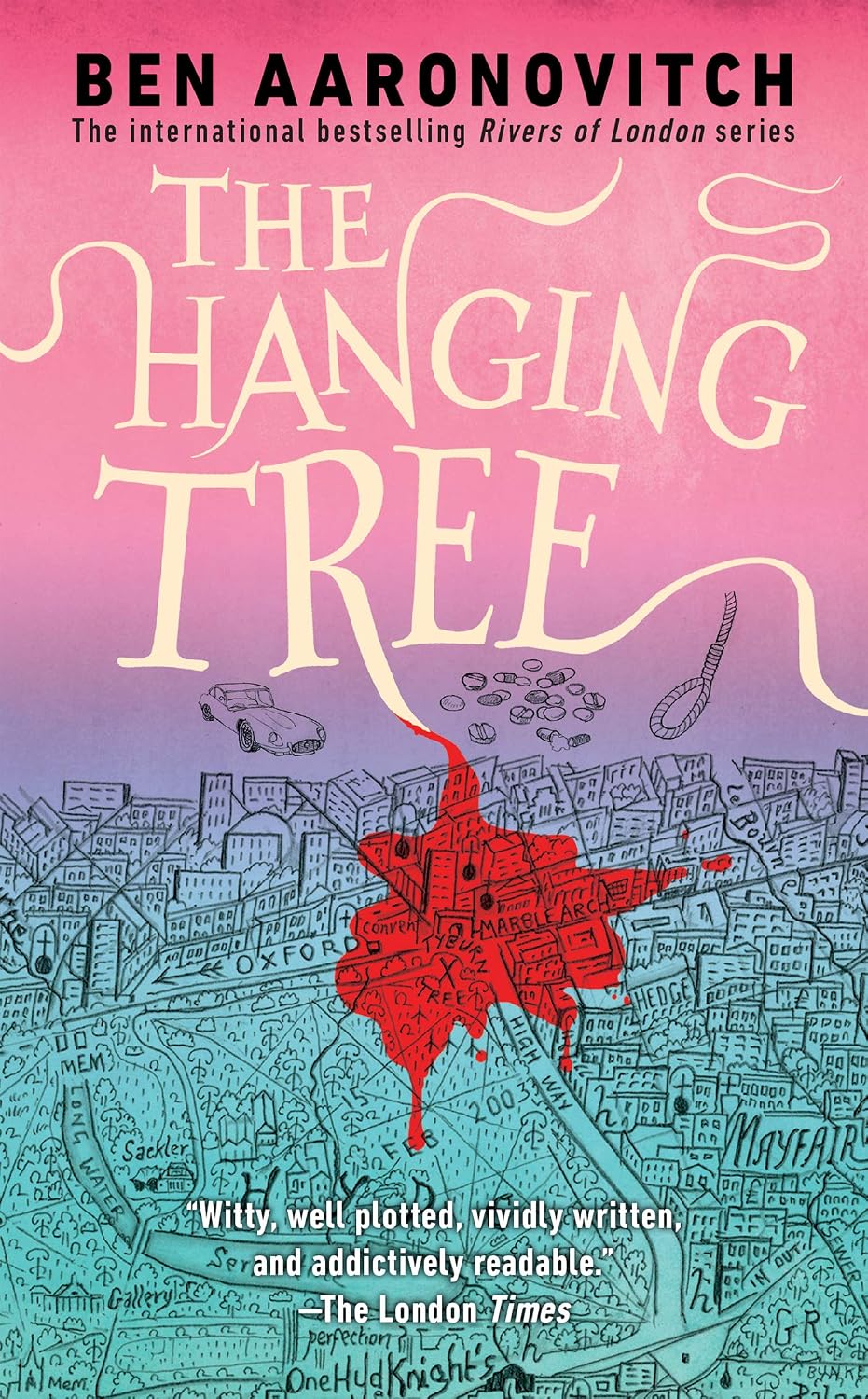
The Hanging Tree drags everything back to money, Mayfair, and consequences. A teenager dies at a party in One Hyde Park, the most expensive address in London, and one of Mama Thames’s daughters calls in the favor Peter owes her, the kind of favor that bends an investigation around the children of the powerful before it even starts. What follows is the series’ study of wealth, old money, new money, and the magical demi-monde’s own one percent, who have lawyers.
After the rural detour, this is where the main arc of the Rivers of London books snaps taut again, with revelations queued for two volumes and a finale that rearranges the board. Longtime readers rate it a return to form, though the two-year wait it ended colors some of that affection. From here to the end of the first era, casual reading stops being an option and the long game takes over.
Lies Sleeping (2018)

Lies Sleeping is the payoff book, the one the previous six novels were quietly assembling. There is no case of the week this time: the Folly, now with more staff than Nightingale has had in decades, goes on the offensive against the adversary who has been building toward something under London since early in the series, and the blow that reshaped it gets its reckoning. Saying more would cost you plenty: threads from every previous volume come due, including several that looked like local color at the time.
The pace is relentless by this series’ standards, and a book that is all climax leaves less room for the digressions readers come here for, a trade most fans accept happily once per era. It earned a Dragon Award nomination and a top-five finish in the Locus poll. Nobody should start here, and everybody who gets here is glad they came.
False Value (2020)

False Value opens the second era of the Rivers of London books, and it opens with Peter outside the Folly, working security at the Serious Cybernetics Company, a tech campus by Old Street’s silicon roundabout, run by a Silicon Valley transplant and named as one long Douglas Adams joke. How much of that arrangement is what it appears to be unspools across a first half told out of order, a structure readers still argue about: some find the time-shuffle a fun heist-movie trick, others call it the series’ one real structural misfire. Behind the office comedy sits the question the new era keeps asking, which is what happens when Silicon Valley notices that magic is real.
It is a deliberate reset, smaller stakes and new rooms after the first arc’s finale, and it reads best approached that way: not a continuation of the war but the series finding out what it does in peacetime. The era’s new recurring players walk in here.
Amongst Our Weapons (2022)

Amongst Our Weapons starts with a body in the London Silver Vaults and a title lifted from Monty Python’s Spanish Inquisition sketch, both of which it earns. The dead man belonged to a circle whose members are being executed one by one, each death attended by what witnesses keep describing as an angel, and the trail runs back through decades-old choices into the kind of old religious history the series usually only gestures at. Meanwhile the Folly’s domestic life, by now half the readership’s reason for showing up, keeps expanding in every direction.
The consensus take is comfort food done by a master of the house style: the mystery is mid-tier, the company is the point, and your mileage tracks exactly with how invested you already are. Nine books into the series, that is less a flaw than a contract, and the book honors it.
Stone and Sky (2025)

Stone and Sky, the tenth novel and the newest, finally takes the mainline out of England: the whole extended Grant-and-Folly household decamps to Aberdeen, the Granite City, for a working holiday that stays a holiday for about a chapter. A body turns up at a bus stop, fresh from the sea and wrong in ways the pathologists will not put in writing, something has been killing sheep with bites no local predator could leave, and Nightingale is along too, training Peter’s cousin Abigail in the arcane arts between coastal walks. Something may be stirring beyond the bay, as the jacket copy has it, and there is something far stranger in the sky.
It arrived in July 2025 after a three-year gap between novels, the longest in the series, and the early word ran friendly rather than ecstatic: Publishers Weekly praised Peter’s narration and promised that series fans will not be disappointed, while the fan verdict so far lands warm rather than rapturous. Not peak Grant, entirely worth it, and the Aaronovitch books are clearly not done with the map yet.
The Novellas and Tales From the Folly
The Aaronovitch books do not stop at the novels, and none of this shelf is required, but most of it gets read anyway, because the series’ real product was never any single case. It is the demi-monde itself, the rivers and fox networks and quiet communities under the pavement, and every satellite adds a room to the house. The five novellas are each sold on their own, each is an afternoon long, and two of them quietly audition the franchise’s future leads. They slot in wherever you meet them, though each sits at a specific point in the timeline.
The Furthest Station (2017)

The Furthest Station is the taster, and the right first novella. Ghosts are accosting commuters on the Metropolitan line, visibly distressed and trying to say something, except every witness forgets the encounter within minutes of leaving the train. Peter, his transport-police counterpart and an alarmingly competent teenage Abigail ride the early services to catch one in the act. An hour or two here settles the question of whether the Aaronovitch books are for you, at a fraction of the commitment. It sits between Foxglove Summer and The Hanging Tree, it is the most purely charming thing on this page, and the missing-persons case underneath the ghost story gives it a spine the short length never cramps.
The October Man (2019)

The October Man is proof the Rivers of London books run past the M25. Germany has its own magical bureau, with its own history and its own hard rules about never discussing the war years, and investigator Tobias Winter is dispatched to Trier, the country’s oldest city, where a dead man has been found crusted with the noble rot that normally makes dessert wine. With a sharp local cop as his sidekick, the novella rebuilds the series’ whole formula in a new key, procedure, river politics and all, and the pleasure is hearing the voice survive translation into a different national temperament. Readers tend to want more of Winter immediately, and so far this is all there is.
What Abigail Did That Summer (2021)

What Abigail Did That Summer hands the series to Peter’s teenage cousin, its sharpest apprentice, and runs parallel to Foxglove Summer: while Peter is out of London, kids keep going missing around Hampstead Heath and turning back up with gaps where the afternoon should be. Abigail investigates with the help of the foxes, who talk, operate like a cross between a spy network and a neighborhood watch, and are the best idea on this shelf. Her voice is distinct from Peter’s, younger, warier, footnoted, and the novella doubles as her job interview for the series’ future: she has been quietly annexing the mainline ever since. Of the novellas, it is the one that matters most to the ongoing story.
Winter’s Gifts (2023)

Winter’s Gifts is the American wing. FBI agent Kimberley Reynolds, the skeptic from Whispers Under Ground who has since learned better, answers a retired agent’s distress call from a small town in northern Wisconsin just as a historic snowstorm closes the roads behind her. What she finds has been waiting in the ground a long time, and the novella plays closer to folk horror than anything else published under the Rivers of London name. It stands almost completely alone, which makes it the easiest gift copy in the whole franchise, and Reynolds carries it: methodical, devout, unarmed with Latin and managing anyway. The blizzard does the rest.
The Masquerades of Spring (2024)

The Masquerades of Spring is the dandy of the set, a jazz-age New York novella narrated by Augustus Berrycloth-Young, a young English magician abroad, whose idle clubs-and-cocktails existence is interrupted when Thomas Nightingale, younger here and quietly alarming, arrives from London chasing a saxophone that does things a saxophone should not. The Bertie Wooster pastiche is open, affectionate and sustained, valet included, and underneath it the novella sketches what the magical twenties looked like from Harlem rather than Russell Square. It is the lightest of the novellas on consequence and the most purely stylish, and readers who collect voices rate it accordingly.
Tales from the Folly (2020)

Tales from the Folly rounds up the strays: the short stories Aaronovitch had scattered across special editions and anthologies over a decade, finally in one place. The contents run from proper cases, like the early Peter story “The Home Crowd Advantage,” to sketches and Christmas pieces, including “Vanessa Sommer’s Other Christmas List,” a coda for The October Man, and “Favourite Uncle,” which belongs to Abigail’s corner of the map. Collections like this live or die by expectations: nothing here is essential, several pieces are barely more than anecdotes, and completists will have a lovely time anyway. It is also the only way to get most of these stories without hunting down the editions they first appeared in.
The Graphic Novels
The comics are not an adaptation. Aaronovitch co-writes them with Andrew Cartmel, who three decades earlier was the Doctor Who script editor buying his first television scripts, with art by Lee Sullivan, and they are full canon: new cases set in the gaps between the novels, with developments the books treat as having happened. Titan has collected a dozen volumes since the run began in 2015, from Body Work through Stray Cat Blues (2024). One entry stands for the lot, because the right way in is simply to start at volume one and see whether the format suits you.
Body Work (2016)

Body Work is the first collected volume and the proof of concept. The case is pure series DNA: cars are killing their owners, something vengeful has gotten into the vehicles, and Peter works the haunted end of London’s used-car market while Nightingale handles the heavy lifting. Cartmel and Aaronovitch plot it like a mid-series novella, Sullivan draws likenesses consistent enough that the cast reads instantly, and the pacing is episode-of-television brisk, which given the writers’ day jobs makes sense. It is slighter than a novel and never pretends otherwise. Comics readers can treat it as a legitimate door into the franchise, and novel readers get the missing-scenes habit: once you know these stories count, the rest of the shelf follows.
Before the Folly: The Doctor Who Shelf
Before any of this, Aaronovitch was a Doctor Who writer, and that fandom still claims him as one of its own. What survives from the era in print is one book, and what survives out of print is worth knowing about anyway.
Remembrance of the Daleks (1990)

Remembrance of the Daleks is Aaronovitch’s own novelization of his 1988 serial, the story that opened the show’s twenty-fifth season and made his name while he was still in his mid-twenties. The serial sent Sylvester McCoy’s Seventh Doctor and Ace back to the London junkyard where the series began in 1963, dropped them between two warring Dalek factions hunting a Time Lord weapon, and played the Doctor as a schemer several steps ahead of everyone, a take that stuck. Doctor Who Magazine’s readers voted it the best story of its season, and it has sat in or near the top ten of the big fan polls ever since.
The novelization has its own standing: when a fiftieth-anniversary reissue line chose a single classic novelization to reprint in 2013, this was the one. Prose gives Aaronovitch room the screen never had, and the book reads as a dry run for the voice that surfaced two decades later. For Rivers of London readers it is the origin story, and it is the one piece of his Doctor Who work you can simply buy new.
The rest of the shelf is for hunters. When the show was canceled, Aaronovitch followed it into Virgin’s New Adventures, the licensed novels that kept Doctor Who alive through the 1990s, and wrote three for the line.
Transit (1992) dropped the Seventh Doctor into a far-future solar system wired together by an interplanetary train network, with a tone so adult and so cyberpunk that readers at the time split hard on it, and it introduced Kadiatu Lethbridge-Stewart, his own addition to the show’s oldest family tree. The Also People (1995) is the fan favorite, a murder mystery inside a Dyson sphere run by a benevolent machine intelligence, and Aaronovitch was cheerfully open about the model, writing online that he “stole the whole Culture,” Iain M. Banks’s great utopia, to give the Doctor somewhere to solve a murder.
So Vile a Sin (1997) closes the run with an asterisk: a hard-drive crash stalled the book mid-delivery, Kate Orman was brought in to finish it, and the published book carries both names. After that came audio work and one more novel, Genius Loci (2006), a Bernice Summerfield story for Big Finish, plus a run of Blake’s 7 audio dramas. The New Adventures are long out of print, which is why nothing in these two paragraphs gets a button. This is secondhand territory, priced accordingly, and only Remembrance above is an ordinary purchase.
Ben Aaronovitch: Deep Dive & FAQ
What Runs Through Ben Aaronovitch’s Books
Procedure is the first thread, and the deepest joke. Aaronovitch’s great insight was that the fantasy police story had always skipped the police part, so his books run on paperwork, jurisdiction, risk assessments and interagency politics, played straight enough that the comedy generates itself. Magic behaves like a discipline with rules and costs rather than a vibe, the Newtonian pedigree is load-bearing, and cases get solved by canvassing and lab work as often as by fireballs. The institutional texture is the point: the Folly begins the series as a relic with a staff of two, and the long story underneath every case is the slow, argued-over rebuilding of that institution into something that looks like the city it serves.
London is the second thread, written with an architect’s crush: boroughs, building codes, demolition histories, and a river system that is also a family of gods with opinions. The city’s diversity is texture rather than topic. Peter, the son of a jazz musician and a mother from Sierra Leone, polices a London where the magical communities are as layered as the human ones, and the series treats that as simple realism. The third thread is accumulation. These books gather people the way long-running shows do, until the cases matter less than the household, which is a structure Aaronovitch learned in television and deploys with intent.
Prizes and Honors
The trophy shelf is lighter than the sales figures, which is the usual fate of crowd-pleasers. The series has twice been a finalist for the Hugo Award for Best Series, in 2017 and 2023, without winning. Rivers of London earned Aaronovitch a New Writer of the Year nomination at the Galaxy National Book Awards, and its audiobook made the CrimeFest shortlist in 2012.
Lies Sleeping picked up a Dragon Award nomination and a top-five finish in the Locus poll in 2019, the comics took a British Fantasy Award nomination in 2021 for The Fey and the Furious, and Whispers Under Ground collected a German Phantastik Preis nomination. The reach is the real honor: more than five million copies sold worldwide and translations into fourteen languages, by the Guardian’s count, plus the Future Worlds Prize, which Aaronovitch founded in 2020 to back science fiction and fantasy writers of color.
Which Ben Aaronovitch Editions to Buy
Start by dodging the famous trap: Rivers of London and Midnight Riot are the same novel, so do not buy both unless you want the souvenir. In the UK the whole series lives at Gollancz in matching paperbacks, which is the cheapest way to build a shelf of Ben Aaronovitch books. In the US the series started at Del Rey, which did the retitling, and is published these days by DAW, Stone and Sky included, so American covers and spine designs vary with the era of the printing you find.
The audiobooks are the series’ second edition in all but name. Kobna Holdbrook-Smith’s narration of the Peter Grant books has a devoted following, enough that plenty of fans take each new release by ear first and in print second, and Stone and Sky pairs him with a second narrator, Shvorne Marks. The comics are collected by Titan and widely available in trade paperback, Body Work first. And the novellas are real books at real prices, slim as they are, so the economical play is picking each up in paperback alongside the novel it sits nearest.
Ben Aaronovitch on Screen
As a screenwriter he is already there. “Remembrance of the Daleks” (1988) and “Battlefield” (1989) are both his, the former a fixture of classic Doctor Who polls, the latter the story that brought the Brigadier out of retirement. After the show’s cancellation came an episode of Casualty and a stretch on the space soap Jupiter Moon, and then the long quiet that ended in a bookshop.
The Rivers of London adaptation, meanwhile, has become its own saga. Simon Pegg and Nick Frost’s company Stolen Picture optioned the books in 2019, with Aaronovitch praising the plan as creator-led TV with a minimum of “corporate bollocks.” That version never escaped what he later called “permanent pre-pre-production.”
A fresh attempt announced in 2022 brought together Pure Fiction Television, See-Saw Films and Aaronovitch’s own company, Unnecessary Logo, and this one has kept moving: John Jackson came aboard as lead writer in 2023 with a full writers room behind him, and in late 2024 Sky Studios boarded the project, set to premiere on Sky in the UK while the producers hunt an American partner. As of this writing there is no cast and no air date, so the audiobooks remain the definitive adaptation, which for a series about institutional patience feels about right.
Questions About Ben Aaronovitch
What Order Should I Read the Ben Aaronovitch Books In?
Publication order, starting with Rivers of London (or Midnight Riot, the identical American edition). The first seven novels braid one long case under their individual mysteries, so skipping around costs real payoffs. The novellas and comics slot in wherever you meet them, and the table above marks where each sits.
Are Rivers of London and Midnight Riot the Same Book?
Yes. Midnight Riot is the American retitle of Rivers of London, applied by Del Rey for the 2011 US release, and it is the same novel. Buy whichever is in front of you and ignore the other. Every later book kept its title on both sides of the Atlantic.
Is the Rivers of London Series Finished?
No, and there is no announced end point. Stone and Sky (July 2025) is the tenth and newest novel, the novellas and graphic novels keep arriving between mainline books, and Aaronovitch has not announced a title or date for an eleventh. The series’ pattern for a decade has been a release of some kind most years, so the safe assumption is more.
Do I Need to Read the Novellas and Graphic Novels?
No. The novels stand complete on their own. But both are canon, written or co-written by Aaronovitch, and they feed the mainline: Abigail’s novella explains a character the later books lean on, The October Man and Winter’s Gifts open the world past London, and the comics fill gaps between novels. Completists are rewarded. Skippers lose nothing essential.
Is There a Rivers of London TV Series?
Not yet, after years of trying. A 2019 option by Simon Pegg and Nick Frost’s Stolen Picture stalled. The current attempt, announced in 2022 and backed by Sky Studios since late 2024, has Pure Fiction Television producing with See-Saw Films behind it, John Jackson leading the writers room, and Aaronovitch aboard as executive producer. No cast or air date has been announced.
What Did Ben Aaronovitch Write for Doctor Who?
Two broadcast serials, “Remembrance of the Daleks” (1988) and “Battlefield” (1989), both for Sylvester McCoy’s Seventh Doctor, plus the novelization of Remembrance and three of Virgin’s New Adventures novels in the 1990s: Transit, The Also People and So Vile a Sin, the last co-written with Kate Orman. Remembrance still places high in all-time fan polls.
Are the Rivers of London Audiobooks Good?
For a large part of the fandom they are the default edition, not an alternative. Kobna Holdbrook-Smith narrates the Peter Grant books, his delivery of Peter’s first-person voice has a devoted following, and a lot of longtime fans take each new book by ear first. The Rivers of London audiobook was shortlisted at CrimeFest in 2012, early proof of what listeners had noticed.
Where to Go Next
One comparison earns its own paragraph, because it is the fork most urban fantasy readers actually face. Harry Dresden and Peter Grant are the genre’s two great wizard-detectives, and my Jim Butcher guide covers the other tine. The temperament test: Dresden is American noir, first-person bravado, escalating apocalypse stakes, and a hero the establishment distrusts. Grant is British procedure, dry institutional comedy, human-scale cases, and a hero busy writing the establishment’s first health-and-safety policy for magic. Dresden also runs one escalating mega-arc across seventeen-plus volumes, while Grant’s books stay case-sized with the long game in the background, so the Folly is the friendlier on-ramp for readers wary of homework. Plenty of readers keep both on the nightstand.
The shelf around the Folly is mapped on my urban fantasy books list, which ranks the sixteen that take the genre seriously, Rivers of London among them. Readers who stay for the workplace comedy more than the magic should meet the Discworld City Watch, the other great fantasy police force, by way of my Terry Pratchett guide. And when you want the widest possible map, the best fantasy books list is the long answer to what comes next.