Raymond E. Feist books have been the genre’s great on-ramp for over forty years, and the machine is still running. Magician (1982) remains the novel a whole generation names as their first fantasy after Tolkien, the Riftwar Cycle it launched ran to thirty books before closing with Magician’s End in 2013, and Feist, now eighty and still in San Diego, is mid-trilogy on something his long-haul readers waited decades to see: a new saga openly built to stitch his second world back into Midkemia, with familiar names waiting on Sorcerer’s Isle.
The Riftwar Saga holds its entry on my best fantasy books pillar and the shelf anchors my classic fantasy list, and what this page adds is the honest map, because thirty-plus books is a country, and not every province deserves equal time. Every sub-series gets placed, every volume lands in the big table, and the peaks get full reviews. The valleys get honesty.
If you just want marching orders: Magician first, straight through the saga, and don’t look up until you’re done. The rest of this guide exists for the moment you finish A Darkness at Sethanon and realize there are twenty-seven more Riftwar books behind the door.
Fiction by René Rehn


The Short Version
Magician first, always, and it satisfies alone if you let it. Then the rest of the Riftwar Saga, then the Empire trilogy, which is the shelf’s secret masterpiece. After that, choose: the Serpentwar Saga for the second peak, the middle sagas only if you’re in love, and the Firemane-into-Dragonwar line for what he’s building right now. The catalog is huge and its quality honestly varies, and this page says where.
Publication order is reading order for the Raymond E. Feist books, with two useful exceptions. The Empire trilogy runs parallel to the Riftwar Saga and reads best right after it, and the Riftwar Legacy and Legends of the Riftwar books are flashbacks you can take any time after the opening saga, or skip.
Raymond E. Feist Books in Order
The table runs by first publication, which tracks the internal history closely. The exceptions sit in the Notes column, and co-written books name the co-author.
| Year | Title | Series or type | Notes |
| 1982 | Magician | The Riftwar Saga, book 1 | Split as Apprentice and Master in US printings |
| 1985 | Silverthorn | The Riftwar Saga, book 2 | |
| 1986 | A Darkness at Sethanon | The Riftwar Saga, book 3 | |
| 1987 | Daughter of the Empire | The Empire Trilogy, book 1 | With Janny Wurts |
| 1988 | Faerie Tale | Standalone | Dark fantasy, outside the Riftwar |
| 1989 | Prince of the Blood | Krondor’s Sons, book 1 | |
| 1990 | Servant of the Empire | The Empire Trilogy, book 2 | With Janny Wurts |
| 1992 | Mistress of the Empire | The Empire Trilogy, book 3 | With Janny Wurts |
| 1992 | The King’s Buccaneer | Krondor’s Sons, book 2 | |
| 1994 | Shadow of a Dark Queen | The Serpentwar Saga, book 1 | |
| 1995 | Rise of a Merchant Prince | The Serpentwar Saga, book 2 | |
| 1997 | Rage of a Demon King | The Serpentwar Saga, book 3 | |
| 1998 | Shards of a Broken Crown | The Serpentwar Saga, book 4 | |
| 1998 | Krondor: The Betrayal | The Riftwar Legacy, book 1 | Novelizes the game Betrayal at Krondor |
| 1999 | Krondor: The Assassins | The Riftwar Legacy, book 2 | |
| 2000 | Krondor: Tear of the Gods | The Riftwar Legacy, book 3 | |
| 2001 | Honoured Enemy | Legends of the Riftwar | With William R. Forstchen |
| 2002 | Murder in LaMut | Legends of the Riftwar | With Joel Rosenberg |
| 2002 | Talon of the Silver Hawk | Conclave of Shadows, book 1 | |
| 2003 | Jimmy the Hand | Legends of the Riftwar | With S. M. Stirling |
| 2003 | King of Foxes | Conclave of Shadows, book 2 | |
| 2004 | Exile’s Return | Conclave of Shadows, book 3 | |
| 2005 | Flight of the Nighthawks | The Darkwar Saga, book 1 | |
| 2006 | Into a Dark Realm | The Darkwar Saga, book 2 | |
| 2008 | Wrath of a Mad God | The Darkwar Saga, book 3 | |
| 2009 | Rides a Dread Legion | The Demonwar Saga, book 1 | |
| 2010 | At the Gates of Darkness | The Demonwar Saga, book 2 | |
| 2011 | A Kingdom Besieged | The Chaoswar Saga, book 1 | |
| 2012 | A Crown Imperilled | The Chaoswar Saga, book 2 | |
| 2013 | Magician’s End | The Chaoswar Saga, book 3 | Closes the Riftwar Cycle |
| 2013 | Jimmy and the Crawler | The Riftwar Legacy, novella | Wraps the abandoned Krondor books |
| 2018 | King of Ashes | The Firemane Saga, book 1 | New world: Garn |
| 2020 | Queen of Storms | The Firemane Saga, book 2 | |
| 2022 | Master of Furies | The Firemane Saga, book 3 | |
| 2024 | A Darkness Returns | The Dragonwar Saga, book 1 | Firemane meets Midkemia |
Where to Start With Raymond E. Feist
Magician, in whichever cover count your shop sells it, and no other answer survives contact with the book. It was built as a door and it still swings open the same way it did in 1982. Read the whole Riftwar Saga, then go straight to Daughter of the Empire before anything else, because Mara is the payoff too many readers never reach.
There are two side doors worth knowing. Readers who come for political fantasy can start with the Empire trilogy directly, since it stands on its own feet and only gains from knowing Magician. And horror readers can meet Feist through Faerie Tale, which shares nothing with Midkemia except the craftsmanship.
What you should not do is start with the middle sagas or the new Dragonwar line. The late Riftwar books assume decades of affection, and A Darkness Returns, helpful recap or not, pays off in proportion to how much Midkemia you carry in. If you’re deciding whether to commit to the long haul at all, my best fantasy series list puts the Riftwar next to its rivals for exactly that choice.
Feist’s Life, Briefly
Raymond E. Feist was born Raymond Elias Gonzales III in Los Angeles in 1945 and grew up in Southern California, taking the surname of his stepfather, Felix E. Feist. He earned a B.A. in Communication Arts with honors from the University of California, San Diego, in 1977, and the degree matters less to this story than what he did at night while earning it.
Midkemia began as a game world. Feist and his friends at UCSD built it as a homebrew alternative to Dungeons and Dragons, the group graduated from Thursday nights to Friday nights, and some of its members formed Midkemia Press to publish the world as game material in its own right. That origin is exactly why the geography, economics, and garrison rosters of the Riftwar books feel load-tested rather than painted on.
The idea for a novel about a boy who becomes a magician came to him during those student years, and Doubleday published Magician in 1982. Feist has acknowledged that Kelewan, his second world, drew heavily on M. A. R. Barker’s Tekumel setting, something he says he didn’t realize while writing.
From there the career runs with unusual steadiness: the Riftwar Cycle from 1982 to 2013, collaborations with Janny Wurts, William R. Forstchen, Joel Rosenberg, and S. M. Stirling along the way, bestseller lists in New York and London, an Inkpot Award in 1988, and reportedly more than fifteen million copies sold. He lives in San Diego, by his own description a San Diegan by choice, and at eighty he is still delivering books.
The Riftwar Saga
Magician, Silverthorn, A Darkness at Sethanon, 1982 to 1986. The evergreen door, and the reason this page exists. Read them in that order, and know that the whole three-volume run remains the correct first purchase among the Raymond E. Feist books.
Magician (1982)

Magician is the on-ramp half the modern genre drove in on, and it still works. Pug, an orphan doing scullery work in the castle of Crydee, is taken as apprentice by the magician Kulgan just as a rift tears open between worlds and the Tsurani, an empire from alien Kelewan, invade Midkemia with bronze weapons and battlefield sorcery. Pug’s road runs through capture, slavery on the far side of the rift, and training in a magic his home world has no word for, while his friend Tomas inherits a power with a much older pedigree, and the war grinds across a decade.
The structural trick still lands. By splitting Pug and Tomas onto diverging power curves, one earned in an enemy’s academy and one inherited from something ancient, the book gets to be a war story and two very different wizard stories at once. And because Pug lives years among the Tsurani, the invaders become people rather than a horde, which was not the standard move in 1982. It’s boy’s-adventure warmth over big machinery, and the early castle chapters read deliberately traditional before the scope arrives.
Two purchasing notes. US printings often split the novel into Magician: Apprentice and Magician: Master, one book in two covers. And in 1992 Feist published the Author’s Preferred Edition for the tenth anniversary, restoring scenes cut from the original and revising others, and that fuller text is the one to buy. The BBC’s Big Read poll put Magician at 89 on its list of Britain’s best-loved novels in 2003, two decades after publication, which tells you something about how this door keeps swinging.
Silverthorn (1985)

Silverthorn is the tighter, darker second act. An assassin’s bolt at a royal wedding in Krondor leaves a victim poisoned with something no priest or healer can touch, and Prince Arutha rides north with a small company to find the one plant that can answer it, through territory held by things that serve a power not yet named. The quest shape is as old as the genre, but Feist runs it fast, and the book belongs to Jimmy the Hand, the boy thief whose charm carried whole future series on his own.
It’s a smaller book than Magician by design, a bridge with a sting in its final pages, and readers who wanted the world-spanning scale back sometimes count that against it. Taken as the middle movement it is, it does exactly what it should: it narrows the war to a blade’s width and makes the enemy personal.
A Darkness at Sethanon (1986)

A Darkness at Sethanon closes the opening saga at full scale. The moredhel chieftain Murmandamus, armed with a prophecy and the horde it buys him, drives south through the Kingdom’s defenses toward a city nobody can explain wanting, while Pug and Tomas chase the war’s true cause across stranger ground than any battlefield. Sieges on one track, cosmology on the other, and the two meet at Sethanon.
The split is the book’s strength and its gamble. The military half, Armengar and the long fighting retreat, contains some of the best sustained action Feist ever wrote. The metaphysical half asks you to take a lot of deep lore at speed. Most readers find the finale earns it, and the saga lands complete, which in 1986, mid-boom, was itself worth something. Finish it before you touch anything else on this page.
The Empire Trilogy, with Janny Wurts
Daughter of the Empire, Servant of the Empire, Mistress of the Empire, 1987 to 1992. The best books bearing Feist’s name are half someone else’s, and the shelf’s devoted have been saying so for thirty years. Co-written with Janny Wurts, and her co-credit is load-bearing, not decorative, the trilogy crosses the rift permanently and tells the Tsurani side of the story. It runs parallel to the Riftwar Saga, starting during Magician and ending after Sethanon, and it reads perfectly as your second stop. Of all the Feist books, these are the ones critics defend hardest, and they get a full entry each.
Daughter of the Empire (1987)

Daughter of the Empire opens with Mara of the Acoma pulled out of a temple moments before taking vows, because her father and brother are dead in the war on Midkemia and she is suddenly the Ruling Lady of a nearly extinguished house. What follows is the Game of the Council, an aristocratic murder-sport played with etiquette, against enemies who erased her family and expect to finish the job inside a season.
It’s political fantasy of a precision the main line never attempts, honor culture examined rather than assumed, and Mara belongs on any shortlist of the genre’s great operators, a protagonist who wins with wits, marriages, grain contracts, and nerve in a world where a misplaced syllable can be a death sentence. The Kelewan that was an exotic backdrop in Magician becomes a whole society here, cruel and coherent, and the book interrogates its cruelty without ever losing the pleasure of watching a sharp mind work.
The standing verdict this page happily co-signs: if Magician is the door, this is the treasure behind it. Readers who skip the Empire books because they look like a side story are skipping the peak of the whole catalog.
Servant of the Empire (1990)

Servant of the Empire is the long middle volume, and many readers call it the strongest of the three. Mara’s house has survived its first storm, so the Game raises its stakes, and into her household comes a purchase that changes everything: Kevin, a barbarian slave from Midkemia whose world has no castes and whose ideas are more dangerous to Tsurani order than any army. The trilogy’s central collision, a mind built by one civilization arguing with a heart claimed by another, plays out against escalating political warfare.
It’s a thick book that uses its thickness, trading the first volume’s tight survival plot for empire-scale consequence, and the slave-and-lady romance is handled with more honesty about power than the setup promises. A readers’ award from the CompuServe forums in 1991 is a period detail, but the lasting evidence is simpler: this is the volume fans reread.
Mistress of the Empire (1992)

Mistress of the Empire finishes the trilogy at maximum scale. The Game of the Council has cost Mara more than any ledger can hold, and her final opponents are beyond the Game entirely: the Assembly of magicians, the Great Ones whose word is law and who answer to no house, no emperor, and no rule Mara has ever been allowed to bend. Taking on an untouchable caste means deciding what the Empire should be, not just who runs it.
The conclusion goes bigger and broader than the earlier books, and a few readers prefer the chamber-piece intensity of Daughter to the epic sweep here. The consensus still lands firmly on satisfied: the trilogy’s slow escalation from survival to reformation is among the most complete arcs the whole era produced, and the ending honors every cost along the way. Finish the three and you’ve read the case for Feist books as serious fantasy, not just comfort food.
Krondor’s Sons
Two books, 1989 and 1992, one generation down. This is where the Riftwar Cycle began its defining habit: time moves, heroes age, and the next set of protagonists are the children of the last.
Prince of the Blood (1989)

Prince of the Blood sends Borric and Erland, Arutha’s twin sons and princes with too much energy and too little sense, south to Great Kesh as royal envoys, straight into an assassination plot aimed at shattering the peace between the two most powerful nations on Midkemia. One twin’s road detours through capture and the slave markets, which is where the spoiled prince gets sanded down into something like a king.
It’s a deliberate change of register after Sethanon, intrigue and desert empire instead of world-ending war, and Kesh itself, all protocol and knives, is the best thing in it. The common verdict is fair: enjoyable mid-tier Feist, lighter than what came before. Its 1992 companion, The King’s Buccaneer, takes Nicholas, Arutha’s youngest, on a sea voyage to the unknown continent of Novindus that plays as pure adventure and quietly builds the stage the Serpentwar will burn down. Read both if the characters charm you, or sail past to the Serpentwar with nothing lost but charm.
The Serpentwar Saga
Shadow of a Dark Queen, Rise of a Merchant Prince, Rage of a Demon King, Shards of a Broken Crown, 1994 to 1998. The consensus second peak of the Riftwar books, and the arc long-haul readers defend hardest after Empire. A generation on from Sethanon, the threat gathering across the sea on Novindus finally moves, and the Cycle’s biggest war comes home.
Shadow of a Dark Queen (1994)

Shadow of a Dark Queen restarts the Cycle with its boots in the mud. Erik von Darkmoor, a smith’s bastard, and Roo Avery, a small quick thief of a friend, end a murder on the gallows’ steps and get an offer instead of a rope: join a company of condemned men being built for a mission so bad the Crown only spends the already-dead on it. The destination is Novindus, the job is to walk into the gathering host of the Emerald Queen and count its teeth, and the model is a hard-bitten military fantasy the earlier Riftwar books never attempted.
This is Feist’s grimmest opening, closer to mercenary fiction than to Pug and Kulgan, and it works precisely because the viewpoint stays low: sergeants, rations, discipline, fear. The reading order from here is strict and worth it. Rise of a Merchant Prince (1995) follows Roo home into commerce and makes trade-war genuinely gripping, though readers allergic to ledgers find it a swerve. Rage of a Demon King (1997) is the payoff, the invasion in full, and it is often named the single best book of the entire Cycle outside Magician. Shards of a Broken Crown (1998) is the quieter aftermath volume, winding the war down to a human scale. Four books, one arc, no skipping.
The Riftwar Legacy and the Krondor Game
This corner of the shelf exists substantially because of a video game, and the game deserves the nod. Betrayal at Krondor (1993), built by Dynamix and published by Sierra On-Line, remains one of the most beloved RPG adaptations of any book world: slow out of the gate on floppy disk, a hit on CD-ROM, Computer Gaming World’s Role-Playing Game of the Year in 1994, and still a cult object today. Feist didn’t write its text, designers Neal Hallford and John Cutter did, with Feist holding final say, but he liked the result enough to canonize it.
Krondor: The Betrayal (1998)
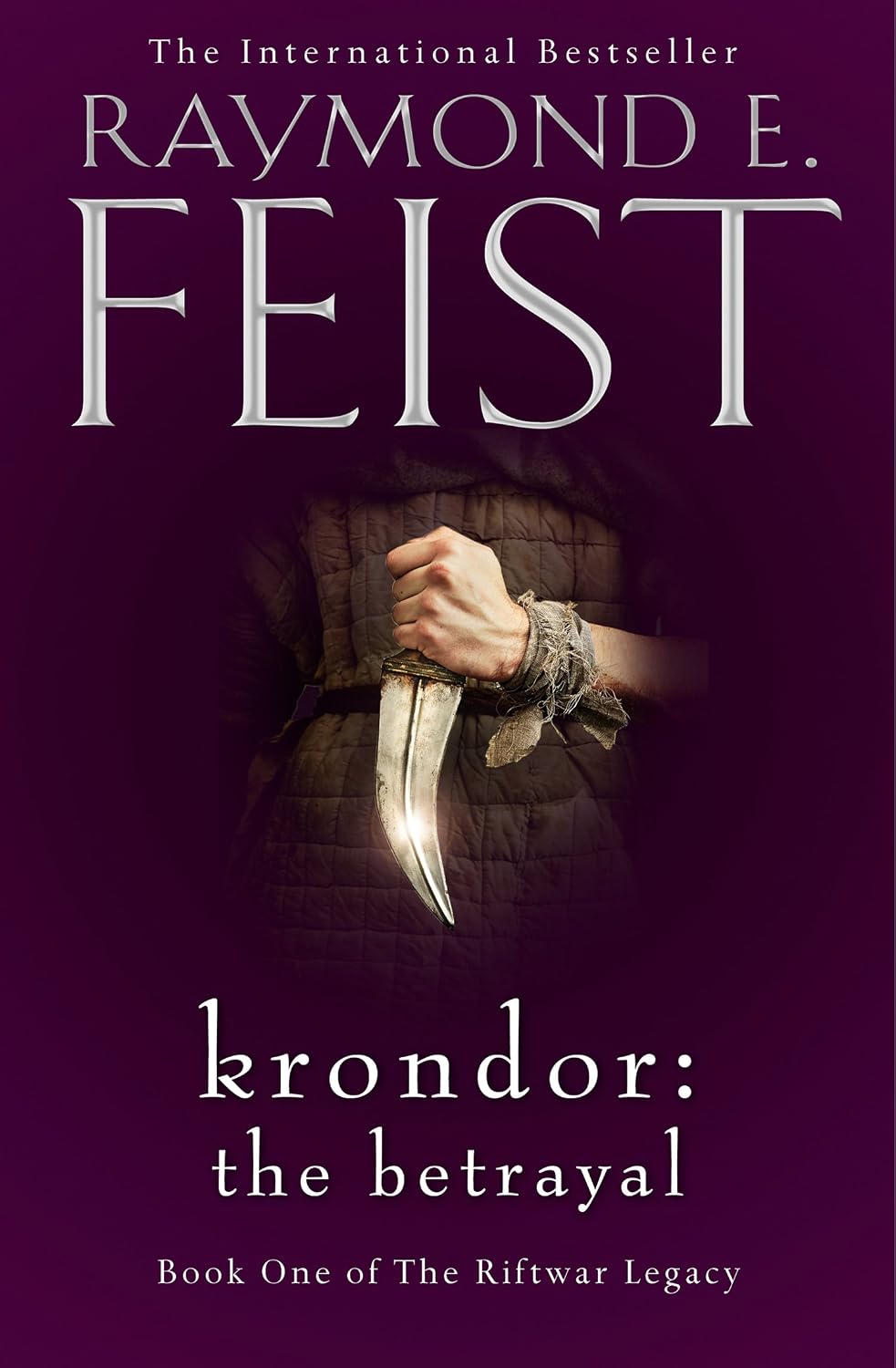
Krondor: The Betrayal is Feist novelizing that game about five years later, with Hallford and Cutter credited for the original story. A moredhel chieftain comes south under truce-flag with a warning the Kingdom has every reason to distrust, a renegade among his people is moving pieces toward war, and Squire James, who used to be Jimmy the Hand, gets the kind of plot his talents were built for. It slots in between the Riftwar Saga and Krondor’s Sons, which makes it a pleasant return visit to a younger cast.
As a novel it’s workmanlike, mainlining the game’s plot while trimming its side quests, and nobody calls it top-shelf Feist. The sequels are for the invested: Krondor: The Assassins (1999), a street-level Krondor book, and Krondor: Tear of the Gods (2000), drawn from the second game, Return to Krondor. The planned later volumes never appeared, and the novella Jimmy and the Crawler (2013) finally tied off their dangling plotline two decades on.
Legends of the Riftwar
Three standalone collaborations, 2001 to 2003, each set during the original Riftwar and each pairing Feist with another writer inside his world. They require nothing but Magician and they owe nothing to each other, so treat them as a shelf of bonus tracks.
Honoured Enemy (2001)

Honoured Enemy, written with William R. Forstchen, is the best of the three and the one with a real idea. Deep in the northern campaigns of the Riftwar, a Kingdom patrol and a Tsurani patrol, sworn enemies by every law of the war, are forced into a running truce when a moredhel force marks them both for death. Enemy soldiers learning each other’s codes while waiting for the inevitable moment the truce expires: it’s a war story with an old, sturdy engine, and Forstchen’s military-history instincts keep the marches and skirmishes honest.
The companions are slighter. Murder in LaMut (2002), with Joel Rosenberg, runs three weary mercenaries through a locked-castle murder plot, and Jimmy the Hand (2003), with S. M. Stirling, gives the young thief his own early adventure in the dark corners of Krondor. For most readers these are completist territory, but Honoured Enemy earns a spot on the main road through the Riftwar books.
The Later Sagas: From the Conclave to Magician’s End
From 2002 to 2013 Feist closed the Cycle with four connected sagas: Conclave of Shadows, the Darkwar, the Demonwar, and the Chaoswar. The honest note, and the fandom largely shares it, is that the machine ran faster than it ran deep through this stretch. Arcs compress, familiar beats recur, and the fair framing is completists’ country with real high points. The reward for the distance is that it all converges: each saga escalates the war behind every war, and the last book closes thirty volumes of story with a finale the fandom mostly walked away from happy. One anchored entry per saga below, with the rest of each in reading order.
Talon of the Silver Hawk (2002)

Talon of the Silver Hawk opens the Conclave of Shadows with the Cycle’s purest revenge setup. A boy of the Orosini, a mountain people with their own gods and name-rites, survives the massacre of everyone he has ever known and is rebuilt, by patient hidden masters, into a weapon pointed at the men responsible. The training-and-infiltration arc, swordsmanship, card tables, and courts, is comfort-food fantasy done with real craft, and the Conclave itself pulls the series’ old guard into the shadows where they now operate.
Read on with King of Foxes (2003), where Talon goes into his enemy’s service wearing a smile, and Exile’s Return (2004), which ends the trilogy somewhere nobody expects by handing the final book’s viewpoint to the other side of the board. The trilogy is the strongest complete unit of the late Riftwar books, and a reasonable soft landing after Serpentwar if you’re not ready to stop.
Flight of the Nighthawks (2005)

Flight of the Nighthawks begins the Darkwar Saga, and the scope jumps from kingdoms to cosmology. The Nighthawks, the assassin brotherhood that has haunted the Cycle since Silverthorn, are back as the visible edge of something far worse, and Pug’s hidden Conclave traces the threat toward the Dasati, a civilization from a plane of reality one level down from Midkemia’s, where life itself runs crueler. Two boys from sleepy Stardock get swept into the kind of apprentice arc Feist has been writing since 1982, deliberately and a little nostalgically.
The saga’s reputation rests on its middle volume: Into a Dark Realm (2006) takes the story into Dasati space, as alien a setting as Feist ever built, and Wrath of a Mad God (2008) spends the accumulated capital in a finale that permanently rearranges the board. Pacing wobbles and shortcuts show, but the ambition is real, and the Dasati chapters are the late Cycle’s most memorable invention.
Rides a Dread Legion (2009)

Rides a Dread Legion opens the two-book Demonwar Saga with a striking premise: a lost colony of elves, gone from Midkemia for ages, comes fleeing home with a demon legion eating the worlds behind them, and their homecoming is as much invasion as refuge. Opposite them stands one of late Feist’s best additions, Amirantha, a warlock who summons demons for a living and whose roguish expertise suddenly matters to everyone, and whose family turns out to be its own small war.
At two volumes, finished by At the Gates of Darkness (2010), this is the shortest and most functional of the late sagas, a bridge that exists to move the demon threat into position for the finale. Taken on those terms it’s brisk, likable, and unapologetically for the long-haul reader. Newcomers who wander in here will feel the forty years of homework they skipped.
A Kingdom Besieged (2011)

A Kingdom Besieged starts the Chaoswar Saga, the Cycle’s final trilogy, by bringing the war home in the most literal way available: Great Kesh invades the Kingdom, the muster reaches Crydee, where a castle boy first met a magician twenty-nine books ago, and a new generation of conDoin heirs inherits the series’ oldest ground as it burns. Behind the armies, the darkness that has worn a dozen masks across the Cycle begins taking its last and largest one.
A Crown Imperilled (2012) holds the middle together, and then Magician’s End (2013) does the thing thirty-book series almost never do: it actually ends. Threads from 1982 onward get gathered, the cosmology gets its final statement, and the send-off for the Cycle’s central figures left the fandom moved and, by broad consensus, satisfied. The trilogy shares the late period’s compression, but the finale is the point, and it holds. If you’ve come this far in the Riftwar books, the landing is worth the trip.
The Standalone: Faerie Tale
Off to one side of the entire Cycle sits one novel with no rift, no Pug, and a completely different temperature. For the horror readers in the audience, it may be the most interesting thing on the whole page.
Faerie Tale (1988)

Faerie Tale is Feist’s 1988 standalone, a contemporary dark fantasy about the Hastings family, a screenwriter father, his actress wife, a teenage daughter, and twin eight-year-old boys, moving into an old farmhouse in rural upstate New York with woods behind it. The woods have tenants. What lives there is the fair folk as the old stories actually told them, bargainers and thieves with beautiful faces, and the family’s new property sits on the terms of a very old arrangement that is about to lapse.
This is Feist writing real dread, and it lands. The research into folklore is visible but worn lightly, the children’s-eye chapters genuinely frighten, and the book builds to a mythic weight the cozy opening never telegraphs. It placed third in the 1989 Locus poll for horror novels, its cult following considers it his most underrated hour, and it sits comfortably next to the entries on my dark fantasy books list. If thirty volumes of epic fantasy are not your shape, this one book justifies Feist on your shelf anyway.
The Firemane Saga
After Magician’s End, Feist signed a reported seven-figure deal with HarperVoyager for six new novels, announced under the series name The War of the Five Crowns with a first book then scheduled for 2014. What actually arrived, in 2018 and retitled, was the Firemane Saga: King of Ashes, Queen of Storms (2020), and Master of Furies (2022), a complete trilogy set on a brand-new world called Garn. No rifts required, no homework assigned.
King of Ashes (2018)

King of Ashes opens on a betrayal: the five kingdoms of Garn break their oldest covenant, the Firemane line of Ithrace is massacred at a parley, and one infant heir vanishes. That child, Hatushaly, grows up inside Coaltachin, a hidden nation that trains and exports spies, thieves, and assassins, knowing nothing of his blood while the Church of the One spreads across the continent burning older faiths ahead of a coming religious war. A second thread follows Declan, a young smith carrying a master’s secret worth killing for.
It’s Feist rebuilding his toolkit on clean ground, the apprentice arcs and working economics of the Riftwar books with a darker political engine, and the trilogy gives the slow fuse a full three volumes to burn. Queen of Storms detonates the quiet coastal life book one establishes, and Master of Furies drives the hidden-heir story to its answer. The fair criticism is pace: book one is mostly fuse. The fair praise is that Garn feels as lived-in as Midkemia did in 1982, and the trilogy completes its arc cleanly while quietly loading the gun the next series fires.
The Dragonwar Saga
And then comes the reveal the long-haul readers assumed would never happen: the new saga, begun in August 2024, puts Garn and Midkemia on one page, the Firemane cast carried through a rift into the world where it all began. Feist has said the project grew from two planned books into a trilogy. As of this writing, October 2026, the second volume has no announced title or release date, though his site’s work-in-progress updates were still ticking along this spring. Treat the schedule as alive and unhurried.
A Darkness Returns (2024)

A Darkness Returns opens the Dragonwar Saga by doing the thing its title promises twice over. Hatu, now in command of his strange inherited power, his wife Hava, and their dubious friend Donte pass through a rift from Garn to Midkemia, where their hosts on Sorcerer’s Isle are magicians whose names, Magnus, Pug, Nakor, need no introduction to anyone who has read this far. What pulls the worlds together is the Void, the destroying force behind the Cycle’s worst days, stirring again on both sides of the rift.
The book opens with a genuinely useful Our Story So Far that recaps both continuities, and Publishers Weekly’s review called the volume a grand setup for an ultimate battle, with the familiar Feist mix of skullduggery, high-seas action, and expanding magic. It is, plainly, a first act, written for people who already love one or both worlds, and on those terms the homecoming delivers. Two worlds, one shelf, and the door from 1982 turning out to open onto all of it: that’s the pitch, and for readers of forty years of Feist books it’s close to irresistible.
Raymond E. Feist: Deep Dive and FAQ
What Runs Through Feist’s Books
The rift is the signature. Feist’s great subject is two worlds forced to know each other, and from Magician onward his wars insist on being seen from both sides: the Tsurani get a whole trilogy, the invaders of later sagas get reasons, and the new Dragonwar literally marries the two halves of his career through one. For a writer so often filed under comfort fantasy, that both-sides reflex is quietly the most modern thing about him, and it’s why the shelf holds its place in the epic fantasy tradition rather than just preceding it.
The second thread is the gaming table. Midkemia was built to be played in before it was written about, and it shows in the best way: economies that balance, garrisons with rosters, roads that go somewhere. The worldbuilding convinces because somebody stress-tested it for years before a single novel existed.
And the third is time. Almost alone among the big catalogs, the Riftwar Cycle ages its people. Heroes become fathers, then regents, then memories, and the next books belong to their children. Read in order, the Raymond E. Feist books are one long meditation on handing things over, which is a strange and touching spine for a series that began with a boy catching a magician’s eye.
Prizes and Honors
The trophy shelf is modest, and it tells you how Feist’s reputation actually works: readers first, critics trailing. He received the Inkpot Award in 1988, Magician placed tenth in the 1983 Locus poll for first novels, and Faerie Tale took third place in the 1989 Locus poll for horror novels. Two decades after publication, Magician placed 89th in the BBC’s 2003 Big Read poll of Britain’s best-loved novels, a better measure of what the book means than any juried prize.
The numbers do the rest: New York Times and Times of London bestseller lists across decades, and reportedly more than fifteen million copies sold. One more honor belongs to the games shelf: Betrayal at Krondor took Computer Gaming World’s Role-Playing Game of the Year in 1994, an award that kept sending new readers to the Riftwar books for years.
Which Raymond E. Feist Editions to Buy
For Magician the answer is specific: get the Author’s Preferred Edition, the 1992 tenth-anniversary text with the restored and revised material, and check the cover or copyright page for it before buying. Watch the US split while you’re at it. Magician: Apprentice and Magician: Master are halves of one novel, not two books, so don’t stop at the first spine. In the UK and Commonwealth, Magician sells as a single fat volume, which is the shape the story wants.
Beyond that, the catalog is in print and unfussy: HarperVoyager keeps the series available in the UK, US paperback and ebook editions cover the Cycle, and HarperVoyager’s The Complete Empire Trilogy omnibus collects Mara’s whole arc in one brick for readers who want it that way. The Riftwar Legacy books and the Legends collaborations drift in and out of print more than the main line, so secondhand copies are sometimes the practical answer there. Nothing on this shelf requires collector money, which fits a writer whose whole career has been about the wide-open door.
Feist on Screen
There is no Feist film or series yet, only a long trail of rumors and one live option. Television rights have circled for years: a 2018 deal with BCDF Television came and went, and in February 2022 Six Studios optioned the first six books, with writers attached to develop a series. As of April 2025 Feist was publicly describing the project as waiting on calls to be returned, and as of October 2026 nothing has been greenlit or dated. State of play: alive, slow, unpromised.
The adaptations that do exist run in other directions. Marvel and Dabel Brothers began a comic adaptation of Magician: Apprentice in 2006, and the definitive Feist adaptation remains Betrayal at Krondor, the 1993 game that turned his world interactive a generation before book-to-screen deals were fashionable. Until a network finally calls back, the game is the screen version, and honestly, the fandom could do far worse.
Questions About Raymond E. Feist
What Order Should I Read the Raymond E. Feist Books In?
Publication order, with one golden detour: read the Empire trilogy right after the Riftwar Saga, since it runs parallel to those events on the Tsurani side. The Riftwar Legacy and Legends of the Riftwar books are flashbacks set during or just after the original saga, readable whenever or skippable. Everything else follows publication year, and the big table above is the map.
Where Should I Start With Feist?
Magician, full stop. In US printings that can mean buying Magician: Apprentice and Magician: Master, which are one novel in two covers. Prefer the Author’s Preferred Edition text from 1992. Political-fantasy readers can alternatively start with Daughter of the Empire, and horror readers with Faerie Tale.
Do I Have to Read All Thirty Riftwar Books?
No, and almost nobody should. The essential path is the Riftwar Saga, the Empire trilogy, and the Serpentwar Saga, roughly ten books of high-grade fantasy. The middle sagas from Conclave of Shadows onward are for readers already in love, though the finale, Magician’s End, rewards anyone who goes the distance.
Is the Riftwar Cycle Finished?
Yes. Magician’s End closed the Cycle in 2013 after thirty books, with a real ending rather than a trailing off. The new Dragonwar Saga, begun with A Darkness Returns in 2024, returns to Midkemia but is its own series, crossing the Firemane cast into Feist’s original world.
What Is the Best Raymond E. Feist Book?
Magician is the famous answer and a fair one. The critical favorite is the Empire trilogy with Janny Wurts, with Daughter of the Empire the single most praised entry point, and among the solo Riftwar books, Rage of a Demon King is the volume most often named the peak. Faerie Tale is the dark-horse pick from outside the Cycle entirely.
Did Feist Write the Betrayal at Krondor Game?
Not directly. The 1993 game was developed by Dynamix for Sierra On-Line, with designers Neal Hallford and John Cutter writing its story and text and Feist holding final approval. He later novelized it as Krondor: The Betrayal (1998), crediting both designers, and the game counts as canon in the Riftwar continuity.
Is There a Riftwar TV Series?
Not yet. Six Studios optioned television rights to the first six books in February 2022 and writers were attached, but as of October 2026 no series has been greenlit, cast, or dated. Feist said in 2025 that the development deal was waiting on responses. Rumors are old companions of this series, so believe dates when you see them.
When Is the Next Raymond E. Feist Book Coming Out?
The second Dragonwar Saga volume is in progress, and Feist has said the series grew from two planned books to three. As of October 2026 no title or release date has been announced. His official site, Crydee.com, is where updates land first.
Where to Go Next
The natural company is the class that built the post-Tolkien boom. The Terry Brooks books guide covers the writer whose Sword of Shannara opened the commercial door in 1977 that Magician walked through five years later, and the David Gemmell books guide has the same decade’s heroic register with harder edges, the shelf for readers who liked Feist’s soldiers more than his magicians.
If what you loved was the big-hearted, Tolkien-shaped scale of it, the books like Lord of the Rings list maps that whole territory honestly. And if you’re choosing your next decade-long commitment, my best fantasy series ranking puts the Riftwar’s rivals side by side so you can pick your next country to live in.