Paul Tremblay writes horror novels that refuse to tell you whether anything supernatural happened, and he has built an entire career on that refusal.
It’s a genuinely risky position, and it’s what unites all the Paul Tremblay books. A reader who wants a monster confirmed will finish A Head Full of Ghosts annoyed, and plenty do. What Tremblay is doing instead is treating ambiguity as the subject rather than as a device: his books are about people constructing explanations for things they cannot bear, and about who gets believed, and about how a story changes once somebody is selling it.
He was a math teacher for years, he sits on the Shirley Jackson Award board, and the influence is direct and acknowledged. If you have read The Haunting of Hill House and want the modern version of that specific unresolvability, this is where to go.
I haven’t read these. What follows is the critical consensus.
Fiction by René Rehn


The Short Version
Read A Head Full of Ghosts. It won the Bram Stoker Award, it’s the book that made his name, and the last chapter reframes everything before it.
Then The Cabin at the End of the World if the ambiguity worked on you, and Survivor Song if you want the one with the most heart.
The Essential
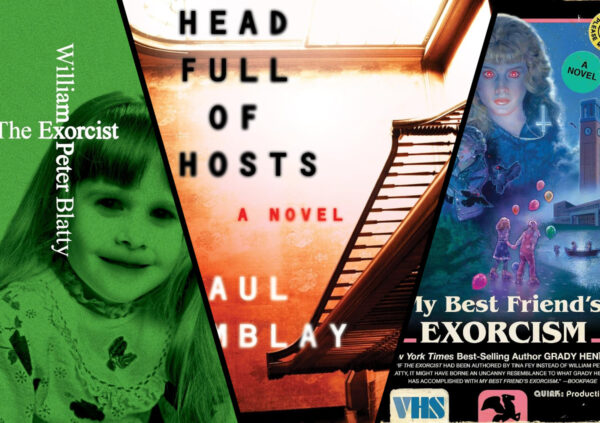
A Head Full of Ghosts (2015)

The Barrett family’s fourteen-year-old daughter Marjorie is behaving in ways nobody can explain. The family is broke, the father has found religion since losing his job, and a television production company has offered a great deal of money to film an exorcism as a reality series called The Possession.
The economics are what make it work. Every decision the family makes is explicable without any supernatural agency at all, because they need the money and the father needs to believe. The novel never confirms whether Marjorie is possessed, ill, or performing, and it gives you enough to build any of the three.
The frame is the second thing people talk about. Merry, the younger sister, tells the story in an interview fifteen years on, and between her chapters sit blog posts from a horror fan picking the television series apart. Those posts carry a great deal of quiet weight, and the final chapter recontextualizes the whole book.
It won the Bram Stoker Award for Best Novel. Stephen King’s line about it scaring the hell out of him is on most editions.
Also on possession books and ghost books.
The Cabin at the End of the World (2018)

A couple and their seven-year-old daughter are on holiday at a remote New Hampshire cabin when four strangers arrive with improvised weapons and tell them that one of the family must be willingly sacrificed to prevent the end of the world.
It’s a single-location novel that runs on one impossible decision, and the entire book takes place over about a day. The intruders are not villains in any straightforward sense. They are frightened, apologetic and certain, and Tremblay makes their certainty the most disturbing thing in it.
It won the Bram Stoker Award for Best Novel. M. Night Shyamalan filmed it in 2023 as Knock at the Cabin and changed the ending, a change most readers count as gutting the whole idea.
Survivor Song (2020)

A rabies-like virus with a very short incubation is spreading through Massachusetts. A paediatrician drives her pregnant best friend, who has just been bitten, across a collapsing state to find a hospital that will take her, against the clock of the infection.
It was published in July 2020, which was either the worst or best possible timing, and it was written before the pandemic. What distinguishes it from the rest of the subgenre is that it’s about friendship and competence rather than about societal collapse, and it is much warmer than his other books while being just as bleak.
Among his readers it gets called his most emotionally direct novel, and by a fair number, his best.
The Rest
Disappearance at Devil’s Rock (2016)

Tommy Sanderson, thirteen, goes into the woods at night with two friends and does not come back, and his mother starts finding pages of his diary appearing on the living room floor.
She also sees him standing in her bedroom doorway. Once, briefly, on the night he vanishes.
Tremblay’s method is the same as in A Head Full of Ghosts and it is applied to grief rather than possession. Everything has an explanation available. The pages are being left by one of the friends. The apparition is a mother who has not slept. And the diary, released in fragments across the novel, tells a story about the woods and an older man called Arnold that is worse than anything supernatural.
The mother is who you’ll remember. Elizabeth is exhausted, angry, and forced to run her own investigation, because the police decided early that the boy ran away.
It was a Bram Stoker nominee, losing the year Langan’s The Fisherman took the novel award, and it remains the least discussed of his novels and one of the best.
The Pallbearers Club (2022)

Art Barbara is a lonely, awkward teenager with scoliosis who starts a club at his high school to attend the funerals of people with no mourners, so he has something for his college applications.
Then Mercy Brown turns up. She is older, she takes photographs at the funerals, she attaches herself to him, and she stays in his life for the next twenty-five years, and Art becomes convinced she is a psychic vampire feeding on him.
The form is the joke and it works. The novel is Art’s memoir, and Mercy has read it and annotated it throughout in handwriting, correcting him, mocking him, disputing his account of events and occasionally being cruel about his prose.
So you get two unreliable narrators arguing in the same document, and no way to determine which is right.
Mercy Brown is a real name, from an 1892 Rhode Island vampire panic, which Art is aware of and Mercy claims is a coincidence.
His funniest book.
Horror Movie (2024)

In 1993 a small crew shot an independent horror film called Horror Movie in and around Boston. It was never finished, three scenes leaked online, and it acquired a following.
Thirty years later the only surviving cast member, who played the character called the Thin Kid, is consulting on a big-budget remake.
The novel alternates between his present-day account, his memories of the shoot, and the actual screenplay of the original, printed as a screenplay, which the reader assembles alongside him.
What happened during that production, and what the Thin Kid did, is disclosed slowly, and Tremblay’s usual ambiguity is present but tighter than usual because a screenplay cannot be unreliable in the same way a memory can.
It’s his most straightforwardly nasty book, and the screenplay sections are genuinely unpleasant.
His most commercially successful novel, and the film rights sold before publication.
Growing Things (2019)

Nineteen stories, and it is where the connections between his novels become visible.
The title story is two sisters barricaded in a house while plants grow over everything outside, told by the older to the younger, and it’s the very story Merry tells Marjorie in A Head Full of Ghosts, which means the collection contains a piece of fiction from inside another book.
“The Thirteenth Temple” returns to Merry as an adult, after the events of that novel and after the book she published about it, and it functions as a sequel.
“Notes for ‘The Barn in the Wild'” is a found-document piece about a hiker and a body in a barn in Maine.
“It’s Against the Law to Feed the Ducks” is the one people find hardest, and it is a family holiday during what appears to be a nuclear event, narrated by a child who does not understand what the adults are doing.
Won the Bram Stoker Award for best collection. The Beast You Are (2023) is the second collection, anchored by a novella-length animal fable told in verse, and it’s the deeper cut.
Where to Start
Read A Head Full of Ghosts, and read the blog post chapters carefully rather than skimming them, because they are not filler.
If the ending frustrates you, he is not going to stop doing that, and you should read Survivor Song instead, which is the least ambiguous of the Paul Tremblay books and the most moving.
If it works on you, read The Cabin at the End of the World next and avoid the film.
And read Growing Things if you want to see how much of the ambiguity is deliberate craft rather than evasion.
My best horror books list ranks the rest of the genre. A Head Full of Ghosts is arguing with everything on my possession books list.