Urban fantasy books have a definition problem. Walk into the section and you’ll find werewolf boyfriends, vampire love triangles, and covers with leather trousers, most of it paranormal romance wearing the genre’s coat. That stuff sells, and this list isn’t it.
What urban fantasy actually means, at its root, is the collision of the mythic with the modern city: magic that has to operate inside traffic, rent, and bureaucracy. The city isn’t a backdrop in the good books. It’s a participant, with its own logic and its own appetites, and the fantastical elements have to negotiate with concrete.
That idea has a longer history than most lists acknowledge. It doesn’t start with Harry Dresden in 2000, and it doesn’t start with Bordertown in 1986 either. It starts decades earlier with writers who worked out that a modern city generates its own supernatural pressure.
So this list runs chronologically, era by era, from the 1940s to the 2010s, and every entry earns its place on one of two grounds: it shaped the genre, or it’s a serious piece of work in its own right. No romance-driven series, no paranormal boyfriends, no YA. If you want more fantasy afterward, my lists of books like Lord of the Rings and the best dystopian novels cover adjacent ground. The genre entire is on my best fantasy books list.
Fiction by René Rehn


Where to Start With Urban Fantasy
Start by deciding what you’re in the mood for, because the best urban fantasy books don’t share a tone, only a conviction that cities and magic belong in the same sentence. If you want a series to live in, the two modern doors are Storm Front and Midnight Riot: a wizard working as a detective in Chicago, or a detective learning wizardry in London, and both series get better as they go. If you want one complete book first, Neverwhere is the friendliest standalone here.
If you’d rather start at the top, The Master and Margarita is the summit and reads like nothing else on this page. And if you care where it all comes from, read Our Lady of Darkness, the genre’s intellectual foundation and still one of its scariest books. Reading the page top to bottom works too: the order is built to tell the genre’s story.
The 16 Urban Fantasy Books at a Glance
Here are the sixteen urban fantasy books on this page, oldest to newest, before the arguments start.
| Year | Title | Author |
| 1966 | The Master and Margarita | Mikhail Bulgakov |
| 1969 | The Face in the Frost | John Bellairs |
| 1977 | Our Lady of Darkness | Fritz Leiber |
| 1981 | Little, Big | John Crowley |
| 1984 | Mythago Wood | Robert Holdstock |
| 1986 | Borderland | Terri Windling and Mark Alan Arnold, eds. |
| 1987 | War for the Oaks | Emma Bull |
| 1992 | Last Call | Tim Powers |
| 1996 | Neverwhere | Neil Gaiman |
| 1998 | King Rat | China Miéville |
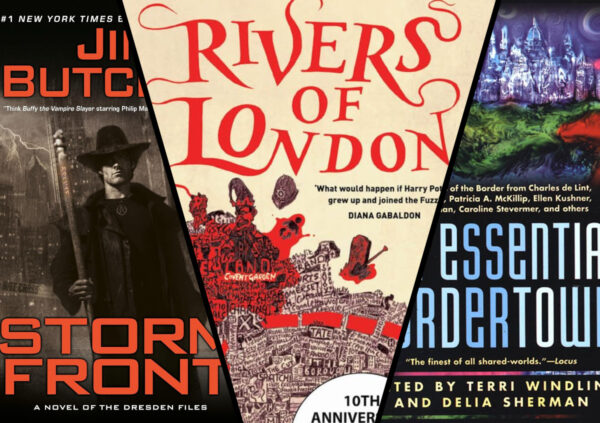
| 2000 | Storm Front | Jim Butcher |
| 2001 | American Gods | Neil Gaiman |
| 2004 | Jonathan Strange & Mr Norrell | Susanna Clarke |
| 2009 | Sandman Slim | Richard Kadrey |
| 2011 | Midnight Riot | Ben Aaronovitch |
| 2012 | The Rook | Daniel O’Malley |
The Deep Roots (1943-1984)
Nobody in this section thought they were writing urban fantasy books, because the genre didn’t exist yet. These five books are where its ideas come from, and not one of them reads like a genre exercise.
Our Lady of Darkness by Fritz Leiber (1977)

If you read one book to understand where urban fantasy came from, read this one.
Fritz Leiber published it in 1977, it took the 1978 World Fantasy Award for best novel, and its central idea is the intellectual bedrock of the entire genre. Leiber invented a discipline he called megapolisomancy: the notion that large cities, by virtue of their accumulated mass, steel, concrete, electrical current, and human misery, generate supernatural forces of their own. Not spirits that happen to live in a city. Forces the city itself produces.
The novel follows Franz Westen, a writer recovering from alcoholism and his wife’s death in a San Francisco apartment building. Through binoculars he sees a figure on a distant hill that shouldn’t be there, and the book becomes a slow, dread-soaked pursuit through a city that is actively hostile.
Few urban fantasy novels are this personal: it’s semi-autobiographical, drawn from Leiber’s own widowhood and drinking, which gives the grief underneath it a weight most genre fiction doesn’t attempt.
If it sounds heavy, his 1943 novel Conjure Wife is the easier way in: a university professor discovers his wife practices witchcraft, then discovers every faculty wife does, and that academic politics run on curses. It’s funnier, faster, nearly as influential, and it picked up a Retro Hugo in 2019. Start there if Our Lady looks daunting, but Our Lady is the one that matters historically. Leiber’s sword and sorcery side lives on my classic fantasy books list.
The Master and Margarita by Mikhail Bulgakov (1966)
Мастер и Маргарита · 1966 · translated by Diana Burgin and Katherine Tiernan O’Connor · 1993

The best executed urban fantasy novel ever written, decades before anyone coined the term.
The devil arrives in 1930s Moscow calling himself Woland, accompanied by a retinue that includes a giant talking cat with a fondness for firearms and chess. They proceed to dismantle the Soviet literary establishment through a series of increasingly deranged pranks: a magic show that showers the audience in money that later vanishes, apartments whose residents are teleported to Yalta, a bureaucrat’s empty suit that carries on signing paperwork without him.
Threaded through it is a second novel, the Master’s rejected manuscript about Pontius Pilate, and a third strand following Margarita, who makes a bargain to get her lover back and ends up flying naked over Moscow and hosting Satan’s ball.
Bulgakov began it in 1928, burned the first draft, rewrote it, and died in 1940 without seeing it published, which is not the usual origin story for urban fantasy novels. It appeared censored in 1966 and uncut in 1973. Of the translations, Burgin and O’Connor’s 1993 version is the usual recommendation for staying closest to Bulgakov, with Michael Glenny’s 1967 the smoother ride.
It belongs on any list of urban fantasy books because it does the thing better than the genre’s own practitioners: the supernatural doesn’t just visit the modern city, it exposes exactly what that city is.
The Face in the Frost by John Bellairs (1969)

The Face in the Frost is a short novel from 1969 with one of the quietest big reputations in fantasy: Lin Carter ranked it among the three best fantasy novels written since The Lord of the Rings, and Ursula K. Le Guin called Bellairs a writer who “knows what wizardry is all about.”
Two wizards, Prospero and Roger Bacon, investigate a magical threat that begins as an oddity and becomes genuinely frightening. What Bellairs does that nobody had quite done is combine the domestic and the terrifying: Prospero has a cluttered house, makes tea, worries about mundane things, and then the book turns and produces images of real dread.
An honest caveat, since this list is strict about definitions: it isn’t set in a city. It takes place in an invented land with invented kingdoms, so by the letter of the genre it doesn’t qualify.
It’s here because of what it did to the writers who came after. The tone Bellairs found, magic as something that happens to ordinary, slightly shabby people in ordinary, slightly shabby surroundings, is the tonal DNA of modern urban fantasy. Read it as an ancestor rather than an example.
It’s also very short and very good, and it costs an evening to see where the genre’s tone was born.
Little, Big by John Crowley (1981)

The great American faerie novel, published in 1981, winner of the World Fantasy Award in 1982, and a book people either revere or bounce off entirely.
Smoky Barnable walks out of the City to marry Daily Alice Drinkwater at Edgewood, a house that is somehow larger inside than out and sits on the border of another country. The novel follows five generations of the Drinkwater family across a century, as the Tale they’re all inside of slowly reveals its shape, while the City decays into something authoritarian and strange.
Among urban fantasy novels the prose here is the point. Crowley writes in long, luminous sentences that some readers find hypnotic and others find impenetrable, and the plot advances at the speed of a season changing.
Harold Bloom called it “a neglected masterpiece” and put it in the Western canon, which caused some consternation among people who don’t read fantasy.
Among urban fantasy books it’s the most literary and the most demanding. It rewards patience like almost nothing else in the genre.
Mythago Wood by Robert Holdstock (1984)

Published in 1984, winner of the BSFA Award that year and the World Fantasy Award the next, and the book that did for English woodland what Leiber did for the city.
Ryhope Wood is three square miles of ancient forest behind the Huxley family home in Herefordshire, and it is very much larger on the inside. The wood generates mythagos: physical manifestations of mythic archetypes drawn out of the unconscious minds of people near it. The older the archetype, the deeper in the wood it lives. Steven Huxley comes home from the Second World War to find his brother Christian already half-lost to the wood, both of them circling the obsessive research that destroyed their father.
The idea is extraordinary and Holdstock follows it rigorously: time dilates as you go deeper, the mythagos are shaped by the observer’s own mind, and the wood defends itself against intrusion.
It’s rural rather than urban, which is worth acknowledging, but the mechanism, myth generated by a specific place and a specific population, is exactly what this genre runs on.
Bleak, strange, and one of the finest British fantasy novels of the last fifty years, urban fantasy books or otherwise.
The Founding Wave (1986-1992)
This is the stretch where the genre became self-aware: a shared city built for the purpose, a Minneapolis fairy war that set the modern template, and the secret-history method at full power. If urban fantasy has founding documents, they’re here.
Borderland edited by Terri Windling (1986)

The anthology usually credited with starting urban fantasy as a self-aware genre.
Published in 1986 and co-edited with Mark Alan Arnold, it’s a shared-world collection set in Bordertown, a city on the frontier between the human world and the Elflands, where neither magic nor technology works reliably and their unpredictable combination is frequently lethal. The population is runaways, outcasts, halfbloods, and musicians, all of them trying to make sense of a place that resists comprehension by design.
What made it matter to every one of the urban fantasy books that followed was the sensibility. Bordertown fused fantasy with punk, with real youth culture, with actual music scenes, and it treated its young protagonists’ problems, disenfranchisement, class conflict, race, generational rupture, as serious rather than decorative.
The Bordertown books ran for decades and shaped a generation of writers, several of whom went on to define the genre themselves: Charles de Lint was there in the first volume, and Emma Bull arrived in the second before adding the Bordertown novel Finder in 1994.
It’s aimed at younger readers and it doesn’t condescend to them, which is why it still reads well.
War for the Oaks by Emma Bull (1987)

Published in 1987, and along with Borderland, the book that established what modern urban fantasy books look like. The Locus Award for best first novel followed a year later.
Eddi McCandry’s band has broken up and her boyfriend has dumped her. Walking home through downtown Minneapolis, she’s conscripted into a war between the Seelie and Unseelie courts, whose immortal combatants need a mortal present to make their deaths real. Assigned a shape-shifting phouka as a bodyguard, she tries to assemble a new rock band while the fae wage a covert war around her.
The music is what separates it from the urban fantasy novels that copied it. Bull was a musician, and the rehearsals, the gigs, the arguments over setlists all feel lived rather than researched, which grounds the fae material in something concrete.
It’s also genuinely a novel about Minneapolis. Specific streets, specific venues, specific weather. That commitment to a real place is a large part of what the genre inherited from it.
Foundational, warm, and still one of the most purely enjoyable urban fantasy books there is.
Last Call by Tim Powers (1992)

Published in 1992, winner of the World Fantasy and Locus fantasy awards the following year, and the most tightly constructed novel on this list.
Scott Crane plays poker. In 1969, on a houseboat on Lake Mead, he sat down to a game of Assumption played with Tarot cards, and won something he didn’t understand he was winning. Twenty years later the debt is being called in, and the game turns out to be for the position of Fisher King of the American West.
Powers works by taking real history, in this case Bugsy Siegel, the founding of Las Vegas, and the flooding of the Colorado, and demonstrating that the occult explanation fits the documented facts better than the conventional one. Few other urban fantasy books attempt anything this rigorous, and the magic never announces itself as a system.
Las Vegas as a city built on chance, luck, and ritual sacrifice is a perfect subject for this treatment, and Powers is deadly serious about it.
If you like this, Declare does the same thing to Cold War espionage and Kim Philby, won Powers a second World Fantasy Award in 2001, and is arguably even better.
The Mainstream Breakthrough (1996-2004)
Then the idea went big. Between 1996 and 2004 the hidden city and the institutional magic novel reached the bestseller lists and the award sweeps, and urban fantasy books stopped needing an introduction. One feral London debut sits in the middle of the stretch to keep it honest.
Neverwhere by Neil Gaiman (1996)

Before American Gods, this was the book that put Gaiman on the fantasy shelves as a novelist: his first solo novel, published in 1996.
Richard Mayhew, an unremarkable young businessman in London, stops to help an injured girl named Door on the pavement one night. In doing so he falls out of London Above and into London Below, a city of monsters, saints, murderers, angels, and people who slipped through the cracks, where the Underground station names are literal and there is an actual Earl holding court at Earl’s Court.
The conceit is the best version of an idea urban fantasy books keep returning to: the hidden city beneath the visible one, populated by everyone the visible one discarded. Gaiman’s London Below is specific, funny, and occasionally genuinely nasty, with Croup and Vandemar among the better villains in modern fantasy.
It started life as a BBC television series that Gaiman novelized to restore everything the production couldn’t realize on screen, and the book is considerably better than the show.
An urban fantasy classic in the most literal sense, and it doesn’t need to stand behind his more famous work.
American Gods by Neil Gaiman (2001)

Gaiman’s second appearance and his most ambitious novel.
Shadow Moon, released from prison days after his wife dies, takes a job with a man calling himself Mr Wednesday and finds himself driving across America recruiting for a war. The premise is that gods are real because belief makes them real, that immigrants brought their gods with them and then stopped tending them, and that those old gods are now scraping by as cab drivers, undertakers, and prostitutes while new gods of media, technology, and stock markets rise.
Most urban fantasy books stay in one city. The road-trip structure here lets Gaiman write America as a foreigner sees it: the roadside attractions, the dying towns, the vast dull spaces between cities. House on the Rock and Rock City work as sacred sites precisely because they’re absurd.
It won the Hugo, Nebula, Bram Stoker, and Locus awards, all in 2002, which almost nothing does. The Starz adaptation ran three seasons from 2017 and stopped short of the book’s ending, so the novel remains the complete version.
The novel is uneven, the middle sags, and the Lakeside subplot is better than the main plot in ways that irritate some readers. It’s still one of the defining fantasy novels of this century.
King Rat by China Miéville (1998)

Miéville’s 1998 debut, and straight urban fantasy before he moved on to the New Weird work he’s better known for. It picked up Bram Stoker and International Horror Guild first-novel nominations on arrival.
Saul Garamond returns to his father’s London flat, goes to bed, and wakes to find his father dead out the window and himself arrested for the murder. He’s broken out of custody by a filthy, impossibly agile figure calling himself King Rat, who informs Saul that his mother was not human and that he is heir to the sewers.
The Pied Piper of Hamelin is the myth being reworked, transposed into London’s late-nineties drum and bass scene, where the Piper’s power over rats becomes a matter of rhythm and frequency. The music is integral rather than decorative.
It’s raw compared to his later work, rawer than most urban fantasy books get away with, and the prose is doing more than it can always support, but the anger and the sheer physical grime of the city are already fully present.
Miéville’s stranger and better-known work sits closer to weird fiction than urban fantasy, but this one belongs squarely here.
Jonathan Strange & Mr Norrell by Susanna Clarke (2004)

Published in 2004 after ten years of writing, and the most acclaimed fantasy debut of its decade.
Magic has been gone from England for centuries, studied by gentleman theoreticians who have never performed any. Then Mr Norrell, a reclusive Yorkshire scholar, demonstrates that he can actually do it, and sets about restoring English magic on his own timid, controlling terms. Jonathan Strange becomes his pupil, then his rival, and the two of them pull something back into England that neither can manage.
Clarke writes in a pastiche of nineteenth-century prose, complete with a running apparatus of scholarly footnotes that contain some of the best material in the book: half-remembered folklore, biographies of medieval magicians, and the long shadow of the Raven King.
It’s not urban in the sense most urban fantasy books are, but Regency London is a genuine character, and the book’s central subject, magic as an institution being negotiated by committees, publishers, and government ministers, is the most sophisticated treatment of the genre’s core idea anyone has managed.
It won the 2005 Hugo and World Fantasy awards after a Booker Prize longlisting the year before, and Clarke’s whole shelf, Piranesi included, is covered on my Susanna Clarke books guide. The first edition runs 782 pages. Worth every one.
The Modern Category (2000-2012)
This is the genre as the bookstore shelf now knows it: open-ended series, working detectives, supernatural bureaucracies. It’s also where the paranormal-romance drift began, which is exactly why these four earn their slots. They’re the lane’s spine, not its padding.
Storm Front by Jim Butcher (2000)

The book that created modern commercial urban fantasy as a category, published in 2000.
Harry Dresden is Chicago’s only professional wizard, listed in the phone book under Wizard, perpetually broke, and consulted by the police when cases stop making sense. His current job involves a missing amateur magician and two bodies whose hearts have burst from their chests, with no weapon that could have done it. Then the police start looking at him.
The formula, hardboiled private detective plus functioning magic system plus a city rendered with real specificity, is now so standard across urban fantasy books that its origin gets forgotten. Butcher wasn’t the first to try the mix, but he’s the one who turned it into the category’s default setting.
Being honest about it: Storm Front is the weakest book in the series by a wide margin. The prose is rough, the plotting is loose, and Harry’s attitude toward women is a running problem in the early volumes. The series improves enormously from around book three and becomes something considerably more ambitious.
It’s also very much alive. Twelve Months, the eighteenth novel, arrived in January 2026 after more than five years without one, opened as a number one New York Times bestseller, and took the 2026 Dragon Award for best fantasy novel, with book nineteen, Mirror Mirror, underway. The full reading order lives on my Jim Butcher books page.
It’s here for what it started, and because the Dresden Files at full strength is one of the genre’s real achievements.
Midnight Riot by Ben Aaronovitch (2011)

Published in Britain as Rivers of London in 2011, and the best police procedural the genre has produced.
Peter Grant is a probationary constable destined for the Case Progression Unit, which means paperwork, until he takes a witness statement from a ghost. Detective Chief Inspector Thomas Nightingale, the last officially sanctioned wizard in England, takes him on as an apprentice, and Peter begins working cases involving the personified spirits of London’s rivers, a malevolent theatrical entity, and a series of attacks that end with faces falling off.
What sets it apart from other urban fantasy novels is that Peter approaches magic like a scientist and a copper simultaneously, running experiments, worrying about procedure, and filling out the correct forms. The comedy comes from bureaucratic friction rather than quips.
Aaronovitch’s London is the real one: specific boroughs, specific tensions, specific history, with the multicultural city treated as a fact rather than a theme.
The first book is overstuffed with plot. The characters and the voice more than carry it, and the engine behind them has proved one of the steadiest in modern urban fantasy: ten novels as of Stone and Sky in July 2025, novellas and canonical comics in the gaps, and a TV series moving at Sky Studios since late 2024, still without a cast or an air date. The whole system, spin-offs included, is mapped on my Ben Aaronovitch books page.
Sandman Slim by Richard Kadrey (2009)

The nastiest book on this list, published in 2009, and a useful corrective to anything too whimsical.
James Stark was sent to Hell alive by his own magic circle, spent eleven years as a gladiator killing demons for the entertainment of the damned, and has just escaped back to Los Angeles with a very specific list of people to visit. He is not a nice man and the book has no interest in redeeming him.
Kadrey writes in a voice that owes more to hardboiled crime and grindhouse cinema than to other urban fantasy books, and the Los Angeles here is all heat, bad food, and the sense that the city was always a little demonic anyway.
There’s no romance arc, no chosen-one prophecy, and no attempt to make the supernatural community charming. What there is instead is momentum, a genuine mean streak, and some very funny dialogue. Kadrey ran it hard for twelve novels, closing the main arc with King Bullet in 2021, and an epilogue novel, In the Devil Wind, lands in November 2026.
If the genre’s cozier corners have worn thin, this is the antidote.
The Rook by Daniel O’Malley (2012)

Published in 2012, and the funniest book here.
A woman wakes in a London park, surrounded by bodies wearing latex gloves, with no memory of who she is. In her pocket is a letter that begins by explaining that the body she is occupying used to belong to the letter’s author. She is Myfanwy Thomas, a Rook in the Checquy, Britain’s secret agency for supernatural threats, and her predecessor knew her memory would be wiped and left detailed briefing documents behind.
The premise gives O’Malley an engine few other urban fantasy novels have used: the protagonist learns the world at the same rate the reader does, via internal memos.
The Checquy itself is the joke that carries the novel. It’s a supernatural organization run as an actual British civil service, with grade structures, expense reports, and interdepartmental politics, and the bureaucratic detail is funnier than any amount of banter would be. It won Australia’s Aurealis Award for best science fiction novel in 2012, a Starz adaptation came and went in a single 2019 season, and the sequels kept coming: Stiletto in 2016, Blitz in 2022, and Royal Gambit in July 2025.
Among recent urban fantasy books it’s the one that best understands that the genre’s real subject is administration: what happens when the impossible has to be filed, budgeted, and managed by people who’d rather go home.
Questions About Urban Fantasy Books
What Actually Counts as an Urban Fantasy Book?
The definition this page runs on: fantasy where the modern world is load-bearing, where magic has to negotiate with traffic, bureaucracy, and rent, and where the city acts instead of decorating. That covers secret histories like Last Call, hidden cities like Neverwhere, and working wizards like the Dresden Files. It rules out books where the skyline is wallpaper and the supernatural is mostly a dating pool.
What Separates Urban Fantasy From Paranormal Romance?
Ask which plot survives removal. Take the romance out of a paranormal romance and nothing is left standing, because the love story is the chassis. Take it out of War for the Oaks or the Dresden Files and you still have a complete novel. Plenty of good urban fantasy books carry romance in them. They don’t run on it, and that’s the line this list holds.
Where Should I Start With Urban Fantasy Books?
Storm Front or Midnight Riot if you want a long series with a working detective at the center, Neverwhere if you want one complete standalone, and The Master and Margarita if you want the genre’s ceiling. The longer answer, sorted by mood, is in the where-to-start section at the top of this page.
What Was the First Urban Fantasy Book?
There’s no clean first. Leiber had campus witchcraft running in Conjure Wife by 1943 and built the genre’s theory outright in Our Lady of Darkness in 1977, while The Master and Margarita predates the label by decades. As a self-aware genre it begins in the mid-1980s with Borderland and War for the Oaks, and the modern commercial category starts with Storm Front in 2000.
Are the Dresden Files and Rivers of London Still Going?
Both. The Dresden Files stands at eighteen novels after Twelve Months arrived in January 2026, with Mirror Mirror being written and a stated plan that runs to roughly book 25. Rivers of London reached ten novels with Stone and Sky in July 2025, and Aaronovitch hasn’t yet put a title or a date on the eleventh.
What’s New in Urban Fantasy Right Now?
It’s a busy stretch. Twelve Months (January 2026) ended the long Dresden drought with a number one New York Times debut, Stone and Sky (July 2025) took Peter Grant to Aberdeen, Royal Gambit (July 2025) reopened O’Malley’s Checquy, and Richard Kadrey returns to the Sandman Slim world with the epilogue novel In the Devil Wind in November 2026.
Where to Go Next
Where you land after these sixteen urban fantasy books depends on which of them held you. If it was the series engines at the modern end, the twenty long hauls that actually earn the commitment are ranked on my best fantasy series list. If it was Leiber’s dread or Kadrey’s mean streak, the shelf next door is my best horror books guide, where the city is usually the least of anyone’s problems.
And if what you actually wanted was the darkness without the daylight world attached, the dark fantasy books list carries the same appetites into invented worlds.