Dystopian novels have never really gone out of fashion, but the last two decades have made them feel less like speculation and more like reporting. Pandemic, climate collapse, surveillance capitalism, resurgent authoritarianism: the genre keeps supplying vocabulary for things that are actually happening, which is an uncomfortable position for it to be in. The neighbouring shelf is my post-apocalyptic list list.
What draws readers back is the setting. Dystopian books take our own world, isolate one element, society, politics, religion, technology, and push it until it breaks. The result is somewhere recognizable and badly wrong, which is far more unsettling than an invented world could ever be.
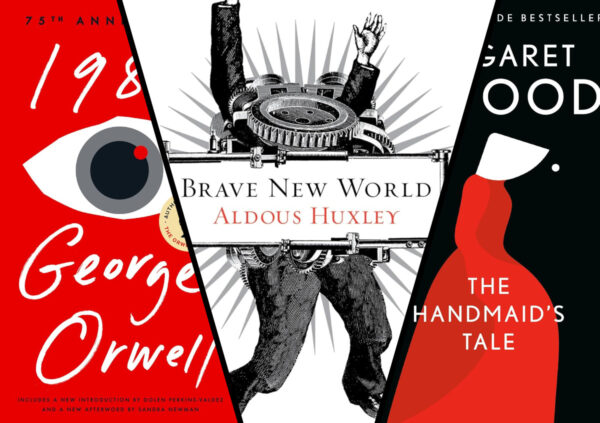
Some of these are apocalyptic, concerned with what happens after the collapse. Others never show a catastrophe at all and are more frightening for it, focusing instead on the slow decay of a society that still functions, still holds elections, still tells itself it’s free.
The best dystopian novels work as cautionary tales. They take a problem we already have and follow it to its conclusion.
This list runs from newer entries and deep cuts through to the canonical works that defined the genre, ending with my own favorite. It mixes classics, contemporary literary fiction, translated work, and a few young adult books that earn their place. If the genre grabs you, my list of the best science fiction books covers the wider field.
Fiction by René Rehn


The Memory Police by Yoko Ogawa

The quietest of the dystopian novels here in its methods, and one of the most disturbing.
On an unnamed island, things disappear. Not gradually, and not by accident. One morning it’s ribbons, another it’s birds, and the islanders wake knowing that something has gone without quite remembering what. They gather the remaining objects, burn them or float them down the river, and carry on. The Memory Police exist to enforce the forgetting and to remove the few people who remain able to remember.
Our narrator is a novelist who hides her editor, one of those who can’t forget, in a room beneath her floorboards.
Ogawa published it in Japanese in 1994, and it took twenty-five years to reach English, where it was shortlisted for the International Booker. The delay is strange, because it reads as though it were written for this decade. It isn’t about a police state crushing dissent so much as about a population that stops noticing what’s been taken, which is a far more plausible way for a society to lose things.
The prose is calm and precise throughout, which makes the erosion worse. Nothing is ever explained. That’s the point.
Riddley Walker by Russell Hoban

A wildcard entry, and I want to be upfront about what you’re getting into.
Riddley Walker is set roughly two thousand years after a nuclear war, in an England reduced to Iron Age subsistence, where the surviving fragments of the old world have been reassembled into religion. A traveling Punch and Judy show carries what remains of doctrine. A garbled account of a medieval saint’s legend has become the creation myth. Twelve-year-old Riddley becomes the connexion man for his settlement, the one who interprets the shows, and stumbles onto people trying to rediscover gunpowder.
Here’s the barrier: the entire novel is written in a phonetic, degraded English that Hoban invented. Not a passage, not the dialogue, all of it. The first thirty pages are genuinely hard work, and plenty of readers give up there.
If you push through, the language stops being an obstacle and starts doing the work no ordinary prose could. You’re not reading about a civilization that lost its knowledge. You’re reading its ruined language directly, and reconstructing meaning the same way Riddley reconstructs history.
It’s the most demanding of these dystopian novels and, for the readers it clicks with, the best. Anthony Burgess put it among the finest novels of the century. If you want something that will occupy you for weeks, this is it.
Battle Royal by Koushun Takami

When Battle Royale was published in Japan in 1999 it caused an outright scandal, and the film adaptation carried it to Western audiences who mostly hadn’t read the book.
The premise is now familiar enough that its origins get forgotten. In a fascist alternate Japan, one third-year junior high class is selected each year, taken to a remote island, given weapons at random, and forced to kill each other until one survives.
The class in question is from Shiroiwa Junior High. Shuya Nanahara refuses to play the game, as he calls it, and tries to protect his friends instead.
What makes it work is the structure. Takami gives nearly all forty-two students interior lives, backstories, and crushes before killing them, which means the deaths land rather than accumulate. Kazuo Kiriyama, the boy who plays the game because he feels nothing at all, is one of the most chilling antagonists in the genre.
Among dystopian novels out of Japan it was dismissed on release as pure exploitation. It’s since been reassessed as something closer to the Lord of the Flies of its era, and it’s a much better novel than its reputation as the thing that came before The Hunger Games suggests.
The Day of the Triffids by John Wyndham

A 1951 catastrophe novel that terrified a generation and invented a template still in use.
A spectacular meteor shower blinds most of the world’s population overnight. That alone would be enough. What compounds it is the Triffids: tall, ambulatory, venomous plants, farmed commercially for their oil, which turn out to be perfectly capable of hunting a blind population.
The novel’s cleverest move is its antagonist. In post-apocalyptic fiction, nature reclaiming the world is usually the consoling image, the sign that the planet will be fine without us. Wyndham makes the returning green world the predator.
The Triffids are strongly implied to be engineered rather than natural, which reflects a genuine Cold War anxiety at the time about Soviet experiments in manipulating biology. That fear dates the book to its moment and hasn’t stopped it working.
It’s also the direct ancestor of every “protagonist wakes in a hospital to find civilization gone” opening in dystopian books since, 28 Days Later included.
Oryx and Crake by Margaret Atwood

The first book of Atwood’s MaddAddam trilogy, and a considerably stranger novel than The Handmaid’s Tale.
Snowman believes he’s the last human alive. He lives near the shore, sleeping in a tree, watched over by the Crakers: gene-spliced humanoids, docile and beautiful, engineered to be incapable of the things that destroyed us. As he scavenges through the ruins of a corporate compound, the story of how the world ended comes out in pieces, and his own part in it becomes clear.
Before the collapse, he was Jimmy, and his best friend was Crake, a brilliant boy at a biotech firm with definite ideas about the human race.
The world it builds is the plausible part: a society segregated into corporate compounds and lawless pleeblands, where the biotech companies engineer both the diseases and the cures. Atwood has always insisted she writes speculative fiction rather than science fiction, meaning she only uses things we can already do or nearly can. That’s what makes it land.
It’s less famous than her handmaids, and it’s one of the better dystopian novels she’s written.
The Dispossessed by Ursula K. Le Guin

Le Guin subtitled it “An Ambiguous Utopia,” which is the most accurate description anyone has managed.
Two worlds share an orbit. Anarres is a barren moon settled generations ago by anarchist revolutionaries, where there is no property, no law, no government, and very little to eat. Urras is the lush home world, wealthy, capitalist, patriarchal, and at war with itself. Shevek, a physicist from Anarres, becomes the first person in two centuries to travel between them.
What makes the book remarkable is that Le Guin refuses to stack the deck. Anarres is genuinely free and genuinely impoverished, and its social pressure to conform turns out to be its own kind of coercion. Urras is genuinely comfortable and genuinely unjust. Neither is a straw man.
The structure alternates between the two worlds chapter by chapter, so the comparison is constant and never resolves into a verdict.
Among dystopian novels this one asks the most interesting question: not what a bad society looks like, but what a good one would actually cost.
Borne by Jeff VanderMeer

A word on why this is here, because Borne is weird fiction first and dystopia second. VanderMeer is the central figure of the New Weird, and this book carries all of that: biotech that behaves like biology gone dreaming, a world explained only in fragments, a refusal to tell you what anything means. It also happens to be a post-apocalyptic novel about surviving in a ruined city, which is why it earns a place among these dystopian novels.
The setting is an unnamed city destroyed by the Company, a biotech firm whose creations eventually consumed it. Rachel is a scavenger, picking through the ruins for salvage and useful organisms. One day she finds something that looks like a sea anemone tangled in fur, takes it home thinking it’s a plant, and names it Borne. It grows. Then it starts talking to her.
I expected a dystopian horror novel about fending off biotech monstrosities. In a way it is that, but it’s far more intimate than I anticipated. The heart of it is Rachel’s relationship with Borne, which is genuinely strange and genuinely moving, and her backstory, doled out in fragments: a girl who went to school and wanted to be a writer, then the world ended, and her life became refugee camps, scavenging, and stretches of fake normalcy before the next collapse. We never learn what happened to the world. The effect is bleak and oddly raw, and you can feel how damaged a person she is.
My one real complaint is the setting is underused. We hear constantly about the biotech, the engineered creatures, the ruined city, and we see comparatively little of it. I wanted VanderMeer to go deeper into the world he built. In fairness, that world was never really the point. Rachel and Borne were.
It’s weird in the good way, and it’s worth the trip.
Animal Farm by George Orwell

Orwell’s other great political novel, and the one people quote without always remembering where the line comes from.
The animals of Manor Farm, sick of their drunk and negligent owner, stage a revolution and drive the humans out. They establish Seven Commandments, the first flush of freedom is genuine, and then the pigs begin to consolidate. By the end, one commandment remains: all animals are equal, but some animals are more equal than others.
It’s a direct allegory of the Russian Revolution and Stalin’s consolidation of power, with the characters mapping onto specific historical figures closely enough that publishers refused it in 1944 while the Soviet Union was a wartime ally.
Two things make it endure past its immediate target. Choosing animals rather than people means the betrayals land with the clarity of fable, and Boxer the carthorse, whose answer to everything is to work harder, is one of the saddest characters in English fiction.
It’s short, it’s on the nose, and among dystopian novels with a political target it has outlived nearly everything written about the same events in earnest.
The Time Machine by H. G. Wells

The book that invented time travel as we understand it, and one of the earliest dystopian novels, though it doesn’t announce itself as one.
The Time Traveler journeys to the year 802,701 and finds humanity split in two. The Eloi live above ground: small, gentle, incurious, spending their days in play among the ruins of enormous buildings. The Morlocks live below in darkness, running the machines. It looks at first like paradise, and the Traveler works out fairly quickly what the arrangement actually is and who is farming whom.
Wells was writing about Victorian class division and extending it across eight hundred millennia, letting the leisured classes and the industrial poor evolve into separate species. As dystopian novels go it’s a brutally efficient piece of satire dressed as adventure.
The final section, where the Traveler pushes further forward to a dying red-sunned Earth on a silent beach, has nothing to do with class at all and is among the most haunting passages in nineteenth-century fiction.
The Chrysalids by John Wyndham

Wyndham’s second appearance, and the more thoughtful of the two.
Generations after a nuclear war remembered only as Tribulation, the community of Waknuk in Labrador has rebuilt itself around a rigid fundamentalism. Any deviation from the true image of man, in crops, livestock, or children, is blasphemy to be destroyed or exiled to the Fringes. David Strorm grows up inside this and discovers he and a handful of others can speak to one another with their minds.
It’s a novel about purity as an organizing principle and what it costs, written a decade after the war and pointed directly at the idea of racial and genetic cleanliness.
The ending is the part that stays with you, because the rescue that arrives is not straightforwardly a rescue, and the people who come are just as certain of their own superiority. Wyndham lets that sit without comment.
It’s often shelved as young adult, and it’s sharper than most dystopian books written for adults.
The Drowned World by J. G. Ballard

Ballard’s 1962 novel is the first great climate dystopia, written decades before anyone used that phrase.
Solar radiation has melted the ice caps and pushed the planet back into something like the Triassic. London lies under warm lagoons, giant reptiles have returned, and the remaining population has retreated toward the poles. A scientific team surveys the drowned city.
What makes it strange is that Ballard isn’t interested in survival. His characters begin dreaming of the swamps, and those dreams start pulling them south into the heat rather than north to safety. The regression of the planet is triggering a corresponding regression in the human mind, back toward something older than consciousness.
It’s less a disaster novel than a psychological one, and it established the Ballardian mode: catastrophe as something his characters half-welcome.
Among dystopian novels concerned with climate, it remains the strangest and most interesting.
The Hunger Games by Suzanne Collins

The book that defined a decade of publishing, and better than its imitators gave it credit for.
Panem is what’s left of North America: a wealthy Capitol surrounded by twelve subjugated districts, which each year send one boy and one girl to fight to the death on live television. Katniss Everdeen volunteers to take her sister’s place.
The reason it worked, where so many imitating dystopian novels didn’t, isn’t the arena. It’s that Collins understood the Games as a media product. The interviews, the sponsors, the stylists, the manufactured romance Katniss has to perform to stay alive: the novel is about the machinery of spectacle as much as the violence, and Katniss’s real skill is learning to play to a camera.
It’s also honest about what surviving that does to a person, which the later books follow through on more thoroughly than most series of its kind would dare.
Yes, it owes a debt to Battle Royale, and the two are doing different things. Read both.
Blindness by José Saramago

The Nobel laureate’s most terrifying novel, and one of the hardest reads on this list.
An epidemic of white blindness sweeps a city with no explanation. The first victims are quarantined in an abandoned asylum under armed guard, food deliveries stop being reliable, and the internal order of the place collapses into something predatory. One woman, the doctor’s wife, can still see, and says nothing about it so she can stay with her husband.
Saramago writes without quotation marks, with dialogue folded into enormous paragraphs and no character given a name. It’s demanding, and it produces exactly the disorientation the subject requires.
The novel is about how thin the layer of civilization is, which is a familiar theme, but the specificity is what makes it unbearable. The practical details of what happens when a few hundred blind people are locked in a building are worse than any monster.
The doctor’s wife, forced to watch everything precisely because she alone can see, is one of the great characters in modern fiction, dystopian novels or otherwise.
Never Let Me Go by Kazuo Ishiguro

The gentlest-seeming book here and the one that does the most damage.
Kathy H., in her thirties, works as a carer and looks back on her childhood at Hailsham, an English boarding school in the 1980s where the students were exceptionally well looked after, encouraged in their art, and told almost nothing about the world outside. She remembers her friends Ruth and Tommy, their small cruelties and loyalties, and the slow process by which they came to understand what Hailsham was for.
Ishiguro withholds nothing exactly. The truth is available early to anyone paying attention. What he does is let his narrator approach it obliquely, the way people approach things they cannot afford to face directly, and the restraint is devastating.
The most disturbing element isn’t the premise. It’s the acceptance. Nobody runs. The characters absorb what’s coming and make small accommodations with it, and the novel’s real subject is how completely people can be shaped to accept their own fate.
Time named it the best novel of 2005, and it stands among the finest dystopian novels of this century.
We by Yevgeny Zamyatin

The novel that started the modern tradition. Orwell read it before writing Nineteen Eighty-Four and reviewed it. Huxley denied having read it, and few people believe him.
Written in Russia in 1920 and banned there, published first in English in 1924, it’s set a thousand years in the future in the One State, a city of glass under a Benefactor, where citizens have numbers instead of names, live on visible schedules in transparent apartments, and are permitted sex only by appointment.
D-503, a mathematician building a spaceship, keeps a journal intended to celebrate this perfection. Then he meets I-330, who smokes, drinks, and takes him beyond the Green Wall, and his journal turns into the record of a man discovering he has an interior life.
The prose is the achievement. Zamyatin writes in clipped, geometric fragments that mirror the world they describe, and the style disintegrates in step with its narrator.
Every one of the dystopian novels written after it owes it something.
The Stand by Stephen King

King’s longest novel and, by his own reckoning and plenty of readers’, his best.
A weaponized influenza strain escapes a military facility and kills ninety-nine percent of the human race in weeks. The survivors, scattered and traumatized, begin having dreams: some of an ancient woman on a farm in Nebraska, others of a dark man out west. They start walking toward one or the other.
I’ve written about the opening third, the plague crossing an America that doesn’t yet understand what’s happening, on my post-apocalyptic list, where it belongs. What earns The Stand a place on this one is what comes after.
The survivors don’t stay scattered. They build two states: the Free Zone in Boulder, which reconvenes committees, drafts a constitution, and rediscovers how quickly a democracy starts keeping secrets from its own citizens, and Flagg’s Las Vegas, which restores order immediately through crucifixion. King’s real subject is that both societies rebuild fast, and that the choice between them was never really about survival.
The characters carry it either way, and few dystopian books have a cast this large that works this well. Larry Underwood, Nick Andros, and the Trash Can Man are among his best creations.
I read it a long time ago in German and the length didn’t feel like an obstacle even then, which is the highest praise a twelve-hundred-page book can get.
Parable of the Sower by Octavia E. Butler

Published in 1993, set in 2024, and its accuracy has become genuinely uncomfortable.
Lauren Olamina is fifteen and living in a walled neighborhood outside Los Angeles, in an America hollowed out by climate collapse, water scarcity, corporate company towns, and a drug that makes arson feel euphoric. She has hyperempathy, a condition that makes her physically feel the pain she witnesses, which is a catastrophic disability in a world this violent. When the walls fail, she heads north on foot, gathering people and building a belief system called Earthseed as she goes.
Butler’s genius is that the collapse isn’t an event. Nothing explodes. Services degrade, prices rise, police become something you pay rather than call, and people adjust incrementally until the situation is unrecoverable. It’s the most plausible apocalypse in dystopian novels because it’s just a series of Tuesdays.
The sequel, Parable of the Talents, is if anything the more prescient book, following a demagogue who wins power promising to make America great again and the Christian nationalist movement that forms around him. Butler wrote it in 1998. Read both, and expect the second to be harder going. Her complete shelf is on my Octavia Butler books guide.
The Children of Men by P. D. James

A dystopia with a premise so simple it’s astonishing nobody used it first: in 1995, human beings stopped being able to reproduce, and no child has been born since.
By 2021 the youngest people alive are twenty-five, the world is aging into silence, and Britain is governed by a Warden with dictatorial powers that nobody much objects to, because what would be the point. Mass suicide ceremonies are state-organized. Kittens are christened.
Theo Faron, an Oxford historian and cousin of the Warden, has arranged his life around feeling as little as possible. Then a small group of dissidents approaches him, and one of them is pregnant.
What makes it exceptional is the texture of the despair. James, better known for detective fiction, is precise about the small things: the abandoned schools, the doll-prams, the way a society that has no future stops maintaining anything.
The film adaptation is superb and almost entirely different. Read the novel for the atmosphere, which is where its real power sits, and which few dystopian books match.
The Man in the High Castle by Philip K. Dick

Dick’s Hugo winner, and unusual in his catalog for being alternate history rather than science fiction, which is worth knowing before you start.
The Axis powers won. The United States is partitioned between Imperial Japan on the West Coast and Nazi Germany on the East, with a neutral zone in the Rockies between them. We follow a handful of characters in 1962: a shopkeeper dealing in American antiques for Japanese collectors, a trade official, a woman in Colorado. Nearly all of them consult the I Ching before making decisions.
The book-within-the-book is what I enjoyed most. Circulating among the characters is a banned novel, The Grasshopper Lies Heavy, which describes a world where the Allies won. They discuss it as an obvious fantasy, pointing out that events in it, Stalingrad among them, could never have happened, that nothing could have stopped the Wehrmacht. Which is, of course, exactly what did happen. Reading those conversations produces a genuinely strange doubled vision.
Dick also goes enormously, almost satirically big on Nazi technological achievement: space colonization, and the draining of the Mediterranean for farmland, presented as the sort of thing only German engineering could accomplish. It reads as a deliberate rendering of the regime’s own fantasies of itself, and it’s chilling rather than impressive.
Fair warning that the ending is divisive. Without spoiling it, the novel closes on a revelation about the nature of the reality the characters inhabit, and it’s abrupt and distinctly out there. Some readers consider it the honest refusal of a tidy resolution. Others find it a cheat. I lean toward finding it odd.
I’d recommend it to anyone who likes Dick’s prose, and strongly to anyone drawn to the Germany-wins-the-war scenario, which no other dystopian novels have done better.
Do Androids Dream of Electric Sheep? by Philip K. Dick

Dick’s second entry, and the one everyone knows through Blade Runner, which is a different beast entirely.
The bounty hunter plot is the famous part, and it’s not what earns the book its place on this list. What does is the society Dick builds around it, which is one of the most complete dystopias in the genre, assembled entirely from small humiliations.
World War Terminus has poisoned the planet, and the healthy are propagandized daily to emigrate off-world, with a free android servant as the signing bonus. Those who stay are sorted: pass your IQ and genetic tests or be reclassified as a “special,” barred from emigrating and from reproducing, which is how J. R. Isidore, the book’s gentlest character, has ended up alone in an empty apartment building full of the dust the war left behind.
The details are where the horror lives. Deckard and his wife start their mornings at the Penfield mood organ, dialing up emotions from a catalog, and one of the available settings schedules a depression. A television host called Buster Friendly broadcasts forty-six hours a day to keep everyone company. Dick even gives entropy itself a name, kipple, the useless matter that multiplies in every abandoned room, and lets Isidore explain that in the end kipple wins.
It’s a dystopia with no dictator anywhere in sight, just a species managing its own decline through gadgets and paperwork, and I’ve covered the android plot and the empathy question where they belong, on the wider science fiction list. This entry is for the world, which deserves the attention the film’s shadow usually takes from it.
Fahrenheit 451 by Ray Bradbury

Published in 1953 and written, famously, on a rented typewriter in a library basement at ten cents per half hour.
Guy Montag is a fireman, which in this future means he burns books. He’s content until he meets his neighbor Clarisse, who asks whether he’s happy, and the question doesn’t stop working on him.
The received reading is that it’s about censorship, and Bradbury spent decades objecting to that. His stated concern was television: a population that stopped reading voluntarily, hollowed out by wall-sized screens and interactive parlor families, and only afterward accepted having the books removed. Montag’s wife Mildred, who has three walls of screens and overdoses without registering it, is the actual argument of the book.
Read that way it’s aged better than almost all dystopian books of its era. The banning is a formality. The audience had already left.
The prose is more lyrical than most dystopian novels manage, occasionally to a fault, and the closing image of the book people, each memorizing a text to preserve it, is one of the genre’s most enduring. Bradbury’s full catalog is mapped on my Ray Bradbury books guide.
The Giver by Lois Lowry

The book that taught a generation of American schoolchildren what a dystopia is.
Jonas’s community has eliminated pain, war, hunger, and choice. Careers are assigned, families are constructed, and language is policed for precision. At twelve, Jonas is selected as Receiver of Memory, the single person who holds the community’s entire history, and begins receiving from the old man who carried it before him. He learns about snow, and color, and love, and then about what happens to the babies who don’t thrive.
It’s written for children and it does not soften anything. The scene where Jonas finally understands what release means is one of the most quietly horrifying moments in any book on this list.
It’s frequently taught and frequently banned, sometimes in the same district, on grounds including infanticide, euthanasia, and suicide.
It’s the best of these dystopian novels for a younger reader, and it holds up entirely for adults.
A Clockwork Orange by Anthony Burgess

Fifteen-year-old Alex leads a gang through a night of robbery, assault, and rape, narrating it in Nadsat, a slang built from Russian, rhyming slang, and invented words. He’s caught, imprisoned, and volunteered for the Ludovico Technique, a conditioning program that makes violence physically unbearable to him. He’s released as a model citizen, incapable of choosing to do wrong, and incapable of choosing at all.
The Nadsat is the whole trick. It’s dense enough that the first pages are hard going, and by fifty pages you’re fluent without having been taught anything. Its actual function is anesthetic: it puts a layer of unfamiliar language between you and the violence, so you’re implicated in enjoying scenes you’d otherwise flinch from.
The book’s argument is blunt: a man who cannot choose evil isn’t good, he’s a mechanism, and the state that does that to him is worse than he ever was.
Worth knowing that American editions omitted the final chapter for decades, which is why Kubrick’s film ends where it does. The full version, with Alex growing out of it, changes the meaning considerably. Get an edition with twenty-one chapters.
Station Eleven by Emily St. John Mandel

A pandemic novel that became a very different reading experience after 2020, and holds up better than that suggests.
A flu with a ninety-nine percent fatality rate ends the world in a matter of weeks. Twenty years later, a group called the Traveling Symphony moves between the small settlements of the Great Lakes, performing Shakespeare and Beethoven, with a line from Star Trek painted on their lead caravan: because survival is insufficient.
The structure moves back and forth between the collapse and the decades on either side, following an actor who collapses mid-performance the night the pandemic makes landfall in North America, his ex-wives, a paparazzo, a child actor who becomes a performer with the Symphony, and a self-published comic that survives in two copies.
What makes it dystopian rather than simply post-collapse is what has grown back. The settlements are governed places with rules, and one of them has produced the Prophet, a charismatic leader running a theocracy on scripture and child brides, assembled out of the same twenty-year gap that produced the Symphony. Mandel puts a traveling orchestra and a cult in the same landscape and lets you see that both are answers to the question of what people organize themselves around when the old organizing principles are gone.
Her real subject is what gets carried forward and why: the museum of dead technology in an airport, the persistence of art in a world with no audience left to impress.
It’s not the bleakest of these dystopian novels by a wide margin, and it’s the better for it.
The Road by Cormac McCarthy

The bleakest thing on this list, and among the most beautifully written novels of this century.
A man and his son walk south through an America burned to ash, pushing a shopping cart, avoiding other people because other people have started eating each other. There is no food growing anywhere. There is no sun visible. They are going to the coast because there is nowhere else to go, and the man knows the coast will not help.
McCarthy never explains the catastrophe, and it doesn’t matter. What interests him is what happens to morality when there is no longer anything to enforce it. The father teaches his son that they are the good guys and that they carry the fire, and the novel keeps testing whether that distinction means anything once no society exists to agree on it. The people who have organized themselves have organized around cannibalism, kept in basements, which is its own kind of functioning order.
Underneath it is the relationship: a father passing on a moral code he isn’t sure survives him, while privately preparing for the possibility of having to kill the child he’s teaching it to.
The prose is stripped almost to nothing, unpunctuated and biblical, the most controlled writing McCarthy ever did and the finest in any of these dystopian novels.
It won the Pulitzer, and it’s the rare book on this list that people describe as difficult to finish for emotional rather than technical reasons. The final paragraph, about brook trout in mountain streams, is one of the great endings in American fiction.
The Handmaid’s Tale by Margaret Atwood

The defining feminist dystopia, and one whose relevance has not receded.
The Republic of Gilead is a theocracy built on the wreckage of the United States after a coup and a fertility collapse. Women cannot read, hold property, or work. They are Wives, Marthas, Aunts, Econowives, Unwomen, or Handmaids: the few remaining fertile women, assigned to Commanders and ritually raped once a month in the presence of their wives.
Offred, whose name means she is Fred’s, narrates from inside the Commander’s house, and the novel is largely her interior life in a situation with almost no external action available to her.
Atwood’s rule while writing was that she would include nothing that hadn’t already happened somewhere. That’s what gives it force, and what separates it from dystopian novels that reach for invention: none of it is made up.
The sequel, The Testaments, arrived thirty-four years later and won the Booker. It’s a faster, more plot-driven book, told by three narrators including Aunt Lydia, and it answers questions the original deliberately left open. Worth reading as a continuation, though the original is the achievement.
Nineteen Eighty-Four by George Orwell

The most influential dystopian novel ever written, to the point that arguing about it has become a substitute for reading it.
Winston Smith works at the Ministry of Truth in Airstrip One, formerly Britain, rewriting old newspapers so the historical record matches the Party’s current position. He is watched constantly by a telescreen that cannot be turned off. He begins a diary, which is a capital offense, and an affair, which is worse.
The vocabulary alone has colonized political language: Big Brother, thoughtcrime, doublethink, memory hole, unperson, and Newspeak itself, the project of making dissent literally unthinkable by removing the words for it.
What people forget between readings is how much of it is about the mutability of the past rather than surveillance. The Party’s real claim is that it controls what happened, and Winston’s crime is insisting that two plus two makes four.
Of all dystopian novels this is the one with no hope in it at all. That’s deliberate, and the appendix on Newspeak, written in the past tense, is the only crack of light anywhere in the book, and easy to miss.
A Canticle for Leibowitz by Walter M. Miller Jr.

The great novel about what societies rebuild into over the long term, and criminally absent from most lists like this.
It spans roughly eighteen hundred years in three parts. After a nuclear war and the Simplification, a violent backlash in which survivors murdered scientists and burned books, a Catholic monastic order in the American southwest preserves the fragments it can find. Its founder is Isaac Leibowitz, a former engineer, and the order’s greatest relic is a circuit diagram and a shopping list.
The Simplification is what makes it dystopian rather than merely post-nuclear. It’s a deliberate political program: a society that decides literacy caused the war and organizes itself around eradicating it, murdering scientists and burning books as policy. What replaces it is the Church as the only surviving institution of government, preserving knowledge it isn’t permitted to understand.
The first section is very funny in ways the premise doesn’t advertise, following a novice whose discovery of a fallout shelter becomes a matter of doctrine and, eventually, of sainthood. The second covers a new Renaissance, secular science returning, and the state reclaiming authority from the monks. The third arrives at a rediscovered nuclear age, a fully functioning modern government, and the same argument the world had before.
The book is about whether human beings are capable of learning anything across a long enough span, and it does not conclude optimistically.
Published in 1959 and never out of print since. If the canonical dystopian novels are familiar territory, start here.
Brave New World by Aldous Huxley

My favorite of all the dystopian novels here, and the one whose prediction record is the most unsettling.
In the year 2540, humans are grown in hatcheries, chemically graded into castes from Alpha to Epsilon, and conditioned from infancy to want exactly what they’re assigned. Nobody is oppressed. Everybody is happy. There’s soma for any dip in mood, recreational sex without consequence, and endless entertainment. Family, monogamy, religion, and art have been discarded as sources of instability.
The plot arrives when Bernard Marx brings John, born naturally on a reservation and raised on Shakespeare, into this world as a curiosity.
What makes it the most frightening book on this list is that its dystopia is voluntary. Orwell imagined a boot on a face forever. Huxley imagined a population that would trade everything for comfort and never once feel coerced, and would consider anyone who objected to be simply unwell. The conversation between John and Mustapha Mond near the end, where the Controller calmly explains what was given up and why it was worth it, is the best-argued passage in the genre.
Read alongside Nineteen Eighty-Four, it’s the more accurate of the two dystopian novels, and by a considerable margin. The rest of his shelf is on my Aldous Huxley books guide.