John Gwynne books come with a formal succession attached. Mark Lawrence’s blurb on the covers calls him “the closest we have to an inheritor of David Gemmell’s mantle,” and the inheritance runs both directions: when Legend turned forty, it was Gwynne the publisher asked to write the new introduction, a fact my David Gemmell guide covers from the other end. Heroic fantasy with grit and heart needed a standard-bearer after 2006, and the genre quietly agreed on the Viking reenactor from Eastbourne.
The reenactor part is not decoration. Gwynne spends his weekends in an actual shield wall, often with his three sons beside him, and the delivered verdict on my best fantasy books pillar, where The Faithful and the Fallen holds its entry, rests on exactly that: nobody currently writing renders the physics of massed combat with his authority. What this page adds is the map, because the shelf now spans two distinct eras, the classic epic that made his name and the Norse saga that made him a bestseller, and, rarest of all in this cluster, every single series on it is finished.
Fiction by René Rehn


The short version
Two doors, both complete. The Shadow of the Gods opens the Bloodsworn Saga, the modern, Norse, three-books-done door, and it’s where most new readers should start. Malice opens The Faithful and the Fallen, the classic four-book epic, with the bridge trilogy Of Blood and Bone waiting after it. Ten novels, zero cliffhangers pending, no waiting room. In this cluster, that sentence is a luxury item. Full-catalog order for the completionist: the Faithful four, then Of Blood and Bone, then the Bloodsworn three, one continuous education in how the man’s craft sharpened.
The Bloodsworn Saga
The Shadow of the Gods, The Hunger of the Gods, The Fury of the Gods. Complete as of October 2024.

Vigrið is the Battle-Plain, a land literally built on the bones of dead gods, because three centuries ago the gods fought their last war here and lost it, all of them, leaving tusk and skull as landscape and their half-blooded descendants, the Tainted, as property to be collared and used. Through it move three strands: Orka, a huntress and mother whose quiet steading life ends in blood and who becomes the saga’s runaway favorite, an axe-swinging force of maternal vengeance the fandom canonized on sight. Varg is an escaped thrall who falls in with the mercenary Bloodsworn while hunting his sister’s killers, and Elvar is a jarl’s daughter chasing battle-fame with the Battle-Grim. The Tainted thread ties the three together: those carrying dead gods’ blood manifest their gifts, wolf and bear and worse, and wear thrall-collars for it, hunted, priced, and sold, which makes every Tainted character a walking argument about what this world does with power it fears. What the three hunts are actually converging on, I’ll leave where book one’s ending puts it.
This is the series that made Gwynne the flagship of the Norse fantasy wave, arriving in 2021 with perfect timing atop the culture’s Viking decade and drawing blurbs like Anthony Ryan’s “masterfully crafted, brutally compelling.” It ran to an instant New York Times bestseller by the finale, now dressed in deluxe editions with new author introductions, and his craft signature is all over it: shield walls that track exhaustion and footing, sea and snow you can feel, and the mead-hall texture of a culture he half lives in on weekends. Honest notes for the record: the three-strand structure means slow braiding early, and the finale’s reception ran strong rather than rapturous, with a visible slice of superfans ranking the trilogy’s ending a step below its opening’s promise. The consensus still lands firmly on satisfied, and the whole thing sits waiting, complete, no risk attached.
The Faithful and the Fallen
Malice, Valor, Ruin, Wrath. 2012 to 2017. The classic epic, played straight.

The first era is the Banished Lands: a prophesied war between a returning angelic host and the demonic Kadoshim, a large cast across several nations, and at its center Corban, a blacksmith’s son growing from boyhood into the war’s hinge. The structure’s quiet masterstroke sits on the other side of the lines: a second thread follows Veradis, a decent young warrior sworn to the charismatic prince the reader clocks long before he does, and watching loyalty and decency serve the wrong cause gives the series its ache. What made it beloved is precisely what the era around it had abandoned: this is good versus evil with the courage of its convictions, loyalty, oaths, and sacrifice treated as real forces rather than setups for subversion, and the series’ watchwords, “truth and courage,” worn without a flinch, a phrase that became the fandom’s own sign-off and, famously, the line Gwynne inscribes in every book he signs. Gwynne proves you can write that sincerity into the grimdark decade and make it land like a hammer, mostly by making the losses real enough that the ideals cost something.
The honest note is the standard one: Malice builds slowly, a full book of groundwork, and the payoff compounds across four volumes until the back half of the series runs on accumulated devotion. Readers who finish rarely rank it below the Norse books, and a large faction ranks it above.
Of Blood and Bone
A Time of Dread, A Time of Blood, A Time of Courage. The bridge trilogy.
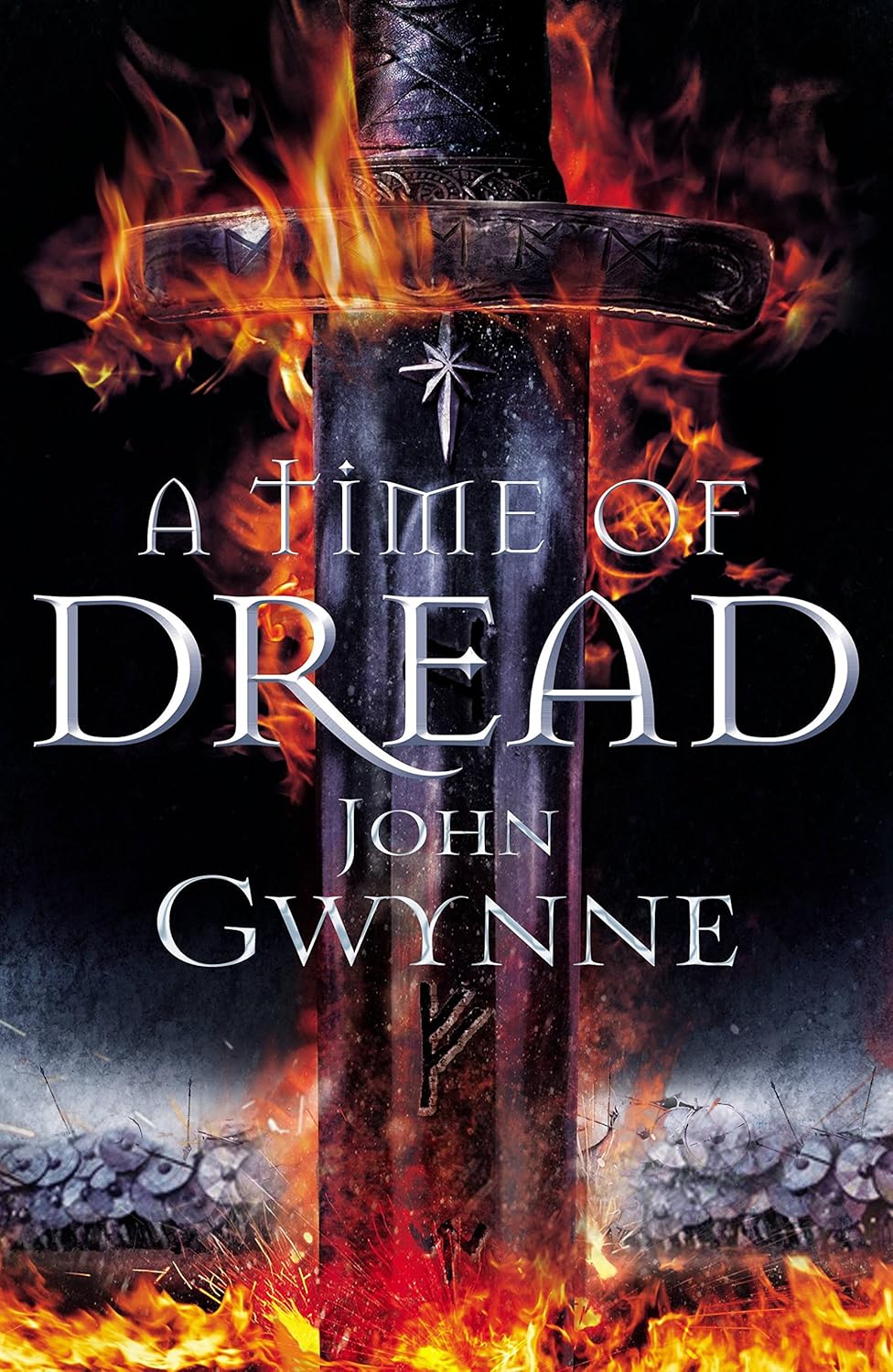
Set over a century after Wrath, the middle trilogy returns to the Banished Lands with the war’s consequences calcified into uneasy institutions and a darker, tighter story growing in the cracks, new leads, old shadows, and connective tissue that rewards Faithful readers directly. It’s the read-second series by design, leaner than either neighbor, and it completes the Banished Lands into one continuous seven-book history. A Time of Dread opens on Drem, a trapper’s son in the frozen north stumbling onto signs that the old enemy never fully died, while the victorious angelic Ben-Elim have hardened from saviors into something closer to occupiers, a ruling order extracting tithes and oaths, which gives the bridge trilogy its distinct flavor: the war’s winners as the new moral problem. Read it between the two eras or after both. Just don’t start here.
A note on where to actually start
The Shadow of the Gods for the current-decade door, Malice if you want the full old-school epic experience first, and the other one afterward either way, because both roads are paved to the end. The man lectured at a university, played double bass in a rock and roll band, and now writes battle scenes between weekends spent holding a literal shield line with his sons, which is about the most honest research posture in the genre. The John Gwynne books are what happened when heroic fantasy’s torch found hands that had actually carried a shield, and with everything finished and nothing pending, the only decision left is which complete story to walk into first.