Cannibalism is the last taboo that still works, and it works for a reason that has nothing to do with gore.
Every other horror premise asks you to accept something. A ghost, a curse, a virus, a creature. This one asks you to accept nothing at all, because it happens, regularly, and the circumstances under which ordinary people do it are well documented and not especially extreme. The Donner Party were not monsters. Neither were the Uruguayan rugby team. The horror is the proximity.
Which is why the good cannibal books are almost never about the eating. They’re about hunger, or class, or what a group decides among itself when the food runs out, or what a society is already doing that it has agreed not to name.
A word on curation, because this subject attracts a particular kind of book. Cannibalism is where a certain strand of extreme horror hides, and a lot of what’s published under it is spectacle with nothing underneath. The test I use for the cannibal books on this list is whether there’s something under the disgust. Where the brutality substitutes for the horror instead of serving it, and nothing sits beneath, the book isn’t here. A couple of genuinely hard books are, and I’ve said so.
Two of these I’ve read. I’ve said which.
Fiction by René Rehn


The Taboo in Literature
A Modest Proposal (1729)

Swift’s pamphlet runs nine pages, appeared anonymously in 1729, and no satire in English has ever cut deeper.
The proposal is that the children of the Irish poor be sold as food to the gentry at a year old, and Swift’s narrator works it through with total seriousness. He supplies the arithmetic: a hundred and twenty thousand children born annually, twenty thousand kept for breeding, the remaining hundred thousand offered at twenty-eight pounds weight, dressed. He recommends the flesh be in season around March, following Lent, and notes it will make a fashionable dish.
The satire is not aimed at cannibalism. It is aimed at the economic writing of the period, which had been discussing the Irish as a population problem and calculating their value as units of labor, and Swift is doing nothing except taking that arithmetic to its conclusion in the same voice.
That is why it belongs at the top of this page. Every book below uses cannibalism to say something about how people are valued, and Swift did it first and did it best.
The String of Pearls (1846)

Sweeney Todd first appears here, in a penny dreadful serialised in eighteen weekly parts from 1846, and there is no historical Todd.
The authorship is uncertain and it is usually credited to James Malcolm Rymer or Thomas Peckett Prest, the same pair associated with Varney the Vampire, working for the same publisher.
The premise is the barber’s chair with a hinged mechanism that tips the customer through the floor into the cellar, and Mrs. Lovett’s pie shop next door on Bell Yard, connected by a passage, and a supply problem solved.
What makes it work as cannibal fiction is that the eating is unwitting. The customers of the pie shop are respectable, the pies are the best in London, and the horror is a commercial arrangement in which nobody buying anything knows what they are participating in.
It is crude, fast, entirely unliterary and enormously entertaining, and it has produced two centuries of adaptation including Sondheim’s musical.
Survival
Alive (1974)

The Uruguayan Air Force flight that came down in the Andes in October 1972 with a rugby team aboard, and the sixteen survivors who were rescued seventy-two days later.
Read’s book is the definitive account and the reason it belongs here is that it takes the decision seriously as a decision. The survivors were Catholic, most of them educated by the Christian Brothers, and the discussion they had about the theology went on for days before anybody acted. Several framed it as communion. Several refused for weeks.
Read interviewed all sixteen and had access to everything, and the book is precise about the sequence, the rationing, the avalanche that killed eight more of them in their sleep, and the ten-day crossing that Parrado and Canessa made on foot.
What it is not is sensational. There is no dwelling anywhere, and the passages about the eating are brief and factual.
The survivors cooperated fully and several have spoken publicly ever since, which is unusual and is why the record is so complete.
The Terror (2007)

Franklin’s expedition, frozen fast above King William Island, September 1846 through three winters.
The cannibalism arrives late, is handled without a trace of sensation, and is presented as a stage in a documented process rather than as a shock, which is why it belongs on this page rather than being merely mentioned.
The documentation carries the entry. Forensic examination of remains recovered from King William Island has found cut marks on the bones consistent with defleshing, and evidence of pot polishing at the ends of long bones, indicating they were boiled. That work was published in the 1990s and has been extended since, and it confirmed what John Rae reported from Inuit testimony in 1854, for which he was attacked in England and effectively destroyed professionally. Dickens led the attack.
Simmons uses all of it. The novel’s position is that these men were killed by scurvy, lead, bad tinned food and the Royal Navy’s confidence, and that the eating was the last stage rather than a moral collapse.
Also on monster books.
The Hunger (2018)

The Donner Party, 1846, and Katsu’s decision was to refuse the thing everybody arrives for.
She never stages the eating as a set piece. It is not described in detail, it is not used for shock, and it occupies a small fraction of a four-hundred-page novel. What she spends the book on instead is the sequence of ordinary decisions that made it inevitable: Hastings’s shortcut, the arguments about pace, the salt flats, the lost oxen, the days burned on a dispute nobody would concede, and the personalities that could not be reconciled.
By the time the party reaches the lake it is November and the pass is closed, and everything that happens afterwards was decided in August.
The historical roster walks it under its own names and on its own calendar, and Keseberg, accused afterward of the worst of it, spent the rest of his life denying it.
The supernatural element is thin and several readers find it unnecessary, and the argument underneath is that they did not need one.
Also on folk horror.
The Road (2006)

Through a landscape where nothing lives, a father and his boy travel south, and cannibalism structures their entire world instead of interrupting it.
McCarthy has constructed an ecology with no food in it. Nothing grows, there are no animals, and every tin in every cellar has already been found by somebody. That leaves exactly one protein source walking around, and McCarthy states the math plainly enough that you complete it yourself.
The house with the locked cellar is the sequence everybody names, and the reason it lands is that McCarthy has spent a hundred pages establishing how hungry everybody is before he opens the door.
There is also a scene involving an infant on a spit that is one line long and is worse than the cellar.
The other half of the argument is a revolver holding two rounds, later one, and the lesson the father keeps rehearsing with his son about its use.
Pulitzer Prize. The seed was a sleepless night in a motel beside his young son.
Survivor Type (1985)

The only entry on this page where the cannibalism is autophagy, which is an entirely different proposition to everything else here.
Richard Pine, surgeon, license gone for dealing, ships out smuggling two kilos of heroin and swims away from the wreck onto bare Pacific rock, cargo intact, larder empty.
There is no group. No siege, no moral debate, no negotiation with other survivors, and nobody to be complicit with. Surgical training covers the technique, the heroin covers the anesthesia, and from there the escalation is pure arithmetic.
The diary form is what makes it unbearable. The journal degrades on schedule with its author, professional inventory down to a final page of repetition, the deterioration written into the syntax itself.
King’s own printed assessment is that it may have overshot even his line, and several magazines agreed before Skeleton Crew collected it.
The Predator
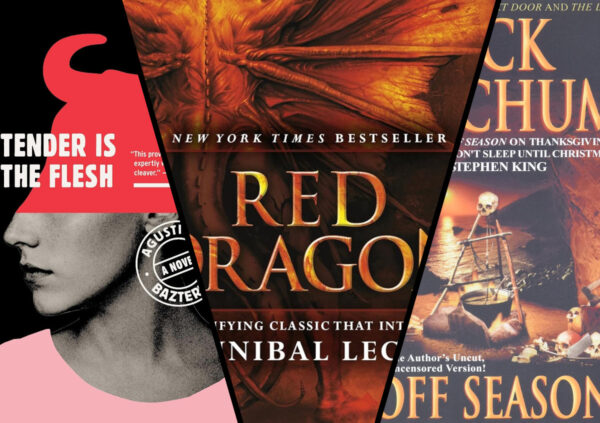
Red Dragon (1981) and The Silence of the Lambs (1988)

Lecter is the most famous cannibal in fiction and the eating is the least interesting thing about him, which is worth stating plainly on a page like this.
Harris uses it sparingly and almost always offstage. The census taker’s liver is a line of dialogue. The nurse is a case file. What the eating does in these novels is function as a social marker: Lecter is a psychiatrist, a gourmet, a patron of the Baltimore Philharmonic, and the cannibalism is presented as the logical extension of a man who regards most people as rude.
The census-taker line, fava beans and a big Amarone in the novel, Chianti only in the film, is the most quoted in the genre, and it lands as a joke at Clarice’s expense.
Red Dragon is the better novel and Dolarhyde the better antagonist. Silence is the better book about Lecter.
Harris researched at the FBI Behavioral Science Unit, and the profiling is where his interest actually lies.
Exquisite Corpse (1996)

By playing dead convincingly enough, English serial killer Andrew Compton slips custody and crosses to New Orleans, into the orbit of Jay Byrne, an American running the same enterprise on inherited money and superior real estate.
The cannibalism is what the collaboration is for, not a detail of it. Both were already doing it separately and neither had anybody to discuss it with, and the novel is largely about two people who have found somebody who understands the appeal.
Brite gives it in full and does not cut away, and the descriptions are extended and sensory and written with the same care given to food elsewhere in the book, which is the deliberate provocation.
Alongside runs the AIDS material, early-nineties French Quarter, with one of the intended victims HIV positive.
Her American publisher refused it on delivery. Both killers draw on Dennis Nilsen and Dahmer.
This is the hardest thing on the page and the description above should be taken as the whole recommendation.
Off Season (1980)

A group of adults rent a cottage on the Maine coast for a week, and a family living in the caves nearby comes down for them.
Ketchum’s cannibals are the American version of the Sawney Bean legend, transplanted: feral, inbred, generational, living in a cave system, and hunting the coast. They are not supernatural, they have no rules, and they cannot be reasoned with, and the novel is a siege that starts about a third of the way in and does not stop.
It was published in 1980 and Ballantine cut it heavily before release because the editorial board would not carry it as written. The full text was not available until Overlook Connection published the restored version in 1999.
Even cut it was attacked in the trade press, and Ketchum has said it damaged his career for years.
It is extremely violent, deliberately, and it has almost no interest in anything else. The restored edition is the one people buy and it is nastier.
More on splatterpunk.
The Satire
Tender Is the Flesh (2020)
2017 · translated by Sarah Moses · 2020

Animal meat turned lethal by virus; the law answered by legalizing the farming and slaughter of people; and Marcos manages the day-to-day of a processing plant.
What earns its place atop the modern section is the vocabulary. Nobody in the book says the word. Stock gets called heads, product, special meat. The infrastructure includes breeding centers, transition units, licensed butchery, game reserves selling hunting concessions, and one line bred voiceless, vocal cords absent, so nothing is ever heard.
Bazterrica’s argument is that the euphemism is what makes it possible, and that the same vocabulary already exists for animals and always has.
The plant chapters run clinical and unhurried, and the second pass through them is longer than the first.
The metaphor does sit in the open for a long while, which is my one complaint, and then the final section collects on it, hard, and that collection is why people say it stayed with them.
More on the Agustina Bazterrica page.
LINK /books-and-media/horror-literature/tender-is-the-flesh/ Bazterrica’s novel on its own page: the vocabulary, the Transition, and the translation.
American Psycho (1991)

Bateman’s cannibalism occupies perhaps four passages in four hundred pages, the least discussed element of a book discussed constantly.
What makes it belong here is the register. It arrives in exactly the same voice as the restaurant reservations, the business cards and the Huey Lewis album reviews, with the same attention to brand and detail, and Ellis never modulates to signal that this section is different.
There is a sequence involving a food processor and one involving a coat hanger, and both are described with the flat competence of somebody explaining a recipe.
Whether any of it happens is deliberately unresolved. Bateman confesses repeatedly and nobody hears him.
The uncomfortable argument the novel is making is that the consumption is continuous with everything else he does, that the women he kills are already interchangeable to everybody in the book including the reader, and that nobody in his world can tell one person from another anyway.
Also on psychological horror books.
The Vegetarian (2007)
2007 · translated by Deborah Smith · 2015

The book on this page where nobody eats anybody, and it earns its place by inversion.
After a dream she refuses to describe, Yeong-hye gives up meat, and the novel charts the mounting violence that one autonomous decision about her own body draws from everyone around her.
At a family dinner, before the whole table, her father, who served in Vietnam, grips her jaw and forces pork into her mouth, her husband and brother holding her down for it.
That scene is the reason it is here. It is the only depiction on this page of a person being made to eat flesh against their will, and Han stages it as an assault, which is what it is.
What Yeong-hye wants by the end is to stop being an animal altogether and become a plant, which the novel treats as a coherent position rather than a symptom.
International Booker 2016. Han won the Nobel in 2024.
The Real Cases

Two worth knowing if the documented history interests you more than the fiction.
The Best Land Under Heaven by Michael Wallis is the modern account of the Donner Party, and it is very good on the specific decisions and the specific weather rather than on the sensational part.
The Wager by David Grann covers the 1741 shipwreck of a British naval vessel off Patagonia, the mutiny, the starvation and the trial that followed, and it reads like a thriller.
Where to Start
Start with Alive, even though it’s nonfiction, because it’s the book that makes every novel here legible.
Read The Road if you want the best-written, and Tender Is the Flesh if you want the sharpest idea.
Read Red Dragon if you came here for Lecter, and read it rather than Silence.
And the one that gets past your defenses is “Survivor Type”, twenty minutes of your life.
The older end of the shelf is on my horror classics page. When the eater stops being human, my monster books list picks it up.